
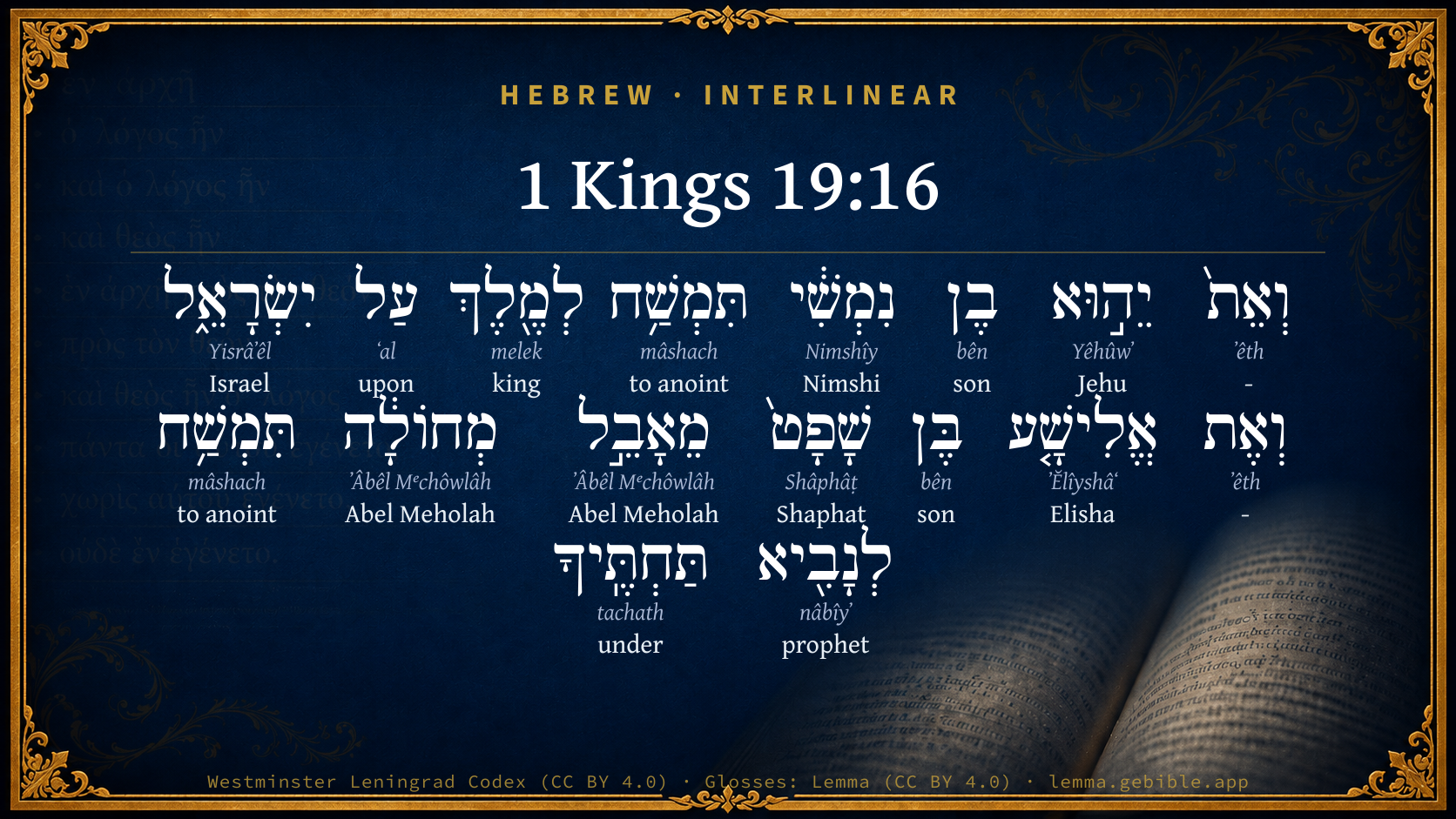
1 Kings 19:16

Hebrew (Westminster Leningrad Codex) 1 Kings 19:16 appears in the Hebrew Old Testament. The text above is from the Westminster Leningrad Codex. Each word links to its Strong’s number, a concise gloss, and parsing drawn from the Open Scriptures Hebrew Bible morphology. Click any word for its full Brown-Driver-Briggs (BDB) entry.
Download image
Cite this verse

1 Kings 19:16 (World English Bible). Public Domain. Lemma interlinear Bible study tool, https://lemma.gebible.app/v/1-kings/19/16.

Show BibTeX & RIS
BibTeX
RIS
English Translation
and Jehu the son of Nimshi shall you anoint to be king over Israel; and Elisha the son of Shaphat of Abel Meholah shall you anoint to be prophet in your room.
World English Bible · Public Domain
Highlights
  • 2 first appearances in the Hebrew Bible
Full analysis ↓
Download a study sheet

One document with this verse’s original text, its word-by-word gloss line, the meaning frame, cross-references with their text, attributed commentary, and full source and license credits — printable, and it pastes into notes with its structure intact.

This verse Autodidact and up

Study sheet (.html) Plain text (.txt)

A passage Seminary Student

Up to 50 verses in one chapter. A passage sheet keeps up to 6 commentary sources and 12 cross-references per verse, in the order this page ranks them, and says so on the sheet whenever that leaves anything out. Ask for a single verse and you get the Autodidact verse sheet above.

Everything on this page stays free to read, with no account — the sheet is a download of what is already on screen, not access to it.

Want to remove ads? Support Godless Engineer
Compare translations 3

The same verse in 3 English versions, stacked beneath the original-language interlinear above. Click any original word for its lexicon entry.

Each is an independent rendering of the whole verse — the interlinear is not word-aligned to these translations.

Highlighted words mark where these versions differ — a whole-verse word diff, not a word-by-word alignment.

  • World English Bible Public Domain
    and Jehu the son of Nimshi shall you anoint to be king over Israel; and Elisha the son of Shaphat of Abel Meholah shall you anoint to be prophet in your room.
  • King James Version Public Domain
    And Jehu the son of Nimshi shalt thou anoint to be king over Israel: and Elisha the son of Shaphat of Abelmeholah shalt thou anoint to be prophet in thy room.
  • unfoldingWord Literal Text CC BY-SA 4.0
    And you shall anoint Jehu, the son of Nimshi, as king over Israel. And you shall anoint Elisha, the son of Shaphat, from Abel Meholah, as prophet in your place.

unfoldingWord Literal Text — © unfoldingWord, licensed CC BY-SA 4.0. Word-aligned USFM3 via Door43 (git.door43.org/unfoldingWord/en_ult).

Versions to compare (up to 4)

3 of 4 selected

Show all 18 translations

Every available English version of this verse, each an independent rendering of the whole verse.

  • World English Bible Public Domain
    and Jehu the son of Nimshi shall you anoint to be king over Israel; and Elisha the son of Shaphat of Abel Meholah shall you anoint to be prophet in your room.
  • Berean Standard Bible Public Domain
    You are also to anoint Jehu son of Nimshi as king over Israel and Elisha son of Shaphat from Abel-meholah to succeed you as prophet.
  • Majority Standard Bible Public Domain
    You are also to anoint Jehu son of Nimshi as king over Israel and Elisha son of Shaphat from Abel-meholah to succeed you as prophet.
  • King James Version Public Domain
    And Jehu the son of Nimshi shalt thou anoint to be king over Israel: and Elisha the son of Shaphat of Abelmeholah shalt thou anoint to be prophet in thy room.
  • American Standard Version (1901) Public Domain
    and Jehu the son of Nimshi shalt thou anoint to be king over Israel; and Elisha the son of Shaphat of Abel-meholah shalt thou anoint to be prophet in thy room.
  • Revised Version (1885) Public Domain
    and Jehu the son of Nimshi shalt thou anoint to be king over Israel: and Elisha the son of Shaphat of Abel-meholah shalt thou anoint to be prophet in thy room.
  • Geneva Bible (1599) Public Domain
    And Iehu the sonne of Nimshi shalt thou anoynt King ouer Israel: and Elisha the sonne of Shaphat of Abel Meholah shalt thou anoynt to be Prophet in thy roume.
  • Douay-Rheims (1899) Public Domain
    And thou shalt anoint Jehu the son of Namsi to be king over Israel: and Eliseus the son of Saphat, of Abelmeula, thou shalt anoint to be prophet in thy room.
  • Young's Literal Translation Public Domain
    and Jehu son of Nimshi thou dost anoint for king over Israel, and Elisha son of Shaphat, of Abel-Meholah, thou dost anoint for prophet in thy stead.
  • Literal Standard Version CC BY-SA 4.0
    and you anoint Jehu son of Nimshi for king over Israel, and you anoint Elisha son of Shaphat, of Abel-Meholah, for prophet in your stead.
  • Unlocked Literal Bible CC BY-SA 4.0
    and you will anoint Jehu son of Nimshi to be king over Israel, and you will anoint Elisha son of Shaphat of Abel Meholah to be prophet in your place.
  • unfoldingWord Literal Text CC BY-SA 4.0
    And you shall anoint Jehu, the son of Nimshi, as king over Israel. And you shall anoint Elisha, the son of Shaphat, from Abel Meholah, as prophet in your place.
  • Darby Bible Public Domain
    and Jehu the son of Nimshi shalt thou anoint king over Israel; and Elisha the son of Shaphat of Abel-meholah shalt thou anoint prophet in thy stead.
  • World Messianic Bible Public Domain
    Anoint Jehu the son of Nimshi to be king over Israel; and anoint Elisha the son of Shaphat of Abel Meholah to be prophet in your place.
  • Webster's Bible Public Domain
    And Jehu the son of Nimshi shalt thou anoint to be king over Israel: and Elisha the son of Shaphat of Abel-meholah shalt thou anoint to be prophet in thy room.
  • Free Bible Version CC BY-SA 4.0
    Also anoint Jehu, son of Nimshi, king of Israel and Elisha, son of Shaphat, from Abel-meholah, to take over from you as prophet.
  • Bible in Basic English Public Domain
    And on Jehu, son of Nimshi, making him king over Israel; and on Elisha, the son of Shaphat of Abel-meholah, to be prophet in your place.
  • JPS Tanakh (1917) Public Domain
    and Jehu the son of Nimshi shalt thou anoint to be king over Israel; and Elisha the son of Shaphat of Abel-meholah shalt thou anoint to be prophet in thy room.

Literal Standard Version (2020), Covenant Press — licensed CC BY-SA 4.0. Text via the HelloAO Bible API (eBible.org). Unlocked Literal Bible (unfoldingWord) — licensed CC BY-SA 4.0. Text via the HelloAO Bible API (eBible.org). unfoldingWord Literal Text — © unfoldingWord, licensed CC BY-SA 4.0. Word-aligned USFM3 via Door43 (git.door43.org/unfoldingWord/en_ult). Free Bible Version, Dr. Jonathan Gallagher — licensed CC BY-SA 4.0. Text via the HelloAO Bible API (eBible.org).

Word by word

More ways to search: Search by grammar → Find every occurrence → Compare this word →

Practice this passage: Drill this verse → Learn its vocabulary →

נִמְשִׁ֔י
Nimshîy
H5250
“Nimshi”
Noun, Proper
Part of Speech
Noun
Type
Proper
Full BDB Definition

Origin: probably from H4871

TWOT: None

Nimshi = "rescued" - grandfather of Jehu
  1. וְאֵת֙ ʼêth H853 “and · -” Conjunction + Particle, Direct Object
  2. יֵה֣וּא Yêhûwʼ H3058 “Jehu” Noun, Proper
  3. בֶן bên H1121 “son of” Noun, Common, Masculine, Singular, Construct
  4. תִּמְשַׁ֥ח mâshach H4886 “to anoint” Verb, Qal, Imperfect, 2nd Person, Masculine, Singular
  5. לְמֶ֖לֶךְ melek H4428 “to/for · king” Preposition + Noun, Common, Masculine, Singular, Absolute
  6. עַל ʻal H5921 “upon” Preposition
  7. יִשְׂרָאֵ֑ל Yisrâʼêl H3478 “Israel” Noun, Proper
  8. וְאֶת ʼêth H853 “and · -” Conjunction + Particle, Direct Object
  9. אֱלִישָׁ֤ע ʼĔlîyshâʻ H477 “Elisha” Noun, Proper
  10. בֶּן bên H1121 “son of” Noun, Common, Masculine, Singular, Construct
  11. שָׁפָט֙ Shâphâṭ H8202 “Shaphat” Noun, Proper
  12. מֵאָבֵ֣ל ʼÂbêl Mᵉchôwlâh H65 “from · Abel Meholah” Preposition + Noun, Proper
  13. מְחוֹלָ֔ה ʼÂbêl Mᵉchôwlâh H65 “Abel Meholah” Noun, Proper
  14. תִּמְשַׁ֥ח mâshach H4886 “to anoint” Verb, Qal, Imperfect, 2nd Person, Masculine, Singular
  15. לְנָבִ֖יא nâbîyʼ H5030 “to/for · prophet” Preposition + Noun, Common, Masculine, Singular, Absolute
  16. תַּחְתֶּֽיךָ tachath H8478 “under · you” Preposition + Suffix, Personal, 2nd Person, Masculine, Singular

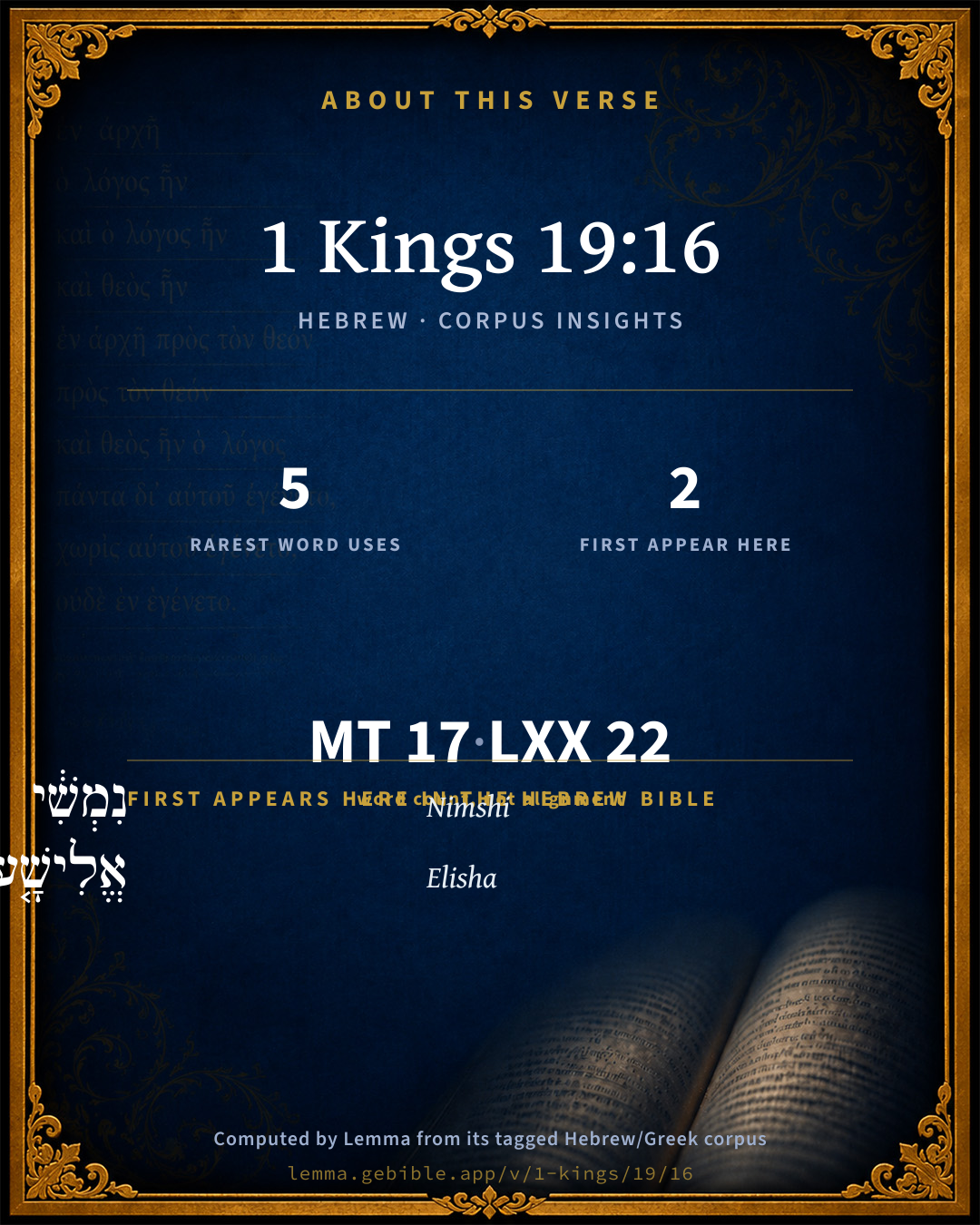
About this verse

These counts appear in no published source. They are computed here, from the morphology-tagged text and Lemma’s own curated glosses. What Lemma adds →

17
words
13
distinct lemmas
Historical
section

Notable vocabulary

The rarest word here is נִמְשִׁ֔י Nimshi H5250 — appearing just 5 times in the whole Hebrew Bible.

First appearance in Scripture

These words make their first canonical appearance in the Hebrew Bible here:

  • נִמְשִׁ֔י Nimshi H5250
  • אֱלִישָׁ֤ע Elisha H477

Shared distinctive vocabulary

נִמְשִׁ֔י Nimshi H5250 occurs in 5 verses of the Hebrew Bible. Also found in:

Grammatical profile

  • 2 verbs
  • 11 nouns
  • 2 prepositions
  • 2 particles

Verb forms

  • תִּמְשַׁ֥ח Qal · Imperfect
  • תִּמְשַׁ֥ח Qal · Imperfect

Repetition

Words recur within this verse — often emphatic in Hebrew:

  • בֶן son H1121 ×2
  • תִּמְשַׁ֥ח to anoint H4886 ×2
  • מֵאָבֵ֣ל Abel Meholah H65 ×2

Hebrew & Septuagint length

In English translation the verse runs 32 words from the Hebrew and 29 from the Septuagint (LXX English) — closely comparable.

A rough comparison of the two English renderings, which tokenize alike — not a word-level alignment.

Word counts can differ between the Hebrew and the Greek without any difference in meaning — e.g. the Hebrew direct-object marker אֵת has no separate Greek word, and Greek often adds the article ὁ.

In the original languages it is 17 Hebrew tokens and 22 Greek tokens — but the two are counted differently (Hebrew bundles its prefixes and suffixes into one token; the Greek is in lemma form), so that isn’t a like-for-like length.

Cross-references

7

Topical passages linked to 1 Kings 19:16 in the Treasury of Scripture Knowledge — connected by theme and wording, ordered by reader-vote popularity; previews shown in the World English Bible.

  • 1 Kings 19:19–21 So he departed there, and found Elisha the son of Shaphat, who was plowing, with twelve yoke [of oxen] before him, and he with the twelfth: and Elijah passed over to him, and cast his mantle on him.
  • 2 Kings 9:1–14 Elisha the prophet called one of the sons of the prophets, and said to him, Gird up your loins, and take this vial of oil in your hand, and go to Ramoth-gilead.
  • 2 Kings 2:9 It happened, when they had gone over, that Elijah said to Elisha, Ask what I shall do for you, before I am taken from you. Elisha said, please let a double portion of your spirit be on me.
  • 2 Kings 2:15 When the sons of the prophets who were at Jericho over against him saw him, they said, The spirit of Elijah does rest on Elisha. They came to meet him, and bowed themselves to the ground before him.
  • Judges 7:22 They blew the three hundred trumpets, and Yahweh set every man's sword against his fellow, and against all the host; and the host fled as far as Beth-shittah toward Zererah, as far as the border of Abel Meholah, by Tabbath.
  • 1 Kings 4:12 Baana the son of Ahilud, in Taanach and Megiddo, and all Beth-shean which is beside Zarethan, beneath Jezreel, from Beth-shean to Abel Meholah, as far as beyond Jokmeam;
  • Luke 4:27 There were many lepers in Israel in the time of Elisha the prophet, yet not one of them was cleansed, except Naaman, the Syrian."

Cross-references courtesy of OpenBible.info (CC BY 4.0).

Hebrew and Greek witnesses Masoretic Hebrew ↔ Greek Septuagint

The same verse in the two great witnesses to the Old Testament, shown verse-for-verse.

These are two independent witnesses, not word-aligned to each other, and the Septuagint is shown in lemma (dictionary) form.

Hebrew 1 Kings 19:16 Masoretic · Westminster Leningrad Codex

וְאֵת֙ יֵה֣וּא בֶן נִמְשִׁ֔י תִּמְשַׁ֥ח לְמֶ֖לֶךְ עַל יִשְׂרָאֵ֑ל וְאֶת אֱלִישָׁ֤ע בֶּן שָׁפָט֙ מֵאָבֵ֣ל מְחוֹלָ֔ה תִּמְשַׁ֥ח לְנָבִ֖יא תַּחְתֶּֽיךָ

and Jehu the son of Nimshi shall you anoint to be king over Israel; and Elisha the son of Shaphat of Abel Meholah shall you anoint to be prophet in your room.

World English Bible · Public Domain

Greek LXX 1 Kings 19:16 Septuagint · lemma form

καί ὁ ιου υἱός ναμεσσι χρίνω εἰς βασιλεύς ἐπί ἰσραήλ καί ὁ ελισαιε υἱός σαφατ ἀπό αβελμαουλα χρίνω εἰς προφήτης ἀντί σύ

And Ju the son of Namessi shall you anoint to be king over Israel; and Elisaie the son of Saphat shall you anoint to be prophet in your room.

LXX2012 (modern English Septuagint) · Public Domain

On this verse, The Cambridge Bible for Schools and Colleges discusses the Septuagint’s reading. Read the note in Commentary ↓

Hebrew: Westminster Leningrad Codex (CC BY 4.0). Greek: Septuagint (public domain); English from LXX2012 (modern English Septuagint) (Public Domain). How the Septuagint differs from the Hebrew →

Targum (Aramaic paraphrase)

1

The Targum is the ancient Jewish Aramaic paraphrase of the Hebrew Scriptures — an interpretive translation, not the Hebrew text itself. Onkelos (literal) and Pseudo-Jonathan (expansive) render the Torah, and Jonathan the Prophets. Coverage is partial: where no permissively-licensed English translation exists for a verse, only the Aramaic is shown. This is verse-level text, not a word-by-word alignment to the Hebrew.

  1. Targum Jonathan Prophets (Joshua–Malachi)
    וְיַת יֵהוּא בַר נִמְשִׁי תִּמְשַׁח לְמֶהֱוֵי מַלְכָּא עַל יִשְׂרָאֵל וְיַת אֱלִישָׁע בַּר שָׁפָט מִמֵישַׁר מְחוֹלָה תִּמְשַׁח לְמֶהֱוֵי נְבִיָא תְּחוֹתָךְ:

    (no public-domain English translation for this verse)

    Targum Jonathan — Aramaic: “Mikraot Gedolot” (public domain). English: “Sefaria Community Translation” (CC0 1.0 (public-domain dedication)); “London "Chaldee Paraphrase," 1871” (public domain). Text via Sefaria.

Commentary

Notes on 1 Kings 19:16 from classic Christian and Jewish commentators (each source and its license shown beneath its notes). The classic Christian expositions comment on the surrounding passage and are grouped to its opening verse, so a note may address several verses; the Jewish commentaries on the Tanakh (Rashi and others) are per-verse, so they appear only where the commentator wrote on this verse.

Lemma curates 59 commentaries, every one of them public domain or Creative Commons licensed, each selected and text-cleaned for this edition rather than reprinted as found. About our sources →

Trapp's Complete Commentary

John Trapp

1Ki 19:16 And Jehu the son of Nimshi shalt thou anoint [to be] king over Israel: and Elisha the son of Shaphat of Abelmeholah shalt thou anoint [to be] prophet in thy room.

Ver. 16. Of Abelmeholah.] Which was, say some, {a} in the tribe of Manasseh, on this side of Jordan, like as Elias was of the tribe of Gad. Isidor and Epiphanius tell us that at the birth of Elisha one of Jeroboam’s golden calves lowed so loud, that it was heard at Jerusalem, and that thereupon one of the priests pronounced that there was one born that day that should be the ruin of idolatry. Others, to set forth the transcendent zeal of Elijah, have legended of him, that when he drew his mother’s breasts he was seen to suck in fire.

{a} Jerome. Adrichom.

John Trapp, A Commentary or Exposition upon All the Books of the Old and New Testament (1647–1656) — public domain. Text from a community e-Sword module.

Jamieson, Fausset & Brown

Robert Jamieson, A. R. Fausset & David Brown

Abel-meholah--that is, "the meadow of dancing," in the valley of the Jordan.

Jamieson, Fausset & Brown — Commentary Critical and Explanatory on the Whole Bible (1871) — public domain (CC PDM 1.0). Text via the HelloAO Bible API.

Adam Clarke's Commentary

Verse 16. Elisha - shalt thou anoint to be prophet in thy room.] Jarchi gives a strange turn to these words: "Thy prophecy (or execution of the prophetic office) does not please me, because thou art the constant accuser of my children." With all their abominations, this rabbin would have us to believe that those vile idolaters and murderers were still the beloved children of God! And why? Because God had made a covenant with their fathers; therefore said the ancient as well as the modern siren song: "Once in the covenant, always in the covenant; once a son, and a son for ever." And yet we have here the testimony of God's own prophet, and the testimony of their history, that they had forsaken the covenant, and consequently renounced all their interest in it.

Adam Clarke's Commentary on the Bible (1810–1826) — public domain. Text from a community e-Sword/MySword module.

Ellicott's Commentary for English Readers

(16) And Jehu.—Of this charge Elijah fulfilled in person but one part, in the call of Elisha: for the fulfilment of the other two parts, see 2Ki_8:8-13; 2Ki_9:1-6. This apparently imperfect correspondence of the event to the charge, is a strong indication of the historical character of the narrative.

The history, indeed, records no actual anointing of Elisha; and it is remarkable that in no other place is any such anointing of a prophet referred to, unless Psa_105:15 be an exception. The anointing, signifying the gift of grace, was first instituted for the priests (Exo_40:15; Num_3:3); next it was extended to the royal office, and became, in common parlance, especially attached to it. The prophetic office, as the third great representative of the power of Jehovah, might well be hallowed by the same ordinance, especially as the prophets dispensed it to the kings; but, whether the prophets were always consecrated with the sacred oil, or whether, as in the Prophet of prophets, the “anointing with the Holy Ghost and with power” sometimes superseded the outward sign, we do not know. Abelmeholah (“the meadow of the dance,” see 1Ki_4:12) lay in the rich country near the Jordan valley and the plain of Esdraelon; it was therefore on Elijah’s way.

A Bible Commentary for English Readers, edited by Charles John Ellicott (1878–1897) — public domain. Text from a community e-Sword module.

The Cambridge Bible for Schools and Colleges

gen. ed. J. J. S. Perowne

16. And Jehu the son of Nimshi] We learn from the account of Jehu’s anointing (2Ki_9:2) that Nimshi was Jehu’s grandfather. He was ‘Jehu the son of Jehoshaphat the son of Nimshi.’ He was one of Ahab’s captains, and heard the sentence which Elijah pronounced against Ahab for the murder of Naboth (2Ki_9:25-26). When Jehoram had succeeded Ahab, Jehu was anointed and conspired against him, and slew not only Jehoram but also caused to be slain seventy sons of Ahab, and the brethren of Ahaziah king of Judah, and all the worshippers of Baal. For the history of these doings see 2 Kings 10. It is clear that Jehu looked upon himself as God’s ordained instrument, and considered his actions as ‘zeal for the Lord.’ We may therefore conclude that there had been made known to him something of the message which the Lord here gives to Elijah, and that inspired by it, he rose against the house of Ahab. For details of Jehu’s history, see notes on 2Ki_9:10.

of Abel-meholah] See above on 1Ki_4:12. These words are omitted by the LXX. For the history of Elisha see 2 Kings chapp. 2–8. At the time of his call Elisha was probably a young man. His father and mother were still alive, and he was living with them.

prophet in thy room] These words would teach Elijah that he was not to expect the accomplishment of all God’s purpose during his own lifetime, but only to prepare a representative to be ready when it was God’s will to call him away. Till Elijah is about to be taken up into heaven (2 Kings 2) we read no more of Elisha than is told us in this chapter. He ministered unto Elijah and was ready to attend him on his last journey, and in those days of his ministration he doubtless received all the teaching which God had given to his master, and was made to see how the hand of God was ever working amidst His people.

The Cambridge Bible for Schools and Colleges (gen. ed. J. J. S. Perowne; Cambridge University Press, 1878–1918) — public domain. Text from a community e-Sword module.

John Gill's Exposition

And Jehu the son of Nimshi shalt thou anoint to be king over Israel,.... This was a son of Jehoshaphat, and a grandson of Nimshi; nor does he appear to have been anointed by Elijah, but by Elisha; and being done by his order and direction was the same as if it was done by himself, unless he was twice anointed, see Kg2 9:1.

and Elisha the son of Shaphat of Abelmeholah shalt thou anoint to be prophet in thy room; which was in the half tribe of Manasseh, on this side Jordan; See Gill on Jdg 7:22.

John Gill's Exposition of the Whole Bible (1746–1763) — public domain (CC PDM 1.0). Text via the HelloAO Bible API.

Albert Barnes' Notes on the Bible

Jehu, the son of Nimshi - In reality the grandson of Nimshi. But he seems to have been commonly known by the above title 2Ki 9:20; 2Ch 22:7, perhaps because his father had died and his grand-father had brought him up.

Abel-meholah - See Jdg 7:22 note. (Conder identifies it with Ain Helweh.)

Elisha ... shalt thou anoint - This is almost the only place where we hear of the anointing of prophets (compare 1Ch 16:22 and Psa 105:15).

Albert Barnes' Notes on the Bible (1834–1885) — public domain. Text from a community e-Sword/MySword module.

Haydock's Catholic Bible Commentary

Jehu, the son of Jospahat, (4 Kings ix. 2.) and grandson of Namsi. (Menochius) --- Eliseus sent one of his disciples to anoint him, (4 Kings ix. 1.; Calmet) with common oil; the sacred was reserved for priests and the kings of Juda, according to the Rabbins. --- Anoint, or call to the ministry, perhaps by placing a mantle on his head, ver. 19. No mention is made of unction. (Calmet) --- Yet the Fathers have hence inferred that prophets received it, as well as priests and kings. (Sanctius) --- Elias had complained that he was left alone. God appoints him a coadjutor, and successor; a person who seemed to have yet made no immediate preparation for the office. His parents were probably known for their probity, and had taken no part in the worship of idols. (Calmet) --- Abelmeula was in the great plain, ten miles south of Scythopolis. (Eusebius)

George Leo Haydock (1774–1849), Haydock's Catholic Family Bible and Commentary, 1859 edition — public domain. Excludes Psalms (Douay-Rheims chapter numbering differs from Protestant) and Deuterocanonical books (Catholic canon only).

Matthew Poole's English Annotations

The son of Nimshi, i. e. his grandson, for he was the son of Jehoshaphat, 2Ki 9:2; he constituted

Elisha prophet, by casting his mantle over him, here, 1Ki 19:19.

Matthew Poole's English Annotations on the Holy Bible (1683–1685) — public domain. Text from a community e-Sword/MySword module.

Whedon's Commentary on the Bible

Daniel D. Whedon

16. Jehu the son of Nimshi — See the fulfilment of this prophecy in 2Ki_9:1-10.

Abel-meholah — A place in the Jordan valley not yet certainly identified with any modern town, but probably in the plain south of Bethshean. Here Gideon and his three hundred pursued the flying Midianites. Jdg_7:22.

Daniel D. Whedon (gen. ed.), Commentary on the Old and New Testaments (1874–1909) — public domain. Text from a community e-Sword module.

The Pulpit Commentary

And Jehu Jehovah is he. The name was as appropriate as Elijah"s the son i.e., descendant, probably grandson. (2Ki_9:2, 2Ki_9:14) Nimshi may have been a person of more importance than Jehoshaphat of Nimshi shalt thou anoint to be king over Israel The prophet thus learns that the house of Omri is to share the fate of the dynasties which had preceded it. Jezebel"s triumph is not to endure: and Elisha My God is salvation. This name, berne by the successor of Elijah, "My God is the Lord," looks like a fresh revelation of God"s nature and purpose of grace the son of Shaphat Judge of Abel-meholah The mention of his abode, Abel-meholah, "the meadow of the dance" (cf. 1Ki_4:12; Jud_1:7:22) a town in the Jordan valley, at no great distance from Beth-shean, almost implies that he was hitherto unknown to Elijah. It is to be observed that no such addition follows the mention of Hazael or Jehu shalt thou anoint to be prophet in thy room So far from Elijah"s work being fruitless, or from the prophetic order being extinguished, provision is now made for his successor.

The Pulpit Commentary (1880–1919), ed. H.D.M. Spence-Jones & Joseph S. Exell — public domain. Text from a community e-Sword module.

John Wesley's Explanatory Notes

The son, &c. - That is, his grand-son, for he was the son of Jehosaphat, 2 Kings ix, 2. This was intended as a prediction that by these God would punish the degenerate Israelites, plead his own cause among them, and avenge the quarrel of his covenant.

John Wesley, Explanatory Notes Upon the Whole Bible (1754–1765) — public domain. Text via the GEBible commentary corpus.

Rashi

Rabbi Shlomo Yitzchaki (Rashi)

You should anoint as prophet in your place. [God said,] “I do not want your prophecy, because you plead for the prosecution of My children.

Rashi on the Tanakh — English translations: “The Judaica Press complete Tanach with Rashi, translated by A. J. Rosenberg” (CC BY 4.0); “Pentateuch with Rashi's commentary by M. Rosenbaum and A.M. Silbermann, 1929-1934” (public domain); “The Metsudah Tanach series, Lakewood, N.J” (CC BY 4.0); and “The Book of Joshua, Metsudah Publications, 1997” (CC BY 4.0). Text via Sefaria.

Lesson kit

Teaching starters — assembled from the data on this page, not authored interpretation. Every prompt links to the verse data it draws on. Edit before teaching.

1 Kings, in the Historical, opens this verse with 17 words (13 distinct Hebrew lemmas). Its most distinctive word is Nimshîy (“Nimshi”). A historical commentator’s framing appears above. Read the whole chapter for the surrounding context.

Discussion questions

  1. What does “Nimshi” (Nimshîy) contribute to the verse as a whole?
  2. 2 words here appear for the first time in Scripture. What is being introduced at this debut?
  3. 2 Kings 9:2 shares the word «Nimshi» with this verse. How do the two illuminate each other?
  4. “son” occurs 2× in this one verse. What is the effect of the repetition?
  5. The translations on this page render this verse differently — a whole-verse word diff, not a word-by-word alignment. What might account for the different wordings?
  6. The verb «תִּמְשַׁ֥ח» is Qal Imperfect. How does its form color the action?
  7. Reading how Trapp's Complete Commentary and Jamieson, Fausset & Brown read this verse, where do the two commentators agree and where do they part?

Things to notice

Reading settings

Reading text

Shown beneath each verse's original-language words.

Old Testament
Old Testament edition

Read the OT as the Masoretic Hebrew (MT) or the Greek Septuagint (LXX).

English shown for the Greek Septuagint (in the Hebrew ↔ Greek comparison).

Comparing translations? Open the Compare panel on any verse page to stack up to four side by side.