Isaiah 10:16

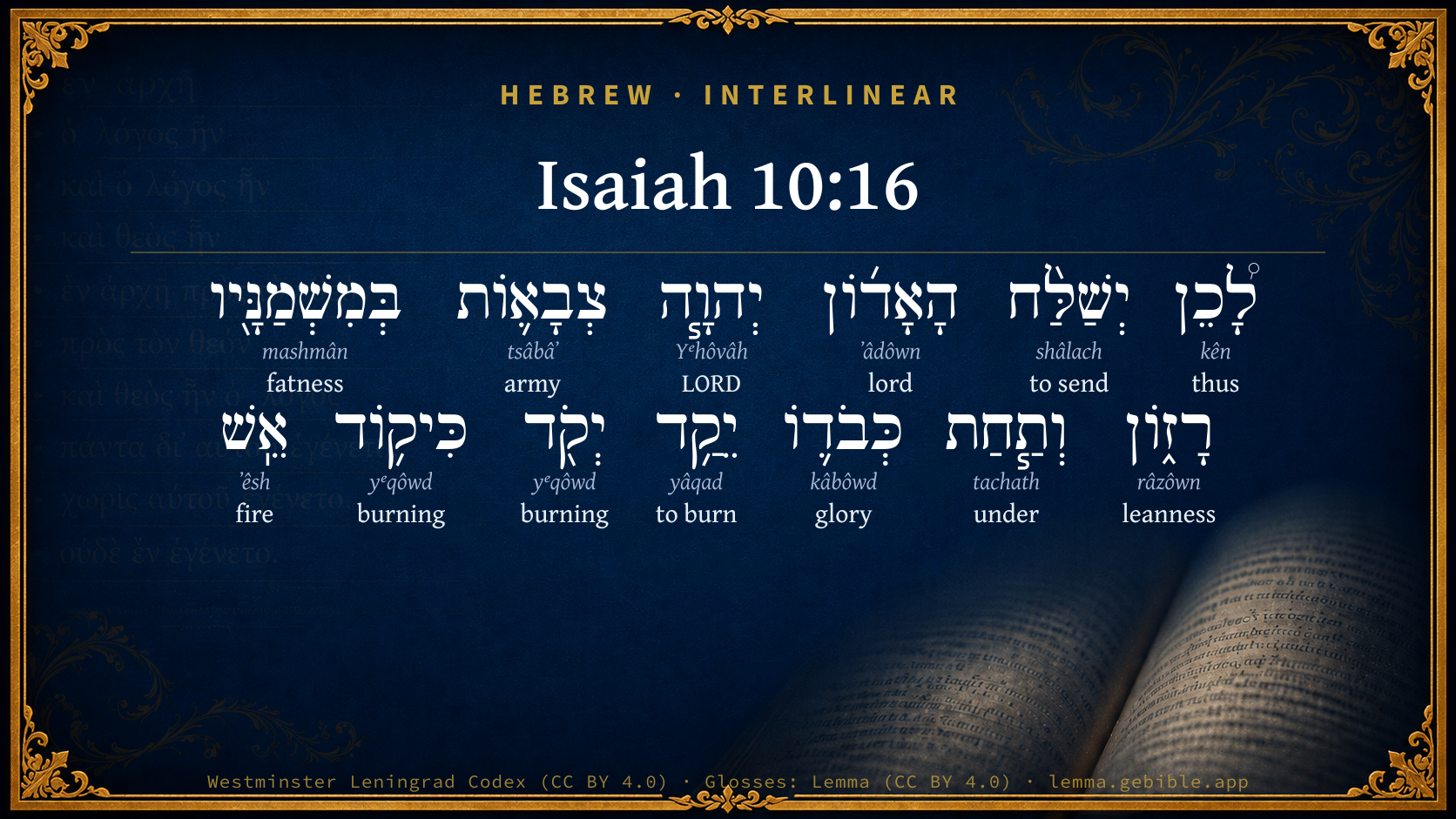
Hebrew (Westminster Leningrad Codex) Isaiah 10:16 appears in the Hebrew Old Testament. The text above is from the Westminster Leningrad Codex. Each word links to its Strong’s number, a concise gloss, and parsing drawn from the Open Scriptures Hebrew Bible morphology. Click any word for its full Brown-Driver-Briggs (BDB) entry.
Download image
Cite this verse

Isaiah 10:16 (World English Bible). Public Domain. Lemma interlinear Bible study tool, https://lemma.gebible.app/v/isaiah/10/16.

Show BibTeX & RIS
BibTeX
RIS
English Translation
Therefore will the Lord, Yahweh of Hosts, send among his fat ones leanness; and under his glory there shall be kindled a burning like the burning of fire.
World English Bible · Public Domain
Highlights Full analysis ↓
Download a study sheet

One document with this verse’s original text, its word-by-word gloss line, the meaning frame, cross-references with their text, attributed commentary, and full source and license credits — printable, and it pastes into notes with its structure intact.

This verse Autodidact and up

Study sheet (.html) Plain text (.txt)

A passage Seminary Student

Up to 50 verses in one chapter. A passage sheet keeps up to 6 commentary sources and 12 cross-references per verse, in the order this page ranks them, and says so on the sheet whenever that leaves anything out. Ask for a single verse and you get the Autodidact verse sheet above.

Everything on this page stays free to read, with no account — the sheet is a download of what is already on screen, not access to it.

Want to remove ads? Support Godless Engineer
Compare translations 3

The same verse in 3 English versions, stacked beneath the original-language interlinear above. Click any original word for its lexicon entry.

Each is an independent rendering of the whole verse — the interlinear is not word-aligned to these translations.

Highlighted words mark where these versions differ — a whole-verse word diff, not a word-by-word alignment.

  • World English Bible Public Domain
    Therefore will the Lord, Yahweh of Hosts, send among his fat ones leanness; and under his glory there shall be kindled a burning like the burning of fire.
  • King James Version Public Domain
    Therefore shall the Lord, the Lord of hosts, send among his fat ones leanness; and under his glory he shall kindle a burning like the burning of a fire.
  • unfoldingWord Literal Text CC BY-SA 4.0
    Therefore, the Lord, Yahweh of Armies, will send leanness among his fat ones, and among his glory he will kindle a burning like the burning of a fire.

unfoldingWord Literal Text — © unfoldingWord, licensed CC BY-SA 4.0. Word-aligned USFM3 via Door43 (git.door43.org/unfoldingWord/en_ult).

Versions to compare (up to 4)

3 of 4 selected

Show all 18 translations

Every available English version of this verse, each an independent rendering of the whole verse.

  • World English Bible Public Domain
    Therefore will the Lord, Yahweh of Hosts, send among his fat ones leanness; and under his glory there shall be kindled a burning like the burning of fire.
  • Berean Standard Bible Public Domain
    Therefore the Lord GOD of Hosts will send a wasting disease among Assyria’s stout warriors, and under his pomp will be kindled a fire like a burning flame.
  • Majority Standard Bible Public Domain
    Therefore the Lord GOD of Hosts will send a wasting disease among Assyria’s stout warriors, and under his pomp will be kindled a fire like a burning flame.
  • King James Version Public Domain
    Therefore shall the Lord, the Lord of hosts, send among his fat ones leanness; and under his glory he shall kindle a burning like the burning of a fire.
  • American Standard Version (1901) Public Domain
    Therefore will the Lord, Jehovah of hosts, send among his fat ones leanness; and under his glory there shall be kindled a burning like the burning of fire.
  • Revised Version (1885) Public Domain
    Therefore shall the Lord, the Lord of hosts, send among his fat ones leanness; and under his glory there shall be kindled a burning like the burning of fire.
  • Geneva Bible (1599) Public Domain
    Therefore shall the Lord God of hostes send amog his fat men, leannes, and vnder his glorie he shall kindle a burning, like the burning of fire.
  • Douay-Rheims (1899) Public Domain
    Therefore the sovereign Lord, the Lord of hosts, shall send leanness among his fat ones: and under his glory shall be kindled a burning, as it were the burning of a fire.
  • Young's Literal Translation Public Domain
    Therefore doth the Lord, the Lord of Hosts, Send among his fat ones leanness, And under his honour He kindleth a burning As the burning of a fire.
  • Literal Standard Version CC BY-SA 4.0
    Therefore the Lord, the Lord of Hosts, || Sends leanness among his fat ones, || And under his glory || He kindles a burning || As the burning of a fire.
  • Unlocked Literal Bible CC BY-SA 4.0
    Therefore the Lord Yahweh of hosts will send emaciation among his elite warriors; and under his glory there will be kindled a burning like fire.
  • unfoldingWord Literal Text CC BY-SA 4.0
    Therefore, the Lord, Yahweh of Armies, will send leanness among his fat ones, and among his glory he will kindle a burning like the burning of a fire.
  • Darby Bible Public Domain
    Therefore shall the Lord, Jehovah of hosts, send among his fat ones leanness, and under his glory he shall kindle a burning, like the burning of a fire:
  • World Messianic Bible Public Domain
    Therefore the Lord, GOD of Hosts, will send among his fat ones leanness; and under his glory a burning will be kindled like the burning of fire.
  • Webster's Bible Public Domain
    Therefore will the Lord, the LORD of hosts, send among his fat ones leanness; and under his glory he will kindle a burning like the burning of a fire.
  • Free Bible Version CC BY-SA 4.0
    So the Lord, the Lord Almighty, will send a disease on the king of Assyria's strong warriors that will make them waste away; a flaming fire will be set under everything he's so proud of.
  • Bible in Basic English Public Domain
    For this cause the Lord, the Lord of armies, will make his fat become wasted; and in his inner parts a fire will be lighted like a burning flame.
  • JPS Tanakh (1917) Public Domain
    Therefore will the Lord, the LORD of hosts, send among his fat ones leanness; and under his glory there shall be kindled a burning like the burning of fire.

Literal Standard Version (2020), Covenant Press — licensed CC BY-SA 4.0. Text via the HelloAO Bible API (eBible.org). Unlocked Literal Bible (unfoldingWord) — licensed CC BY-SA 4.0. Text via the HelloAO Bible API (eBible.org). unfoldingWord Literal Text — © unfoldingWord, licensed CC BY-SA 4.0. Word-aligned USFM3 via Door43 (git.door43.org/unfoldingWord/en_ult). Free Bible Version, Dr. Jonathan Gallagher — licensed CC BY-SA 4.0. Text via the HelloAO Bible API (eBible.org).

Word by word

More ways to search: Search by grammar → Find every occurrence → Compare this word →

Practice this passage: Drill this verse → Learn its vocabulary →

יְקֹ֖ד
yᵉqôwd
H3350
“burning”
Noun, Common, Masculine, Singular, Absolute
Part of Speech
Noun
Type
Common
Gender
Masculine
Number
Singular
State
Absolute
Full BDB Definition

Origin: from H3344

TWOT: 901a

a burning
  1. לָ֠כֵן kên H3651 “to/for · thus” Preposition + Adverb
  2. יְשַׁלַּ֨ח shâlach H7971 “to send” Verb, Piel, Imperfect, 3rd Person, Masculine, Singular
  3. הָאָד֜וֹן ʼâdôwn H113 “the · lord” Particle, Definite Article + Noun, Common, Masculine, Singular, Absolute
  4. יְהוָ֧ה Yᵉhôvâh H3068 “LORD” Noun, Proper
  5. צְבָא֛וֹת tsâbâʼ H6635 “armies” Noun, Common, Both, Plural, Absolute
  6. בְּמִשְׁמַנָּ֖יו mashmân H4924 “in/at · fat pieces · his” Preposition + Noun, Common, Masculine, Plural, Construct + Suffix, Personal, 3rd Person, Masculine, Singular
  7. רָז֑וֹן râzôwn H7332 “leanness” Noun, Common, Masculine, Singular, Absolute
  8. וְתַ֧חַת tachath H8478 “and · under” Conjunction + Preposition
  9. כְּבֹד֛וֹ kâbôwd H3519 “glory · his” Noun, Common, Both, Singular, Construct + Suffix, Personal, 3rd Person, Masculine, Singular
  10. יֵקַ֥ד yâqad H3344 “to burn” Verb, Qal, Imperfect, 3rd Person, Masculine, Singular
  11. כִּיק֥וֹד yᵉqôwd H3350 “like/as · burning of” Preposition + Noun, Common, Masculine, Singular, Construct
  12. אֵֽשׁ ʼêsh H784 “fire” Noun, Common, Both, Singular, Absolute

About this verse

These counts appear in no published source. They are computed here, from the morphology-tagged text and Lemma’s own curated glosses. What Lemma adds →

13
words
12
distinct lemmas
Prophets
section

Notable vocabulary

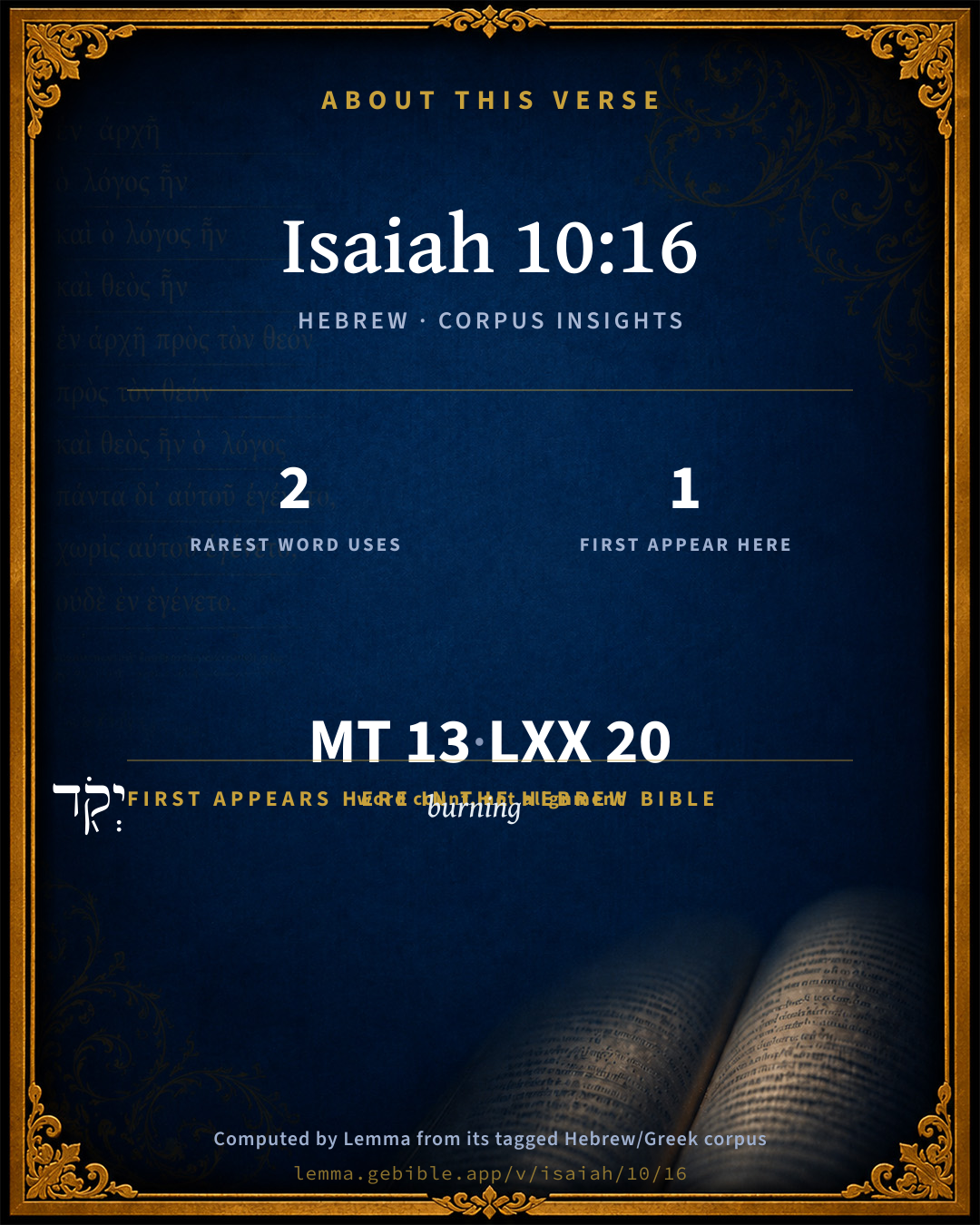
The rarest word here is יְקֹ֖ד burning H3350 — appearing just 2 times in the whole Hebrew Bible.

First appearance in Scripture

This word makes its first canonical appearance in the Hebrew Bible here:

  • יְקֹ֖ד burning H3350

Grammatical profile

  • 2 verbs
  • 9 nouns
  • 1 preposition
  • 1 adverb

Verb forms

  • יְשַׁלַּ֨ח Piel · Imperfect
  • יֵקַ֥ד Qal · Imperfect

Repetition

A word recurs within this verse — often emphatic in Hebrew:

  • יְקֹ֖ד burning H3350 ×2

Hebrew & Septuagint length

In English translation the verse runs 28 words from the Hebrew and 20 from the Septuagint (LXX English) — the Septuagint runs noticeably shorter here. See the side-by-side →

A rough comparison of the two English renderings, which tokenize alike — not a word-level alignment.

Word counts can differ between the Hebrew and the Greek without any difference in meaning — e.g. the Hebrew direct-object marker אֵת has no separate Greek word, and Greek often adds the article ὁ.

In the original languages it is 13 Hebrew tokens and 20 Greek tokens — but the two are counted differently (Hebrew bundles its prefixes and suffixes into one token; the Greek is in lemma form), so that isn’t a like-for-like length.

Cross-references

15

Topical passages linked to Isaiah 10:16 in the Treasury of Scripture Knowledge — connected by theme and wording, ordered by reader-vote popularity; previews shown in the World English Bible.

  • 2 Chronicles 32:21 Yahweh sent an angel, who cut off all the mighty men of valor, and the leaders and captains, in the camp of the king of Assyria. So he returned with shame of face to his own land. When he was come into the house of his god, those who came forth from his own bowels killed him there with the sword.
  • Psalms 106:15 He gave them their request, But sent leanness into their soul.
  • Acts 12:23 Immediately an angel of the Lord struck him, because he didn't give God the glory, and he was eaten by worms and died.
  • Isaiah 5:17 Then the lambs will graze as in their pasture, And strangers will eat the ruins of the rich.
  • Isaiah 9:5 For all the armor of the armed man in the tumult, and the garments rolled in blood, shall be for burning, for fuel of fire.
  • Isaiah 10:18 He will consume the glory of his forest, and of his fruitful field, both soul and body: and it shall be as when a standard-bearer faints.
  • Isaiah 14:24–27 Yahweh of Hosts has sworn, saying, Surely, as I have thought, so shall it happen; and as I have purposed, so shall it stand:
  • Isaiah 17:4 It shall happen in that day, that the glory of Jacob shall be made thin, and the fatness of his flesh shall wax lean.
  • Isaiah 29:5–8 But the multitude of your foes shall be like small dust, and the multitude of the awesome ones as chaff that passes away: yes, it shall be in an instant suddenly.
  • Isaiah 30:30–33 Yahweh will cause his glorious voice to be heard, and will show the lighting down of his arm, with the indignation of [his] anger, and the flame of a devouring fire, with a blast, and tempest, and hailstones.
  • Isaiah 33:10–14 Now will I arise, says Yahweh; now will I lift up myself; now will I be exalted.
  • Isaiah 37:6–7 Isaiah said to them, Thus shall you tell your master, Thus says Yahweh, Don't be afraid of the words that you have heard, with which the servants of the king of Assyria have blasphemed me.
  • Isaiah 37:29 Because of your raging against me, and because your arrogance is come up into my ears, therefore will I put my hook in your nose, and my bridle in your lips, and I will turn you back by the way by which you came.
  • Isaiah 37:36 The angel of Yahweh went forth, and struck in the camp of the Assyrians one hundred and eighty-five thousand; and when men arose early in the morning, behold, these were all dead bodies.
  • Isaiah 8:7 now therefore, behold, the Lord brings up on them the waters of the River, strong and many, [even] the king of Assyria and all his glory: and it shall come up over all its channels, and go over all its banks;

Cross-references courtesy of OpenBible.info (CC BY 4.0).

Hebrew and Greek witnesses Masoretic Hebrew ↔ Greek Septuagint

The same verse in the two great witnesses to the Old Testament, shown verse-for-verse.

Here the Septuagint runs noticeably shorter than the Hebrew — LXX2012 (modern English Septuagint) 20 words vs World English Bible 28. A rough length comparison of the two English translations, not a word-level alignment — read both below.

These are two independent witnesses, not word-aligned to each other, and the Septuagint is shown in lemma (dictionary) form.

Hebrew Isaiah 10:16 Masoretic · Westminster Leningrad Codex

לָ֠כֵן יְשַׁלַּ֨ח הָאָד֜וֹן יְהוָ֧ה צְבָא֛וֹת בְּמִשְׁמַנָּ֖יו רָז֑וֹן וְתַ֧חַת כְּבֹד֛וֹ יֵקַ֥ד יְקֹ֖ד כִּיק֥וֹד אֵֽשׁ

Therefore will the Lord, Yahweh of Hosts, send among his fat ones leanness; and under his glory there shall be kindled a burning like the burning of fire.

World English Bible · Public Domain

Greek LXX Isaiah 10:16 Septuagint · lemma form

καί οὐ οὕτως ἀλλά ἀποστέλλω κύριος σαβαωθ εἰς ὁ σός τιμή ἀτιμία καί εἰς ὁ σός δόξα πῦρ καίω καίω

but the Lord of hosts shall send dishonor upon your honor, and burning fire shall be kindled upon your glory.

LXX2012 (modern English Septuagint) · Public Domain

On this verse, Joseph Benson's Commentary discusses the Septuagint’s reading. Read the note in Commentary ↓

Hebrew: Westminster Leningrad Codex (CC BY 4.0). Greek: Septuagint (public domain); English from LXX2012 (modern English Septuagint) (Public Domain). How the Septuagint differs from the Hebrew →

Targum (Aramaic paraphrase)

1

The Targum is the ancient Jewish Aramaic paraphrase of the Hebrew Scriptures — an interpretive translation, not the Hebrew text itself. Onkelos (literal) and Pseudo-Jonathan (expansive) render the Torah, and Jonathan the Prophets. Coverage is partial: where no permissively-licensed English translation exists for a verse, only the Aramaic is shown. This is verse-level text, not a word-by-word alignment to the Hebrew.

  1. Targum Jonathan Prophets (Joshua–Malachi)
    חֲלַף דְאִתְרַבְרַב מַלְכָּא דְאַתּוּר בְּכֵן יְשַׁלַח רִבּוֹן עַלְמָא יְיָ צְבָאוֹת בְּרַבְרְבָנוֹהִי מָחָא וּתְחוֹת מָנַי יְקָרְהוֹן מֵיקַד יֵיקְדוּן כִּיקֵידַת אֶשָׁא:

    Because the king of Assyria magnifies himself, therefore the Lord of the world, the Lord of hosts, shall send among his princes a blow; and beneath the vessels of their glory they are utterly burned up like the burning of a fire.

    Targum Jonathan — Aramaic: “Mikraot Gedolot” (public domain). English: “Sefaria Community Translation” (CC0 1.0 (public-domain dedication)); “London "Chaldee Paraphrase," 1871” (public domain). Text via Sefaria.

Commentary

Notes on Isaiah 10:16 from classic Christian and Jewish commentators (each source and its license shown beneath its notes). The classic Christian expositions comment on the surrounding passage and are grouped to its opening verse, so a note may address several verses; the Jewish commentaries on the Tanakh (Rashi and others) are per-verse, so they appear only where the commentator wrote on this verse.

Lemma curates 59 commentaries, every one of them public domain or Creative Commons licensed, each selected and text-cleaned for this edition rather than reprinted as found. About our sources →

The Cambridge Bible for Schools and Colleges

gen. ed. J. J. S. Perowne

16. the Lord, the Lord of hosts] as in ch. Isa_1:24. The ordinary printed editions have the unparalleled expression Adônâi Tsìbâôth, for which Baer rightly restores Yahveh Tsìbâôth.

send among his fat ones] Better, “send into his fat limbs,” the image being that of a human body. For the metaphor see ch. Isa_17:4.

he shall kindle … fire] Better, there shall burn a burning like the burning of fire. The monotony is as marked in the Hebrew as in this translation.

Isa_10:17. The same figure as in ch. Isa_9:18.

Isa_10:18. both soul and body] For similarly abrupt changes of metaphor, cf. ch. Isa_5:24, Isa_8:8, Isa_28:18.

and they shall be … fainteth] Render with R.V. marg., and it shall be as when a sick man pineth away, a return to the figure with which Isa_10:16 opens. The participle nôṣçṣ occurs nowhere else: A.V. connects it with nçṣ a standard; the translation “sick man” rests on the analogy of the Syriac.

Isa_10:19. And the rest] the remnant (R.V.); the same word as in Isa_10:20-22. shall be few] lit. “a number,” a numerable quantity.

a child may write them] i.e. make a list of them.

16–19. The destruction of the Assyrian army is described under the two figures of sickness and a conflagration. There is a certain amount of confusion in the metaphors, and undoubtedly the style deteriorates at this point.

The Cambridge Bible for Schools and Colleges (gen. ed. J. J. S. Perowne; Cambridge University Press, 1878–1918) — public domain. Text from a community e-Sword module.

Trapp's Complete Commentary

John Trapp

Isa 10:16 Therefore shall the Lord, the Lord of hosts, send among his fat ones leanness; and under his glory he shall kindle a burning like the burning of a fire.

Ver. 16. Therefore shall the Lord … send among his fat ones,] i.e., Pingues, torosos et validos milites, his lusty and mastive soldiers, in whom he confided.

Leanness,] i.e., Luem, a plague to tame them, and take them down. See this fulfilled, Isa 37:36.

And under his glory,] i.e., His huge army wherein he glorieth. What need we to fear the Turks, said Sigismund, the young king of Hungary, who need not at all to fear the falling of the heavens? which, if they should fall, yet were we able with our spears and halberds to hold them up from falling upon us. {a}

He will kindle a burning.] A plague parching up their vitals. The Hebrews say that the bodies of Sennacherib’s soldiers were, by the stroke of an angel, so consumed and burnt up, as that their garments and weapons were not burnt at all.

{a} Turkish History, fol. 206.

John Trapp, A Commentary or Exposition upon All the Books of the Old and New Testament (1647–1656) — public domain. Text from a community e-Sword module.

Joseph Benson's Commentary

Isa 10:16-19. Therefore shall the Lord, the Lord of hosts — The sovereign Lord and General of his and of all other armies; send among his fat ones leanness — Strip him, and all his great princes and commanders, of all their wealth, and might, and glory. And under his glory he shall kindle, &c. — He will destroy his numerous and victorious army, and that suddenly and irrecoverably, as the fire doth those combustible things which are cast into it; which was fulfilled 2Ki 19:25. And the light of Israel — That God, who is, and will be, a comfortable light to his people; shall be a fire — To the Assyrians; and it shall devour his thorns and briers — His vast army, which is no more able to resist God than dry thorns and briers are to oppose the fire which is kindled among them. And shall consume the glory of his forest — “The briers and thorns,” says Bishop Lowth, “are the common people; and the glory of his forest are the nobles, and those of the highest rank and importance. The fire of God’s wrath shall destroy them, great and small.” And of his fruitful field — Of his soldiers, who stand as thick as ears of corn do in a fruitful field. Hebrew, Of his Carmel; an allusion possibly to the vain threat, which God foreknew the Assyrian would hereafter utter, with regard to Israel, I will enter into the height of his border, and the forest of his Carmel, Isa 37:24. Both soul and body — Hebrew, מנפשׁ ועד בשׂר, from the soul, even to the flesh, a proverbial expression. The fire of God’s wrath shall consume them entirely and altogether. And they shall be — The state of the king, and of his vast and valiant army, shall be as when a standard- bearer fainteth — Like that of an army, when either the standard-bearer is slain, or rather flees away, which strikes a terror into the whole army, and puts them to flight. Bishop Lowth, in this clause, follows the reading of the LXX., ως ο φευγων απο φλογος καιομενης, It shall be, as when one fleeth out of raging flames: that is, “The few that escape shall be looked upon as having escaped from the most imminent danger.” The rest of the trees of his forest — The remainders of that mighty host; a child may write them — A child, or the meanest accountant, may number and register them. It is justly observed by Dr. Dodd, that “the emphasis of this passage consists in the elegance of the metaphors.” The first, taken from leanness, destroying the fat, and marring the beauty of the human form, well describes that terrible plague which destroyed the flower of the Assyrian host. The second, taken from fire, which, with unconquerable fury, in a short time reduces combustible matter to ashes, gives us a striking picture of the quick and almost instantaneous ruin brought on that army, by the irresistible power of the destroying angel, especially as that fire is represented as kindled by the light of Israel. And the third metaphor of the thorns and briers, which are so far from having any power to withstand the fury of the flames, that they provoke and feed it, affords us a lively emblem of the utter inability of the Assyrian monarch, or his mighty host, to make the least resistance against that divine vengeance which their crimes had merited.

Joseph Benson's Commentary on the Old and New Testaments (1811–1818) — public domain. Text from a community e-Sword module.

Lange's Commentary on the Holy Scriptures

3. THE EXECUTION OF THE WOE

Isa_10:16-19

16          Therefore shall the Lord, the Lord of hosts, send

Among his fat ones leanness;

And under his glory he shall kindle a burning

Like the burning of a fire.

17     And the light Israel shall be for a fire,

And his Holy One for a flame:

And it shall burn and devour his thorns

And his briers in one day;

18     And shall consume the glory of his forest, and of his fruitful field,19Both soul and body:

And they shall be as when20 a standard-bearer fainteth.

19     And the rest of the trees of his forest shall be 21few,

That a child may write them.

TEXTUAL AND GRAMMATICAL

On Isa_10:16. האדוו comp. Isa_10:33; Isa_1:24; Isa_3:1; Isa_19:4.—אדני צבאות are found thus combined only here. Elsewhere it is always אדני יהוה צבאות, Isa_10:23-24; Isa_3:15; Isa_22:5; Isa_22:12; Isa_22:14-15; Isa_28:22; Jer_2:19; Jer_46:10; Jer_49:5; Jer_50:25; Jer_50:31.—מִשְׁמַנִּ׳ם are properly “the fat parts” (comp. Gen_27:28; Gen_27:39), then (abstr. pro concr. Psa_78:31); “the fat men,” by whom Isaiah understands all that have a share in Assyria’s greatness. Comp. Isa_27:4, where alone the word occurs again in Isaiah.—רזוו, from רָזה attenuare, maciare, Niph. contabescere (Isa_17:4) occurs only here in Isaiah (comp. רָוִי Isa_24:16). It means macies, tabies, “consumption, phthisis.”—יָקַד verb, comp. Isa_30:14; Isa_65:5, יְקרֹ only here. Note the paronomasia which evidently aims at an artistic sound imitation.

On Isa_10:17. ביום אחד comp. on Isa_9:13.—כרמל, “the fruitful, cultivated garden and field,” is also elsewhere opposed to forest (Isa_29:17), while again in other places יער is mentioned as part of the כרמל (Isa_37:24; 2Ki_19:23). This is no contradiction, the notions of the two words occurring sometimes in a broader, sometimes in a narrower sense.

On Isa_10:18. נֹסֵם, ἅπ. λεγ. Comp. נָשׁ, Syr. nesiso, νοσεῖν, “to be sick.”—מְסֹם infin. from מָסַם Isa_13:7; Isa_19:1; Isa_34:3, “to pine away.”—מספר like Jer_44:28; Eze_12:16, etc.

EXEGETICAL AND CRITICAL

2. Therefore——write them.

Isa_10:16-19. “Therefore” introduces the consequences that follow the double guilt of Assyria portrayed above. That necessary consequence is punishment. The, not personal, glory of Assyria shall be burnt so as if the Lord kindled a fire under it. The comparison of the consumption which is not meant literally, and the כְּ before יְקוֹד show that no real fire is meant. It is the fire of God’s holy wrath that is the correlative of His love. The latter is the light of Israel in whom God takes pleasure (2Sa_22:29; Psa_27:1; Mic_7:8), but a consuming fire for all that is against God and His kingdom (Deu_4:24; Deu_9:3; Isa_30:33; Isa_33:14). Like Isa_9:17, thorns and thistles are contrasted with the nobler representatives of vegetation. The comparison does not refer to the army of Assyria with its various grades of rank and file, but to the nation with all its glory. Thorns and thistles mean all lowly and inferior persons, forest and fruitful field those of elevation and splendor.

The expression “from soul to body” (מנבּשׁ ועד בשׂר is found only here). It is to be compared with Isa_1:6, “from the sole of the foot to the head.” As the latter signifies the entire outward, visible surface of the body, so the latter the entire organism generally. Not only the outward, but the inward shall be anihilated. “For body and soul are the entire man (Psa_16:9; Psa_78:26; Psa_84:3.”)—Knobel. I except to this only that the expression is restricted to men. Have not the beast and the plant a soul too? Comp. Gen_2:19. And is it not said in our very passage that forest and field shall be anihilated from the soul to the flesh? Thus in some sense soul and flesh, i.e., body are attributed to plants. From his exhaustless store the Prophet produces another figure, and calls Assyria a weakling, who pining dies away.

Yet a remnant shall remain, but a very feeble one. Of the lordly forest there shall be left only a clump that may be counted; so far from numerous that a boy can count and write a list of them. And truly, what was left of Assyria after its destruction may be compared to the little forest or grove of cedars that the traveller now finds on Lebanon. But I mean not merely the overthrow of Sennacherib, but Nineveh’s destruction by the Babylonians and Medes. For the Prophet’s vision comprehends the whole future both of Israel and of Assyria.

The figure of the boy writing down the trees, seems to me remarkable in respect to the history of culture. We hear in this place of a boy that can write, the like of which we find even Jdg_8:14, and that counts the trunks of the trees. Is the figure pure invention of the Prophet? or was he brought to use it from observation?

DOCTRINAL AND ETHICAL

1. On Isa_7:1. “Hierosolyma oppugnatur, etc. Jerusalem is assaulted but not conquered. The church is pressed but not oppressed.”—Foerster.

2. On Isa_7:2. “Quando ecclesia, etc. When the Church is assaulted and Christ crucified over again in His elect, Rezin and Pekah, Herod and Pilate are wont to form alliance and enter into friendly relations. There are, so to speak, the foxes of Samson, joined indeed by the tails, but their heads are disconnected.”—Foerster.—“He that believes flees not (Isa_28:16). ‘The righteous is bold as a lion’ (Pro_28:1). Hypocrites and those that trust in works (work-saints) have neither reason nor faith. Therefore they cannot by any means quiet their heart. In prosperity they are, indeed, overweening, but in adversity they fall away (Jer_17:9).” Cramer.

3. On Isa_7:9. (“If ye will not believe, surely ye shall not be established.”) “Insignis sententia, etc. A striking sentiment that may be adapted generally to all temptation, because all earnest endeavor after anything, as you know, beguiles us in temptation. But only faith in the word of promise makes us abide and makes sure whatever we would execute. He warns Ahaz, therefore, as if he said: I now promise you by the word, it shall be that those two kings shall not hurt you. Believe this word! For if you do not, whatever you afterwards devise will deceive you: because all confidence is vain which is not supported by the word of God.”—Luther.

4. On Isa_7:10-12. “Wicked Ahaz pretends to great sanctity in abstaining from asking a sign through fear of God. Thus hypocrites are most conscientious where there is no need for it: on the other hand, when they ought to be humble, they are the most insolent. But where God commands to be bold, one must be bold. For to be obedient to the word is not tempting God. That is rather tempting God when one proposes something without having the word for it. It is, indeed, the greatest virtue to rest only in the word, and desire nothing more. But where God would add something more than the word, then it must not be thought a virtue to reject it as superfluous. We must therefore exercise such a faith in the word of God that we will not despise the helps that are given in addition to it as aids to faith. For example the Lord offers us in the gospel all that is necessary to salvation. Why then Baptism and the Lord’s Supper? Are they to be treated as superfluous? By no means. For if one believes the word he will at the same time exhibit an entire obedience toward God. We ought therefore to learn to join the sign with the word, for no man has the power to sever the two.

But do you ask: is it permitted to ask God for a sign? We have an example of this in Gideon. Answer: Although Gideon was not told of God to ask a sign, yet he did it by the impulse of the Holy Spirit, and not according to his own fancy. We must not therefore abuse his example, and must be content with the sign that is offered by the Lord. But there are extraordinary signs or miracles, like that of the text, and ordinary ones like Baptism and the Lord’s Supper. Yet both have the same object and use. For as Gideon was strengthened by that miraculous event, so, too, are we strengthened by Baptism and the Lord’s Supper, although no miracle appears before our eyes.” Heim and Hoffmann after Luther. Eliezer, the servant of Abraham, also asked the Lord to show him the right wife for Isaac by means of a sign of His own choosing, (Gen_24:14).

It ought to be said that this asking a sign (opening the Bible at a venture, or any other book) does not suit Christian perfection (Heb_6:1). A Christian ought to be inwardly sensible of the divine will. He ought to content himself with the guarantees that God Himself offers. Only one must have open eyes and ears for them. This thing of demanding a sign, if it is not directly an effect of superstition (Mat_12:39; Mat_16:4; 1Co_1:22), is certainly childish, and, because it easily leads to superstitious abuses, it is dangerous.

5. On Isa_7:13. “Non caret, etc. That the Prophet calls God his God is not without a peculiar emphasis. In Zec_2:12 it is said, that whoever touches the servants of God touches the pupil of God’s eye. Whoever opposes teacher and preacher will have to deal with God in heaven or with the Lord who has put them into office.”—Foerster.

6. On Isa_7:14. “The name Immanuel is one of the most beautiful and richest in contents of all the Holy Scripture. ‘God with us’ comprises God’s entire plan of salvation with sinful humanity. In a narrower sense it means ‘God-man’ (Mat_1:23), and points to the personal union of divinity and humanity, in the double nature of the Son of God become man. Jesus Christ was a God-with-us, however, in this, that for about 33 years He dwelt among us sinners (Joh_1:11; Joh_1:14). In a deeper and wider sense still He was such by the Immanuel’s work of the atonement (2Co_5:19; 1Ti_2:3). He will also be such to every one that believes on Him by the work of regeneration and sanctification and the daily renewal of His holy and divine communion of the Spirit (Joh_17:23; Joh_17:26; Joh_14:19-21; Joh_14:23). He is such now by His high-priestly and royal administration and government for His whole Church (Mat_28:20; Heb_7:25). He will be snch in the present time of the Church in a still more glorious fashion (Joh_10:16). The entire and complete meaning of the name Immanuel, however, will only come to light in the new earth, and in the heavenly Jerusalem (Rev_21:3; Rev_21:23; Rev_22:5).”—Wilh. Fried. Roos.

Isa_8:7. On Isa_8:5 sqq. “Like boastful swimmers despise small and quiet waters, and on the other hand, for the better display of their skill, boast of the great sea and master it, but often are lost in it,—thus, too, did the hypocrites that despised the small kingdom of Judah, and bragged much and great things of the power and splendor of the kingdom of Israel and of the Syrians; such hypocrites are still to be found now-a-days—such that bear in their eye the admiranda Romae, the splendor, riches, power, ceremonies and pomp of the Romish church, and thereupon ‘set their bushel by the bigger-heap.’ It is but the devil’s temptation over again: ‘I will give all this to thee.’ ”—Cramer.—“Fons Siloa,” etc. “The fountain of Siloam, near the temple, daily reminded the Jews that Christ was coming.”—Calvin on Joh_9:7.

8. On Isa_8:10. “When the great Superlatives sit in their council chambers and have determined everything, how it ought to be, and especially how they will extinguish the gospel, then God sends the angel Gabriel to them, who must look through the window and say: nothing will come of it.”—Luther.—“Christ, who is our Immanuel, is with us by His becoming man, for us by His office of Mediator, in us by the work of His sanctification, by us by His personal, gracious presence.”—Cramer.

9. On Isa_8:14-15. Christ alone is set by God to be a stone by which we are raised up. That He is, however, an occasion of offence to many is because of their purpose, petulance and contempt (1Pe_2:8). Therefore we ought to fear lest we take offence at Him. For whoever falls on this stone will shatter to pieces (Mat_21:44).” Cramer.

10. On Isa_8:16 sqq. He warns His disciples against heathenish superstition, and exhorts them to show respect themselves always to law and testimony. “They must not think that God must answer them by visions and signs, therefore He refers them to the written word, that they may not become altogether too spiritual, like those now-a-days who cry: spirit! spirit! … Christ says, Luke 16 : They have Moses and the prophets, and again Joh_5:39 : Search the Scriptures. So Paul says, 2Ti_3:16 : The Scripture is profitable for doctrine. So says Peter, 2Pe_1:9 : We have a sure word of prophecy. It is the word that changes hearts and moves them. But revelations puff people up and make them insolent.” Heim and Hoffmann after Luther.

Chap. 9–11. On Isa_9:1 sqq. (2). “Postrema pars, etc. The latter part of chap. 8 was νομικὴ καὶ ἀπειλητική (legal and threatening) so, on the other hand, the first and best part of chap. 9 is εὐαγγελικὴ καὶ παραμυθητική, (evangelical and comforting). Thus must ever law and gospel, preaching wrath and grace, words of reproof and words of comfort, a voice of alarm and a voice of peace follow one another in the church.” Foerster.

12. On Isa_9:1 (2). Both in the Old Testament and New Testament Christ is often called light. Thus Isaiah calls Him “a light to the gentiles,” Isa_42:6; Isa_49:6. The same Prophet says: “Arise, shine (make thyself light), for thy light is come,” Isa_60:1. And again Isa_9:19 : “The Lord shall be unto thee an everlasting light.” In the New Testament it is principally John that makes use of this expression: “The life was the light of men,” Joh_1:4, “and the light shined in the darkness,” Joh_9:5. John was not that light, but bore testimony to the light, Joh_9:8. “That was the true light that lighteth every man that cometh into the world,” Joh_9:9. And further: “And this is the condemnation that light is come into the world, and men loved darkness rather than light,” Joh_3:19. “I am the light of the world,” (Joh_8:12; Joh_9:5; comp. Joh_12:35).

13. On Isa_9:1 (2). The people that sit in darkness may be understood to comprise three grades. First, the inhabitants of Zebulon and Naphtali are called so (Isaiah 8:23), for the Prophet’s gaze is fixed first on that region lying in the extreme end of Palestine, which was neighbor to the heathen and mixed with them, and on this account was held in low esteem by the dwellers in Judah. The night that spreads over Israel in general is darkest there. But all Israel partakes of this night, therefore all Israel, too, may be understood, as among the people sitting in darkness. Finally, no one can deny that this night extends over the borders of Israel to the whole human race. For far as men dwell extends the night which Christ, as light of the world, came to dispel, Luk_1:76 sqq.

14. On Isa_9:5 (6). Many lay stress on the notion “child,” inasmuch as they see in that the reason for the reign of peace spoken of afterwards. It is not said a man, a king, a giant is given to us. But this is erroneous. For the child does not remain a child. He becomes a man: and the six names that are ascribed to Him and also the things predicted of His kingdom apply to Him, not as a child, but as a man. That His birth as a child is made prominent, has its reason in this, that thereby His relation to human kind should be designated as an organic one. He does not enter into humanity as a man, i.e. as one whose origin was outside of it, but He was born from it, and especially from the race of David. He is Son of man and Son of David. He is a natural offshoot, but also the crowning bloom of both. Precisely because He was to be conceived, carried and born of a human mother, and indeed of a virgin, this prophecy belongs here as the completion and definition of the two prophetic pictures Isa_7:10 sqq.; Isa_8:1 sqq.—“He came down from heaven for the sake of us men, and for our bliss (1Ti_1:15; Luk_2:7). For our advantage: for He undertook not for the seed of angels, but for the seed of Abraham (Heb_2:16). Not sold to us by God out of great love, but given (Rom_5:15; Joh_3:16). Therefore every one ought to make an application of the word ‘to us’ to himself, and to learn to say: this child was given to me, conceived for me, born to me.”—Cramer.—“Cur oportuit, etc. Why did it become the Redeemer of human kind to be not merely man nor merely God, but God and man conjoined or θεάνθρωπον? Anselm replies briefly, indeed, but pithily: Deum qui posset, hominem, qui deberet.” Foerster.

15. On Isa_9:5 (6). “You must not suppose here that He is to be named and called according to His person, as one usually calls another by his name; but these are names that one must preach, praise and celebrate on account of His act, works and office.” Luther.

16. On Isa_9:6. “Verba pauca, etc. A few words, but to be esteemed great, not for their number but for their weight.” Augustine. “Admirabilis in, etc. Wonderful in birth, counsellor in what He preaches, God in working, strong in suffering, father of the world to come in resurrection, Prince of peace in bliss perpetual.” Bernard of Clairvaux. In reference to “a child is born,” and “a son is given,” Joh. Cocceius remarks in his Heb. Lex. s. v. יֶלֶד: “respectu, etc., in respect to His human nature He is said to be born, and in respect to His divine nature and eternal generation not indeed born, but given, as, Joh_3:16, it reads God gave His only begotten Son.”

“In the application of this language all depends on the words is born to us, is given to us.” The angels are, in this matter, far from being as blessed as we are. They do not say: To us a Saviour is born this day, but; to you. As long as we do not regard Christ as ours, so long we shall have little joy in Him. But when we know Him as our wisdom, righteousness, sanctification and redemption, as a gift that our heavenly Father designed for us, we will appropriate Him to ourselves in humble faith, and take possession of all His redeeming effects that He has acquired. For giving and taking go together. The Son is given to us; we must in faith receive Him.” J. J. Rambach, Betracht. über das Ev. Esaj., Halle, 1724.

On Isa_9:6 (7). “The government is on His shoulders.” “It is further shown how Christ differs in this respect from worldly kings. They remove from themselves the burden of government and lay it on the shoulders of the privy counsellors. But He does not lay His dominion as a burden on any other; He needs no prime minister and vicegerent to help Him bear the burden of administration, but He bears all by the word of His power as He to whom all things are given of the Father. Therefore He says to the house of Jacob (Isa_46:3 sq.): Hearken unto me ye who were laid on my shoulders from your mothers’ womb. I will carry you to old age. I will do it, I will lift, and carry and deliver,—on the contrary the heathen must bear and lift up their idols, (Isa_46:1; Isa_46:7).”—Rambach. “In the first place we must keep in mind His first name: He is called Wonderful. This name affects all the following.” “All is wonderful that belongs to this king: wonderfully does He counsel and comfort; wonderfully He helps to acquire and conquer, and all this in suffering and want of strength. (Luther, Jen. germ. Tom. III. Fol. 184 b.). ” “He uses weakness as a means of subduing all things to Himself. A wretched reed, a crown of thorns and an infamous cross, are the weapons of this almighty God, by means of which He achieves such great things. In the second place, He was a hero and conqueror in that just by death, He robbed him of his might who had the power of death, i.e., the devil (Heb_2:14); in that He, like Samson, buried His enemies with Himself, yea, became poison to death itself, and a plague to hell (Hos_13:14) and more gloriously resumed His life so freely laid down, which none of the greatest heroes can emulate.”—Rambach.

17. On Isa_9:18 (19) sqq. True friendship can never exist among the wicked. For every one loves only himself. Therefore they are enemies one of another; and they are in any case friends to each other, only as long as it concerns making war on a third party.

Isaiah 10-18. On Isa_10:4. (Comp. the same expression in chap. 10). God’s quiver is well filled. If one arrow does not attain His object, He takes another, and so on, until the rights of God, and justice have conquered.

19. On Isa_10:5-7. “God works through men in a threefold way. First, we all live, move and have our being in Him, in that all activity is an outflow of His power. Then, He uses the services of the wicked so that they mutually destroy each other, or He chastises His people by their hand. Of this sort the Prophet speaks here. In the third place, by governing His people by the Spirit of sanctification: and this takes place only in the elect.”—Heim and Hoffmann.

20. On Isa_10:5 sqq. “Ad hunc, etc. Such places are to be turned to uses of comfort. Although the objects of temptation vary and enemies differ, yet the effects are the same, and the same spirit works in the pious. We are therefore to learn not to regard the power of the enemy nor our own weakness, but to look steadily and simply into the word, that will assuredly establish our minds that they despair not, but expect help of God. For God will not subdue our enemies, either spiritual or corporal, by might and power, but by weakness, as says the text: my strength is made perfect in weakness.” (2Co_12:9).—Luther.

21. On Isa_10:15. “Efficacia agendi penes Deum est, homines ministerium tantum praebent. Quare nunc sibilo suo se illos evocaturum minabatur (cap. Isa_5:26; Isa_7:18); nunc instar sagenae sibi fore ad irretiendos, nunc mallei instar ad feriendos Israelitas. Sed praecipue tum declaravit, quod non sit otiosus in illis, dum Sennacherib securim vocat, quae ad secandum manu sua et destinata fuit et impacta. Non male alicubi Augustinus ita definit, quod ipsi peccant, eorum esse; quod peccando hoc vel illud agant, ex virtute Dei esse, tenebras prout visum est dividentis (De praedest Sanctt.).”—Calvin Inst. II. 4, 4.

22. On Isa_10:20-27. “In time of need one ought to look back to the earlier great deliverances of the children of God, as to the deliverance of Israel out of Egypt, or later, from the hand of the Midianites. Israel shall again grow out of the yoke.”—Diedrich.

Isaiah 11-23. On Isa_11:4. “The staff of His mouth.” “Evidence that the kingdom of Christ will not be like an earthly kingdom, but consist in the power of the word and of the sacraments; not in leathern, golden or silver girdles, but in girdles of righteousness and faith.”—Cramer.

24. On Isa_11:10 sqq. If the Prophet honors the heathen in saying that they will come to Christ before Israel, he may be the more readily believed, when Isa_11:11 sqq., he gives the assurance that the return out of the first, the Egyptian exile, shall be succeeded by a return out of the second, the Assyrian exile, (taking this word in the wider sense of Isaiah). It is manifest that the return that took place under Zerubbabel and Ezra was only an imperfect beginning of that promised return. For according to our passage this second return can only take place after the Messiah has appeared. Farthermore, all Israelites that belong to “the remnant of Israel,” in whatever land they may dwell, shall take part in it. It will be, therefore, a universal, not a partial return. If now the Prophet paints this return too with the colors of the present (Isa_11:13 sqq.), still that is no reason for questioning the reality of the matter. Israel will certainly not disappear, but arise to view in the church of the new covenant. But if the nation is to be known among the nations as a whole, though no more as a hostile contrast, but in fraternal harmony, why then shall not the land, too, assume a like position among the lands? But the nation can neither assume its place among nations, nor the land its place among lands, if they are not both united: the people Israel in the land of their fathers.

25. On Isaiah 11 “We may here recall briefly the older, so-called spiritual interpretation. Isa_11:1-5 were understood of Christ’s prophetic office that He exercised in the days of His flesh, then of the overthrow of the Roman Empire and of Antichrist, who was taken to be the Pope. But the most thorough-going of those old expositors must acknowledge, at Isa_11:4, that the Antichrist is not yet enough overthrown, and must be yet more overthrown. If such is the state of the case, then this interpretation is certainly false, for Isa_11:4 describes not a gradual judgment, but one accomplished at once. There have been many Antichrists, and among the Popes too, but the genuine Antichrist described 2 Thessalonians 2, is yet to be expected, and also the fulfillment of Isa_11:4 of our chapter. Thereby is proved at the same time that the peaceful state of things in the brute world and the return of the Jews to their native land are still things of the future, for they must happen in that period when the Antichristian world, and its head shall be judged by Christ. But then, too, the dwelling together of tame and wild beasts is not the entrance of the heathen into the church, to which they were heretofore hostile, and the return of the Jews is not the conversion of a small part of Israel that took place at Pentecost and after. The miracles and signs too, contained in Isa_11:15-16 did not take place then. We see just here how one must do violence to the word if he will not take it as it stands. But if we take it as we have done, then the whole chapter belongs to the doctrine of hope (Hoffnungslehre) of the Scripture, and constitutes an important member of it. The Lord procures right and room for His church. He overthrows the world-kingdom, together with Antichrist. He makes of the remnant of Israel a congregation of believers filled with the Spirit, to whom He is near in an unusual way, and from it causes His knowledge to go out into all the world. He creates peace in the restless creatures, and shows us here in advance what more glorious things we may look for in the new earth. He presents to the world a church which, united in itself, unmolested by neighbors, stands under God’s mighty protection. All these facts are parts of a chain of hope that must be valuable and dear to our hearts. The light of this future illumines the obscurity of the present; the comfort of that day makes the heart fresh.” Weber, der Prophet Jesaja, 1875.

Chap. 12–26. On Isa_12:4 sq. “These will not be the works of the New Testament: sacrificing and slaying, and make pilgrimage to Jerusalem and to the Holy Sepulchre, but praising God and giving thanks, preaching and hearing, believing with the heart and confessing with the mouth. For to praise our God is good; such praise is pleasant and lovely” (Psa_147:1). Cramer.

27. On Chap. 12 “With these words conclude the prophetic discourses on Immanuel. Through what obscurity of history have we not had to go, until we came to the bright light of the kingdom of Christ! How Israel and the nations had to pass through the fire of judgment before the sun arises in Israel and the entire gentile world is illumined! It is the, same way that every Christian has to travel. In and through the fire we become blessed. Much must be burnt up in us, before we press to the full knowledge of God and of His Son, before we become entirely one with Him, entirely glad and joyful in Him. Israel was brought up and is still brought up for glory, and we too. O that our end too were such a psalm of praise as this psalm!” Weber, Der Pr. Jes. 1875.

Footnotes:

[19]Heb. from the soul, and even to the flesh.

[20]a weakly person pines away.

[21]Heb. number.

Lange's Commentary on the Holy Scriptures (Critical, Doctrinal, and Homiletical), ed. John Peter Lange, English translation edited by Philip Schaff (1864–1880) — public domain. Text from a community e-Sword module.

Tyndale Open Study Notes

Tyndale Open Resources

10:16 The fulfillment of this prophecy was in 701 BC, when 185,000 Assyrian troops were killed by plague and flaming fire (see 37:36).

Tyndale Open Study Notes — © Tyndale Open Resources, licensed CC BY-SA 4.0. Text via the HelloAO Bible API.

Jamieson, Fausset & Brown

Robert Jamieson, A. R. Fausset & David Brown

fat ones-- (Isa 5:17). The robust and choice soldiers of Assyria (Psa 78:31, where "fattest" answers in the parallelism to "chosen," or "young men," Margin).

leanness--carrying out the image on "fat ones." Destruction (Psa 106:15). Fulfilled (Isa 37:36).

his glory--Assyria's nobles. So in Isa 5:13, Margin; Isa 8:7.

kindle--a new image from fire consuming quickly dry materials (Zac 12:6).

Jamieson, Fausset & Brown — Commentary Critical and Explanatory on the Whole Bible (1871) — public domain (CC PDM 1.0). Text via the HelloAO Bible API.

Adam Clarke's Commentary

Verse 16. The Lord - "JEHOVAH."] For אדני Adonai, fifty-two MSS., eleven editions, and two of my own, ancient, read יהוה, Yehovah, as in other cases.

And under his glory] That is, all that he could boast of as great and strong in his army, (Sal. ben Melec in loc.,) expressed afterwards, Isa 10:18, by the glory of his forest, and of his fruitful field.

Adam Clarke's Commentary on the Bible (1810–1826) — public domain. Text from a community e-Sword/MySword module.

Ellicott's Commentary for English Readers

(16) Therefore shall the Lord . . . send among his fat ones leanness.—The overthrow of the Assyrian is painted in the two-fold imagery of famine and of fire. (Isa_17:4; comp. Pharaoh’s vision in Gen_41:18-24.) The “fat ones” are the warriors of the Assyrian army. The fire that burns the glory of the king is explained in the next verse as the wrath of Jehovah.

A Bible Commentary for English Readers, edited by Charles John Ellicott (1878–1897) — public domain. Text from a community e-Sword module.

John Gill's Exposition

And the light of Israel shall be for a fire,.... That is, the Lord, who is the light of his people; who enlightens them by his word and Spirit, and by his grace effectually calls them out of darkness into marvellous light, to the light of grace here, and to the light of glory hereafter; and who comforts and refreshes them with his gracious presence, and with the light of his countenance when in affliction and distress, which is sometimes signified by darkness; and the same Lord, who is as light to his people, and gives light and comfort to them, is as a consuming fire to others:

and his Holy One for a flame; that is, the Holy One of Israel, the God of Israel, who is holy in himself, and the sanctifier of others; the Syriac version reads, "his Holy Ones": so Jarchi observes it as the sense of some, that the righteous of that generation are meant; the Targum is,

"and there shall be the Lord, the light of Israel, and his Holy One; and his word strong as fire, and his word as a flame;''

see Jer 23:29 so Jarchi interprets it of the law Hezekiah studied:

and it shall burn and devour his thorns and his briers in one day; the Targum interprets it, his rulers and governors; and so Jarchi, his princes and mighty men; the chief in the Assyrian army, called briers and thorns, because mischievous and hurtful, and caused grief; but rather the multitude of the common soldiers is designed, who were all destroyed in one night, Kg2 19:35 by an angel; who, according to Aben Ezra, is the light and Holy One of Israel here spoken of.

John Gill's Exposition of the Whole Bible (1746–1763) — public domain (CC PDM 1.0). Text via the HelloAO Bible API.

Albert Barnes' Notes on the Bible

Therefore shall the Lord - Hebrew, אדון 'ādôn.

The Lord of hosts - In the present Hebrew text, the original word is also אדני 'ădonāy, but fifty-two manuscripts and six editions read Jehovah. On the meaning of the phrase, “the Lord of hosts,” see the note at Isa 1:9. This verse contains a threatening of the punishment that would come upon the Assyrian for his insolence and pride, and the remainder of the chapter is mainly occupied with the details of that punishment. The punishment here threatened is, that while he appeared to be a victor, and was boasting of success and of his plunder, God would send leanness - as a body becomes wasted with disease.

His fat ones - That is, those who had fattened on the spoils of victory; his vigorous, prosperous, and flourishing army. The prophet here evidently intends to describe his numerous army glutted with the trophies of victor, and revelling on the spoils.

Leanness - They shall be emaciated and reduced; their vigor and strength shall be diminished. In Psa 106:15, the word “leanness,” רזון râzôn, is used to denote destruction, disease. In Mic 6:10, it denotes diminution, scantiness - ‘the scant ephah.’ Here it denotes, evidently, that the army which was so large and vigorous, should waste away as with a pestilential disease; compare Isa 10:19. The “fact” was, that of that vast host few escaped. The angel of the Lord killed 185,000 men in a single night; 2Ki 18:35; see the notes at Isa. 38:36.

And under his glory - That is, beneath the boasted honor, might, and magnificence of the proud monarch.

He shall kindle - That is, God shall suddenly and entirely destroy his magnificence and pride, as when a fire is kindled beneath a magnificent temple. A similar passage occurs in Zec 12:6 :

In that day I shall make the governors of Judah

Like a hearth of fire among the wood,

And like a torch of fire in a sheaf;

And they shall devour all the people round about.

Albert Barnes' Notes on the Bible (1834–1885) — public domain. Text from a community e-Sword/MySword module.

Haydock's Catholic Bible Commentary

Fire. The Jews assert, that 185,000 perished by an inward burning, so that only ten men were left, ver. 19. (St. Jerome)

George Leo Haydock (1774–1849), Haydock's Catholic Family Bible and Commentary, 1859 edition — public domain. Excludes Psalms (Douay-Rheims chapter numbering differs from Protestant) and Deuterocanonical books (Catholic canon only).

Matthew Poole's English Annotations

The Lord of hosts; the sovereign Lord and General of thine and all other armies.

Send among his fat ones leanness; strip him, and all his great princes and commanders, of all their wealth, and might, and glory. He shall kindle a burning like the burning of a fire; he will destroy his numerous and victorious army, and that suddenly and irrecoverably, as the fire doth those combustible things which are cast into it; which was fulfilled 2Ki 19:25.

Matthew Poole's English Annotations on the Holy Bible (1683–1685) — public domain. Text from a community e-Sword/MySword module.

Whedon's Commentary on the Bible

Daniel D. Whedon

16. Therefore… the Lord — Haadon, a term implying supremacy, supreme judge, sovereign ruler.

The Lord of hosts — The term denoting commander of all agencies.

Shall… send — Will commission one to inflict upon the fat ones, or well-fed Assyrian magnates, (observe the masses of flesh in the men of the Assyrian sculptures,) razon, a withering disease, like a galloping consumption. This word is among the diseases named in Lev_26:16; Deu_28:22.

And under his glory — The Assyrian’s glory was his army.

A burning like the burning of a fire — The Hebrew alliteration is, Yekad, y’kod, cicodish, painted tones, such as almost makes audible the crackling, spluttering, and hissing of fires burning all within their reach. Storms of lightning, plague, and such like agencies were at God’s command in destroying the Assyrian armies. See 2Ki_7:6; 2Ki_19:35.

Daniel D. Whedon (gen. ed.), Commentary on the Old and New Testaments (1874–1909) — public domain. Text from a community e-Sword module.

The Pulpit Commentary

Therefore shall the Lord... send among his fat ones leanness. A continuation of ver. 12, showing what the nature of Assyria"s punishment shall be. The prophet expresses it by two images first, that of a wasting sickness; and secondly, that of a fire. The first image expresses that gradual decay of national spirit which saps the vital strength of a nation; the second is more suited to denote some external attack under which the weakened nation should succumb. There are traces, in the later history of Assyria, both of increasing internal weakness through luxury and effeminacy, and of violent external attacks culminating in the combined Median and Babylonian invasion, before which her power collapsed (Abyden. ap. Euseb., "Chronicles Can.," pars i.e. 9.; Syncell., "Chronograph.," p, 210, B; RAPC Tob 14:15).

Vers. 16-23. Judgment and conversion.

I FIGURES OF JUDGMENT. The Assyrian is viewed under the image of a stout, well-fed body, into which a wasting disease comes by. Divine judgment. Again, that judgment is depicted as a flaming fire, kindling and devouring thorns and making a swift end to the towering beauty of the forest trees, the smiling pleasantness of the fruitful field. The remnant of the host will soon be counted "on one"s fingers," as a boy might count the still standing stems in a wood devastated by the fiery element. The decline of a sick man, lastly, may represent the falling away of a nation"s power. At best, what is humanity but a flower fading in its pride? As we read in the "Prometheus" of Aeschylus, "Its strength, is it strong; its beauty, is it fair? What hope have they, these dying briers, living one day long? How like a dream they go, this poor blind manhood, drifted from its end!" And in the light of moral disapproval, of Divine judgment, a declining nation seems to be under a blight, whose ravages cannot be checked. Where are the ancient civilizations, Assyria, Babylonia, Egypt, Greece, Rome? Their root was long ago cankered, and their blossom went up as dust. The explorer, digging out a statue here, or there deciphering an inscription, helps us to construct the picture of cities that were magnificent poems in stone, of a life to which no secret of pleasure or of power was denied. Were such heights in vain reached for mankind? Were yonder works of mighty kings the efforts of giants who fought against God? Rather let us say that it is he who both raises up and sets down raises up to illustrate the greatness of the spirit of man, his breath; casts down to show the bitterness of human pride and the vanity of human ambitions. As we survey the remains of the "cloud-capp"d towers and gorgeous palaces" of Nineveh and Persepolis, we are reminded that all earth"s splendor is but a dream, from which we must again and again awake anew, to find in the spiritual the only eternal; in the right the only enduring throne of potentates; in the sweet happiness of millions, not in the multitude of armed men, the mirror of God"s will on earth.

II CONVERSION THROUGH JUDGMENT. It was false reliances that corrupted Judah and Israel As faith in the true objects of faith is nothing but strength, so the illusion which tempts us to trust where there is nothing in reality to lean on, must betray us. Men under such illusions will confide in their deadly enemy as a bosom friend; will invite the point of the weapon aimed at the heart; will "stay themselves upon them that smite them." We are limp, drooping creatures. Rare is he who walks with head quite erect, with eye undauntedly fixed on the unseen, with heart bound up in principle alone. If we crave countenance in our foibles, much more in our serious projects. And never was there craze, weakness, silliness, or sin, for which abettors may not be found. Never have we so sought confirmation in views that should never have been entertained, but the hour of disenchantment has come, soon or late. The reed breaks, the cistern leaks; the soft foundation gives, and the ominous crack appears in our dwelling. And then we return to "stay ourselves on the Holy One of Israel with faithfulness." Or so the prophet forecasts the effect of his people"s disenchantment. "The remnant will return, the remnant of Jacob to the Hero-God." He the only Head, the only Battle-leader, as the only Prince of Peace, will be found again in the day of adversity, at least by a few. As in the olden time but a few were saved in the ark from the great flood, so from these overflowing judgments which are to descend, a few, though only a few, will be able to escape. A public end and decision of these controversies between Jehovah and his people is to be made, and it cannot be delayed nor averted.

1. To the prophetic consciousness it seems, at any epoch, that "the whole world lies in wickedness," and that the righteous are but a very small remnant.

2. Historically, such a view seems to hold good. At critical epochs, England has probably been saved by the virtuous, the Christian, the self-denying few.

3. But history is too profound for any mortal reading or rendering. If nations have passed away notwithstanding that they had a core of true hearts among them; if Israel still remains, though her lamp has been removed from its stand, there is, doubtless, a deeper meaning in the prophet"s words. It is the "remnant" which has given us our Hebrew Scriptures. From the caldron of suffering, exile, external sorrow, came forth the fine gold of the great prophet of the Captivity, and of many of the psalmists. Every nation that leaves noble and Divine thoughts for the possession of mankind forever; every individual who, out of the wreck of life"s mistakes, bequeaths some legacy of truth to posterity, fulfils in a way the prophecies of the recovery of the remnant. J.

The Pulpit Commentary (1880–1919), ed. H.D.M. Spence-Jones & Joseph S. Exell — public domain. Text from a community e-Sword module.

John Wesley's Explanatory Notes

The Lord - The sovereign Lord of thine and all other armies, shall strip him and all his princes, of their wealth, and might, and glory; and destroy his numerous army, as the fire doth those combustible things which are cast into it.

John Wesley, Explanatory Notes Upon the Whole Bible (1754–1765) — public domain. Text via the GEBible commentary corpus.

Keil & Delitzsch

C. F. Keil & F. Delitzsch

There follows in the next v. the punishment provoked by such self-deification (cf., Hab 1:11). "Therefore will the Lord, the Lord of hosts, send consumption against his fat men; and under Asshur's glory there burns a brand like a firebrand." Three epithets are here employed to designate God according to His unlimited, all-controlling omnipotence: viz., hâ'âdōn, which is always used by Isaiah in connection with judicial and penal manifestations of power; and adonâi zebâoth, a combination never met with again, similar to the one used in the Elohistic Psalms, Elohim zebaoth (compare, on the other hand, Isa 3:15; Isa 10:23-24). Even here a large number of codices and editions (Norzi's, for example) have the reading Jehovah Zebaoth, which is customary in other cases.

(Note: This passage is not included in the 134 vaddâ'ı̄n (i.e., "real") adonai, or passages in which adonai is written, and not merely to be read, that are enumerated by the Masora (see Br's Psalterium, p. 133).)

Râzōn (Isa 17:4) is one of the diseases mentioned in the catalogue of curses in Lev 26:16 and Deu 28:22. Galloping consumption comes like a destroying angel upon the great masses of flesh seen in the well-fed Assyrian magnates: mishmannim is used in a personal sense, as in Psa 78:31. And under the glory of Asshur, i.e., its richly equipped army (câbōd as in Isa 8:7), He who makes His angels flames of fire places fire so as to cause it to pass away in flames. In accordance with Isaiah's masterly art of painting in tones, the whole passage is so expressed, that we can hear the crackling, and spluttering, and hissing of the fire, as it seizes upon everything within its reach. This fire, whatever it may be so far as its natural and phenomenal character is concerned, is in its true essence the wrath of Jehovah.

Keil & Delitzsch — Biblical Commentary on the Old Testament (1861–1891) — public domain (CC PDM 1.0). Text via the HelloAO Bible API. (Old Testament only.)

J. A. Alexander on Isaiah

Joseph Addison Alexander

“Therefore (on account of this impious self-confidence) the Lord, the Lord of Hosts, will send upon his fat ones leanness, and under his glory shall burn a burning like the burning of fire.” The accumulation of divine names calls attention to the source of the threatened evil, and reminds the Assyrian that Jehovah is the only rightful Sovereign and the God of battles. The sending of leanness upon them seems to be a figure for the reduction of their strength, with or without allusion to the health of individuals. Some suppose an exclusive reference to the slaughter of Sennacherib’s army, others a more general one to the decline of the Assyrian power. Both are probably included, the first as one of the most striking indications of the last. By glory we are to understand magnificence and greatness in the general, civil and military, moral and material. The last clause is a lively figure for the suddenness, completeness, and rapidity of the destruction.

Joseph Addison Alexander, The Prophecies of Isaiah (1846–1847; New York: Scribner, 1870–1878) — public domain. Text from a community e-Sword module.

Rashi

Rabbi Shlomo Yitzchaki (Rashi)

and in the place of his honor Under their clothing they shall be burnt. The garments [are referred to as “his honor” since] they command respect for the man.

a burning shall burn A burning shall burn like the burning of fire. The Midrash Aggadah [states]: Here He repaid the children of Shem for the respect Shem showed for his father, when he covered the nakedness of Noah his father, as it is said (Gen. 9:23): “And Shem and Japeth took the garment...”

Rashi on the Tanakh — English translations: “The Judaica Press complete Tanach with Rashi, translated by A. J. Rosenberg” (CC BY 4.0); “Pentateuch with Rashi's commentary by M. Rosenbaum and A.M. Silbermann, 1929-1934” (public domain); “The Metsudah Tanach series, Lakewood, N.J” (CC BY 4.0); and “The Book of Joshua, Metsudah Publications, 1997” (CC BY 4.0). Text via Sefaria.

Ibn Ezra

Rabbi Abraham ibn Ezra

Among his fat ones, leanness. This refers to the death of the nobles of Assyria, related 2 Chr. 32:21.

יֵקַד He will kindle. Comp. וַיֵרַד, And he came down (Ps. 18:10.) in the second syllable of the future Kal; e.g., יֵצֵא יֵרֵד, but occasionally Pathah, e.g. וַיׅרֵד יֵקֵד.

יקד. A burning. A noun like כְּפׂר, hoar frost (Ps. 147:16.

Ibn Ezra on the Tanakh — English translations: “Sefaria Community Translation” (CC0 1.0 (public-domain dedication)); “Yalkut, Sifsei Chachomim Chumash, Metsudah Publications, 2009” (CC BY 4.0); and “Commentary of Ibn Ezra on Isaiah - trans. by M. Friedlander, 1873” (public domain). Text via Sefaria.

Lesson kit

Teaching starters — assembled from the data on this page, not authored interpretation. Every prompt links to the verse data it draws on. Edit before teaching.

Isaiah, in the Prophets, opens this verse with 13 words (12 distinct Hebrew lemmas). Its most distinctive word is yᵉqôwd (“burning”). The Greek Septuagint runs shorter here. A historical commentator’s framing appears above. Read the whole chapter for the surrounding context.

Discussion questions

  1. What does “burning” (yᵉqôwd) contribute to the verse as a whole?
  2. This is the first place “burning” appears in Scripture (first appears here). What does its debut here establish?
  3. How does 2 Chronicles 32:21, which shares this passage’s theme, read alongside this verse?
  4. What does the repetition of “burning” (2× in this one verse) do in this verse?
  5. The Septuagint runs shorter here than the Hebrew. What might account for the difference?
  6. The translations on this page render this verse differently — a whole-verse word diff, not a word-by-word alignment. What might account for the different wordings?
  7. «יְשַׁלַּ֨ח» is a Piel Imperfect verb. How does that grammatical form shape the action described?
  8. Compare how The Cambridge Bible for Schools and Colleges and Trapp's Complete Commentary read this verse. Where do they agree or differ?

Things to notice

Reading settings

Reading text

Shown beneath each verse's original-language words.

Old Testament
Old Testament edition

Read the OT as the Masoretic Hebrew (MT) or the Greek Septuagint (LXX).

English shown for the Greek Septuagint (in the Hebrew ↔ Greek comparison).

Comparing translations? Open the Compare panel on any verse page to stack up to four side by side.