
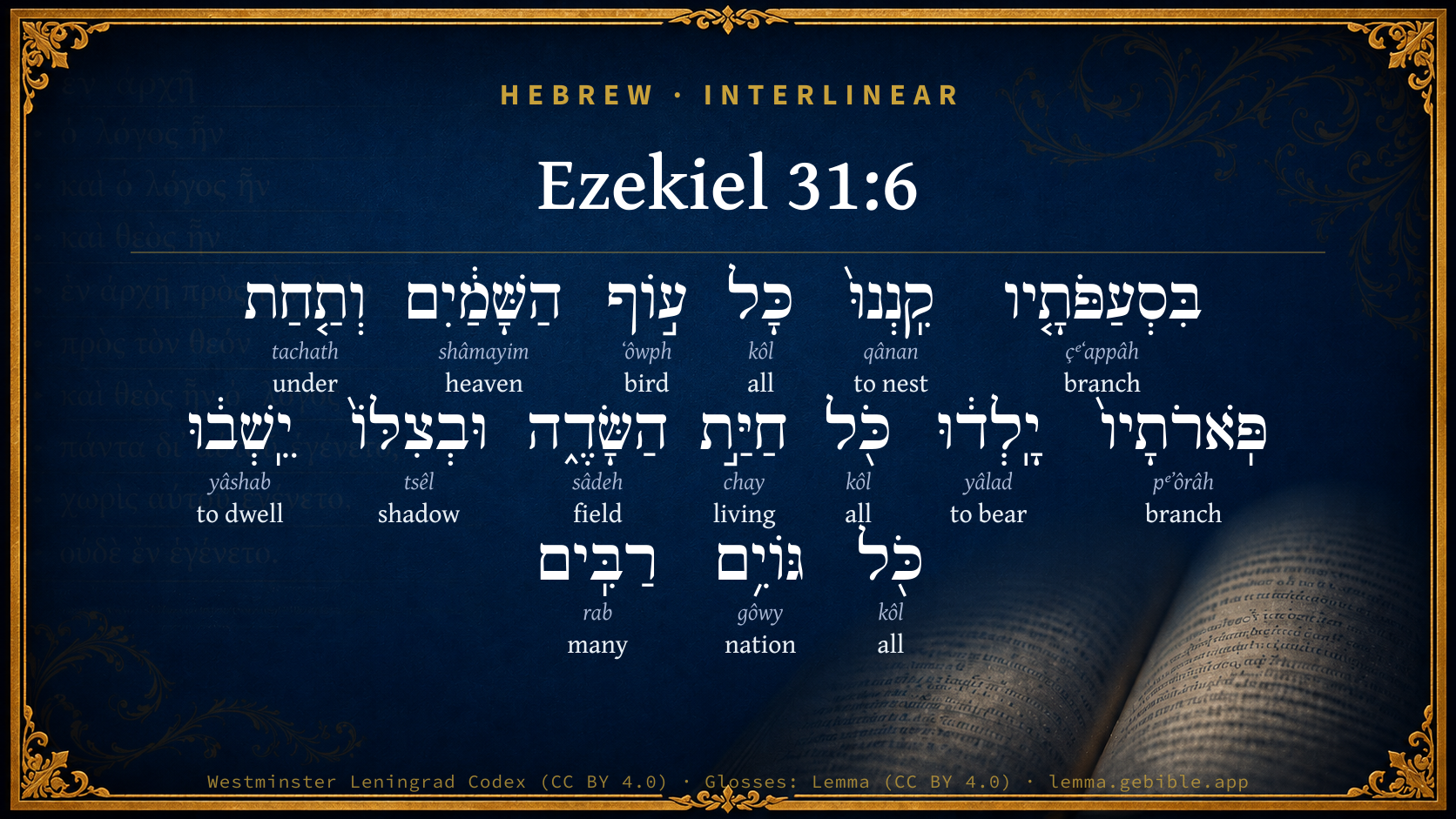
Ezekiel 31:6

Hebrew (Westminster Leningrad Codex) Ezekiel 31:6 appears in the Hebrew Old Testament. The text above is from the Westminster Leningrad Codex. Each word links to its Strong’s number, a concise gloss, and parsing drawn from the Open Scriptures Hebrew Bible morphology. Click any word for its full Brown-Driver-Briggs (BDB) entry.
Download image
Cite this verse

Ezekiel 31:6 (World English Bible). Public Domain. Lemma interlinear Bible study tool, https://lemma.gebible.app/v/ezekiel/31/6.

Show BibTeX & RIS
BibTeX
RIS
English Translation
All the birds of the sky made their nests in its boughs; and under its branches did all the animals of the field bring forth their young; and under its shadow lived all great nations.
World English Bible · Public Domain
Highlights
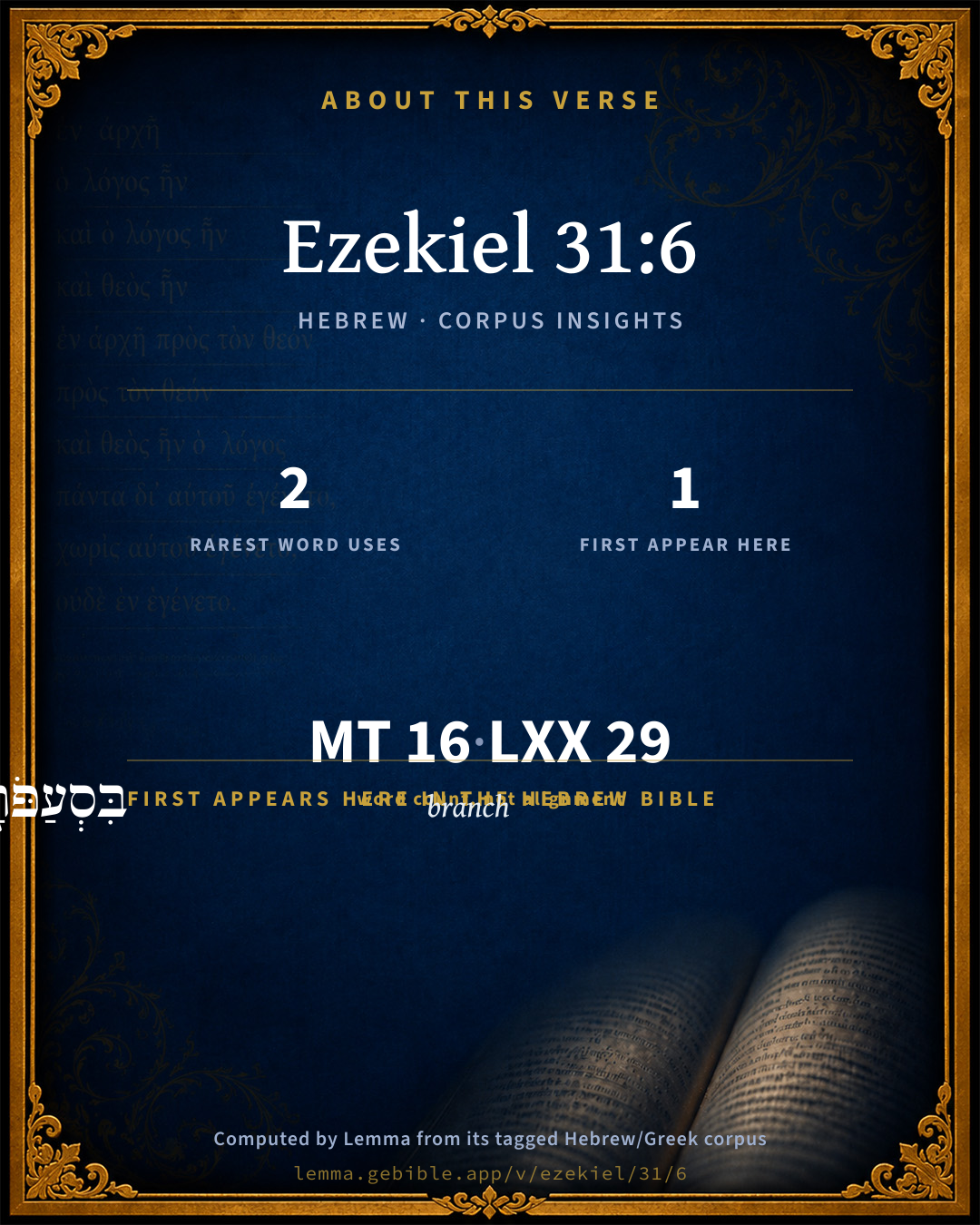
  • 1 first appearance in the Hebrew Bible
Full analysis ↓
Download a study sheet

One document with this verse’s original text, its word-by-word gloss line, the meaning frame, cross-references with their text, attributed commentary, and full source and license credits — printable, and it pastes into notes with its structure intact.

This verse Autodidact and up

Study sheet (.html) Plain text (.txt)

A passage Seminary Student

Up to 50 verses in one chapter. A passage sheet keeps up to 6 commentary sources and 12 cross-references per verse, in the order this page ranks them, and says so on the sheet whenever that leaves anything out. Ask for a single verse and you get the Autodidact verse sheet above.

Everything on this page stays free to read, with no account — the sheet is a download of what is already on screen, not access to it.

Want to remove ads? Support Godless Engineer
Compare translations 3

The same verse in 3 English versions, stacked beneath the original-language interlinear above. Click any original word for its lexicon entry.

Each is an independent rendering of the whole verse — the interlinear is not word-aligned to these translations.

Highlighted words mark where these versions differ — a whole-verse word diff, not a word-by-word alignment.

  • World English Bible Public Domain
    All the birds of the sky made their nests in its boughs; and under its branches did all the animals of the field bring forth their young; and under its shadow lived all great nations.
  • King James Version Public Domain
    All the fowls of heaven made their nests in his boughs, and under his branches did all the beasts of the field bring forth their young, and under his shadow dwelt all great nations.
  • unfoldingWord Literal Text CC BY-SA 4.0
    Every bird of the heavens nested in its branches, while every living thing of the field gave birth to its young under its foliage. All of the many nations lived under its shade.

unfoldingWord Literal Text — © unfoldingWord, licensed CC BY-SA 4.0. Word-aligned USFM3 via Door43 (git.door43.org/unfoldingWord/en_ult).

Versions to compare (up to 4)

3 of 4 selected

Show all 18 translations

Every available English version of this verse, each an independent rendering of the whole verse.

  • World English Bible Public Domain
    All the birds of the sky made their nests in its boughs; and under its branches did all the animals of the field bring forth their young; and under its shadow lived all great nations.
  • Berean Standard Bible Public Domain
    All the birds of the air nested in its branches, and all the beasts of the field gave birth beneath its boughs; all the great nations lived in its shade.
  • Majority Standard Bible Public Domain
    All the birds of the air nested in its branches, and all the beasts of the field gave birth beneath its boughs; all the great nations lived in its shade.
  • King James Version Public Domain
    All the fowls of heaven made their nests in his boughs, and under his branches did all the beasts of the field bring forth their young, and under his shadow dwelt all great nations.
  • American Standard Version (1901) Public Domain
    All the birds of the heavens made their nests in its boughs; and under its branches did all the beasts of the field bring forth their young; and under its shadow dwelt all great nations.
  • Revised Version (1885) Public Domain
    All the fowls of heaven made their nests in his boughs, and under his branches did all the beasts of the field bring forth their young, and under his shadow dwelt all great nations.
  • Geneva Bible (1599) Public Domain
    All the foules of the heauen made their nestes in his boughes, and vnder his branches did all the beastes of the fielde bring foorth their yong, and vnder his shadowe dwelt all mightie nations.
  • Douay-Rheims (1899) Public Domain
    And when he had spread forth his shadow, all the fowls of the air made their nests in his boughs, and all the beasts of the forest brought forth their young under his branches, and the assembly of many nations dwelt under his shadow.
  • Young's Literal Translation Public Domain
    In his boughs made a nest hath every fowl of the heavens, And under his branches brought forth hath every beast of the field, And in his shade dwell do all great nations.
  • Literal Standard Version CC BY-SA 4.0
    Every bird of the heavens has made a nest in his boughs, || And every beast of the field has brought forth under his branches, || And all great nations dwell in his shade.
  • Unlocked Literal Bible CC BY-SA 4.0
    Every bird of the heavens nested in its branches, while every living thing of the field gave birth to its young under its foliage. All of the many nations lived under its shade.
  • unfoldingWord Literal Text CC BY-SA 4.0
    Every bird of the heavens nested in its branches, while every living thing of the field gave birth to its young under its foliage. All of the many nations lived under its shade.
  • Darby Bible Public Domain
    All the fowl of the heavens made their nests in his boughs, and under his branches did all the beasts of the field bring forth their young, and under his shadow dwelt all the great nations.
  • World Messianic Bible Public Domain
    All the birds of the sky made their nests in its boughs. Under its branches, all the animals of the field gave birth to their young. All great nations lived under its shadow.
  • Webster's Bible Public Domain
    All the fowls of heaven made their nests in his boughs, and under his branches did all the beasts of the field bring forth their young, and under his shade dwelt all great nations.
  • Free Bible Version CC BY-SA 4.0
    All kinds of birds nested in its branches, while underneath it different wild animals had their young, and all the powerful nations lived in its shade.
  • Bible in Basic English Public Domain
    In its branches all the birds of heaven came to rest, and under its arms all the beasts of the field gave birth to their young, and great nations were living in its shade.
  • JPS Tanakh (1917) Public Domain
    All the fowls of heaven made their nests in its boughs, and all the beasts of the field did bring forth their young under its branches, and under its shadow dwelt all great nations.

Literal Standard Version (2020), Covenant Press — licensed CC BY-SA 4.0. Text via the HelloAO Bible API (eBible.org). Unlocked Literal Bible (unfoldingWord) — licensed CC BY-SA 4.0. Text via the HelloAO Bible API (eBible.org). unfoldingWord Literal Text — © unfoldingWord, licensed CC BY-SA 4.0. Word-aligned USFM3 via Door43 (git.door43.org/unfoldingWord/en_ult). Free Bible Version, Dr. Jonathan Gallagher — licensed CC BY-SA 4.0. Text via the HelloAO Bible API (eBible.org).

Word by word

More ways to search: Search by grammar → Find every occurrence → Compare this word →

Practice this passage: Drill this verse → Learn its vocabulary →

בִּסְעַפֹּתָ֤יו
çᵉʻappâh
H5589
“in/at · branches · his”
Preposition + Noun, Common, Feminine, Plural, Construct + Suffix, Personal, 3rd Person, Masculine, Singular
Part of Speech
Preposition + Noun
Type
Common
Gender
Feminine
Number
Plural
State
Construct
Full BDB Definition

Origin: from H5585

TWOT: 1527b

bough, branch
  1. קִֽנְנוּ֙ qânan H7077 “to nest” Verb, Piel, Perfect, 3rd Person, Common, Plural
  2. כָּל kôl H3605 “all of” Noun, Common, Masculine, Singular, Construct
  3. ע֣וֹף ʻôwph H5775 “bird of” Noun, Common, Masculine, Singular, Construct
  4. הַשָּׁמַ֔יִם shâmayim H8064 “the · heaven(s)” Particle, Definite Article + Noun, Common, Masculine, Plural, Absolute
  5. וְתַ֤חַת tachath H8478 “and · under” Conjunction + Preposition
  6. פֹּֽארֹתָיו֙ pᵉʼôrâh H6288 “branches · his” Noun, Common, Feminine, Plural, Construct + Suffix, Personal, 3rd Person, Masculine, Singular
  7. יָֽלְד֔וּ yâlad H3205 “to bear” Verb, Qal, Perfect, 3rd Person, Common, Plural
  8. כֹּ֖ל kôl H3605 “all of” Noun, Common, Masculine, Singular, Construct
  9. חַיַּ֣ת chay H2416 “living of” Noun, Common, Feminine, Singular, Construct
  10. הַשָּׂדֶ֑ה sâdeh H7704 “the · field” Particle, Definite Article + Noun, Common, Masculine, Singular, Absolute
  11. וּבְצִלּוֹ֙ tsêl H6738 “and · in/at · shadow · his” Conjunction + Preposition + Noun, Common, Masculine, Singular, Construct + Suffix, Personal, 3rd Person, Masculine, Singular
  12. יֵֽשְׁב֔וּ yâshab H3427 “to dwell” Verb, Qal, Imperfect, 3rd Person, Masculine, Plural
  13. כֹּ֖ל kôl H3605 “all of” Noun, Common, Masculine, Singular, Construct
  14. גּוֹיִ֥ם gôwy H1471 “nations” Noun, Common, Masculine, Plural, Absolute
  15. רַבִּֽים rab H7227 “many” Adjective, Adjective, Masculine, Plural, Absolute

About this verse

These counts appear in no published source. They are computed here, from the morphology-tagged text and Lemma’s own curated glosses. What Lemma adds →

16
words
14
distinct lemmas
Prophets
section

Notable vocabulary

The rarest word here is בִּסְעַפֹּתָ֤יו branch H5589 — appearing just 2 times in the whole Hebrew Bible.

First appearance in Scripture

This word makes its first canonical appearance in the Hebrew Bible here:

  • בִּסְעַפֹּתָ֤יו branch H5589

Shared distinctive vocabulary

בִּסְעַפֹּתָ֤יו branch H5589 occurs in 2 verses of the Hebrew Bible. Also found in:

Grammatical profile

  • 3 verbs
  • 11 nouns
  • 1 adjective
  • 1 preposition

Verb forms

  • קִֽנְנוּ֙ Piel · Perfect
  • יָֽלְד֔וּ Qal · Perfect
  • יֵֽשְׁב֔וּ Qal · Imperfect

Repetition

A word recurs within this verse — often emphatic in Hebrew:

Hebrew & Septuagint length

In English translation the verse runs 35 words from the Hebrew and 33 from the Septuagint (LXX English) — closely comparable.

A rough comparison of the two English renderings, which tokenize alike — not a word-level alignment.

Word counts can differ between the Hebrew and the Greek without any difference in meaning — e.g. the Hebrew direct-object marker אֵת has no separate Greek word, and Greek often adds the article ὁ.

In the original languages it is 16 Hebrew tokens and 29 Greek tokens — but the two are counted differently (Hebrew bundles its prefixes and suffixes into one token; the Greek is in lemma form), so that isn’t a like-for-like length.

Cross-references

4

Topical passages linked to Ezekiel 31:6 in the Treasury of Scripture Knowledge — connected by theme and wording, ordered by reader-vote popularity; previews shown in the World English Bible.

  • Ezekiel 17:23 in the mountain of the height of Israel will I plant it; and it shall bring forth boughs, and bear fruit, and be a goodly cedar: and under it shall dwell all birds of every wing; in the shade of the branches of it shall they dwell.
  • Matthew 13:32 which indeed is smaller than all seeds. But when it is grown, it is greater than the herbs, and becomes a tree, so that the birds of the air come and lodge in its branches."
  • Daniel 4:12 The leaves of it were beautiful, and the fruit of it much, and in it was food for all: the animals of the field had shadow under it, and the birds of the sky lived in the branches of it, and all flesh was fed from it.
  • Daniel 4:21 whose leaves were beautiful, and the fruit of it much, and in it was food for all; under which the animals of the field lived, and on whose branches the birds of the sky had their habitation:

Cross-references courtesy of OpenBible.info (CC BY 4.0).

Hebrew and Greek witnesses Masoretic Hebrew ↔ Greek Septuagint

The same verse in the two great witnesses to the Old Testament, shown verse-for-verse.

These are two independent witnesses, not word-aligned to each other, and the Septuagint is shown in lemma (dictionary) form.

Hebrew Ezekiel 31:6 Masoretic · Westminster Leningrad Codex

בִּסְעַפֹּתָ֤יו קִֽנְנוּ֙ כָּל ע֣וֹף הַשָּׁמַ֔יִם וְתַ֤חַת פֹּֽארֹתָיו֙ יָֽלְד֔וּ כֹּ֖ל חַיַּ֣ת הַשָּׂדֶ֑ה וּבְצִלּוֹ֙ יֵֽשְׁב֔וּ כֹּ֖ל גּוֹיִ֥ם רַבִּֽים

All the birds of the sky made their nests in its boughs; and under its branches did all the animals of the field bring forth their young; and under its shadow lived all great nations.

World English Bible · Public Domain

Greek LXX Ezekiel 31:6 Septuagint · lemma form

ἐν ὁ παραφυάς αὐτός νοσσεύω πᾶς ὁ πετεινόν ὁ οὐρανός καί ὑποκάτω ὁ κλάδος αὐτός γεννάω πᾶς ὁ θηρίον ὁ πεδίον ἐν ὁ σκιά αὐτός καταοἰκέω πᾶς πλῆθος ἔθνος

All the birds of the sky made their nests in his boughs, and under his branches all the wild beasts of the field bred; the whole multitude of nations lived under his shadow.

LXX2012 (modern English Septuagint) · Public Domain

Hebrew: Westminster Leningrad Codex (CC BY 4.0). Greek: Septuagint (public domain); English from LXX2012 (modern English Septuagint) (Public Domain). How the Septuagint differs from the Hebrew →

Targum (Aramaic paraphrase)

1

The Targum is the ancient Jewish Aramaic paraphrase of the Hebrew Scriptures — an interpretive translation, not the Hebrew text itself. Onkelos (literal) and Pseudo-Jonathan (expansive) render the Torah, and Jonathan the Prophets. Coverage is partial: where no permissively-licensed English translation exists for a verse, only the Aramaic is shown. This is verse-level text, not a word-by-word alignment to the Hebrew.

  1. Targum Jonathan Prophets (Joshua–Malachi)
    בְּמַשִׁרְיָתֵיהּ כְּבֵישׁ כָּל כְּרַכִּין תַּקִיפִין וּתְחוֹת שִׁלְטוֹנוֹהִי שַׁעְבֵּיד כָּל מְדִינַת אַרְעָא וּבִטְלַל מַלְכוּתֵיהּ יְתִיבוּ כָּל עַמְמִין סַגִיאִין:

    (no public-domain English translation for this verse)

    Targum Jonathan — Aramaic: “Mikraot Gedolot” (public domain). English: “Sefaria Community Translation” (CC0 1.0 (public-domain dedication)); “London "Chaldee Paraphrase," 1871” (public domain). Text via Sefaria.

Commentary

Notes on Ezekiel 31:6 from classic Christian and Jewish commentators (each source and its license shown beneath its notes). The classic Christian expositions comment on the surrounding passage and are grouped to its opening verse, so a note may address several verses; the Jewish commentaries on the Tanakh (Rashi and others) are per-verse, so they appear only where the commentator wrote on this verse.

Lemma curates 59 commentaries, every one of them public domain or Creative Commons licensed, each selected and text-cleaned for this edition rather than reprinted as found. About our sources →

Trapp's Complete Commentary

John Trapp

Eze 31:6 All the fowls of heaven made their nests in his boughs, and under his branches did all the beasts of the field bring forth their young, and under his shadow dwelt all great nations.

Ver. 6. All the fowls.] See Dan 4:12.

John Trapp, A Commentary or Exposition upon All the Books of the Old and New Testament (1647–1656) — public domain. Text from a community e-Sword module.

Tyndale Open Study Notes

Tyndale Open Resources

31:6 Like a great tree, Assyria provided shelter for all of the birds and wild animals of the earth. This tree was more splendid than all the trees in the garden of God (that is, the garden of Eden), with a God-given beauty and stature reminiscent of the prince of Tyre in ch 28. Assyria’s power was once so great that all the great nations of the world lived in its shadow.

Tyndale Open Study Notes — © Tyndale Open Resources, licensed CC BY-SA 4.0. Text via the HelloAO Bible API.

Jamieson, Fausset & Brown

Robert Jamieson, A. R. Fausset & David Brown

fowls . . . made . . . nests in . . . boughs--so Eze 17:23; Dan 4:12. The gospel kingdom shall gather all under its covert, for their good and for the glory of God, which the world kingdoms did for evil and for self-aggrandizement (Mat 13:32).

Jamieson, Fausset & Brown — Commentary Critical and Explanatory on the Whole Bible (1871) — public domain (CC PDM 1.0). Text via the HelloAO Bible API.

Ellicott's Commentary for English Readers

(6) All the fowls of heaven.—Comp. Eze_17:23; Dan_4:21.

A Bible Commentary for English Readers, edited by Charles John Ellicott (1878–1897) — public domain. Text from a community e-Sword module.

The Cambridge Bible for Schools and Colleges

gen. ed. J. J. S. Perowne

6. The “fowls” and “beasts” are as much figurative as the tree; they are probably interpreted by “nations” in the end of the verse; cf. Eze_17:23; Dan_4:12; Dan_4:14. But see Jer_27:6.

The Cambridge Bible for Schools and Colleges (gen. ed. J. J. S. Perowne; Cambridge University Press, 1878–1918) — public domain. Text from a community e-Sword module.

John Gill's Exposition

All the fowls of the heavens made their nests in his boughs,.... People from all parts of the world, under the whole heavens, flocked to his dominions, and settled themselves in one province or another; promising themselves protection, prosperity, and peace under his government:

and under his branches did all the beasts of the field bring forth their young; even people of a more savage disposition, being either conquered by him, and placed in his provinces; or coming thither of their own accord, took up their residence there, built houses, planted vineyards, married wives, begat children, and settled their families there:

and under his shadow dwelt all great nations; under his protection, care, and government, many large kingdoms and states were; yea, all were either subject to him, or sought to be his friends and allies: this explains the above figurative expressions. The Targum is,

"by his army he subdued all the strong towers; and under his governors he subjected all the provinces of the earth; and in the shadow of his kingdom dwelt all the numerous people.''

John Gill's Exposition of the Whole Bible (1746–1763) — public domain (CC PDM 1.0). Text via the HelloAO Bible API.

Matthew Poole's English Annotations

All the fowls; not every individual, but all sorts and kinds of men and people, nobles, merchants, husbandmen, likened to fowls.

Made their nests; did settle their habitations and families, expecting what they found, safety and rest, and hoping what did ensue, an increase of their children and posterity, as birds do in a quiet and safe nest.

In his boughs; in his kingdom, in the cities or towns of it.

Under his branches; the very same thing expressed by a new hieroglyphic. Beasts here are people, the field is the countries round about, their bringing forth their young includes their making their dens, that is, men’s building, begetting children, and breeding them under his branches, under his government and protection.

Under his shadow dwelt all great nations: this gives some light to the riddle. No nation, that was great at that time in the world, but either owned the dominion, or sought the alliance and friendship, of this king and kingdom.

Matthew Poole's English Annotations on the Holy Bible (1683–1685) — public domain. Text from a community e-Sword/MySword module.

Whedon's Commentary on the Bible

Daniel D. Whedon

6. Compare Dan_4:12. This was as true of Egypt as of Assyria. The beasts and fowls (all the people of the earth) looked to it for protection.

Daniel D. Whedon (gen. ed.), Commentary on the Old and New Testaments (1874–1909) — public domain. Text from a community e-Sword module.

The Pulpit Commentary

All the fowls of heaven as in Eze_17:23; Dan_4:9; Mat_13:32, was the natural symbol of the fact that all the neighboring nations owned the sovereignty of Assyria and were sheltered by her protection. In the great nation we have the parable passing into its interpretation.

The Pulpit Commentary (1880–1919), ed. H.D.M. Spence-Jones & Joseph S. Exell — public domain. Text from a community e-Sword module.

Rashi

Rabbi Shlomo Yitzchaki (Rashi)

In its boughs [Heb. בִּסְעַפֹתָיו.]

nested [Heb. קִנְנוּ,] from the word קֵּן, nest.

Rashi on the Tanakh — English translations: “The Judaica Press complete Tanach with Rashi, translated by A. J. Rosenberg” (CC BY 4.0); “Pentateuch with Rashi's commentary by M. Rosenbaum and A.M. Silbermann, 1929-1934” (public domain); “The Metsudah Tanach series, Lakewood, N.J” (CC BY 4.0); and “The Book of Joshua, Metsudah Publications, 1997” (CC BY 4.0). Text via Sefaria.

Lesson kit

Teaching starters — assembled from the data on this page, not authored interpretation. Every prompt links to the verse data it draws on. Edit before teaching.

Ezekiel, in the Prophets, opens this verse with 16 words (14 distinct Hebrew lemmas). Its most distinctive word is çᵉʻappâh (“branch”). A historical commentator’s framing appears above. Read the whole chapter for the surrounding context.

Discussion questions

  1. What does “branch” (çᵉʻappâh) contribute to the verse as a whole?
  2. This is the first place “branch” appears in Scripture (first appears here). What does its debut here establish?
  3. How does Ezekiel 31:8, which shares the word «branch», read alongside this verse?
  4. What does the repetition of “all” (3× in this one verse) do in this verse?
  5. These translations render this verse differently; the difference is in the English rendering, not the original. What questions does that raise?
  6. «קִֽנְנוּ֙» is a Piel Perfect verb. How does that grammatical form shape the action described?
  7. Compare how Trapp's Complete Commentary and Tyndale Open Study Notes read this verse. Where do they agree or differ?

Things to notice

Reading settings

Reading text

Shown beneath each verse's original-language words.

Old Testament
Old Testament edition

Read the OT as the Masoretic Hebrew (MT) or the Greek Septuagint (LXX).

English shown for the Greek Septuagint (in the Hebrew ↔ Greek comparison).

Comparing translations? Open the Compare panel on any verse page to stack up to four side by side.