
Isaiah 3:24

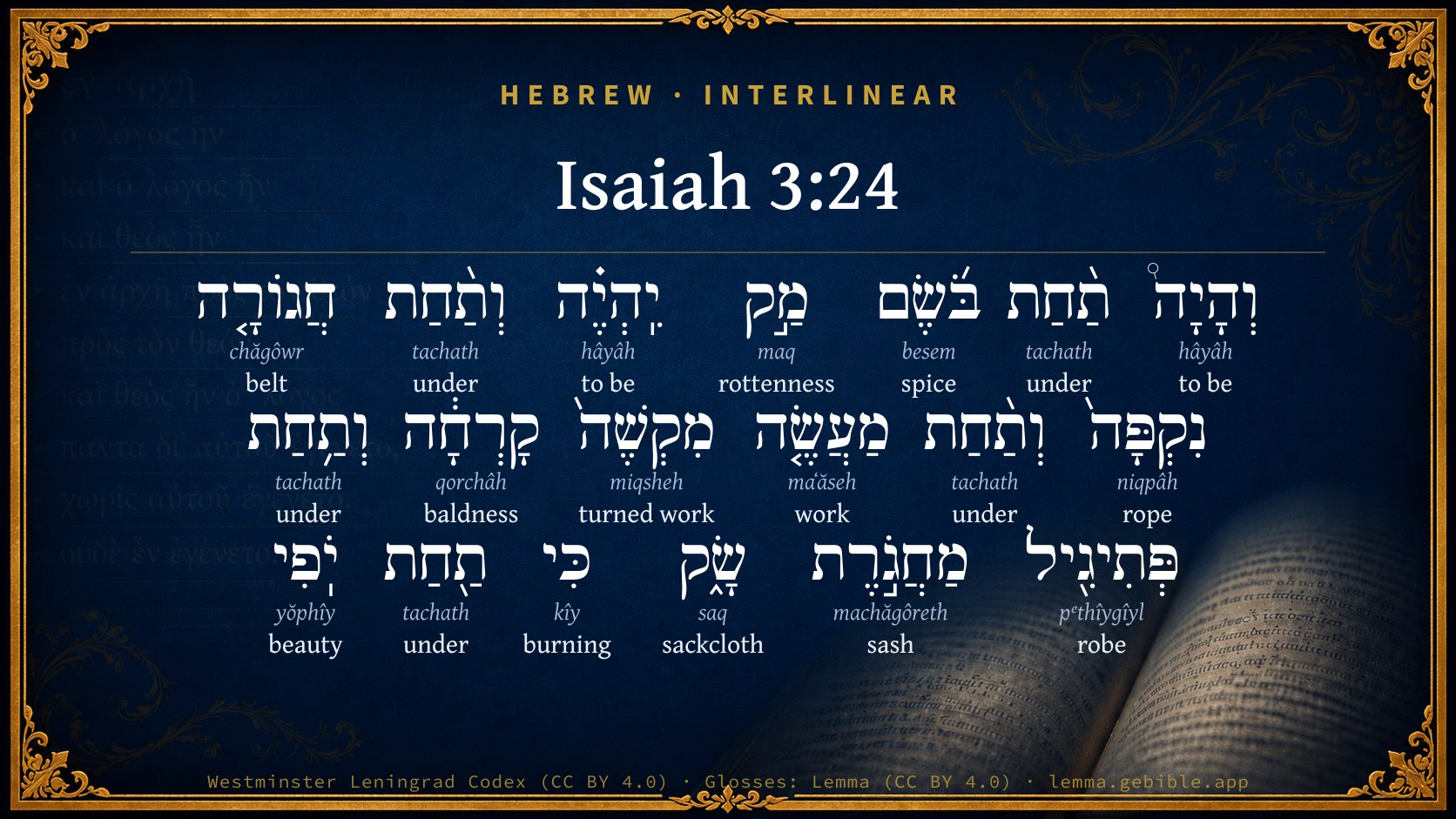
Hebrew (Westminster Leningrad Codex) Isaiah 3:24 appears in the Hebrew Old Testament. The text above is from the Westminster Leningrad Codex. Each word links to its Strong’s number, a concise gloss, and parsing drawn from the Open Scriptures Hebrew Bible morphology. Click any word for its full Brown-Driver-Briggs (BDB) entry.
Download image
Cite this verse

Isaiah 3:24 (World English Bible). Public Domain. Lemma interlinear Bible study tool, https://lemma.gebible.app/v/isaiah/3/24.

Show BibTeX & RIS
BibTeX
RIS
English Translation
It shall happen that instead of sweet spices, there shall be rottenness; Instead of a belt, a rope; Instead of well set hair, baldness; Instead of a robe, a girding of sackcloth; And branding instead of beauty.
World English Bible · Public Domain
Highlights Full analysis ↓
Download a study sheet

One document with this verse’s original text, its word-by-word gloss line, the meaning frame, cross-references with their text, attributed commentary, and full source and license credits — printable, and it pastes into notes with its structure intact.

This verse Autodidact and up

Study sheet (.html) Plain text (.txt)

A passage Seminary Student

Up to 50 verses in one chapter. A passage sheet keeps up to 6 commentary sources and 12 cross-references per verse, in the order this page ranks them, and says so on the sheet whenever that leaves anything out. Ask for a single verse and you get the Autodidact verse sheet above.

Everything on this page stays free to read, with no account — the sheet is a download of what is already on screen, not access to it.

Want to remove ads? Support Godless Engineer
Compare translations 3

The same verse in 3 English versions, stacked beneath the original-language interlinear above. Click any original word for its lexicon entry.

Each is an independent rendering of the whole verse — the interlinear is not word-aligned to these translations.

Highlighted words mark where these versions differ — a whole-verse word diff, not a word-by-word alignment.

  • World English Bible Public Domain
    It shall happen that instead of sweet spices, there shall be rottenness; Instead of a belt, a rope; Instead of well set hair, baldness; Instead of a robe, a girding of sackcloth; And branding instead of beauty.
  • King James Version Public Domain
    And it shall come to pass, that instead of sweet smell there shall be stink; and instead of a girdle a rent; and instead of well set hair baldness; and instead of a stomacher a girding of sackcloth; and burning instead of beauty.
  • unfoldingWord Literal Text CC BY-SA 4.0
    And it will be, instead of perfume, a stench will be, and instead of a belt, a rope, and instead of the craft [of] hairdo, baldness, and instead of a robe, girding of sackcloth, branding instead of beauty.

unfoldingWord Literal Text — © unfoldingWord, licensed CC BY-SA 4.0. Word-aligned USFM3 via Door43 (git.door43.org/unfoldingWord/en_ult).

Versions to compare (up to 4)

3 of 4 selected

Show all 18 translations

Every available English version of this verse, each an independent rendering of the whole verse.

  • World English Bible Public Domain
    It shall happen that instead of sweet spices, there shall be rottenness; Instead of a belt, a rope; Instead of well set hair, baldness; Instead of a robe, a girding of sackcloth; And branding instead of beauty.
  • Berean Standard Bible Public Domain
    Instead of fragrance there will be a stench; instead of a belt, a rope; instead of styled hair, baldness; instead of fine clothing, sackcloth; instead of beauty, shame.
  • Majority Standard Bible Public Domain
    Instead of fragrance there will be a stench; instead of a belt, a rope; instead of styled hair, baldness; instead of fine clothing, sackcloth; instead of beauty, shame.
  • King James Version Public Domain
    And it shall come to pass, that instead of sweet smell there shall be stink; and instead of a girdle a rent; and instead of well set hair baldness; and instead of a stomacher a girding of sackcloth; and burning instead of beauty.
  • American Standard Version (1901) Public Domain
    And it shall come to pass, that instead of sweet spices there shall be rottenness; and instead of a girdle, a rope; and instead of well set hair, baldness; and instead of a robe, a girding of sackcloth; branding instead of beauty.
  • Revised Version (1885) Public Domain
    And it shall come to pass, that instead of sweet spices there shall be rottenness; and instead of a girdle a rope; and instead of well set hair baldness; and instead of a stomacher a girding of sackcloth: branding instead of beauty.
  • Geneva Bible (1599) Public Domain
    And in steade of sweete sauour, there shall be stinke, and in steade of a girdle, a rent, and in steade of dressing of the heare, baldnesse, and in steade of a stomacher, a girding of sackecloth, and burning in steade of beautie.
  • Douay-Rheims (1899) Public Domain
    And instead of a sweet smell there shall be stench, and instead of a girdle, a cord, and instead of curled hair, baldness, and instead of a stomacher, haircloth.
  • Young's Literal Translation Public Domain
    And it hath been, instead of spice is muck, And instead of a girdle, a rope, And instead of curled work, baldness, And instead of a stomacher a girdle of sackcloth.
  • Literal Standard Version CC BY-SA 4.0
    And it has been, instead of spice is muck, || And instead of a girdle, a rope, || And instead of curled work, baldness, || And instead of a stomacher a girdle of sackcloth.
  • Unlocked Literal Bible CC BY-SA 4.0
    Instead of sweet perfume there will be stench; and instead of a sash, a rope; instead of well-arranged hair, baldness; and instead of a robe, a covering of sackcloth; and branding instead of beauty.
  • unfoldingWord Literal Text CC BY-SA 4.0
    And it will be, instead of perfume, a stench will be, and instead of a belt, a rope, and instead of the craft [of] hairdo, baldness, and instead of a robe, girding of sackcloth, branding instead of beauty.
  • Darby Bible Public Domain
    And it shall come to pass, instead of perfume there shall be rottenness; and instead of a girdle, a rope; and instead of well-set hair, baldness; and instead of a robe of display, a girding of sackcloth; brand instead of beauty.
  • World Messianic Bible Public Domain
    It shall happen that instead of sweet spices, there shall be rottenness; instead of a belt, a rope; instead of well set hair, baldness; instead of a robe, a wearing of sackcloth; and branding instead of beauty.
  • Webster's Bible Public Domain
    And it shall come to pass, that instead of sweet smell there shall be an offensive odor; and instead of a girdle a rent; and instead of well set hair baldness; and instead of a stomacher a girding of sackcloth; and burning instead of beauty.
  • Free Bible Version CC BY-SA 4.0
    What will happen is that instead of smelling of perfume, she will stink. Instead of a wearing a sash, she will be tied with a rope. Instead of styled hair, she will be bald. Instead of fine clothes, she will wear sackcloth. Instead of looking beautiful, she will be shamed.
  • Bible in Basic English Public Domain
    And in the place of sweet spices will be an evil smell, and for a fair band a thick cord; for a well-dressed head there will be the cutting-off of the hair, and for a beautiful robe there will be the clothing of sorrow; the mark of the prisoner in place of the ornaments of the free.
  • JPS Tanakh (1917) Public Domain
    And it shall come to pass, that instead of sweet spices there shall be rottenness; and instead of a girdle rags; and instead of curled hair baldness; and instead of a stomacher a girding of sackcloth; branding instead of beauty.

Literal Standard Version (2020), Covenant Press — licensed CC BY-SA 4.0. Text via the HelloAO Bible API (eBible.org). Unlocked Literal Bible (unfoldingWord) — licensed CC BY-SA 4.0. Text via the HelloAO Bible API (eBible.org). unfoldingWord Literal Text — © unfoldingWord, licensed CC BY-SA 4.0. Word-aligned USFM3 via Door43 (git.door43.org/unfoldingWord/en_ult). Free Bible Version, Dr. Jonathan Gallagher — licensed CC BY-SA 4.0. Text via the HelloAO Bible API (eBible.org).

Word by word

More ways to search: Search by grammar → Find every occurrence → Compare this word →

Practice this passage: Drill this verse → Learn its vocabulary →

נִקְפָּה֙
niqpâh
H5364
“rope”
Noun, Common, Feminine, Singular, Absolute
Part of Speech
Noun
Type
Common
Gender
Feminine
Number
Singular
State
Absolute
Full BDB Definition

Origin: from H5362

TWOT: 1416a

tether, rope, encircling rope
  1. וְהָיָה֩ hâyâh H1961 “and · to be” Conjunction + Verb, Qal, Sequential Perfect, 3rd Person, Masculine, Singular
  2. תַ֨חַת tachath H8478 “under” Preposition
  3. בֹּ֜שֶׂם besem H1314 “spice” Noun, Common, Masculine, Singular, Absolute
  4. מַ֣ק maq H4716 “rottenness” Noun, Common, Masculine, Singular, Absolute
  5. יִֽהְיֶ֗ה hâyâh H1961 “to be” Verb, Qal, Imperfect, 3rd Person, Masculine, Singular
  6. וְתַ֨חַת tachath H8478 “and · under” Conjunction + Preposition
  7. חֲגוֹרָ֤ה chăgôwr H2290 “belt” Noun, Common, Feminine, Singular, Absolute
  8. וְתַ֨חַת tachath H8478 “and · under” Conjunction + Preposition
  9. מַעֲשֶׂ֤ה maʻăseh H4639 “work” Noun, Common, Masculine, Singular, Absolute
  10. מִקְשֶׁה֙ miqsheh H4748 “turned work” Noun, Common, Masculine, Singular, Absolute
  11. קָרְחָ֔ה qorchâh H7144 “baldness” Noun, Common, Feminine, Singular, Absolute
  12. וְתַ֥חַת tachath H8478 “and · under” Conjunction + Preposition
  13. פְּתִיגִ֖יל pᵉthîygîyl H6614 “robe” Noun, Common, Masculine, Singular, Absolute
  14. מַחֲגֹ֣רֶת machăgôreth H4228 “sash of” Noun, Common, Feminine, Singular, Construct
  15. שָׂ֑ק saq H8242 “sackcloth” Noun, Common, Masculine, Singular, Absolute
  16. כִּי kîy H3587 “burning” Conjunction
  17. תַ֖חַת tachath H8478 “under” Preposition
  18. יֹֽפִי yŏphîy H3308 “beauty” Noun, Common, Masculine, Singular, Absolute

About this verse

These counts appear in no published source. They are computed here, from the morphology-tagged text and Lemma’s own curated glosses. What Lemma adds →

19
words
14
distinct lemmas
Prophets
section

Notable vocabulary

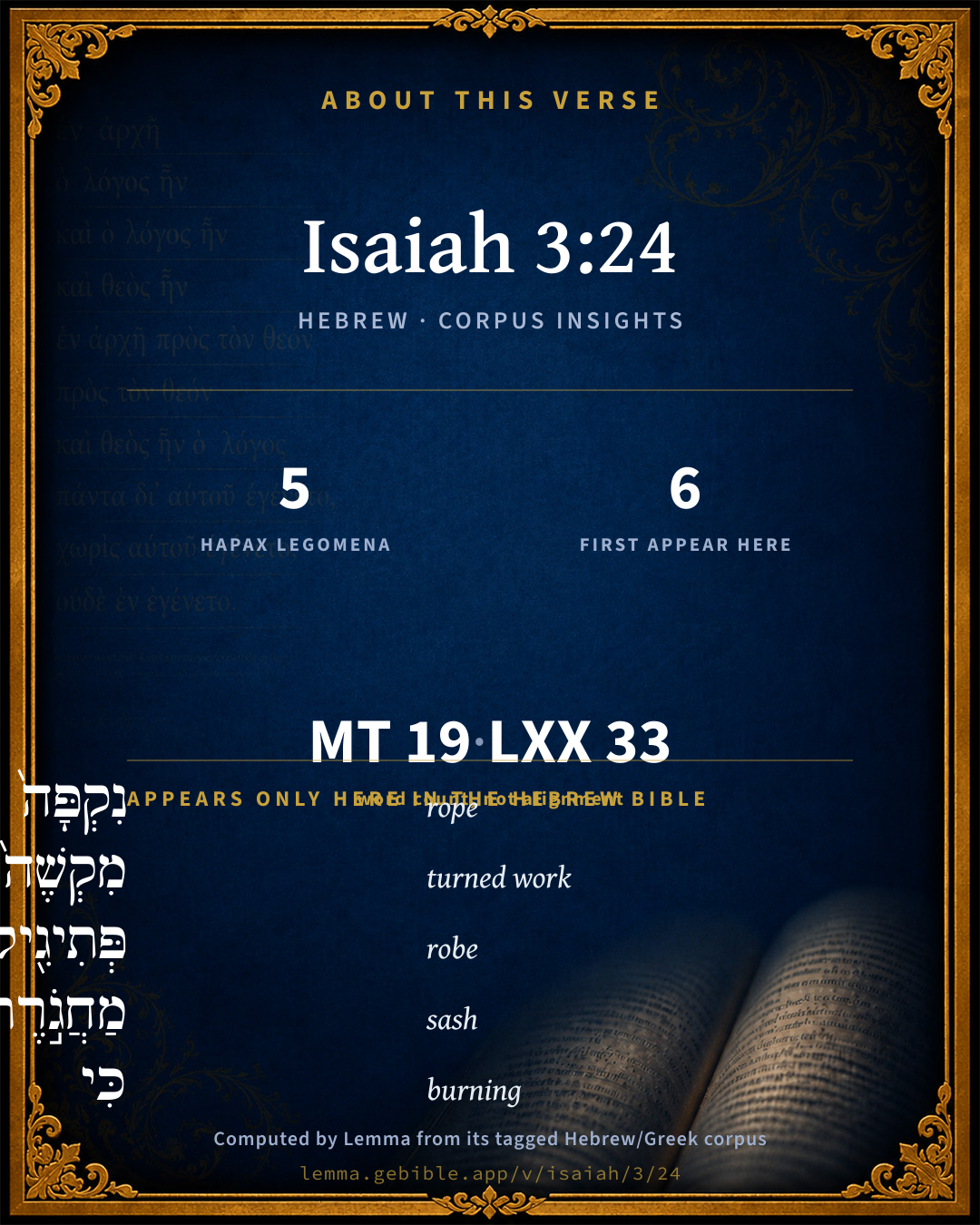
5 hapax legomena — words that appear only here in the entire Hebrew Bible:

  • נִקְפָּה֙ rope H5364
  • מִקְשֶׁה֙ turned work H4748
  • פְּתִיגִ֖יל robe H6614
  • מַחֲגֹ֣רֶת sash H4228
  • כִּי burning H3587

First appearance in Scripture

These words make their first canonical appearance in the Hebrew Bible here:

  • מַ֣ק rottenness H4716
  • נִקְפָּה֙ rope H5364
  • מִקְשֶׁה֙ turned work H4748
  • פְּתִיגִ֖יל robe H6614
  • מַחֲגֹ֣רֶת sash H4228
  • כִּי burning H3587

Shared distinctive vocabulary

מַ֣ק rottenness H4716 occurs in 2 verses of the Hebrew Bible. Also found in:

Grammatical profile

  • 2 verbs
  • 11 nouns
  • 5 prepositions
  • 1 conjunction

Verb forms

  • וְהָיָה֩ Qal · Sequential Perfect
  • יִֽהְיֶ֗ה Qal · Imperfect

Repetition

Words recur within this verse — often emphatic in Hebrew:

  • תַ֨חַת under H8478 ×5
  • וְהָיָה֩ to be H1961 ×2

Hebrew & Septuagint length

In English translation the verse runs 37 words from the Hebrew and 21 from the Septuagint (LXX English) — the Septuagint runs noticeably shorter here. See the side-by-side →

A rough comparison of the two English renderings, which tokenize alike — not a word-level alignment.

Word counts can differ between the Hebrew and the Greek without any difference in meaning — e.g. the Hebrew direct-object marker אֵת has no separate Greek word, and Greek often adds the article ὁ.

In the original languages it is 19 Hebrew tokens and 33 Greek tokens — but the two are counted differently (Hebrew bundles its prefixes and suffixes into one token; the Greek is in lemma form), so that isn’t a like-for-like length.

Cross-references

26

Topical passages linked to Isaiah 3:24 in the Treasury of Scripture Knowledge — connected by theme and wording, ordered by reader-vote popularity; previews shown in the World English Bible.

  • Lamentations 2:10 The elders of the daughter of Zion sit on the ground, they keep silence; They have cast up dust on their heads; they have girded themselves with sackcloth: The virgins of Jerusalem hang down their heads to the ground.
  • Ezekiel 27:31 and they shall make themselves bald for you, and gird them with sackcloth, and they shall weep for you in bitterness of soul with bitter mourning.
  • Isaiah 15:3 In their streets they gird themselves with sackcloth; on their housetops, and in their broad places, everyone wails, weeping abundantly.
  • Isaiah 22:12 In that day did the Lord, Yahweh of Hosts, call to weeping, and to mourning, and to baldness, and to girding with sackcloth:
  • Micah 1:16 Shave your heads, And cut off your hair for the children of your delight. Enlarge your baldness like the vulture; For they have gone into captivity from you!
  • 1 Peter 3:3 Let your beauty be not just the outward adorning of braiding the hair, and of wearing jewels of gold, or of putting on fine clothing;
  • Leviticus 26:16 I also will do this to you: I will appoint terror over you, even consumption and fever, that shall consume the eyes, and make the soul to pine away; and you will sow your seed in vain, for your enemies will eat it.
  • Esther 2:12 Now when the turn of every maiden was come to go in to king Ahasuerus, after it had been done to her as prescribed for the women twelve months (for so were the days of their purification accomplished, [to wit], six months with oil of myrrh, and six months with sweet odors and with the things for the purifying of the women),
  • Isaiah 32:9–11 Rise up, you women who are at ease, [and] hear my voice; you careless daughters, give ear to my speech.
  • Amos 8:10 I will turn your feasts into mourning, And all your songs into lamentation; And I will make you wear sackcloth on all your bodies, And baldness on every head. I will make it like the mourning for an only son, And the end of it like a bitter day.
  • Revelation 18:9 The kings of the earth, who committed sexual immorality and lived wantonly with her, will weep and wail over her, when they look at the smoke of her burning,
  • Deuteronomy 28:22 Yahweh will strike you with consumption, and with fever, and with inflammation, and with fiery heat, and with the sword, and with blasting, and with mildew; and they shall pursue you until you perish.
  • Deuteronomy 32:24 [They shall be] wasted with hunger, and devoured with burning heat Bitter destruction; The teeth of animals will I send on them, With the poison of crawling things of the dust.
  • Job 16:15 I have sewed sackcloth on my skin, And have thrust my horn in the dust.
  • Proverbs 7:17 I have perfumed my bed with myrrh, aloes, and cinnamon.
  • Proverbs 31:24 She makes linen garments and sells them, And delivers sashes to the merchant.
  • Isaiah 57:9 You went to the king with oil, and did increase your perfumes, and did send your ambassadors far off, and did debase yourself even to Sheol.
  • Jeremiah 4:8 For this gird you with sackcloth, lament and wail; for the fierce anger of Yahweh hasn't turned back from us.
  • Jeremiah 6:26 Daughter of my people, gird you with sackcloth, and wallow yourself in ashes: make you mourning, as for an only son, most bitter lamentation; for the destroyer shall suddenly come on us.
  • Jeremiah 48:37 For every head is bald, and every beard clipped: on all the hands are cuttings, and on the loins sackcloth.
  • Ezekiel 7:18 They shall also gird themselves with sackcloth, and horror shall cover them; and shame shall be on all faces, and baldness on all their heads.
  • Joel 1:8 Mourn like a virgin dressed in sackcloth for the husband of her youth!
  • Revelation 11:3 I will give power to my two witnesses, and they will prophesy one thousand two hundred sixty days, clothed in sackcloth."
  • Revelation 16:9 People were scorched with great heat, and people blasphemed the name of God who has the power over these plagues. They didn't repent and give him glory.
  • Isaiah 4:4 when the Lord shall have washed away the filth of the daughters of Zion, and shall have purged the blood of Jerusalem from its midst, by the spirit of justice, and by the spirit of burning.
  • Jeremiah 49:3 Wail, Heshbon, for Ai is laid waste; cry, you daughters of Rabbah, gird you with sackcloth: lament, and run back and forth among the fences; for Malcam shall go into captivity, his priests and his princes together.

Cross-references courtesy of OpenBible.info (CC BY 4.0).

Hebrew and Greek witnesses Masoretic Hebrew ↔ Greek Septuagint

The same verse in the two great witnesses to the Old Testament, shown verse-for-verse.

Here the Septuagint runs noticeably shorter than the Hebrew — LXX2012 (modern English Septuagint) 21 words vs World English Bible 37. A rough length comparison of the two English translations, not a word-level alignment — read both below.

These are two independent witnesses, not word-aligned to each other, and the Septuagint is shown in lemma (dictionary) form.

Hebrew Isaiah 3:24 Masoretic · Westminster Leningrad Codex

וְהָיָה֩ תַ֨חַת בֹּ֜שֶׂם מַ֣ק יִֽהְיֶ֗ה וְתַ֨חַת חֲגוֹרָ֤ה נִקְפָּה֙ וְתַ֨חַת מַעֲשֶׂ֤ה מִקְשֶׁה֙ קָרְחָ֔ה וְתַ֥חַת פְּתִיגִ֖יל מַחֲגֹ֣רֶת שָׂ֑ק כִּי תַ֖חַת יֹֽפִי

It shall happen that instead of sweet spices, there shall be rottenness; Instead of a belt, a rope; Instead of well set hair, baldness; Instead of a robe, a girding of sackcloth; And branding instead of beauty.

World English Bible · Public Domain

Greek LXX Isaiah 3:24 Septuagint · lemma form

καί εἰμί ἀντί ὀσμή ἡδύς κονιορτός καί ἀντί ζωνή σχοινίον ζώνυμμι καί ἀντί ὁ κόσμος ὁ κεφαλή ὁ χρυσίον φαλάκρωμα ἔχω διά ὁ ἔργον σύ καί ἀντί ὁ χιτών ὁ μεσοπόρφυρος περιζώνυμμι σάκκος

And the stores of your ornaments shall mourn, and you shall be left alone, and shall be levelled with the ground.

LXX2012 (modern English Septuagint) · Public Domain

On this verse, Jamieson, Fausset & Brown discusses the Septuagint’s reading. Read the note in Commentary ↓

Hebrew: Westminster Leningrad Codex (CC BY 4.0). Greek: Septuagint (public domain); English from LXX2012 (modern English Septuagint) (Public Domain). How the Septuagint differs from the Hebrew →

Targum (Aramaic paraphrase)

1

The Targum is the ancient Jewish Aramaic paraphrase of the Hebrew Scriptures — an interpretive translation, not the Hebrew text itself. Onkelos (literal) and Pseudo-Jonathan (expansive) render the Torah, and Jonathan the Prophets. Coverage is partial: where no permissively-licensed English translation exists for a verse, only the Aramaic is shown. This is verse-level text, not a word-by-word alignment to the Hebrew.

  1. Targum Jonathan Prophets (Joshua–Malachi)
    וִיהֵי אֲתַר דַהֲוָאָה יָהֲבַן בּוּסְמִין יִתְמְסֵי אֲתַר דַהֲוָאָה אָסְרָן פְּסִיקַיָא יְהֵי רוּשְׁמִין דִמְחָא וַחֲלַף אַקָפּוּת פָּתָא גִזוּז רֵישׁ וַחֲלַף דַהֲוָאָה מְהַלְכִין בְּגֵיוָה יַסְרָן סַקִין דָא פּוּרְעֲנוּתָא תִּתְעֲבֵיד מִנְהוֹן אֲרֵי טְעָאָה בְשׁוּפְרְהוֹן:

    It shall come to pass, that in the place where they were giving forth sweet smells, there shall be putrefaction; and in the place where they were binding the girdles, shall be marks of smiting; and instead of plaited locks, baldness; and instead of their walking in pride, they shall bind on sackcloth; this vengeance shall be taken on them because they have committed fornication in their beauty.

    Targum Jonathan — Aramaic: “Mikraot Gedolot” (public domain). English: “Sefaria Community Translation” (CC0 1.0 (public-domain dedication)); “London "Chaldee Paraphrase," 1871” (public domain). Text via Sefaria.

Commentary

Notes on Isaiah 3:24 from classic Christian and Jewish commentators (each source and its license shown beneath its notes). The classic Christian expositions comment on the surrounding passage and are grouped to its opening verse, so a note may address several verses; the Jewish commentaries on the Tanakh (Rashi and others) are per-verse, so they appear only where the commentator wrote on this verse.

Lemma curates 59 commentaries, every one of them public domain or Creative Commons licensed, each selected and text-cleaned for this edition rather than reprinted as found. About our sources →

Trapp's Complete Commentary

John Trapp

Isa 3:24 And it shall come to pass, [that] instead of sweet smell there shall be stink; and instead of a girdle a rent; and instead of well set hair baldness; and instead of a stomacher a girding of sackcloth; [and] burning instead of beauty.

Ver. 24. And there shall be instead of sweet smell, stink.] Ex illuvie et sordibus captivitatis et carceris. Martial and Marcellinus tell us of a natural stench the Jews have, such as made the Emperor Aurelius, coming among some of them, and annoyed with their ill savour, to cry out, O Marcomanni, O Quadi, O Sarmatae, &c., O Marcomans, Quades, and Sarmatians, at length I have met with those that are more nasty and loathsome than you are. {a} These dainty dames are threatened with dirty doings in captivity and prison, such as should render them odious.

And instead of a girdle, a rent.] Or, Rags; or, a beating. The Vulgate rendereth it a cord.

And instead of well set hair.] Heb., Work of even or smooth setting, or trimming, Tριχολασται, or hair trimmers, were anciently noted for effeminate. Pompey is taxed in history for that he did unico digitulo caput scalpere, scratch his well set hair with his little finger only.

Baldness.] Pro crispanti crine calvitium, et pro fascia pectorali cilicium. Pride is so hateful to God that such as are guilty of it seldom escape his visible vengeance.

And burning instead of beauty.] Burning; that is, sun burning.

{a} Ammian. lib. ii.

John Trapp, A Commentary or Exposition upon All the Books of the Old and New Testament (1647–1656) — public domain. Text from a community e-Sword module.

Jamieson, Fausset & Brown

Robert Jamieson, A. R. Fausset & David Brown

stink--arising from ulcers (Zac 14:12).

girdle--to gird up the loose Eastern garments, when the person walked.

rent--the Septuagint, better, a "rope," an emblem of poverty; the poor have nothing else to gird up their clothes with.

well-set hair-- (Pe1 3:3-4).

baldness-- (Isa 3:17).

stomacher--a broad plaited girdle.

sackcloth-- (Sa2 3:31).

burning--a sunburnt countenance, owing to their hoods and veils being stripped off, while they had to work as captives under a scorching sun (Sol 1:6).

Jamieson, Fausset & Brown — Commentary Critical and Explanatory on the Whole Bible (1871) — public domain (CC PDM 1.0). Text via the HelloAO Bible API.

Adam Clarke's Commentary

Verse 24. Instead of sweet smell - "perfume."] A principal part of the delicacy of the Asiatic ladies consists in the use of baths, and of the richest oils and perfumes; an attention to which is in some degree necessary in those hot countries. Frequent mention is made of the rich ointments of the spouse in the Song of Solomon, Son 4:10-11: -

"How beautiful are thy breasts, my sister, my spouse!

How much more excellent than wine;

And the odour of thine ointments than all perfumes!

Thy lips drop as the honey-comb, my spouse!

Honey and milk are under thy tongue:

And the odour of thy garments is as the odour of Lebanon."

The preparation for Esther's being introduced to King Ahasuerus was a course of bathing and perfuming for a whole year; "six months with oil of myrrh, and six months with sweet odours;" Es 2:12. See the notes on this place. See Clarke on Es 2:12. A diseased and loathsome habit of body, instead of a beautiful skin, softened and made agreeable with all that art could devise, and all that nature, so prodigal in those countries of the richest perfumes, could supply, must have been a punishment the most severe and the most mortifying to the delicacy of these haughty daughters of Sion.

Burning instead of beauty - "A sunburnt skin."] Gaspar Sanctius thinks the words כי תחת ki thachath an interpolation, because the Vulgate has omitted them. The clause כי תחת יפי ki thachath yophi seems to me rather to be imperfect at the end. Not to mention that כי ki, taken as a noun for adustio, burning, is without example, and very improbable. The passage ends abruptly, and seems to want a fuller conclusion.

In agreement with which opinion, of the defect of the Hebrew text in this place, the Septuagint, according to MSS. Pachom. and 1 D. ii., and Marchal., which are of the best authority, express it with the same evident marks of imperfection at the end of the sentence; thus: ταυτα σοι αντι καλλωπισμου - The two latter add δου. This chasm in the text, from the loss probably of three or four words, seems therefore to be of long standing.

Taking כי ki in its usual sense, as a particle, and supplying לך lech from the σοι of the Septuagint, it might possibly have been originally somewhat in this form: -

מראה רעת לך תהיה יפי תחת כי marah raath lech thihyeh yophi thachath ki "Yea, instead of beauty thou shalt have an ill-favoured countenance."

כי תחת יפי ki thachath yophi (q. יחת yachath,) "for beauty shall be destroyed." Syr. חתת chathath or נחת nachath. - Dr. DURELL.

"May it not be כהי cohey, 'wrinkles instead of beauty?' as from יפה yaphah is formed יפי yephi, yophi; from מרה marah, מרי meri, c. so from כהה cahah, to be wrinkled, כהי cohey." - Dr. JUBB. The כי ki is wanting in one MS., and has been omitted by several of the ancients.

Adam Clarke's Commentary on the Bible (1810–1826) — public domain. Text from a community e-Sword/MySword module.

Ellicott's Commentary for English Readers

(24) And it shall come to pass.—Now comes the terrible contrast of the day of destruction that is coming on all this refined luxury. Instead of the balmy perfume of the scent-bottles, there shall be the stench of squalor and pestilence; instead of the embroidered girdle (Isa_11:5), not a “rent,” but the rope by which they would be dragged in the march of their conquerors; instead of the plaited hair (1Pe_3:3; 1Ti_2:9), natural or artificial, the baldness of those who were cropped as slaves were cropped (comp. 1Co_11:5-6); instead of the “stomacher” (better, cloak, or mantle), the scanty tunic of the coarsest sackcloth; instead of the elaborate beauty in which they had exulted, the burning, or brand, stamped on their flesh, often in the barbarism of the East on the forehead, to mark them as the slaves of their captors.

A Bible Commentary for English Readers, edited by Charles John Ellicott (1878–1897) — public domain. Text from a community e-Sword module.

The Cambridge Bible for Schools and Colleges

gen. ed. J. J. S. Perowne

24. A description of the degradation of the high-born women of Jerusalem, reduced to beggary and slavery. The verse would appear to connect better with Isa_3:17 than with 18–23.

instead of … stink] R.V. instead of sweet spices (lit. “balsam”) there shall be rottenness. a rent] Render with R.V. a rope.

well set hair] artificial curls (Cheyne), lit. “turner’s work.”

baldness] the result of disease, Isa_3:17, or, possibly, a sign of mourning.

a stomacher] an obscure word; perhaps mantle.

branding instead of beauty; branding the symbol of slavery.

The Cambridge Bible for Schools and Colleges (gen. ed. J. J. S. Perowne; Cambridge University Press, 1878–1918) — public domain. Text from a community e-Sword module.

John Gill's Exposition

And it shall come to pass, that instead of sweet smell there shall be a stink,.... Instead of "spice", or in the place where they put spices, carried musk, or had their smelling bottles, of precious and aromatic ointment, balsam, and myrrh, and such like things (g), namely, in their bosoms, there should be a "stink" or putrefaction, arising from ulcers and diseases of the body, Zac 14:12 the Septuagint, Syriac, and Arabic versions, render it "dust"; or this may refer to the anointing of their hair with ointment of myrrh and other things, which gave an agreeable scent; but instead of this there would be a scab, giving an ill scent, Isa 3:17.

and instead of a girdle a rent; such as is made in times of mourning and distress, or by the enemy. The Septuagint and Arabic versions render it, a "rope"; instead of fine curious girdles, wrought with gold and silver, they should have nothing but a rope about their loins. The Targum is,

"in the place where they bind the girdles, shall be marks of smiting;''

stripes, cuts, see Isa 10:34 as either by blows from the enemy, by whom they should be taken, or by the hand of God, being smitten with sores and ulcers, so that they should not be able to bear girdles upon them; or "holes", in their clothes or skin:

and instead of well set hair baldness; instead of plaited hair, and curled locks, kept in order, there would be scabs, ulcers, leprosy, or such diseases as would cause the hair to fall off, and leave a baldness. The Septuagint and Arabic versions render it, "instead of the golden ornament of the head, thou shall have baldness for thy works"; and the Syriac version, "instead of gems, incisions":

and instead of a stomacher a girding of sackcloth; the word for a "stomacher" is only used in this place; according to Kimchi, it signifies a very broad girdle; but Aben Ezra says it was a thin garment embroidered, which was put over all the rest of the clothes; perhaps something like a "mantelet". The Septuagint version renders it, "instead of the garment worked with purple"; and so the Syriac version, "instead of their hyacinths, or purples"; and the Arabic version, "instead of thy silken garment thou shall be girt with sackcloth"; which was usually done in times of distress and mourning:

and burning instead of beauty; either through the scorching beams of the sun, being stripped of their hoods and veils; or rather this is to be understood of carbuncles, and such like hot burning ulcers in their faces, which once were beautiful, and they prided themselves in; though the Hebrew word seems rather to be a preposition than a noun; so Jarchi, whose note is,

"for this is fit to be unto them instead of beauty, with which they have prided themselves,''

or have lifted up themselves; and so in his gloss upon the Talmud (h), where this clause, with the context, is cited and paraphrased,

"for all these things shall come unto thee instead of thy beauty;''

and this clause may be read in connection with the following, "because of beauty", or "instead of beauty, thy men shall fall", &c. and so the Targum,

"this vengeance shall be taken on them, because they have committed fornication in their beauty; thy beautiful men shall be killed by the sword.''

The Syriac version is, "because their beauty shall be corrupted", and those versions which seem to have left out this clause, yet retain something of it in the beginning of the next verse Isa 3:25. The Vulgate Latin version is, "thy most beautiful men also shall fall by the sword". The Septuagint and Arabic versions begin it thus, "and thy beautiful son, whom thou lovest, shall fall by the sword".

(g) Misn. Sabbat, c. 6. sect. 3. (h) T. Bab. Sabbat, fol. 62. 2.

John Gill's Exposition of the Whole Bible (1746–1763) — public domain (CC PDM 1.0). Text via the HelloAO Bible API.

Albert Barnes' Notes on the Bible

And it shall come to pass - The prophet proceeds to denounce the “judgment” or “punishment” that would come upon them for their pride and vanity. In the calamities that would befall the nation, all their ornaments of pride and vainglory would be stripped off; and instead of them, they would exhibit the marks, and wear the badges of calamity and grief.

Instead of sweet smell - Hebrew בשׂם bôs'em, aromatics, perfumes, spicy fragrance; such as they used on their garments and persons. ‘No one ever enters a company without being well perfumed; and in addition to various scents and oils, they are adorned with numerous garlands, made of the most odoriferous flowers.’ - “Roberts.” ‘The persons of the Assyrian ladies are elegantly clothed and scented with the richest oils and perfumes. When a queen was to be chosen to the king of Persia, instead of Vashti, the virgins collected at Susana, the capital, underwent a purification of twelve months’ duration, to wit: “six months with oil of myrrh, and six months with sweet odors.” The general use of such precious oil and fragrant perfumes among the ancient Roamns, particularly among the ladies of rank and fashion, may be inferred from these words of Virgil:

Arabrosiaeque comae divinum vertice odorem Spiravere:

AEn. i. 403.

“From her head the ambrosial locks breathed divine fragrance.”

Paxton.

A stink - This word properly means the fetor or offensive smell which attends the decomposition of a deceased body. It means that the bodies which they so carefully adorned, and which they so assiduously endeavored to preserve in beauty by unguents and perfumes, would die and turn to corruption.

And instead of a girdle - Girdles were an indispensable part of an Oriental dress. Their garments were loose and flowing, and it became necessary to gird them up when they ran, or danced, or labored.

A rent - There has been a great variety of opinion about the meaning of this word. The most probable signification is that which is derived from a verb meaning “to go around, encompass;” and hence, that it denotes “a cord.” Instead of the beautiful girdle with which they girded themselves, there shall be “a cord” - an emblem of poverty, as the poor had nothing else with which to gird up their clothes; a humiliating description of the calamities which were to come upon proud and vain females of the court.

And instead of well-set hair - Hair that was curiously braided and adorned. ‘No ladies pay more attention to the dressing of the hair than these (the dancing girls of India), for as they never wear caps, they take great delight in this their natural ornament.’ - “Roberts.” Miss Pardoe, in ‘The City of the Sultan,’ says, that after taking a bath, the slaves who attended her spent an hour and a half in dressing and adorning her hair; compare 1Pe 3:3.

Instead of a stomacher - It is not certainly known what is meant by this, but it probably means some sort of “girdle,” or a platted or stiffened ornament worn on the breast. ‘I once saw a dress beautifully plaited and stiffened for the front, but I do not think it common.’ - “Roberts.”

A girding of sackcloth - This is a coarse cloth that was commonly worn in times of affliction, as emblematic of grief; 2Sa 3:31; 1Ki 20:31; 1Ki 21:27; Job 16:15; Isa 32:11.

And burning - The word used here does not occur elsewhere. It seems to denote “a brand, a mark burnt in, a stigma;” perhaps a sun-burned countenance, indicating exposure in the long and wearisome journey of a captivity over burning sands and beneath a scorching sun.

Instead of beauty - Instead of a fair and delicate complexion, cherished and nourished with care. Some of the articles of dress shown in the book exhibit several varieties of the costume of an Oriental female. To what “particular” time the prophet refers in this chapter is not known, perhaps, however, to the captivity at Babylon. To whatever he refers, it is one of the most striking reproofs of vanity and pride, especially the pride of female ornament, any where to be found. And although he had “particular” reference to the Jewish females, yet there is no impropriety in regarding it as applicable to all such ornaments wherever they may be found. They indicate the same state of the heart, and they must meet substantially the same rebuke from God. The body, however delicately pampered and adorned, must become the prey of corruption. ‘The worm shall feed sweetly on it, and the earth-worm shall be its covering;’ compare Isa 14:2; Job 24:20. The single thought that the body must die - that it must lie and moulder in the grave - should check the love of frivolous adorning, and turn the mind to a far more important matter - the salvation of the soul, which cannot die; to ‘the ornament of a weak and quiet spirit, which is in the sight of God of great price;’ 1Pe 3:4.

Albert Barnes' Notes on the Bible (1834–1885) — public domain. Text from a community e-Sword/MySword module.

Haydock's Catholic Bible Commentary

Stench. The Jews are noted on this account, as if in consequence of this curse, or of their being confined to prisons, &c. Fœtentium Judæorum et tumultuantium sæpe tædio percitus. --- M. Aurelius "was often weary of the stinking and seditious Jews." (Marcellin ii.)

George Leo Haydock (1774–1849), Haydock's Catholic Family Bible and Commentary, 1859 edition — public domain. Excludes Psalms (Douay-Rheims chapter numbering differs from Protestant) and Deuterocanonical books (Catholic canon only).

Matthew Poole's English Annotations

Instead of sweet smell, those perfumes mentioned Isa 3:20,

there shall be stink, from their scabs, mentioned Isa 3:17, or from other ill usages of their enemies.

Instead of a girdle, which were fine and costly, and useful to gird their garments about them,

a rent; either the rending of their garments for grief; or torn and tattered garments, not sufficient to cover their bodies.

Burning, by the heat of the sun, to which they are now commonly exposed, from which they used formerly to guard themselves with great care.

Matthew Poole's English Annotations on the Holy Bible (1683–1685) — public domain. Text from a community e-Sword/MySword module.

Whedon's Commentary on the Bible

Daniel D. Whedon

24. It shall come to pass — The divine judgment against this luxurious finery is, that in place of sweet smell — aromatics, spicy fragrance, and the like, upon the garments of the person, (Roberts says, “No one ever enters a company without being perfumed,”) there shall be stink — a stench from dead bodies.

Instead of a girdle — An ornament for the waist; used, also, to hold up the gathers of the long outer robe when engaged in active employment.

A rent — Better, a rope; either an emblem of poverty or of captivity: in the latter case the proud females being thereby hauled along in the train of conquerors.

Well set hair — Hair curiously braided and adorned.

Baldness — In this connexion made so by the razor, the hair being shaved off; as conquerors of old time resorted to the last degree of humiliations upon their captives.

Stomacher — It is matter of uncertainty what is meant by this. Most concur in its being a plaited or stiffened ornament worn on the breast, or a broad plaited girdle for the breast.

A girding of sackcloth — The material only changed. “Sackcloth” was of the coarsest material, and worn only in affliction.

Burning — A sunburnt face, from the exposures of captivity and slavery. This, instead of the fair complexion and the well adorned person in a highly civilized and luxurious life.

Daniel D. Whedon (gen. ed.), Commentary on the Old and New Testaments (1874–1909) — public domain. Text from a community e-Sword module.

The Pulpit Commentary

Instead of sweet smell; literally, spice. (comp. 1Ki_10:10, etc.) Stink; rather, rottenness, as translated in Isa_5:24. (compare the cognate verb in Lev_26:39) Instead of a girdle a rent. So Lowth and Kay; but most moderns prefer the meaning given by the Septuagint and Vulgate, "instead of a girdle, a rope." The word used occurs only in this place. Instead of well-set hair baldness (compare above, ver. 17). By "well-set hair" seems to be meant "hair arranged with such exactness and order as to look like a work of art." The exact arrangement of the hair is very remarkable, both in the Egyptian and the Assyrian sculptures. Instead of such elaborate attempts to improve their looks, the daughters of Jerusalem would soon pluck their hair out by the roots, or shave it off, in mourning. A girding of sackcloth. (comp. Gen_37:34 2Sa_3:31, etc.; and for the adoption of the custom by women, see 2Sa_21:10 Joe_1:8) Burning instead of beauty. This meaning is now generally acknowledged, the sense of "burning" being borne out by the cognate verb used in Pro_6:28 Isa_43:2, and the cognate noun used in Exo_21:25. The" burning" intended is probably branding by a barbarous enemy (see Herod., 7:233; "Hist. Tamerlau.," p. 320).

The Pulpit Commentary (1880–1919), ed. H.D.M. Spence-Jones & Joseph S. Exell — public domain. Text from a community e-Sword module.

John Wesley's Explanatory Notes

Girdle - Which were fine and costly, and useful to gird their garments about them. A rent - Torn and tattered garments. Burning - By the heat of the sun, to which they are now commonly exposed, from which they used formerly to guard themselves with the utmost care.

John Wesley, Explanatory Notes Upon the Whole Bible (1754–1765) — public domain. Text via the GEBible commentary corpus.

Keil & Delitzsch

C. F. Keil & F. Delitzsch

When Jehovah took away all this glory, with which the women of Jerusalem were adorned, they would be turned into wretched-looking prisoners, disfigured by ill-treatment and dirt. - "And instead of balmy scent there will be mouldiness, and instead of the sash a rope, and instead of artistic ringlets a baldness, and instead of the dress-cloak a frock of sackcloth, branding instead of beauty." Mouldiness, or mother (mak, as in Isa 5:24, the dust of things that have moulded away), with which they would be covered, and which they would be obliged to breathe, would take the place of the bosem, i.e., the scent of the balsam shrub (bâsâm), and of sweet-scented pomade in general; and nipâh that of the beautifully embroidered girdle (Pro 31:24). The meaning of this word is neither "a wound," as the Targums and Talmud render it, nor "rags," as given by Knobel, ed. 1 (from nâkaph, percutere, perforare), but the rope thrown over them as prisoners (from kâphâh = kâvâh, Contorquere: lxx, Vulg., Syr.).

(Note: Credner (Joel, p. 147) renders the word "tatters," from nâkaph, to rub in pieces; but the word has no such meaning, whereas the meaning vulnus, lit., percussio, is admissible (see at Job 19:26), but does not suit the antithesis. Luzzatto connects it with n'kaph, to bind (from which the makkeph derives its name), and understands it as referring to the dressing applied to wounds, to lint into which the girdle was torn. The most plausible derivation is from kâphâh, which is really employed in post-biblical usage to signify not only to congeal and wrinkle, but also to thicken (Sabbath 21a, l'hakpoth: "Make the wick thicker, that it may burn the brighter"). It is probably radically akin to the Arabic nukbe (explained in Lamachzari as equivalent to the Persian mijân-bend, a girdle), which is apparently used to denote the coarse girdle worn by peasants or by Arab women of the wandering tribes, resembling a rope of goat's hair, as distinguished from the artistic and costly girdle worn by women of the upper classes in the towns.)

Baldness takes the place of artistic ringlets (מקשׁה מעשׂה, not מעשׂה, so that it is in apposition: cf., Isa 30:20; Ges. 113; Ewald, 287, b). The reference is not to golden ornaments for the head, as the Sept. rendering gives it, although miksheh is used elsewhere to signify embossed or carved work in metal or wood; but here we are evidently to understand by the "artificial twists" either curls made with the curling-tongs, or the hair plaited and twisted up in knots, which they would be obliged to cut off in accordance with the mourning customs (Isa 15:2; Isa 22:12), or which would fall off in consequence of grief. A frock of sackcloth (machagoreth sak), i.e., a smock of coarse haircloth worn next to the skin, such as Layard found depicted upon a bas-relief at Kouyunjik, would take the place of the pethigil, i.e., the dress-cloak (either from pâthag, to be wide or full, with the substantive termination ı̄l, or else composed of pethi, breadth, and gil, festive rejoicing); and branding the place of beauty. Branding (Ci = Cevi, from Câvâh, καἰειν), the mark burnt upon the forehead by their conquerors: Ci is a substantive,

(Note: It is so understood in b. Sabbath 62b, with an allusion to the proverb, "The end of beauty is burning" (viz., inflammation). In Arabia, the application of the Cey with a red-hot iron (mikwâh) plays a very important part in the medical treatment of both man and beast. You meet with many men who have been burned not only on their legs and arms, but in their faces as well, and, as a rule, the finest horses are disfigured by the Cey. - Wetzstein.)

not a particle, as the Targum and others render it, and as the makkeph might make it appear. There is something very effective in the inverted order of the words in the last clause of the five. In this five-fold reverse would shame and mourning take the place of proud, voluptuous rejoicing.

Keil & Delitzsch — Biblical Commentary on the Old Testament (1861–1891) — public domain (CC PDM 1.0). Text via the HelloAO Bible API. (Old Testament only.)

J. A. Alexander on Isaiah

Joseph Addison Alexander

The threatening is still continued, but with a change of form, the things to be taken away being now contrasted with those which should succeed them. “And it shall be or happen that instead of perfume (aromatic odor, or the spices which afford it) there shall be stench, and instead of a girdle a rope, and instead of braided work baldness (or loss of hair by disease or shaving, as a sign of captivity or mourning), and instead of a full robe a girdling of sackcloth, burning instead of beauty.” The inversion of the terms in this last clause, and its brevity, add greatly to the strength of the expression. The burning mentioned is supposed by some to be that of the skin from long exposure; most interpreters understand by it a brand, here mentioned either as a stigma of captivity, or as a self-inflicted sign of mourning. Sackcloth is mentioned as the coarsest kind of cloth, and also as that usually worn by mourners.

Joseph Addison Alexander, The Prophecies of Isaiah (1846–1847; New York: Scribner, 1870–1878) — public domain. Text from a community e-Sword module.

unfoldingWord translationNotes

Door43 World Missions Community

sash

a piece of cloth that people wear around the waist or across the chest. See how you translated this in Isaiah 3:20.

a rope

This may refer to a rope that enemies would tie on the people of Judah when they captured them. Or it might mean that Jerusalem's women would have nothing to wear but rough clothing secured with ropes.

well-arranged hair, baldness

"pretty hair, their heads will be bald"

Your men will fall by the sword, and your strong men will fall in war

Falling represents being killed, and the sword represents battle. AT: "Your men will be killed in battle, and your strong men will be killed in war" or "Enemies will kill your soldiers in battle" (See: Metonymy)

Jerusalem's gates will lament and mourn

Here the city gates represent the people who sit at the public places near the city gates. AT: "The people of Jerusalem will sit at the city gates and cry and mourn" (See:- Metonymy)

she will be alone and sit upon the ground

Isaiah speaks of the people of Jerusalem, whom no one will save from their enemies, as if they were the city itself and as if they were a woman who sits on the ground because all her friends have deserted her. (See: Personification and Metonymy)

translationWords

robe

sackcloth

sword

lament

unfoldingWord translationNotes — © Distant Shores Media and the Door43 World Missions Community, licensed CC BY-SA 4.0. Source: git.door43.org/Door43/en_tn.

Rashi

Rabbi Shlomo Yitzchaki (Rashi)

And it shall come to pass, that, instead of perfume, there will be decay The place where they would perfume themselves will be decayed.

and in the place of a girdle, laceration Heb. נקפה. The place where she girded herself, there will be lacerated, cut with wounds and signs of blows, as (Job: 19:26): “And after my skin is cut to pieces (נִקְּפוּ)”; (infra 10:34) “and the thickets of forest shall be cut down (וְנִקַּף).”

and in the place of the deed, a wound Heb. (מַעֲשֶׂה מִקְשֶׁה). [The place where they would do the deed mentioned above: “walking and raising themselves they walk,” and that is at the height of the head, there will be] מִקְשֶׁה קָרְחָה, a wound that makes the head bald. מִקְשֶׁה is an expression similar to (Daniel 5:6): “knocked one against the other (נַקְשָׁן).” I would explain it as follows: The place where they would put the plates of gold made by hammering batdec in O.F.but it is vowelized in the Masorah among the ten words vowelized with a ‘pattach’ [i.e., a ‘segol,’ and none of them is connected to the following word, and every [instance of the word] that is in the construct state is vowelized with a ‘kamatz’ [i.e., a ‘tzeireh’].

and in the place of the organ of levity Heb. וְתַחַתפְּתִיגִיל. This is like two words: פְּתִי גִיל, a vessel [or organ] that brings levity; the secret parts about which is mentioned above: shall pour out their ‘vessels.’ Instead of that levity, a girdle of sackcloth will be on all loins.

for this is instead of beauty For this is fitting for them to have instead of the beauty with which they acted haughtily.

Rashi on the Tanakh — English translations: “The Judaica Press complete Tanach with Rashi, translated by A. J. Rosenberg” (CC BY 4.0); “Pentateuch with Rashi's commentary by M. Rosenbaum and A.M. Silbermann, 1929-1934” (public domain); “The Metsudah Tanach series, Lakewood, N.J” (CC BY 4.0); and “The Book of Joshua, Metsudah Publications, 1997” (CC BY 4.0). Text via Sefaria.

Ibn Ezra

Rabbi Abraham ibn Ezra

בושם Sweet smell. It keeps the body fresh and healthy.

מק Rottenness is nearly the opposite of the preceding. Root מקק, to rot; verb, ע״ע; comp. תמקנה They shall consume away (Zac. 14:2).

נקפה A noun; נ is radical; we may fairly compare with it ונקף And he shall cut down (10:34); its mean-is a kind of cutting.

מעשה מקשה Well set hair; comp. עשה שפמו ולא Nor trimmed his beard (1 Sam. 19:25).

פתיגיל A fine embroidered garment, which is worn over all the dresses.

כי תחת יופי According to Saadiah: for the contrary (תחת) is more fit for them; others take כויה ═ כי burning (Exod. 21:24); comp. ברויה ═ ברי (root רוה) with plenty (Job. 37:11); but this is contrary to the rules of the grammar, since ו in כויה is radical. I think the passage must be taken in this sense: For instead of beauty, the above-mentioned consumption, destruction and baldness shall come.

Ibn Ezra on the Tanakh — English translations: “Sefaria Community Translation” (CC0 1.0 (public-domain dedication)); “Yalkut, Sifsei Chachomim Chumash, Metsudah Publications, 2009” (CC BY 4.0); and “Commentary of Ibn Ezra on Isaiah - trans. by M. Friedlander, 1873” (public domain). Text via Sefaria.

Lesson kit

Teaching starters — assembled from the data on this page, not authored interpretation. Every prompt links to the verse data it draws on. Edit before teaching.

Isaiah, in the Prophets, opens this verse with 19 words (14 distinct Hebrew lemmas). Its most distinctive word is niqpâh (“rope”). The Greek Septuagint runs shorter here. A historical commentator’s framing appears above. Read the whole chapter for the surrounding context.

Discussion questions

  1. What does “rope” (niqpâh) contribute to the verse as a whole?
  2. This verse holds 5 words here found nowhere else in the Hebrew Bible. What might the rare words draw attention to?
  3. 6 words here appear for the first time in Scripture. What is being introduced at this debut?
  4. Isaiah 5:24 shares the word «rottenness» with this verse. How do the two illuminate each other?
  5. “under” occurs 5× in this one verse. What is the effect of the repetition?
  6. Compared with the Hebrew, the Septuagint runs shorter here. What questions does that raise?
  7. The translations on this page render this verse differently — a whole-verse word diff, not a word-by-word alignment. What might account for the different wordings?
  8. The verb «וְהָיָה֩» is Qal Sequential Perfect. How does its form color the action?

Things to notice

  • 5 words in this verse appear nowhere else in the Hebrew Bible.
  • 6 words make their first canonical appearance in Scripture here.
  • This verse counts 19 Hebrew ↔ 33 Greek words.
  • These translations choose different wording for 26 words in this verse.
  • “under” occurs 5× in this single verse.

Reading settings

Reading text

Shown beneath each verse's original-language words.

Old Testament
Old Testament edition

Read the OT as the Masoretic Hebrew (MT) or the Greek Septuagint (LXX).

English shown for the Greek Septuagint (in the Hebrew ↔ Greek comparison).

Comparing translations? Open the Compare panel on any verse page to stack up to four side by side.