
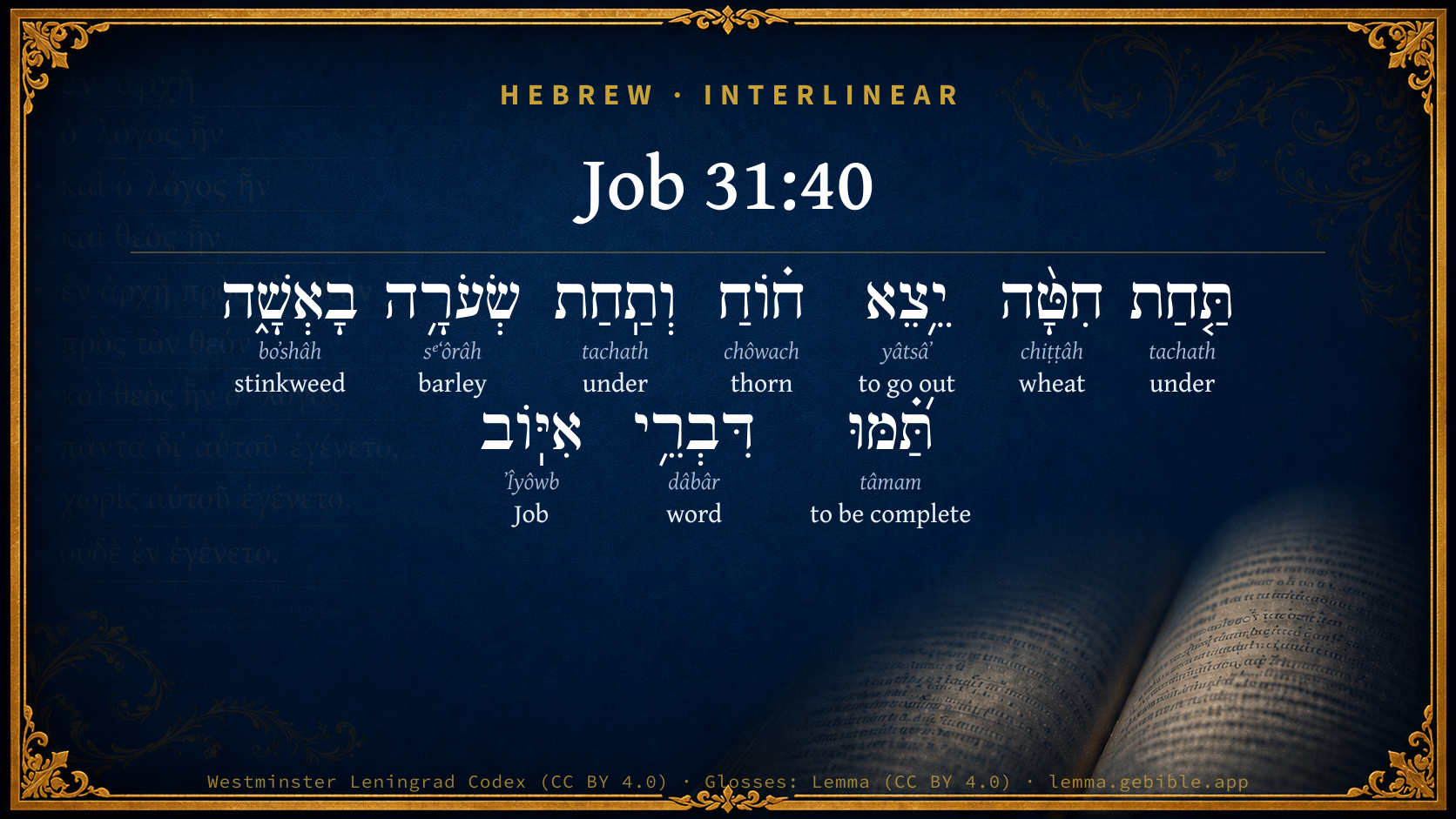
Job 31:40

Hebrew (Westminster Leningrad Codex) Job 31:40 appears in the Hebrew Old Testament. The text above is from the Westminster Leningrad Codex. Each word links to its Strong’s number, a concise gloss, and parsing drawn from the Open Scriptures Hebrew Bible morphology. Click any word for its full Brown-Driver-Briggs (BDB) entry.
Download image
Cite this verse

Job 31:40 (World English Bible). Public Domain. Lemma interlinear Bible study tool, https://lemma.gebible.app/v/job/31/40.

Show BibTeX & RIS
BibTeX
RIS
English Translation
Let briars grow instead of wheat, And stinkweed instead of barley." The words of Job are ended.
World English Bible · Public Domain
Highlights
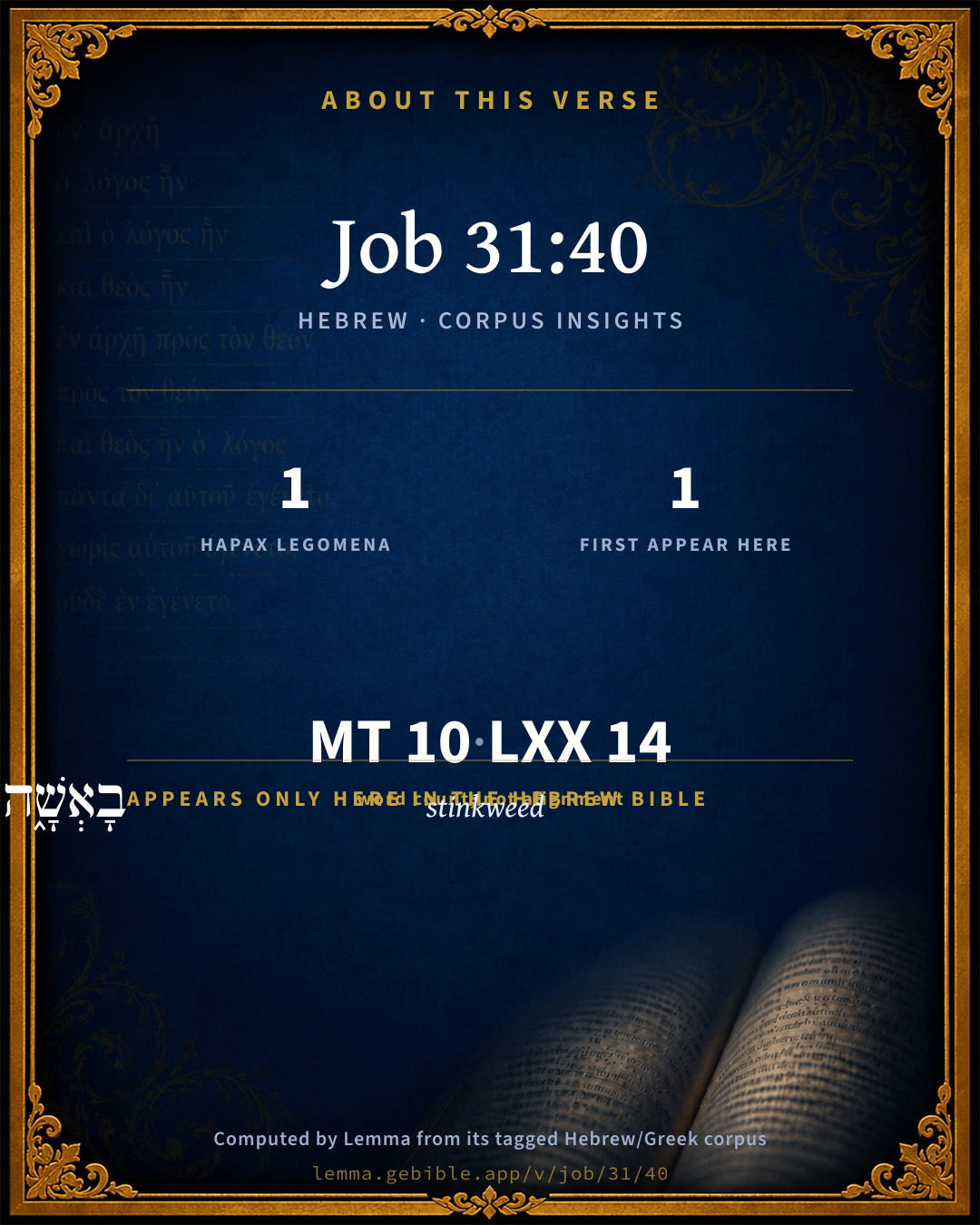
  • 1 hapax legomenon — only here in the Hebrew Bible
  • 1 first appearance in the Hebrew Bible
Full analysis ↓
Download a study sheet

One document with this verse’s original text, its word-by-word gloss line, the meaning frame, cross-references with their text, attributed commentary, and full source and license credits — printable, and it pastes into notes with its structure intact.

This verse Autodidact and up

Study sheet (.html) Plain text (.txt)

A passage Seminary Student

Up to 50 verses in one chapter. A passage sheet keeps up to 6 commentary sources and 12 cross-references per verse, in the order this page ranks them, and says so on the sheet whenever that leaves anything out. Ask for a single verse and you get the Autodidact verse sheet above.

Everything on this page stays free to read, with no account — the sheet is a download of what is already on screen, not access to it.

Want to remove ads? Support Godless Engineer
Compare translations 3

The same verse in 3 English versions, stacked beneath the original-language interlinear above. Click any original word for its lexicon entry.

Each is an independent rendering of the whole verse — the interlinear is not word-aligned to these translations.

Highlighted words mark where these versions differ — a whole-verse word diff, not a word-by-word alignment.

  • World English Bible Public Domain
    Let briars grow instead of wheat, And stinkweed instead of barley." The words of Job are ended.
  • King James Version Public Domain
    Let thistles grow instead of wheat, and cockle instead of barley. The words of Job are ended.
  • unfoldingWord Literal Text CC BY-SA 4.0
    may a thorn grow instead of wheat and a weed instead of barley!” The words of Job have ended.

unfoldingWord Literal Text — © unfoldingWord, licensed CC BY-SA 4.0. Word-aligned USFM3 via Door43 (git.door43.org/unfoldingWord/en_ult).

Versions to compare (up to 4)

3 of 4 selected

Show all 18 translations

Every available English version of this verse, each an independent rendering of the whole verse.

  • World English Bible Public Domain
    Let briars grow instead of wheat, And stinkweed instead of barley." The words of Job are ended.
  • Berean Standard Bible Public Domain
    then let briers grow instead of wheat and stinkweed instead of barley.” Thus conclude the words of Job.
  • Majority Standard Bible Public Domain
    then let briers grow instead of wheat and stinkweed instead of barley.” Thus conclude the words of Job.
  • King James Version Public Domain
    Let thistles grow instead of wheat, and cockle instead of barley. The words of Job are ended.
  • American Standard Version (1901) Public Domain
    Let thistles grow instead of wheat, And cockle instead of barley. The words of Job are ended.
  • Revised Version (1885) Public Domain
    Let thistles grow instead of wheat, and cockle instead of barley. The words of Job are ended.
  • Geneva Bible (1599) Public Domain
    Let thistles growe in steade of wheate, and cockle in the stead of Barley. The wordes of Iob are ended.
  • Douay-Rheims (1899) Public Domain
    Let thistles grow up to me instead of wheat, and thorns instead of barley.
  • Young's Literal Translation Public Domain
    Instead of wheat let a thorn go forth, And instead of barley a useless weed! The words of Job are finished.
  • Literal Standard Version CC BY-SA 4.0
    Instead of wheat let a thorn go forth, || And instead of barley a useless weed!” The words of Job are finished.
  • Unlocked Literal Bible CC BY-SA 4.0
    then let thorns grow instead of wheat and weeds instead of barley.” The words of Job are finished.
  • unfoldingWord Literal Text CC BY-SA 4.0
    may a thorn grow instead of wheat and a weed instead of barley!” The words of Job have ended.
  • Darby Bible Public Domain
    Let thistles grow instead of wheat, and tares instead of barley. The words of Job are ended.
  • World Messianic Bible Public Domain
    let briers grow instead of wheat, and stinkweed instead of barley.” The words of Job are ended.
  • Webster's Bible Public Domain
    Let thistles grow instead of wheat, and cockle instead of barley. The words of Job are ended.
  • Free Bible Version CC BY-SA 4.0
    then let thorns grow instead of wheat, and weeds instead of barley.” The words of Job are ended.
  • Bible in Basic English Public Domain
    Then in place of grain let thorns come up, and in place of barley evil-smelling plants.
  • JPS Tanakh (1917) Public Domain
    Let thistles grow instead of wheat, and noisome weeds instead of barley. The words of Job are ended.

Literal Standard Version (2020), Covenant Press — licensed CC BY-SA 4.0. Text via the HelloAO Bible API (eBible.org). Unlocked Literal Bible (unfoldingWord) — licensed CC BY-SA 4.0. Text via the HelloAO Bible API (eBible.org). unfoldingWord Literal Text — © unfoldingWord, licensed CC BY-SA 4.0. Word-aligned USFM3 via Door43 (git.door43.org/unfoldingWord/en_ult). Free Bible Version, Dr. Jonathan Gallagher — licensed CC BY-SA 4.0. Text via the HelloAO Bible API (eBible.org).

Word by word

More ways to search: Search by grammar → Find every occurrence → Compare this word →

Practice this passage: Drill this verse → Learn its vocabulary →

About this verse

These counts appear in no published source. They are computed here, from the morphology-tagged text and Lemma’s own curated glosses. What Lemma adds →

10
words
9
distinct lemmas
Wisdom
section

Notable vocabulary

1 hapax legomenon — a word that appears only here in the entire Hebrew Bible:

  • בָאְשָׁ֑ה stinkweed H890

First appearance in Scripture

This word makes its first canonical appearance in the Hebrew Bible here:

  • בָאְשָׁ֑ה stinkweed H890

Shared distinctive vocabulary

ח֗וֹחַ thorn H2336 occurs in 9 verses of the Hebrew Bible. Also found in:

Grammatical profile

  • 2 verbs
  • 6 nouns
  • 2 prepositions

Verb forms

  • יֵ֥צֵא Qal · Imperfect
  • תַּ֝֗מּוּ Qal · Perfect

Repetition

A word recurs within this verse — often emphatic in Hebrew:

  • תַּ֤חַת under H8478 ×2

Hebrew & Septuagint length

In English translation the verse runs 17 words from the Hebrew and 21 from the Septuagint (LXX English) — closely comparable.

A rough comparison of the two English renderings, which tokenize alike — not a word-level alignment.

Word counts can differ between the Hebrew and the Greek without any difference in meaning — e.g. the Hebrew direct-object marker אֵת has no separate Greek word, and Greek often adds the article ὁ.

In the original languages it is 10 Hebrew tokens and 14 Greek tokens — but the two are counted differently (Hebrew bundles its prefixes and suffixes into one token; the Greek is in lemma form), so that isn’t a like-for-like length.

Cross-references

5

Topical passages linked to Job 31:40 in the Treasury of Scripture Knowledge — connected by theme and wording, ordered by reader-vote popularity; previews shown in the World English Bible.

  • Genesis 3:17–18 To Adam he said, "Because you have listened to your wife's voice, and have eaten of the tree, of which I commanded you, saying, 'You shall not eat of it,' cursed is the ground for your sake. In toil you will eat of it all the days of your life.
  • Psalms 72:20 This ends the prayers by David, the son of Jesse.
  • Isaiah 7:23 It will happen in that day that every place where there were a thousand vines at a thousand silver shekels, shall be for briers and thorns.
  • Zephaniah 2:9 Therefore as I live, says Yahweh of Hosts, the God of Israel, surely Moab will be as Sodom, and the children of Ammon as Gomorrah, a possession of nettles, and salt pits, and a perpetual desolation. The remnant of my people will plunder them, and the survivors of my nation will inherit them.
  • Malachi 1:3 but Esau I hated, and made his mountains a desolation, and gave his heritage to the jackals of the wilderness."

Cross-references courtesy of OpenBible.info (CC BY 4.0).

Hebrew and Greek witnesses Masoretic Hebrew ↔ Greek Septuagint

The same verse in the two great witnesses to the Old Testament, shown verse-for-verse.

These are two independent witnesses, not word-aligned to each other, and the Septuagint is shown in lemma (dictionary) form.

Hebrew Job 31:40 Masoretic · Westminster Leningrad Codex

תַּ֤חַת חִטָּ֨ה יֵ֥צֵא ח֗וֹחַ וְתַֽחַת שְׂעֹרָ֥ה בָאְשָׁ֑ה תַּ֝֗מּוּ דִּבְרֵ֥י אִיּֽוֹב

Let briars grow instead of wheat, And stinkweed instead of barley." The words of Job are ended.

World English Bible · Public Domain

Greek LXX Job 31:40 Septuagint · lemma form

ἀντί πυρός ἄρα ἐκἔρχομαι ἐγώ κνίδη ἀντί δέ κριθή βάτος καί παύω ιωβ ῥῆμα

then let the nettle come up to me instead of wheat, and a bramble instead of barley. And Job ceased speaking.

LXX2012 (modern English Septuagint) · Public Domain

On this verse, Albert Barnes' Notes on the Bible discusses the Septuagint’s reading. Read the note in Commentary ↓

Hebrew: Westminster Leningrad Codex (CC BY 4.0). Greek: Septuagint (public domain); English from LXX2012 (modern English Septuagint) (Public Domain). How the Septuagint differs from the Hebrew →

Commentary

Notes on Job 31:40 from classic Christian and Jewish commentators (each source and its license shown beneath its notes). The classic Christian expositions comment on the surrounding passage and are grouped to its opening verse, so a note may address several verses; the Jewish commentaries on the Tanakh (Rashi and others) are per-verse, so they appear only where the commentator wrote on this verse.

Lemma curates 59 commentaries, every one of them public domain or Creative Commons licensed, each selected and text-cleaned for this edition rather than reprinted as found. About our sources →

Trapp's Complete Commentary

John Trapp

Job 31:40 Let thistles grow instead of wheat, and cockle instead of barley. The words of Job are ended.

Ver. 40. Let thistles grow instead of wheat] This was a piece of that first curse, Gen 3:8, under which the earth hath lain bedridden, as it were, ever since, waiting for the coming of the Son of God, that it may he delivered from the bondage of corruption, Rom 8:20; and Job wished it as due to him, Ex lege Talionis, if he should be guilty of the forementioned cruelty, Jas 2:13, αρουρα et Arvum ab Heb. Arur, accursed.

And cockle instead of barley] Lolium et lappae, stinking stuff the word signifieth; as those were stinking grapes, Isa 5:2; Isa 5:4, rotten, corrupted, vitiated; and as that was blasted corn, yielding nothing better than dust and chaff, Mat 13:25, ζιζανιον, Frumentum adustum. Whereas wheat and barley are the precious fruits of the earth, Jas 5:7, whereof when the Metapontines had one year a great crop, they dedicated to their god Delphos, in token of thankfulness, a harvest graven in gold, Cρυσουν θερος (Strabo).

The words of Job are ended] i.e. His conference with his three friends, whom having before silenced, and now for himself sufficiently apologized, he putteth a period to that discourse; having (as Octavius once said to Decius) to the understanding spoken sufficient, and to the ignorant or obstinate too much, had he said less.

John Trapp, A Commentary or Exposition upon All the Books of the Old and New Testament (1647–1656) — public domain. Text from a community e-Sword module.

The Biblical Illustrator

Joseph S. Exell

Job_31:40

The words of Job are ended.

Jobs final position

Running like a golden thread through all this vehement and passionate language, we have seen a vein of thought which has given this half-rebellious questioner a claim upon our sympathy, and which even had the book ended here, would have prevented thoughtful men from joining his opponents, and from abandoning the solitary and tortured sufferer to the reproaches of his friends, and to the condemnation of the future readers of this great controversy. His soul, ripened by the hot blast of cruel affliction, is being prepared for a step, a long step forward, in that progressive revelation of God Himself to man, given us in Holy Scripture. He sickens at the sight and sense of wrong, and clinging to the conviction that, in spite of all appearances, God must be just--juster than his friends, or his own creed, or his own experience have declared Him to be--he struggles to be true, at once to himself, to his conscience, and his God. He yearns for a clearer sight of, and a nearer approach to the Divine Being against whom, as seen in the insufficient light given him, he has launched so vehement an indictment, so terrible a flood of fervid and poetic wrath. And while he has no sure and certain hope of a life beyond the grave, such as was revealed to the world in Christ, yet his pathetic moans at the finality of death give place, once to a dim aspiration, and once and again to a more loud assertion of his conviction--bursting forth like a flash of light from his darkest mood--that even if he is to die, die in his misery and desolation, God will yet be his Goel, his Vindicator; that somehow, he knows not how, he shall even after the shock of death have sight of God, and have his wrongs redressed; and therefore that he who has once been so dear to Him, and who has fallen so low in this life, will not be left to be of all men most miserable. And we have noticed how, in his description of his early life, he moves in a serene and lofty atmosphere, puts before us a moral standard of practice and even of thought which a Christian might be thankful to attain and realise And now, he and his friends are alike silent, silent but unconvinced. Neither the one side nor the other have won the adhesion of those against whom they argue. They cannot point to any guilt on Jobs part. He cannot convince them of his innocence. Neither one side nor the other have, we cannot but feel, laid their hands upon the whole truth. Yet each has exhausted his store of arguments, shot his arrows, and emptied his quiver. And deep as is the hold which Job has gained upon our interest and sympathy, yet the light and shade has been so graduated that those sympathies are not entirely confined to one side. (Dean Bradley.)

.

The Biblical Illustrator, edited by Joseph S. Exell (c. 1880s–1900s) — public domain. Text from a community e-Sword module.

Tyndale Open Study Notes

Tyndale Open Resources

31:40 let thistles grow: Job’s curse on himself echoed God’s primal curse on Adam (Gen 3:17-18; cp. Isa 7:25; Zeph 2:9).

Tyndale Open Study Notes — © Tyndale Open Resources, licensed CC BY-SA 4.0. Text via the HelloAO Bible API.

Geneva Bible (1599)

Geneva Bible translators

That is, the talk which he had with his three friends.

Geneva Bible (1599) marginal notes — public domain. Text via Bolls.life.

Jamieson, Fausset & Brown

Robert Jamieson, A. R. Fausset & David Brown

thistles--or brambles, thorns.

cockle--literally, "noxious weeds."

The words . . . ended--that is, in the controversy with the friends. He spoke in the book afterwards, but not to them. At Job 31:37 would be the regular conclusion in strict art. But Job 31:38-40 are naturally added by one whose mind in agitation recurs to its sense of innocence, even after it has come to the usual stopping point; this takes away the appearance of rhetorical artifice. Hence the transposition by EICHORN of Job 31:38-40 to follow Job 31:25 is quite unwarranted.

Next: Job Chapter 32

Jamieson, Fausset & Brown — Commentary Critical and Explanatory on the Whole Bible (1871) — public domain (CC PDM 1.0). Text via the HelloAO Bible API.

Adam Clarke's Commentary

Verse 40. Let thistles grow instead of wheat] What the word חוח choach means, which we translate thistles, we cannot tell: but as חח chach seems to mean to hold, catch as a hook, to hitch, it must signify some kind of hooked thorn, like the brier; and this is possibly its meaning.

And cockle] באשה bashah, some fetid plant, from באש baash, to stink. In Isa 5:2; Isa 5:4, we translate it wild grapes; and Bishop Lowth, poisonous berries: but Hasselquist, a pupil of the famous Linnaeus, in his Voyages, p. 289, is inclined to believe that the solanum incanum, or hoary nightshade is meant, as this is common in Egypt, Palestine, and the East. Others are of opinion that it means the aconite, which [Arabic] beesh, in Arabic, denotes: this is a poisonous herb, and grows luxuriantly on the sunny hills among the vineyards, according to Celsus in Hieroboticon. [Arabic] beesh is not only the name of an Indian poisonous herb, called the napellus moysis, but [Arabic] beesh moosh, or [Arabic] farut al beesh, is the name of an animal, resembling a mouse, which lives among the roots of this very plant. "May I have a crop of this instead of barley, if I have acted improperly either by my land or my labourers!"

The words of Job are ended.] That is, his defence of himself against the accusations of his friends, as they are called. He spoke afterwards, but never to them; he only addresses God, who came to determine the whole controversy.

These words seem very much like an addition by a later hand. They are wanting in many of the MSS. of the Vulgate, two in my own possession; and in the Editio Princeps of this version.

I suppose that at first they were inserted in rubric, by some scribe, and afterwards taken into the text. In a MS. of my own, of the twelfth or thirteenth century, these words stand in rubric, actually detached from the text; while in another MS., of the fourteenth century, they form a part of the text.

In the Hebrew text they are also detached: the hemistichs are complete without them; nor indeed can they be incorporated with them. They appear to me an addition of no authority. In the first edition of our Bible, that by Coverdale, 1535, there is a white line between these words and the conclusion of the chapter; and they stand, forming no part of the text, thus: -

Here ende the wordes of Job.

Just as we say, in reading the Scriptures "Here ends such a chapter;" or, "Here ends the first lesson," c.

Or the subject of the transposition, mentioned above, I have referred to the reasons at the end of the chapter.

Dr. Kennicott, on this subject, observes: "Chapters xxix., xxx., and xxxi., contain Job's animated self-defence, which was made necessary by the reiterated accusation of his friends. This defense now concludes with six lines (in the Hebrew text) which declare, that if he had enjoyed his estates covetously, or procured them unjustly, he wished them to prove barren and unprofitable. This part, therefore seems naturally to follow Job 31:25, where he speaks of his gold, and how much his hand had gotten. The remainder of the chapter will then consist of these four regular parts, viz.,

"1. His piety to God, in his freedom from idolatry, Job 31:26-28.

"2. His benevolence to men, in his charity both of temper and behaviour, Job 31:29-32.

"3. His solemn assurance that he did not conceal his guilt, from fearing either the violence of the poor, or the contempt of the rich, Job 31:33; Job 31:34.

"4. (Which must have been the last article, because conclusive of the work) he infers that, being thus secured by his integrity, he may appeal safely to God himself. This appeal he therefore makes boldly, and in such words as, when rightly translated, form an image which perhaps has no parallel. For where is there an image so magnificent or so splendid as this?

Job, thus conscious of innocence, wishing even God himself to draw up his indictment, [rather his adversary Eliphaz and companions to draw up this indictment, the Almighty to be judge,] that very indictment he would bind round his head and with that indictment as his crown of glory, he would, with the dignity of a prince, advance to his trial! Of this wonderful passage I add a version more just and more intelligible than the present: -

"Ver. 35. O that one would grant me a hearing!

Behold, my desire is that the Almighty would answer me;

And, as plaintiff against me, draw up the indictment.

With what earnestness would I take it on my shoulders!

I would bind it upon me as a diadem.

The number of my steps would I set forth unto Him;

Even as a prince would I approach before Him!"

I have already shown that Eliphaz and his companions, not GOD, are the adversary or plaintiff of whom Job speaks. This view makes the whole clear and consistent, and saves Job from the charge of presumptuous rashness. See also Kennicott's Remarks, p. 163.

It would not be right to say that no other interpretation has been given of the first clause of Job 31:10 than that given above. The manner in which Coverdale has translated the 9th and 10th verses is the way in which they are generally understood: Yf my hert hath lusted after my neghbour's wife, or yf I have layed wayte at his dore; O then let my wife be another man's harlot, and let other lye with her.

In this sense the word grind is not unfrequently used by the ancients. Horace represents the divine Cato commending the young men whom he saw frequenting the stews, because they left other men's wives undefiled!

Virtute esto, inquit sententia dia Catonis,

Nam simul ac venas inflavit tetra libido,

Hue juvenes aequum est descendere, non alienas

Permolere uxores.

SAT. lib. i., s. 2., ver. 32.

"When awful Cato saw a noted spark

From a night cellar stealing in the dark:

'Well done, my friend, if lust thy heart inflame,

Indulge it here, and spare the married dame.'"

FRANCIS.

Such were the morals of the holiest state of heathen Rome; and even of Cato, the purest and severest censor of the public manners! O tempora! O mores!

I may add from a scholiast: - Molere vetus verbum est pro adulterare, subagitare, quo verbo in deponenti significatione utitur alibi Ausonius, inquiens, Epigr. vii., ver. 6, de crispa impudica et detestabili: -

Deglubit, fellat, molitur, per utramque cavernam.

Qui enim coit, quasi molere et terere videtur. Hinc etiam molitores dicti sunt, subactores, ut apud eundem, Epigr. xc., ver. 3.

Cum dabit uxori molitor tuus, et tibi adulter.

Thus the rabbins understand what is spoken of Samson grinding in the prison-house: quod ad ipsum Palaestini certatim suas uxores adduxerunt, suscipiendae ex eo prolis causa, ob ipsius robur.

In this sense St. Jerome understands La 5:13: They took the young men to GRIND. Adolescentibus ad impudicitiam sunt abusi, ad concubitum scilicet nefandum. Concerning grinding of corn, by portable millstones, or querns, and that this was the work of females alone, and they the meanest slaves; See Clarke on Ex 11:5, and on "Jdg 16:21".

The Greeks use μυλλας to signify a harlot; and μυλλω, to grind, and also coeo, ineo, in the same sense in which Horace, as quoted above, alienas PERMOLERE uxores.

So Theocritus, Idyll. iv., ver. 58.

Ειπ' αγε μοι Κορυδων, το γεροντιον η ῥ' ετι μυλλει

Τηναν ταν κυανοφρυν ερωτιδα, τας ποτ' εκνισθη·

Dic age mihi, Corydon, senecio ille num adhuc molit,

Illud nigro supercilio scortillum, quod olim deperibat?

Hence the Greek paronomasia, μυλλαδα μυλλειν, scortam molere. I need make no apology for leaving the principal part of this note in a foreign tongue. To those for whom it is designed it will be sufficiently plain. If the above were Job's meaning, how dreadful is the wish or imprecation in verse the tenth! Job 31:10

Adam Clarke's Commentary on the Bible (1810–1826) — public domain. Text from a community e-Sword/MySword module.

The Cambridge Bible for Schools and Colleges

gen. ed. J. J. S. Perowne

40. For “thistles” perhaps thorns is more accurate. The word translated “cockle” means perhaps any noisome weed. The concrete expressions, however, add to the vigour of the passage.

Some have thought that these last verses (38–40) have been misplaced, and ought to be introduced at some other point in the chapter, allowing Job’s challenge Job_31:35-37 to be the last words which he utters. To modern feeling the passage would thus gain in rhetorical effect; but it is not certain that the Author’s taste would have coincided with modern feeling in this instance. And it is difficult to find in the chapter a suitable place where the verses could be inserted. If the verses belong to the passage at all, which there is no reason to doubt, they seem to stand in the only place suitable for them.

The concluding statement “the words of Job are ended” hardly belongs to the Author of the Book. It is the remark of some editor or copyist, who drew attention to the fact that Job’s connected discourses here come to an end. It is rather hazardous to draw any critical conclusion from it in reference to the immediately following speeches of Elihu.

The Cambridge Bible for Schools and Colleges (gen. ed. J. J. S. Perowne; Cambridge University Press, 1878–1918) — public domain. Text from a community e-Sword module.

Albert Barnes' Notes on the Bible

Let thistles grow; - Gen 3:18. Thistles are valueless; and Job is so confident of entire innocence in regard to this, that he says he would be willing, if he were guilty, to have his whole land overrun with noxious weeds.

And cockle - Cockle is a well known herb that gets into wheat or other grain. It has a bluish flower, and small black seed, and is injurious because it tends to discolor the flour. It is not certain by any means, however, that this is intended here. The margin is, noisome weeds. The Hebrew word באשׁה bo'shâh is from באשׁ bâ'ash, “to have a bad smell, to stink,” and was given to the weed here referred to on that account, compare Isa 34:3. The cockle however, has no unpleasant odor, and the word here probably means noxious weeds. So it is rendered by Herder and by Noyes. The Septuagint has βάτος batos, bramble; the Vulgate, spina, thorn; Prof. Lee, prunus sylvestris, “a bramble resembling the hawthorn;” Schultens, labrusca, wild vine.

The words of Job are ended - That is, in the present speech or argument; his discussions with his friends are closed. He spoke afterward, as recorded in the subsequent chapters, but not in controversy with them. He had vindicated his character, sustained his positions, and they had nothing to reply. The remainder of the book is occupied mainly with the speech of Elihu, and with the solemn and sublime address which God himself makes.

Albert Barnes' Notes on the Bible (1834–1885) — public domain. Text from a community e-Sword/MySword module.

Haydock's Catholic Bible Commentary

Thorns. Protestants, "cockle." Marginal note, "loathsome weeds." (Haydock) --- The precise import of the word is not known; but it means something "stinking." (Calmet) --- Septuagint, Batos, "a briar." (Haydock) --- Ended. Many Latin editions omit these words with St. Gregory, &c. The old Vulgate has & quieverunt verba Job, as a title. (Calmet) --- Septuagint place at the beginning of the next chapter, "And Job ceased to speak. His three friends also left off contending with Job; for Job was just before them." Grabe substitutes "himself," as they were not perhaps yet convinced. (Haydock) --- Job, however, addresses his discourse no more to them, but only to God, (Calmet) acknowledging some unadvised speeches; (Worthington) or want of information. (Haydock)

George Leo Haydock (1774–1849), Haydock's Catholic Family Bible and Commentary, 1859 edition — public domain. Excludes Psalms (Douay-Rheims chapter numbering differs from Protestant) and Deuterocanonical books (Catholic canon only).

Matthew Poole's English Annotations

To wit, in answer to his friends; for he speaks but little afterwards, and that is to God.

Matthew Poole's English Annotations on the Holy Bible (1683–1685) — public domain. Text from a community e-Sword/MySword module.

Whedon's Commentary on the Bible

Daniel D. Whedon

40. Thistles — Translated elsewhere thorns.

Cockle — The Hebrew root points to some kind of noxious, ill-smelling weed. The word is also the last in the Hebrew text, and forms a surprising climax to the discourse, and possibly an unsavory reflection on the friends. Among the calamities Sennacherib declares himself to have entailed upon a conquered race was the sowing of thistles over their corn fields. Inscription 30. The words of Job are ended — The poetical accents with which this sentence is marked express the very ancient opinion that these closing words are the words of Job. Hitzig, however, regards them as “a boundary set up by the revisers of Job!” A boundary stone they may be, but, by whomsoever set up, they serve to mark the line between Job’s darkness and despair on the one side, and the rich dawning light of a divine solution on the other, first through Elihu, God’s servant, and then from God himself. “All words,” observes Hengstenberg, “spoken against God come, after a brief season, to an end, either of grace, as in Job’s case, who begs that the folly of his discourses may be forgiven, or of wrath, when the mouth that uttereth great things is closed with violence.”

Daniel D. Whedon (gen. ed.), Commentary on the Old and New Testaments (1874–1909) — public domain. Text from a community e-Sword module.

The Pulpit Commentary

Let thistles grow instead of wheat, and cockles instead of barley. Then let me be appropriately punished by finding the land, whereof I have wrongfully become possessed, produce nothing but thistles (or thorns) and noxious weeds, such as cockles (Authorized Version) or hemlock (Professor Lee). The words of Job are ended. This may be regarded either as Job"s own conclusion of his long speech, or as a remark of the author"s. On the whole, the former view is to be preferred.

The Pulpit Commentary (1880–1919), ed. H.D.M. Spence-Jones & Joseph S. Exell — public domain. Text from a community e-Sword module.

Rashi

Rabbi Shlomo Yitzchaki (Rashi)

noisome weeds Heb. באשה, (a malodorous plant) like בְּאֻשִׁים (Isa. 5:2). And if I did not do so, may thistles emerge instead of wheat. (Rabbi Oshia taught: The Torah teaches you practical advice, that in a field beset with thistles it is advisable to sow wheat, and in a field beset with weeds, it is advisable to sow barley. This is the reading of Yalkut.) Now what is the reason? “Instead of wheat, thistles shall emerge.”

Until this point, he repeatedly prophesies many prophecies, and you say: Job’s words are ended? Rather, Job says as follows, “If I have not done so, may Job’s words be ended, and may he have no pretext for saying before You (Deut. 26:13), ‘I have cleared away what is holy.’” I saw this in the Pesikta of the portion עשר תעשר (ibid. 14), explained in this manner from these verses.

Rashi on the Tanakh — English translations: “The Judaica Press complete Tanach with Rashi, translated by A. J. Rosenberg” (CC BY 4.0); “Pentateuch with Rashi's commentary by M. Rosenbaum and A.M. Silbermann, 1929-1934” (public domain); “The Metsudah Tanach series, Lakewood, N.J” (CC BY 4.0); and “The Book of Joshua, Metsudah Publications, 1997” (CC BY 4.0). Text via Sefaria.

Lesson kit

Teaching starters — assembled from the data on this page, not authored interpretation. Every prompt links to the verse data it draws on. Edit before teaching.

Job, in the Wisdom, opens this verse with 10 words (9 distinct Hebrew lemmas). Its most distinctive word is boʼshâh (“stinkweed”). A historical commentator’s framing appears above. Read the whole chapter for the surrounding context.

Discussion questions

  1. How does “stinkweed” (boʼshâh) shape what this verse is saying?
  2. 1 word here appears nowhere else in the Hebrew Bible. Why might the author reach for such rare wording?
  3. This is the first place “stinkweed” appears in Scripture (first appears here). What does its debut here establish?
  4. How does 2 Kings 14:9, which shares the word «thorn», read alongside this verse?
  5. What does the repetition of “under” (2× in this one verse) do in this verse?
  6. The translations on this page render this verse differently — a whole-verse word diff, not a word-by-word alignment. What might account for the different wordings?
  7. «יֵ֥צֵא» is a Qal Imperfect verb. How does that grammatical form shape the action described?
  8. Compare how Trapp's Complete Commentary and The Biblical Illustrator read this verse. Where do they agree or differ?

Things to notice

  • 1 word in this verse appears nowhere else in the Hebrew Bible.
  • 1 word makes its first canonical appearance in Scripture here.
  • This verse counts 10 Hebrew ↔ 14 Greek words.
  • These translations choose different wording for 9 words in this verse.
  • “under” occurs 2× in this single verse.

Reading settings

Reading text

Shown beneath each verse's original-language words.

Old Testament
Old Testament edition

Read the OT as the Masoretic Hebrew (MT) or the Greek Septuagint (LXX).

English shown for the Greek Septuagint (in the Hebrew ↔ Greek comparison).

Comparing translations? Open the Compare panel on any verse page to stack up to four side by side.