
Zechariah 6:12

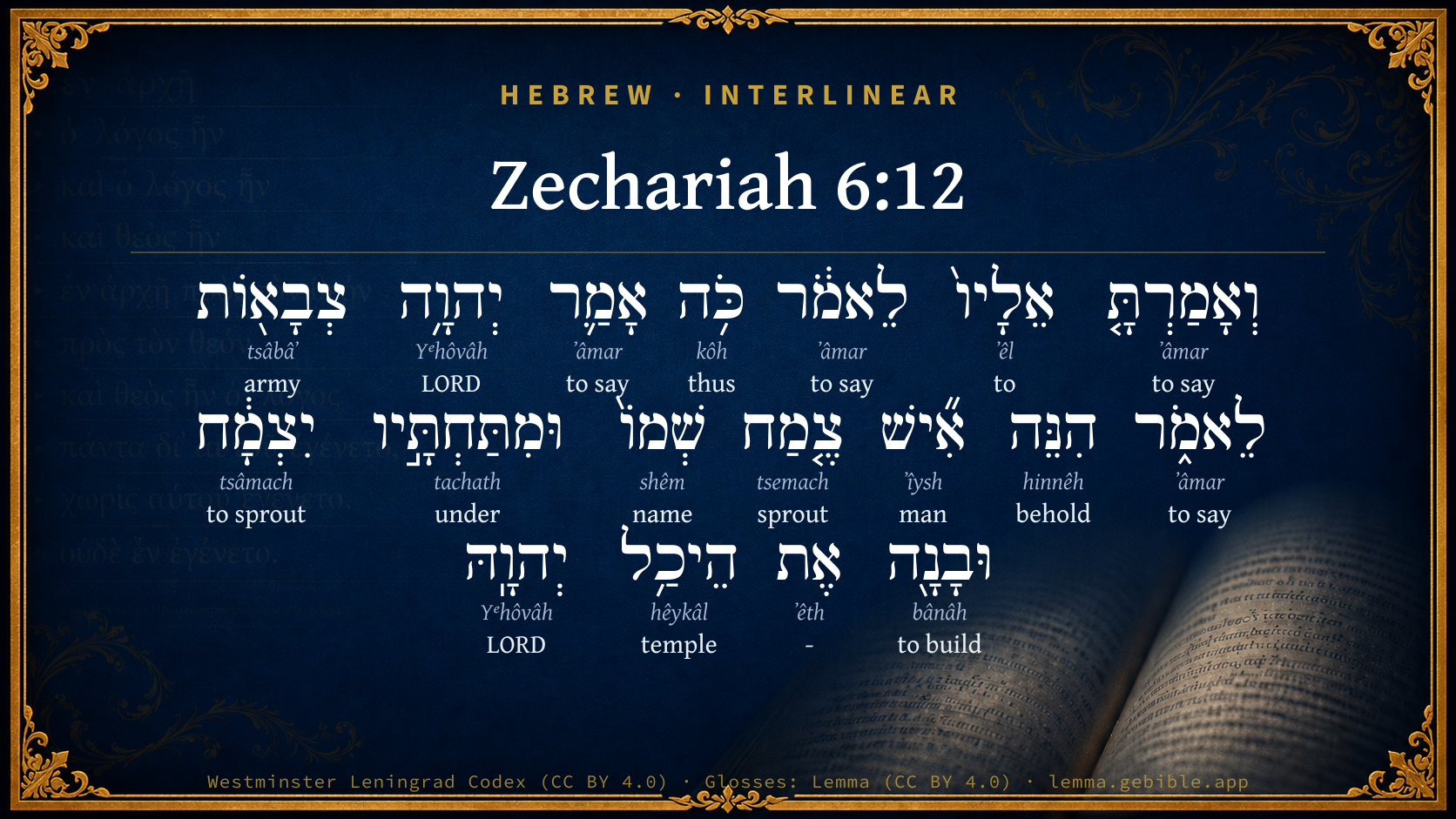
Hebrew (Westminster Leningrad Codex) Zechariah 6:12 appears in the Hebrew Old Testament. The text above is from the Westminster Leningrad Codex. Each word links to its Strong’s number, a concise gloss, and parsing drawn from the Open Scriptures Hebrew Bible morphology. Click any word for its full Brown-Driver-Briggs (BDB) entry.
Download image
Cite this verse

Zechariah 6:12 (World English Bible). Public Domain. Lemma interlinear Bible study tool, https://lemma.gebible.app/v/zechariah/6/12.

Show BibTeX & RIS
BibTeX
RIS
English Translation
and speak to him, saying, 'Thus says Yahweh of Hosts, "Behold, the man whose name is the Branch: and he shall grow up out of his place; and he shall build the temple of Yahweh;
World English Bible · Public Domain
Download a study sheet

One document with this verse’s original text, its word-by-word gloss line, the meaning frame, cross-references with their text, attributed commentary, and full source and license credits — printable, and it pastes into notes with its structure intact.

This verse Autodidact and up

Study sheet (.html) Plain text (.txt)

A passage Seminary Student

Up to 50 verses in one chapter. A passage sheet keeps up to 6 commentary sources and 12 cross-references per verse, in the order this page ranks them, and says so on the sheet whenever that leaves anything out. Ask for a single verse and you get the Autodidact verse sheet above.

Everything on this page stays free to read, with no account — the sheet is a download of what is already on screen, not access to it.

Want to remove ads? Support Godless Engineer
Compare translations 3

The same verse in 3 English versions, stacked beneath the original-language interlinear above. Click any original word for its lexicon entry.

Each is an independent rendering of the whole verse — the interlinear is not word-aligned to these translations.

Highlighted words mark where these versions differ — a whole-verse word diff, not a word-by-word alignment.

  • World English Bible Public Domain
    and speak to him, saying, 'Thus says Yahweh of Hosts, "Behold, the man whose name is the Branch: and he shall grow up out of his place; and he shall build the temple of Yahweh;
  • King James Version Public Domain
    And speak unto him, saying, Thus speaketh the LORD of hosts, saying, Behold the man whose name is The BRANCH; and he shall grow up out of his place, and he shall build the temple of the LORD:
  • unfoldingWord Literal Text CC BY-SA 4.0
    And you shall speak to him, saying, ‘Thus says Yahweh of Armies, saying: Behold, a man— Branch is his name— and from his place he will sprout, and he will build the temple of Yahweh.

unfoldingWord Literal Text — © unfoldingWord, licensed CC BY-SA 4.0. Word-aligned USFM3 via Door43 (git.door43.org/unfoldingWord/en_ult).

Versions to compare (up to 4)

3 of 4 selected

Show all 18 translations

Every available English version of this verse, each an independent rendering of the whole verse.

  • World English Bible Public Domain
    and speak to him, saying, 'Thus says Yahweh of Hosts, "Behold, the man whose name is the Branch: and he shall grow up out of his place; and he shall build the temple of Yahweh;
  • Berean Standard Bible Public Domain
    And you are to tell him that this is what the LORD of Hosts says: ‘Here is a man whose name is the Branch, and He will branch out from His place and build the temple of the LORD.
  • Majority Standard Bible Public Domain
    And you are to tell him that this is what the LORD of Hosts says: ‘Here is a man whose name is the Branch, and He will branch out from His place and build the temple of the LORD.
  • King James Version Public Domain
    And speak unto him, saying, Thus speaketh the LORD of hosts, saying, Behold the man whose name is The BRANCH; and he shall grow up out of his place, and he shall build the temple of the LORD:
  • American Standard Version (1901) Public Domain
    and speak unto him, saying, Thus speaketh Jehovah of hosts, saying, Behold, the man whose name is the Branch: and he shall grow up out of his place; and he shall build the temple of Jehovah;
  • Revised Version (1885) Public Domain
    and speak unto him, saying, Thus speaketh the LORD of hosts, saying, Behold, the man whose name is the Branch; and he shall grow up out of his place, and he shall build the temple of the LORD:
  • Geneva Bible (1599) Public Domain
    And speake vnto him, saying, Thus speaketh the Lord of hostes, and sayth, Behold the man whose name is the Branch, and he shall growe vp out of his place, and he shall build the Temple of the Lord.
  • Douay-Rheims (1899) Public Domain
    And thou shalt speak to him, saying: Thus saith the Lord of hosts, saying: BEHOLD A MAN, THE ORIENT IS HIS NAME: and under him shall he spring up, and shall build a temple to the Lord.
  • Young's Literal Translation Public Domain
    and hast spoken unto him, saying: Thus spake Jehovah of Hosts, saying: Lo, a man! A Shoot -- `is' his name, And from his place he doth shoot up, And he hath built the temple of Jehovah.
  • Literal Standard Version CC BY-SA 4.0
    and have spoken to him, saying, || Thus spoke YHWH of Hosts, saying, || Behold, the Man! A Shoot—[is] His Name, || And from His place He shoots up, || And He has built the temple of YHWH.
  • Unlocked Literal Bible CC BY-SA 4.0
    Speak to him and say, 'Yahweh of hosts says this: This man, his name is Branch! He will grow up where he is and will then build the temple of Yahweh!
  • unfoldingWord Literal Text CC BY-SA 4.0
    And you shall speak to him, saying, ‘Thus says Yahweh of Armies, saying: Behold, a man— Branch is his name— and from his place he will sprout, and he will build the temple of Yahweh.
  • Darby Bible Public Domain
    and speak unto him, saying, Thus speaketh Jehovah of hosts, saying, Behold a man whose name is [the] Branch; and he shall grow up from his own place, and he shall build the temple of Jehovah:
  • World Messianic Bible Public Domain
    and speak to him, saying, ‘The LORD of Hosts says, “Behold, the man whose name is the Branch! He will grow up out of his place; and he will build the LORD’s temple.
  • Webster's Bible Public Domain
    And speak to him, saying, Thus speaketh the LORD of hosts, saying, Behold the man whose name is The BRANCH; and he shall grow up out of his place, and he shall build the temple of the LORD;
  • Free Bible Version CC BY-SA 4.0
    Tell him this is what the Lord Almighty says: Look! The man who is called the Branch will grow from where he is and will build the Lord's Temple.
  • Bible in Basic English Public Domain
    And say to him, These are the words of the Lord of armies: See, the man whose name is the Branch, under whom there will be fertile growth.
  • JPS Tanakh (1917) Public Domain
    and speak unto him, saying: Thus speaketh the LORD of hosts, saying: Behold, a man whose name is the Shoot, and who shall shoot up out of his place, and build the temple of the LORD;

Literal Standard Version (2020), Covenant Press — licensed CC BY-SA 4.0. Text via the HelloAO Bible API (eBible.org). Unlocked Literal Bible (unfoldingWord) — licensed CC BY-SA 4.0. Text via the HelloAO Bible API (eBible.org). unfoldingWord Literal Text — © unfoldingWord, licensed CC BY-SA 4.0. Word-aligned USFM3 via Door43 (git.door43.org/unfoldingWord/en_ult). Free Bible Version, Dr. Jonathan Gallagher — licensed CC BY-SA 4.0. Text via the HelloAO Bible API (eBible.org).

Word by word

More ways to search: Search by grammar → Find every occurrence → Compare this word →

Practice this passage: Drill this verse → Learn its vocabulary →

צֶ֤מַח
tsemach
H6780
“sprout”
Noun, Common, Masculine, Singular, Absolute
Part of Speech
Noun
Type
Common
Gender
Masculine
Number
Singular
State
Absolute
Full BDB Definition

Origin: from H6779

TWOT: 1928a

sprout, growth, branch - sprouting, growth, sprout - growth (of process) - sprout, shoot (of Messiah from Davidic tree)
  1. וְאָמַרְתָּ֤ ʼâmar H559 “and · to say” Conjunction + Verb, Qal, Sequential Perfect, 2nd Person, Masculine, Singular
  2. אֵלָיו֙ ʼêl H413 “to · him” Preposition + Suffix, Personal, 3rd Person, Masculine, Singular
  3. לֵאמֹ֔ר ʼâmar H559 “to say” Preposition + Verb, Qal, Infinitive Construct
  4. כֹּ֥ה kôh H3541 “thus” Adverb
  5. אָמַ֛ר ʼâmar H559 “to say” Verb, Qal, Perfect, 3rd Person, Masculine, Singular
  6. יְהוָ֥ה Yᵉhôvâh H3068 “LORD” Noun, Proper
  7. צְבָא֖וֹת tsâbâʼ H6635 “armies” Noun, Common, Both, Plural, Absolute
  8. לֵאמֹ֑ר ʼâmar H559 “to say” Preposition + Verb, Qal, Infinitive Construct
  9. הִנֵּה hinnêh H2009 “behold” Particle, Demonstrative
  10. אִ֞ישׁ ʼîysh H376 “man” Noun, Common, Masculine, Singular, Absolute
  11. שְׁמוֹ֙ shêm H8034 “name · his” Noun, Common, Masculine, Singular, Construct + Suffix, Personal, 3rd Person, Masculine, Singular
  12. וּמִתַּחְתָּ֣יו tachath H8478 “and · from · under · him” Conjunction + Preposition + Preposition + Suffix, Personal, 3rd Person, Masculine, Singular
  13. יִצְמָ֔ח tsâmach H6779 “to sprout” Verb, Qal, Imperfect, 3rd Person, Masculine, Singular
  14. וּבָנָ֖ה bânâh H1129 “and · to build” Conjunction + Verb, Qal, Sequential Perfect, 3rd Person, Masculine, Singular
  15. אֶת ʼêth H853 “-” Particle, Direct Object
  16. הֵיכַ֥ל hêykâl H1964 “temple of” Noun, Common, Masculine, Singular, Construct
  17. יְהוָֽהּ Yᵉhôvâh H3068 “LORD” Noun, Proper

About this verse

These counts appear in no published source. They are computed here, from the morphology-tagged text and Lemma’s own curated glosses. What Lemma adds →

18
words
14
distinct lemmas
Prophets
section

Notable vocabulary

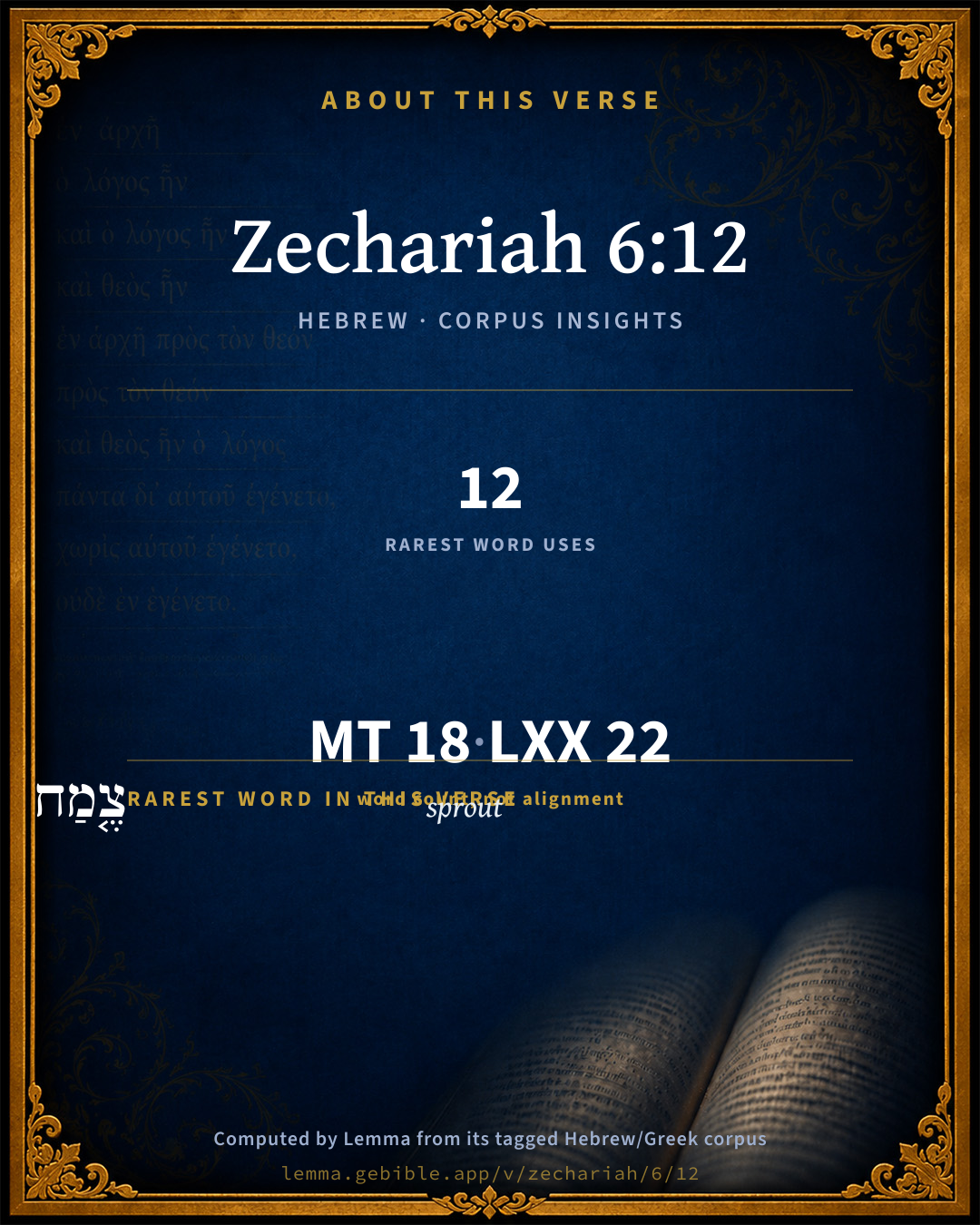
The rarest word here is צֶ֤מַח sprout H6780 — appearing just 12 times in the whole Hebrew Bible.

Shared distinctive vocabulary

צֶ֤מַח sprout H6780 occurs in 12 verses of the Hebrew Bible. Also found in:

Grammatical profile

  • 6 verbs
  • 7 nouns
  • 2 prepositions
  • 1 adverb
  • 2 particles

Verb forms

  • וְאָמַרְתָּ֤ Qal · Sequential Perfect
  • לֵאמֹ֔ר Qal · Infinitive Construct
  • אָמַ֛ר Qal · Perfect
  • לֵאמֹ֑ר Qal · Infinitive Construct
  • יִצְמָ֔ח Qal · Imperfect
  • וּבָנָ֖ה Qal · Sequential Perfect

Repetition

Words recur within this verse — often emphatic in Hebrew:

  • וְאָמַרְתָּ֤ to say H559 ×4
  • יְהוָ֥ה LORD H3068 ×2

Hebrew & Septuagint length

In English translation the verse runs 35 words from the Hebrew and 34 from the Septuagint (LXX English) — closely comparable.

A rough comparison of the two English renderings, which tokenize alike — not a word-level alignment.

Word counts can differ between the Hebrew and the Greek without any difference in meaning — e.g. the Hebrew direct-object marker אֵת has no separate Greek word, and Greek often adds the article ὁ.

In the original languages it is 18 Hebrew tokens and 22 Greek tokens — but the two are counted differently (Hebrew bundles its prefixes and suffixes into one token; the Greek is in lemma form), so that isn’t a like-for-like length.

Cross-references

33

Topical passages linked to Zechariah 6:12 in the Treasury of Scripture Knowledge — connected by theme and wording, ordered by reader-vote popularity; previews shown in the World English Bible.

  • Jeremiah 33:15 In those days, and at that time, will I cause a Branch of righteousness to grow up to David; and he shall execute justice and righteousness in the land.
  • Zechariah 3:8 Hear now, Joshua the high priest, you and your fellows who sit before you; for they are men who are a sign: for, behold, I will bring forth my servant, the Branch.
  • Isaiah 4:2 In that day, Yahweh's branch will be beautiful and glorious, and the fruit of the land will be the beauty and glory of the survivors of Israel.
  • Isaiah 11:1 There shall come forth a shoot out of the stock of Jesse, and a branch out of his roots shall bear fruit.
  • Jeremiah 23:5 Behold, the days come, says Yahweh, that I will raise to David a righteous Branch, and he shall reign as king and deal wisely, and shall execute justice and righteousness in the land.
  • Isaiah 53:2 For he grew up before him as a tender plant, and as a root out of a dry ground: he has no form nor comeliness; and when we see him, there is no beauty that we should desire him.
  • Zechariah 4:6–9 Then he answered and spoke to me, saying, "This is the word of Yahweh to Zerubbabel, saying, 'Not by might, nor by power, but by my Spirit,' says Yahweh of Hosts.
  • Acts 17:31 because he has appointed a day in which he will judge the world in righteousness by the man whom he has ordained; of which he has given assurance to all men, in that he has raised him from the dead."
  • Ezra 3:8 Now in the second year of their coming to the house of God at Jerusalem, in the second month, began Zerubbabel the son of Shealtiel, and Jeshua the son of Jozadak, and the rest of their brothers the priests and the Levites, and all those who were come out of the captivity to Jerusalem, and appointed the Levites, from twenty years old and upward, to have the oversight of the work of the house of Yahweh.
  • Ezra 3:10 When the builders laid the foundation of the temple of Yahweh, they set the priests in their clothing with trumpets, and the Levites the sons of Asaph with cymbals, to praise Yahweh, after the order of David king of Israel.
  • Psalms 80:15–17 The stock which your right hand planted, The branch that you made strong for yourself.
  • Isaiah 32:1–2 Behold, a king shall reign in righteousness, and princes shall rule in justice.
  • Micah 5:5 He will be our peace when Assyria invades our land, And when he marches through our fortresses, Then we will raise against him seven shepherds, And eight leaders of men.
  • Zechariah 8:9 Thus says Yahweh of Hosts: "Let your hands be strong, you who hear in these days these words from the mouth of the prophets who were in the day that the foundation of the house of Yahweh of Hosts was laid, even the temple, that it might be built.
  • Zechariah 13:7 "Awake, sword, against my shepherd, And against the man who is close to me," says Yahweh of Hosts. Strike the shepherd, and the sheep will be scattered; And I will turn my hand against the little ones.
  • Matthew 16:18 I also tell you that you are Peter, and on this rock I will build my assembly, and the gates of Hades will not prevail against it.
  • Matthew 26:61 and said, "This man said, 'I am able to destroy the temple of God, and to build it in three days.'"
  • Mark 14:58 "We heard him say, 'I will destroy this temple that is made with hands, and in three days I will build another made without hands.'"
  • Mark 15:29 Those who passed by blasphemed him, wagging their heads, and saying, "Ha! You who destroy the temple, and build it in three days,
  • Mark 15:39 When the centurion, who stood by opposite him, saw that he cried out like this and breathed his last, he said, "Truly this man was the Son of God!"
  • Luke 1:78 Because of the tender mercy of our God, Whereby the dawn from on high will visit us,
  • John 1:45 Philip found Nathanael, and said to him, "We have found him, of whom Moses in the law, and the prophets, wrote: Jesus of Nazareth, the son of Joseph."
  • John 2:19–21 Jesus answered them, "Destroy this temple, and in three days I will raise it up."
  • Acts 13:38 Be it known to you therefore, brothers, that through this man is proclaimed to you remission of sins,
  • 1 Corinthians 3:9 For we are God's fellow workers. You are God's farming, God's building.
  • Ephesians 2:20–22 being built on the foundation of the apostles and prophets, Christ Jesus himself being the chief cornerstone;
  • Hebrews 3:3–4 For he has been counted worthy of more glory than Moses, inasmuch as he who built the house has more honor than the house.
  • Hebrews 7:4 Now consider how great this man was, to whom even Abraham, the patriarch, gave a tenth out of the best spoils.
  • Hebrews 7:24 But he, because he lives forever, has his priesthood unchangeable.
  • Hebrews 8:3 For every high priest is appointed to offer both gifts and sacrifices. Therefore it is necessary that this high priest also have something to offer.
  • John 19:5 Jesus therefore came out, wearing the crown of thorns and the purple garment. Pilate said to them, "Behold, the man!"
  • Hebrews 10:12 but he, when he had offered one sacrifice for sins for ever, sat down on the right hand of God;
  • 1 Peter 2:4–5 coming to him, a living stone, rejected indeed by men, but chosen by God, precious.

Cross-references courtesy of OpenBible.info (CC BY 4.0).

Hebrew and Greek witnesses Masoretic Hebrew ↔ Greek Septuagint

The same verse in the two great witnesses to the Old Testament, shown verse-for-verse.

These are two independent witnesses, not word-aligned to each other, and the Septuagint is shown in lemma (dictionary) form.

Hebrew Zechariah 6:12 Masoretic · Westminster Leningrad Codex

וְאָמַרְתָּ֤ אֵלָיו֙ לֵאמֹ֔ר כֹּ֥ה אָמַ֛ר יְהוָ֥ה צְבָא֖וֹת לֵאמֹ֑ר הִנֵּה אִ֞ישׁ צֶ֤מַח שְׁמוֹ֙ וּמִתַּחְתָּ֣יו יִצְמָ֔ח וּבָנָ֖ה אֶת הֵיכַ֥ל יְהוָֽהּ

and speak to him, saying, 'Thus says Yahweh of Hosts, "Behold, the man whose name is the Branch: and he shall grow up out of his place; and he shall build the temple of Yahweh;

World English Bible · Public Domain

Greek LXX Zechariah 6:12 Septuagint · lemma form

καί εἶπον πρός αὐτός ὅδε λέγω κύριος παντοκράτωρ ἰδού ἀνήρ ἀνατολή ὄνομα αὐτός καί ὑποκάτωθεν αὐτός ἀνατέλλω καί οἰκοδομέω ὁ οἶκος κύριος

and you shall say to him, Thus says the Lord Almighty; Behold the man whose name is The Branch; and he shall spring up from his stem, and build the house of the Lord.

LXX2012 (modern English Septuagint) · Public Domain

On this verse, Keil & Delitzsch discusses the Septuagint’s reading. Read the note in Commentary ↓

Hebrew: Westminster Leningrad Codex (CC BY 4.0). Greek: Septuagint (public domain); English from LXX2012 (modern English Septuagint) (Public Domain). How the Septuagint differs from the Hebrew →

Targum (Aramaic paraphrase)

1

The Targum is the ancient Jewish Aramaic paraphrase of the Hebrew Scriptures — an interpretive translation, not the Hebrew text itself. Onkelos (literal) and Pseudo-Jonathan (expansive) render the Torah, and Jonathan the Prophets. Coverage is partial: where no permissively-licensed English translation exists for a verse, only the Aramaic is shown. This is verse-level text, not a word-by-word alignment to the Hebrew.

  1. Targum Jonathan Prophets (Joshua–Malachi)
    וְתֵימַר לֵיהּ לְמֵימָר כִּדְנַן אֲמַר יְיָ צְבָאוֹת לְמֵימָר הָא גַבְרָא מְשִׁיחָא שְׁמֵיה עָתִיד דְיִתְגְלֵי וְיִתְרַבֵּי וְיִבְנֵי יַת הֵיכְלָא דַיָי:

    (no public-domain English translation for this verse)

    Targum Jonathan — Aramaic: “Mikraot Gedolot” (public domain). English: “Sefaria Community Translation” (CC0 1.0 (public-domain dedication)); “London "Chaldee Paraphrase," 1871” (public domain). Text via Sefaria.

Commentary

Notes on Zechariah 6:12 from classic Christian and Jewish commentators (each source and its license shown beneath its notes). The classic Christian expositions comment on the surrounding passage and are grouped to its opening verse, so a note may address several verses; the Jewish commentaries on the Tanakh (Rashi and others) are per-verse, so they appear only where the commentator wrote on this verse.

Lemma curates 59 commentaries, every one of them public domain or Creative Commons licensed, each selected and text-cleaned for this edition rather than reprinted as found. About our sources →

Trapp's Complete Commentary

John Trapp

Zec 6:12 And speak unto him, saying, Thus speaketh the LORD of hosts, saying, Behold the man whose name [is] The BRANCH; and he shall grow up out of his place, and he shall build the temple of the LORD:

Ver. 12. And spake unto him, saying, Thus speaketh the Lord of hosts, saying] That is, confidently and constantly affirm and aver it; that, notwithstanding all unlikelihood and unbelief on the people’s part, Almighty God will surely bring it to pass; this heap of words importeth so much; for "do ye think the Scripture speaketh in vain?" saith St James, not without some holy indignation, Jas 4:5.

Behold the man whose name is The Branch] The man Christ Jesus, who was made of the seed of David according to the flesh, Rom 1:3; and as a Branch grew out of his roots, Isa 11:1. {See Trapp on "Zec 3:4"} Joshua, that he might not be exalted above measure with the abundance of this new honour, or think of himself more highly than he ought to think, 2Co 12:7 Rom 12:3, is given to understand that he is crowned for no other cause than this, that the Jews might understand that there should One arise that should be both a king and a priest also for ever, after the order of Melchisedec; and his name should be the Branch, not only because when he was a child he grew in age and in wisdom, and in grace with God and men (which is Vatablus’ reason), but because he is the root, fountain, and foundation of all the faithful, who do grow up and increase in him, with the increase of God: hence it followeth,

He shall grow up out of his place, and shall build the temple of God] That is, the Church, which at all times hath been gathered together by Christ, through the preaching of the gospel.

And he shall grow up out of his place] Or he (the Branch) shall branch up de sub se, from under himself; he shall be born of himself, as it were, of poor parentage; for this Branch grew out of the root of Jesse, when that goodly family was sunk so low, as from David the king to Joseph the carpenter. He that writeth the life of King Edward VI saith of his tutors, Dr Cox and Mr John Cheek, that they were men of mean birth; but so well esteemed for virtue and learning, that they might well be said to be born of themselves (Sir John Heywood).

And he shall build the temple of the Lord] i.e. The spiritual temple, that temple, the Church, the glory whereof was far greater than the glory of the former, Hag 2:9. {See Trapp on "Hag 2:9"} And this he should do in the quality of a king, and with royal magnificence. "Ye also, as lively stones, elect and precious, are built up a spiritual house, a holy priesthood," &c., 1Pe 2:5.

John Trapp, A Commentary or Exposition upon All the Books of the Old and New Testament (1647–1656) — public domain. Text from a community e-Sword module.

Joseph Benson's Commentary

Zec 6:12. And speak unto him, saying — Bishop Chandler justly observes, that the prophet’s speech is directed to Joshua only; the two crowns are put only on the head of Joshua; to him only it is said, Behold the man whose name is The Branch — As much as to say, “Behold the sign of the BRANCH, the person whom I promised to David in Solomon, and by the prophets after David to the Jews, by the name of the BRANCH.” “There cannot be a doubt,” says Blayney, “that the same person is meant by the BRANCH here, who is so called chap. Zec 3:8, and this has been already shown to be, not Zerubbabel, but the Messiah himself; of whom Joshua is made the type, or representative, by the crown placed on his head. For to what end should he have been called in to represent Zerubbabel, who was his cotemporary, and altogether as ready at hand as himself. Nor will the passage, strictly and literally translated, answer to any other but him who was at once both king and priest, and, by uniting both characters in himself, was completely qualified to bring about the counsel of peace, or reconciliation between God and man.” It must be observed, however, that the human nature of our Lord is here chiefly intended by the expression, The man, the BRANCH. For, considered in his divine nature, he is not the branch out of the stem of Jesse, or David, but their root, as he is termed Isa 11:10; Rev 5:5; Rev 22:16. In this his human nature, he was small in his beginning, even as to his kingdom as well as his person; and mean in his appearance, as a mere bud or sprout, but gradually flourishing and becoming great and fruitful. As a branch, he was to be cut off, but would produce sprouts, branches, and trees of righteousness innumerable. He shall grow up out of his place — Out of the tribe and family, and in the place foretold; as if he had said, Though you may suspect the root to be dry and dead, yet assuredly it is not: the branch will spring up, the Messiah, who shall be both priest and king, will make his appearance in due time. The Hebrew, מתחתיו יצמח, is literally, He shall spring up, or flourish, from under himself; by his own power, or by the power of his own Spirit, he shall be both stock and stem to himself. The words seem evidently to express his miraculous conception. He shall build the temple of the Lord — As the preceding clause speaks of his person, his conception, and birth, so this describes his work; as if he had said, He it is that stands by you, though unseen, and enables you to build this material temple; which neither Zerubbabel, nor Joshua, nor all the Jews uniting with them, would be able to complete without him. This, however, is a temple far inferior to that spiritual building, the gospel church, which the Messiah will in due time raise, beautify, preserve, and honour; the spiritual house, in which he will dwell, 1Pe 2:4; the temple built on the foundations laid in Zion, where he will manifest his grace and glory, and be worshipped in Spirit and in truth, 1Co 3:9-16; 2Co 6:16; Eph 2:19-22.

Joseph Benson's Commentary on the Old and New Testaments (1811–1818) — public domain. Text from a community e-Sword module.

Keil & Delitzsch

C. F. Keil & F. Delitzsch

The meaning of this is explained in Zac 6:12-15. Zac 6:12. "And speak to him, saying, Thus speaketh Jehovah of hosts, saying, Behold a man, His name is Tsemach (Sprout), and from His place will He sprout up, and build the temple of Jehovah. Zac 6:13. And He will build the temple of Jehovah, and He will carry loftiness, and will sit and rule upon His throne, and will be a priest upon His throne, and the counsel of peace will be between them both. Zac 6:14. And the crown will be to Chelem, and to Tobijah, and to Jedahjah, and the favour of the son of Zephaniah, for a memorial in the temple of Jehovah. Zac 6:15. And they that are far off will come and build at the temple of Jehovah; then will ye know that Jehovah of hosts hath sent me to you; and it will come to pass, if ye hearken to the voice of Jehovah your God." Two things are stated in these verses concerning the crown: (1) In Zac 6:12 and Zac 6:13 the meaning is explained of the setting of the crown upon the head of Joshua the high priest; and (2) in Zac 6:14, Zac 6:15, an explanation is given of the circumstance, that the crown had been made of silver and gold presented by men of the captivity. The crowning of Joshua the high priest with a royal crown, which did not properly belong to the high priest as such, as his headdress is neither called a crown (‛ătârâh) nor formed part of the insignia of royal dignity and glory, had a typical significance. It pointed to a man who would sit upon his throne as both ruler and priest, that is to say, would combine both royalty and priesthood in his own person and rank. The expression "Speak thou to him" shows that the words of Jehovah are addressed to Joshua, and to him alone (אליו is singular), and therefore that Zerubbabel must not be interpolated into Zac 6:11 along with Joshua. The man whom Joshua is to represent or typify, by having a crown placed upon his head, is designated as the Messiah, by the name Tsemach (see at Zac 3:8); and this name is explained by the expression מתּחתּיו יצמח. These words must not be taken impersonally, in the sense of "under him will it sprout" (lxx, Luth., Calov., Hitzig, Maurer, and others); for this thought cannot be justified from the usage of the language, to say nothing of its being quite remote from the context, since we have מתּחתּיו, and not תּחתּיו (under him); and moreover, the change of subject in יצמח and וּבנה would be intolerably harsh. In addition to this, according to Jer 33:15, the Messiah is called Tsemach, because Jehovah causes a righteous growth to spring up to David, so that Tsemach is the sprouting one, and not he who makes others or something else to sprout. מתּחתּיו, "from under himself," is equivalent to "from his place" (Exo 10:23), i.e., from his soil; and is correctly explained by Alting in Hengstenberg thus: "both as to his nation and as to his country, of the house of David, Judah, and Abraham, to whom the promises were made." It also contains an allusion to the fact that He will grow from below upwards, from lowliness to eminence.

This Sprout will build the temple of the Lord. That these words do not refer to the building of the earthly temple of stone and wood, as Ros. and Hitzig with the Rabbins suppose, is so obvious, that even Koehler has given up this view here, and understands the words, as Hengstenberg, Tholuck, and others do, as relating to the spiritual temple, of which the tabernacle and the temples of both Solomon and Zerubbabel were only symbols, the temple which is the church of God itself (Hos 8:1; Pe1 2:5; Heb 3:6; and Eph 2:21-22). Zechariah not only speaks of this temple here, but also in Zac 4:9, as Haggai had done before him, in Hag 2:6-9, which puts the correctness of our explanation of these passages beyond the reach of doubt. The repetition of this statement in Zac 6:13 is not useless, but serves, as the emphatic והוּא before this and the following sentence shows, to bring the work of the Tsemach into connection with the place He will occupy, in other words, to show the glory of the temple to be built. The two clauses are to be linked together thus: "He who will build the temple, the same will carry eminence." There is no "antithesis to the building of the temple by Joshua and Zerubbabel" (Koehler) in והוּא; but this is quite as foreign to the context as another view of the same commentator, viz., that Zac 6:13 interrupts the explanation of what the shoot is to be. הוד, eminence, is the true word for regal majesty (cf. Jer 22:18; Ch1 29:25; Dan 11:21). In this majesty He will sit upon His throne and rule, also using His regal dignity and power for the good of His people, and will be a Priest upon His throne, i.e., will be at once both Priest and King upon the throne which He assumes. The rendering, "And there will be a priest upon His throne" (Ewald and Hitzig), is precluded by the simple structure of the sentences, and still more by the strangeness of the thought which it expresses; for the calling of a priest in relation to God and the people is not to sit upon a throne, but to stand before Jehovah (cf. Jdg 20:28; Deu 17:12). Even the closing words of this verse, "And a counsel of peace will be between them both," do not compel us to introduce a priest sitting upon the throne into the text by the side of the Tsemach ruling upon His throne. שׁניהם cannot be taken as a neuter in the sense of "between the regal dignity of the Messiah and His priesthood" (Capp., Ros.), and does not even refer to the Tsemach and Jehovah, but to the Mōshēl and Kōhēn, who sit upon the throne, united in one person, in the Tsemach. Between these two there will be ‛ătsath shâlōm. This does not merely mean, "the most perfect harmony will exist" (Hofmann, Umbreit), for that is a matter of course, and does not exhaust the meaning of the words. ‛Atsath shâlōm, counsel of peace, is not merely peaceful, harmonious consultation, but consultation which has peace for its object; and the thought is the following: The Messiah, who unites in Himself royalty and priesthood, will counsel and promote the peace of His people.

This is the typical meaning of the crowning of the high priest Joshua. But another feature is added to this. The crown, which has been placed upon the head of Joshua, to designate him as the type of the Messiah, is to be kept in the temple of the Lord after the performance of this act, as a memorial for those who bring the silver and gold from the exiles in Babel, and לחן בּן־צ, i.e., for the favour or grace of the son of Zephaniah. Chēn is not a proper name, or another name for Josiah, but an appellative in the sense of favour, or a favourable disposition, and refers to the favour which the son of Zephaniah has shown to the emigrants who have come from Babylon, by receiving them hospitably into his house. For a memorial of these men, the crown is to be kept in the temple of Jehovah. The object of this is not merely "to guard it against profanation, and perpetuate the remembrance of the givers" (Kliefoth); but this action has also a symbolical and prophetic meaning, which is given in Zac 6:15 in the words, "Strangers will come and build at the temple of the Lord." Those who have come from the far distant Babylon are types of the distant nations who will help to build the temple of the Lord with their possessions and treasures. This symbolical proceeding therefore furnishes a confirmation of the promise in Hag 2:7, that the Lord will fill His temple with the treasures of all nations. By the realization of what is indicated in this symbolical proceeding, Israel will perceive that the speaker has been sent to them by the Lord of hosts; that is to say, not that Zechariah has spoken by the command of God, but that the Lord has sent the angel of Jehovah. For although in what precedes, only the prophet, and not the angel of Jehovah, has appeared as acting and speaking, we must not change the "sending" into "speaking" here, or take the formula וידעתּם כּי וגו in any other sense here than in Zac 2:13, Zac 3:2, and Zac 4:9. We must therefore assume, that just as the words of the prophet pass imperceptibly into words of Jehovah, so here they pass into the words of the angel of Jehovah, who says concerning himself that Jehovah has sent him. The words conclude with the earnest admonition to the hearers, that they are only to become partakers of the predicted good when they hearken to the voice of their God. The sentence commencing with והיה does not contain any aposiopesis; there is no valid ground for such an assumption as this in the simple announcement, which shows no trace of excitement; but vehâhâh may be connected with the preceding thought, "ye will know," etc., and affirms that they will only discern that the angel of Jehovah has been sent to them when they pay attention to the voice of their God. Now, although the recognition of the sending of the angel of the Lord involves participation in the Messianic salvation, the fact that this recognition is made to depend upon their giving heed to the word of God, by no means implies that the coming of the Messiah, or the participation of the Gentiles in His kingdom, will be bound up with the fidelity of the covenant nation, as Hengstenberg supposes; but the words simply declare that Israel will not come to the knowledge of the Messiah or to His salvation, unless it hearkens to the voice of the Lord. Whoever intentionally closes his eyes, will be unable to see the salvation of God.

The question whether the prophet really carried out the symbolical action enjoined upon him in Zac 6:10., externally or not, can neither be answered in the affirmative nor with a decided negative. The statement in Zac 6:11, that the prophet who was hardly a goldsmith, was to make the crown, is no more a proof that it was not actually done, than the talmudic notice in Middoth iii., concerning the place where the crown was hung up in the temple, is a proof that it was. For עשׂית in Zac 6:11 may also express causing to be made; and the talmudic notice referred to does not affirm that this crown was kept in the temple, but simply states that in the porch of the temple there were beams stretching from one wall to the other, and that golden chains were fastened to them, upon which the priestly candidates climbed up and saw crowns; and the verse before us is then quoted, with the formula שׁנאמר as a confirmation of this.

Keil & Delitzsch — Biblical Commentary on the Old Testament (1861–1891) — public domain (CC PDM 1.0). Text via the HelloAO Bible API. (Old Testament only.)

Tyndale Open Study Notes

Tyndale Open Resources

6:12-13 The Branch is a title for the Messiah (see 3:8), whom Jeshua represents. • he will build the Temple of the Lord: Just as Jeshua the high priest helped to build the Temple in Jerusalem (Ezra 3:1-2, 8-9; 5:2), Jesus the Messiah would build the eternal heavenly Temple through his death, burial, and resurrection (John 2:19-22; 4:23-24; Eph 2:19-22; Heb 8:1-2). • The Messiah would rule as king, a role associated with David and the tribe of Judah (2 Sam 7:12-16). • He will also serve as priest from his throne: The Messiah’s priestly role is associated with Aaron and the tribe of Levi (Exod 29:44). • Jeshua’s crown represents his two roles. Melchizedek also fulfilled the double functions of priest and king (Gen 14:17-20), as does the Messiah (Ps 110:4; Heb 7:1-3, 15-17).

Tyndale Open Study Notes — © Tyndale Open Resources, licensed CC BY-SA 4.0. Text via the HelloAO Bible API.

Geneva Bible (1599)

Geneva Bible translators

Meaning, Christ, of whom Joshua was the figure: for in Greek they were both called Jesus.

Which declareth, that none could build this Temple whereof Haggai speaketh, but only Christ: and therefore it was spiritual, and not material, Hag. 2:10.

That is, of himself without the help of man.

Geneva Bible (1599) marginal notes — public domain. Text via Bolls.life.

Jamieson, Fausset & Brown

Robert Jamieson, A. R. Fausset & David Brown

Behold, the man--namely, shall arise. Pilate unconsciously spake God's will concerning Him, "Behold the man" (Joh 19:5). The sense here is, "Behold in Joshua a remarkable shadowing forth of Messiah." It is not for his own sake that the crown is placed on him, but as type of Messiah about to be at once king and priest. Joshua could not personally be crowned king, not being of the royal line of David, but only in his representative character.

Branch--(See on Zac 3:8; Isa 4:2; Jer 23:5; Jer 33:15).

he shall grow up out of his place--retaining the image of a "Branch"; "He shall sprout up from His place," that is, the place peculiar to Him: not merely from Beth-lehem or Nazareth, but by His own power, without man's aid, in His miraculous conception [HENDERSON]; a sense brought out in the original, "from under Himself," or "from (of) Himself" [CALVIN]. MOORE makes it refer to His growing lowly in His place of obscurity, "as a tender plant and a root out of a dry ground" (Isa 53:2), for thirty years unknown except as the son of a carpenter. MAURER translates, "Under Him there shall be growth (in the Church)." English Version accords better with the Hebrew (compare Exo 10:23). The idea in a Branch is that Christ's glory is growing, not yet fully manifested as a full-grown tree. Therefore men reject Him now.

build the temple--The promise of the future true building of the spiritual temple by Messiah (Mat 16:18; Co1 3:17; Co2 6:16; Eph 2:20-22; Heb 3:3) is an earnest to assure the Jews, that the material temple will be built by Joshua and Zerubbabel, in spite of all seeming obstacles. It also raises their thoughts beyond the material to the spiritual temple, and also to the future glorious temple, to be reared in Israel under Messiah's superintendence (Eze. 40:1-43:27). The repetition of the same clause (Zac 6:13) gives emphasis to the statement as to Messiah's work.

Jamieson, Fausset & Brown — Commentary Critical and Explanatory on the Whole Bible (1871) — public domain (CC PDM 1.0). Text via the HelloAO Bible API.

Adam Clarke's Commentary

Verse 12. Behold the man whose name is The BRANCH!] I cannot think that Zerubbabel is here intended; indeed, he is not so much as mentioned in Zec 3:8. Joshua and his companions are called אנשי מופת anshey mopheth, figurative or typical men; the crowning therefore of Joshua in this place, and calling him the BRANCH, was most probably in reference to that glorious person, the Messiah, of whom he was the type or figure. The Chaldee has, "whose name is my MESSIAH," or CHRIST.

And he shall grow up out of his place] That is, out of David's root, tribe, and family.

And he shall build the temple of the Lord.] This cannot refer to the building of the temple then in hand, for Zerubbabel was its builder: but to that temple, the Christian Church, that was typified by it; for Zerubbabel is not named here, and only Joshua or Jesus (the name is the same) is the person who is to be crowned and to build this spiritual temple.

Adam Clarke's Commentary on the Bible (1810–1826) — public domain. Text from a community e-Sword/MySword module.

John Calvin's Commentaries

The vision is now explained; for if the chief priest, without this explanation, had been adorned with two crowns, there must have been much talk among the people, “What means this?” God here shows that what he has commanded to be done to Joshua does not belong to him, but has a reference to another, Thou shalt say to him, Behold the Man, Branch is his name. It is the same as though the Prophet had expressly testified that Joshua was not crowned, because he was worthy of such an honor, or because he could look for royal dignity; but that he was to bear this honor for a time, in order that the Jews might understand that one was to arise who would be both a king and a priest. Hence he says, that there would be a man, whose name was to be Branch

As to this name, it has been explained elsewhere. I omit those refinements with which some are delighted; but as I have shown in another place, the simple and true reason why Christ is so called, is, because he was not like a tall tree, with deep and strong roots, but like a small plant. He is indeed called in another place, “a shoot from the root of Jesse.” (Isaiah 11:1.) But the meaning is the same; for that root of Jesse was obscure and of no repute. Besides, this kind of shoot has nothing in it that is illustrious. We hence see that Christ is called Branch, because his beginning was contemptible, so that he was of hardly any repute among heathens; nay even among his own nation. But God intimates at the same time, that this little plant would be set, as it were, by his own hand, and thus would gather strength. Though then the beginning of Christ was humble, yet God declares, that he would give vigor for continued growth, until he should attain to a great height. In this sense it is that Christ is called Branch: and we clearly conclude, that the minds of the people were transferred to Christ who was to come, that they might not fix their attention on Joshua, who was then but a typical priest. Say to Joshua, Behold the man, whose name is Branch. Where is that man? He does not speak of Joshua; he does not say, “Thou art the man;” but he says, Behold the man, whose name is Branch, that is, who comes elsewhere. We then hence learn, that these crowns were those of Christ, but given to Joshua, that the Jews might see in the type, what was as yet hid under hope.

He afterwards adds, He shall arise from himself, or grow up from his own place, literally, from under himself. Here also some have too refinedly philosophised, — that Christ arose from himself by his own power, because he is the eternal God. I think, on the contrary, that all human means are only excluded, as though the Prophet had said, that though Christ was like a little plant, he would yet grow up as though he had roots deeply fixed in the earth. There is indeed no doubt, but that Christ grew up by his own celestial power, and this is what the words of the Prophet include; but what he meant was this, — that Christ had nothing in his beginning calculated to draw the admiration of men. Though then Christ was only a shoot, yet God had sufficient power, that he should grow from his own place, that though human means were absent, it would yet be enough, that God should bless this branch, so as to cause it to grow to its proper height.

He then says, And he shall build the temple of Jehovah. This is a remarkable passage: it hence appears that the temple which the Jews had then begun to build, and which was afterwards built by Herod, was not the true temple of which Haggai had prophesied, when he said,

“The glory of the second house shall be greater than that of the first.” (Haggai 2:9.)

For though the temple of Herod was splendid, yet we see what the Spirit declares in this place, — that to build the temple would be Christ’s own work. Hence no one, had he heaped together all the gold and the silver of the world, could have built the true temple of which Haggai prophesied, and of which Ezekiel has so largely spoken near the end of his book. Christ alone then has been chosen by the Father to build this temple. Christ indeed himself was a temple as to his body, for the fullness of the Godhead dwelt in him, (Colossians 2:6;) but he built a temple to God the Father, when he raised up everywhere pure worship, having demolished superstitions, and when he consecrated us to be a royal priesthood.

We now then see what was shown to the Prophet, — that though the Jews were then exposed to many evils, to reproaches and wrongs, yet Christ would come to restore all things to a perfect order, that he would be not only a king but also a priest; and further, that his beginning would be obscure and despised by the world, and yet that he would attain without any earthly helps his own elevation; and, lastly, that his own proper office would be to build a temple to God.

John Calvin's Commentaries (1540-1563) — public domain. Text from the Calvin Translation Society English edition (1840s-50s) via the Christian Classics Ethereal Library (ccel.org). Calvin's coverage is partial (roughly two-thirds of the Bible); uncommented books and verses are honest gaps, never fabricated. The 19th-century editor's footnotes and remarks are omitted so the notes are faithfully Calvin's own voice.

Ellicott's Commentary for English Readers

(12) The man.—Better, a man, as in Isa_32:2.

Branch.—See Note on Zec_3:8.

Shall build.—This verb is often used in a figurative sense: e.g., of a family (Gen_16:2). Since Zerubbabel is not even mentioned in this passage, Zechariah’s hearers could not possibly have thought that this symbolical action was merely a repetition of the promise of Zec_4:9, but must have perceived that the building of the Temple here spoken of referred to something of a higher nature than the material building then in progress.

A Bible Commentary for English Readers, edited by Charles John Ellicott (1878–1897) — public domain. Text from a community e-Sword module.

The Cambridge Bible for Schools and Colleges

gen. ed. J. J. S. Perowne

12. the Branch] See chap. Zec_3:8 and note.

out of his place] Lit. from under him. Comp. for the expression Exo_10:23; and for the meaning Isa_11:1; Isa_53:2. Other less satisfactory renderings are, it shall grow up under Him, i.e. all things fair and good shall spring up and flourish under Him. Cf. Pers. Sat. 2, 38: “quidquid calcaverit hic, rosa fiat” (Maurer); or, “He shall sprout forth from under Himself, i.e. send forth shoots as from a parent stem.” (Speaker’s Comment.)

The Cambridge Bible for Schools and Colleges (gen. ed. J. J. S. Perowne; Cambridge University Press, 1878–1918) — public domain. Text from a community e-Sword module.

John Gill's Exposition

Even he shall build the temple of the Lord,.... Which is repeated, as Kimchi observes, for confirmation sake:

and he shall bear the glory; that is, of building the temple; and the phrase denotes that the glory of it shall be upon him, shall be hung upon him, as in Isa 22:24 and so shall be visible; that it would be weighty and heavy, he having many crowns on his head, put there by all the saints, who everyone of them ascribe glory to him; that it would continue, and not pass away like the glory of this world; and that he, and he alone, should bear it; not Joshua, nor Zerubbabel, nor the ministers of the word, nor members of churches, nor any other, but himself; he, and he alone, shall be exalted:

and shall sit and rule upon his throne; in heaven, having done his work on earth, where he is at ease and rest, and exercises power and authority; he rules over the whole world, and the kings of it in general, and in particular over his saints, by his Spirit, word, and ordinates, feeding, protecting, and defending them:

and he shall be a Prince upon his throne; he is both Priest and King, and exercises both offices at one and the same time, and even now in heaven; having offered himself as a sacrifice on earth, by which he has put away sin for ever, and perfected his people; he is set down upon his throne, as a King crowned with glory and honour; and ever lives as a Priest the throne, to make intercession for them; by appearing in the presence of God for them; by presenting his blood, sacrifice, and righteousness, to his divine Father; by offering up the prayers and praises of his people; by declaring it as his will that such and such blessings be bestowed upon them; and by applying the benefits of his death unto them:

and the counsel of peace shall be between them both; not between Joshua and Zerubbabel, who should agree together, as they did, in the administration of government belonging to their distinct offices; rather between the priestly and kingly offices of Christ; nor the council of peace between the Father and the Son, concerning the salvation of the elect; for that was past in eternity; but better the Gospel of peace, called the whole counsel of God, which, in consequence of Christ being a Priest on his throne, was preached to both Jews and Gentiles; which brought the glad tidings of peace and salvation by Christ to both, and was the means of making peace between them both.

John Gill's Exposition of the Whole Bible (1746–1763) — public domain (CC PDM 1.0). Text via the HelloAO Bible API.

Albert Barnes' Notes on the Bible

The prophet is taught to explain his own symbolic act. “Behold the Man whose name is the Branch” . “Not for himself, but for Christ, whose name Joshua bare, and whose Priesthood and Princedom he represented,” was the crown given him. The prophet had already foretold the Messiah, under the name of the Branch. Here he adds,

And he shall grow up out of His place - Lowly and of no seeming account, as God foretold by Jeremiah, “I will cause the Branch of righteousness to grow up unto David” Jer 33:15; and Jesus Himself said, “Except a grain of wheat fall into the earth and die, it abideth alone; but if it die, it bringeth forth much fruit” Joh 12:24. Alone He grew up before God, as a tender plant Isa 53:2, unknown of man, known to God. It is that still, Divine Life at Nazareth, of which we see only that one bright flash in the temple, the deep saying, not understood even by Joseph and Mary, and then, “He went down with them and came to Nazareth and was subject unto them” (see Luk 2:49-51).

And he shall build the temple of the Lord - The material temple was soon to be finished, and that by Zerubbabel, to whom this had been promised, Zec 4:10, not by Joshua. It was then a new temple, to be built from the foundation, of which He Himself was to be “the foundation” Isa 28:16; 1Co 3:11; Eph 2:20-21, as He said, “On this rock I will build My Church” Mat 16:18; and in Him “all the building, fitly framed together, groweth unto an holy temple to the Lord” Eph 2:21. Osorius: “He it is, who built the house; for neither Solomon nor Zerubbabel nor Joshua son of Josedech could build a house worthy of the majesty of God. For “the Most High” Act 7:48-49, Stephen says, “dwelleth not in temples made with hands, as saith the prophet; Heaven is My throne and earth is My footstool; what house will ye build Me, saith the Lord?” For if they could have built a house for God, He would not have allowed His house to be burned and overthrown. What then is the house of God which Christ built? The Church, founded on faith in Him, dedicated by His Blood, stablished by the stayedness of divine virtue, adorned with divine and eternal riches, wherein the Lord ever dwelleth.”

Albert Barnes' Notes on the Bible (1834–1885) — public domain. Text from a community e-Sword/MySword module.

Haydock's Catholic Bible Commentary

Orient. Protestants, "the branch, and he shall grow up out of his place." (Haydock) --- Hebrew, "under or from himself." This alludes to the miraculous birth of Christ, (Isaias xi. 1.) whom the prophet had principally in view; though his hearers might naturally understand (Calmet) Zorobabel, who was to preserve the royal family and build the temple. (Theodoret; St. Jerome) --- Yet he was only a shadow of the Messias, chap. iii. 8. (Calmet)

George Leo Haydock (1774–1849), Haydock's Catholic Family Bible and Commentary, 1859 edition — public domain. Excludes Psalms (Douay-Rheims chapter numbering differs from Protestant) and Deuterocanonical books (Catholic canon only).

Matthew Poole's English Annotations

Speak unto him; Joshua, but in hearing of others, and in the name of the Lord.

Behold; consider thoroughly the import and meaning of this unusual ceremony.

The man; thou, Joshua, art the type or figure, but he that is the man signified by thee, is that great person God hath promised, and you do expect, and who shall come.

Whose name is the Branch; whom you know by the name of the Branch, who was called so long since, Messiah Ben David; this wonderful person is the man that is crowned, as King and Priest, by proxy, or in effigy: thou, O Joshua, art the portrait; he is the Branch itself, Zec 3:8.

He shall grow up; though you may perhaps suspect the root dry or dead, yet assuredly it is not, the Branch will spring up, Messiah, King and Priest, shall be born in due time.

Out of his place; of the same tribe and family, and in the same place, foretold.

He shall build the temple; he it is, though unseen, that stands by you, that builds the material temple: neither Zerubbabel nor Joshua, nor all the Jews, could do any thing without Christ in the present building, which is yet far inferior to the spiritual temple, which Christ will build, beautify, and preserve, and dwell in for ever.

Matthew Poole's English Annotations on the Holy Bible (1683–1685) — public domain. Text from a community e-Sword/MySword module.

The Pulpit Commentary

Speak unto him, saying. The prophet is to explain to Joshua the meaning of this public act. Behold the Man whose name is The BRANCH; literally, behold the man, BRANCH is his name. (see note on Zec_3:8) The Targum has, "Behold the Man, Messiah is his name." It is plain that the term "Branch" or "Shoot" (LXX, Anatolh : Vulgate, Oriens) could not be addressed to Joshua; indeed, the very form of the sentence, "his name," not "thy name," shows this. All who saw the transaction and heard the words must have understood that they had reference to the "Shoot" of David, the Messiah that was to come, to whom was committed the regal and priestly dignity. And he shall grow up out of his place; Septuagint, Kai upokatwyen autou anatelei , "And item beneath him he shall spring up;" Vulgate, Et subter eum orietur; Drake, "He shall sprout forth from under himself;" Revised Version margin, "And it (or they) shall bud forth under him;" Hitzig, Ewald, "From under him there shall be sprouting." But them is no need to alter the rendering of the Authorized Version, which indicates that the shoot shall grow from its own soil, that Messiah shall arise in his own country and nation, and shall spring from a lowly origin to the highest glory. (see Isa_11:1 Isa_53:2) He shall build the temple of the Lord. He should build, not the material temple whose foundations Zerubbabel had laid, but the spiritual temple of which the tabernacle and the temple of Jerusalem were only the type and shadow that new sanctuary which Ezekiel beheld. (Eze 41) a house not made with hands, the Church of the living God. (Eph_2:20, etc.; 1Pe_2:5)

The Pulpit Commentary (1880–1919), ed. H.D.M. Spence-Jones & Joseph S. Exell — public domain. Text from a community e-Sword module.

John Wesley's Explanatory Notes

Unto him - Joshua, but in the hearing of others. Whose name is the Branch - Whom you know by the name of the Branch, who was called so long since. Thou, O Joshua art the portrait, he is the Branch itself. Out of his place - Of the tribe and family, and in the place foretold. He shall build - He it is, though unseen, that stands by you, who build the material temple, far inferior to the spiritual temple, which Christ will build, preserve, and dwell in forever. 13. The glory - Of both kingly and priestly office; the glory of both those crowns shall abide on him. Shall sit - Which speaks both his royal magnificence, and the perpetuity of it. A priest - The great high-priest, to offer the great sacrifice to God, to make reconciliation, to intercede for his people. The counsel of peace - The peace made for God's people shall rest upon these two, the kingly and priestly office of Christ; by his priestly office he shall make their peace with God, by his kingly office he shall deliver them from their spiritual enemies.

John Wesley, Explanatory Notes Upon the Whole Bible (1754–1765) — public domain. Text via the GEBible commentary corpus.

Scofield Reference Notes

C. I. Scofield

BRANCH

(See Scofield "Isa 4:2")

The Scofield Reference Bible (1917 edition), notes by C. I. Scofield — public domain. Text from a community e-Sword module.

unfoldingWord translationNotes

Door43 World Missions Community

Speak to him and say

"Speak to Joshua and say"

his name is Branch

The word "Branch" refers to a messianic figure that would serve as king over Yahweh's people. Yahweh speaks of this person as if he were a branch that grows out from a tree. Since the word "Branch" is a title, it should be translated with an equivalent word in your language. See how you translated this name in Zechariah 3:8. (See: Metaphor)

He will grow up where he is

The phrase "grow up" refers to the growth of a plant, and so continues the metaphor of this person as a "Branch." This likely refers to this person appearing or coming into power as the one who would supervise the rebuilding of the temple. (See: Metaphor)

He will be a priest on his throne

Possible meanings are 1) the "Branch" will be both priest and king or 2) the "Branch" will be king, and another person will be a priest who will share the royal power. AT: "There will be a priest upon his throne"

he will bear a counsel of peace between the two

The words "the two" refer to the roles of king and priest. The meaning of this phrase depends upon the meaning of the previous phrase. Possible meanings are 1) the "Branch" will faithfully carry out his duties as both priest and king and not forsake one in order to fulfill the other or 2) the "Branch" who serves as king and the other person who serves as a priest will each carry out their duties faithfully and they will work together in peace.

translationWords

Yahweh of hosts

temple

splendor

rule

throne

priest

understand

peace

unfoldingWord translationNotes — © Distant Shores Media and the Door43 World Missions Community, licensed CC BY-SA 4.0. Source: git.door43.org/Door43/en_tn.

Rashi

Rabbi Shlomo Yitzchaki (Rashi)

whose name is the Shoot He is Zerubbabel, mentioned above (3:8): “Behold, I bring My servant, the Shoot,” since his greatness burgeoned little by little. Some interpret this as referring to the King Messiah, but the entire context deals with the [time of the] Second Temple.

who will spring up out of his place From royal descent.

Rashi on the Tanakh — English translations: “The Judaica Press complete Tanach with Rashi, translated by A. J. Rosenberg” (CC BY 4.0); “Pentateuch with Rashi's commentary by M. Rosenbaum and A.M. Silbermann, 1929-1934” (public domain); “The Metsudah Tanach series, Lakewood, N.J” (CC BY 4.0); and “The Book of Joshua, Metsudah Publications, 1997” (CC BY 4.0). Text via Sefaria.

Lesson kit

Teaching starters — assembled from the data on this page, not authored interpretation. Every prompt links to the verse data it draws on. Edit before teaching.

Zechariah, in the Prophets, opens this verse with 18 words (14 distinct Hebrew lemmas). Its most distinctive word is tsemach (“sprout”). A historical commentator’s framing appears above. Read the whole chapter for the surrounding context.

Discussion questions

  1. How does “sprout” (tsemach) shape what this verse is saying?
  2. Genesis 19:25 shares the word «sprout» with this verse. How do the two illuminate each other?
  3. “to say” occurs 4× in this one verse. What is the effect of the repetition?
  4. The translations on this page render this verse differently — a whole-verse word diff, not a word-by-word alignment. What might account for the different wordings?
  5. The verb «וְאָמַרְתָּ֤» is Qal Sequential Perfect. How does its form color the action?
  6. Reading how Trapp's Complete Commentary and Joseph Benson's Commentary read this verse, where do the two commentators agree and where do they part?

Things to notice

Reading settings

Reading text

Shown beneath each verse's original-language words.

Old Testament
Old Testament edition

Read the OT as the Masoretic Hebrew (MT) or the Greek Septuagint (LXX).

English shown for the Greek Septuagint (in the Hebrew ↔ Greek comparison).

Comparing translations? Open the Compare panel on any verse page to stack up to four side by side.