
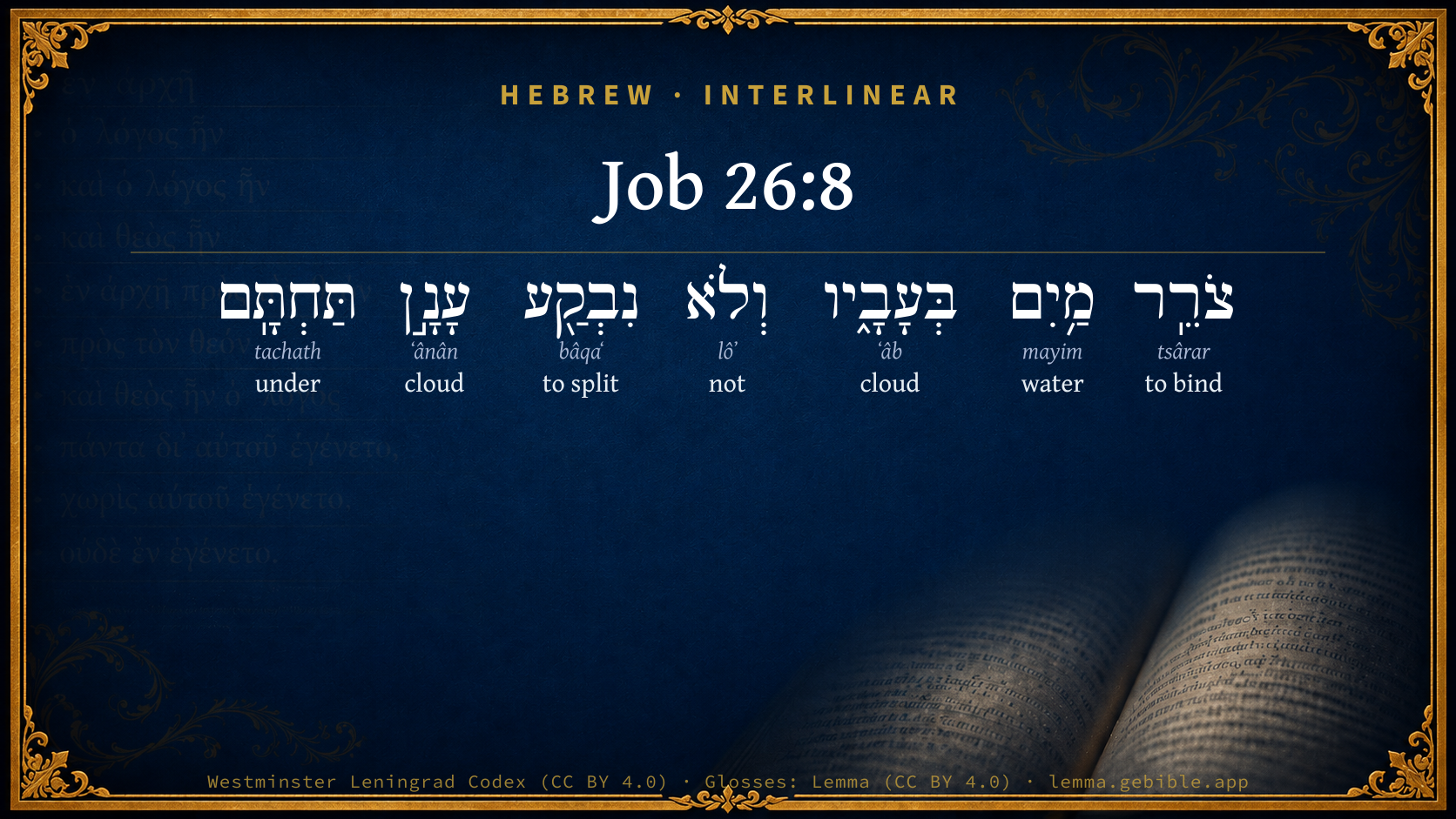
Job 26:8

Hebrew (Westminster Leningrad Codex) Job 26:8 appears in the Hebrew Old Testament. The text above is from the Westminster Leningrad Codex. Each word links to its Strong’s number, a concise gloss, and parsing drawn from the Open Scriptures Hebrew Bible morphology. Click any word for its full Brown-Driver-Briggs (BDB) entry.
Download image
Cite this verse

Job 26:8 (World English Bible). Public Domain. Lemma interlinear Bible study tool, https://lemma.gebible.app/v/job/26/8.

Show BibTeX & RIS
BibTeX
RIS
English Translation
He binds up the waters in his thick clouds, And the cloud is not burst under them.
World English Bible · Public Domain
Download a study sheet

One document with this verse’s original text, its word-by-word gloss line, the meaning frame, cross-references with their text, attributed commentary, and full source and license credits — printable, and it pastes into notes with its structure intact.

This verse Autodidact and up

Study sheet (.html) Plain text (.txt)

A passage Seminary Student

Up to 50 verses in one chapter. A passage sheet keeps up to 6 commentary sources and 12 cross-references per verse, in the order this page ranks them, and says so on the sheet whenever that leaves anything out. Ask for a single verse and you get the Autodidact verse sheet above.

Everything on this page stays free to read, with no account — the sheet is a download of what is already on screen, not access to it.

Want to remove ads? Support Godless Engineer
Compare translations 3

The same verse in 3 English versions, stacked beneath the original-language interlinear above. Click any original word for its lexicon entry.

Each is an independent rendering of the whole verse — the interlinear is not word-aligned to these translations.

Highlighted words mark where these versions differ — a whole-verse word diff, not a word-by-word alignment.

  • World English Bible Public Domain
    He binds up the waters in his thick clouds, And the cloud is not burst under them.
  • King James Version Public Domain
    He bindeth up the waters in his thick clouds; and the cloud is not rent under them.
  • unfoldingWord Literal Text CC BY-SA 4.0
    the one binding the waters in his clouds, but the cloud is not torn under them;

unfoldingWord Literal Text — © unfoldingWord, licensed CC BY-SA 4.0. Word-aligned USFM3 via Door43 (git.door43.org/unfoldingWord/en_ult).

Versions to compare (up to 4)

3 of 4 selected

Show all 18 translations

Every available English version of this verse, each an independent rendering of the whole verse.

  • World English Bible Public Domain
    He binds up the waters in his thick clouds, And the cloud is not burst under them.
  • Berean Standard Bible Public Domain
    He wraps up the waters in His clouds, yet the clouds do not burst under their own weight.
  • Majority Standard Bible Public Domain
    He wraps up the waters in His clouds, yet the clouds do not burst under their own weight.
  • King James Version Public Domain
    He bindeth up the waters in his thick clouds; and the cloud is not rent under them.
  • American Standard Version (1901) Public Domain
    He bindeth up the waters in his thick clouds; And the cloud is not rent under them.
  • Revised Version (1885) Public Domain
    He bindeth up the waters in his thick clouds; and the cloud is not rent under them.
  • Geneva Bible (1599) Public Domain
    He bindeth the waters in his cloudes, and the cloude is not broken vnder them.
  • Douay-Rheims (1899) Public Domain
    He bindeth up the waters in his clouds, so that they break not out and fall down together.
  • Young's Literal Translation Public Domain
    Binding up the waters in His thick clouds, And the cloud is not rent under them.
  • Literal Standard Version CC BY-SA 4.0
    Binding up the waters in His thick clouds, || And the cloud is not burst under them.
  • Unlocked Literal Bible CC BY-SA 4.0
    He binds up the waters in his thick clouds, but the clouds are not torn under them.
  • unfoldingWord Literal Text CC BY-SA 4.0
    the one binding the waters in his clouds, but the cloud is not torn under them;
  • Darby Bible Public Domain
    He bindeth up the waters in his thick clouds, and the cloud is not rent under them.
  • World Messianic Bible Public Domain
    He binds up the waters in his thick clouds, and the cloud is not burst under them.
  • Webster's Bible Public Domain
    He bindeth up the waters in his thick clouds; and the cloud is not rent under them.
  • Free Bible Version CC BY-SA 4.0
    He gathers the rain in his storm clouds which do not break under the weight.
  • Bible in Basic English Public Domain
    By him the waters are shut up in his thick clouds, and the cloud does not give way under them.
  • JPS Tanakh (1917) Public Domain
    He bindeth up the waters in His thick clouds; and the cloud is not rent under them.

Literal Standard Version (2020), Covenant Press — licensed CC BY-SA 4.0. Text via the HelloAO Bible API (eBible.org). Unlocked Literal Bible (unfoldingWord) — licensed CC BY-SA 4.0. Text via the HelloAO Bible API (eBible.org). unfoldingWord Literal Text — © unfoldingWord, licensed CC BY-SA 4.0. Word-aligned USFM3 via Door43 (git.door43.org/unfoldingWord/en_ult). Free Bible Version, Dr. Jonathan Gallagher — licensed CC BY-SA 4.0. Text via the HelloAO Bible API (eBible.org).

Word by word

More ways to search: Search by grammar → Find every occurrence → Compare this word →

Practice this passage: Drill this verse → Learn its vocabulary →

About this verse

These counts appear in no published source. They are computed here, from the morphology-tagged text and Lemma’s own curated glosses. What Lemma adds →

7
words
7
distinct lemmas
Wisdom
section

Shared distinctive vocabulary

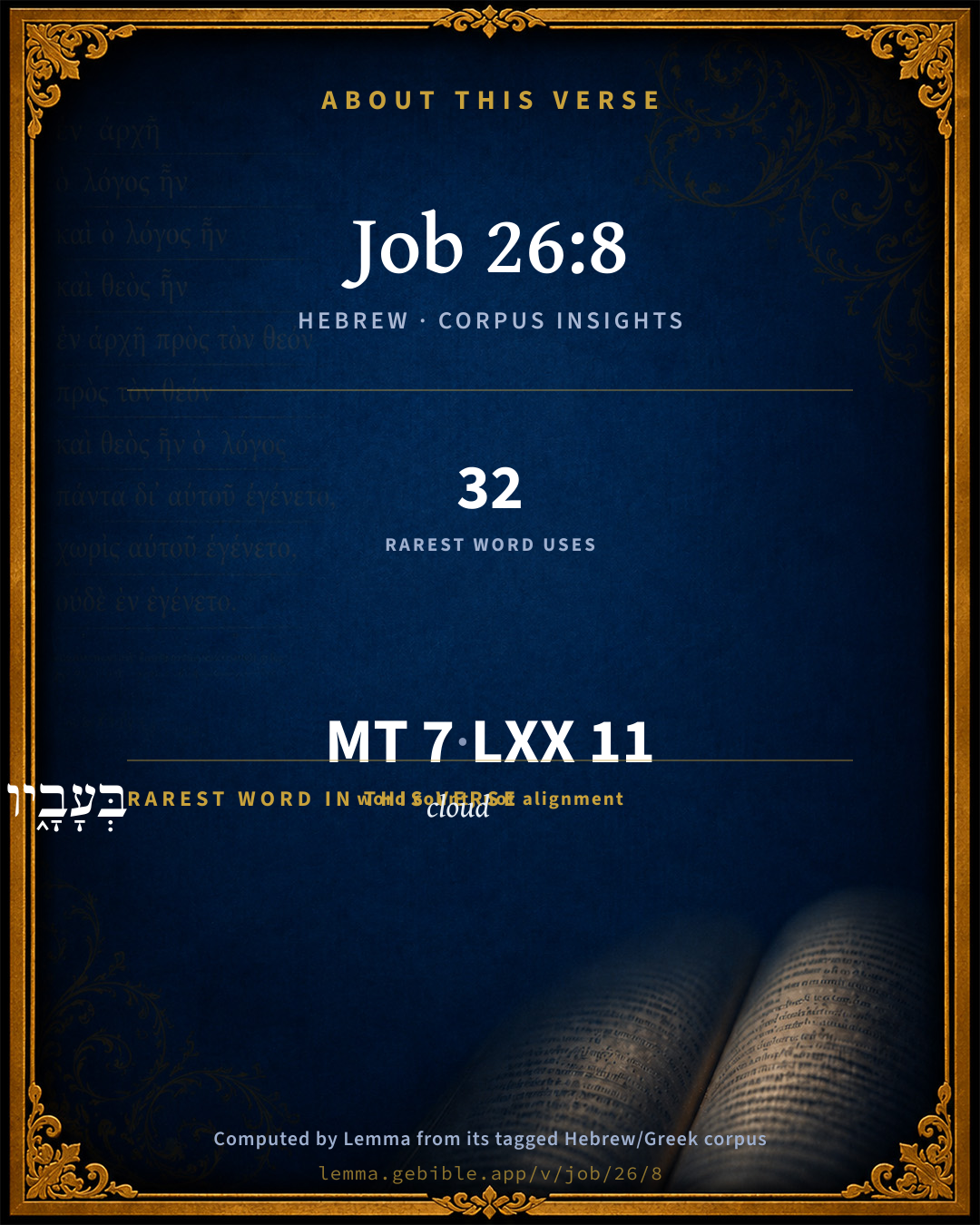
בְּעָבָ֑יו cloud H5645 occurs in 32 verses of the Hebrew Bible. Also found in:

Grammatical profile

  • 2 verbs
  • 3 nouns
  • 1 preposition
  • 1 particle

Verb forms

  • צֹרֵֽר Qal · Participle Active
  • נִבְקַ֖ע Niphal · Perfect

Hebrew & Septuagint length

In English translation the verse runs 17 words from the Hebrew and 13 from the Septuagint (LXX English) — closely comparable.

A rough comparison of the two English renderings, which tokenize alike — not a word-level alignment.

Word counts can differ between the Hebrew and the Greek without any difference in meaning — e.g. the Hebrew direct-object marker אֵת has no separate Greek word, and Greek often adds the article ὁ.

In the original languages it is 7 Hebrew tokens and 11 Greek tokens — but the two are counted differently (Hebrew bundles its prefixes and suffixes into one token; the Greek is in lemma form), so that isn’t a like-for-like length.

Cross-references

10

Topical passages linked to Job 26:8 in the Treasury of Scripture Knowledge — connected by theme and wording, ordered by reader-vote popularity; previews shown in the World English Bible.

  • Job 37:11–16 Yes, he loads the thick cloud with moisture. He spreads abroad the cloud of his lightning.
  • Proverbs 30:4 Who has ascended up into heaven, and descended? Who has gathered the wind in his fists? Who has bound the waters in his garment? Who has established all the ends of the earth? What is his name, and what is his son's name, if you know?
  • Jeremiah 10:13 when he utters his voice, there is a tumult of waters in the heavens, and he causes the vapors to ascend from the ends of the earth; he makes lightnings for the rain, and brings forth the wind out of his treasuries.
  • Isaiah 5:6 I will lay it a wasteland. It won't be pruned nor hoed, But it will grow briers and thorns. I will also command the clouds that they rain no rain on it."
  • Job 38:9 When I made clouds the garment of it, Thick darkness a swaddling-band for it,
  • Job 38:37 Who can number the clouds by wisdom? Or who can pour out the bottles of the sky,
  • Psalms 18:10–11 He rode on a cherub, and flew. Yes, he soared on the wings of the wind.
  • Psalms 135:7 Who causes the clouds to rise from the ends of the earth; Who makes lightnings with the rain; Who brings forth the wind out of his treasuries;
  • Genesis 1:6–7 God said, "Let there be an expanse in the midst of the waters, and let it divide the waters from the waters."
  • Job 36:29 Yes, can any understand the spreading of the clouds, And the thunderings of his pavilion?

Cross-references courtesy of OpenBible.info (CC BY 4.0).

Hebrew and Greek witnesses Masoretic Hebrew ↔ Greek Septuagint

The same verse in the two great witnesses to the Old Testament, shown verse-for-verse.

These are two independent witnesses, not word-aligned to each other, and the Septuagint is shown in lemma (dictionary) form.

Hebrew Job 26:8 Masoretic · Westminster Leningrad Codex

צֹרֵֽר מַ֥יִם בְּעָבָ֑יו וְלֹא נִבְקַ֖ע עָנָ֣ן תַּחְתָּֽם

He binds up the waters in his thick clouds, And the cloud is not burst under them.

World English Bible · Public Domain

Greek LXX Job 26:8 Septuagint · lemma form

δεσμεύω ὕδωρ ἐν νεφέλη αὐτός καί οὐ ῥήγνυμι νέφος ὑποκάτω αὐτός

binding water in his clouds, and the cloud is not torn under it.

LXX2012 (modern English Septuagint) · Public Domain

On this verse, Keil & Delitzsch discusses the Septuagint’s reading. Read the note in Commentary ↓

Hebrew: Westminster Leningrad Codex (CC BY 4.0). Greek: Septuagint (public domain); English from LXX2012 (modern English Septuagint) (Public Domain). How the Septuagint differs from the Hebrew →

Commentary

Notes on Job 26:8 from classic Christian and Jewish commentators (each source and its license shown beneath its notes). The classic Christian expositions comment on the surrounding passage and are grouped to its opening verse, so a note may address several verses; the Jewish commentaries on the Tanakh (Rashi and others) are per-verse, so they appear only where the commentator wrote on this verse.

Lemma curates 59 commentaries, every one of them public domain or Creative Commons licensed, each selected and text-cleaned for this edition rather than reprinted as found. About our sources →

Trapp's Complete Commentary

John Trapp

Job 26:8 He bindeth up the waters in his thick clouds; and the cloud is not rent under them.

Ver. 8. He bindeth up the waters in his thick clouds] Heb. Clouds, which yet have their name from thickness, because they arise from air condensed. In these God bottleth up the rain, and there keepeth it in by main strength (as the word signifieth), though those vessels are as thin and thinner than the liquor that is contained in them. This, duly weighed, were enough to convince an atheist, especially if he consider how.

The cloud is not rent under them] And so causeth a cataclism to drown the earth; as sometimes at sea, especially, great harm is done this way among the ships, by a water spout, as mariners call it, the Greek εξυδρια, and the Dutch Ein Wolckenbruch, or a breach of heaven; viz. when clouds cleave asunder, and discharge themselves all at once, for a great mischief to mankind. Now that God thus binds up these heavy vapours, and keeps them in the clouds, as a strong man in a cobweb, till brought by the winds whithersoever he pleaseth to appoint them, they drop upon the earth by little and little, to make it fruitful; this is a wonderful work of God, and should bring us to the knowledge of his power, wisdom, and goodness, Rom 1:19-20 Job 38:37 Jer 5:22.

John Trapp, A Commentary or Exposition upon All the Books of the Old and New Testament (1647–1656) — public domain. Text from a community e-Sword module.

The Biblical Illustrator

Joseph S. Exell

Job_26:8

He bindeth up the waters in His thick clouds.

Water and its wonderful transportation by clouds

The average quantity of aqueous vapour, or water held in the air, is estimated to be 54,460,000,000,000 tons. The annual amount of rainfall is estimated to be 186,240 cubic miles. If this rain were at any one moment equally spread over the land portion of the globe, it would cover all the continents with water three feet deep. Reflect now that water in its natural state is 773 times heavier than air. And now suppose that you had never heard or conceived of the principle of evaporation, and that you were required to lift up this vast mass of 54,460,000,000,000 tons of water one mile, two, three, four or five miles high into the air, and keep it suspended there. Well, what man, or all mankind combined cannot do, or begin to do, God did on that second day of creation, and does daily. Water as vapour occupies 1600 times larger space than water as liquid. Hence, water as vapour is lighter than air, and naturally ascends. That is the whole secret. How manifold are the works of God. (G. D. Boardman.)

The Biblical Illustrator, edited by Joseph S. Exell (c. 1880s–1900s) — public domain. Text from a community e-Sword module.

Joseph Benson's Commentary

Job 26:8. He bindeth up the waters — Those fluid and heavy bodies, pressing downward with great force; in his thick clouds — As it were in bags, keeping them there suspended often for a long time; and the cloud is not rent under them — But sustains them, notwithstanding their great weight, so that they do not burst forth all at once, and fall suddenly and violently upon the earth, but distil in dews, drops, and showers, to moisten, refresh, and fertilize it in due season.

Joseph Benson's Commentary on the Old and New Testaments (1811–1818) — public domain. Text from a community e-Sword module.

Whedon's Commentary on the Bible

Daniel D. Whedon

Second strophe — In lofty flight Job’s imagination rises from the under world and the earth to the heavens, the seat of God’s throne, and thence surveys the enshrouding clouds (Psa_18:11) and the confines of light and darkness, Job_26:8-10.

8. The waters in his thick clouds — That an inconceivable weight of water should be suspended mid-heaven, not unlike the earth, self-balanced, struck Job as a never ceasing manifestation of divine power. Compare Job_37:16.

Daniel D. Whedon (gen. ed.), Commentary on the Old and New Testaments (1874–1909) — public domain. Text from a community e-Sword module.

Jamieson, Fausset & Brown

Robert Jamieson, A. R. Fausset & David Brown

in . . . clouds--as if in airy vessels, which, though light, do not burst with the weight of water in them (Pro 30:4).

Jamieson, Fausset & Brown — Commentary Critical and Explanatory on the Whole Bible (1871) — public domain (CC PDM 1.0). Text via the HelloAO Bible API.

Adam Clarke's Commentary

Verse 8. He bindeth up the waters] Drives the aqueous particles together, which were raised by evaporation, so that, being condensed, they form clouds which float in the atmosphere, till, meeting with strong currents of wind, or by the agency of the electric fluid, they are farther condensed; and then, becoming too heavy to be sustained in the air, fall down in the form of rain, when, in this poetic language, the cloud is rent under them.

Adam Clarke's Commentary on the Bible (1810–1826) — public domain. Text from a community e-Sword/MySword module.

Ellicott's Commentary for English Readers

(8) He bindeth up the waters.—The idea of the waters being bound up in the clouds, so that the clouds are not rent thereby, is similar to that in Gen_1:7. The conception is that of a vast treasury of water above the visible sky, which is kept there in apparent defiance of what we know as the laws of gravitation, and which all experience would show was liable to fall of itself.

A Bible Commentary for English Readers, edited by Charles John Ellicott (1878–1897) — public domain. Text from a community e-Sword module.

The Cambridge Bible for Schools and Colleges

gen. ed. J. J. S. Perowne

8. The wonder of the clouds, floating reservoirs of water, which do not burst under the weight of waters which they contain. Men bind up water in skins or bottles, God binds up the rain floods in the thin, gauzy texture of the changing cloud, which yet by His power does not rend under its burden of waters. Comp. Pro_30:4; Job_38:37.

The Cambridge Bible for Schools and Colleges (gen. ed. J. J. S. Perowne; Cambridge University Press, 1878–1918) — public domain. Text from a community e-Sword module.

John Gill's Exposition

He bindeth up the waters in his thick clouds,.... The clouds are of his making; when he utters his voice, or gives the word of command, there is a multitude of waters in the heavens; and the vapours he exhales from the ends of the earth and forms them into clouds, and they are his chariots, in which he rides up and down in the heavens, and waters his gardens and plantations on earth; see Jer 10:13; which may be said to be thick in comparison of the air, in which they are; otherwise they are but thin, and the thinner they are, the greater wonder it is that the waters, and such a heavy body of them, should be bound up in them, as there often is; and which is bound up, held, and retained therein, as anything bound up in a sack or bag, or in a garment, or the skirt of a man's coat; see Pro 30:4; and what is still more marvellous:

and the cloud is not rent under them; under the waters, and through the weight of them; which, if it was, would fall in vast water spouts, and were such to fall upon the earth, as it may be supposed they did at the general deluge, they would destroy man and beast, and wash off and wash away the things of the earth: but God has so ordered it in his infinite wisdom, and by his almighty power, that clouds should not be thus rent, but fall in small drops and gentle showers, as if they passed through a sieve or colander, whereby the earth is refreshed, and made fruitful; see Job 36:26.

John Gill's Exposition of the Whole Bible (1746–1763) — public domain (CC PDM 1.0). Text via the HelloAO Bible API.

Albert Barnes' Notes on the Bible

He bindeth up the waters in his thick clouds - That is, he seems to do it, or to collect the waters in the clouds, as in bottles or vessels. The clouds appear to hold the waters, as if bound up, until he is pleased to send them drop by drop upon the earth.

And the cloud is not rent under them - The wonder which Job here expresses is, that so large a quantity of water as is poured down from the clouds, should be held suspended in the air without seeming to rend the cloud, and falling all at once. His image is that of a bottle, or vessel, filled with water, suspended in the air, and which is not rent. What were the views which he had of the clouds, of course it is impossible now to say. If he regarded them as they are, as vapors, or if he considered them to be a more solid substance, capable of holding water, there was equal ground for wonder. In the former case, his amazement would have arisen from the fact, that so light, fragile, and evanescent a substance as vapor should contain so large a quantity of water; in the latter case, his wonder would have been that such a substance should distil its contents drop by drop. There is equal reason for admiring the wisdom of God in the production of rain, now that the cause is understood. The clouds are collections of vapors. They contain moisture, or vapor, which ascends from the earth, and which is held in suspension when in small particles in the clouds; as, when a room is swept, the small particles of dust will be seen to float in the room. When these small particles are attracted, and form masses as large as drops, the air will no longer sustain them, and they fall to the earth. Man never could have devised a way for causing rain; and the mode in which it is provided that large quantities of water shall be borne from one place to another in the air, and made to fall when it is needed, by which the vapors that ascend from the ocean shall not be suffered to fall again into the ocean, but shall be carried on to the land, is adapted to excite our admiration of the wisdom of God now, no less than it was in the time of Job.

Albert Barnes' Notes on the Bible (1834–1885) — public domain. Text from a community e-Sword/MySword module.

Haydock's Catholic Bible Commentary

Clouds, as in a vessel or garment, Proverbs xxx. 4.

George Leo Haydock (1774–1849), Haydock's Catholic Family Bible and Commentary, 1859 edition — public domain. Excludes Psalms (Douay-Rheims chapter numbering differs from Protestant) and Deuterocanonical books (Catholic canon only).

Matthew Poole's English Annotations

This also is a miraculous work of God, considering the nature of these waters, which are fluid and heavy, and pressing downward, especially being ofttimes there in great abundance; and withal, the quality of the clouds, which are thin and loose bodies of the same nature with fogs and mists upon the face of the earth, and therefore of themselves utterly unable to bear that weight, and to keep up those waters from falling suddenly and violently upon the earth.

Matthew Poole's English Annotations on the Holy Bible (1683–1685) — public domain. Text from a community e-Sword/MySword module.

The Pulpit Commentary

He bindeth up the waters in his thick clouds; i.e. he makes the clouds, that we see floating in the atmosphere, contain and hold the waters on which the productiveness of the earth depends, and which he restrains, or allows to fall in fertilizing rain, at his pleasure. (comp. 1Ki_17:1) And the cloud is not rent under them. The metaphor is, no doubt, drawn from those water-skins, so well known in the East, and especially in Arabia, in which men stored the water for their journeys and other needs, which were liable to be "rent" by the weight of the liquid within them.

Clouds.

As we proceed through the poem we cannot but be struck with the wonderful wealth of its nature-imagery, which continues to open out with ever-increasing luxuriance till it reaches its fulness in the burst of splendour that accompanies the final theophany. Each aspect of nature touched by the poet has its special lessons. Now he calls us to look at the gorgeous pageantry of the clouds. Here truths of Divine order and government are displayed before our eyes.

I CLOUDS ARE OF DIVINE ORIGIN. God bindeth up the waters; the thick clouds are his. Whenever we touch nature we should move with reverence, for we are in the temple of God. Whether we understand the clouds, whether we can see the wisdom by which they are shaped and led out over the heavens or not, at least we must discuss them with the humility that becomes a consideration of the works of the infinitely Wise and the perfectly Good.

II CLOUDS ARE BENEFICIAL TO THE WORLD. In Southern countries they are greatly valued both for their shade and for the much-needed showers they bring to the parched land. The arrangement by which they float overhead, and then descend on broad areas in finely distributed drops of water, makes man"s most advanced system of irrigation look childish and clumsy. Great masses of water are stored aloft and driven through the air, and made to descend so that every minute plant is watered, and not a blade of grass is crushed. Here is the perfection of the art of distribution.

III CLOUDS ILLUSTRATE THE MUTUAL MINISTRIES OF NATURE. Drawn up from the sea in invisible vapour, driven over the land by strong winds, condensed against the mountains or in cool currents of the upper air, descending in gentle rain over fields and gardens, over woods and hills and plains, trickling through the soil, breaking out in little springs, streaming down the slopes in minute rills, gathering supplies from all directions in the valleys, and flowing back to the sea in full-fed rivers, the water of the clouds moves through a circuit, every stage of which is of use in the economy of nature, while the whole is completed by the help of many forces and circumstances.

IV CLOUDS COME AS MERCIES IN DISGUISE. Thick clouds are black and ugly, hiding the blue sky, and casting gloom on the earth. They do not always have a silver lining. They may be heavy and lowering, sombre and threatening. Yet they burst in refreshing showers. When shall we believe that it is the same with those apprehensions of trouble which are really the chariots in which God"s love rides?

V CLOUDS ARE BEAUTIFUL IN THE SUNLIGHT. It is only a difference of light, and their gloom is turned into splendour. When the sun touches the clouds it sets them on fire. Morning and evening unroll leagues of rose and gold curtains on the distant horizon. When God"s love touches our clouds, by a magic alchemy they pass into heavenly beauty.

VI CLOUDS ARE FLEETING AND TRANSIENT. Molded out of invisible vapours, they melt while we gaze at them. Their high bastions and clustered domes, their silvery lakes and purple mountains, are in rapid dissolution. For they must serve their purpose. They must vanish to fulfil their mission. Earthly joys like palaces of cloudland, earthly terrors like its gloomy shadows, both melt away, and must do so to serve their purpose of blessing and discipline. But beyond the clouds is the blue sky. We are thankful for the clouds. But we must neither cling to them, nor shrink from them. Standing on the solid earth, our lasting hope is in the eternal heavens. W.F.A.

The Pulpit Commentary (1880–1919), ed. H.D.M. Spence-Jones & Joseph S. Exell — public domain. Text from a community e-Sword module.

Keil & Delitzsch

C. F. Keil & F. Delitzsch

8 He bindeth up the waters in His clouds,

Without the clouds being rent under their burden.

9 He enshroudeth the face of His throne,

Spreading His clouds upon it.

10 He compasseth the face of the waters with bounds,

To the boundary between light and darkness.

The clouds consist of masses of water rolled together, which, if they were suddenly set free, would deluge the ground; but the omnipotence of God holds the waters together in the hollow of the clouds (צרר, Milel, according to a recognised law, although it is also found in Codd. accented as Milra, but contrary to the Masora), so that they do not burst asunder under the burden of the waters (תּחתּם); by which nothing more nor less is meant, than that the physical and meteorological laws of rain are of God's appointment. Job 26:9 describes the dark and thickly-clouded sky that showers down the rain in the appointed rainy season. אחז signifies to take hold of, in architecture to hold together by means of beams, or to fasten together (vid., Thenius on Kg1 6:10, comp. Ch2 9:18, מאחזים, coagmentata), then also, as usually in Chald. and Syr., to shut (by means of cross-bars, Neh 7:3), here to shut off by surrounding with clouds: He shuts off פּני־כסּה, the front of God's throne, which is turned towards the earth, so that it is hidden by storm-clouds as by a סכּה, Job 36:29; Psa 18:12. God's throne, which is here, as in Kg1 10:19, written כּסּה instead of כּסּא (comp. Arab. cursi, of the throne of God the Judge, in distinction from Arab. 'l-‛arš, the throne of God who rules over the world),

(Note: According to the more recent interpretation, under Aristotelian influence, Arab. 'l-‛rš is the outermost sphere, which God as πρῶτον κινοῦν having set in motion, communicates light, heat, life, and motion to the other revolving spheres; for the causae mediae gradually descend from God the Author of being (muhejji) from the highest heaven into the sublunary world.)

is indeed in other respects invisible, but the cloudless blue of heaven is His reflected splendour (Exo 24:10) which is cast over the earth. God veils this His radiance which shines forth towards the earth, פּרשׁז אליו עננו, by spreading over it the clouds which are led forth by Him. פּרשׁו is commonly regarded as a Chaldaism for פּרשׁז (Ges. 56, Olsh. 276), but without any similar instance in favour of this vocalizaton of the 3 pr. Piel (Pil.). Although רענן and שׁאנן, Job 15:32; Job 3:18, have given up the i of the Pil., it has been under the influence of the following guttural; and although, moreover, i before Resh sometimes passes into a, e.g., ויּרא, it is more reliable to regard פרשז as inf. absol. (Ew. 141, c): expandendo. Ges. and others regard this פרשז as a mixed form, composed from פרשׁ and פרז; but the verb פרשׁ (with Shin) has not the signification to expand, which is assumed in connection with this derivation; it signifies to separate (also Eze 34:12, vid., Hitzig on that passage), whereas פרשׂ certainly signifies to expand (Job 36:29-30); wherefore the reading פּרשׂז (with Sin), which some Codd. give, is preferred by Br, and in agreement with him by Luzzatto (vid., Br's Leket zebi, p. 244), and it seems to underlie the interpretation where פרשז עליו is translated by עליו (פּרשׂ) פרש, He spreadeth over it (e.g., by Aben-Ezra, Kimchi, Ralbag). But the Talmud, b. Sabbath, 88 b (פירש שדי מזיו שכינתו ועננו עליו, the Almighty separated part of the splendour of His Shechina and His cloud, and laid it upon him, i.e., Moses, as the passage is applied in the Haggada), follows the reading פּרשׁז (with Shin), which is to be retained on account of the want of naturalness in the consonantal combination שׂז; but the word is not to be regarded as a mixed formation (although we do not deny the possibility of such forms in themselves, vid., supra, p. 468), but as an intensive form of פרשׂ formed by Prosthesis and an Arabic change of Sin into Shin, like Arab. fršḥ, fršd, fršṭ, which, being formed from Arab. frš = פּרשׂ (פּרשׂ), to expand, signifies to spread out (the legs).

Job 26:10 passes from the waters above to the lower waters. תּכלית signifies, as in Job 11:7; Job 28:3; Neh 3:21, the extremity, the extreme boundary; and the connection of תּכלית אור is genitival, as the Tarcha by the first word correctly indicates, whereas אור with Munach, the substitute for Rebia mugrasch In this instance (according to Psalter, ii. 503, 2), is a mistake. God has marked out (חן, lxx ἐγύρωσεν) a law, i.e., here according to the sense: a fixed bound (comp. Pro 8:29 with Psa 104:9), over the surface of the waters (i.e., describing a circle over them which defines their circuit) unto the extreme point of light by darkness, i.e., where the light is touched by the darkness. Most expositors (Rosenm., Hirz., Hahn, Schlottm., and others) take עד־תכלית adverbially: most accurately, and refer חג to אור as a second object, which is contrary to the usage of the language, and doubtful and unnecessary. Pareau has correctly interpreted: ad lucis usque tenebrarumque confinia; עם in the local sense, not aeque ac, although it might also have this meaning, as e.g., Ecc 2:16. The idea is, that God has appointed a fixed limit to the waters, as far as to the point at which they wash the terra firma of the extreme horizon, and where the boundary line of the realms of light and darkness is; and the basis of the expression, as Bouillier, by reference to Virgil's Georg. i. 240f., has shown, is the conception of the ancients, that the earth is surrounded by the ocean, on the other side of which the region of darkness begins.

Keil & Delitzsch — Biblical Commentary on the Old Testament (1861–1891) — public domain (CC PDM 1.0). Text via the HelloAO Bible API. (Old Testament only.)

Rashi

Rabbi Shlomo Yitzchaki (Rashi)

and the cloud does not split It never [split] so that its water [i.e., rain] should fall together.

beneath it Beneath the water.

Rashi on the Tanakh — English translations: “The Judaica Press complete Tanach with Rashi, translated by A. J. Rosenberg” (CC BY 4.0); “Pentateuch with Rashi's commentary by M. Rosenbaum and A.M. Silbermann, 1929-1934” (public domain); “The Metsudah Tanach series, Lakewood, N.J” (CC BY 4.0); and “The Book of Joshua, Metsudah Publications, 1997” (CC BY 4.0). Text via Sefaria.

Lesson kit

Teaching starters — assembled from the data on this page, not authored interpretation. Every prompt links to the verse data it draws on. Edit before teaching.

Job, in the Wisdom, opens this verse with 7 words (7 distinct Hebrew lemmas). Its most distinctive word is ʻâb (“cloud”). A historical commentator’s framing appears above. Read the whole chapter for the surrounding context.

Discussion questions

  1. What does “cloud” (ʻâb) contribute to the verse as a whole?
  2. How does Exodus 19:9, which shares the word «cloud», read alongside this verse?
  3. These translations render this verse differently; the difference is in the English rendering, not the original. What questions does that raise?
  4. «צֹרֵֽר» is a Qal Participle Active verb. How does that grammatical form shape the action described?
  5. Compare how Trapp's Complete Commentary and The Biblical Illustrator read this verse. Where do they agree or differ?

Things to notice

Reading settings

Reading text

Shown beneath each verse's original-language words.

Old Testament
Old Testament edition

Read the OT as the Masoretic Hebrew (MT) or the Greek Septuagint (LXX).

English shown for the Greek Septuagint (in the Hebrew ↔ Greek comparison).

Comparing translations? Open the Compare panel on any verse page to stack up to four side by side.