
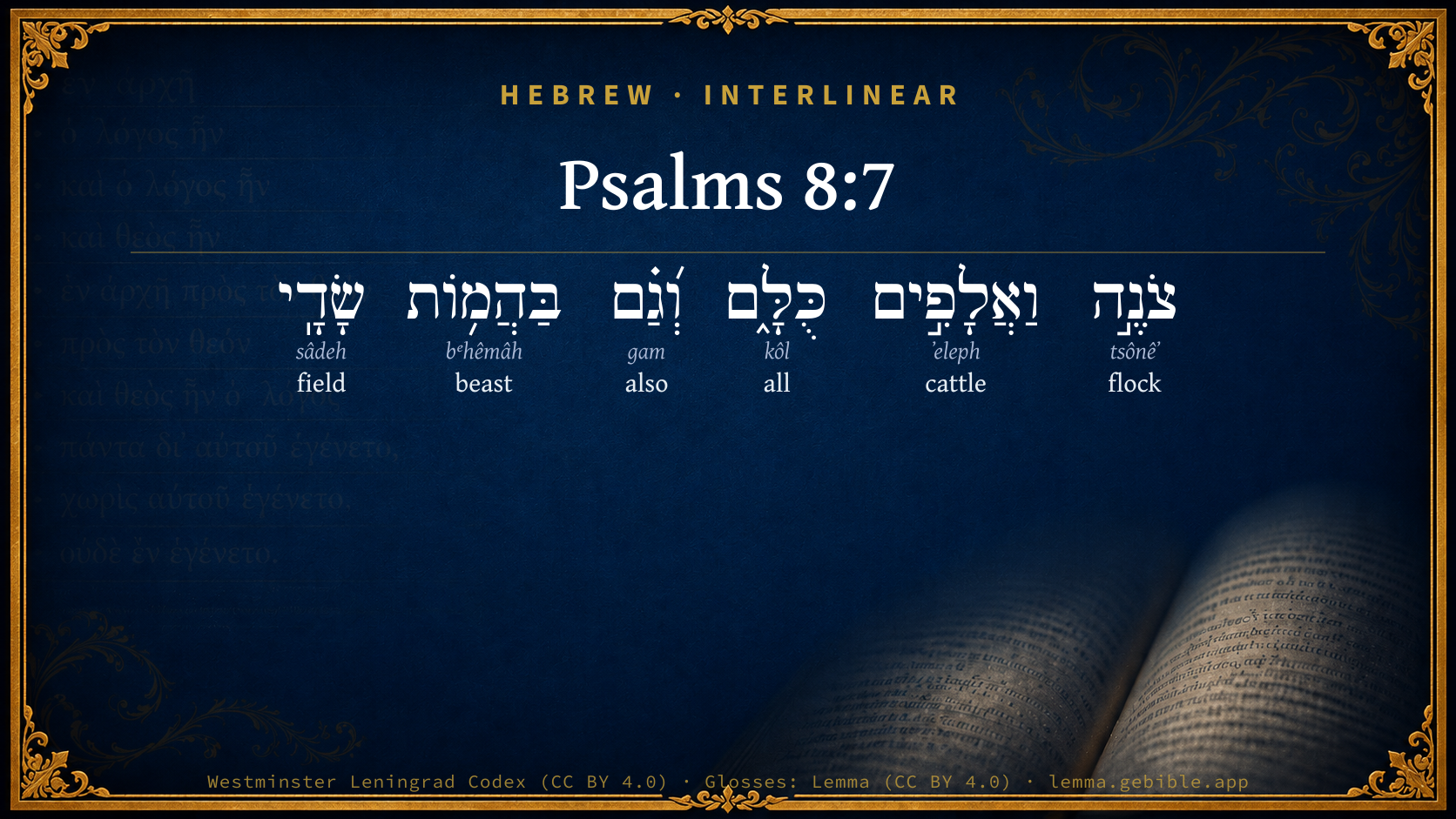
Psalms 8:7

Hebrew (Westminster Leningrad Codex) Psalms 8:7 appears in the Hebrew Old Testament. The text above is from the Westminster Leningrad Codex. Each word links to its Strong’s number, a concise gloss, and parsing drawn from the Open Scriptures Hebrew Bible morphology. Click any word for its full Brown-Driver-Briggs (BDB) entry.
Download image
Cite this verse

Psalms 8:7 (World English Bible). Public Domain. Lemma interlinear Bible study tool, https://lemma.gebible.app/v/psalms/8/7.

Show BibTeX & RIS
BibTeX
RIS
English Translation
All sheep and oxen, Yes, and the animals of the field,
World English Bible · Public Domain
Download a study sheet

One document with this verse’s original text, its word-by-word gloss line, the meaning frame, cross-references with their text, attributed commentary, and full source and license credits — printable, and it pastes into notes with its structure intact.

This verse Autodidact and up

Study sheet (.html) Plain text (.txt)

A passage Seminary Student

Up to 50 verses in one chapter. A passage sheet keeps up to 6 commentary sources and 12 cross-references per verse, in the order this page ranks them, and says so on the sheet whenever that leaves anything out. Ask for a single verse and you get the Autodidact verse sheet above.

Everything on this page stays free to read, with no account — the sheet is a download of what is already on screen, not access to it.

Want to remove ads? Support Godless Engineer
Compare translations 3

The same verse in 3 English versions, stacked beneath the original-language interlinear above. Click any original word for its lexicon entry.

Each is an independent rendering of the whole verse — the interlinear is not word-aligned to these translations.

Highlighted words mark where these versions differ — a whole-verse word diff, not a word-by-word alignment.

  • World English Bible Public Domain
    All sheep and oxen, Yes, and the animals of the field,
  • King James Version Public Domain
    All sheep and oxen, yea, and the beasts of the field;
  • unfoldingWord Literal Text CC BY-SA 4.0
    sheep and oxen—all of them, and also the animals of the field,

unfoldingWord Literal Text — © unfoldingWord, licensed CC BY-SA 4.0. Word-aligned USFM3 via Door43 (git.door43.org/unfoldingWord/en_ult).

Versions to compare (up to 4)

3 of 4 selected

Show all 18 translations

Every available English version of this verse, each an independent rendering of the whole verse.

  • World English Bible Public Domain
    All sheep and oxen, Yes, and the animals of the field,
  • Berean Standard Bible Public Domain
    all sheep and oxen, and even the beasts of the field,
  • Majority Standard Bible Public Domain
    all sheep and oxen, and even the beasts of the field,
  • King James Version Public Domain
    All sheep and oxen, yea, and the beasts of the field;
  • American Standard Version (1901) Public Domain
    All sheep and oxen, Yea, and the beasts of the field,
  • Revised Version (1885) Public Domain
    All sheep and oxen, yea, and the beasts of the field;
  • Geneva Bible (1599) Public Domain
    All sheepe and oxen: yea, and the beastes of the fielde:
  • Douay-Rheims (1899) Public Domain
    and hast set him over the works of thy hands.
  • Young's Literal Translation Public Domain
    Sheep and oxen, all of them, And also beasts of the field,
  • Literal Standard Version CC BY-SA 4.0
    Sheep and oxen, all of them, || And also beasts of the field,
  • Unlocked Literal Bible CC BY-SA 4.0
    all sheep and oxen, and even the animals of the field,
  • unfoldingWord Literal Text CC BY-SA 4.0
    sheep and oxen—all of them, and also the animals of the field,
  • Darby Bible Public Domain
    Sheep and oxen, all of them, and also the beasts of the field;
  • World Messianic Bible Public Domain
    All sheep and cattle, yes, and the animals of the field,
  • Webster's Bible Public Domain
    \\8:6\\Thou hast made him to have dominion over the works of thy hands; thou hast put all things under his feet:
  • Free Bible Version CC BY-SA 4.0
    the sheep, the cattle, and the wild animals,
  • Bible in Basic English Public Domain
    All sheep and oxen, and all the beasts of the field;
  • JPS Tanakh (1917) Public Domain
    (8-8) Sheep and oxen, all of them, yea, and the beasts of the field;

Literal Standard Version (2020), Covenant Press — licensed CC BY-SA 4.0. Text via the HelloAO Bible API (eBible.org). Unlocked Literal Bible (unfoldingWord) — licensed CC BY-SA 4.0. Text via the HelloAO Bible API (eBible.org). unfoldingWord Literal Text — © unfoldingWord, licensed CC BY-SA 4.0. Word-aligned USFM3 via Door43 (git.door43.org/unfoldingWord/en_ult). Free Bible Version, Dr. Jonathan Gallagher — licensed CC BY-SA 4.0. Text via the HelloAO Bible API (eBible.org).

Word by word

More ways to search: Search by grammar → Find every occurrence → Compare this word →

Practice this passage: Drill this verse → Learn its vocabulary →

About this verse

These counts appear in no published source. They are computed here, from the morphology-tagged text and Lemma’s own curated glosses. What Lemma adds →

6
words
6
distinct lemmas
Wisdom
section

Notable vocabulary

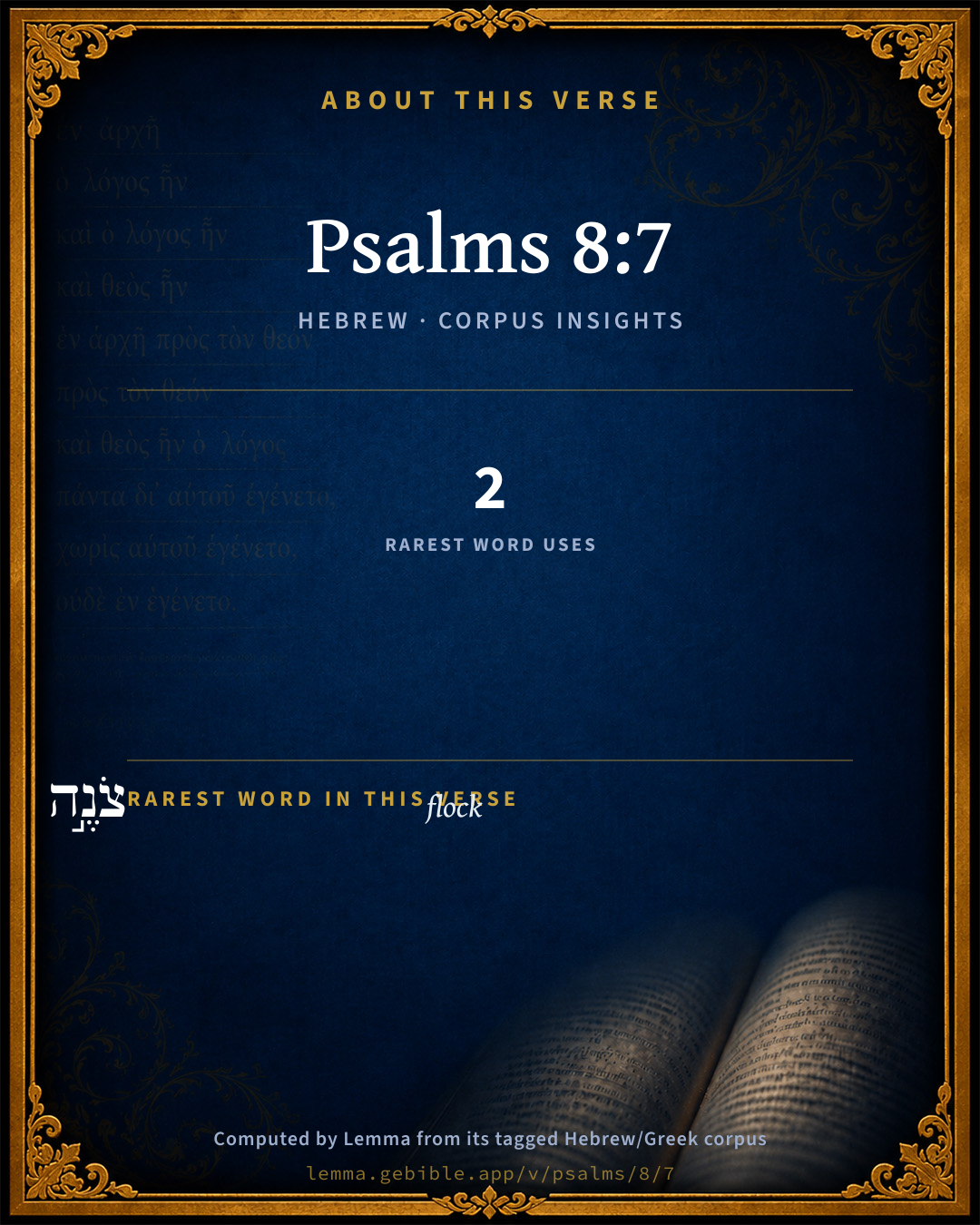
The rarest word here is צֹנֶ֣ה flock H6792 — appearing just 2 times in the whole Hebrew Bible.

Shared distinctive vocabulary

צֹנֶ֣ה flock H6792 occurs in 2 verses of the Hebrew Bible. Also found in:

Grammatical profile

  • 5 nouns
  • 1 particle

Hebrew & Septuagint length

In English translation the verse runs 11 words from the Hebrew and 11 from the Septuagint (LXX English) — the same length.

A rough comparison of the two English renderings, which tokenize alike — not a word-level alignment.

Word counts can differ between the Hebrew and the Greek without any difference in meaning — e.g. the Hebrew direct-object marker אֵת has no separate Greek word, and Greek often adds the article ὁ.

Cross-references

1

Topical passages linked to Psalms 8:7 in the Treasury of Scripture Knowledge — connected by theme and wording, ordered by reader-vote popularity; previews shown in the World English Bible.

  • Genesis 2:20 The man gave names to all cattle, and to the birds of the sky, and to every animal of the field; but for man there was not found a helper suitable for him.

Cross-references courtesy of OpenBible.info (CC BY 4.0).

Hebrew and Greek witnesses Masoretic Hebrew ↔ Greek Septuagint

The same verse in the two great witnesses to the Old Testament, shown verse-for-verse.

You’re reading Greek Psalm 8 (Hebrew Psalm 8). The Septuagint counts the superscription, so verse numbers can differ from the Hebrew — chapter-level alignment, not verse-by-verse. Numbering follows Rahlfs.

These are two independent witnesses, not word-aligned to each other, and the Septuagint is shown in lemma (dictionary) form.

Hebrew Psalms 8:7 Masoretic · Westminster Leningrad Codex

צֹנֶ֣ה וַאֲלָפִ֣ים כֻּלָּ֑ם וְ֝גַ֗ם בַּהֲמ֥וֹת שָׂדָֽי

All sheep and oxen, Yes, and the animals of the field,

World English Bible · Public Domain

Greek LXX Greek Psalm 8:7 Septuagint · lemma form

καί καταἵστημι αὐτός ἐπί ὁ ἔργον ὁ χείρ σύ πᾶς ὑποτάσσω ὑποκάτω ὁ πούς αὐτός

sheep and all oxen, yes and the cattle of the field;

LXX2012 (modern English Septuagint) · Public Domain

Hebrew: Westminster Leningrad Codex (CC BY 4.0). Greek: Septuagint (public domain); English from LXX2012 (modern English Septuagint) (Public Domain). How the Septuagint differs from the Hebrew →

Commentary

Notes on Psalms 8:7 from classic Christian and Jewish commentators (each source and its license shown beneath its notes). The classic Christian expositions comment on the surrounding passage and are grouped to its opening verse, so a note may address several verses; the Jewish commentaries on the Tanakh (Rashi and others) are per-verse, so they appear only where the commentator wrote on this verse.

Lemma curates 59 commentaries, every one of them public domain or Creative Commons licensed, each selected and text-cleaned for this edition rather than reprinted as found. About our sources →

Trapp's Complete Commentary

John Trapp

Psa 8:7 All sheep and oxen, yea, and the beasts of the field;

Ver. 7. All sheep and oxen, &c.] There are beasts ad esum et ad usum, saith one. Some are profitable dead, not alive, as the hog; some alive, not dead, as the dog, horse, &c.; some both, as the ox; yet none so profitable as the sheep, who hath wool for raiment, skin for parchment, flesh for meat, guts for music, and was, therefore, in sacrifice so frequently offered.

John Trapp, A Commentary or Exposition upon All the Books of the Old and New Testament (1647–1656) — public domain. Text from a community e-Sword module.

J. A. Alexander on Psalms

Joseph Addison Alexander

8. (Psa 8:7). This verse contains a mere specification of the general term all in the verse before it. Sheep, or rather flocks, including sheep and goats, and oxen, as a generic term for larger cattle, and also, not only these domesticated animals, but also, beasts of the field, which always means in Scripture wild beasts (Gen 2:20; Gen 3:14, 1Sa 17:44, Joe 1:20), field being used in such connections to denote, not the cultivated land, but the open, unenclosed, and wilder portions of the country. The whole verse is a general description of all quadrupeds or beasts, whether tame or wild.

Joseph Addison Alexander, The Psalms Translated and Explained (1850) — public domain. Text from a community e-Sword module.

Tyndale Open Study Notes

Tyndale Open Resources

8:7-8 Wild animals, including birds and fish, remind readers of God’s creation of the animal world in Gen 1. Contrary to beliefs among Israel’s neighbors in the ancient Near East, animals are not sacred.

Tyndale Open Study Notes — © Tyndale Open Resources, licensed CC BY-SA 4.0. Text via the HelloAO Bible API.

Geneva Bible (1599)

Geneva Bible translators

By the temporal gifts of man’s creation, he is led to consider the benefits which he hath by his regeneration through Christ.

Geneva Bible (1599) marginal notes — public domain. Text via Bolls.life.

Adam Clarke's Commentary

Verse 7. All sheep and oxen] All domestic animals, and those to be employed in agriculture.

Beasts of the field] All wild beasts, and inhabitants of the forest.

Adam Clarke's Commentary on the Bible (1810–1826) — public domain. Text from a community e-Sword/MySword module.

John Calvin's Commentaries

The preceding question, with respect to the extent of man’s dominion over the works of God, seems not yet to be fully answered. If the prophet here declares, by way of exposition, to what extent God has put all things in subjection to us, this subjection, it seems, must be restricted to what contributes to the temporal comfort and convenience of man while he continues in this world. To this difficulty I answer, That the Psalmist does not intend in these verses to give a complete enumeration of all the things which are subjected to man’s dominion, and of which he had spoken generally in the preceding verse, but he brings forward an example of this subjection only in one part or particular; yea, he has especially chosen that part which affords a clear and manifest evidence of the truth he intended to establish, even to those whose minds are uncultivated and slow of apprehension. There is no man of a mind so dull and stupid but may se if he will be at the trouble to open his eyes, that it is by the wonderful providence of God that horses and oxen yield their service to men, — that sheep produce wool to clothe them — and that all sorts of animals supply them with food for their nourishment and support, even from their own flesh. And the more that this dominion is apparent, the more ought we to be affected with a sense of the goodness and grace of our God as often as we either eat food, or enjoy any of the other comforts of life. We are, therefore, not to understand David as meaning that it is a proof that man is invested with dominion over all the works of God, because he clothes himself with the wool and the skins of beasts, because he lives upon their flesh, and because he employs their labor for his own advantage; for this would be inconclusive reasoning. He only brings forward this as an example, and as a mirror in which we may behold and contemplate the dominion over the works of his hands, with which God has honored man. The sum is this: God, in creating man, gave a demonstration of his infinite grace and more than fatherly love towards him, which ought justly to strike us with amazement; and although, by the fall of man, that happy condition has been almost entirely ruined, yet there is still in him some remains of the liberality which God then displayed towards him, which should suffice to fill us with admiration. In this mournful and wretched overthrow, it is true, the legitimate order which God originally established no longer shines forth, but the faithful whom God gathers to himself, under Christ their head, enjoy so much of the fragments of the good things which they lost in Adam, as may furnish them with abundant matter of wonder at the singularly gracious manner in which God deals with them. David here confines his attention to God’s temporal benefits, but it is our duty to rise higher, and to contemplate the invaluable treasures of the kingdom of heaven which he has unfolded in Christ, and all the gifts which belong to the spiritual life, that by reflecting upon these our hearts may be inflamed with love to God, that we may be stirred up to the practice of godliness, and that we may not suffer ourselves to become slothful and remiss in celebrating his praises.

John Calvin's Commentaries (1540-1563) — public domain. Text from the Calvin Translation Society English edition (1840s-50s) via the Christian Classics Ethereal Library (ccel.org). Calvin's coverage is partial (roughly two-thirds of the Bible); uncommented books and verses are honest gaps, never fabricated. The 19th-century editor's footnotes and remarks are omitted so the notes are faithfully Calvin's own voice.

The Cambridge Bible for Schools and Colleges

gen. ed. J. J. S. Perowne

7, 8. Man’s subjects are as it were mustered and passed in review: domestic animals, and even the wild creatures that roam at large over the open country; the birds of the air (lit. heaven, as Psa_104:12), and the fish of the sea, and all the manifold inhabitants of the mysterious depths of ocean. See Gen_1:21; Gen_9:2. Cp. Homer’s ὑγρὰ κέλευθα (Il. i. 312); “the wet sea-paths,” as Milton calls them in his version of the Psalm.

The living creatures here enumerated are only mentioned by way of example and illustration of “all things.” In the Psalmist’s day the dominion of man over nature was most strikingly exercised in his mastery over the animal creation, which he tamed or caught and turned to his own use. “Man has become,” says Darwin, “even in his rudest state, the most dominant animal that has ever appeared on this earth.” In our own day it is by the investigation of the great laws of nature, and by the utilisation of the great forces of nature, that man asserts and extends his sovereignty.

The Cambridge Bible for Schools and Colleges (gen. ed. J. J. S. Perowne; Cambridge University Press, 1878–1918) — public domain. Text from a community e-Sword module.

John Gill's Exposition

All sheep and oxen,.... The tame creatures, which are useful for food and clothing:

yea, and the beasts of the field; the wild beasts, which he can make use of to destroy and devour his enemies, and whom he can restrain from harming his own people, Jer 15:8.

John Gill's Exposition of the Whole Bible (1746–1763) — public domain (CC PDM 1.0). Text via the HelloAO Bible API.

Albert Barnes' Notes on the Bible

All sheep and oxen - Flocks and herds. Gen 1:26, “over the cattle.” Nothing is more manifest than the control which man exercises over flocks and herds - making them subservient to his use, and obedient to his will.

And the beasts of the field - Those not included in the general phrase “sheep and oxen.” The word rendered “field,” שׂדה śâdeh - or the poetic form, as here - שׂדי śâday, means properly a plain; a level tract of country; then, a field, or a tilled farm, Gen 23:17; Gen 47:20-21,; and then the fields, the open country, as opposed to a city, a village, a camp Gen 25:27; and hence, in this place the expression means the beasts that roam at large - wild beasts, Gen 2:20; Gen 3:14. Here the allusion is to the power which man has of subduing the wild beasts; of capturing them, and making them subservient to his purposes; of preventing their increase and their depredations; and of taming them so that they shall obey his will, and become his servants. Nothing is more remarkable than this, and nothing furnishcs a better illustration of Scripture than the conformity of this with the declaration Gen 9:2, “And the fear of you, and the dread of you, shall be upon every beast of the earth, and upon every fowl of the air,” etc. Compare the notes at Jam 3:7. It is to be remembered that no small number of what are now domestic animals were originally wild, and that they have been subdued and tamed by the power anti skill of man. No animal has shown himself superior to this power and skill.

Albert Barnes' Notes on the Bible (1834–1885) — public domain. Text from a community e-Sword/MySword module.

Matthew Poole's English Annotations

All sheep and oxen; here is no perfect enumeration, but under these are comprehended all other beasts, and much more men and angels.

The beasts of the field, i.e. the wild beasts; which together with divers fowls and fishes were subject to Christ, and are governed and employed as it pleaseth him; although many of them be without the reach and are not brought under the, power of any other man.

Matthew Poole's English Annotations on the Holy Bible (1683–1685) — public domain. Text from a community e-Sword/MySword module.

The Pulpit Commentary

All sheep and oxen; literally, flocks and oxen, all of them. The domesticated animals are placed first, as most completely under man"s actual dominion. Yea, and the beasts of the field; i.e. "and all other land animals". (comp. Gen_1:28 Gen_9:2) If some were still unsubdued, (2Ki_17:25, 26 Job_40:24 Job_41:1-10) their subjugation was only a question of time. (see Isa_11:6-9 Isa_65:25)

The Pulpit Commentary (1880–1919), ed. H.D.M. Spence-Jones & Joseph S. Exell — public domain. Text from a community e-Sword module.

Radak

Rabbi David Kimhi (Radak)

Thou makest him to have dominion over the works of Thy hands: – i.e. the inferior beings. Or the meaning of the expression may include the higher ones also; and the dominion then consists in his knowing by his understanding the movement of the spheres and the stars.

Thou hast put all things under his feet: – The lower (beings) are all under him, as it says (Gen. 9:2): “And the fear of you and the dread of you shall be upon every beast of the earth and upon every fowl of the air.'”

Radak on the Tanakh — English translations: “Sefaria Community Translation” (CC0 1.0 (public-domain dedication)); “Eliyahu Munk, HaChut Hameshulash” (CC BY 4.0); “Rabbi Mike Feuer, Jerusalem Anthology” (CC BY 4.0); and “R. David Kimhi on the first book of Psalms, Translated by R.G. Finch, London, 1919” (public domain). Text via Sefaria.

Lesson kit

Teaching starters — assembled from the data on this page, not authored interpretation. Every prompt links to the verse data it draws on. Edit before teaching.

Psalms, in the Wisdom, opens this verse with 6 words (6 distinct Hebrew lemmas). Its most distinctive word is tsônêʼ (“flock”). A historical commentator’s framing appears above. Read the whole chapter for the surrounding context.

Discussion questions

  1. What does “flock” (tsônêʼ) contribute to the verse as a whole?
  2. How does Numbers 32:24, which shares the word «flock», read alongside this verse?
  3. The translations on this page render this verse differently — a whole-verse word diff, not a word-by-word alignment. What might account for the different wordings?
  4. Compare how Trapp's Complete Commentary and J. A. Alexander on Psalms read this verse. Where do they agree or differ?

Things to notice

Reading settings

Reading text

Shown beneath each verse's original-language words.

Old Testament
Old Testament edition

Read the OT as the Masoretic Hebrew (MT) or the Greek Septuagint (LXX).

English shown for the Greek Septuagint (in the Hebrew ↔ Greek comparison).

Comparing translations? Open the Compare panel on any verse page to stack up to four side by side.