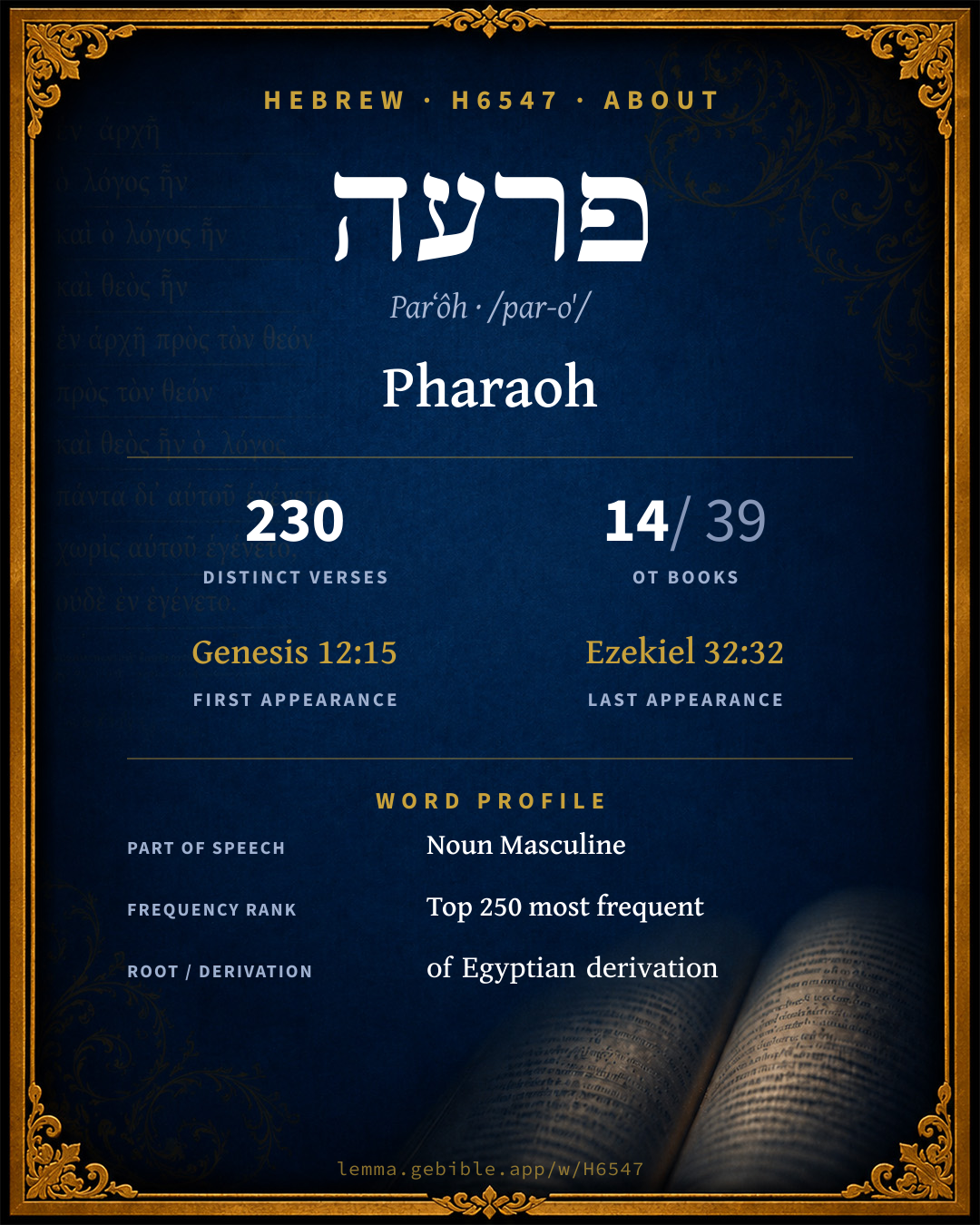
פַּרְעֹה
Pharaoh
BDB lists 2 entries for ‘Pharaoh’ fuller range ↓
Full lexicon entry — Brown-Driver-Briggs (BDB)
From Brown-Driver-Briggs (BDB)
Where this word appears
Grammar key — what these labels mean
Part of speech
- Noun
- A naming word — a person, place, thing, or idea.
Noun type
- Proper
- A name of a specific person, place, or people (e.g. Abraham, Zion, Israel).
Every verse where H6547 appears in the Book of Exodus — 106 distinct verses. Click any verse to open its interlinear word-by-word view. Verse text shown in the World English Bible for context — . Each verse’s Hebrew form is shown with its reference; the English is not keyword-highlighted, since the data carries no word-level English alignment. Use “Compare translations” on any verse to read it across multiple English versions. This concordance covers the Hebrew Bible; Septuagint (Greek Old Testament) occurrences are not indexed here.
Exodus
- Exodus 1:11 לְ/פַרְעֹ֔ה prep + n Proper Therefore they set taskmasters over them to afflict them with their burdens. They built storage cities for Pharaoh: Pithom and Raamses.
- Exodus 1:19 פַּרְעֹ֔ה n Proper The midwives said to Pharaoh, "Because the Hebrew women aren't like the Egyptian women; for they are vigorous, and give birth before the midwife comes to them."
- Exodus 1:22 פַּרְעֹ֔ה n Proper Pharaoh charged all his people, saying, "You shall cast every son who is born into the river, and every daughter you shall save alive."
- Exodus 2:5 פַּרְעֹה֙ n Proper Pharaoh's daughter came down to bathe at the river. Her maidens walked along by the riverside. She saw the basket among the reeds, and sent her handmaid to get it.
- Exodus 2:7 פַּרְעֹה֒ n Proper Then his sister said to Pharaoh's daughter, "Should I go and call a nurse for you from the Hebrew women, that she may nurse the child for you?"
- Exodus 2:8 פַּרְעֹ֖ה n Proper Pharaoh's daughter said to her, "Go." The maiden went and called the child's mother.
- Exodus 2:9 פַּרְעֹ֗ה n Proper Pharaoh's daughter said to her, "Take this child away, and nurse him for me, and I will give you your wages." The woman took the child, and nursed it.
- Exodus 2:10 פַּרְעֹ֔ה n Proper The child grew, and she brought him to Pharaoh's daughter, and he became her son. She named him Moses, and said, "Because I drew him out of the water."
- Exodus 2:15 פַּרְעֹה֙ פַרְעֹ֔ה n Proper n Proper Now when Pharaoh heard this thing, he sought to kill Moses. But Moses fled from the face of Pharaoh, and lived in the land of Midian, and he sat down by a well.
- Exodus 3:10 פַּרְעֹ֑ה n Proper Come now therefore, and I will send you to Pharaoh, that you may bring forth my people, the children of Israel, out of Egypt."
- Exodus 3:11 פַּרְעֹ֑ה n Proper Moses said to God, "Who am I, that I should go to Pharaoh, and that I should bring forth the children of Israel out of Egypt?"
- Exodus 4:21 פַרְעֹ֑ה n Proper Yahweh said to Moses, "When you go back into Egypt, see that you do before Pharaoh all the wonders which I have put in your hand, but I will harden his heart and he will not let the people go.
- Exodus 4:22 פַּרְעֹ֑ה n Proper You shall tell Pharaoh, 'Thus says Yahweh, Israel is my son, my firstborn,
- Exodus 5:1 פַּרְעֹ֑ה n Proper Afterward Moses and Aaron came, and said to Pharaoh, "This is what Yahweh, the God of Israel, says, 'Let my people go, that they may hold a feast to me in the wilderness.'"
- Exodus 5:2 פַּרְעֹ֔ה n Proper Pharaoh said, "Who is Yahweh, that I should listen to his voice to let Israel go? I don't know Yahweh, and moreover I will not let Israel go."
- Exodus 5:5 פַּרְעֹ֔ה n Proper Pharaoh said, "Behold, the people of the land are now many, and you make them rest from their burdens."
- Exodus 5:6 פַּרְעֹ֖ה n Proper The same day Pharaoh commanded the taskmasters of the people, and their officers, saying,
- Exodus 5:10 פַּרְעֹ֔ה n Proper The taskmasters of the people went out, and their officers, and they spoke to the people, saying, This is what Pharaoh says: "I will not give you straw.
- Exodus 5:14 פַרְעֹ֖ה n Proper The officers of the children of Israel, whom Pharaoh's taskmasters had set over them, were beaten, and demanded, "Why haven't you fulfilled your quota both yesterday and today, in making brick as before?"
- Exodus 5:15 פַּרְעֹ֖ה n Proper Then the officers of the children of Israel came and cried to Pharaoh, saying, "Why do you deal this way with your servants?
- Exodus 5:20 פַּרְעֹֽה n Proper They met Moses and Aaron, who stood in the way, as they came forth from Pharaoh:
- Exodus 5:21 פַרְעֹה֙ n Proper and they said to them, "May Yahweh look at you, and judge, because you have made us a stench to be abhorred in the eyes of Pharaoh, and in the eyes of his servants, to put a sword in their hand to kill us."
- Exodus 5:23 פַּרְעֹה֙ n Proper For since I came to Pharaoh to speak in your name, he has brought trouble on this people; neither have you delivered your people at all."
- Exodus 6:1 לְ/פַרְעֹ֑ה prep + n Proper Yahweh said to Moses, "Now you shall see what I will do to Pharaoh, for by a strong hand he shall let them go, and by a strong hand he shall drive them out of his land."
- Exodus 6:11 פַּרְעֹ֖ה n Proper "Go in, speak to Pharaoh king of Egypt, that he let the children of Israel go out of his land."
- Exodus 6:12 פַרְעֹ֔ה n Proper Moses spoke before Yahweh, saying, "Behold, the children of Israel haven't listened to me. How then shall Pharaoh listen to me, who am of uncircumcised lips?"
- Exodus 6:13 פַּרְעֹ֖ה n Proper Yahweh spoke to Moses and to Aaron, and gave them a charge to the children of Israel, and to Pharaoh king of Egypt, to bring the children of Israel out of the land of Egypt.
- Exodus 6:27 פַּרְעֹ֣ה n Proper These are those who spoke to Pharaoh king of Egypt, to bring out the children of Israel from Egypt. These are that Moses and Aaron.
- Exodus 6:29 פַּרְעֹה֙ n Proper that Yahweh spoke to Moses, saying, "I am Yahweh. Speak to Pharaoh king of Egypt all that I speak to you."
- Exodus 6:30 פַּרְעֹֽה n Proper Moses said before Yahweh, "Behold, I am of uncircumcised lips, and how shall Pharaoh listen to me?"
- Exodus 7:1 לְ/פַרְעֹ֑ה prep + n Proper Yahweh said to Moses, "Behold, I have made you as God to Pharaoh; and Aaron your brother shall be your prophet.
- Exodus 7:2 פַּרְעֹ֔ה n Proper You shall speak all that I command you; and Aaron your brother shall speak to Pharaoh, that he let the children of Israel go out of his land.
- Exodus 7:3 פַּרְעֹ֑ה n Proper I will harden Pharaoh's heart, and multiply my signs and my wonders in the land of Egypt.
- Exodus 7:4 פַּרְעֹ֔ה n Proper But Pharaoh will not listen to you, and I will lay my hand on Egypt, and bring forth my hosts, my people the children of Israel, out of the land of Egypt by great judgments.
- Exodus 7:7 פַּרְעֹֽה n Proper Moses was eighty years old, and Aaron eighty-three years old, when they spoke to Pharaoh.
- Exodus 7:9 פַּרְעֹה֙ פַרְעֹ֖ה n Proper n Proper "When Pharaoh speaks to you, saying, 'Perform a miracle!' then you shall tell Aaron, 'Take your rod, and cast it down before Pharaoh, that it become a serpent.'"
- Exodus 7:10 פַּרְעֹ֔ה פַרְעֹ֛ה n Proper n Proper Moses and Aaron went in to Pharaoh, and they did so, as Yahweh had commanded: and Aaron cast down his rod before Pharaoh and before his servants, and it became a serpent.
- Exodus 7:11 פַּרְעֹ֔ה n Proper Then Pharaoh also called for the wise men and the sorcerers. They also, the magicians of Egypt, did in like manner with their enchantments.
- Exodus 7:13 פַּרְעֹ֔ה n Proper Pharaoh's heart was hardened, and he didn't listen to them; as Yahweh had spoken.
- Exodus 7:14 פַּרְעֹ֑ה n Proper Yahweh said to Moses, "Pharaoh's heart is stubborn. He refuses to let the people go.
- Exodus 7:15 פַּרְעֹ֞ה n Proper Go to Pharaoh in the morning. Behold, he goes out to the water; and you shall stand by the river's bank to meet him; and the rod which was turned to a serpent you shall take in your hand.
- Exodus 7:20 פַרְעֹ֔ה n Proper Moses and Aaron did so, as Yahweh commanded; and he lifted up the rod, and struck the waters that were in the river, in the sight of Pharaoh, and in the sight of his servants; and all the waters that were in the river were turned to blood.
- Exodus 7:22 פַּרְעֹה֙ n Proper The magicians of Egypt did in like manner with their enchantments; and Pharaoh's heart was hardened, and he didn't listen to them; as Yahweh had spoken.
- Exodus 7:23 פַּרְעֹ֔ה n Proper Pharaoh turned and went into his house, neither did he lay even this to heart.
- Exodus 8:1 פַּרְעֹ֑ה n Proper Yahweh spoke to Moses, Go in to Pharaoh, and tell him, "This is what Yahweh says, 'Let my people go, that they may serve me.
- Exodus 8:8 פַרְעֹ֜ה n Proper Then Pharaoh called for Moses and Aaron, and said, "Entreat Yahweh, that he take away the frogs from me, and from my people; and I will let the people go, that they may sacrifice to Yahweh."
- Exodus 8:9 לְ/פַרְעֹה֮ prep + n Proper Moses said to Pharaoh, "I give you the honor of setting the time that I should pray for you, and for your servants, and for your people, that the frogs be destroyed from you and your houses, and remain in the river only."
- Exodus 8:12 פַּרְעֹ֑ה לְ/פַרְעֹֽה n Proper prep + n Proper Moses and Aaron went out from Pharaoh, and Moses cried to Yahweh concerning the frogs which he had brought on Pharaoh.
- Exodus 8:15 פַּרְעֹ֗ה n Proper But when Pharaoh saw that there was a respite, he hardened his heart, and didn't listen to them, as Yahweh had spoken.
- Exodus 8:19 פַּרְעֹ֔ה פַּרְעֹה֙ n Proper n Proper Then the magicians said to Pharaoh, "This is the finger of God:" and Pharaoh's heart was hardened, and he didn't listen to them; as Yahweh had spoken.
- Exodus 8:20 פַרְעֹ֔ה n Proper Yahweh said to Moses, "Rise up early in the morning, and stand before Pharaoh; behold, he comes forth to the water; and tell him, 'This is what Yahweh says, "Let my people go, that they may serve me.
- Exodus 8:24 פַרְעֹ֖ה n Proper Yahweh did so; and there came grievous swarms of flies into the house of Pharaoh, and into his servants' houses: and in all the land of Egypt the land was corrupted by reason of the swarms of flies.
- Exodus 8:25 פַרְעֹ֔ה n Proper Pharaoh called for Moses and for Aaron, and said, "Go, sacrifice to your God in the land!"
- Exodus 8:28 פַּרְעֹ֗ה n Proper Pharaoh said, "I will let you go, that you may sacrifice to Yahweh your God in the wilderness, only you shall not go very far away. Pray for me."
- Exodus 8:29 מִ/פַּרְעֹ֛ה פַּרְעֹה֙ prep + n Proper n Proper Moses said, "Behold, I go out from you, and I will pray to Yahweh that the swarms of flies may depart from Pharaoh, from his servants, and from his people, tomorrow; only don't let Pharaoh deal deceitfully any more in not letting the people go to sacrifice to Yahweh."
- Exodus 8:30 פַּרְעֹ֑ה n Proper Moses went out from Pharaoh, and prayed to Yahweh.
- Exodus 8:31 מִ/פַּרְעֹ֖ה prep + n Proper Yahweh did according to the word of Moses, and he removed the swarms of flies from Pharaoh, from his servants, and from his people. There remained not one.
- Exodus 8:32 פַּרְעֹה֙ n Proper Pharaoh hardened his heart this time also, and he didn't let the people go.
- Exodus 9:1 פַּרְעֹ֑ה n Proper Then Yahweh said to Moses, "Go in to Pharaoh, and tell him, 'This is what Yahweh, the God of the Hebrews, says: "Let my people go, that they may serve me.
- Exodus 9:7 פַּרְעֹ֔ה פַּרְעֹ֔ה n Proper n Proper Pharaoh sent, and, behold, there was not so much as one of the cattle of the Israelites dead. But the heart of Pharaoh was stubborn, and he didn't let the people go.
- Exodus 9:8 פַרְעֹֽה n Proper Yahweh said to Moses and to Aaron, "Take to you handfuls of ashes of the furnace, and let Moses sprinkle it toward the sky in the sight of Pharaoh.
- Exodus 9:10 פַרְעֹ֔ה n Proper They took ashes of the furnace, and stood before Pharaoh; and Moses sprinkled it up toward the sky; and it became a boil breaking forth with boils on man and on animal.
- Exodus 9:12 פַּרְעֹ֔ה n Proper Yahweh hardened the heart of Pharaoh, and he didn't listen to them, as Yahweh had spoken to Moses.
- Exodus 9:13 פַרְעֹ֑ה n Proper Yahweh said to Moses, "Rise up early in the morning, and stand before Pharaoh, and tell him, 'This is what Yahweh, the God of the Hebrews, says: "Let my people go, that they may serve me.
- Exodus 9:20 פַּרְעֹ֑ה n Proper Those who feared the word of Yahweh among the servants of Pharaoh made their servants and their cattle flee into the houses.
- Exodus 9:27 פַּרְעֹ֗ה n Proper Pharaoh sent, and called for Moses and Aaron, and said to them, "I have sinned this time. Yahweh is righteous, and I and my people are wicked.
- Exodus 9:33 פַּרְעֹה֙ n Proper Moses went out of the city from Pharaoh, and spread abroad his hands to Yahweh; and the thunders and hail ceased, and the rain was not poured on the earth.
- Exodus 9:34 פַּרְעֹ֗ה n Proper When Pharaoh saw that the rain and the hail and the thunders were ceased, he sinned yet more, and hardened his heart, he and his servants.
- Exodus 9:35 פַּרְעֹ֔ה n Proper The heart of Pharaoh was hardened, and he didn't let the children of Israel go, just as Yahweh had spoken through Moses.
- Exodus 10:1 פַּרְעֹ֑ה n Proper Yahweh said to Moses, "Go in to Pharaoh, for I have hardened his heart, and the heart of his servants, that I may show these my signs in the midst of them,
- Exodus 10:3 פַּרְעֹה֒ n Proper Moses and Aaron went in to Pharaoh, and said to him, "This is what Yahweh, the God of the Hebrews, says: 'How long will you refuse to humble yourself before me? Let my people go, that they may serve me.
- Exodus 10:6 פַּרְעֹֽה n Proper Your houses shall be filled, and the houses of all your servants, and the houses of all the Egyptians; as neither your fathers nor your fathers' fathers have seen, since the day that they were on the earth to this day.'" He turned, and went out from Pharaoh.
- Exodus 10:7 פַרְעֹ֜ה n Proper Pharaoh's servants said to him, "How long will this man be a snare to us? Let the men go, that they may serve Yahweh, their God. Don't you yet know that Egypt is destroyed?"
- Exodus 10:8 פַּרְעֹ֔ה n Proper Moses and Aaron were brought again to Pharaoh, and he said to them, "Go, serve Yahweh your God; but who are those who will go?"
- Exodus 10:11 פַרְעֹֽה n Proper Not so! Go now you who are men, and serve Yahweh; for that is what you desire!" They were driven out from Pharaoh's presence.
- Exodus 10:16 פַּרְעֹ֔ה n Proper Then Pharaoh called for Moses and Aaron in haste, and he said, "I have sinned against Yahweh your God, and against you.
- Exodus 10:18 פַּרְעֹ֑ה n Proper He went out from Pharaoh, and prayed to Yahweh.
- Exodus 10:20 פַּרְעֹ֑ה n Proper But Yahweh hardened Pharaoh's heart, and he didn't let the children of Israel go.
- Exodus 10:24 פַרְעֹ֜ה n Proper Pharaoh called to Moses, and said, "Go, serve Yahweh. Only let your flocks and your herds stay behind. Let your little ones also go with you."
- Exodus 10:27 פַּרְעֹ֑ה n Proper But Yahweh hardened Pharaoh's heart, and he wouldn't let them go.
- Exodus 10:28 פַרְעֹ֖ה n Proper Pharaoh said to him, "Get away from me! Be careful to see my face no more; for in the day you see my face you shall die!"
- Exodus 11:1 פַּרְעֹה֙ n Proper Yahweh said to Moses, "Yet one plague more will I bring on Pharaoh, and on Egypt; afterwards he will let you go. When he lets you go, he will surely thrust you out altogether.
- Exodus 11:3 פַרְעֹ֖ה n Proper Yahweh gave the people favor in the sight of the Egyptians. Moreover the man Moses was very great in the land of Egypt, in the sight of Pharaoh's servants, and in the sight of the people.
- Exodus 11:5 פַּרְעֹה֙ n Proper and all the firstborn in the land of Egypt shall die, from the firstborn of Pharaoh who sits on his throne, even to the firstborn of the maid-servant who is behind the mill; and all the firstborn of cattle.
- Exodus 11:8 פַּרְעֹ֖ה n Proper All these your servants shall come down to me, and bow down themselves to me, saying, 'Get out, and all the people who follow you; and after that I will go out.'" He went out from Pharaoh in hot anger.
- Exodus 11:9 פַּרְעֹ֑ה n Proper Yahweh said to Moses, "Pharaoh won't listen to you, that my wonders may be multiplied in the land of Egypt."
- Exodus 11:10 פַרְעֹ֑ה פַּרְעֹ֔ה n Proper n Proper Moses and Aaron did all these wonders before Pharaoh, and Yahweh hardened Pharaoh's heart, and he didn't let the children of Israel go out of his land.
- Exodus 12:29 פַּרְעֹה֙ n Proper It happened at midnight, that Yahweh struck all the firstborn in the land of Egypt, from the firstborn of Pharaoh who sat on his throne to the firstborn of the captive who was in the dungeon; and all the firstborn of cattle.
- Exodus 12:30 פַּרְעֹ֜ה n Proper Pharaoh rose up in the night, he, and all his servants, and all the Egyptians; and there was a great cry in Egypt, for there was not a house where there was not one dead.
- Exodus 13:15 פַרְעֹה֮ n Proper and it happened, when Pharaoh would hardly let us go, that Yahweh killed all the firstborn in the land of Egypt, both the firstborn of man, and the firstborn of animal. Therefore I sacrifice to Yahweh all that opens the womb, being males; but all the firstborn of my sons I redeem.'
- Exodus 13:17 פַּרְעֹה֮ n Proper It happened, when Pharaoh had let the people go, that God didn't lead them by the way of the land of the Philistines, although that was near; for God said, "Lest perhaps the people change their minds when they see war, and they return to Egypt;"
- Exodus 14:3 פַּרְעֹה֙ n Proper Pharaoh will say of the children of Israel, 'They are entangled in the land. The wilderness has shut them in.'
- Exodus 14:4 פַּרְעֹה֮ בְּ/פַרְעֹה֙ n Proper prep + n Proper I will harden Pharaoh's heart, and he will follow after them; and I will get honor over Pharaoh, and over all his host; and the Egyptians shall know that I am Yahweh." They did so.
- Exodus 14:5 פַּרְעֹ֤ה n Proper It was told the king of Egypt that the people had fled; and the heart of Pharaoh and of his servants was changed towards the people, and they said, "What is this we have done, that we have let Israel go from serving us?"
- Exodus 14:8 פַּרְעֹה֙ n Proper Yahweh hardened the heart of Pharaoh king of Egypt, and he pursued after the children of Israel; for the children of Israel went out with a high hand.
- Exodus 14:9 פַּרְעֹ֔ה n Proper The Egyptians pursued after them: all the horses and chariots of Pharaoh, his horsemen, and his army; and overtook them encamping by the sea, beside Pihahiroth, before Baal Zephon.
- Exodus 14:10 וּ/פַרְעֹ֖ה conj + n Proper When Pharaoh drew near, the children of Israel lifted up their eyes, and behold, the Egyptians were marching after them; and they were very afraid. The children of Israel cried out to Yahweh.
- Exodus 14:17 בְּ/פַרְעֹה֙ prep + n Proper I, behold, I will harden the hearts of the Egyptians, and they shall go in after them: and I will get myself honor over Pharaoh, and over all his host, over his chariots, and over his horsemen.
- Exodus 14:18 בְּ/פַרְעֹ֔ה prep + n Proper The Egyptians shall know that I am Yahweh, when I have gotten myself honor over Pharaoh, over his chariots, and over his horsemen."
- Exodus 14:23 פַּרְעֹ֔ה n Proper The Egyptians pursued, and went in after them into the midst of the sea: all of Pharaoh's horses, his chariots, and his horsemen.
- Exodus 14:28 פַּרְעֹ֔ה n Proper The waters returned, and covered the chariots and the horsemen, even all Pharaoh's army that went in after them into the sea. There remained not so much as one of them.
- Exodus 15:4 פַּרְעֹ֛ה n Proper Pharaoh's chariots and his host has he cast into the sea; His chosen captains are sunk in the Red Sea.
- Exodus 15:19 פַּרְעֹ֜ה n Proper For the horses of Pharaoh went in with his chariots and with his horsemen into the sea, and Yahweh brought back the waters of the sea on them; but the children of Israel walked on dry land in the midst of the sea.
- Exodus 18:4 פַּרְעֹֽה n Proper The name of the other was Eliezer, for he said, "My father's God was my help and delivered me from Pharaoh's sword."
- Exodus 18:8 לְ/פַרְעֹ֣ה prep + n Proper Moses told his father-in-law all that Yahweh had done to Pharaoh and to the Egyptians for Israel's sake, all the hardships that had come on them on the way, and how Yahweh delivered them.
- Exodus 18:10 פַּרְעֹ֑ה n Proper Jethro said, "Blessed be Yahweh, who has delivered you out of the hand of the Egyptians, and out of the hand of Pharaoh; who has delivered the people from under the hand of the Egyptians.
About this entry
At a glance — auto-summarized from this page’s data, not written by a person. Every figure links to its source below. This summary describes the numbers; it doesn’t interpret them.
At its core, פרעה (Parʻôh) means “Pharaoh.” It first appears in Genesis 12:15. It turns up in 230 verses across 14 books, a common footprint. The word gravitates to Exodus (46%), then Genesis and Ezekiel. Each statement above links to its evidence; the full detail follows below.
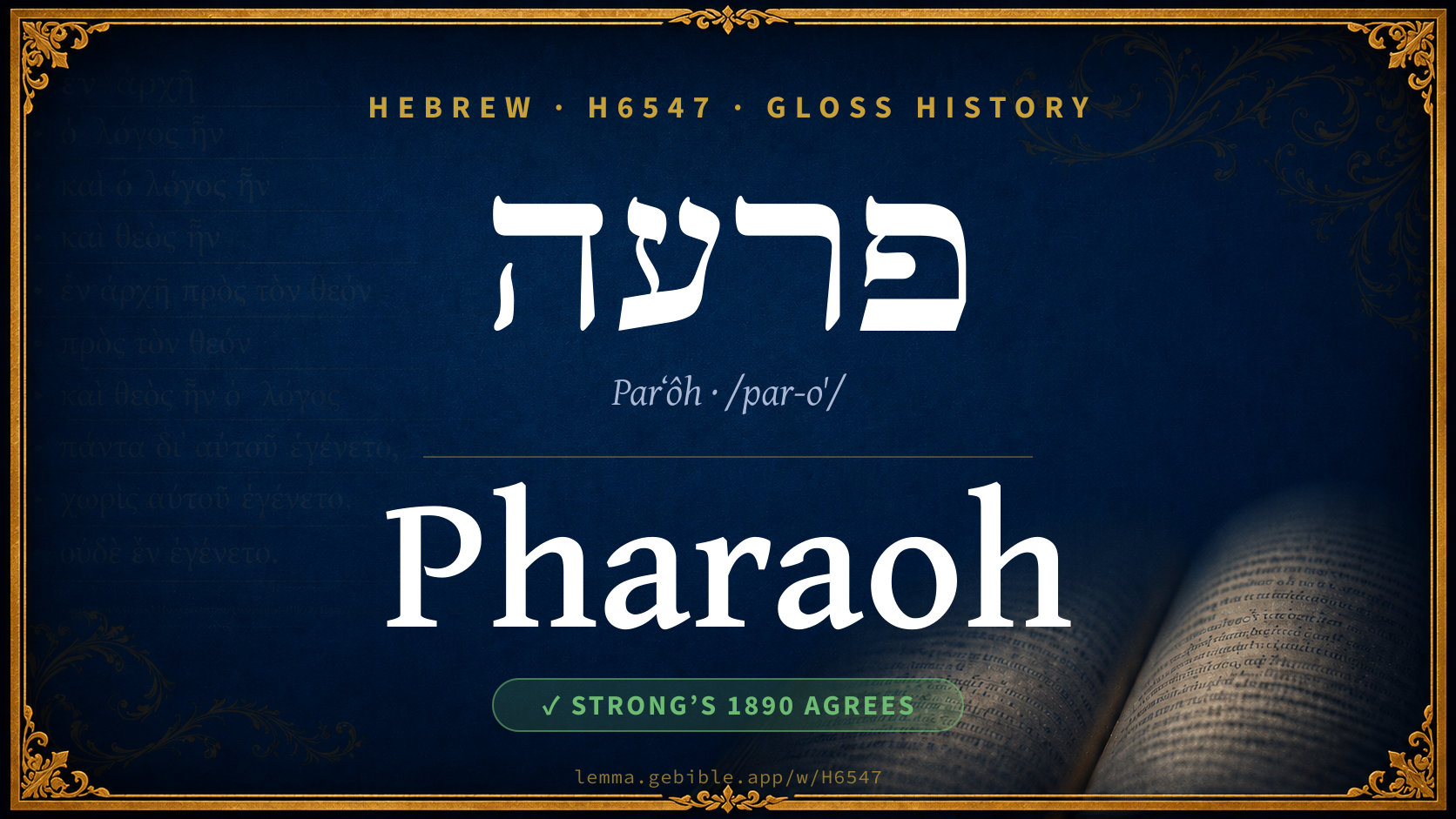
Gloss history
Strong's 1890 vs modern scholarship
About this word
Strong's H6547 catalogs a Hebrew word from the Hebrew Old Testament.
These counts are not copied from any lexicon or concordance. They are computed here, from the morphology-tagged Hebrew Old Testament. What Lemma adds →
- 230
- distinct verses
- The word appears in 230 distinct verses.
- 14 / 39
- OT books
- The word appears in 14 of 39 Old Testament books.
- #185
- by frequency
- Top 250 most frequent Hebrew words (rank 185 of 8,640 Hebrew words by occurrence).
View all 230 occurrences in the concordance →
By section of the Old Testament
By traditional corpus
Conventional, traditional groupings — biblical authorship is debated, so this is a traditional corpus grouping, not an authorship claim. Each share is this word’s portion of its verses in that division of the Hebrew canon. Each figure is a share of the word’s 230 distinct verses.
- Torah (Pentateuch) 185 verses · 80%
- Prophets (Nevi'im) 39 verses · 17%
- Writings (Ketuvim) 6 verses · 3%
How translations render this word
Counts come from each version’s own published word-to-Strong’s tagging or interlinear alignment — an approximate guide to how each version renders this word, not a word-level alignment the data otherwise carries. Because each total is that version’s own tagged count, the per-version totals vary from one another and need not match the appearance or distinct-verse counts above. These counts may also differ from a printed concordance because Lemma counts each distinctly tagged rendering and does not collapse phrase taggings into a single head-word total. This is a fixed set of word-tagged versions (KJV, ASV, BSB, ULT) and does not change with the reading translation you choose elsewhere. Each version’s license is shown beside its name below (and on Sources).
- King James Version: Pharaoh 190×, Pharaoh's 38×, Is pharaoh 3×
- American Standard Version: Pharaoh 223×, Shall pharaoh 3×, Behold 2×
- Berean Standard Bible: Pharaoh 186×, Pharaoh’s 48×, Against pharaoh 3×
- unfoldingWord Literal Text: Pharaoh 249×, The 5×, Pharaoh s 3×
King James Version Public Domain
Renders H6547 across 268 tagged occurrences — most commonly:
Plus 28 renderings that appear only once — usually multi-word phrases or single function words the recovered tagging swept in, not distinct renderings.
American Standard Version Public Domain
Renders H6547 across 267 tagged occurrences — most commonly:
Plus 33 renderings that appear only once — usually multi-word phrases or single function words the recovered tagging swept in, not distinct renderings.
Berean Standard Bible Public Domain
Renders H6547 across 263 tagged occurrences — most commonly:
Plus 16 renderings that appear only once — usually multi-word phrases or single function words the recovered tagging swept in, not distinct renderings. Not rendered by a distinct English word in 11 further occurrences.
unfoldingWord Literal Text CC BY-SA 4.0
Renders H6547 across 266 tagged occurrences — most commonly:
Plus 5 renderings that appear only once — usually multi-word phrases or single function words the recovered tagging swept in, not distinct renderings.
Senses in BDB
The 2 senses BDB distinguishes for this word, in lexicon order (not ranked by frequency or importance). The full entry — with sub-senses — is in the Lexicon Entry tab.
- Pharaoh = "great house"
- the common title of the king of Egypt
Word origin
n.m. Pharaoh, Φαραω, title of Egyptian kings (Egyptian pr-ʿo, great house, of royal court, and (in new kingdom) of king GriffithHastings DB MeyGesch. Alt. i. 59 SteindBAS i. 343; in Assyrian priʾu according to most, cf. COTGloss. Steindl.c., but v. WklMVAG, 1898, 3 f.);—פ׳ Gn 12:15(×3), 17 + 212 times Hex (mostly JE, rarely DP), 1 S 2:27; 6:6; 1 K 3:1(×2) + 19 times K, Is 19:11(×2) + 3 times, Je 25:19 + 10 times, Ez 17:17 + 12 times, Ne 9:10; 1 Ch 4:18; 2 Ch 8:11 ψ 135:9; 136:15; Ct 1:9; + מֶלֶךְ מִצְרַיִם (not early) Je 25:19; 46:17; Dt 7:8; 11:3; Ez 29:2, 3; 30:21, 22; 31:2; 1 K 3:1; 9:16; 11:18; 2 K 17:7; 18:21 = Is 36:6; Gn 41:46 (E), Ex 6:11, 13, 27, 29; 14:8 (all P); c. n.pr. פ׳ חָפְרַע Je 44:30, פ׳ נְכֹה 46:2; 2 K 23:29, 33, 34, 35.
— Brown-Driver-Briggs (Oxford 1906, public domain), digitized via Sefaria, supplemented by the OpenScriptures HebrewLexicon (CC BY 4.0). See Sources.
Origin: of Egyptian derivation
Jastrow Dictionary
A second Hebrew/Aramaic lexicon for comparison, covering Aramaic and post-biblical (Talmudic, Targumic, Midrashic) usage that the biblical-Hebrew BDB does not. Matched by lemma rather than by Strong’s number, so a lemma may carry more than one Jastrow headword (shown separately below), and the entries cover usage well beyond the Bible.
פְּרָעָה
- , pl. פְּרָעוֹת(b. h.;
- 1. = preced., wild irregular growth, esp. the case of protruding boughs on one of which is an uncleanness, v. סְכָכָה. Ohol. VIII, 2 והפ׳, expl. היוצאות מן הגדר which protrude from the hedge; Tosef. ib. IX, 3 פֶּרַע היוצא מן וכ׳; Naz. VII, 3; 54ᵇ. Y. ib. VII, 56ᶜ
- 2. (homilet.) payment, retribution. Sabb. 119ᵇ (ref. to Jud. V, 2) מ"ט בפרוע פרעות משום דברכו ה׳ why are decreed punishments disarranged (reversed)? Because of ‘praise the Lord’; Yalk. Jud. 46. e.g. Judges 5:2
פַּרְעֹה
- (b. h.) pr. n. m. Pharaoh, the Egyptian king. M. Kat. 18ᵃ פ׳ שהיה בימי משה the Pharaoh of Moses’ time. Ex. R. s. 8 מי גרם לפ׳ שילקה what was the cause of Pharaoh’s being smitten?; a. v. fr.
A Dictionary of the Targumim, the Talmud Babli and Yerushalmi, and the Midrashic Literature (Marcus Jastrow; London, Luzac, 1903) — Public Domain. Digitized via Sefaria. Digitized via Sefaria. Full attribution on Sources.
Forms in the corpus
The 46 distinct written forms H6547 takes in the Hebrew Bible, most frequent first — each parse links to that state’s occurrences in the concordance. Hebrew forms include their vowel points and cantillation, so a single lemma takes many written forms.
| Form | Parsing | Example | Uses |
|---|---|---|---|
| פַּרְעֹ֔ה | Noun, Proper | Exodus 1:19 | 39 |
| פַּרְעֹ֖ה | Noun, Proper | Exodus 2:8 | 27 |
| פַּרְעֹ֑ה | Noun, Proper | Exodus 3:10 | 24 |
| פַּרְעֹה֙ | Noun, Proper | Exodus 2:5 | 24 |
| פַּרְעֹֽה | Noun, Proper | Exodus 5:20 | 16 |
| פַרְעֹ֔ה | Noun, Proper | Exodus 2:15 | 15 |
| פַּרְעֹ֗ה | Noun, Proper | Exodus 2:9 | 12 |
| פַּרְעֹ֣ה | Noun, Proper | Exodus 6:27 | 11 |
| פַרְעֹ֑ה | Noun, Proper | Exodus 4:21 | 8 |
| פַרְעֹ֖ה | Noun, Proper | Exodus 5:14 | 8 |
| פַרְעֹֽה | Noun, Proper | Exodus 9:8 | 7 |
| פַרְעֹה֙ | Noun, Proper | Exodus 5:21 | 7 |
| לְ/פַרְעֹֽה | Noun, Proper | Exodus 8:12 | 6 |
| פַּרְעֹ֛ה | Noun, Proper | Exodus 15:4 | 6 |
| לְ/פַרְעֹ֑ה | Noun, Proper | Exodus 6:1 | 5 |
| פַּרְעֹ֤ה | Noun, Proper | Exodus 14:5 | 5 |
| לְ/פַרְעֹ֔ה | Noun, Proper | Exodus 1:11 | 4 |
| לְ/פַרְעֹ֖ה | Noun, Proper | Deuteronomy 6:21 | 3 |
| לְ/פַרְעֹ֥ה | Noun, Proper | Deuteronomy 11:3 | 3 |
| פַרְעֹ֜ה | Noun, Proper | Exodus 8:8 | 3 |
| פַּרְעֹ֜ה | Noun, Proper | Exodus 12:30 | 3 |
| פַּרְעֹ֥ה | Noun, Proper | Deuteronomy 7:8 | 3 |
| בְּ/פַרְעֹה֙ | Noun, Proper | Exodus 14:4 | 2 |
| וּ/פַרְעֹ֖ה | Noun, Proper | Exodus 14:10 | 2 |
| פַרְעֹ֗ה | Noun, Proper | Genesis 40:7 | 2 |
| פַּרְעֹה֒ | Noun, Proper | Exodus 2:7 | 2 |
| פַּרְעֹה֮ | Noun, Proper | Exodus 13:17 | 2 |
| בְּ/פַרְעֹ֔ה | Noun, Proper | Exodus 14:18 | 1 |
| בְּ/פַרְעֹ֤ה | Noun, Proper | Nehemiah 9:10 | 1 |
| בְּ/פַרְעֹ֥ה | Noun, Proper | Deuteronomy 6:22 | 1 |
| בְּ֝/פַרְעֹ֗ה | Noun, Proper | Psalms 135:9 | 1 |
| וּ/פַרְעֹ֣ה | Noun, Proper | Genesis 41:1 | 1 |
| כְּ/פַרְעֹֽה | Noun, Proper | Genesis 44:18 | 1 |
| לְ/פַרְעֹ֗ה | Noun, Proper | Genesis 45:8 | 1 |
| לְ/פַרְעֹ֣ה | Noun, Proper | Exodus 18:8 | 1 |
| לְ/פַרְעֹה֒ | Noun, Proper | Genesis 47:1 | 1 |
| לְ/פַרְעֹה֮ | Noun, Proper | Exodus 8:9 | 1 |
| מִ/פַּרְעֹ֖ה | Noun, Proper | Exodus 8:31 | 1 |
| מִ/פַּרְעֹ֛ה | Noun, Proper | Exodus 8:29 | 1 |
| פַרְעֹ֛ה | Noun, Proper | Exodus 7:10 | 1 |
| פַרְעֹ֣ה | Noun, Proper | Genesis 41:45 | 1 |
| פַרְעֹ֤ה | Noun, Proper | Genesis 40:19 | 1 |
| פַרְעֹה֮ | Noun, Proper | Exodus 13:15 | 1 |
| פַּרְעֹ֞ה | Noun, Proper | Exodus 7:15 | 1 |
| פַּרְעֹ֧ה | Noun, Proper | Jeremiah 25:19 | 1 |
| פַּרְעֹ֨ה | Noun, Proper | 1 Kings 9:16 | 1 |
Same root — word family
Other BDB entries built from the same root as H6547, grouped by Strong’s listed origin. These share a root / origin per the lexicon — not necessarily a shared meaning. Each links to that word’s own entry.
Proper names from this root
People and places named from this root — a name, not an additional meaning of the word.
Compare all same-root words → 1 of the same-root words is a proper name (a person or place). They share a root, not necessarily a meaning.
Bible dictionary
Public-domain dictionary articles matched to this entry by name (Pharaoh). A biblical name can be shared by more than one person or place, so an article may treat several.
Easton's Bible Dictionary · M. G. Easton, 1897
The official title borne by the Egyptian kings down to the time when that country was conquered by the Greeks. (See EGYPT.) The name is a compound, as some think, of the words Ra, the "sun" or "sun-god," and the article phe, "the," prefixed; hence phera, "the sun," or "the sun-god." But others, perhaps more correctly, think the name derived from Perao, "the great house" = his majesty = in Turkish, "the Sublime Porte."
(1.) The Pharaoh who was on the throne when Abram went down into Egypt (Gen. 12:10-20) was probably one of the Hyksos, or "shepherd kings." The Egyptians called the nomad tribes of Syria Shasu, "plunderers," their king or chief Hyk, and hence the name of those invaders who conquered the native kings and established a strong government, with Zoan or Tanis as their capital. They were of Semitic origin, and of kindred blood accordingly with Abram. They were probably driven forward by the pressure of the Hittites. The name they bear on the monuments is "Mentiu."
(2.) The Pharaoh of Joseph's days (Gen. 41) was probably Apopi, or Apopis, the last of the Hyksos kings. To the old native Egyptians, who were an African race, shepherds were "an abomination;" but to the Hyksos kings these Asiatic shepherds who now appeared with Jacob at their head were congenial, and being akin to their own race, had a warm welcome (Gen. 47:5, 6). Some argue that Joseph came to Egypt in the reign of Thothmes III., long after the expulsion of the Hyksos, and that his influence is to be seen in the rise and progress of the religious revolution in the direction of monotheism which characterized the middle of the Eighteenth Dynasty. The wife of Amenophis III., of that dynasty, was a Semite. Is this singular fact to be explained from the presence of some of Joseph's kindred at the Egyptian court? Pharaoh said to Joseph, "Thy father and thy brethren are come unto thee: the land of Egypt is before thee; in the best of the land make thy father and brethren to dwell" (Gen. 47:5, 6).
(3.) The "new king who knew not Joseph" (Ex. 1:8-22) has been generally supposed to have been Aahmes I., or Amosis, as he is called by Josephus. Recent discoveries, however, have led to the conclusion that Seti was the "new king."
For about seventy years the Hebrews in Egypt were under the powerful protection of Joseph. After his death their condition was probably very slowly and gradually changed. The invaders, the Hyksos, who for some five centuries had been masters of Egypt, were driven out, and the old dynasty restored. The Israelites now began to be looked down upon. They began to be afflicted and tyrannized over. In process of time a change appears to have taken place in the government of Egypt. A new dynasty, the Nineteenth, as it is called, came into power under Seti I., who was its founder. He associated with him in his government his son, Rameses II., when he was yet young, probably ten or twelve years of age.
Note, Professor Maspero, keeper of the museum of Bulak, near Cairo, had his attention in 1870 directed to the fact that scarabs, i.e., stone and metal imitations of the beetle (symbols of immortality), originally worn as amulets by royal personages, which were evidently genuine relics of the time of the ancient Pharaohs, were being sold at Thebes and different places along the Nile. This led him to suspect that some hitherto undiscovered burial-place of the Pharaohs had been opened, and that these and other relics, now secretly sold, were a part of the treasure found there. For a long time he failed, with all his ingenuity, to find the source of these rare treasures. At length one of those in the secret volunteered to give information regarding this burial-place. The result was that a party was conducted in 1881 to Dier el-Bahari, near Thebes, when the wonderful discovery was made of thirty-six mummies of kings, queens, princes, and high priests hidden away in a cavern prepared for them, where they had lain undisturbed for thirty centuries. "The temple of Deir el-Bahari stands in the middle of a natural amphitheatre of cliffs, which is only one of a number of smaller amphitheatres into which the limestone mountains of the tombs are broken up. In the wall of rock separating this basin from the one next to it some ancient Egyptian engineers had constructed the hiding-place, whose secret had been kept for nearly three thousand years." The exploring party being guided to the place, found behind a great rock a shaft 6 feet square and about 40 feet deep, sunk into the limestone. At the bottom of this a passage led westward for 25 feet, and then turned sharply northward into the very heart of the mountain, where in a chamber 23 feet by 13, and 6 feet in height, they came upon the wonderful treasures of antiquity. The mummies were all carefully secured and brought down to Bulak, where they were deposited in the royal museum, which has now been removed to Ghizeh.
Among the most notable of the ancient kings of Egypt thus discovered were Thothmes III., Seti I., and Rameses II. Thothmes III. was the most distinguished monarch of the brilliant Eighteenth Dynasty. When this mummy was unwound "once more, after an interval of thirty-six centuries, human eyes gazed on the features of the man who had conquered Syria and Cyprus and Ethiopia, and had raised Egypt to the highest pinnacle of her power. The spectacle, however, was of brief duration. The remains proved to be in so fragile a state that there was only time to take a hasty photograph, and then the features crumbled to pieces and vanished like an apparition, and so passed away from human view for ever." "It seems strange that though the body of this man," who overran Palestine with his armies two hundred years before the birth of Moses, "mouldered to dust, the flowers with which it had been wreathed were so wonderfully preserved that even their colour could be distinguished" (Manning's Land of the Pharaohs).
Seti I. (his throne name Merenptah), the father of Rameses II., was a great and successful warrior, also a great builder. The mummy of this Pharaoh, when unrolled, brought to view "the most beautiful mummy head ever seen within the walls of the museum. The sculptors of Thebes and Abydos did not flatter this Pharaoh when they gave him that delicate, sweet, and smiling profile which is the admiration of travellers. After a lapse of thirty-two centuries, the mummy retains the same expression which characterized the features of the living man. Most remarkable of all, when compared with the mummy of Rameses II., is the striking resemblance between the father and the son. Seti I. is, as it were, the idealized type of Rameses II. He must have died at an advanced age. The head is shaven, the eyebrows are white, the condition of the body points to considerably more than threescore years of life, thus confirming the opinions of the learned, who have attributed a long reign to this king."
(4.) Rameses II., the son of Seti I., is probably the Pharaoh of the Oppression. During his forty years' residence at the court of Egypt, Moses must have known this ruler well. During his sojourn in Midian, however, Rameses died, after a reign of sixty-seven years, and his body embalmed and laid in the royal sepulchre in the Valley of the Tombs of Kings beside that of his father. Like the other mummies found hidden in the cave of Deir el-Bahari, it had been for some reason removed from its original tomb, and probably carried from place to place till finally deposited in the cave where it was so recently discovered.
In 1886, the mummy of this king, the "great Rameses," the "Sesostris" of the Greeks, was unwound, and showed the body of what must have been a robust old man. The features revealed to view are thus described by Maspero: "The head is long and small in proportion to the body. The top of the skull is quite bare. On the temple there are a few sparse hairs, but at the poll the hair is quite thick, forming smooth, straight locks about two inches in length. White at the time of death, they have been dyed a light yellow by the spices used in embalmment. The forehead is low and narrow; the brow-ridge prominent; the eye-brows are thick and white; the eyes are small and close together; the nose is long, thin, arched like the noses of the Bourbons; the temples are sunk; the cheek-bones very prominent; the ears round, standing far out from the head, and pierced, like those of a woman, for the wearing of earrings; the jaw-bone is massive and strong; the chin very prominent; the mouth small, but thick-lipped; the teeth worn and very brittle, but white and well preserved. The moustache and beard are thin. They seem to have been kept shaven during life, but were probably allowed to grow during the king's last illness, or they may have grown after death. The hairs are white, like those of the head and eyebrows, but are harsh and bristly, and a tenth of an inch in length. The skin is of an earthy-brown, streaked with black. Finally, it may be said, the face of the mummy gives a fair idea of the face of the living king. The expression is unintellectual, perhaps slightly animal; but even under the somewhat grotesque disguise of mummification there is plainly to be seen an air of sovereign majesty, of resolve, and of pride."
Both on his father's and his mother's side it has been pretty clearly shown that Rameses had Chaldean or Mesopotamian blood in his veins to such a degree that he might be called an Assyrian. This fact is thought to throw light on Isa. 52:4.
(5.) The Pharaoh of the Exodus was probably Menephtah I., the fourteenth and eldest surviving son of Rameses II. He resided at Zoan, where he had the various interviews with Moses and Aaron recorded in the book of Exodus. His mummy was not among those found at Deir el-Bahari. It is still a question, however, whether Seti II. or his father Menephtah was the Pharaoh of the Exodus. Some think the balance of evidence to be in favour of the former, whose reign it is known began peacefully, but came to a sudden and disastrous end. The "Harris papyrus," found at Medinet-Abou in Upper Egypt in 1856, a state document written by Rameses III., the second king of the Twentieth Dynasty, gives at length an account of a great exodus from Egypt, followed by wide-spread confusion and anarchy. This, there is great reason to believe, was the Hebrew exodus, with which the Nineteenth Dynasty of the Pharaohs came to an end. This period of anarchy was brought to a close by Setnekht, the founder of the Twentieth Dynasty.
"In the spring of 1896, Professor Flinders Petrie discovered, among the ruins of the temple of Menephtah at Thebes, a large granite stela, on which is engraved a hymn of victory commemorating the defeat of Libyan invaders who had overrun the Delta. At the end other victories of Menephtah are glanced at, and it is said that the Israelites (I-s-y-r-a-e-l-u) are minished (?) so that they have no seed.' Menephtah was son and successor of Rameses II., the builder of Pithom, and Egyptian scholars have long seen in him the Pharaoh of the Exodus. The Exodus is also placed in his reign by the Egyptian legend of the event preserved by the historian Manetho. In the inscription the name of the Israelites has no determinative of country' or 'district' attached to it, as is the case with all the other names (Canaan, Ashkelon, Gezer, Khar or Southern Palestine, etc.) mentioned along with it, and it would therefore appear that at the time the hymn was composed, the Israelites had already been lost to the sight of the Egyptians in the desert. At all events they must have had as yet no fixed home or district of their own. We may therefore see in the reference to them the Pharaoh's version of the Exodus, the disasters which befell the Egyptians being naturally passed over in silence, and only the destruction of the men children' of the Israelites being recorded. The statement of the Egyptian poet is a remarkable parallel to Ex. 1:10-22."
(6.) The Pharaoh of 1 Kings 11:18-22.
(7.) So, king of Egypt (2 Kings 17:4).
(8.) The Pharaoh of 1 Chr. 4:18.
(9.) Pharaoh, whose daughter Solomon married (1 Kings 3:1; 7:8).
(10.) Pharaoh, in whom Hezekiah put his trust in his war against Sennacherib (2 Kings 18:21).
(11.) The Pharaoh by whom Josiah was defeated and slain at Megiddo (2 Chr. 35:20-24; 2 Kings 23:29, 30). (See NECHO.)
(12.) Pharaoh-hophra, who in vain sought to relieve Jerusalem when it was besieged by Nebuchadnezzar (q.v.), 2 Kings 25:1-4; comp. Jer. 37:5-8; Ezek. 17:11-13. (See ZEDEKIAH.)
Smith's Bible Dictionary · William Smith, 1863
the common title of the native kings of Egypt in the Bible, corresponding to P-ra or Ph-ra "the sun," of the hieroglyphics. Brugsch, Ebers and other modern Egyptologists define it to mean 'the great house," which would correspond to our "the Sublime Porte." As several kings are mentioned only by the title "Pharaoh" in the Bible, it is important to endeavor to discriminate them:
+ The Pharaoh of Abraham . (Genesis 12:15)--At the time at which the patriarch went into Egypt, it is generally held that the country, or at least lower Egypt, was ruled by the Shepherd kings, of whom the first and moat powerful line was the fifteenth dynasty, the undoubted territories of which would be first entered by one coming from the east. The date at which Abraham visited Egypt was about B.C. 2081, which would accord with the time of Salatis the head of the fifteenth dynasty, according to our reckoning. + The Pharoah of Joseph . (Genesis 41:1) ...--One of the Shepherd kings perhaps Apophis, who belonged to the fifteenth dynasty. He appears to have reigned from Joseph's appointment (or perhaps somewhat earlier) until Jacob's death, a period of at least twenty-six years, from about B.C. 1876 to 1850 and to have been the fifth or sixth king of the fifteenth dynasty. + The Pharoah of the oppression . (Exodus 1:8)--The first Persecutor of the Israelites may be distinguished as the Pharaoh of the oppression, from the second, the Pharoah of the exodus especially as he commenced and probably long carried on the persecution. The general view is that he was an Egyptian. One class of Egyptologists think that Amosis (Ahmes), the first sovereign of the eighteenth dynasty, is the Pharaoh of the oppression; but Brugsch and others identify him with Rameses II. (the Sesostris of the Greeks), of the nineteenth dynasty. (B.C. 1340.) + The Pharoah of the exodus . (Exodus 5:1)--Either Thothmes III., as Wilkinson, or Menephthah son of Rameses II., whom Brugsch thinks was probably the Pharaoh of the exodus, who with his army pursued the Israelites and were overwhelmed in the Red Sea. "The events which form the lamentable close of his rule over Egypt are Passed over by the monuments (very naturally) with perfect silence. The dumb tumults covers the misfortune: which was suffered, for the record of these events was inseparably connected with the humiliating confession of a divine visitation, to which a patriotic writer at the court of Pharaoh would hardly have brought his mind." The table on page 186 gives some of the latest opinions. + Pharaoh, father-in-law of Mered .--In the genealogies of the tribe of Judah, mention is made of the daughter of a Pharaoh married to an Israelite--" Bithiah the daughter of Pharaoh. which Mered took." (1 Chronicles 4:18) + Pharaoh, brother-in-law of Hadad the Edomite .--This king gave Haadad. as his wife, the sister of his own wife, Tahpenes. (1 Kings 11:18-20) + Pharaoh, father-in-law of Solomon .--The mention that the queen was brought into the city of David while Solomon's house and the temple and the city wall were building shows that the marriage took place not later than the eleventh year of the king, when the temple was finished, having been commenced in the Pharaoh led an expedition into Palestine. (1 Kings 9:16) + Pharaoh, the opponent of Sennacherib .--This Pharaoh, (Isaiah 36:6) can only be the Sethos whom Herodotus mentions as the opponent of Sennacherib and who may reasonably be supposed to be the Zet of Manetho. + Pharoah-necho .--The first mention in the Bible of a proper name with the title Pharaoh is the case of Pharaoh-necho, who is also called Necho simply. This king was of the Saite twenty-sixth dynasty, of which Manetho makes him either the fifth or the sixth ruler. Herodotus calls him Nekos, and assigns to him a reign of sixteen years, which is confirmed by the monuments. He seems to have been an enterprising king, as he is related to have attempted to complete the canal connecting the Red Sea with the Nile, and to have sent an expedition of Phoenicians to circumnavigate Africa, which was successfully accomplished. At the commencement of his reign B.C. 610, he made war against the king of Assyria, and, being encountered on his way by Josiah, defeated and slew the king of Judah at Megiddo. (2 Kings 23:29,30; 2 Chronicles 35:20-24) Necho seems to have soon returned to Egypt. Perhaps he was on his way thither when he deposed Jehoahaz. The army was probably posted at Carchemish, and was there defeated by Nebuchadnezzar in the fourth year of Necho, B.C. 607, that king not being, as it seems, then at its head. (Jeremiah 46:1,2,6,10) This battle led to the loss of all the Asiatic dominions of Egypt. (2 Kings 24:7) + Pharaoh-hophra .--The next king of Egypt mentioned in the Bible is Pharaoh-hophra, the second successor of Necho, from whom he was separated by the six-years reign of Psammetichus II. He came to the throne about B.C. 589, and ruled nineteen years. Herodotus who calls him Apries, makes him son of Psammetichus II., whom he calls Psammis, and great-grandson of Psammetichus I. In the Bible it is related that Zedekiah, the last king of Judah was aided by a Pharaoh against Nebuchadnezzar, in fulfillment of it treaty, and that an army came out of Egypt, so that the Chaldeans were obliged to raise the siege of Jerusalem. The city was first besieged in the ninth year of Zedekiah B.C. 590, and was captured in his eleventh year, B.C. 588. It was evidently continuously invested for a length of time before was taken, so that it is most probable that Pharaoh's expedition took place during 590 or 589. The Egyptian army returned without effecting its purpose. (Jeremiah 27:5-8; Ezekiel 17:11-18) comp. 2Kin 25:1-4 No subsequent Pharaoh is mentioned in Scripture, but there are predictions doubtless referring to the misfortunes of later princes until the second Persian conquest, when the prophecy, "There shall be no more a prince of the land of Egypt," (Ezekiel 30:13) was fulfilled. (In the summer of 1881 a large number of the mummies of the Pharaohs were found in a tomb near Thebes--among them Raskenen, of the seventeenth dynasty, Ahmes I., founder of the eighteenth dynasty, Thothmes I,II, and III., and Rameses I. It was first thought that Rameses II, of the nineteenth dynasty, was there, But this was found to be a mistake. A group of coffins belonging to the twenty-first dynasty has been found, and it is probable that we will learn not a little about the early Pharaohs, especially from the inscriptions on their shrouds.--ED.)
Hitchcock's Bible Names Dictionary · Roswell D. Hitchcock, 1869
that disperses; that spoils
Classic public-domain reference works; full attribution on Sources.
Septuagint verse parallels
This word appears in 219 verses that also exist in the Greek Old Testament (Septuagint), out of the 230 Hebrew verses it occurs in. You can read those verses in Greek by switching the Old Testament edition to the Septuagint.
Read these verses in the Septuagint
- Genesis 12:15
- Exodus 1:11
- Deuteronomy 6:21
- 1 Samuel 2:27
- 1 Kings 7:8
- 2 Kings 17:7
- 1 Chronicles 4:18
- 2 Chronicles 8:11
- Psalms 135:9
- Song of Solomon 1:9
- Isaiah 19:11
- Jeremiah 25:19
This is a verse-level parallel only — the same verses exist in both the Hebrew and Greek Old Testaments. No word-level Hebrew↔Greek correspondence is claimed: the data carries no such alignment, so no Greek word is shown as this Hebrew word’s translation. Coverage is not total — the Septuagint omits the deuterocanon and renumbers the Psalms, so some Hebrew verses have no direct Greek parallel.