Exodus 3:11

Hebrew (Westminster Leningrad Codex) Exodus 3:11 appears in the Hebrew Old Testament. The text above is from the Westminster Leningrad Codex. Each word links to its Strong’s number, a concise gloss, and parsing drawn from the Open Scriptures Hebrew Bible morphology. Click any word for its full Brown-Driver-Briggs (BDB) entry.
Download image
Cite this verse

Exodus 3:11 (World English Bible). Public Domain. Lemma interlinear Bible study tool, https://lemma.gebible.app/v/exodus/3/11.

Show BibTeX & RIS
BibTeX
RIS
English Translation
Moses said to God, "Who am I, that I should go to Pharaoh, and that I should bring forth the children of Israel out of Egypt?"
World English Bible · Public Domain
Download a study sheet

One document with this verse’s original text, its word-by-word gloss line, the meaning frame, cross-references with their text, attributed commentary, and full source and license credits — printable, and it pastes into notes with its structure intact.

This verse Autodidact and up

Study sheet (.html) Plain text (.txt)

A passage Seminary Student

Up to 50 verses in one chapter. A passage sheet keeps up to 6 commentary sources and 12 cross-references per verse, in the order this page ranks them, and says so on the sheet whenever that leaves anything out. Ask for a single verse and you get the Autodidact verse sheet above.

Everything on this page stays free to read, with no account — the sheet is a download of what is already on screen, not access to it.

Want to remove ads? Support Godless Engineer
Compare translations 3

The same verse in 3 English versions, stacked beneath the original-language interlinear above. Click any original word for its lexicon entry.

Each is an independent rendering of the whole verse — the interlinear is not word-aligned to these translations.

Highlighted words mark where these versions differ — a whole-verse word diff, not a word-by-word alignment.

  • World English Bible Public Domain
    Moses said to God, "Who am I, that I should go to Pharaoh, and that I should bring forth the children of Israel out of Egypt?"
  • King James Version Public Domain
    And Moses said unto God, Who am I, that I should go unto Pharaoh, and that I should bring forth the children of Israel out of Egypt?
  • unfoldingWord Literal Text CC BY-SA 4.0
    And Moses said to God, “Who am I, that I should go to Pharaoh, and that I should bring out the sons of Israel from Egypt?”

unfoldingWord Literal Text — © unfoldingWord, licensed CC BY-SA 4.0. Word-aligned USFM3 via Door43 (git.door43.org/unfoldingWord/en_ult).

Versions to compare (up to 4)

3 of 4 selected

Show all 18 translations

Every available English version of this verse, each an independent rendering of the whole verse.

  • World English Bible Public Domain
    Moses said to God, "Who am I, that I should go to Pharaoh, and that I should bring forth the children of Israel out of Egypt?"
  • Berean Standard Bible Public Domain
    But Moses asked God, “Who am I, that I should go to Pharaoh and bring the Israelites out of Egypt?”
  • Majority Standard Bible Public Domain
    But Moses asked God, “Who am I, that I should go to Pharaoh and bring the Israelites out of Egypt?”
  • King James Version Public Domain
    And Moses said unto God, Who am I, that I should go unto Pharaoh, and that I should bring forth the children of Israel out of Egypt?
  • American Standard Version (1901) Public Domain
    And Moses said unto God, Who am I, that I should go unto Pharaoh, and that I should bring forth the children of Israel out of Egypt?
  • Revised Version (1885) Public Domain
    And Moses said unto God, Who am I, that I should go unto Pharaoh, and that I should bring forth the children of Israel out of Egypt?
  • Geneva Bible (1599) Public Domain
    But Moses said vnto God, Who am I, that I should go vnto Pharaoh, and that I should bring the children of Israel out of Egypt?
  • Douay-Rheims (1899) Public Domain
    And Moses said to God: Who am I that I should go to Pharao, and should bring forth the children of Israel out of Egypt?
  • Young's Literal Translation Public Domain
    And Moses saith unto God, `Who `am' I, that I go unto Pharaoh, and that I bring out the sons of Israel from Egypt?'
  • Literal Standard Version CC BY-SA 4.0
    And Moses says to God, “Who [am] I, that I go to Pharaoh, and that I bring out the sons of Israel from Egypt?”
  • Unlocked Literal Bible CC BY-SA 4.0
    But Moses said to God, “Who am I, that I should go to Pharaoh and bring the Israelites from Egypt?”
  • unfoldingWord Literal Text CC BY-SA 4.0
    And Moses said to God, “Who am I, that I should go to Pharaoh, and that I should bring out the sons of Israel from Egypt?”
  • Darby Bible Public Domain
    And Moses said to God, Who am I, that I should go unto Pharaoh, and that I should bring forth the children of Israel out of Egypt?
  • World Messianic Bible Public Domain
    Moses said to God, “Who am I, that I should go to Pharaoh, and that I should bring the children of Israel out of Egypt?”
  • Webster's Bible Public Domain
    And Moses said to God, Who am I, that I should go to Pharaoh, and that I should bring forth the children of Israel out of Egypt?
  • Free Bible Version CC BY-SA 4.0
    But Moses said to God, “Why me? I'm a nobody! I couldn't go to Pharaoh and lead the Israelites out of Egypt!”
  • Bible in Basic English Public Domain
    And Moses said to God, Who am I to go to Pharaoh and take the children of Israel out of Egypt?
  • JPS Tanakh (1917) Public Domain
    And Moses said unto God: 'Who am I, that I should go unto Pharaoh, and that I should bring forth the children of Israel out of Egypt?'

Literal Standard Version (2020), Covenant Press — licensed CC BY-SA 4.0. Text via the HelloAO Bible API (eBible.org). Unlocked Literal Bible (unfoldingWord) — licensed CC BY-SA 4.0. Text via the HelloAO Bible API (eBible.org). unfoldingWord Literal Text — © unfoldingWord, licensed CC BY-SA 4.0. Word-aligned USFM3 via Door43 (git.door43.org/unfoldingWord/en_ult). Free Bible Version, Dr. Jonathan Gallagher — licensed CC BY-SA 4.0. Text via the HelloAO Bible API (eBible.org).

Word by word

More ways to search: Search by grammar → Find every occurrence → Compare this word →

Practice this passage: Drill this verse → Learn its vocabulary →

פַּרְעֹ֑ה
Parʻôh
H6547
“Pharaoh”
Noun, Proper
Part of Speech
Noun
Type
Proper
Full BDB Definition

Origin: of Egyptian derivation

TWOT: 1825

Pharaoh = "great house" - the common title of the king of Egypt
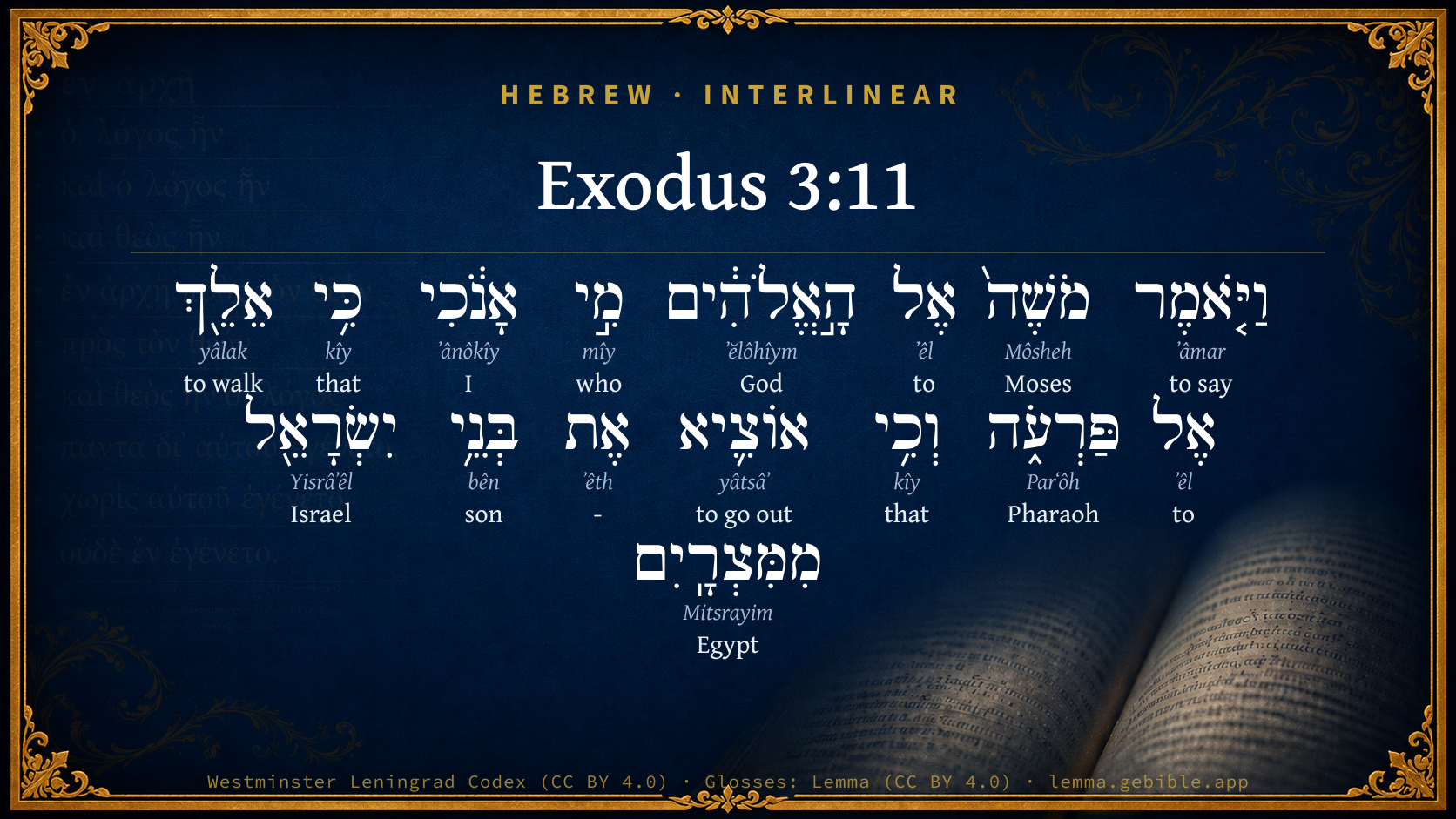
  1. וַיֹּ֤אמֶר ʼâmar H559 “and · to say” Conjunction + Verb, Qal, Sequential Imperfect, 3rd Person, Masculine, Singular
  2. מֹשֶׁה֙ Môsheh H4872 “Moses” Noun, Proper
  3. אֶל ʼêl H413 “to” Preposition
  4. הָ֣אֱלֹהִ֔ים ʼĕlôhîym H430 “the · God(s)” Particle, Definite Article + Noun, Common, Masculine, Plural, Absolute
  5. מִ֣י mîy H4310 “who” Particle, Interrogative
  6. אָנֹ֔כִי ʼânôkîy H595 “I” Pronoun, Personal, 1st Person, Common, Singular
  7. כִּ֥י kîy H3588 “that” Conjunction
  8. אֵלֵ֖ךְ yâlak H3212 “to walk” Verb, Qal, Imperfect, 1st Person, Common, Singular
  9. אֶל ʼêl H413 “to” Preposition
  10. וְכִ֥י kîy H3588 “and · that” Conjunction + Conjunction
  11. אוֹצִ֛יא yâtsâʼ H3318 “to go out” Verb, Hiphil, Imperfect, 1st Person, Common, Singular
  12. אֶת ʼêth H853 “-” Particle, Direct Object
  13. בְּנֵ֥י bên H1121 “sons of” Noun, Common, Masculine, Plural, Construct
  14. יִשְׂרָאֵ֖ל Yisrâʼêl H3478 “Israel” Noun, Proper
  15. מִמִּצְרָֽיִם Mitsrayim H4714 “from · Egypt” Preposition + Noun, Proper

About this verse

These counts appear in no published source. They are computed here, from the morphology-tagged text and Lemma’s own curated glosses. What Lemma adds →

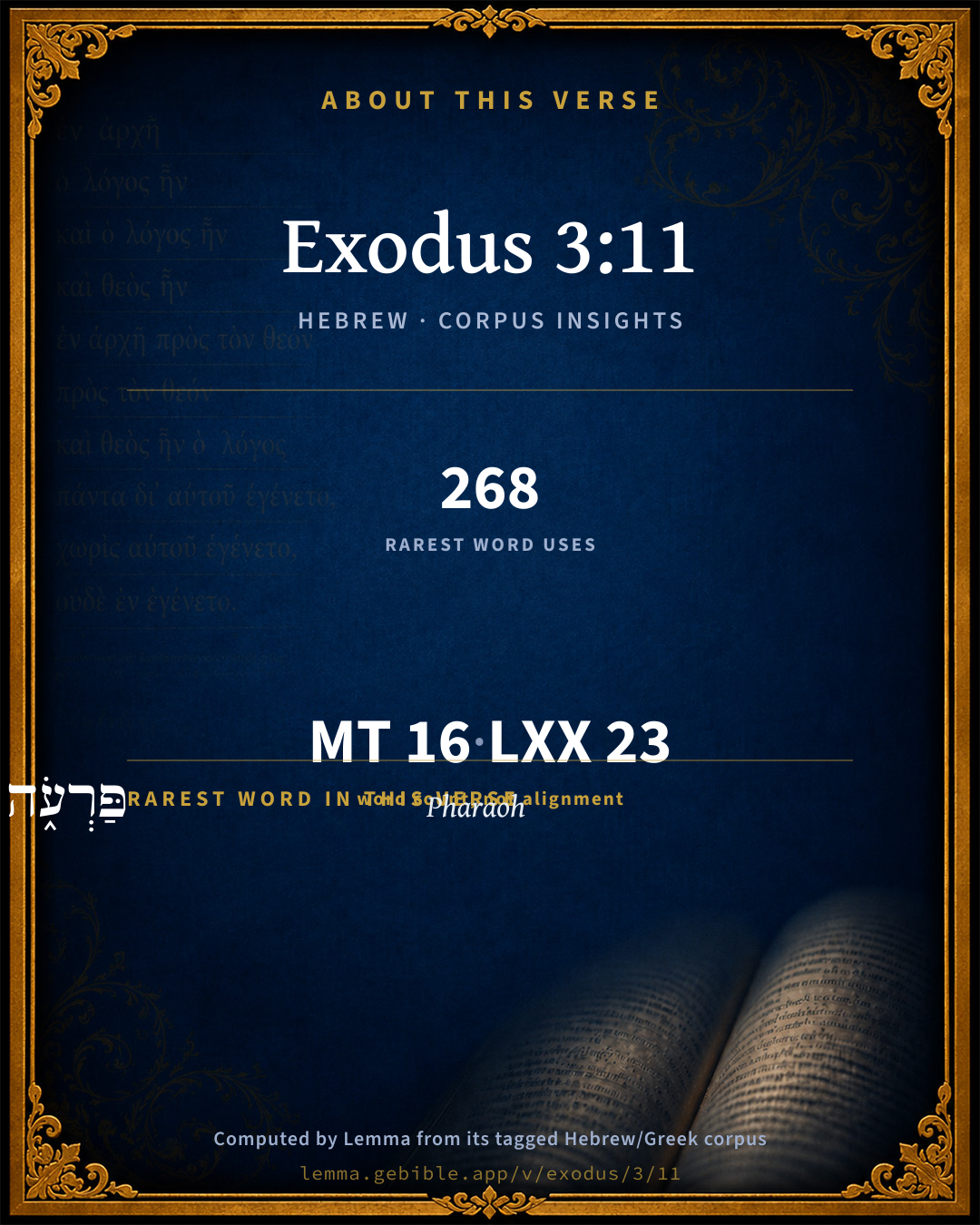
16
words
14
distinct lemmas
Pentateuch
section

Grammatical profile

  • 3 verbs
  • 6 nouns
  • 1 pronoun
  • 2 prepositions
  • 2 conjunctions
  • 2 particles

Verb forms

  • וַיֹּ֤אמֶר Qal · Sequential Imperfect
  • אֵלֵ֖ךְ Qal · Imperfect
  • אוֹצִ֛יא Hiphil · Imperfect

Repetition

Words recur within this verse — often emphatic in Hebrew:

  • אֶל to H413 ×2
  • כִּ֥י that H3588 ×2

Hebrew & Septuagint length

In English translation the verse runs 26 words from the Hebrew and 32 from the Septuagint (LXX English) — closely comparable.

A rough comparison of the two English renderings, which tokenize alike — not a word-level alignment.

Word counts can differ between the Hebrew and the Greek without any difference in meaning — e.g. the Hebrew direct-object marker אֵת has no separate Greek word, and Greek often adds the article ὁ.

In the original languages it is 16 Hebrew tokens and 23 Greek tokens — but the two are counted differently (Hebrew bundles its prefixes and suffixes into one token; the Greek is in lemma form), so that isn’t a like-for-like length.

Cross-references

11

Topical passages linked to Exodus 3:11 in the Treasury of Scripture Knowledge — connected by theme and wording, ordered by reader-vote popularity; previews shown in the World English Bible.

  • 1 Samuel 18:18 David said to Saul, Who am I, and what is my life, [or] my father's family in Israel, that I should be son-in-law to the king?
  • Exodus 6:12 Moses spoke before Yahweh, saying, "Behold, the children of Israel haven't listened to me. How then shall Pharaoh listen to me, who am of uncircumcised lips?"
  • 2 Corinthians 3:5 not that we are sufficient of ourselves, to account anything as from ourselves; but our sufficiency is from God;
  • Jeremiah 1:6 Then said I, Ah, Lord Yahweh! behold, I don't know how to speak; for I am a child.
  • 2 Corinthians 2:16 to the one a stench from death to death; to the other a sweet aroma from life to life. Who is sufficient for these things?
  • Exodus 4:10–13 Moses said to Yahweh, "Oh, Lord, I am not eloquent, neither before now, nor since you have spoken to your servant; for I am slow of speech, and of a slow tongue."
  • 2 Samuel 7:18 Then David the king went in, and sat before Yahweh; and he said, Who am I, Lord Yahweh, and what is my house, that you have brought me thus far?
  • 1 Kings 3:9 Give your servant therefore an understanding heart to judge your people, that I may discern between good and evil; for who is able to judge this your great people?
  • Isaiah 6:5–8 Then I said, "Woe is me! For I am undone, because I am a man of unclean lips, and I dwell in the midst of a people of unclean lips: for my eyes have seen the King, Yahweh of Hosts!"
  • 1 Kings 3:7 Now, Yahweh my God, you have made your servant king instead of David my father: and I am but a little child; I don't know how to go out or come in.
  • Acts 7:23–25 But when he was forty years old, it came into his heart to visit his brothers, the children of Israel.

Cross-references courtesy of OpenBible.info (CC BY 4.0).

Hebrew and Greek witnesses Masoretic Hebrew ↔ Greek Septuagint

The same verse in the two great witnesses to the Old Testament, shown verse-for-verse.

These are two independent witnesses, not word-aligned to each other, and the Septuagint is shown in lemma (dictionary) form.

Hebrew Exodus 3:11 Masoretic · Westminster Leningrad Codex

וַיֹּ֤אמֶר מֹשֶׁה֙ אֶל הָ֣אֱלֹהִ֔ים מִ֣י אָנֹ֔כִי כִּ֥י אֵלֵ֖ךְ אֶל פַּרְעֹ֑ה וְכִ֥י אוֹצִ֛יא אֶת בְּנֵ֥י יִשְׂרָאֵ֖ל מִמִּצְרָֽיִם

Moses said to God, "Who am I, that I should go to Pharaoh, and that I should bring forth the children of Israel out of Egypt?"

World English Bible · Public Domain

Greek LXX Exodus 3:11 Septuagint · lemma form

καί εἶπον μωυσῆς πρός ὁ θεός τίς εἰμί ὅτι πορεύομαι πρός φαραώ βασιλεύς αἴγυπτος καί ὅτι ἐκἄγω ὁ υἱός ἰσραήλ ἐκ γῆ αἴγυπτος

And Moses said to God, Who am I, that I should go to Pharao king of Egypt, and that I should bring out the children of Israel from the land of Egypt?

LXX2012 (modern English Septuagint) · Public Domain

On this verse, Keil & Delitzsch discusses the Septuagint’s reading. Read the note in Commentary ↓

Hebrew: Westminster Leningrad Codex (CC BY 4.0). Greek: Septuagint (public domain); English from LXX2012 (modern English Septuagint) (Public Domain). How the Septuagint differs from the Hebrew →

Targum (Aramaic paraphrase)

2

The Targum is the ancient Jewish Aramaic paraphrase of the Hebrew Scriptures — an interpretive translation, not the Hebrew text itself. Onkelos (literal) and Pseudo-Jonathan (expansive) render the Torah, and Jonathan the Prophets. Coverage is partial: where no permissively-licensed English translation exists for a verse, only the Aramaic is shown. This is verse-level text, not a word-by-word alignment to the Hebrew.

  1. Targum Onkelos Torah (Genesis–Deuteronomy)
    וַאֲמַר משֶׁה קֳדָם יְיָ מָן אֲנָא אֲרֵי אֵזִיל לְוָת פַּרְעֹה וַאֲרֵי אַפֵּיק יָת בְּנֵי יִשְׂרָאֵל מִמִצְרָיִם:

    (no public-domain English translation for this verse)

    Targum Onkelos — Aramaic: “Onkelos Genesis” (public domain); “Onkelos Exodus” (public domain); “Onkelos Leviticus” (public domain); “Onkelos Numbers” (public domain); “Onkelos Deuteronomy” (public domain). English: “Sefaria Community Translation” (CC0 1.0 (public-domain dedication)); “J.W. Etheridge. The Targums of Onkelos and Jonathan Ben Uzziel on the Pentateuch. London: Longmans, Green, 1862” (public domain). Text via Sefaria.

  2. Targum Pseudo-Jonathan Torah (Genesis–Deuteronomy)
    וַאֲמַר משֶׁה קֳדָם יְיָ מַאן אֲנָא אֲרוּם אֵזִיל לְוַת פַּרְעה וַאֲרוּם אַפֵּיק יַת בְּנֵי יִשְרָאֵל מִמִצְרָיִם

    And Mosheh said before the Lord, Who am I, that I should go to Pharoh, and bring forth the sons of Israel out of Mizraim?

    Targum Pseudo-Jonathan — Aramaic: “Targum Jonathan on Genesis” (public domain); “Targum Jonathan on Exodus” (public domain); “Targum Jonathan on Leviticus” (public domain); “Targum Jonathan on Numbers” (public domain); “Targum Jonathan on Deuteronomy” (public domain). English: “The Targum of Jonathan ben Uzziel, trans. J. W. Etheridge, London, 1862” (public domain). Text via Sefaria.

Commentary

Notes on Exodus 3:11 from classic Christian and Jewish commentators (each source and its license shown beneath its notes). The classic Christian expositions comment on the surrounding passage and are grouped to its opening verse, so a note may address several verses; the Jewish commentaries on the Tanakh (Rashi and others) are per-verse, so they appear only where the commentator wrote on this verse.

Lemma curates 59 commentaries, every one of them public domain or Creative Commons licensed, each selected and text-cleaned for this edition rather than reprinted as found. About our sources →

Matthew Henry's Commentary

God, having spoken to Moses, allows him also a liberty of speech, which he here improves; and,

I. He objects his own insufficiency for the service he was called to (Exo 3:11): Who am I? He thinks himself unworthy of the honour, and not par negotio - equal to the task. He thinks he wants courage, and therefore cannot go to Pharaoh, to make a demand which might cost the demandant his head: he thinks he wants skill, and therefore cannot bring forth the children of Israel out of Egypt; they are unarmed, undisciplined, quite dispirited, utterly unable to help themselves; it is morally impossible to bring them out. 1. Moses was incomparably the fittest of any man living for this work, eminent for learning, wisdom, experience, valour, faith, holiness; and yet he says, Who am I? Note, The more fit any person is for service commonly the less opinion he has of himself: see Jdg 9:8, etc. 2. The difficulties of the work were indeed very great, enough to startle the courage and stagger the faith of Moses himself. Note, Even wise and faithful instruments may be much discouraged at the difficulties that lie in the way of the church's salvation. 3. Moses had formerly been very courageous when he slew the Egyptian, but now his heart failed him; for good men are not always alike bold and zealous. 4. Yet Moses is the man that does it at last; for God gives grace to the lowly. Modest beginnings are very good presages.

II. God answers this objection, Exo 3:12. 1. He promises him his presence: Certainly I will be with thee, and that is enough. Note, Those that are weak in themselves may yet do wonders, being strong in the Lord and in the power of his might; and those that are most diffident of themselves may be most confident in God. God's presence puts an honour upon the worthless, wisdom and strength into the weak and foolish, makes the greatest difficulties dwindle to nothing, and is enough to answer all objections. 2. He assures him of success, and that the Israelites should serve God upon this mountain. Note, (1.) Those deliverances are most valuable which open to us a door of liberty to serve God. (2.) If God gives us opportunity and a heart to serve him, it is a happy and encouraging earnest of further favours designed us.

III. He begs instructions for the executing of his commission, and has them, thoroughly to furnish him. He desires to know by what name God would at this time make himself known, Exo 3:13.

1. He supposes the children of Israel would ask him, What is his name? This they would ask either, (1.) To perplex Moses: he foresaw difficulty, not only in dealing with Pharaoh, to make him willing to part with them, but in dealing with them, to make them willing to remove. They would be scrupulous and apt to cavil, would bid him produce his commission, and probably this would be the trial: "Does he know the name of God? Has he the watch-word?" Once he was asked, Who made thee a judge? Then he had not his answer ready, and he would not be nonplussed so again, but would be able to tell in whose name he came. Or, (2.) For their own information. It is to be feared that they had grown very ignorant in Egypt, by reason of their hard bondage, want of teachers, and loss of the sabbath, so that they needed to be told the first principles of the oracles of God. Or this question, What is his name? amounted to an enquiry into the nature of the dispensation they were now to expect: "How will God in it be known to us, and what may we depend upon from him?"

2. He desires instructions what answer to give them: "What shall I say to them? What name shall I vouch to them for the proof of my authority? I must have something great and extraordinary to say to them; what must it be? If I must go, let me have full instructions, that I may not run in vain." Note, (1.) It highly concerns those who speak to people in the name of God to be well prepared beforehand. (2.) Those who would know what to say must go to God, to the word of his grace and to the throne of his grace, for instructions, Eze 2:7; Eze 3:4, Eze 3:10, Eze 3:17. (3.) Whenever we have any thing to do with God, it is desirable to know, and our duty to consider, what is his name.

IV. God readily gives him full instructions in this matter. Two names God would now be known by: -

1. A name that denotes what he is in himself (Exo 3:14): I am that I am. This explains his name Jehovah, and signifies, (1.) That he is self-existent; he has his being of himself, and has no dependence upon any other: the greatest and best man in the world must say, By the grace of God I am what I am; but God says absolutely - and it is more than any creature, man or angel, can say - I am that I am. Being self-existent, he cannot but be self-sufficient, and therefore all-sufficient, and the inexhaustible fountain of being and bliss. (2.) That he is eternal and unchangeable, and always the same, yesterday, today, and for ever; he will be what he will be and what he is; see Rev 1:8. (3.) That we cannot by searching find him out. This is such a name as checks all bold and curious enquiries concerning God, and in effect says, Ask not after my name, seeing it is secret, Jdg 13:18; Pro 30:4. Do we ask what is God? Let it suffice us to know that he is what he is, what he ever was, and ever will be. How little a portion is heard of him! Job 26:14. (4.) That he is faithful and true to all his promises, unchangeable in his word as well as in his nature, and not a man that he should lie. Let Israel know this, I AM hath sent me unto you.

2. A name that denotes what he is to his people. Lest that name I AM should amuse and puzzle them, he is further directed to make use of another name of God more familiar and intelligible: The Lord God of your fathers hath sent me unto you (Exo 3:15): Thus God had made himself know to him (Exo 3:6), and thus he must make him known to them, (1.) That he might revive among them the religion of their fathers, which, it is to be feared, was much decayed and almost lost. This was necessary to prepare them for deliverance, Psa 80:19. (2.) That he might raise their expectations of the speedy performance of the promises made unto their fathers. Abraham, Isaac, and Jacob, are particularly named, because with Abraham the covenant was first made, and with Isaac and Jacob often expressly renewed; and these three were distinguished from their brethren, and chosen to be the trustees of the covenant, when their brethren were rejected. God will have this to be his name for ever, and it has been, is, and will be, his name, by which his worshippers know him, and distinguish him from all false gods; see Kg1 18:36. Note, God's covenant-relation to his people is what he will be ever mindful of, what he glories in, and what he will have us never forget, but give him the glory of: if he will have this to be his memorial unto all generations, we have all the reason in the world to make it so with us, for it is a precious memorial.

Matthew Henry's Commentary on the Whole Bible (1708–1710) — public domain (CC PDM 1.0). Text via the HelloAO Bible API.

Trapp's Complete Commentary

John Trapp

Exo 3:11 And Moses said unto God, Who [am] I, that I should go unto Pharaoh, and that I should bring forth the children of Israel out of Egypt?

Ver. 11. Who am I?] Worth is modest: the proud man asketh, Who am I not? παντα ποιειν εδωυαμτω, Curi Maioris sepulchro inscriptum refert Arrianus. Worth with modesty is καλον καλως; nothing is so amiable.

John Trapp, A Commentary or Exposition upon All the Books of the Old and New Testament (1647–1656) — public domain. Text from a community e-Sword module.

The Biblical Illustrator

Joseph S. Exell

Exo_3:11

Who am I?

Ministerial timidity

I. It is sometimes occasioned by undue and depreciating thoughts of self.

1. By undue thought of our social position.

2. By undue thought of our intellectual weakness.

3. By undue thought of our moral inability.

II. It is sometimes occasioned by an undue estimation of the difficulties of the work.

1. This may arise from the depressing experiences of youth.

2. This may arise from the removal of friendly aids.

III. It is sometimes occasioned by our not appreciating, as we ought, the divine presence and help.

1. The Divine presence is our guide.

2. The Divine presence is our sustaining influence.

3. The Divine presence is our victory.

IV. It should be removed by the hopes with which it is animated.

1. By the hope of achieving the freedom of a vast nation.

2. By the hope of leading a vast nation into the land of promise. Moses was to lead the Israelites into Canaan:

(1) Fertile.

(2) Abundance.

(3) Beauty.

So, the minister of Christ has to lead men to heaven--this is the hope by which he is animated--and ought to subdue all timidity--and inspire him with holy joy. (J. S. Exell, M. A.)

Notes

1. God may sometimes be denied by the best of men in their infirmity.

2. The best souls are apt to have the lowest thoughts of themselves for Gods work.

3. Visible difficulties in the Church may dishearten men to work.

4. The power of Egyptian oppressors may startle weak instruments of deliverance.

5. The redemption of men from the house of bondage is a startling fact. (J. S. Exell, M. A.)

The power of increasing age

1. To change the views.

2. To calm the temper.

3. To humble the soul. (J. S. Exell, M. A.)

Work greater than self

No wonder that he so inquired. The message seemed to be much greater than the messenger. He works best who magnifies his office. Preachers, and all ministers of good, should see their work to be greater than themselves if they would work at the highest point of energy. Let a man suppose his work to be easy, to be unworthy of his talents, and he will not achieve much success. (J. Parker, D. D.)

A Divine commission

I. Good men often want greater confidence in the service of God.

1. Distrust may arise from an honest conviction of personal unfitness. The most suitable workers are often the most diffident. Great talkers are little workers.

2. Distrust may arise from a false impression of opposing difficulties. Our estimate of what we can accomplish should be measured by our determination and love.

3. Distrust may arise from a positive relapse of religious fervour. Love inspires zeal.

II. Good men often want special encouragement in the service of God.

1. God encourages His servants by the assurance of His presence. He will give--

(1) Strength for every conflict;

(2) Wisdom for every emergency;

(3) Protection from every danger.

2. God encourages His servants by the assurance of ultimate success.

III. Good men often require minute instruction in the service of God. When Moses determined to go to the Israelites, he anticipated the difficulties that would arise. They would want proof of his Divine commission, and he asks, What shall I say unto them?

1. We should inquire of God respecting our secular engagements. Why am I engaged in this work, and not in some other? What is the object for which I work? What is the influence of my work upon my life? What is the spirit in which I work?

2. We should inquire of God respecting our intellectual tendencies. This is an age of intellectual unrest. Old theories are discarded, and old doctrines thrown aside. Am I wandering from the old paths? Am I resting on the true foundation?

3. We should inquire of God respecting our religious progress. Spiritual life necessitates spiritual growth. Our progress may be slow and imperceptible, but it must advance or perish. Are we going forward in the Divine life? Is faith stronger? is love deeper? is zeal more intense?

IV. Good men often received Divine authority for the service of God.

1. What evidence had Moses of his Divine commission? It was attested by a miraculous call.

2. What evidence had the Israelites of his Divine commission? It was attested by a miraculous power. (J. T. Woodhouse.)

Moses self-distrust

These words indicate humility, not fear. Among the grounds which he alleges for his hesitation, in no instance is there any allusion to personal danger; what he feared was failure owing to incompetency, especially in the power of expression. This shrinking from self-assertion is the quality which seems to be specially intimated by the word rendered meek in Num_12:3. (Canon Cook.)

False humility

Some people in studying this passage in the life of Moses will praise his humility. His pleas were all on the ground of personal unworthiness or unfitness for the great work. But let us not be deceived. That humility is not to be commended that shrinks from any duty which God commands. At Baalbec, in a quarry, lies a magnificent block, almost detached and ready for transportation. It was undoubtedly intended to be placed with its fellows in the wall which supported the Temple of the Sun. So large, so grand, it is a failure, because it never filled the place for which it was hewn. Like failures are many human lives. Who can tell how many men lie among the wastes and ruins of life, that God designed to fill grand places, but that, when called, refused to go? They folded their talents away in the napkins of supposed humility, of self-distrust, or of indolence or disobedience, and buried them in the earth. For ever they will lie in the quarries, pale ghosts of glorious might have beens, while the places in Gods temple which they were meant to fill remain for ever vacant. We can only make our lives successful by promptly, joyfully, and unhesitatingly accepting every call of our Master to His service, by putting ourselves utterly into His hands to be used anywhere, in any way, in any work, for any end, as He may direct. (The Westminster Teacher.)

The Biblical Illustrator, edited by Joseph S. Exell (c. 1880s–1900s) — public domain. Text from a community e-Sword module.

Joseph Benson's Commentary

Exo 3:11. Who am I? — He thinks himself unworthy of the honour, and unable for the work. He thinks he wants courage, and therefore cannot go to Pharaoh: he thinks he wants conduct, and therefore cannot bring forth the children of Israel out of Egypt — They are unarmed, undisciplined, quite dispirited, utterly unable to help themselves. Moses was incomparably the fittest of any man living for this work, eminent for learning, wisdom, experience, valour, faith, holiness, and yet he says, Who am I? The more fit any person is for service, the less opinion he has of himself.

Joseph Benson's Commentary on the Old and New Testaments (1811–1818) — public domain. Text from a community e-Sword module.

The Preacher's Complete Homiletical Commentary

Joseph S. Exell (gen. ed.)

MAIN HOMILETICS OF THE PARAGRAPH.—Exo_3:11-12

MINISTERIAL TIMIDITY

I. It is sometimes occasioned by undue and depreciating thoughts of self. (Exo_3:11.) By undue thought of our social position. “Who am I, that I should go unto Pharaoh?” Moses might imagine the need of social position, in order to obtain an interview with the King. Some of the best ministers of the gospel have come from the most humble scenes of social life. There are times in ministerial labour when good social position may aid the mission of truth and freedom—but it is not an absolute necessity. Men from the lower ranks of humanity may do as much to subdue the tyranny of a king, as the most refined aristocrat of the realm. A man of great soul, independent of social standing, may successfully accomplish a campaign against moral evil.

2. By undue thought of our intellectual weakness. “Who am I?” True, Moses was well educated—still his mental discipline would hardly appear to him as equal to the present crisis and undertaking. He would have to fall back upon his knowledge of the Egyptian court, and upon other matters, of important bearing on his mission. So, may ministers of to-day feel their inability to combat the error—scepticism—and refined sin of the age—through their lack of brain power. They have not had the advantages in their early days that even Moses had. Of what little information they possess, they make the best possible use. It requires a well disciplined mind to go to the Pharaohs of the world, and to demand efficiently the moral freedom of their slaves.

3. By undue thought of our moral inability. A man requires not only a strong mind—but much more, a strong soul—of devout impulse—large sympathy—and strong determination, to perform such a commission as that now given to Moses. Equally so, with the minister of Christ. And, when the true preacher looks into his heart in moments of depression, he feels his lack of great moral qualities—and cries, “Who am I,” &c.

II. That it is sometimes occasioned by an undue estimation of the difficulties of the work.

1. This may arise from the depressing experiences of youth. When young—living in the palaces of Pharaoh—Moses had striven to interrupt a quarrel between two Hebrews by referring them to the fact of their common brotherhood and suffering—he had been repulsed. No doubt a remembrance of this fact now lingered within his mind—as there are certain experiences that never leave us—they become the constant, and great educational influences of our souls. This reminiscence would give Moses to feel the difficulty of the task now imposed upon him. So, with ministers of the Gospel—it may be that the experiences of boyhood and younger manhood, have introduced an element of difficulty, perplexity, into their toil, that they almost shrink from the call.

2. This may arise from the removal of friendly aids. Moses once had friends in the court of Pharaoh—he was the adopted son of the King’s daughter—had he retained her friendship—it might have been of use to him now; but he had lost it by flight. So, it sometimes happens that ministers often lose earthly, accidental friendships, aids to the achievement of their mission, and hence their timidity as to its issue.

III. That it is sometimes occasioned by our not appreciating, as we ought, the Divine Presence and help.

1. The Divine Presence is our Guide. God would teach—guide Moses as to the best methods of approach to Pharaoh. So, the same Jehovah will equally guide all true ministers who are seeking the moral freedom of men. This guidance makes up for any scholastic deficiency—is our truest help.

2. The Divine Presence is our sustaining influence. It would sustain Moses under his memory of youthful failure to subdue the quarrel of the two Israelites. It would sustain him in the performance of all arduous toils—in the event of suffering—rebuff, either from Pharaoh—his courtiers—or his bondmen. So, the Divine Presence sustains the minister of Christ—under the bitter memories of past failure—misdirected effort—wanderings—loneliness—and opposition, from whatever source. But for this he would be unequal to the task for an hour.

3. The Divine Presence is our victory. It gave Moses an insight into the future history of Pharaoh—it enabled him to work miracles—it empowered his moral nature—rendered it superior to the conflict. So, with the minister of truth—though he cannot work miracles—the Divine Presence is the pledge of moral conviction in the minds of others—and of final victory.

IV. It should be removed by the hopes with which it is animated.

1. By the hope of achieving the freedom of a vast nation. Moses was to bring the children of Israel out of Egypt. So, it is the hope of the gospel ministry to bring the universe from under the reign of sin—to freedom—happiness—hope—what a sublime anticipation!

2. By the hope of leading a vast nation into the land of promise. Moses was to lead the Israelites into Canaan: (i.) Fertile. (ii.) Abundance. (iii.) Beauty. So, the minister of Christ has to lead men to heaven—this is the hope by which he is animated—and ought to subdue all timidity—and inspire him with holy joy.

SUGGESTIVE COMMENTS ON THE VERSES

Exo_3:11. The man who in youth slew the Egyptian, and was willing to undertake the emancipation of his nation, now modestly shrinks from the task.

The power of increasing age—

1. To change the views.

2. To calm the temper.

3. To humble the soul.

No wonder that he so inquired. The message seemed to be much greater than the messenger. He works best who magnifies his office. Preachers, and all ministers of good, should see their work to be greater than themselves if they would work at the highest point of energy. Let a man suppose his work to be easy, to be unworthy of his talents, and he will not achieve much success [City Temple].

It is far better to partake of the spirit of Moses as manifested in this verse, than to too rashly seek the dignity and position of ministerial work.

Worth is modest: the proud man asketh, who am I not? [Trapp].

God may sometimes be denied by the best of men in their infirmity.

The best souls are apt to have the lowest thoughts of themselves for God’s work.

Visible difficulties in the Church may dishearten men to work.

The power of Egyptian oppressors may startle weak instruments of deliverance.

The redemption of men from the house of bondage is a startling fact.

Exo_3:12. “Certainly I will be with thee.” The Divine companionship realised by the good in the service of the Christian life:—

I. It was considerate. Never did Moses more need the Divine companionship than in this exigency of toil. The work is great—he feels his inability for it—it is at the time of his weakness that the Divine companionship is promised. This promise will stand true for Christian workers during all time.

II. It was emphatic. “Certainly.” The promise—in tone—manner—could leave no doubt on the mind of Moses as to the likelihood of its fulfilment. Its emphasis satisfied his utmost requirement—left no room for doubt. So, now the promise of the Divine companionship is emphatic—becoming even more so by the accumulating experiences of the good.

III. It was sympathetic. “With thee.” Not I will follow thee—not I will go before thee—not I will be near thee—but with thee—as a companion to cheer thy soul; as a friend—to give thee counsel; as a God—to make thee victorious. How can a mission fail when God is with the worker. How refreshing to a timid soul is the sympathy of Heaven. Our sufficiency is of God.

THE GUARANTEE OF SUCCESS

I. “Certainly I will be with thee.” Then man is servant, not master. He should know his place, or he can never keep it. As servant—

1. He should consult his master.

2. Speak in the name of his master.

3. Be jealous of the honour of his master.

II. “Certainly I will be with thee.” Then the work must succeed. The guarantee of success:—

1. Not human cleverness.

2. Not skilful organisation.

3. But the word of the Lord. “My word shall not return unto Me void.”

III. Certainly I will be with thee. Then the servant is to be received for the master’s sake. “He that receiveth you, receiveth me.” The Romans were to receive Phebe in the Lord.

IV. “Certainly I will be with thee.” Then there need be no lack of grace or power. “I any man lack wisdom,” &c. “Lo, I am with you alway.” God is with His servants for,

1. Their comfort.

2. Justice.

3. Safety [City Temple].

“This shall be a token unto thee that I have sent thee.” Tokens that a minister is Divinely commissioned:—

1. That he reflects the light of heavenly vision.

2. That he is conscious, and his life gives evidence, of Divine companionship.

3. That he seeks to proclaim the name of God, as connected with the moral freedom of men.

4. That some amount of spiritual success attends his labours.

5. Sometimes special evidences of favour given in answer to prayer.

We render the highest honour to God when, relying on His proffered aid, we seek no ground of confidence out of Himself, when in the deep sense of our own impotence we count it enough that He is with us and for us [Bush].

God is not moved from His purpose by the objections of men.

To all human appearance Moses is to undertake the responsibility of this mission, whereas he is only a secondary agent. God is invisible.… God’s goodness satisfieth the plea of His unwilling instruments for His work.

God’s presence is always with those who are engaged in His redemptive work.

God will answer the objection, and solve the difficulties of His workers.

Redemption promised by God will surely be performed.

The worship and service of God is the great end of His people’s freedom.

The true worship of God in the place appointed by Him is the best return for deliverance.

ILLUSTRATIONS

Exo_3:12. There is an excellent story of a young man that was at sea in a mighty, raging tempest, and when all the passengers were at their wits’ end for fear, he only was merry; and when he was asked the reason of his mirth, he answered that the pilot of the ship was his father, and he knew that his father would have a care of him. The great and wise God, who is our Father, hath from all eternity decreed what shall be the issues of all wars, what the event of all troubles. He is our pilot, He sits at the stern; and though the ship of the Church or State be in a sinking condition, yet be of good comfort, our pilot will have a care of us. There is nothing done in the lower House of Parliament on earth but what is first decreed in the higher house in heaven. All the lesser wheels are ordered and overruled by the upper. “Are not five sparrows,” saith Christ “sold for a farthing?” One sparrow is not worth half a farthing, and there is no man shall have half a farthing’s worth of harm more than God hath decreed from all eternity [Calamy’s Sermon].

The Preacher's Complete Homiletical Commentary (gen. ed. Joseph S. Exell; Funk & Wagnalls, c. 1892) — public domain (pre-1929). A full-Bible homiletical/sermon-outline anthology covering 65 of 66 books (2 John is absent from the source module). Text from a community e-Sword module.

Tyndale Open Study Notes

Tyndale Open Resources

3:11–4:17 Moses, in his response to God, presented four reasons why he was not the one to fulfill God’s call. Although each reason supposedly relates to Moses and his ability, God’s answers show that they were really questions about God.

3:11-12 Moses first protested that he was unworthy of such a great task, but God responded that this was not the issue. Human worthiness is of no significance if God’s presence is with that person.

Tyndale Open Study Notes — © Tyndale Open Resources, licensed CC BY-SA 4.0. Text via the HelloAO Bible API.

Geneva Bible (1599)

Geneva Bible translators

He doth not fully disobey God, but acknowledgeth his own weakness.

Geneva Bible (1599) marginal notes — public domain. Text via Bolls.life.

Adam Clarke's Commentary

Verse 11. Who am I - that I should bring] He was so satisfied that this was beyond his power, and all the means that he possessed, that he is astonished that even God himself should appoint him to this work! Such indeed was the bondage of the children of Israel, and the power of the people by whom they were enslaved, that had not their deliverance come through supernatural means, their escape had been utterly impossible.

Adam Clarke's Commentary on the Bible (1810–1826) — public domain. Text from a community e-Sword/MySword module.

Ellicott's Commentary for English Readers

(11) Who am I, that I should go?—The men most fit for great missions are apt to deem themselves unfit. When God called Jeremiah to be a prophet, his reply was, “O Lord God! Behold, I cannot speak, for I am a child” ( Jer_1:6). St. Ambrose fought hard to escape being made Archbishop of Milan. Augustine was loth to undertake the mission to England. Anselm was with difficulty persuaded to accept the headship of our Church in the evil days of Rufus. The first impression of a fit man selected for a high post generally is, “Who am I?” In Moses’s case, though there were some manifest grounds of fitness—e.g., his Egyptian training and learning, his familiarity with the court. his knowledge of both nations and both languages—yet, on the other hand, there were certain very marked (apparent) disqualifications. Forty years of exile, and of a shepherd’s life had at once unfitted him for dealing with a court, and made him a stranger to his brethren. Want of eloquence seemed to be a fatal defect in one who must work mainly by persuasion. Even his age (eighty) might well have seemed to him unsuitable.

A Bible Commentary for English Readers, edited by Charles John Ellicott (1878–1897) — public domain. Text from a community e-Sword module.

The Cambridge Bible for Schools and Colleges

gen. ed. J. J. S. Perowne

11–12. Moses’ first difficulty: he is unsuited either to treat with Pharaoh, or to become the leader of his people. Cf. Jdg_6:15.

The Cambridge Bible for Schools and Colleges (gen. ed. J. J. S. Perowne; Cambridge University Press, 1878–1918) — public domain. Text from a community e-Sword module.

John Gill's Exposition

And Moses said unto God, who am I, that I should go unto Pharaoh,.... A private person, an exile in a foreign country, a poor shepherd, unknown to Pharaoh, and had no interest in him; and he a great king, and possessed of numerous forces to defend his country, and prevent the Israelites' departure out of it: time was when he was known to a Pharaoh, dwelt in his court, and made a figure there, and had great interest and authority there, being the adopted son of the king's daughter; but now it was otherwise with him:

and that I should bring forth the children of Israel out of Egypt: who though a people numerous, yet unarmed, and held in great bondage; and he might remember how he had been repulsed and rejected by some of them forty years ago, which might be discouraging to him.

John Gill's Exposition of the Whole Bible (1746–1763) — public domain (CC PDM 1.0). Text via the HelloAO Bible API.

Albert Barnes' Notes on the Bible

Who am I - These words indicate humility (compare Num 12:3), not fear. He feared failure, owing to incompetency, especially in the power of expression.

Albert Barnes' Notes on the Bible (1834–1885) — public domain. Text from a community e-Sword/MySword module.

Matthew Poole's English Annotations

What a mean, inconsiderable person am I! how unworthy and unfit for that employment! He was more forward in the work forty years ago, by reason of the fervours of his youth, his inexperience in affairs, the advantage of his power and interest in the court, by which he thought he could and should procure their deliverance; but now age had made him cool and considerate; the remembrance of his brethren’s rejection of him, when he was a great man at court, took away all probability of prevailing with them to follow him, much more of prevailing with Pharaoh to let them go. Thus Moses falls into that distemper to which most men are prone, of measuring God by himself, and by the probabilities or improbabilities of second causes.

Matthew Poole's English Annotations on the Holy Bible (1683–1685) — public domain. Text from a community e-Sword/MySword module.

Whedon's Commentary on the Bible

Daniel D. Whedon

11. Who am I — Forty years before he had been all ready in his youthful confidence, but the work that God had for him has been rising before him in its vastness, till now it overwhelms him. So Isaiah, when he had seen Jehovah and received his commission, cried, “Woe is me!” So Paul cried, “Who is sufficient for these things!”

Daniel D. Whedon (gen. ed.), Commentary on the Old and New Testaments (1874–1909) — public domain. Text from a community e-Sword module.

The Pulpit Commentary

And Moses said Who am I, that I should go, etc. A great change had come over Moses. Forty years earlier he had been forward to offer himself as a "deliverer." He "went out" to his brethren and slew one of their oppressors, and "supposed his brethren would have understood how that God by his hand would deliver them". (Act_7:25) "But they understood not" (ibid.) They declined to accept him for leader, they reproached him with setting himself up to be "a ruler and a judge" over them. And now, taught by this lesson, and sobered by forty years of inaction, he has become timid and distrustful of himself, and shrinks from putting himself forward. Who am I, that I should go to Pharaoh? What weight can I, a foreigner, forty years an exile, with the manners of a rough shepherd, expect to have with the mighty monarch of all Egypt the son of Rameses the Great, the inheritor of his power and his glories? And again, Who am I, that I should bring forth the children of Israel? What weight can I expect to have with my countrymen, who will have forgotten me whom, moreover, I could not influence when I was,in my full vigour who then "refused" my guidance and forced me to quit them? Truediffidence speaks in the words used there is no ring of insincerity in them; Moses was now as distrustful of himself as in former days he had been confident, and when he had become fit to be a deliverer, ceased to think himself fit.

Fitness of Moses to be God"s instrument in delivering Israel.

The fitness of Moses to be Israel"s deliverer will appear if we consider, first, What were the qualities which the part of deliverer required; secondly, how far they were united in him; and thirdly, what reasons there are for believing that, at the time, they were not united to the same extent in any other person.

1. NECESSARY QUALITIES OF THE DELIVERER. As having to deal,in the first instance, with a great king and his court, it was necessary that the Deliverer should be familiar with the habits of the court, should be able to assume its manners, speak its language, and not unwittingly infringe its etiquette. Not being set merely to petition, but to require to prefer demands it was requisite that he should feel himself, socially, on a par with the monarch, so as not to be timid or abashed before him, but able without difficulty to assert himself, to use freedom of speech, to talk as prince with prince, and not as mere courtier with monarch. Again, as having to meet and baffle Egyptian priests, and further, to be not only the Deliverer, but the Teacher and Educator of his nation, it was to the last degree necessary that he should be "learned in all the wisdom" of the time; that he should have had as good an education as any other man of the day; be able to foil the priests with their own weapons; and, after delivering his people out of bondage, be capable of elevating them, instructing them, advancing them from a rabble of slaves into an orderly, self-sufficient, fairly-enlightened, if not highly-civilised, nation. Once more: a moral fitness was necessary. The Deliverer needed to have high aspirations, a bold spirit, fervent zeal, and yet to have all these under control; to be calm, quiet, serf-contained, imperturbable in danger, persevering, prompt, considerate. Moreover, he needed to be a religious man. Anyone not upheld by high religious principle, anyone not possessed of deep and true faith, would have fallen away in some of the trials through which the nation had to pass; would have desisted, or murmured, or "lusted after evil things", (1Co_10:6) or waxed proud and wanton, or grown weary of seemingly interminable wanderings, and settled down in Arabia or even returned to Egypt.

2. MOSES" POSSESSION OF THESE QUALITIES. Moses was familiarwith the customs of the Egyptian court, having been brought up in the household of a princess, and been himself a courtier until he was nearly forty years of age. Though he had subsequently spent forty years in the desert, this would not unfit him; since, in the first place, Egyptian manners and customs were unchanging; and secondly, life in the desert is at no time a bad school of manners. Arabian shepherds are not like European ones. As much politeness is often seen in the tent of a Bedouin as in the drawingroom of an empress. Moses probably thought that his forty years of seclusion rendered him less suited for the atmosphere of a court, but he was probably mistaken. What he may have lost in polish he gained in simplicity, directness, and general force of character. Moses, again, could speak with the Pharaoh almost as an equal, since as the adopted son of a princess he had born accounted a prince, and may even, before his flight, have met Menephthah in the royal palace on terms of social equality. On the education and "wisdom" of Moses we have already descanted, and it will scarcely be questioned that in these respects he was eminently fitted for the part assigned to him by Providence. His character, too, as chastened and ripened in Midian, made him exceptionally fit. Audacity, high aspirations, strong sympathies, a burning zeal, had shown themselves in the conduct that led to his exile. These had been disciplined and brought under control by the influences of desert life, which had made him calm, self-contained, patient, persevering, considerate, without quenching his zeal or taming his high spirit. And of his religious principle there is no question. If he angered God once by "speaking unadvisedly" (Psa_106:33; Num_20:10) this does but show that he was human, and therefore not perfect. Apart from this one occasion his conduct as leader of the people is, as nearly as possible, blameless. And his piety is everywhere conspicuous.

3. NO ONE BUT MOSES POSSESSED THE NECESSARYQUALITIES. With the limited knowledge that we possess, the negative is incapable of positive proof. But, so far as our historical knowledge goes, there is no one who can be named as possessing any one of the necessary qualities in a higher degree than Moses, much less as uniting them all. No Hebrew but Moses had had, so far as we know, the advantages of education and position enjoyed by Moses. No Egyptian would have been trusted by the Hebrew nation and accepted as their leader. No one who was neither Egyptian nor Hebrew would have had any weight with either people. Thus Moses was the one and only possible deliverer, exactly fitted by Providence for the position which it was intended he should take: raised up, saved, educated, trained by God to be his instrument in delivering his people, and so exactly fitted for the purpose.

Vers. 11-12. Moses" timidity notwithstanding his fitness.

It is not often that those are most confident of their powers who are fittest for God"s work. Great capacity is constantly accompanied by a humble estimate of itself. Jeremiah"s reply when God called him was: "Ah! Lord God, I cannot speak, for I am a child". (Jer_1:6) Newton seemed to himself a child gathering shells upon the shores of the ocean of Truth. The exclamation of Moses, "Who am I that I should go," etc. has been echoed by thousands. If, however, God"s call is clear, the voice of self-depreciation is not to be much listened to. He knows best whether we are fit to work out his purposes, or no. Whether the call is to be an ordinary minister, or a missionary, or a bishop, or a civil leader, the foremost in a political movement, or a general at the crisis of a war, or anything else, too much timidity ought not to be shown. There is cowardice in shrinking from responsibility. If the call be clearly from without, not courted by ourselves, not sought, not angled for, not assignable to any unworthy motive, then it is to be viewed as God"s call; and the proper answer is "Speak, Lord, for thy servant heareth." Unfit as we may think ourselves, we may be. sure that he will not leave us to ourselves his grace will be sufficient for us he will give us all the strength we need.

Vers. 11-17. Hindrances to service and how God removes them.

1. THE HINDRANCE FOUND IN THE SENSE OF OUR OWNWEAKNESS (vers. 11, 12).

1. Moses knew the pomp and pride of the Egyptian court. He rememberedhow Israel had rejected him when he was more than he was now. Once he had believed himself able for the task, but he was wiser now: "Who am I?" etc. He might serve God in the lowly place he held, but not there. Moses in this the type of multitudes. God"s call for service is met on every hand by the cry, "Who am I that I should go?

2. How God meets this sense of weakness.

(1) By the assurance of his presence. It was not Moses only that should go, but God also. The conviction that he is with us, and that we speak for him, makes the meekest bold, the weakest strong.

(2) By the assurance of success: "Ye shall serve God upon this mountain. " He is armed with faith and hope. From self let us look to God and his pledged word.

II THE HINDRANCE FOUND IN THE SENSE OF OUR IGNORANCE (vers. 13-17).

1. His own thought of God was dim. How then could he carry convictionto the hearts of the people? The same lack of clear, living thought of God keeps tongues tied to-day.

2. How it may be removed.

(1) God is THE UNCHANGING ONE. He had revealed himself to their fathers: he was all this still. It was his memorial for ever. Grasping this thought, all the past is God"s revelation.

(2) He takes with him a gospel for present need (vers. 16, 17), and these two things will be God"s full revelation. We must make men apprehend the revelation which God has given of himself in the past, and proclaim him as the God of to-day. "I have surely visited you, and I will bring you up out of the affliction. U.

The Pulpit Commentary (1880–1919), ed. H.D.M. Spence-Jones & Joseph S. Exell — public domain. Text from a community e-Sword module.

John Wesley's Explanatory Notes

Who am I? - He thinks himself unworthy of the honour and unable for the work. He thinks he wants courage, and therefore cannot go to Pharaoh: he thinks he wants conduct, and therefore cannot bring forth the children of Israel out of Egypt; they are unarmed, undisciplined, quite dispirited, utterly unable to help themselves, Moses was incomparably the fittest of any man living for this work, eminent for learning, wisdom, experience, valour, faith, holiness, and yet Who am I? The more fit any person is for service, commonly the less opinion he has of himself.

John Wesley, Explanatory Notes Upon the Whole Bible (1754–1765) — public domain. Text via the GEBible commentary corpus.

Keil & Delitzsch

C. F. Keil & F. Delitzsch

To the divine commission Moses made this reply: "Who am I, that I should go to Pharaoh, and bring forth the children of Israel out of Egypt?" Some time before he had offered himself of his own accord as a deliverer and judge; but now he had learned humility in the school of Midian, and was filled in consequence with distrust of his own power and fitness. The son of Pharaoh's daughter had become a shepherd, and felt himself too weak to go to Pharaoh. But God met this distrust by the promise, "I will be with thee," which He confirmed by a sign, namely, that when Israel was brought out of Egypt, they should serve (עבד, i.e., worship) God upon that mountain. This sign, which was to be a pledge to Moses of the success of his mission, was one indeed that required faith itself; but, at the same time, it was a sign adapted to inspire both courage and confidence. God pointed out to him the success of his mission, the certain result of his leading the people out: Israel should serve Him upon the very same mountain in which He had appeared to Moses. As surely as Jehovah had appeared to Moses as the God of his fathers, so surely should Israel serve Him there. The reality of the appearance of God formed the pledge of His announcement, that Israel would there serve its God; and this truth was to till Moses with confidence in the execution of the divine command. The expression "serve God" (λατρεύειν τῷ Θεῷ, lxx) means something more than the immolare of the Vulgate, or the "sacrifice" of Luther; for even though sacrifice formed a leading element, or the most important part of the worship of the Israelites, the patriarchs before this had served Jehovah by calling upon His name as well as offering sacrifice. And the service of Israel at Mount Horeb consisted in their entering into covenant with Jehovah (Exo 24); not only in their receiving the law as the covenant nation, but their manifesting obedience by presenting free-will offerings for the building of the tabernacle (Exo 36:1-7; Num 7:1).

(Note: Kurtz follows the Lutheran rendering "sacrifice," and understands by it the first national sacrifice; and then, from the significance of the first, which included potentially all the rest, supposes the covenant sacrifice to be intended. But not only is the original text disregarded here, the fact is also overlooked, that Luther himself has translated עבד correctly, to "serve," in every other place. And it is not sufficient to say, that by the direction of God (Exo 3:18) Moses first of all asked Pharaoh for permission merely to go a three days' journey into the wilderness to sacrifice to their God (Exo 5:1-3), in consequence of which Pharaoh afterwards offered to allow them to sacrifice (Exo 8:3) within the land, and at a still later period outside (Exo 8:21.). For the fact that Pharaoh merely spoke of sacrificing may be explained on the ground that at first nothing more was asked. But this first demand arose from the desire on the part of God to make known His purposes concerning Israel only step by step, that it might be all the easier for the hard heart of the king to grant what was required. But even if Pharaoh understood nothing more by the expression "serve God" than the offering of sacrifice, this would not justify us in restricting the words which Jehovah addressed to Moses, "When thou hast brought forth the people out of Egypt, ye shall serve God upon this mountain," to the first national offering, or to the covenant sacrifice.)

Keil & Delitzsch — Biblical Commentary on the Old Testament (1861–1891) — public domain (CC PDM 1.0). Text via the HelloAO Bible API. (Old Testament only.)

Kretzmann's Popular Commentary

Paul E. Kretzmann

The Emphatic Commission

v. 11. And Moses said unto God, Who am I that I should go unto Pharaoh, and that I should bring forth the children of Israel out of Egypt? Moses certainly had learned humility in. the school of Midian, not unmixed with dejection; all his youthful rashness was forgotten. "He who once would, when as yet he ought not, now will no longer when he ought. "

v. 12. And He said, Certainly I will be with thee, the presence, the power, and the wisdom of God was to accompany Moses; and this shall be a token unto thee that I have sent thee: When thou halt brought forth the people out of Egypt, ye shall serve God upon this mountain. This was literally fulfilled, for it was on almost the identical spot then occupied by Moses that the children of Israel were encamped when they entered into the formal relation of worshipers of Jehovah. But Moses had another objection.

v. 13. And Moses said unto God, Behold, when I come unto the children of Israel and shall say unto them, The God of your fathers hath sent me unto you, and they shall say unto me, What is His name? what shall I say unto them? The name God Almighty was too general to distinguish the true God from the idols of Egypt, and therefore the inquiry for the name has the purpose of obtaining some expression on the part of God which would indicate His essence and the actual manifestation of the divine essence toward His people, by which they might understand and apprehend Him.

v. 14. And God said unto Moses, I am that I am; and He said, Thus shalt thou say unto the children of Israel, I AM hath sent me unto you. It is a majestic declaration in which God reveals His essence to Moses as the unchangeable, eternally faithful covenant God. From past to future, from everlasting to everlasting, He is the same merciful Lord over all, without change or shadow of turning.

v. 15. And God said, moreover, unto Moses, Thus shalt thou say unto the children of Israel, The Lord God of your fathers, the God of Abraham, the God of Isaac, and the God of Jacob, hath sent me unto you; this is My name forever and ever, and this is My memorial unto all generations. Forward into the endless future, and backward into the past without beginning: there is only that one true God as He should be accepted by all men.

v. 16. Go, and gather the elders of Israel together, and say unto them, The Lord God of your fathers, the God of Abraham, of Isaac, and of Jacob, appeared unto me, saying, I have surely visited you, visiting I have visited you, and seen that which is done to you in Egypt;

v. 17. and I have said, I will bring you up out of the affliction, the burden, of Egypt unto the land of the Canaanites, and the Hittites, and the Amorites, and the Perizzites, and the Hivites, and the Jebusites, unto a land flowing with milk and honey. The apparently cumbersome repetition of the name of God and the long enumeration of the Canaanitish tribes all serve for emphasis to bring out the certainty of the fulfilment.

v. 18. And they shall hearken to thy voice; and thou shalt come, thou and the elders of Israel, unto the king of Egypt, and ye shall say unto him, The Lord God of the Hebrews hath met with us, for the present revelation of God to Moses concerned, and had significance for, all the people; and now let us go, we beseech thee, three days’ journey into the wilderness, that we may sacrifice to the Lord, our God. This request was not a deception, but agreed with the plan of God, for because the Lord knew the hard heart of Pharaoh, Moses and the elders were, at the beginning, not to ask more than a leave of absence, for Pharaoh’s denial of this petition would then reveal the hardness of his heart. God intended to make Pharaoh an example for all time.

Paul E. Kretzmann, Popular Commentary of the Bible (1921–1924) — public domain. Text from a community e-Sword module.

unfoldingWord translationNotes

Door43 World Missions Community

Who am I, that I should go to Pharaoh ... Egypt?

Moses uses this question to tell God that Moses is a nobody and no one will listen to him. AT: "I am not important enough to go to Pharaoh ... Egypt!" (See: Rhetorical Question)

translationWords

Moses

God

Pharaoh

Israel

Egypt

sign

worship

unfoldingWord translationNotes — © Distant Shores Media and the Door43 World Missions Community, licensed CC BY-SA 4.0. Source: git.door43.org/Door43/en_tn.

Rashi

Rabbi Shlomo Yitzchaki (Rashi)

מי אנכי WHO AM I? — Of what importance am I that I should speak with monarchs?

וכי אוציא את בני ישראל AND THAT I SHOULD BRING FORTH THE CHILDREN OF ISRAEL — and even if I am of sufficient importance for this, how has Israel merited that a miracle should be wrought for them and that I should bring them forth from Egypt?

Rashi on the Tanakh — English translations: “The Judaica Press complete Tanach with Rashi, translated by A. J. Rosenberg” (CC BY 4.0); “Pentateuch with Rashi's commentary by M. Rosenbaum and A.M. Silbermann, 1929-1934” (public domain); “The Metsudah Tanach series, Lakewood, N.J” (CC BY 4.0); and “The Book of Joshua, Metsudah Publications, 1997” (CC BY 4.0). Text via Sefaria.

Lesson kit

Teaching starters — assembled from the data on this page, not authored interpretation. Every prompt links to the verse data it draws on. Edit before teaching.

Exodus, in the Pentateuch, opens this verse with 16 words (14 distinct Hebrew lemmas). Its most distinctive word is Parʻôh (“Pharaoh”). A historical commentator’s framing appears above. Read the whole chapter for the surrounding context.

Discussion questions

  1. The word Parʻôh carries the sense “Pharaoh.” How does it shape the verse?
  2. How does 1 Samuel 18:18, which shares this passage’s theme, read alongside this verse?
  3. What does the repetition of “to” (2× in this one verse) do in this verse?
  4. The translations on this page render this verse differently — a whole-verse word diff, not a word-by-word alignment. What might account for the different wordings?
  5. «וַיֹּ֤אמֶר» is a Qal Sequential Imperfect verb. How does that grammatical form shape the action described?
  6. Compare how Matthew Henry's Commentary and Trapp's Complete Commentary read this verse. Where do they agree or differ?

Things to notice

Reading settings

Reading text

Shown beneath each verse's original-language words.

Old Testament
Old Testament edition

Read the OT as the Masoretic Hebrew (MT) or the Greek Septuagint (LXX).

English shown for the Greek Septuagint (in the Hebrew ↔ Greek comparison).

Comparing translations? Open the Compare panel on any verse page to stack up to four side by side.