Exodus 10:8

Hebrew (Westminster Leningrad Codex) Exodus 10:8 appears in the Hebrew Old Testament. The text above is from the Westminster Leningrad Codex. Each word links to its Strong’s number, a concise gloss, and parsing drawn from the Open Scriptures Hebrew Bible morphology. Click any word for its full Brown-Driver-Briggs (BDB) entry.
Download image
Cite this verse

Exodus 10:8 (World English Bible). Public Domain. Lemma interlinear Bible study tool, https://lemma.gebible.app/v/exodus/10/8.

Show BibTeX & RIS
BibTeX
RIS
English Translation
Moses and Aaron were brought again to Pharaoh, and he said to them, "Go, serve Yahweh your God; but who are those who will go?"
World English Bible · Public Domain
Download a study sheet

One document with this verse’s original text, its word-by-word gloss line, the meaning frame, cross-references with their text, attributed commentary, and full source and license credits — printable, and it pastes into notes with its structure intact.

This verse Autodidact and up

Study sheet (.html) Plain text (.txt)

A passage Seminary Student

Up to 50 verses in one chapter. A passage sheet keeps up to 6 commentary sources and 12 cross-references per verse, in the order this page ranks them, and says so on the sheet whenever that leaves anything out. Ask for a single verse and you get the Autodidact verse sheet above.

Everything on this page stays free to read, with no account — the sheet is a download of what is already on screen, not access to it.

Want to remove ads? Support Godless Engineer
Compare translations 3

The same verse in 3 English versions, stacked beneath the original-language interlinear above. Click any original word for its lexicon entry.

Each is an independent rendering of the whole verse — the interlinear is not word-aligned to these translations.

Highlighted words mark where these versions differ — a whole-verse word diff, not a word-by-word alignment.

  • World English Bible Public Domain
    Moses and Aaron were brought again to Pharaoh, and he said to them, "Go, serve Yahweh your God; but who are those who will go?"
  • King James Version Public Domain
    And Moses and Aaron were brought again unto Pharaoh: and he said unto them, Go, serve the LORD your God: but who are they that shall go?
  • unfoldingWord Literal Text CC BY-SA 4.0
    And Moses and Aaron were brought back to Pharaoh, and he said to them, “Go serve Yahweh your God. Who and who shall go?”

unfoldingWord Literal Text — © unfoldingWord, licensed CC BY-SA 4.0. Word-aligned USFM3 via Door43 (git.door43.org/unfoldingWord/en_ult).

Versions to compare (up to 4)

3 of 4 selected

Show all 18 translations

Every available English version of this verse, each an independent rendering of the whole verse.

  • World English Bible Public Domain
    Moses and Aaron were brought again to Pharaoh, and he said to them, "Go, serve Yahweh your God; but who are those who will go?"
  • Berean Standard Bible Public Domain
    So Moses and Aaron were brought back to Pharaoh. “Go, worship the LORD your God,” he said. “But who exactly will be going?”
  • Majority Standard Bible Public Domain
    So Moses and Aaron were brought back to Pharaoh. “Go, worship the LORD your God,” he said. “But who exactly will be going?”
  • King James Version Public Domain
    And Moses and Aaron were brought again unto Pharaoh: and he said unto them, Go, serve the LORD your God: but who are they that shall go?
  • American Standard Version (1901) Public Domain
    And Moses and Aaron were brought again unto Pharaoh: and he said unto them, Go, serve Jehovah your God; but who are they that shall go?
  • Revised Version (1885) Public Domain
    And Moses and Aaron were brought again unto Pharaoh: and he said unto them, Go, serve the LORD your God; but who are they that shall go?
  • Geneva Bible (1599) Public Domain
    So Moses and Aaron were brought againe vnto Pharaoh, and he saide vnto them, Goe, serue the Lord your God, but who are they that shall goe?
  • Douay-Rheims (1899) Public Domain
    And they called back Moses and Aaron to Pharao: and he said to them: Go, sacrifice to the Lord your God: who are they that shall go?
  • Young's Literal Translation Public Domain
    And Moses is brought back -- Aaron also -- unto Pharaoh, and he saith unto them, `Go, serve Jehovah your God; -- who and who `are' those going?'
  • Literal Standard Version CC BY-SA 4.0
    And Moses is brought back—Aaron also—to Pharaoh, and he says to them, “Go, serve your God YHWH, but who—who [are] those going?”
  • Unlocked Literal Bible CC BY-SA 4.0
    Moses and Aaron were brought again to Pharaoh, who said to them, “Go worship Yahweh your God. But what people will go?”
  • unfoldingWord Literal Text CC BY-SA 4.0
    And Moses and Aaron were brought back to Pharaoh, and he said to them, “Go serve Yahweh your God. Who and who shall go?”
  • Darby Bible Public Domain
    And Moses and Aaron were brought again to Pharaoh. And he said to them, Go, serve Jehovah your God. Who are they that shall go?
  • World Messianic Bible Public Domain
    Moses and Aaron were brought again to Pharaoh, and he said to them, “Go, serve the LORD your God; but who are those who will go?”
  • Webster's Bible Public Domain
    And Moses and Aaron were brought again to Pharaoh: and he said to them, Go, serve the LORD your God: but who are they that shall go?
  • Free Bible Version CC BY-SA 4.0
    Moses and Aaron were brought back to see Pharaoh. “Go and worship the Lord your God,” he told them. “But who of you will be going?”
  • Bible in Basic English Public Domain
    Then Moses and Aaron came in again before Pharaoh: and he said to them, Go and give worship to the Lord your God: but which of you are going?
  • JPS Tanakh (1917) Public Domain
    And Moses and Aaron were brought again unto Pharaoh; and he said unto them: 'Go, serve the LORD your God; but who are they that shall go?'

Literal Standard Version (2020), Covenant Press — licensed CC BY-SA 4.0. Text via the HelloAO Bible API (eBible.org). Unlocked Literal Bible (unfoldingWord) — licensed CC BY-SA 4.0. Text via the HelloAO Bible API (eBible.org). unfoldingWord Literal Text — © unfoldingWord, licensed CC BY-SA 4.0. Word-aligned USFM3 via Door43 (git.door43.org/unfoldingWord/en_ult). Free Bible Version, Dr. Jonathan Gallagher — licensed CC BY-SA 4.0. Text via the HelloAO Bible API (eBible.org).

Word by word

More ways to search: Search by grammar → Find every occurrence → Compare this word →

Practice this passage: Drill this verse → Learn its vocabulary →

פַּרְעֹ֔ה
Parʻôh
H6547
“Pharaoh”
Noun, Proper
Part of Speech
Noun
Type
Proper
Full BDB Definition

Origin: of Egyptian derivation

TWOT: 1825

Pharaoh = "great house" - the common title of the king of Egypt
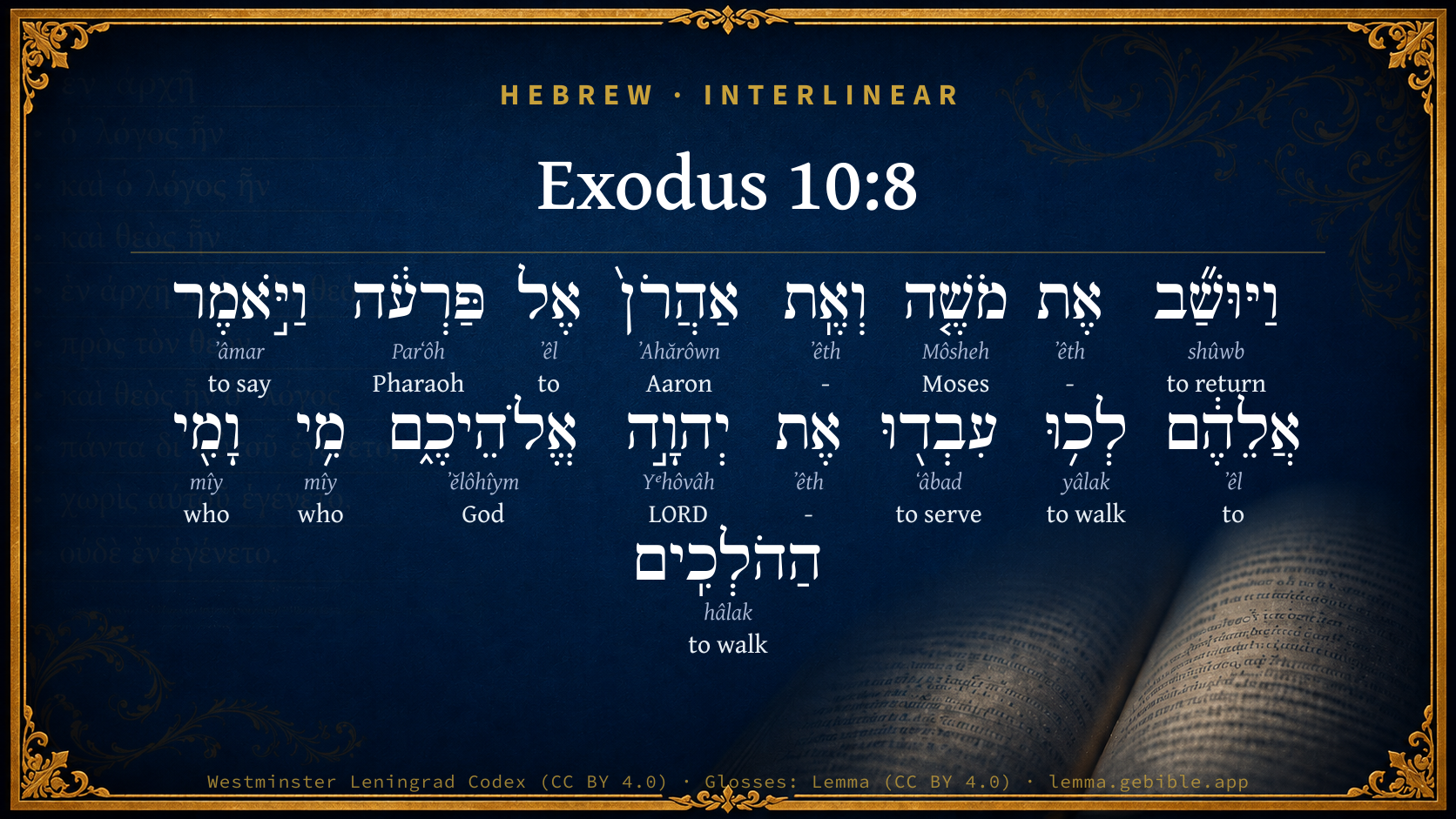
  1. וַיּוּשַׁ֞ב shûwb H7725 “and · to return” Conjunction + Verb, Hophal, Sequential Imperfect, 3rd Person, Masculine, Singular
  2. אֶת ʼêth H853 “-” Particle, Direct Object
  3. מֹשֶׁ֤ה Môsheh H4872 “Moses” Noun, Proper
  4. וְאֶֽת ʼêth H853 “and · -” Conjunction + Particle, Direct Object
  5. אַהֲרֹן֙ ʼAhărôwn H175 “Aaron” Noun, Proper
  6. אֶל ʼêl H413 “to” Preposition
  7. וַיֹּ֣אמֶר ʼâmar H559 “and · to say” Conjunction + Verb, Qal, Sequential Imperfect, 3rd Person, Masculine, Singular
  8. אֲלֵהֶ֔ם ʼêl H413 “to · them” Preposition + Suffix, Personal, 3rd Person, Masculine, Plural
  9. לְכ֥וּ yâlak H3212 “walk” Verb, Qal, Imperative, 2nd Person, Masculine, Plural
  10. עִבְד֖וּ ʻâbad H5647 “serve” Verb, Qal, Imperative, 2nd Person, Masculine, Plural
  11. אֶת ʼêth H853 “-” Particle, Direct Object
  12. יְהוָ֣ה Yᵉhôvâh H3068 “LORD” Noun, Proper
  13. אֱלֹהֵיכֶ֑ם ʼĕlôhîym H430 “God(s) · your” Noun, Common, Masculine, Plural, Construct + Suffix, Personal, 2nd Person, Masculine, Plural
  14. מִ֥י mîy H4310 “who” Particle, Interrogative
  15. וָמִ֖י mîy H4310 “and · who” Conjunction + Particle, Interrogative
  16. הַהֹלְכִֽים hâlak H1980 “the · walking” Particle, Definite Article + Verb, Qal, Participle Active, Masculine, Plural, Absolute

About this verse

These counts appear in no published source. They are computed here, from the morphology-tagged text and Lemma’s own curated glosses. What Lemma adds →

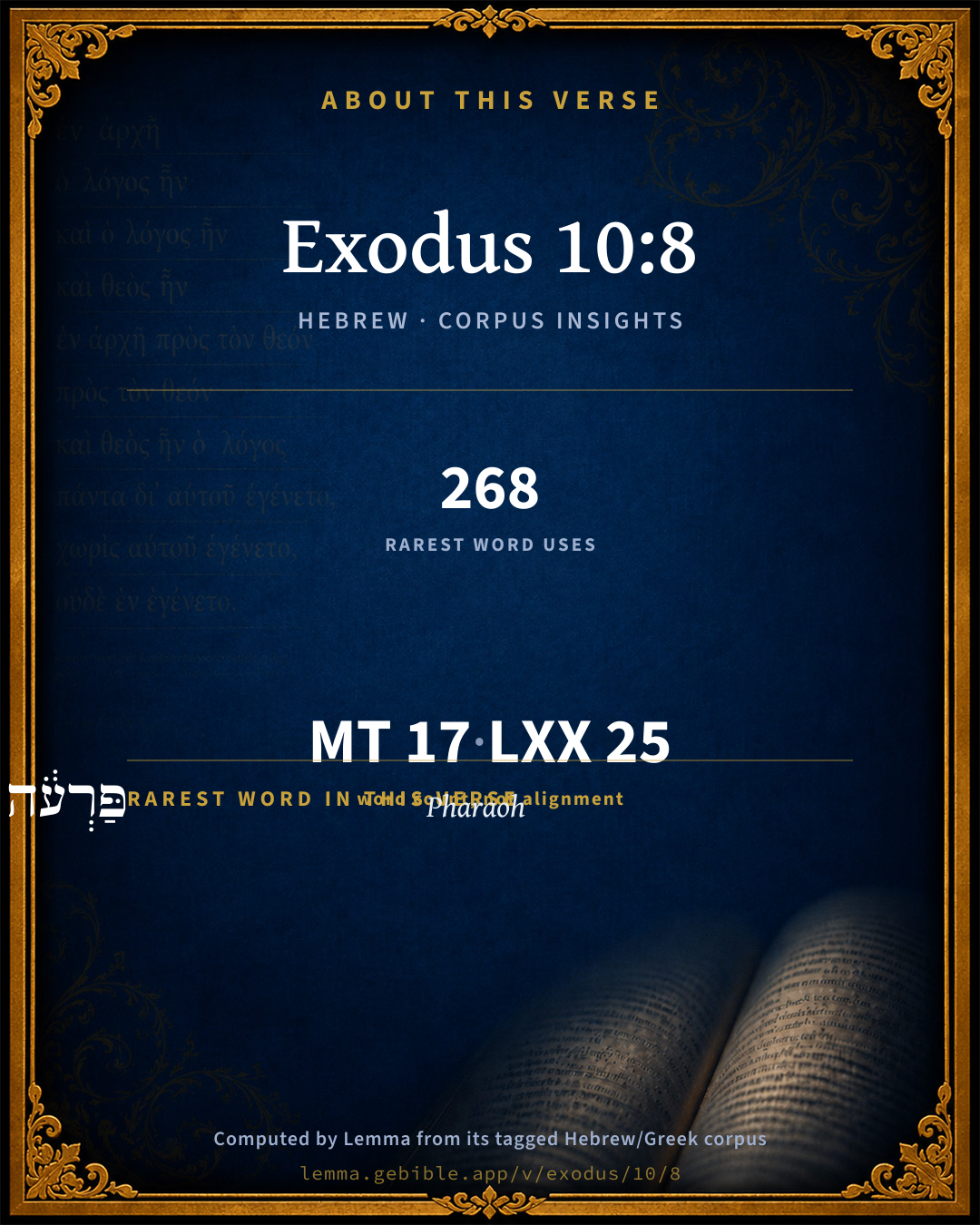
17
words
13
distinct lemmas
Pentateuch
section

Grammatical profile

  • 5 verbs
  • 5 nouns
  • 2 prepositions
  • 5 particles

Verb forms

  • וַיּוּשַׁ֞ב Hophal · Sequential Imperfect
  • וַיֹּ֣אמֶר Qal · Sequential Imperfect
  • לְכ֥וּ Qal · Imperative
  • עִבְד֖וּ Qal · Imperative
  • הַהֹלְכִֽים Qal · Participle Active

Repetition

Words recur within this verse — often emphatic in Hebrew:

Hebrew & Septuagint length

In English translation the verse runs 25 words from the Hebrew and 31 from the Septuagint (LXX English) — closely comparable.

A rough comparison of the two English renderings, which tokenize alike — not a word-level alignment.

Word counts can differ between the Hebrew and the Greek without any difference in meaning — e.g. the Hebrew direct-object marker אֵת has no separate Greek word, and Greek often adds the article ὁ.

In the original languages it is 17 Hebrew tokens and 25 Greek tokens — but the two are counted differently (Hebrew bundles its prefixes and suffixes into one token; the Greek is in lemma form), so that isn’t a like-for-like length.

Cross-references

4

Topical passages linked to Exodus 10:8 in the Treasury of Scripture Knowledge — connected by theme and wording, ordered by reader-vote popularity; previews shown in the World English Bible.

  • Exodus 10:24 Pharaoh called to Moses, and said, "Go, serve Yahweh. Only let your flocks and your herds stay behind. Let your little ones also go with you."
  • Exodus 8:8 Then Pharaoh called for Moses and Aaron, and said, "Entreat Yahweh, that he take away the frogs from me, and from my people; and I will let the people go, that they may sacrifice to Yahweh."
  • Exodus 10:16 Then Pharaoh called for Moses and Aaron in haste, and he said, "I have sinned against Yahweh your God, and against you.
  • Exodus 12:31 He called for Moses and Aaron by night, and said, "Rise up, get out from among my people, both you and the children of Israel; and go, serve Yahweh, as you have said!

Cross-references courtesy of OpenBible.info (CC BY 4.0).

Hebrew and Greek witnesses Masoretic Hebrew ↔ Greek Septuagint

The same verse in the two great witnesses to the Old Testament, shown verse-for-verse.

These are two independent witnesses, not word-aligned to each other, and the Septuagint is shown in lemma (dictionary) form.

Hebrew Exodus 10:8 Masoretic · Westminster Leningrad Codex

וַיּוּשַׁ֞ב אֶת מֹשֶׁ֤ה וְאֶֽת אַהֲרֹן֙ אֶל פַּרְעֹ֔ה וַיֹּ֣אמֶר אֲלֵהֶ֔ם לְכ֥וּ עִבְד֖וּ אֶת יְהוָ֣ה אֱלֹהֵיכֶ֑ם מִ֥י וָמִ֖י הַהֹלְכִֽים

Moses and Aaron were brought again to Pharaoh, and he said to them, "Go, serve Yahweh your God; but who are those who will go?"

World English Bible · Public Domain

Greek LXX Exodus 10:8 Septuagint · lemma form

καί ἀποστρέφω ὁ τε μωυσῆς καί ααρων πρός φαραώ καί εἶπον αὐτός πορεύομαι καί λατρεύω ὁ θεός σύ τίς δέ καί τίς εἰμί ὁ πορεύομαι

And they brought back both Moses and Aaron to Pharao; and he said to them, Go and serve the Lord your God; but who are they that are going with you?

LXX2012 (modern English Septuagint) · Public Domain

Hebrew: Westminster Leningrad Codex (CC BY 4.0). Greek: Septuagint (public domain); English from LXX2012 (modern English Septuagint) (Public Domain). How the Septuagint differs from the Hebrew →

Targum (Aramaic paraphrase)

2

The Targum is the ancient Jewish Aramaic paraphrase of the Hebrew Scriptures — an interpretive translation, not the Hebrew text itself. Onkelos (literal) and Pseudo-Jonathan (expansive) render the Torah, and Jonathan the Prophets. Coverage is partial: where no permissively-licensed English translation exists for a verse, only the Aramaic is shown. This is verse-level text, not a word-by-word alignment to the Hebrew.

  1. Targum Onkelos Torah (Genesis–Deuteronomy)
    וְאִתּוֹתַב יָת משֶׁה וְיָת אַהֲרֹן לְוָת פַּרְעֹה וַאֲמַר לְהוֹן אֱזִילוּ פְלָחוּ קֳדָם יְיָ אֱלָהֲכוֹן מָן וּמָן דְאָזְלִין:

    (no public-domain English translation for this verse)

    Targum Onkelos — Aramaic: “Onkelos Genesis” (public domain); “Onkelos Exodus” (public domain); “Onkelos Leviticus” (public domain); “Onkelos Numbers” (public domain); “Onkelos Deuteronomy” (public domain). English: “Sefaria Community Translation” (CC0 1.0 (public-domain dedication)); “J.W. Etheridge. The Targums of Onkelos and Jonathan Ben Uzziel on the Pentateuch. London: Longmans, Green, 1862” (public domain). Text via Sefaria.

  2. Targum Pseudo-Jonathan Torah (Genesis–Deuteronomy)
    וּפַקֵּיד לְאִיתּוֹתָבָא יַת משֶׁה וְיַת אַהֲרן לְוַת פַּרְעה וַאֲמַר לְהוֹם אִיזִילוּ פְּלָחוּ קֳדָם יְיָ אֱלָהָכוֹן מָן וּמָן הִינוּן דְּאָזְלִין

    And he commanded to bring back Mosheh and Aharon to Pharoh, and said to them, Go, worship before the Lord your God: but who are they that are to go?

    Targum Pseudo-Jonathan — Aramaic: “Targum Jonathan on Genesis” (public domain); “Targum Jonathan on Exodus” (public domain); “Targum Jonathan on Leviticus” (public domain); “Targum Jonathan on Numbers” (public domain); “Targum Jonathan on Deuteronomy” (public domain). English: “The Targum of Jonathan ben Uzziel, trans. J. W. Etheridge, London, 1862” (public domain). Text via Sefaria.

Commentary

Notes on Exodus 10:8 from classic Christian and Jewish commentators (each source and its license shown beneath its notes). The classic Christian expositions comment on the surrounding passage and are grouped to its opening verse, so a note may address several verses; the Jewish commentaries on the Tanakh (Rashi and others) are per-verse, so they appear only where the commentator wrote on this verse.

Lemma curates 59 commentaries, every one of them public domain or Creative Commons licensed, each selected and text-cleaned for this edition rather than reprinted as found. About our sources →

Trapp's Complete Commentary

John Trapp

Exo 10:8 And Moses and Aaron were brought again unto Pharaoh: and he said unto them, Go, serve the LORD your God: [but] who [are] they that shall go?

Ver. 8. And Moses and Aaron were brought, &c.] Something the tyrant would seem to yield to his counsellors, and not to deal by them as the Persian monarchs, who were wont to advise with their peers: but if any of them delivered that which was contrary to the king’s mind, flagris caedebantur; they were whipped: which is a punishment also usually inflicted at this day by the great Turk, even upon the greatest Bashaws of the court, upon the least displeasure. {a}

{a} Keckerman. Turk. Hist.

John Trapp, A Commentary or Exposition upon All the Books of the Old and New Testament (1647–1656) — public domain. Text from a community e-Sword module.

The Biblical Illustrator

Joseph S. Exell

Exo_10:8-9

We will go with our young and with our old.

Lessons

1. Upon importunity of men wicked powers may be moved to recall and treat further with Gods ministers when His own word is slighted by them.

2. Upon carnal considerations powers may license the Church to serve its God.

3. Such wicked powers bound their grants of liberty with provisos destructive to Gods will (Exo_10:8). (G. Hughes, B. D.)

Lessons

1. Captious questions from the wicked are answered with plain answers by Gods servants.

2. Faithfulness to God will not suffer His servants to hide His mind to the wicked.

3. Gods instruments have encouragement from Him to deliver His demands to greatest powers.

4. Little ones as well as great must be carried along with the Church of God to their rest.

5. The Churchs portion in this life as to outward estate God is pleased to have free as well as themselves, that they may comfortably serve Him therewith.

6. The Churchs work after redemption is to serve Jehovah, or keep a feast to Him (Exo_10:9). (G. Hughes, B. D.)

Renewed opportunities of moral good

And Moses and Aaron were brought again unto Pharaoh.

I. Consequent upon the faithful rebuke of friends.

II. Through contact with a holy man.

III. May be left unused through the perverseness of the soul. (J. S. Exell, M. A.)

The children must be rescued

But particularly observe the subject of dispute. Concerning whom did it arise? Concerning boys and girls--little children. Pharaoh did not wish them to accompany their parents to hold a feast unto the Lord; he required that they should remain at home as hostages. Moses refused. Well, there are often similar disputes in our time between the devil and the servants of God concerning you. The devil causes worldly men to say, like Pharaoh, Why should you trouble children with religion, they are too young yet? How can they understand the Bible, since I, who am a grown-up man, and perhaps a learned man, do not understand it? They can take no pleasure in it; it is too serious for them, since for my part I find it a weariness. At their age it becomes them to play, and not to study deeply. Let them enjoy their diversions; let them amuse themselves on the Sunday. Thus the prince of this world, the great Pharaoh of the darkness of this world, would wish to keep you as hostages in error, and ensnare your parents also. If your house were on fire, what would you think of a person who should say to your father, Go out as quickly as you can, but leave your children in bed? Or if you were at school, or an apprentice to a trade, what would you think of a man who should say to your father, Your son has a holiday, but do not let him come home to be with you, for he is at an age to amuse himself. Do not teach him to love you, and to obey you, for that would weary him. Ah! dear children, you have as much need as we have to escape the wrath to come, and to love God. Ask from Him grace to love Him. The prayer of a child who seeks a new heart for the sake of Jesus Christ always ascends to heaven. (Prof. Gaussen.)

The Biblical Illustrator, edited by Joseph S. Exell (c. 1880s–1900s) — public domain. Text from a community e-Sword module.

Joseph Benson's Commentary

Exo 10:8. Who are they that shall go? — I am not willing you should all go: it will degrade me in the sight of my subjects that I should be obliged to submit to him who thus makes himself the very friend of my slaves. When he is compelled to yield, yet it is with extreme reluctance, and as little as possible.

Joseph Benson's Commentary on the Old and New Testaments (1811–1818) — public domain. Text from a community e-Sword module.

Adam Clarke's Commentary

Verse 8. Who are they that shall go?] Though the Egyptians, about fourscore years before, wished to destroy the Hebrews, yet they found them now so profitable to the state that they were unwilling to part with them.

Adam Clarke's Commentary on the Bible (1810–1826) — public domain. Text from a community e-Sword/MySword module.

Ellicott's Commentary for English Readers

(8) Moses and Aaron were brought again unto Pharaoh.—Moses and Aaron had uttered their threat, and had straightway left his presence. The courtiers “brought them again to Pharaoh.” The courtiers, no doubt, supposed that the king would yield; and the king was prepared to yield to a certain extent. But he had conceived of a compromise in his own mind, and this he hoped to impose upon Moses; hence his insidious question—

Who are they that shall go?—Pharaoh had not hitherto raised this question. He had known well enough that the demand extended to all the people (Exo_8:8); but now he pretends that there had been an ambiguity, and requires that it shall be cleared up. Moses gives him an answer (Exo_10:9) which takes away all further pretence of doubt.

A Bible Commentary for English Readers, edited by Charles John Ellicott (1878–1897) — public domain. Text from a community e-Sword module.

The Cambridge Bible for Schools and Colleges

gen. ed. J. J. S. Perowne

8. again] back, a frequent sense of ‘again’ in Old English.

The Cambridge Bible for Schools and Colleges (gen. ed. J. J. S. Perowne; Cambridge University Press, 1878–1918) — public domain. Text from a community e-Sword module.

John Gill's Exposition

And Moses and Aaron were brought again unto Pharaoh,.... Upon this motion of his ministers, messengers were sent to bring them in again:

and he said, go, serve the Lord your God; as you have often desired:

but who are they that shall go? or, "who and who" (f)? for Pharaoh was unwilling that they should all go, but would have some retained as pledges of their return; for he was jealous of a design to get out of his country, and never return again, which he could not bear the thoughts of, even of losing such a large number of men he had under his power, and from whom he received so much profit and advantage by their labour.

(f) "qui et qui?" Pagninus, Montanus; "quis & quis?" Vatablus.

John Gill's Exposition of the Whole Bible (1746–1763) — public domain (CC PDM 1.0). Text via the HelloAO Bible API.

The Pulpit Commentary

Moses and Aaron were brought again unto Pharaoh. Pharaoh did not condescend so far as to send for them, but he allowed his courtiers to bring them to him. And he so far took the advice of his courtiers, that he began by a general permission to the Israelites to take their departure. This concession, however, he almost immediately retracted by a question, which implied that all were not to depart. Who are they that shall go? It seems somewhat strange that the king had not yet clearly understood what the demand made of him was. But perhaps he had not cared to know, since he had had no intention of granting it.

The Pulpit Commentary (1880–1919), ed. H.D.M. Spence-Jones & Joseph S. Exell — public domain. Text from a community e-Sword module.

Rashi

Rabbi Shlomo Yitzchaki (Rashi)

ויושב [AND MOSES AND AARON] WERE BROUGHT BACK (The verb has a passive meaning [Hophal], not an active as the particle את before משה and אהרן might lead one to suppose) — They were brought back by a messenger: they (Pharaoh’s servants) sent people after them and these brought them back to Pharaoh.

Rashi on the Tanakh — English translations: “The Judaica Press complete Tanach with Rashi, translated by A. J. Rosenberg” (CC BY 4.0); “Pentateuch with Rashi's commentary by M. Rosenbaum and A.M. Silbermann, 1929-1934” (public domain); “The Metsudah Tanach series, Lakewood, N.J” (CC BY 4.0); and “The Book of Joshua, Metsudah Publications, 1997” (CC BY 4.0). Text via Sefaria.

Ramban (Nachmanides)

Rabbi Moshe ben Nachman (Ramban / Nachmanides)

BUT WHO ARE THEY THAT SHALL GO? Pharaoh desired that their leaders, elders, and officers should go, men that are pointed out by name. Moses answered him that also the sons and daughters will go, “for we must hold a feast unto the Eternal, and it is mandatory upon us all to take part in the feast.” Pharaoh’s anger was then kindled on account of the sons and daughters, and he said that under no circumstances will he send the little ones, for they take no part in the offerings. Instead he would send all the adult males because of the feast which Moses mentioned, while the little ones and the women will remain [in Egypt].

Ramban (Nachmanides) on the Tanakh — English translation: “Commentary on the Torah by Ramban (Nachmanides). Translated and annotated by Charles B. Chavel. New York, Shilo Pub. House, 1971-1976” (CC BY 4.0). Text via Sefaria.

Lesson kit

Teaching starters — assembled from the data on this page, not authored interpretation. Every prompt links to the verse data it draws on. Edit before teaching.

Exodus, in the Pentateuch, opens this verse with 17 words (13 distinct Hebrew lemmas). Its most distinctive word is Parʻôh (“Pharaoh”). A historical commentator’s framing appears above. Read the whole chapter for the surrounding context.

Discussion questions

  1. What does “Pharaoh” (Parʻôh) contribute to the verse as a whole?
  2. How does Exodus 10:24, which shares this passage’s theme, read alongside this verse?
  3. What does the repetition of “to” (2× in this one verse) do in this verse?
  4. The translations on this page render this verse differently — a whole-verse word diff, not a word-by-word alignment. What might account for the different wordings?
  5. «וַיּוּשַׁ֞ב» is a Hophal Sequential Imperfect verb. How does that grammatical form shape the action described?
  6. Compare how Trapp's Complete Commentary and The Biblical Illustrator read this verse. Where do they agree or differ?

Things to notice

Reading settings

Reading text

Shown beneath each verse's original-language words.

Old Testament
Old Testament edition

Read the OT as the Masoretic Hebrew (MT) or the Greek Septuagint (LXX).

English shown for the Greek Septuagint (in the Hebrew ↔ Greek comparison).

Comparing translations? Open the Compare panel on any verse page to stack up to four side by side.