
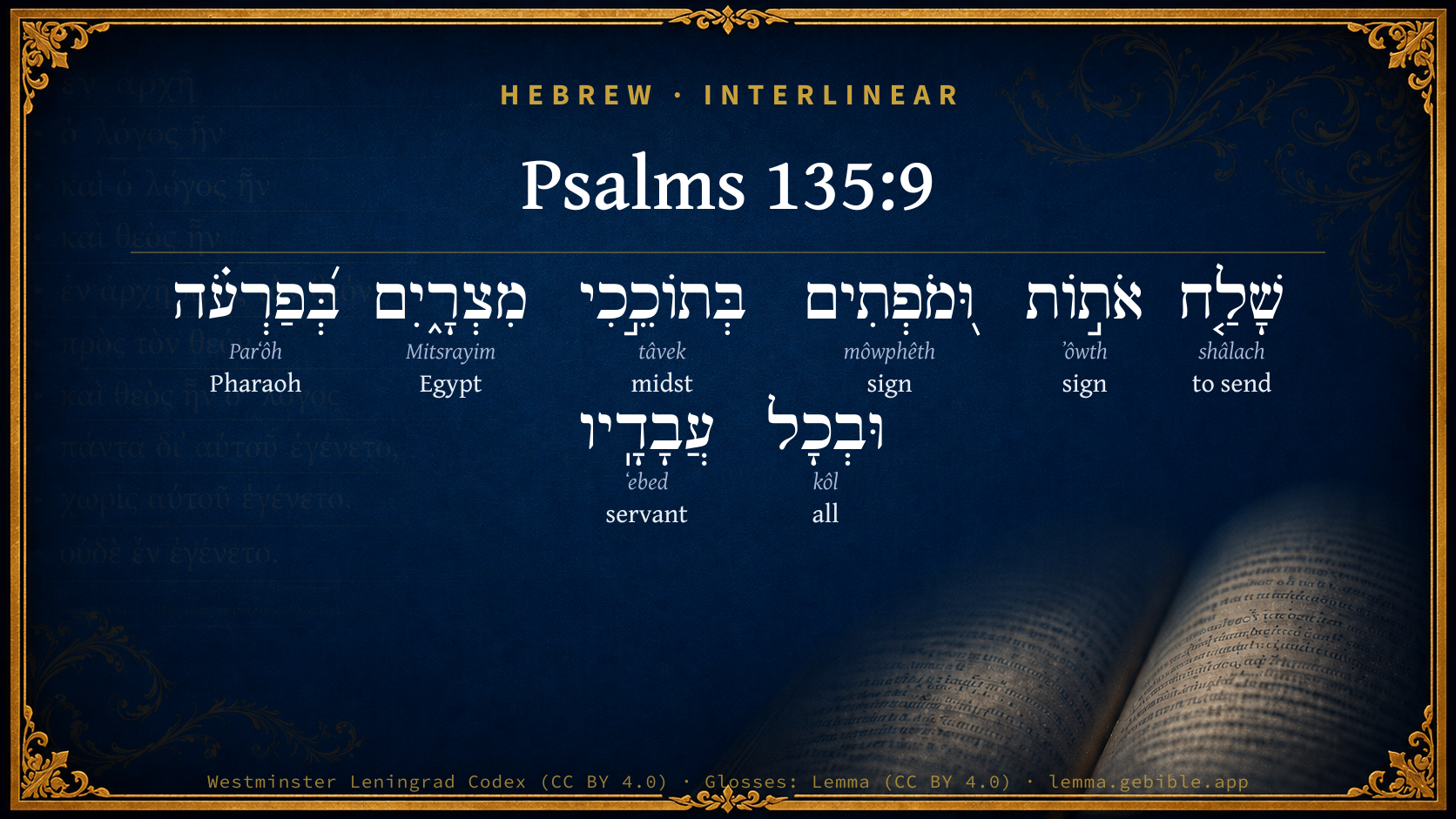
Psalms 135:9

Hebrew (Westminster Leningrad Codex) Psalms 135:9 appears in the Hebrew Old Testament. The text above is from the Westminster Leningrad Codex. Each word links to its Strong’s number, a concise gloss, and parsing drawn from the Open Scriptures Hebrew Bible morphology. Click any word for its full Brown-Driver-Briggs (BDB) entry.
Download image
Cite this verse

Psalms 135:9 (World English Bible). Public Domain. Lemma interlinear Bible study tool, https://lemma.gebible.app/v/psalms/135/9.

Show BibTeX & RIS
BibTeX
RIS
English Translation
Who sent signs and wonders into the midst of you, Egypt, On Pharaoh, and on all his servants;
World English Bible · Public Domain
Download a study sheet

One document with this verse’s original text, its word-by-word gloss line, the meaning frame, cross-references with their text, attributed commentary, and full source and license credits — printable, and it pastes into notes with its structure intact.

This verse Autodidact and up

Study sheet (.html) Plain text (.txt)

A passage Seminary Student

Up to 50 verses in one chapter. A passage sheet keeps up to 6 commentary sources and 12 cross-references per verse, in the order this page ranks them, and says so on the sheet whenever that leaves anything out. Ask for a single verse and you get the Autodidact verse sheet above.

Everything on this page stays free to read, with no account — the sheet is a download of what is already on screen, not access to it.

Want to remove ads? Support Godless Engineer
Compare translations 3

The same verse in 3 English versions, stacked beneath the original-language interlinear above. Click any original word for its lexicon entry.

Each is an independent rendering of the whole verse — the interlinear is not word-aligned to these translations.

Highlighted words mark where these versions differ — a whole-verse word diff, not a word-by-word alignment.

  • World English Bible Public Domain
    Who sent signs and wonders into the midst of you, Egypt, On Pharaoh, and on all his servants;
  • King James Version Public Domain
    Who sent tokens and wonders into the midst of thee, O Egypt, upon Pharaoh, and upon all his servants.
  • unfoldingWord Literal Text CC BY-SA 4.0
    He sent signs and wonders into your midst, Egypt, against Pharaoh and against all of his servants,

unfoldingWord Literal Text — © unfoldingWord, licensed CC BY-SA 4.0. Word-aligned USFM3 via Door43 (git.door43.org/unfoldingWord/en_ult).

Versions to compare (up to 4)

3 of 4 selected

Show all 17 translations

Every available English version of this verse, each an independent rendering of the whole verse.

  • World English Bible Public Domain
    Who sent signs and wonders into the midst of you, Egypt, On Pharaoh, and on all his servants;
  • Berean Standard Bible Public Domain
    He sent signs and wonders into your midst, O Egypt, against Pharaoh and all his servants.
  • Majority Standard Bible Public Domain
    He sent signs and wonders into your midst, O Egypt, against Pharaoh and all his servants.
  • King James Version Public Domain
    Who sent tokens and wonders into the midst of thee, O Egypt, upon Pharaoh, and upon all his servants.
  • American Standard Version (1901) Public Domain
    Who sent signs and wonders into the midst of thee, O Egypt, Upon Pharaoh, and upon all his servants;
  • Revised Version (1885) Public Domain
    He sent signs and wonders into the midst of thee, O Egypt, upon Pharaoh, and upon all his servants.
  • Geneva Bible (1599) Public Domain
    He hath sent tokens and wonders into the middes of thee, O Egypt, vpon Pharaoh, and vpon all his seruants.
  • Young's Literal Translation Public Domain
    He sent tokens and wonders into thy midst, O Egypt, On Pharaoh and on all his servants.
  • Literal Standard Version CC BY-SA 4.0
    He sent tokens and wonders into your midst, O Egypt, || On Pharaoh and on all his servants.
  • Unlocked Literal Bible CC BY-SA 4.0
    He sent signs and wonders into your midst, Egypt, against Pharaoh and all his servants.
  • unfoldingWord Literal Text CC BY-SA 4.0
    He sent signs and wonders into your midst, Egypt, against Pharaoh and against all of his servants,
  • Darby Bible Public Domain
    Who sent signs and miracles into the midst of thee, O Egypt, upon Pharaoh and upon all his servants;
  • World Messianic Bible Public Domain
    He sent signs and wonders into the middle of you, Egypt, on Pharaoh, and on all his servants.
  • Webster's Bible Public Domain
    Who sent tokens and wonders into the midst of thee, O Egypt, upon Pharaoh, and upon all his servants.
  • Free Bible Version CC BY-SA 4.0
    He did wonderful miracles among you in Egypt, against Pharaoh and all his servants.
  • Bible in Basic English Public Domain
    He sent signs and wonders among you, O Egypt, on Pharaoh, and on all his servants.
  • JPS Tanakh (1917) Public Domain
    He sent signs and wonders into the midst of thee, O Egypt, upon Pharaoh, and upon all his servants.

Literal Standard Version (2020), Covenant Press — licensed CC BY-SA 4.0. Text via the HelloAO Bible API (eBible.org). Unlocked Literal Bible (unfoldingWord) — licensed CC BY-SA 4.0. Text via the HelloAO Bible API (eBible.org). unfoldingWord Literal Text — © unfoldingWord, licensed CC BY-SA 4.0. Word-aligned USFM3 via Door43 (git.door43.org/unfoldingWord/en_ult). Free Bible Version, Dr. Jonathan Gallagher — licensed CC BY-SA 4.0. Text via the HelloAO Bible API (eBible.org).

Word by word

More ways to search: Search by grammar → Find every occurrence → Compare this word →

Practice this passage: Drill this verse → Learn its vocabulary →

וּ֭מֹפְתִים
môwphêth
H4159
“and · signs”
Conjunction + Noun, Common, Masculine, Plural, Absolute
Part of Speech
Conjunction + Noun
Type
Common
Gender
Masculine
Number
Plural
State
Absolute
Full BDB Definition

Origin: from H3302 in the sense of conspicuousness

TWOT: 152a

wonder, sign, miracle, portent - wonder (as a special display of God's power) - sign, token (of future event)
  1. שָׁלַ֤ח shâlach H7971 “to send” Verb, Qal, Perfect, 3rd Person, Masculine, Singular
  2. אֹת֣וֹת ʼôwth H226 “signs” Noun, Common, Both, Plural, Absolute
  3. בְּתוֹכֵ֣כִי tâvek H8432 “in/at · midst · your” Preposition + Noun, Common, Masculine, Singular, Construct + Suffix, Personal, 2nd Person, Feminine, Singular
  4. מִצְרָ֑יִם Mitsrayim H4714 “Egypt” Noun, Proper
  5. בְּ֝פַרְעֹ֗ה Parʻôh H6547 “in/at · Pharaoh” Preposition + Noun, Proper
  6. וּבְכָל kôl H3605 “and · in/at · all of” Conjunction + Preposition + Noun, Common, Masculine, Singular, Construct
  7. עֲבָדָֽיו ʻebed H5650 “servants · his” Noun, Common, Masculine, Plural, Construct + Suffix, Personal, 3rd Person, Masculine, Singular

About this verse

These counts appear in no published source. They are computed here, from the morphology-tagged text and Lemma’s own curated glosses. What Lemma adds →

8
words
8
distinct lemmas
Wisdom
section

Shared distinctive vocabulary

וּ֭מֹפְתִים sign H4159 occurs in 35 verses of the Hebrew Bible. Also found in:

Grammatical profile

  • 1 verb
  • 7 nouns

Verb forms

  • שָׁלַ֤ח Qal · Perfect

Hebrew & Septuagint length

In English translation the verse runs 18 words from the Hebrew and 19 from the Septuagint (LXX English) — closely comparable.

A rough comparison of the two English renderings, which tokenize alike — not a word-level alignment.

Word counts can differ between the Hebrew and the Greek without any difference in meaning — e.g. the Hebrew direct-object marker אֵת has no separate Greek word, and Greek often adds the article ὁ.

Cross-references

10

Topical passages linked to Psalms 135:9 in the Treasury of Scripture Knowledge — connected by theme and wording, ordered by reader-vote popularity; previews shown in the World English Bible.

  • Psalms 136:15 But overthrew Pharaoh and his host in the Red Sea; For his loving kindness endures forever:
  • Deuteronomy 6:22 and Yahweh shown signs and wonders, great and sore, on Egypt, on Pharaoh, and on all his house, before our eyes;
  • Exodus 7:1–15 Yahweh said to Moses, "Behold, I have made you as God to Pharaoh; and Aaron your brother shall be your prophet.
  • Deuteronomy 4:34 Or has God tried to go and take him a nation from the midst of [another] nation, by trials, by signs, and by wonders, and by war, and by a mighty hand, and by an outstretched arm, and by great terrors, according to all that Yahweh your God did for you in Egypt before your eyes?
  • Nehemiah 9:10 and shown signs and wonders on Pharaoh, and on all his servants, and on all the people of his land; for you knew that they dealt proudly against them, and did get you a name, as it is this day.
  • Psalms 78:43–50 How he set his signs in Egypt, His wonders in the field of Zoan,
  • Isaiah 51:9–10 Awake, awake, put on strength, arm of Yahweh; awake, as in the days of old, the generations of ancient times. Isn't it you who did cut Rahab in pieces, who pierced the monster?
  • Jeremiah 32:20–21 who performed signs and wonders in the land of Egypt, even to this day, both in Israel and among [other] men; and made you a name, as in this day;
  • Acts 7:36 This man led them out, having worked wonders and signs in Egypt, in the Red Sea, and in the wilderness for forty years.
  • Psalms 105:27–29 They performed miracles among them, And wonders in the land of Ham.

Cross-references courtesy of OpenBible.info (CC BY 4.0).

Hebrew and Greek witnesses Masoretic Hebrew ↔ Greek Septuagint

The same verse in the two great witnesses to the Old Testament, shown verse-for-verse.

You’re reading Greek Psalm 134 (Hebrew Psalm 135). The Septuagint counts the superscription, so verse numbers can differ from the Hebrew — chapter-level alignment, not verse-by-verse. Numbering follows Rahlfs.

These are two independent witnesses, not word-aligned to each other, and the Septuagint is shown in lemma (dictionary) form.

Hebrew Psalms 135:9 Masoretic · Westminster Leningrad Codex

שָׁלַ֤ח אֹת֣וֹת וּ֭מֹפְתִים בְּתוֹכֵ֣כִי מִצְרָ֑יִם בְּ֝פַרְעֹ֗ה וּבְכָל עֲבָדָֽיו

Who sent signs and wonders into the midst of you, Egypt, On Pharaoh, and on all his servants;

World English Bible · Public Domain

Greek LXX Greek Psalm 134:9 Septuagint · lemma form

ἐκ ἀποστέλλω σημεῖον καί τέρας ἐν μέσος σύ αἴγυπτος ἐν φαραώ καί ἐν πᾶς ὁ δοῦλος αὐτός

He sent signs and wonders into the midst of you, O Egypt, on Pharao, and on all his servants.

LXX2012 (modern English Septuagint) · Public Domain

Hebrew: Westminster Leningrad Codex (CC BY 4.0). Greek: Septuagint (public domain); English from LXX2012 (modern English Septuagint) (Public Domain). How the Septuagint differs from the Hebrew →

Commentary

Notes on Psalms 135:9 from classic Christian and Jewish commentators (each source and its license shown beneath its notes). The classic Christian expositions comment on the surrounding passage and are grouped to its opening verse, so a note may address several verses; the Jewish commentaries on the Tanakh (Rashi and others) are per-verse, so they appear only where the commentator wrote on this verse.

Lemma curates 59 commentaries, every one of them public domain or Creative Commons licensed, each selected and text-cleaned for this edition rather than reprinted as found. About our sources →

Trapp's Complete Commentary

John Trapp

Psa 135:9 [Who] sent tokens and wonders into the midst of thee, O Egypt, upon Pharaoh, and upon all his servants.

Ver. 9. Who sent tokens and wonders] Vocal wonders, Exo 4:8, to be as so many warning pieces.

John Trapp, A Commentary or Exposition upon All the Books of the Old and New Testament (1647–1656) — public domain. Text from a community e-Sword module.

J. A. Alexander on Psalms

Joseph Addison Alexander

9. (Psa 135:9) Sent signs and wonders into the midst of thee, 0 Egypt, upon Pharaoh and on all his servants. Signs and wonders, i.e. miracles, to wit, those which preceded and accompanied the exodus. See above, on Psa 78:43. In the midst of thee, 0 Egypt, an expression similar to that in Psa 116:19, in the midst of thee, 0 Jerusalem! Upon Pharaoh, literally in Pharaoh and in all his servants.

Joseph Addison Alexander, The Psalms Translated and Explained (1850) — public domain. Text from a community e-Sword module.

The Cambridge Bible for Schools and Colleges

gen. ed. J. J. S. Perowne

9. Who sent tokens] He sent signs.

The Cambridge Bible for Schools and Colleges (gen. ed. J. J. S. Perowne; Cambridge University Press, 1878–1918) — public domain. Text from a community e-Sword module.

John Gill's Exposition

Who smote great nations, and slew mighty kings. Or "many nations" (l). The seven nations of the Hittites, Girgashites, Amorites, Canaanites, Perizzites, Hivites, and Jebusites; the kings of which were mighty and many, even thirty one in number, Jos 12:1. This the Lord did by Joshua, a type of Christ; who has overcome the world by his sufferings and death, and delivered his people from it; who went forth conquering and to conquer, into the Roman Pagan empire, called the whole world, and subdued it by his Spirit and word; and will show his power in all the kingdoms of this world, either by converting or destroying them; and at last will judge all the nations and kings of the earth. Aben Ezra interprets this of the kings of Midian, or of those next mentioned, which is best.

(l) "gentes multas", V. L. Pagninus, Montanus, Musculus; "plurimas gentes", Tigurine version; so Ainsworth.

John Gill's Exposition of the Whole Bible (1746–1763) — public domain (CC PDM 1.0). Text via the HelloAO Bible API.

Albert Barnes' Notes on the Bible

Who sent tokens and wonders - Tokens: that is, signs or evidences of the divine power. Wonders: things suited to impress the mind with awe; things outside of the ordinary course of events; things not produced by natural laws, but by the direct power of God. The allusion here is, of course, to the plagues of Egypt, as recorded in Exodus. See the notes at Psa 105:27-36.

Albert Barnes' Notes on the Bible (1834–1885) — public domain. Text from a community e-Sword/MySword module.

The Treasury of David

Charles H. Spurgeon

Ver. 9. Who sent tokens and wonders into the midst of thee, O Egypt, upon Pharaoh, and upon all his servants. The Lord is still seen by the Psalmist as sending judgments upon rebellious men; he keeps before us the personal action of God, "who sent tokens", etc. The more distinctly God is seen the better. Even in plagues he is to be seen, as truly as in mercies. The plagues were not only terrible wonders which astounded men, but forcible tokens or signs by which they were instructed. No doubt the plagues were aimed at the various deities of the Egyptians, and were a grand exposure of their impotence; each one had its own special significance. The judgments of the Lord were no side blows, they struck the nation at the heart; he sent his bolts "into the midst of thee, O Egypt!" These marvels happened in the centre of the proud and exclusive nation of Egypt, which thought itself far superior to other lands; and many of these plagues touched the nation in points upon which it prided itself. The Psalmist addresses that haughty nation, saying, "O Egypt", as though reminding it of the lessons which it had been taught by the Lord's right hand. Imperious Pharaoh had been the ringleader in defying Jehovah, and he was made personally to smart for it; nor did his flattering courtiers escape, upon each one of them the scourge fell heavily. God's servants are far better off than Pharaoh's servants: those who stand in the courts of Jehovah are delivered, but the courtiers of Pharaoh are smitten all of them, for they were all partakers in his evil deeds. The Lord is to be praised for thus rescuing his own people, and causing their cruel adversaries to bite the dust. Let no true Israelite forget the song of the Red Sea, but anew let us hear a voice summoning us to exulting praise: "Sing unto the Lord, for he hath triumphed gloriously."

Ver. 9. Who sent tokens and wonders. "Tokens", that is, signs or evidences of the Divine power. "Wonders", things fitted to impress the mind with awe; things outside of the ordinary course of events; things not produced by natural laws, but by the direct power of God. The allusion here is, of course, to the plagues of Egypt, as recorded in Exodus. Albert Barnes.

Psalms 135:10*

Charles H. Spurgeon's The Treasury of David (1869–1885) — public domain. Psalms only. Text from a community e-Sword/MySword module.

The Pulpit Commentary

Who sent tokens and wonders into the midst of thee, O Egypt; or, "signs and wonders". (comp. Exo_4:9, 21 Neh_9:10 Psa_78:43) Upon Pharaoh, and upon all his servants; i.e. "upon all his subjects." The plagues fell upon the whole people of Egypt. (Exo_7:21 Exo_8:4, Exo_8:11, Exo_8:17, 24 9:6, 11, 25 10:6, 15 12:30)

The Pulpit Commentary (1880–1919), ed. H.D.M. Spence-Jones & Joseph S. Exell — public domain. Text from a community e-Sword module.

Rashi

Rabbi Shlomo Yitzchaki (Rashi)

in the midst Heb. בתוככי, like בתוךְ in the midst.

Rashi on the Tanakh — English translations: “The Judaica Press complete Tanach with Rashi, translated by A. J. Rosenberg” (CC BY 4.0); “Pentateuch with Rashi's commentary by M. Rosenbaum and A.M. Silbermann, 1929-1934” (public domain); “The Metsudah Tanach series, Lakewood, N.J” (CC BY 4.0); and “The Book of Joshua, Metsudah Publications, 1997” (CC BY 4.0). Text via Sefaria.

Lesson kit

Teaching starters — assembled from the data on this page, not authored interpretation. Every prompt links to the verse data it draws on. Edit before teaching.

Psalms, in the Wisdom, opens this verse with 8 words (8 distinct Hebrew lemmas). Its most distinctive word is môwphêth (“sign”). A historical commentator’s framing appears above. Read the whole chapter for the surrounding context.

Discussion questions

  1. The word môwphêth carries the sense “sign.” How does it shape the verse?
  2. Exodus 4:21 shares the word «sign» with this verse. How do the two illuminate each other?
  3. These translations render this verse differently; the difference is in the English rendering, not the original. What questions does that raise?
  4. The verb «שָׁלַ֤ח» is Qal Perfect. How does its form color the action?
  5. Reading how Trapp's Complete Commentary and J. A. Alexander on Psalms read this verse, where do the two commentators agree and where do they part?

Things to notice

Reading settings

Reading text

Shown beneath each verse's original-language words.

Old Testament
Old Testament edition

Read the OT as the Masoretic Hebrew (MT) or the Greek Septuagint (LXX).

English shown for the Greek Septuagint (in the Hebrew ↔ Greek comparison).

Comparing translations? Open the Compare panel on any verse page to stack up to four side by side.