
1 Kings 7:8

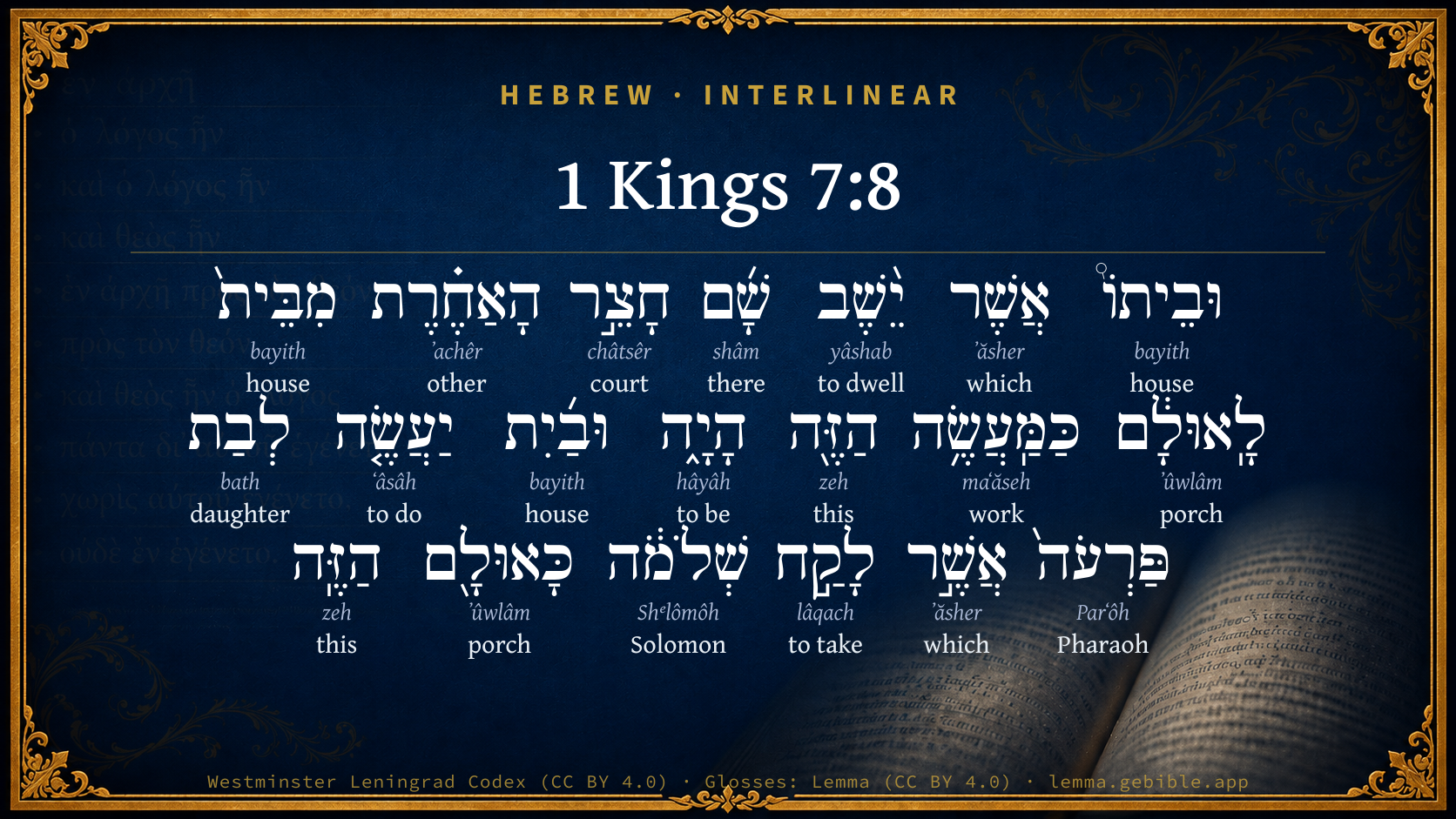
Hebrew (Westminster Leningrad Codex) 1 Kings 7:8 appears in the Hebrew Old Testament. The text above is from the Westminster Leningrad Codex. Each word links to its Strong’s number, a concise gloss, and parsing drawn from the Open Scriptures Hebrew Bible morphology. Click any word for its full Brown-Driver-Briggs (BDB) entry.
Download image
Cite this verse

1 Kings 7:8 (World English Bible). Public Domain. Lemma interlinear Bible study tool, https://lemma.gebible.app/v/1-kings/7/8.

Show BibTeX & RIS
BibTeX
RIS
English Translation
His house where he was to dwell, the other court within the porch, was of the like work. He made also a house for Pharaoh's daughter (whom Solomon had taken as wife), like this porch.
World English Bible · Public Domain
Download a study sheet

One document with this verse’s original text, its word-by-word gloss line, the meaning frame, cross-references with their text, attributed commentary, and full source and license credits — printable, and it pastes into notes with its structure intact.

This verse Autodidact and up

Study sheet (.html) Plain text (.txt)

A passage Seminary Student

Up to 50 verses in one chapter. A passage sheet keeps up to 6 commentary sources and 12 cross-references per verse, in the order this page ranks them, and says so on the sheet whenever that leaves anything out. Ask for a single verse and you get the Autodidact verse sheet above.

Everything on this page stays free to read, with no account — the sheet is a download of what is already on screen, not access to it.

Want to remove ads? Support Godless Engineer
Compare translations 3

The same verse in 3 English versions, stacked beneath the original-language interlinear above. Click any original word for its lexicon entry.

Each is an independent rendering of the whole verse — the interlinear is not word-aligned to these translations.

Highlighted words mark where these versions differ — a whole-verse word diff, not a word-by-word alignment.

  • World English Bible Public Domain
    His house where he was to dwell, the other court within the porch, was of the like work. He made also a house for Pharaoh's daughter (whom Solomon had taken as wife), like this porch.
  • King James Version Public Domain
    And his house where he dwelt had another court within the porch, which was of the like work. Solomon made also an house for Pharaoh's daughter, whom he had taken to wife, like unto this porch.
  • unfoldingWord Literal Text CC BY-SA 4.0
    And his house where he would dwell there, the other courtyard from the house of the porch, was like this work. And he made a house for the daughter of Pharaoh, whom Solomon had taken, like this porch.

unfoldingWord Literal Text — © unfoldingWord, licensed CC BY-SA 4.0. Word-aligned USFM3 via Door43 (git.door43.org/unfoldingWord/en_ult).

Versions to compare (up to 4)

3 of 4 selected

Show all 18 translations

Every available English version of this verse, each an independent rendering of the whole verse.

  • World English Bible Public Domain
    His house where he was to dwell, the other court within the porch, was of the like work. He made also a house for Pharaoh's daughter (whom Solomon had taken as wife), like this porch.
  • Berean Standard Bible Public Domain
    And the palace where Solomon would live, set further back, was of similar construction. He also made a palace like this hall for Pharaoh’s daughter, whom he had married.
  • Majority Standard Bible Public Domain
    And the palace where Solomon would live, set further back, was of similar construction. He also made a palace like this hall for Pharaoh’s daughter, whom he had married.
  • King James Version Public Domain
    And his house where he dwelt had another court within the porch, which was of the like work. Solomon made also an house for Pharaoh's daughter, whom he had taken to wife, like unto this porch.
  • American Standard Version (1901) Public Domain
    And his house where he was to dwell, the other court within the porch, was of the like work. He made also a house for Pharaoh's daughter (whom Solomon had taken to wife), like unto this porch.
  • Revised Version (1885) Public Domain
    And his house where he might dwell, the other court within the porch, was of the like work. He made also an house for Pharaoh’s daughter, (whom Solomon had taken to wife,) like unto this porch.
  • Geneva Bible (1599) Public Domain
    And in his house, where he dwelt, was an other hall more inwarde then the porche which was of the same worke. Also Salomon made an house for Pharaohs daughter ( whom he had taken to wife) like vnto this porche.
  • Douay-Rheims (1899) Public Domain
    And in the midst of the porch, was a small house where he sat in judgment, of the like work. He made also a house for the daughter of Pharao (whom Solomon had taken to wife) of the same work, as this porch,
  • Young's Literal Translation Public Domain
    As to his house where he dwelleth, the other court `is' within the porch -- as this work it hath been; and a house he maketh for the daughter of Pharaoh -- whom Solomon hath taken -- like this porch.
  • Literal Standard Version CC BY-SA 4.0
    As for his house where he dwells, the other court [is] within the porch—it has been as this work; and he makes a house for the daughter of Pharaoh—whom Solomon has taken—like this porch.
  • Unlocked Literal Bible CC BY-SA 4.0
    Solomon's house in which he was to live, in another courtyard within the palace grounds, was similarly designed. He also built a house like this for Pharaoh's daughter, whom he had taken as a wife.
  • unfoldingWord Literal Text CC BY-SA 4.0
    And his house where he would dwell there, the other courtyard from the house of the porch, was like this work. And he made a house for the daughter of Pharaoh, whom Solomon had taken, like this porch.
  • Darby Bible Public Domain
    And his house where he dwelt had another court within the porch, which was of the like work. And he made, like to this porch, a house for Pharaoh's daughter, whom Solomon had taken.
  • World Messianic Bible Public Domain
    His house where he was to dwell, the other court within the porch, was of the same construction. He made also a house for Pharaoh’s daughter (whom Solomon had taken as wife), like this porch.
  • Webster's Bible Public Domain
    And his house where he dwelt had another court within the porch, which was of the like work. Solomon made also a house for Pharaoh's daughter, whom he had married, like to this porch.
  • Free Bible Version CC BY-SA 4.0
    Solomon's own palace where he lived was in a courtyard behind the porch, made in a similar way to the Temple. He also had a palace made for Pharaoh's daughter, whom he'd married.
  • Bible in Basic English Public Domain
    And the house for his living-place, the other open square in the covered room, was made in the same way. And then he made a house like it for Pharaoh's daughter, whom Solomon had taken as his wife.
  • JPS Tanakh (1917) Public Domain
    And his house where he might dwell, in the other court, within the porch, was of the like work. He made also a house for Pharaoh's daughter, whom Solomon had taken to wife, like unto this porch.

Literal Standard Version (2020), Covenant Press — licensed CC BY-SA 4.0. Text via the HelloAO Bible API (eBible.org). Unlocked Literal Bible (unfoldingWord) — licensed CC BY-SA 4.0. Text via the HelloAO Bible API (eBible.org). unfoldingWord Literal Text — © unfoldingWord, licensed CC BY-SA 4.0. Word-aligned USFM3 via Door43 (git.door43.org/unfoldingWord/en_ult). Free Bible Version, Dr. Jonathan Gallagher — licensed CC BY-SA 4.0. Text via the HelloAO Bible API (eBible.org).

Word by word

More ways to search: Search by grammar → Find every occurrence → Compare this word →

Practice this passage: Drill this verse → Learn its vocabulary →

לָֽאוּלָ֔ם
ʼûwlâm
H197
“to/for the · porch”
Preposition, Determined + Noun, Common, Masculine, Singular, Absolute
Part of Speech
Preposition + Noun
Type
Common
Gender
Masculine
Number
Singular
State
Absolute
Full BDB Definition

Origin: from H481 (in the sense of tying)

TWOT: 45c

porch - in Solomon's temple - in Solomon's palace - in temple of Ezekiel's vision
  1. וּבֵיתוֹ֩ bayith H1004 “and · house · his” Conjunction + Noun, Common, Masculine, Singular, Construct + Suffix, Personal, 3rd Person, Masculine, Singular
  2. אֲשֶׁר ʼăsher H834 “which” Particle, Relative
  3. יֵ֨שֶׁב yâshab H3427 “to dwell” Verb, Qal, Imperfect, 3rd Person, Masculine, Singular
  4. שָׁ֜ם shâm H8033 “there” Adverb
  5. חָצֵ֣ר châtsêr H2691 “court” Noun, Common, Both, Singular, Absolute
  6. הָאַחֶ֗רֶת ʼachêr H312 “the · other” Particle, Definite Article + Adjective, Adjective, Feminine, Singular, Absolute
  7. מִבֵּית֙ bayith H1004 “from · house of” Preposition + Noun, Common, Masculine, Singular, Construct
  8. כַּמַּֽעֲשֶׂ֥ה maʻăseh H4639 “like/as the · work” Preposition, Determined + Noun, Common, Masculine, Singular, Absolute
  9. הַזֶּ֖ה zeh H2088 “the · this” Particle, Definite Article + Pronoun, Demonstrative, Masculine, Singular
  10. הָיָ֑ה hâyâh H1961 “to be” Verb, Qal, Perfect, 3rd Person, Masculine, Singular
  11. וּבַ֜יִת bayith H1004 “and · house” Conjunction + Noun, Common, Masculine, Singular, Absolute
  12. יַעֲשֶׂ֤ה ʻâsâh H6213 “to do” Verb, Qal, Imperfect, 3rd Person, Masculine, Singular
  13. לְבַת bath H1323 “to/for · daughter of” Preposition + Noun, Common, Feminine, Singular, Construct
  14. פַּרְעֹה֙ Parʻôh H6547 “Pharaoh” Noun, Proper
  15. אֲשֶׁ֣ר ʼăsher H834 “which” Particle, Relative
  16. לָקַ֣ח lâqach H3947 “to take” Verb, Qal, Perfect, 3rd Person, Masculine, Singular
  17. שְׁלֹמֹ֔ה Shᵉlômôh H8010 “Solomon” Noun, Proper
  18. כָּאוּלָ֖ם ʼûwlâm H197 “like/as the · porch” Preposition, Determined + Noun, Common, Masculine, Singular, Absolute
  19. הַזֶּֽה zeh H2088 “the · this” Particle, Definite Article + Pronoun, Demonstrative, Masculine, Singular

About this verse

These counts appear in no published source. They are computed here, from the morphology-tagged text and Lemma’s own curated glosses. What Lemma adds →

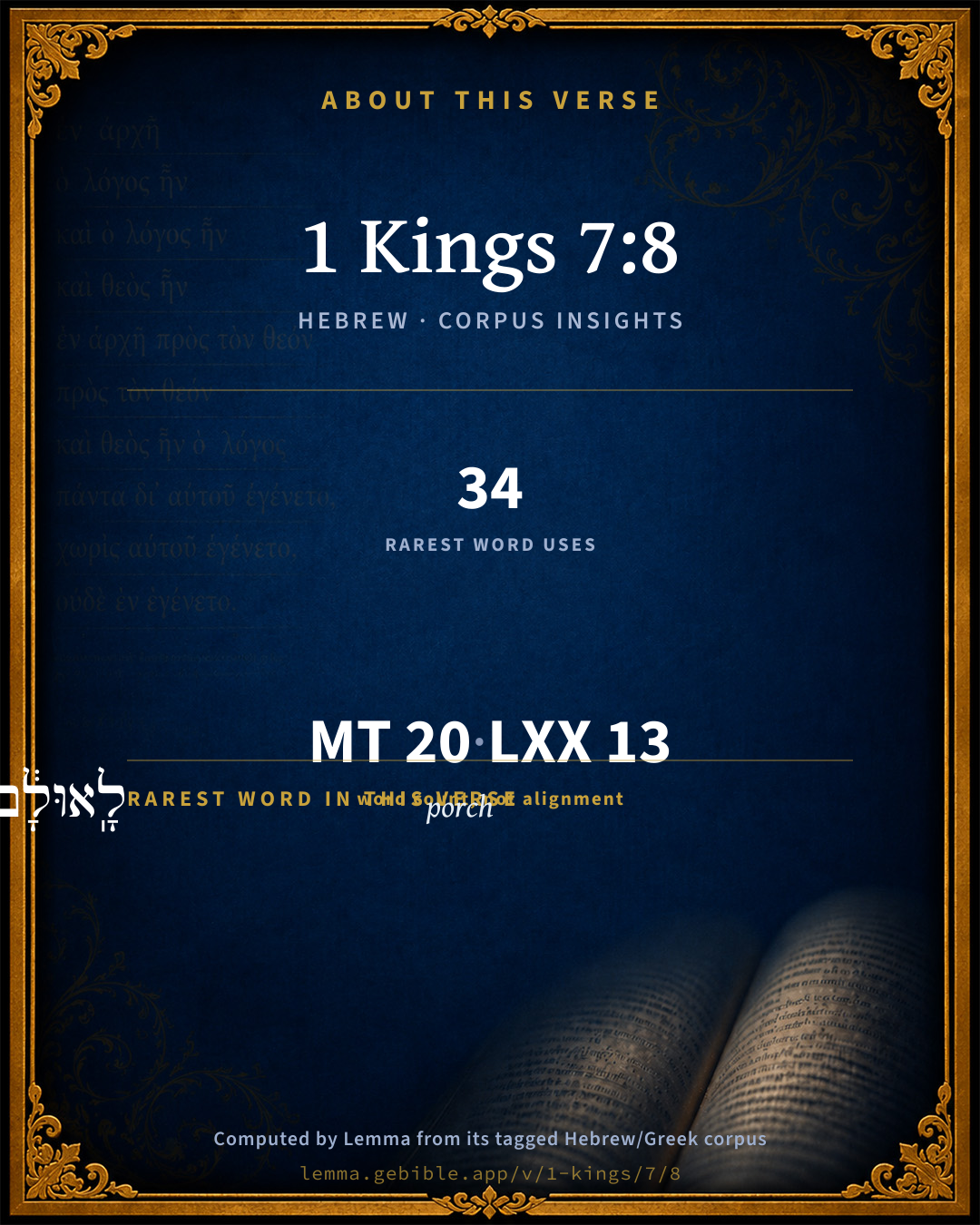
20
words
15
distinct lemmas
Historical
section

Shared distinctive vocabulary

לָֽאוּלָ֔ם porch H197 occurs in 29 verses of the Hebrew Bible. Also found in:

Grammatical profile

  • 4 verbs
  • 10 nouns
  • 1 adjective
  • 2 pronouns
  • 1 adverb
  • 2 particles

Verb forms

  • יֵ֨שֶׁב Qal · Imperfect
  • הָיָ֑ה Qal · Perfect
  • יַעֲשֶׂ֤ה Qal · Imperfect
  • לָקַ֣ח Qal · Perfect

Repetition

Words recur within this verse — often emphatic in Hebrew:

  • וּבֵיתוֹ֩ house H1004 ×3
  • לָֽאוּלָ֔ם porch H197 ×2
  • אֲשֶׁר which H834 ×2
  • הַזֶּ֖ה this H2088 ×2

Hebrew & Septuagint length

In the original languages it is 20 Hebrew tokens and 13 Greek tokens — but the two are counted differently (Hebrew bundles its prefixes and suffixes into one token; the Greek is in lemma form), so that isn’t a like-for-like length.

Cross-references

4

Topical passages linked to 1 Kings 7:8 in the Treasury of Scripture Knowledge — connected by theme and wording, ordered by reader-vote popularity; previews shown in the World English Bible.

  • 2 Chronicles 8:11 Solomon brought up the daughter of Pharaoh out of the city of David to the house that he had built for her; for he said, My wife shall not dwell in the house of David king of Israel, because the places are holy, whereunto the ark of Yahweh has come.
  • 1 Kings 3:1 Solomon made affinity with Pharaoh king of Egypt, and took Pharaoh's daughter, and brought her into the city of David, until he had made an end of building his own house, and the house of Yahweh, and the wall of Jerusalem round about.
  • 1 Kings 9:24 But Pharaoh's daughter came up out of the city of David to her house which [Solomon] had built for her: then did he build Millo.
  • 2 Kings 20:4 It happened, before Isaiah was gone out into the middle part of the city, that the word of Yahweh came to him, saying,

Cross-references courtesy of OpenBible.info (CC BY 4.0).

Hebrew and Greek witnesses Masoretic Hebrew ↔ Greek Septuagint

The same verse in the two great witnesses to the Old Testament, shown verse-for-verse.

These are two independent witnesses, not word-aligned to each other, and the Septuagint is shown in lemma (dictionary) form.

Hebrew 1 Kings 7:8 Masoretic · Westminster Leningrad Codex

וּבֵיתוֹ֩ אֲשֶׁר יֵ֨שֶׁב שָׁ֜ם חָצֵ֣ר הָאַחֶ֗רֶת מִבֵּית֙ לָֽאוּלָ֔ם כַּמַּֽעֲשֶׂ֥ה הַזֶּ֖ה הָיָ֑ה וּבַ֜יִת יַעֲשֶׂ֤ה לְבַת פַּרְעֹה֙ אֲשֶׁ֣ר לָקַ֣ח שְׁלֹמֹ֔ה כָּאוּלָ֖ם הַזֶּֽה

His house where he was to dwell, the other court within the porch, was of the like work. He made also a house for Pharaoh's daughter (whom Solomon had taken as wife), like this porch.

World English Bible · Public Domain

Greek LXX 1 Kings 7:8 Septuagint · lemma form

καί ἐπί ὁ κεφαλή ὁ στῦλος ἔργον κρίνον κατά ὁ αιλαμ τέσσαρες πῆχυς

No English rendering of this Greek verse — the small residue in the structurally divergent books.

Hebrew: Westminster Leningrad Codex (CC BY 4.0). Greek: Septuagint (public domain); English from a public-domain English Septuagint. How the Septuagint differs from the Hebrew →

Targum (Aramaic paraphrase)

1

The Targum is the ancient Jewish Aramaic paraphrase of the Hebrew Scriptures — an interpretive translation, not the Hebrew text itself. Onkelos (literal) and Pseudo-Jonathan (expansive) render the Torah, and Jonathan the Prophets. Coverage is partial: where no permissively-licensed English translation exists for a verse, only the Aramaic is shown. This is verse-level text, not a word-by-word alignment to the Hebrew.

  1. Targum Jonathan Prophets (Joshua–Malachi)
    וּבֵיתֵיהּ דִיתַב תַּמָן דָרְתָּא אוֹחֲרַנְתָּא מִגָיו לְאוּלַמָא כְּעוֹבָדָא הָדֵין הֲוָה וּבֵיתָא עֲבַד לְבַת פַּרְעֹה דִנְסֵיב שְׁלֹמֹה כְּאוּלַמָא הָדֵין:

    (no public-domain English translation for this verse)

    Targum Jonathan — Aramaic: “Mikraot Gedolot” (public domain). English: “Sefaria Community Translation” (CC0 1.0 (public-domain dedication)); “London "Chaldee Paraphrase," 1871” (public domain). Text via Sefaria.

Commentary

Notes on 1 Kings 7:8 from classic Christian and Jewish commentators (each source and its license shown beneath its notes). The classic Christian expositions comment on the surrounding passage and are grouped to its opening verse, so a note may address several verses; the Jewish commentaries on the Tanakh (Rashi and others) are per-verse, so they appear only where the commentator wrote on this verse.

Lemma curates 59 commentaries, every one of them public domain or Creative Commons licensed, each selected and text-cleaned for this edition rather than reprinted as found. About our sources →

Trapp's Complete Commentary

John Trapp

1Ki 7:8 And his house where he dwelt [had] another court within the porch, [which] was of the like work. Solomon made also an house for Pharaoh’s daughter, whom he had taken [to wife], like unto this porch.

Ver. 8. Had another court.] Called "the middle court." {2Ki 20:4}

Like unto this porch.] All was uniform and spacious.

John Trapp, A Commentary or Exposition upon All the Books of the Old and New Testament (1647–1656) — public domain. Text from a community e-Sword module.

Joseph Benson's Commentary

1Ki 7:8. His house where he dwelt had another court within the porch — That is, between the porch and the house, called therefore the middle court, 1Ki 20:4. Solomon made also a house for Pharaoh’s daughter — Of which, see 2Ch 2:11. Like unto this porch — Not for form or size, but for the materials and workmanship, the rooms being covered with cedar and the like ornaments.

Joseph Benson's Commentary on the Old and New Testaments (1811–1818) — public domain. Text from a community e-Sword module.

Adam Clarke's Commentary

Verse 8. A house for Pharaoh's daughter] This appears to have been a third house; probably the whole three made but one building, and were in the same place, but distinguished from each other; the first as Solomon's palace, the second as a house of judgment, a court-house; the third, the harem, or apartments for the women.

Adam Clarke's Commentary on the Bible (1810–1826) — public domain. Text from a community e-Sword/MySword module.

Ellicott's Commentary for English Readers

(8-11) The residence of the king, and the separate palace for the queen, distinct from the apartments of the inferior wives and concubines, are not described; except that they lay “within the porch,” that is, in the rear in another court, and were of “like work.” This is further explained by saying that they had costly stones of great size in the foundation, and stones above, hewn and sawn from top to bottom, carefully finished on the outside towards the great court, as well as on the inside, and were in all cases roofed with cedar. Josephus tells us that the inner court was adorned with trees and fountains, and had colonnades round it; and gives an enthusiastic description of the internal decoration of the rooms, panelled up to a certain height with polished marble, with a band of highly-wrought metal-work of foliage of all kinds above this, and the rest of the wall up to the ceiling plastered and painted in colours (“ceiled with cedar, and painted with vermilion.” Jer_22:14). This description is curiously confirmed and illustrated by some of the recent discoveries at Nineveh.

A Bible Commentary for English Readers, edited by Charles John Ellicott (1878–1897) — public domain. Text from a community e-Sword module.

The Cambridge Bible for Schools and Colleges

gen. ed. J. J. S. Perowne

8. And his house where he dwelt had another court within the porch, which was of the like work] It is better to leave out the italics of A V. and translate ‘And his house where he might dwell, the other court within the porch, was of the like work.’ The description has apparently been carrying us, from the front of the house of the forest, regularly more and more inward. Now we are brought to a court behind the previously mentioned porch, and in this court stood the king’s own dwelling house. It is noteworthy how little description is given to this or to the house for Pharaoh’s daughter. This probably comes to pass because the public were never admitted to these quarters.

Pharaoh’s daughter] Cf. 1Ki_3:1. The house for her probably joined the king’s residence. Josephus (Ant. viii. 5. 2) tells us that it was united with the porch of the throne, but his description is so vague that little reliance can be placed on it, and little help derived from it. The women’s apartments, as usual in the East, were removed as far from public view as possible.

The Cambridge Bible for Schools and Colleges (gen. ed. J. J. S. Perowne; Cambridge University Press, 1878–1918) — public domain. Text from a community e-Sword module.

John Gill's Exposition

All these were of costly stones,.... Marble, porphyry, &c.

according to the measure of hewed stones, sawed with saws, within and without; they were all hewed, and squared, and polished, and so they appeared both on the inside of the building, and without:

even from the foundation unto the coping; from the bottom to the top:

and so on the outside toward the great court: where the people used to assemble when they had causes to be tried, and was adjoining to the king's house.

John Gill's Exposition of the Whole Bible (1746–1763) — public domain (CC PDM 1.0). Text via the HelloAO Bible API.

Albert Barnes' Notes on the Bible

Like unto this porch - i. e., of similar materials, hewn stone and cedar. The zenana could not have been a mere portico.

Albert Barnes' Notes on the Bible (1834–1885) — public domain. Text from a community e-Sword/MySword module.

Haydock's Catholic Bible Commentary

House. In the form of a recess or alcove, at the end of one of the aforesaid porches, and probably in that which was nearer the palace. Guards would be stationed in the other. (Haydock) --- This is the idea which travellers have given us of the palaces in the East. They consisted of various apartments, galleries, and courts. Under the outward porch there are guards standing, in a double row; and hence there is a communication with other parts of the house, and with the apartments of the women, which are far removed, and inaccessible to strangers. The women still continue to have separate tents, or apartments; as they had in the days of Sara, Esther, Herodias, &c., Genesis xxiv., Esther i. 11., and Matthew xiv. 8. (Calmet) --- Pharao. Till it was finished, this lady had lodged in David’s palace; though as it was deemed in a manner sacred, on account of the presence of the ark, it was judged expedient to remove her, 2 Paralipomenon viii. 11. (Haydock) --- Perhaps she had begun to manifest some signs of a relapse towards idolatry, into which she is supposed chiefly to have induced her husband, chap. xi. 4. (Salien)

George Leo Haydock (1774–1849), Haydock's Catholic Family Bible and Commentary, 1859 edition — public domain. Excludes Psalms (Douay-Rheims chapter numbering differs from Protestant) and Deuterocanonical books (Catholic canon only).

Matthew Poole's English Annotations

Within the porch, i.e. between the porch and the house, called therefore the middle court, 2Ki 20:4.

A house for Pharaoh’s daughter; of which see 1Ki 3:1; 2Ch 8:11.

Like unto this porch; not for form or quantity, but for the materials and workmanship, the rooms being covered with cedar, and furnished with like ornaments.

Matthew Poole's English Annotations on the Holy Bible (1683–1685) — public domain. Text from a community e-Sword/MySword module.

Whedon's Commentary on the Bible

Daniel D. Whedon

8. His house where he dwelt — The royal residence proper. (D D in plan.) All the building’s and porches of the palace hitherto described were as so many vestibules or passage ways extending lengthwise through the midst of the great court, (1Ki_7:12,) and conducting to the immediate apartments of the king. They formed a grand approach to the throne; and a person passing through them in the order named would become more and more impressed with feelings of reverence and awe as he drew near the royal presence.

Another court within the porch — Rather, the other court, in distinction from the great court round about the entire group of palatial buildings. This inner court was behind the porch of judgment, and enclosed by that porch in front, and the royal residence on the other three sides. (E in plan.)

Was of the like work — Work like that of the porch of judgment; that is, the king’s house, (not the court, as the which supplied in the English version seems to indicate,) was wainscotted with cedar from floor to ceiling throughout all its apartments.

A house for Pharaoh’s daughter — This probably formed the back part of the royal residence, (F in plan,) and at a later period became the royal harem, where the king kept the “many strange women, together with the daughter of Pharaoh,” who turned his heart away from the Lord. 1Ki_11:1.

Daniel D. Whedon (gen. ed.), Commentary on the Old and New Testaments (1874–1909) — public domain. Text from a community e-Sword module.

The Pulpit Commentary

And his house where he dwelt i.e., his private residence. Not to be identified with the" house" of ver. 1. The term is here expressly restricted to his dwelling house. There it as clearly includes all the several palaces had or was. The "court" is apparently in apposition to "his house." The words in italics, here as elsewhere, merely darken the sense another Heb. the hinder court within For the use of l tyBemi =within, compare 1Ki_6:16; Num_18:7, and see Gesen., Thesaur. 1:193 the porch, which was of the like work i.e. , the walls were covered with cedar. The reference is clearly to materials, adornment, etc., not to size. Solomon made also a house for Pharaoh"s daughter, whom he had taken to wife Heb. he made also a house for whom Solomon had taken, i.e., married, like unto this porch. This would seem to have been the private residence of the queen, not the harem where all the wives and concubines (1Ki_11:3) were collected. It was evidently distinct from and behind the residence of the king, an arrangement which still prevails in Eastern palaces.

The Pulpit Commentary (1880–1919), ed. H.D.M. Spence-Jones & Joseph S. Exell — public domain. Text from a community e-Sword module.

John Wesley's Explanatory Notes

Another court - That is, between the porch and the house, called therefore the middle court, chap. 2 Kings xx, 4. Like this - Not for form or quantity, but for the materials and workmanship, the rooms being covered with cedar, and furnished with like ornaments.

John Wesley, Explanatory Notes Upon the Whole Bible (1754–1765) — public domain. Text via the GEBible commentary corpus.

unfoldingWord translationNotes

Door43 World Missions Community

General Information:

The author continues to write about the palace area.

Solomon's house in which he was to live, in another courtyard within the palace grounds, was similarly designed

This can be translated in active form. AT: "Solomon had someone design the house in which he was to live, in another courtyard within the palace grounds, in the same way" (See: Active or Passive)

He also built

Solomon would have commanded his workers to do this work. AT: "He also commanded them to build" (See: Metonymy)

translationWords

life

court

Pharaoh

unfoldingWord translationNotes — © Distant Shores Media and the Door43 World Missions Community, licensed CC BY-SA 4.0. Source: git.door43.org/Door43/en_tn.

Rashi

Rabbi Shlomo Yitzchaki (Rashi)

His house where he dwelt. A complete residence to eat and sleep there.

From within the entrance hall. Inward from the entrance hall of the house of the Forest of Lebanon.

And the house which he intended to build. He planned to make a house for Pharaoh’s daughter.

Like this entrance hall. Like the work of this entrance hall.

Rashi on the Tanakh — English translations: “The Judaica Press complete Tanach with Rashi, translated by A. J. Rosenberg” (CC BY 4.0); “Pentateuch with Rashi's commentary by M. Rosenbaum and A.M. Silbermann, 1929-1934” (public domain); “The Metsudah Tanach series, Lakewood, N.J” (CC BY 4.0); and “The Book of Joshua, Metsudah Publications, 1997” (CC BY 4.0). Text via Sefaria.

Lesson kit

Teaching starters — assembled from the data on this page, not authored interpretation. Every prompt links to the verse data it draws on. Edit before teaching.

1 Kings, in the Historical, opens this verse with 20 words (15 distinct Hebrew lemmas). Its most distinctive word is ʼûwlâm (“porch”). A historical commentator’s framing appears above. Read the whole chapter for the surrounding context.

Discussion questions

  1. What does “porch” (ʼûwlâm) contribute to the verse as a whole?
  2. 1 Kings 6:3 shares the word «porch» with this verse. How do the two illuminate each other?
  3. “house” occurs 3× in this one verse. What is the effect of the repetition?
  4. These translations render this verse differently. What is at stake in choosing one wording over another?
  5. The verb «יֵ֨שֶׁב» is Qal Imperfect. How does its form color the action?
  6. Reading how Trapp's Complete Commentary and Joseph Benson's Commentary read this verse, where do the two commentators agree and where do they part?

Things to notice

Reading settings

Reading text

Shown beneath each verse's original-language words.

Old Testament
Old Testament edition

Read the OT as the Masoretic Hebrew (MT) or the Greek Septuagint (LXX).

English shown for the Greek Septuagint (in the Hebrew ↔ Greek comparison).

Comparing translations? Open the Compare panel on any verse page to stack up to four side by side.