
Nehemiah 9:10

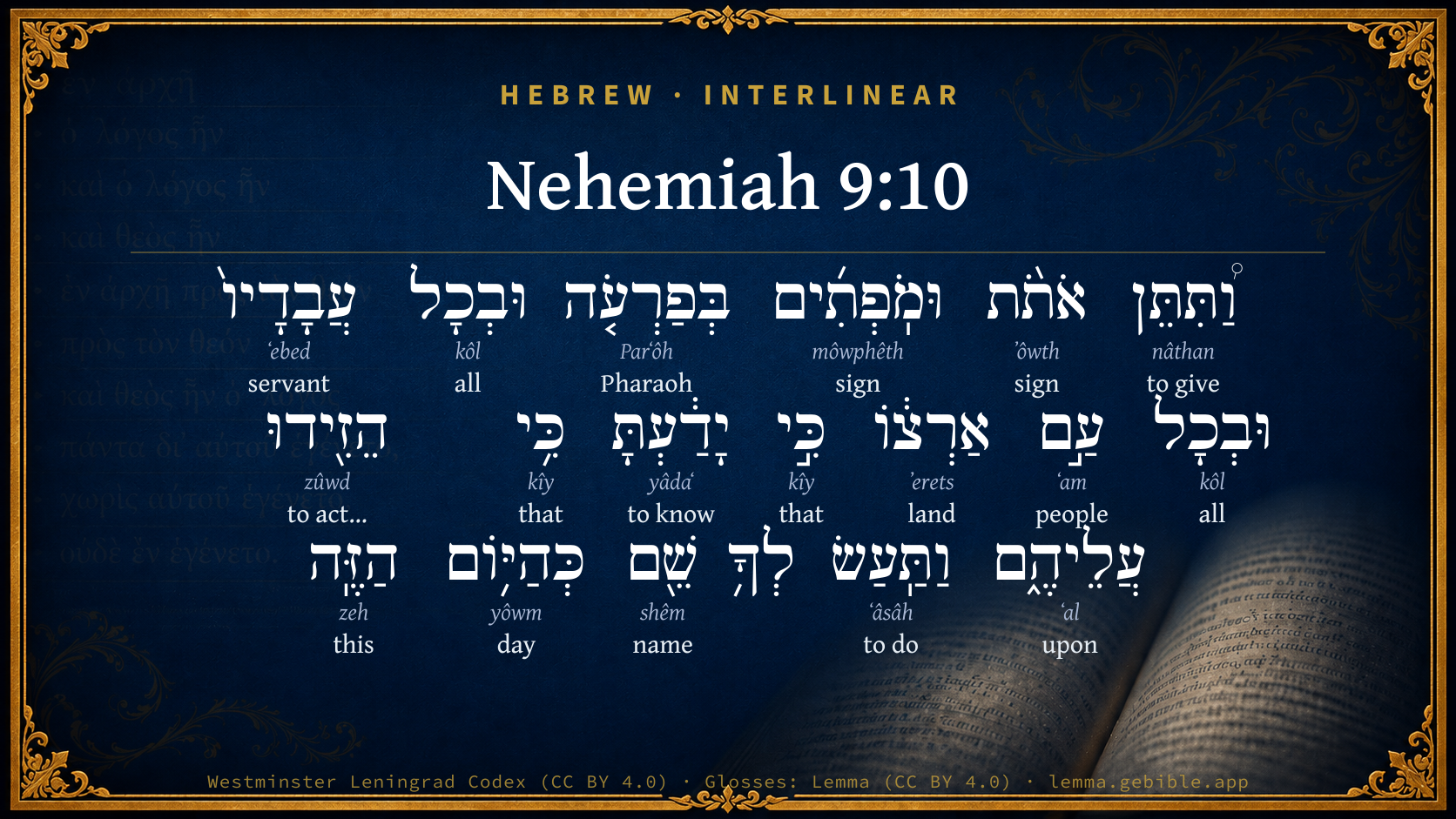
Hebrew (Westminster Leningrad Codex) Nehemiah 9:10 appears in the Hebrew Old Testament. The text above is from the Westminster Leningrad Codex. Each word links to its Strong’s number, a concise gloss, and parsing drawn from the Open Scriptures Hebrew Bible morphology. Click any word for its full Brown-Driver-Briggs (BDB) entry.
Download image
Cite this verse

Nehemiah 9:10 (World English Bible). Public Domain. Lemma interlinear Bible study tool, https://lemma.gebible.app/v/nehemiah/9/10.

Show BibTeX & RIS
BibTeX
RIS
English Translation
and shown signs and wonders on Pharaoh, and on all his servants, and on all the people of his land; for you knew that they dealt proudly against them, and did get you a name, as it is this day.
World English Bible · Public Domain
Download a study sheet

One document with this verse’s original text, its word-by-word gloss line, the meaning frame, cross-references with their text, attributed commentary, and full source and license credits — printable, and it pastes into notes with its structure intact.

This verse Autodidact and up

Study sheet (.html) Plain text (.txt)

A passage Seminary Student

Up to 50 verses in one chapter. A passage sheet keeps up to 6 commentary sources and 12 cross-references per verse, in the order this page ranks them, and says so on the sheet whenever that leaves anything out. Ask for a single verse and you get the Autodidact verse sheet above.

Everything on this page stays free to read, with no account — the sheet is a download of what is already on screen, not access to it.

Want to remove ads? Support Godless Engineer
Compare translations 3

The same verse in 3 English versions, stacked beneath the original-language interlinear above. Click any original word for its lexicon entry.

Each is an independent rendering of the whole verse — the interlinear is not word-aligned to these translations.

Highlighted words mark where these versions differ — a whole-verse word diff, not a word-by-word alignment.

  • World English Bible Public Domain
    and shown signs and wonders on Pharaoh, and on all his servants, and on all the people of his land; for you knew that they dealt proudly against them, and did get you a name, as it is this day.
  • King James Version Public Domain
    And shewedst signs and wonders upon Pharaoh, and on all his servants, and on all the people of his land: for thou knewest that they dealt proudly against them. So didst thou get thee a name, as it is this day.
  • unfoldingWord Literal Text CC BY-SA 4.0
    And you gave signs and wonders to Pharaoh, and to all his servants, and to all the people of his land, because you knew that they were acting presumptuously toward them. And you made for yourself a name, as it is this day.

unfoldingWord Literal Text — © unfoldingWord, licensed CC BY-SA 4.0. Word-aligned USFM3 via Door43 (git.door43.org/unfoldingWord/en_ult).

Versions to compare (up to 4)

3 of 4 selected

Show all 18 translations

Every available English version of this verse, each an independent rendering of the whole verse.

  • World English Bible Public Domain
    and shown signs and wonders on Pharaoh, and on all his servants, and on all the people of his land; for you knew that they dealt proudly against them, and did get you a name, as it is this day.
  • Berean Standard Bible Public Domain
    You performed signs and wonders against Pharaoh, all his officials, and all the people of his land, for You knew they had acted with arrogance against our fathers. You made a name for Yourself that endures to this day.
  • Majority Standard Bible Public Domain
    You performed signs and wonders against Pharaoh, all his officials, and all the people of his land, for You knew they had acted with arrogance against our fathers. You made a name for Yourself that endures to this day.
  • King James Version Public Domain
    And shewedst signs and wonders upon Pharaoh, and on all his servants, and on all the people of his land: for thou knewest that they dealt proudly against them. So didst thou get thee a name, as it is this day.
  • American Standard Version (1901) Public Domain
    and showedst signs and wonders upon Pharaoh, and on all his servants, and on all the people of his land; for thou knewest that they dealt proudly against them, and didst get thee a name, as it is this day.
  • Revised Version (1885) Public Domain
    and shewedst signs and wonders upon Pharaoh, and on all his servants, and on all the people of his land; for thou knewest that they dealt proudly against them; and didst get thee a name, as it is this day.
  • Geneva Bible (1599) Public Domain
    And shewed tokens and wonders vpon Pharaoh, and on all his seruants, and on all the people of his land: for thou knewest that they dealt proudely against them: therefore thou madest thee a Name, as appeareth this day.
  • Douay-Rheims (1899) Public Domain
    And thou shewedst signs and wonders upon Pharao, and upon all his servants, and upon the people of his land: for thou knewest that they dealt proudly against them: and thou madest thyself a name, as it is at this day.
  • Young's Literal Translation Public Domain
    and dost give signs and wonders on Pharaoh, and on all his servants, and on all the people of his land, for Thou hast known that they have acted proudly against them, and Thou makest to Thee a name as `at' this day.
  • Literal Standard Version CC BY-SA 4.0
    And give signs and wonders on Pharaoh, || And on all his servants, || And on all the people of his land, || For You have known that they have acted proudly against them, || And You make to Yourself a name as [at] this day.
  • Unlocked Literal Bible CC BY-SA 4.0
    You gave signs and wonders against Pharaoh, and all his servants, and on all the people of his land, for you knew that the Egyptians acted with arrogance against them. But you made a name for yourself which stands to this day.
  • unfoldingWord Literal Text CC BY-SA 4.0
    And you gave signs and wonders to Pharaoh, and to all his servants, and to all the people of his land, because you knew that they were acting presumptuously toward them. And you made for yourself a name, as it is this day.
  • Darby Bible Public Domain
    and didst shew signs and wonders upon Pharaoh, and upon all his servants, and upon all the people of his land; for thou knewest that they dealt proudly against them, and thou didst make thee a name, as it is this day.
  • World Messianic Bible Public Domain
    and showed signs and wonders against Pharaoh, against all his servants, and against all the people of his land, for you knew that they dealt proudly against them, and made a name for yourself, as it is today.
  • Webster's Bible Public Domain
    And shewedst signs and wonders upon Pharaoh, and on all his servants, and on all the people of his land: for thou knewest that they dealt proudly against them. So didst thou get thee a name, as it is this day.
  • Free Bible Version CC BY-SA 4.0
    You performed miraculous signs and wonders against Pharaoh, all his officials, and all his people of his land, for you recognized how arrogantly they treated our forefathers. You created a wonderful reputation for yourself that people still recognize to this day.
  • Bible in Basic English Public Domain
    And you did signs and wonders on Pharaoh and all his servants and all the people of his land; for you saw how cruel they were to them. So you got yourself a name as it is today.
  • JPS Tanakh (1917) Public Domain
    and didst show signs and wonders upon Pharaoh, and on all his servants, and on all the people of his land; for Thou knewest that they dealt proudly against them; and didst get Thee a name, as it is this day.

Literal Standard Version (2020), Covenant Press — licensed CC BY-SA 4.0. Text via the HelloAO Bible API (eBible.org). Unlocked Literal Bible (unfoldingWord) — licensed CC BY-SA 4.0. Text via the HelloAO Bible API (eBible.org). unfoldingWord Literal Text — © unfoldingWord, licensed CC BY-SA 4.0. Word-aligned USFM3 via Door43 (git.door43.org/unfoldingWord/en_ult). Free Bible Version, Dr. Jonathan Gallagher — licensed CC BY-SA 4.0. Text via the HelloAO Bible API (eBible.org).

Word by word

More ways to search: Search by grammar → Find every occurrence → Compare this word →

Practice this passage: Drill this verse → Learn its vocabulary →

הֵזִ֖ידוּ
zûwd
H2102
“to act presumptuously”
Verb, Hiphil, Perfect, 3rd Person, Common, Plural
Part of Speech
Verb
Stem
Hiphil
Form
Perfect
Person
3rd Person
Gender
Common
Number
Plural
Full BDB Definition

Origin: a primitive root

TWOT: 547

to boil, boil up, seethe, act proudly, act presumptuously, act rebelliously, be presumptuous, be arrogant, be rebelliously proud - (Qal) - to act presumptuously - to deal arrogantly (with 'al') - to defy proudly (with 'el') - (Hiphil) - to boil, seethe, act proudly - to act presumptuously, act insolently
  1. וַ֠תִּתֵּן nâthan H5414 “and · to give” Conjunction + Verb, Qal, Sequential Imperfect, 2nd Person, Masculine, Singular
  2. אֹתֹ֨ת ʼôwth H226 “signs” Noun, Common, Both, Plural, Absolute
  3. וּמֹֽפְתִ֜ים môwphêth H4159 “and · signs” Conjunction + Noun, Common, Masculine, Plural, Absolute
  4. בְּפַרְעֹ֤ה Parʻôh H6547 “in/at · Pharaoh” Preposition + Noun, Proper
  5. וּבְכָל kôl H3605 “and · in/at · all of” Conjunction + Preposition + Noun, Common, Masculine, Singular, Construct
  6. עֲבָדָיו֙ ʻebed H5650 “servants · his” Noun, Common, Masculine, Plural, Construct + Suffix, Personal, 3rd Person, Masculine, Singular
  7. וּבְכָל kôl H3605 “and · in/at · all of” Conjunction + Preposition + Noun, Common, Masculine, Singular, Construct
  8. עַ֣ם ʻam H5971 “people of” Noun, Common, Masculine, Singular, Construct
  9. אַרְצ֔וֹ ʼerets H776 “land · his” Noun, Common, Both, Singular, Construct + Suffix, Personal, 3rd Person, Masculine, Singular
  10. כִּ֣י kîy H3588 “that” Conjunction
  11. יָדַ֔עְתָּ yâdaʻ H3045 “to know” Verb, Qal, Perfect, 2nd Person, Masculine, Singular
  12. כִּ֥י kîy H3588 “that” Conjunction
  13. עֲלֵיהֶ֑ם ʻal H5921 “upon · them” Preposition + Suffix, Personal, 3rd Person, Masculine, Plural
  14. וַתַּֽעַשׂ ʻâsâh H6213 “and · to do” Conjunction + Verb, Qal, Sequential Imperfect, 2nd Person, Masculine, Singular
  15. שֵׁ֖ם shêm H8034 “name” Noun, Common, Masculine, Singular, Absolute
  16. כְּהַיּ֥וֹם yôwm H3117 “like/as · the · day” Preposition + Particle, Definite Article + Noun, Common, Masculine, Singular, Absolute
  17. הַזֶּֽה zeh H2088 “the · this” Particle, Definite Article + Pronoun, Demonstrative, Masculine, Singular

About this verse

These counts appear in no published source. They are computed here, from the morphology-tagged text and Lemma’s own curated glosses. What Lemma adds →

19
words
16
distinct lemmas
Historical
section

Notable vocabulary

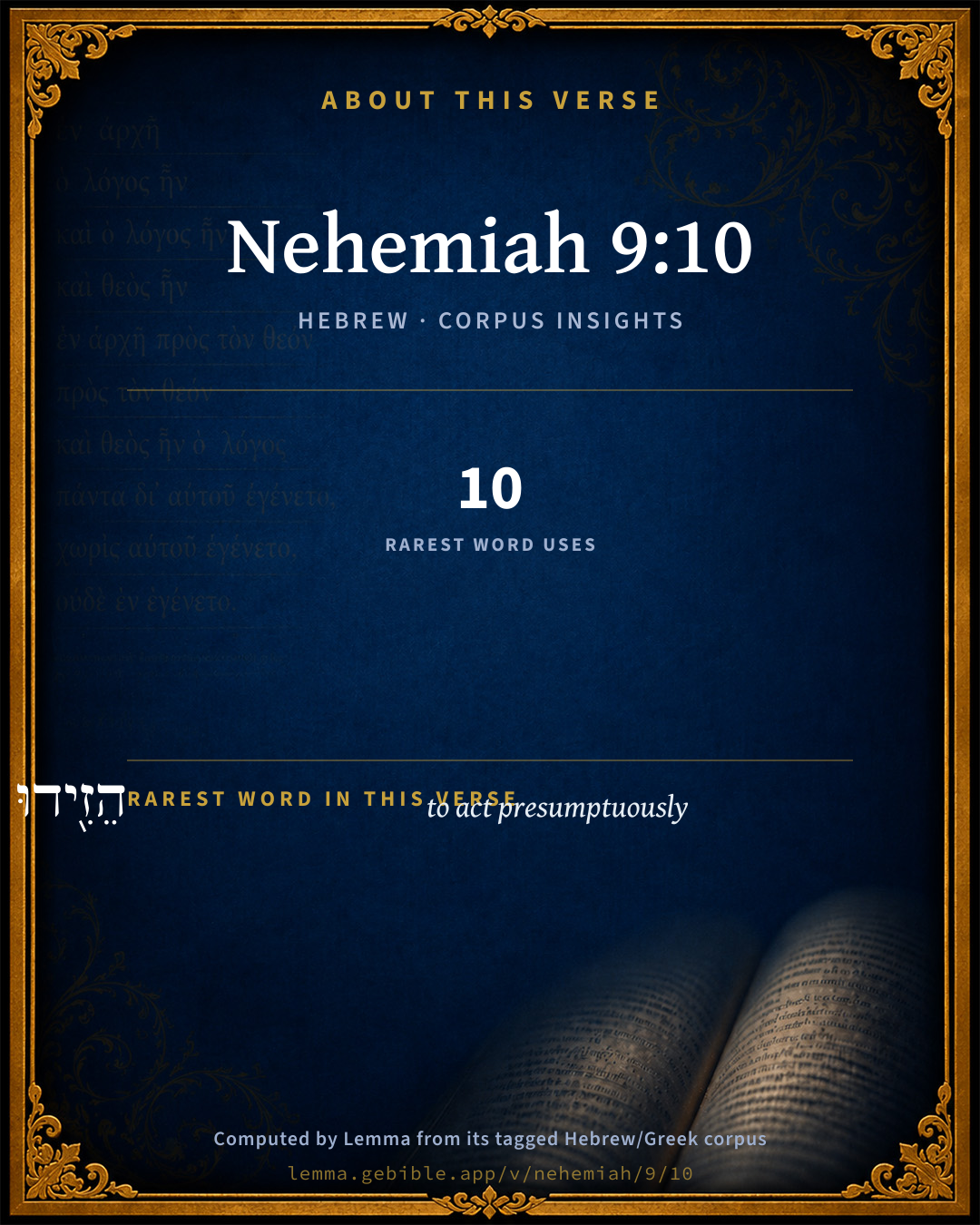
The rarest word here is הֵזִ֖ידוּ to act presumptuously H2102 — appearing just 10 times in the whole Hebrew Bible.

Shared distinctive vocabulary

הֵזִ֖ידוּ to act presumptuously H2102 occurs in 10 verses of the Hebrew Bible. Also found in:

Grammatical profile

  • 4 verbs
  • 10 nouns
  • 1 pronoun
  • 2 prepositions
  • 2 conjunctions

Verb forms

  • וַ֠תִּתֵּן Qal · Sequential Imperfect
  • יָדַ֔עְתָּ Qal · Perfect
  • הֵזִ֖ידוּ Hiphil · Perfect
  • וַתַּֽעַשׂ Qal · Sequential Imperfect

Repetition

Words recur within this verse — often emphatic in Hebrew:

  • וּבְכָל all H3605 ×2
  • כִּ֣י that H3588 ×2

Cross-references

26

Topical passages linked to Nehemiah 9:10 in the Treasury of Scripture Knowledge — connected by theme and wording, ordered by reader-vote popularity; previews shown in the World English Bible.

  • Jeremiah 32:20 who performed signs and wonders in the land of Egypt, even to this day, both in Israel and among [other] men; and made you a name, as in this day;
  • Daniel 9:15 Now, Lord our God, who has brought your people forth out of the land of Egypt with a mighty hand, and have gotten you renown, as at this day; we have sinned, we have done wickedly.
  • Exodus 5:2 Pharaoh said, "Who is Yahweh, that I should listen to his voice to let Israel go? I don't know Yahweh, and moreover I will not let Israel go."
  • Exodus 14:1–31 Yahweh spoke to Moses, saying,
  • Exodus 18:11 Now I know that Yahweh is greater than all gods because of the thing in which they dealt arrogantly against them."
  • Deuteronomy 4:34 Or has God tried to go and take him a nation from the midst of [another] nation, by trials, by signs, and by wonders, and by war, and by a mighty hand, and by an outstretched arm, and by great terrors, according to all that Yahweh your God did for you in Egypt before your eyes?
  • Isaiah 63:12 who caused his glorious arm to go at the right hand of Moses? who divided the waters before them, to make himself an everlasting name?
  • Isaiah 63:14 As the cattle that go down into the valley, the Spirit of Yahweh caused them to rest; so did you lead your people, to make yourself a glorious name.
  • Exodus 5:7–8 "You shall no longer give the people straw to make brick, as before. Let them go and gather straw for themselves.
  • Exodus 7:1–12:32 Yahweh said to Moses, "Behold, I have made you as God to Pharaoh; and Aaron your brother shall be your prophet.
  • Deuteronomy 11:3–4 and his signs, and his works, which he did in the midst of Egypt to Pharaoh the king of Egypt, and to all his land;
  • Joshua 2:10–11 For we have heard how Yahweh dried up the water of the Red Sea before you, when you came out of Egypt; and what you did to the two kings of the Amorites, who were beyond the Jordan, to Sihon and to Og, whom you utterly destroyed.
  • Job 40:11–12 Pour forth the fury of your anger. Look on everyone who is proud, and bring him low.
  • Psalms 78:12–13 He did marvelous things in the sight of their fathers, In the land of Egypt, in the field of Zoan.
  • Psalms 78:43–53 How he set his signs in Egypt, His wonders in the field of Zoan,
  • Psalms 83:18 That they may know that you alone, whose name is Yahweh, Are the Most High over all the earth.
  • Psalms 105:27–37 They performed miracles among them, And wonders in the land of Ham.
  • Psalms 106:7–11 Our fathers didn't understand your wonders in Egypt. They didn't remember the multitude of your loving kindnesses, But were rebellious at the sea, even at the Red Sea.
  • Psalms 135:8–9 Who struck the firstborn of Egypt, Both of man and animal;
  • Psalms 136:10–15 To him who struck down the Egyptian firstborn; For his loving kindness endures forever;
  • Ezekiel 20:9 But I worked for my name's sake, that it should not be profaned in the sight of the nations, among which they were, in whose sight I made myself known to them, in bringing them forth out of the land of Egypt.
  • Daniel 4:37 Now I, Nebuchadnezzar, praise and extol and honor the King of heaven; for all his works are truth, and his ways justice; and those who walk in pride he is able to abase.
  • Daniel 5:23 but have lifted up yourself against the Lord of heaven; and they have brought the vessels of his house before you, and you and your lords, your wives and your concubines, have drunk wine from them; and you have praised the gods of silver and gold, of brass, iron, wood, and stone, which don't see, nor hear, nor know; and the God in whose hand your breath is, and whose are all your ways, you have not glorified.
  • Acts 7:36 This man led them out, having worked wonders and signs in Egypt, in the Red Sea, and in the wilderness for forty years.
  • Romans 9:17 For the Scripture says to Pharaoh, "For this very purpose I caused you to be raised up, that I might show in you my power, and that my name might be published abroad in all the earth."
  • 1 Peter 5:5 Likewise, you younger ones, be subject to the elder. Yes, all of you gird yourselves with humility, to subject yourselves to one another; for "God resists the proud, but gives grace to the humble."

Cross-references courtesy of OpenBible.info (CC BY 4.0).

Hebrew and Greek witnesses Masoretic Hebrew ↔ Greek Septuagint

The same verse in the two great witnesses to the Old Testament, shown verse-for-verse.

These are two independent witnesses, not word-aligned to each other, and the Septuagint is shown in lemma (dictionary) form.

Hebrew Nehemiah 9:10 Masoretic · Westminster Leningrad Codex

וַ֠תִּתֵּן אֹתֹ֨ת וּמֹֽפְתִ֜ים בְּפַרְעֹ֤ה וּבְכָל עֲבָדָיו֙ וּבְכָל עַ֣ם אַרְצ֔וֹ כִּ֣י יָדַ֔עְתָּ כִּ֥י הֵזִ֖ידוּ עֲלֵיהֶ֑ם וַתַּֽעַשׂ לְךָ֥ שֵׁ֖ם כְּהַיּ֥וֹם הַזֶּֽה

and shown signs and wonders on Pharaoh, and on all his servants, and on all the people of his land; for you knew that they dealt proudly against them, and did get you a name, as it is this day.

World English Bible · Public Domain

Greek LXX Structure differs

The Septuagint has no separate book of Nehemiah. Its Greek text is the second half of Esdras B (2 Esdras), chapters 11–23; Ezra is the first half (1–10).

A verse-for-verse comparison isn’t shown here because the chapters and verses don’t line up. Switch to the LXX edition with the MT / LXX toggle above to read the Greek directly.

Hebrew: Westminster Leningrad Codex (CC BY 4.0). Greek: Septuagint (public domain); English from a public-domain English Septuagint. How the Septuagint differs from the Hebrew →

Commentary

Notes on Nehemiah 9:10 from classic Christian and Jewish commentators (each source and its license shown beneath its notes). The classic Christian expositions comment on the surrounding passage and are grouped to its opening verse, so a note may address several verses; the Jewish commentaries on the Tanakh (Rashi and others) are per-verse, so they appear only where the commentator wrote on this verse.

Lemma curates 59 commentaries, every one of them public domain or Creative Commons licensed, each selected and text-cleaned for this edition rather than reprinted as found. About our sources →

Trapp's Complete Commentary

John Trapp

Neh 9:10 And shewedst signs and wonders upon Pharaoh, and on all his servants, and on all the people of his land: for thou knewest that they dealt proudly against them. So didst thou get thee a name, as [it is] this day.

Ver. 10. And shewedst signs and wonders upon Pharaoh] That sturdy rebel, whom neither ministry, nor misery, nor miracle, nor mercy could possibly mollify. This was worse than any or all those ten plagues sent upon him, whereof see Exo 3:19. {See Trapp on "Exo 3:19"}

For thou knewest that they dealt proudly, &c.] This the just and jealous God could not away with, Exo 18:11. His work in heaven is (said that heathen) to cast down the lofty, and to lift up the lowly, τα μεν υφηλα ταπεινουν, &c. (Aesop. Chilon).

So didst thou get thee a name] i.e. A great fame of thy power and justice, to the conversion of some (as Jethro, Exo 18:1) and conviction of others, as Deu 32:31 Jos 2:10 1Sa 4:8.

John Trapp, A Commentary or Exposition upon All the Books of the Old and New Testament (1647–1656) — public domain. Text from a community e-Sword module.

Tyndale Open Study Notes

Tyndale Open Resources

9:10-11 You have a glorious reputation: In the Exodus, God had demonstrated his character with plagues, parting the sea, and defeating the arrogant Egyptian army (Exod 15:5, 9-10, 19).

Tyndale Open Study Notes — © Tyndale Open Resources, licensed CC BY-SA 4.0. Text via the HelloAO Bible API.

The Cambridge Bible for Schools and Colleges

gen. ed. J. J. S. Perowne

10. and shewedst signs and wonders, &c.] This epitome of the history of the Plagues shows acquaintance with Deu_6:22, ‘And the Lord shewed signs and wonders, great and sore, upon Egypt, upon Pharaoh, and upon all his house.’ Cf. Psa_105:27; Psa_106:7; Psa_135:9.

dealt proudly] Perhaps an echo of the use of the same verb in Exo_18:11, ‘yea, in the thing wherein they dealt proudly against them.’

So didst thou get, &c.] R.V. and didst get. Not a recapitulation, but the continuance of the description. The Divine visitation upon Egypt is referred to in similar language, Exo_9:16, ‘And that my name may be declared throughout all the earth;’ Exo_14:17-18.

The words of our verse are best illustrated by Isa_63:12, ‘that divided the water before them, to make himself an everlasting name.’ 14, ‘so didst thou lead thy people, to make thyself a glorious name.’

as it is this day] The vivid impression of the deliverance from Egypt is indestructible. The recollection of the nation’s sin is referred to in the same way, Ezr_9:7.

The Cambridge Bible for Schools and Colleges (gen. ed. J. J. S. Perowne; Cambridge University Press, 1878–1918) — public domain. Text from a community e-Sword module.

John Gill's Exposition

And shewedst signs and wonders upon Pharaoh, and on all his servants, and on all the people of his land,.... By inflicting the ten plagues upon them:

for thou knowest that they dealt proudly against them; behaved haughtily to them, and despised them, see Exo 18:11

so didst thou get thee a name, as it is this day; displayed his power on Pharaoh, and his goodness to Israel, the fame of which reached all over the world, and continued to that day, see Exo 9:16.

John Gill's Exposition of the Whole Bible (1746–1763) — public domain (CC PDM 1.0). Text via the HelloAO Bible API.

Haydock's Catholic Bible Commentary

A name, Glorious, (Menochius) and to be feared by all, Exodus xiv.

George Leo Haydock (1774–1849), Haydock's Catholic Family Bible and Commentary, 1859 edition — public domain. Excludes Psalms (Douay-Rheims chapter numbering differs from Protestant) and Deuterocanonical books (Catholic canon only).

Matthew Poole's English Annotations

They dealt proudly against them; treating thy people with great scorn and contempt, like slaves and beasts.

Matthew Poole's English Annotations on the Holy Bible (1683–1685) — public domain. Text from a community e-Sword/MySword module.

Whedon's Commentary on the Bible

Daniel D. Whedon

10. Get thee a name — A wondrous fame for Almighty power over false gods. Jehovah made for himself such a name by the miracles which he wrought for Israel.

As it is this day — Jehovah’s fame had not departed, for in Nehemiah’s time the miracles of the Exodus were still remembered and extolled.

Daniel D. Whedon (gen. ed.), Commentary on the Old and New Testaments (1874–1909) — public domain. Text from a community e-Sword module.

The Pulpit Commentary

They dealt proudly. The "proud dealing" of the Egyptians is spoken of in Exo_18:11. That God "got himself a name" by the signs and wonders shown in Egypt is often declared. (see Exo_9:16 Exo_14:17 Exo_15:14-16, etc.)

The Divine self-made name.

"So didst thou get make thee a name, as it is this day." "What is thy name?" is a question asked of God by thoughtful men in all ages. How shall we conceive and speak of God? The answer is found in the various manifestations he has made of himself. He is the maker and publisher of his own name.

I THE WAYS BY WHICH GOD HAS MADE FOR HIMSELF A NAME.

1. By his works. Of nature, providence, miracle, grace.

2. By his word. Directly instructing men how to think and speak of him, and enabling them to interpret his works.

3. Preeminently by the manifestation of himself in his Son. The character, teaching, and works of Christ present a perfect revelation of the invisible God. "I have declared thy name, and will declare it". (Joh_17:26)

II THE NAME HE HAS THUS MADE FOR HIMSELF. The Almighty, All-wise, All-good, the Holy, Just, Faithful, Merciful, Terrible, Father and Saviour of all, especially of believers, LOVE, etc.

III ITS ENDURANCE. "As it is this day." He remains the same; his name is so written that it can never be blotted out, so proclaimed that it shall resound through the world, through the universe, for ever.

IV WHY HE HAS MADE HIMSELF SUCH A NAME. For his own glory, and for the benefit of his creatures; that they may fear, trust, love, worship, and obey him, and thus be saved and blessed. Finally, we shall at length in our own personal experience know and illustrate the name of God. Which part of his name? This depends on how we are affected by and towards it now.

The Pulpit Commentary (1880–1919), ed. H.D.M. Spence-Jones & Joseph S. Exell — public domain. Text from a community e-Sword module.

Rashi

Rabbi Shlomo Yitzchaki (Rashi)

that they dealt wickedly Heb. הֵזִידוּ, that they dealt wickedly, like (Exod. 18:11): “...that they plotted (זָדוּ) against them.”

a name Heb. שֵּׁם, renom in French, renown.

Rashi on the Tanakh — English translations: “The Judaica Press complete Tanach with Rashi, translated by A. J. Rosenberg” (CC BY 4.0); “Pentateuch with Rashi's commentary by M. Rosenbaum and A.M. Silbermann, 1929-1934” (public domain); “The Metsudah Tanach series, Lakewood, N.J” (CC BY 4.0); and “The Book of Joshua, Metsudah Publications, 1997” (CC BY 4.0). Text via Sefaria.

Lesson kit

Teaching starters — assembled from the data on this page, not authored interpretation. Every prompt links to the verse data it draws on. Edit before teaching.

Nehemiah, in the Historical, opens this verse with 19 words (16 distinct Hebrew lemmas). Its most distinctive word is zûwd (“to act presumptuously”). A historical commentator’s framing appears above. Read the whole chapter for the surrounding context.

Discussion questions

  1. The word zûwd carries the sense “to act presumptuously.” How does it shape the verse?
  2. How does Genesis 25:29, which shares the word «to act presumptuously», read alongside this verse?
  3. What does the repetition of “all” (2× in this one verse) do in this verse?
  4. The translations on this page render this verse differently — a whole-verse word diff, not a word-by-word alignment. What might account for the different wordings?
  5. «וַ֠תִּתֵּן» is a Qal Sequential Imperfect verb. How does that grammatical form shape the action described?
  6. Compare how Trapp's Complete Commentary and Tyndale Open Study Notes read this verse. Where do they agree or differ?

Things to notice

Reading settings

Reading text

Shown beneath each verse's original-language words.

Old Testament
Old Testament edition

Read the OT as the Masoretic Hebrew (MT) or the Greek Septuagint (LXX).

English shown for the Greek Septuagint (in the Hebrew ↔ Greek comparison).

Comparing translations? Open the Compare panel on any verse page to stack up to four side by side.