
Exodus 6:11

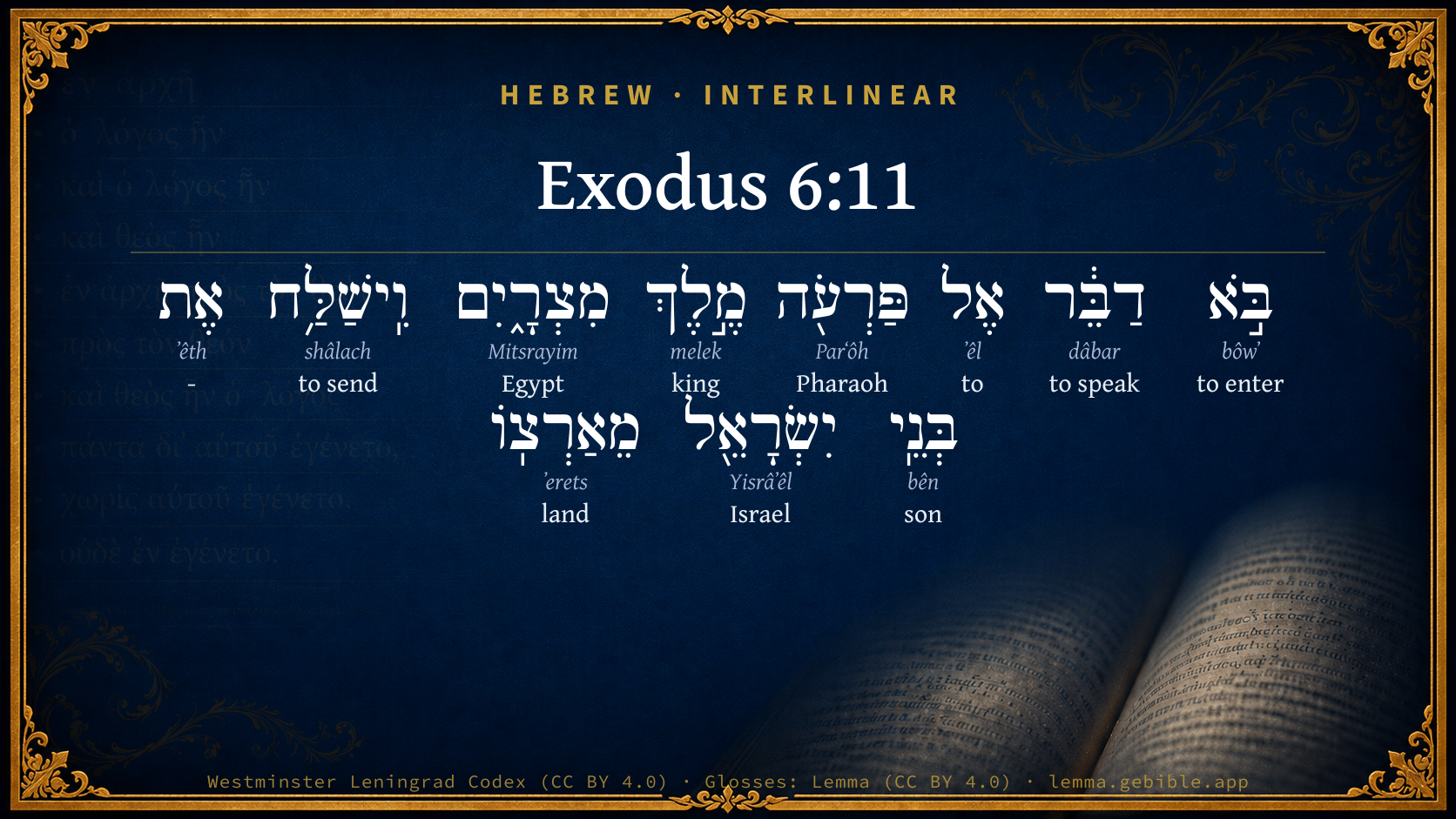
Hebrew (Westminster Leningrad Codex) Exodus 6:11 appears in the Hebrew Old Testament. The text above is from the Westminster Leningrad Codex. Each word links to its Strong’s number, a concise gloss, and parsing drawn from the Open Scriptures Hebrew Bible morphology. Click any word for its full Brown-Driver-Briggs (BDB) entry.
Download image
Cite this verse

Exodus 6:11 (World English Bible). Public Domain. Lemma interlinear Bible study tool, https://lemma.gebible.app/v/exodus/6/11.

Show BibTeX & RIS
BibTeX
RIS
English Translation
"Go in, speak to Pharaoh king of Egypt, that he let the children of Israel go out of his land."
World English Bible · Public Domain
Download a study sheet

One document with this verse’s original text, its word-by-word gloss line, the meaning frame, cross-references with their text, attributed commentary, and full source and license credits — printable, and it pastes into notes with its structure intact.

This verse Autodidact and up

Study sheet (.html) Plain text (.txt)

A passage Seminary Student

Up to 50 verses in one chapter. A passage sheet keeps up to 6 commentary sources and 12 cross-references per verse, in the order this page ranks them, and says so on the sheet whenever that leaves anything out. Ask for a single verse and you get the Autodidact verse sheet above.

Everything on this page stays free to read, with no account — the sheet is a download of what is already on screen, not access to it.

Want to remove ads? Support Godless Engineer
Compare translations 3

The same verse in 3 English versions, stacked beneath the original-language interlinear above. Click any original word for its lexicon entry.

Each is an independent rendering of the whole verse — the interlinear is not word-aligned to these translations.

Highlighted words mark where these versions differ — a whole-verse word diff, not a word-by-word alignment.

  • World English Bible Public Domain
    "Go in, speak to Pharaoh king of Egypt, that he let the children of Israel go out of his land."
  • King James Version Public Domain
    Go in, speak unto Pharaoh king of Egypt, that he let the children of Israel go out of his land.
  • unfoldingWord Literal Text CC BY-SA 4.0
    “Go speak to Pharaoh, king of Egypt, that he should let the sons of Israel go from his land.”

unfoldingWord Literal Text — © unfoldingWord, licensed CC BY-SA 4.0. Word-aligned USFM3 via Door43 (git.door43.org/unfoldingWord/en_ult).

Versions to compare (up to 4)

3 of 4 selected

Show all 18 translations

Every available English version of this verse, each an independent rendering of the whole verse.

  • World English Bible Public Domain
    "Go in, speak to Pharaoh king of Egypt, that he let the children of Israel go out of his land."
  • Berean Standard Bible Public Domain
    “Go and tell Pharaoh king of Egypt to let the Israelites go out of his land.”
  • Majority Standard Bible Public Domain
    “Go and tell Pharaoh king of Egypt to let the Israelites go out of his land.”
  • King James Version Public Domain
    Go in, speak unto Pharaoh king of Egypt, that he let the children of Israel go out of his land.
  • American Standard Version (1901) Public Domain
    Go in, speak unto Pharaoh king of Egypt, that he let the children of Israel go out of his land.
  • Revised Version (1885) Public Domain
    Go in, speak unto Pharaoh king of Egypt, that he let the children of Israel go out of his land.
  • Geneva Bible (1599) Public Domain
    Go speak to Pharaoh King of Egypt, that he let the children of Israel goe out of his land.
  • Douay-Rheims (1899) Public Domain
    Go in, and speak to Pharao king of Egypt, that he let the children of Israel go out of his land.
  • Young's Literal Translation Public Domain
    `Go in, speak unto Pharaoh king of Egypt, and he doth send the sons of Israel out of his land;
  • Literal Standard Version CC BY-SA 4.0
    “Go in, speak to Pharaoh king of Egypt, and he sends the sons of Israel out of his land”;
  • Unlocked Literal Bible CC BY-SA 4.0
    “Go tell Pharaoh, king of Egypt, to let the people of Israel go from his land.”
  • unfoldingWord Literal Text CC BY-SA 4.0
    “Go speak to Pharaoh, king of Egypt, that he should let the sons of Israel go from his land.”
  • Darby Bible Public Domain
    Go in, speak unto Pharaoh king of Egypt, that he let the children of Israel go out of his land.
  • World Messianic Bible Public Domain
    “Go in, speak to Pharaoh king of Egypt, that he let the children of Israel go out of his land.”
  • Webster's Bible Public Domain
    Go in, speak to Pharaoh, king of Egypt, that he let the children of Israel depart from his land.
  • Free Bible Version CC BY-SA 4.0
    “Go and speak to Pharaoh, king of Egypt. Tell him to let the Israelites leave his country.”
  • Bible in Basic English Public Domain
    Go in and say to Pharaoh, king of Egypt, that he is to let the children of Israel go out of his land.
  • JPS Tanakh (1917) Public Domain
    'Go in, speak unto Pharaoh king of Egypt, that he let the children of Israel go out of his land.'

Literal Standard Version (2020), Covenant Press — licensed CC BY-SA 4.0. Text via the HelloAO Bible API (eBible.org). Unlocked Literal Bible (unfoldingWord) — licensed CC BY-SA 4.0. Text via the HelloAO Bible API (eBible.org). unfoldingWord Literal Text — © unfoldingWord, licensed CC BY-SA 4.0. Word-aligned USFM3 via Door43 (git.door43.org/unfoldingWord/en_ult). Free Bible Version, Dr. Jonathan Gallagher — licensed CC BY-SA 4.0. Text via the HelloAO Bible API (eBible.org).

Word by word

More ways to search: Search by grammar → Find every occurrence → Compare this word →

Practice this passage: Drill this verse → Learn its vocabulary →

About this verse

These counts appear in no published source. They are computed here, from the morphology-tagged text and Lemma’s own curated glosses. What Lemma adds →

11
words
11
distinct lemmas
Pentateuch
section

Grammatical profile

  • 3 verbs
  • 6 nouns
  • 1 preposition
  • 1 particle

Verb forms

  • בֹּ֣א Qal · Imperative
  • דַבֵּ֔ר Piel · Imperative
  • וִֽישַׁלַּ֥ח Piel · Imperfect

Hebrew & Septuagint length

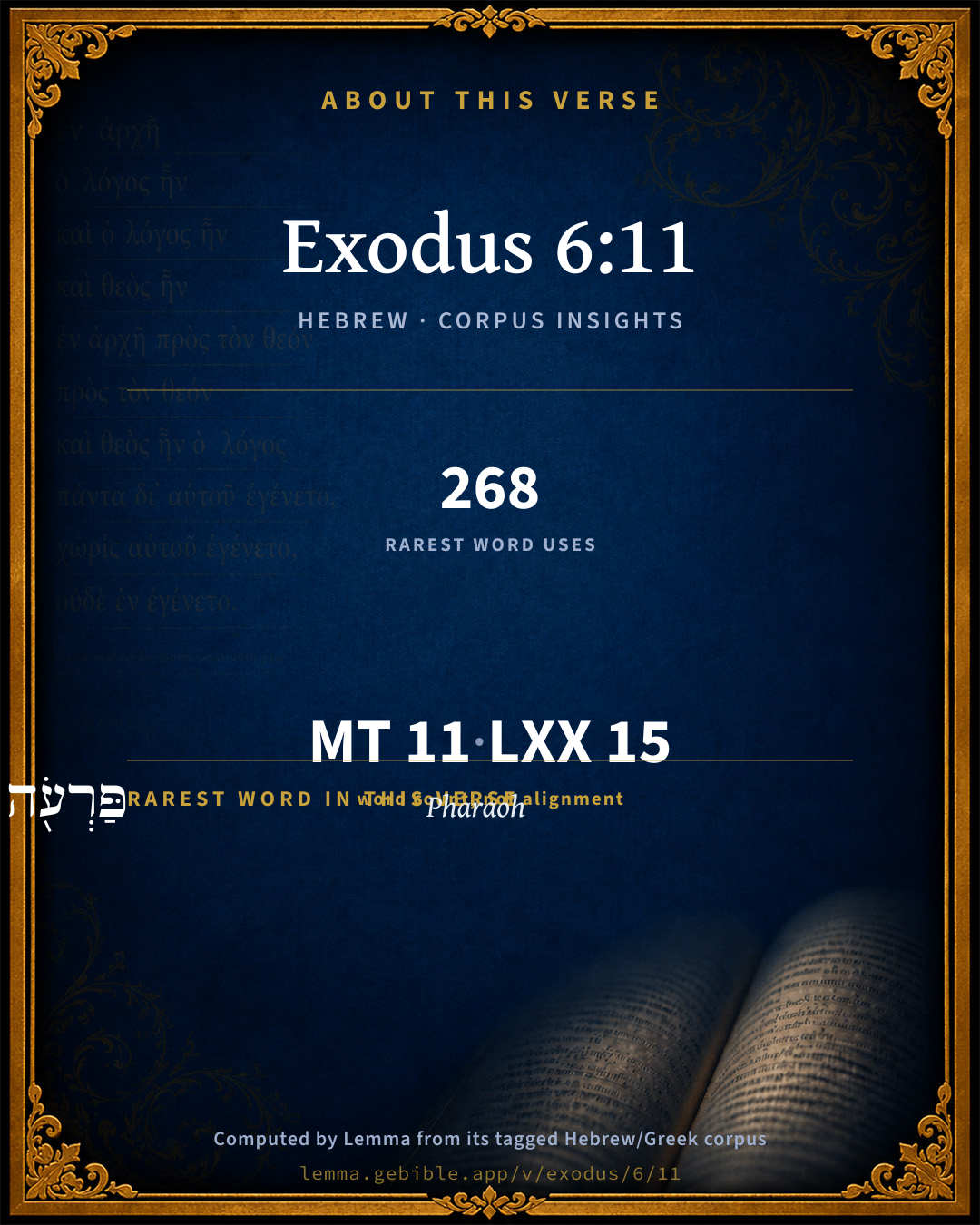
In English translation the verse runs 20 words from the Hebrew and 20 from the Septuagint (LXX English) — the same length.

A rough comparison of the two English renderings, which tokenize alike — not a word-level alignment.

Word counts can differ between the Hebrew and the Greek without any difference in meaning — e.g. the Hebrew direct-object marker אֵת has no separate Greek word, and Greek often adds the article ὁ.

In the original languages it is 11 Hebrew tokens and 15 Greek tokens — but the two are counted differently (Hebrew bundles its prefixes and suffixes into one token; the Greek is in lemma form), so that isn’t a like-for-like length.

Cross-references

5

Topical passages linked to Exodus 6:11 in the Treasury of Scripture Knowledge — connected by theme and wording, ordered by reader-vote popularity; previews shown in the World English Bible.

  • Exodus 3:10 Come now therefore, and I will send you to Pharaoh, that you may bring forth my people, the children of Israel, out of Egypt."
  • Exodus 5:1 Afterward Moses and Aaron came, and said to Pharaoh, "This is what Yahweh, the God of Israel, says, 'Let my people go, that they may hold a feast to me in the wilderness.'"
  • Exodus 5:23 For since I came to Pharaoh to speak in your name, he has brought trouble on this people; neither have you delivered your people at all."
  • Exodus 6:29 that Yahweh spoke to Moses, saying, "I am Yahweh. Speak to Pharaoh king of Egypt all that I speak to you."
  • Exodus 7:1 Yahweh said to Moses, "Behold, I have made you as God to Pharaoh; and Aaron your brother shall be your prophet.

Cross-references courtesy of OpenBible.info (CC BY 4.0).

Hebrew and Greek witnesses Masoretic Hebrew ↔ Greek Septuagint

The same verse in the two great witnesses to the Old Testament, shown verse-for-verse.

These are two independent witnesses, not word-aligned to each other, and the Septuagint is shown in lemma (dictionary) form.

Hebrew Exodus 6:11 Masoretic · Westminster Leningrad Codex

בֹּ֣א דַבֵּ֔ר אֶל פַּרְעֹ֖ה מֶ֣לֶךְ מִצְרָ֑יִם וִֽישַׁלַּ֥ח אֶת בְּנֵֽי יִשְׂרָאֵ֖ל מֵאַרְצֽוֹ

"Go in, speak to Pharaoh king of Egypt, that he let the children of Israel go out of his land."

World English Bible · Public Domain

Greek LXX Exodus 6:11 Septuagint · lemma form

εἰςἔρχομαι λαλέω φαραώ βασιλεύς αἴγυπτος ἵνα ἐκ ἀποστέλλω ὁ υἱός ἰσραήλ ἐκ ὁ γῆ αὐτός

Go in, speak to Pharao king of Egypt, that he send forth the children of Israel out of his land.

LXX2012 (modern English Septuagint) · Public Domain

Hebrew: Westminster Leningrad Codex (CC BY 4.0). Greek: Septuagint (public domain); English from LXX2012 (modern English Septuagint) (Public Domain). How the Septuagint differs from the Hebrew →

Targum (Aramaic paraphrase)

2

The Targum is the ancient Jewish Aramaic paraphrase of the Hebrew Scriptures — an interpretive translation, not the Hebrew text itself. Onkelos (literal) and Pseudo-Jonathan (expansive) render the Torah, and Jonathan the Prophets. Coverage is partial: where no permissively-licensed English translation exists for a verse, only the Aramaic is shown. This is verse-level text, not a word-by-word alignment to the Hebrew.

  1. Targum Onkelos Torah (Genesis–Deuteronomy)
    עוּל מַלֵיל לְוָת פַּרְעֹה מַלְכָּא דְמִצְרָיִם וִישַׁלַח יָת בְּנֵי יִשְׂרָאֵל מֵאַרְעֵהּ:

    (no public-domain English translation for this verse)

    Targum Onkelos — Aramaic: “Onkelos Genesis” (public domain); “Onkelos Exodus” (public domain); “Onkelos Leviticus” (public domain); “Onkelos Numbers” (public domain); “Onkelos Deuteronomy” (public domain). English: “Sefaria Community Translation” (CC0 1.0 (public-domain dedication)); “J.W. Etheridge. The Targums of Onkelos and Jonathan Ben Uzziel on the Pentateuch. London: Longmans, Green, 1862” (public domain). Text via Sefaria.

  2. Targum Pseudo-Jonathan Torah (Genesis–Deuteronomy)
    עוּל מַלֵיל עִם פַרְעה מַלְכָּא דְמִצְרָיִם וְיִפְטוֹר יַת בְּנֵי יִשְרָאֵל מֵאַרְעֵיהּ

    Go in, speak with Pharoh, the king of Mizraim, that he release the children of Israel from his land.

    Targum Pseudo-Jonathan — Aramaic: “Targum Jonathan on Genesis” (public domain); “Targum Jonathan on Exodus” (public domain); “Targum Jonathan on Leviticus” (public domain); “Targum Jonathan on Numbers” (public domain); “Targum Jonathan on Deuteronomy” (public domain). English: “The Targum of Jonathan ben Uzziel, trans. J. W. Etheridge, London, 1862” (public domain). Text via Sefaria.

Commentary

Notes on Exodus 6:11 from classic Christian and Jewish commentators (each source and its license shown beneath its notes). The classic Christian expositions comment on the surrounding passage and are grouped to its opening verse, so a note may address several verses; the Jewish commentaries on the Tanakh (Rashi and others) are per-verse, so they appear only where the commentator wrote on this verse.

Lemma curates 59 commentaries, every one of them public domain or Creative Commons licensed, each selected and text-cleaned for this edition rather than reprinted as found. About our sources →

Trapp's Complete Commentary

John Trapp

Exo 6:11 Go in, speak unto Pharaoh king of Egypt, that he let the children of Israel go out of his land.

Ver. 11. Go in, speak unto Pharaoh.] "Whether he will hear, or whether he will forbear." {Eze 2:5} Speak when God bids us, though it may seem to little purpose: we have lost many a worse labour. The man of God "must be patient" - ανεξικακον, tolerant - "to all," yea, to "those that oppose," proving "if at any time God will give them repentance," &c. {2Ti 2:25}

John Trapp, A Commentary or Exposition upon All the Books of the Old and New Testament (1647–1656) — public domain. Text from a community e-Sword module.

Joseph Benson's Commentary

Exo 6:11. That he let the children of Israel go — God repeats his precepts before he begins his punishments. Those that have oft been called in vain to leave their sins, yet must be called again and again.

Joseph Benson's Commentary on the Old and New Testaments (1811–1818) — public domain. Text from a community e-Sword module.

Ellicott's Commentary for English Readers

THE SECOND MESSAGE TO PHARAOH.

(11) Speak unto Pharaoh.—The second message was an advance upon the first. The first asked only for permission to enter the wilderness, much of which was within the limits of Egypt; the second was a demand that the Israelites should be allowed “to go out of the land.” Such is the way of Providence generally. If we refuse a light cross, a heavier cross is laid on us. If we will not close with the Sybil on the first occasion, she offers us a worse bargain on the second.

A Bible Commentary for English Readers, edited by Charles John Ellicott (1878–1897) — public domain. Text from a community e-Sword module.

The Cambridge Bible for Schools and Colleges

gen. ed. J. J. S. Perowne

11. In P (cf. Exo_7:2) an unconditional release of the people is asked for, not merely (as in J: see on Exo_3:18 and Exo_4:23) a temporary one, to hold a three days’ feast in the wilderness.

The Cambridge Bible for Schools and Colleges (gen. ed. J. J. S. Perowne; Cambridge University Press, 1878–1918) — public domain. Text from a community e-Sword module.

John Gill's Exposition

And Moses spake before the Lord,.... Who appeared in a visible form, and had spoke to him with an articulate voice, and before whom Moses stood, and made the following reply:

saying, behold, the children of Israel have not hearkened unto me; even though he brought a comfortable message to them from the Lord, and delivered many gracious promises of his to them, assuring them of deliverance out of Egypt, and of their possession of the land of Canaan:

how then shall Pharaoh hear me? making a demand upon him to part with a people, from whose labour he receives so much advantage, and has such an addition to his revenues, and who is a mighty king, and haughty monarch. And this is further enforced from his own weakness and unfitness to speak to Pharaoh:

who am of uncircumcised lips? had an impediment in his speech, could not speak freely and readily, but with difficulty; perhaps stammered, and so uttered superfluous syllables, repeated them before he could fully pronounce what he aimed at; or in other words, he was not eloquent, which was his old objection, and had been fully answered before: and by this it appears that there was no alteration in the speech of Moses since God spoke with him at Mount Horeb. Some think Moses expected to have had this impediment removed, and tacitly hints at it here, not being so well satisfied with Aaron's being joined with him as his mouth and spokesman, which seemed to carry in it some reflection upon him.

John Gill's Exposition of the Whole Bible (1746–1763) — public domain (CC PDM 1.0). Text via the HelloAO Bible API.

Albert Barnes' Notes on the Bible

Go out of his land - Moses is now bidden to demand not a permission for a three days’ journey (Exo 3:18 note), which might be within the boundaries of Egypt, but for departure from the land.

Albert Barnes' Notes on the Bible (1834–1885) — public domain. Text from a community e-Sword/MySword module.

The Pulpit Commentary

HOMILIES BY H. T. ROBJOHNS Ver. Exo_6:9.

I THE AUDACITY OF FAITH. Describe the treatment of Moses and Aaron. They acted under Divine direction, did their very best, but just because everything did not go well instantly, and that through the frowardness and waywardness of others, the people turned upon them, and upbraided them as accessories to their slavery. See Matthew Henry for some valuable practical notes on this and other parts of this passage from (Exo_5:22-23; Exo_6:1-13) Moses felt this keenly, and in a moral sense retreated upon his base that is, upon God. Compare Hezekiah and the letter. Alone with God, Moses complained. Moses is very bold tells God to his face that he has not delivered Israel at all; that he has brought evil upon the nation, already oppressed to the border of despair; and challenges the Eternal as to his own commission. All this is high tragedy in the realms of spiritual life, and may well demand consideration. Consider

1. The audacity of Moses. See Exo_5:22, Exo_5:23. Is this the language of enquiry or entreaty? Not at all. Of impetuosity, of remonstrance; it borders on the irreverent; the tone is angry, and nearly rebellious. Note Such a speech as this would never have been put into the mouth of Moses by any later writer sure mark this, that we have the history under the hand of Moses.) Such expressions are not uncommon with Old Testament saints. See especially Jer_20:7, et seq. We learn that believers do not stand related to God as stones lying under a cast-iron canopy of destiny. They are quivering sensibilities in the presence of the Father of spirits. What they feel, they may say; better to say it. And if an earthly parent will make allowances for an angry, misapprehending child, shall not our Father in heaven? "Let us therefore come boldly," etc.

2. The error of Moses. God was all the time working in the direction of salvation for the people and of extraordinary eminence for Moses; but he thought everything looked the other way. A similar error may be ours.

3. The accomplishment of the Divine purpose in Moses. To draw him away from all secondary causes, to dependence on and communion with God.

II THE CONDESCENDING FORBEARANCE OF GOD. In answer to the cry of Moses, God made five announcements of the very first importance. They were made with distinctness, formality, and solemnity. Note Them may have been an interval of months between the cry and these announcements. Note also, that this is not a second account of the revelation of the Burning Bush. The true explanation of the likeness between the two revelations is, that Moses having fallen into a desponding state of mind, God recalled to him first principles. So now, one cure at least for discouragement is to fall back on elemental Gospel truths. God announced

1. His resolve: ver. 1, see Hebrew; and expound the true meaning. Pharaoh would be forced, not only to "send" Israel out, but to "drive" them out.

2. His name. First, God gave again his proper name, "Jehovah;" and thenwe have a positive and a negative declaration

(1) Positive. To the fathers God had been known as El-Shaddai God all-sufficient that is, to and for them in their moving tents.

(2) Negative. This may not mean that "Jehovah" had never fallen on their ear; but this, that all in that name had not dawned on their intelligence. God"s revelation of himself is always gradual. So it is in the gradual unfolding of the successive Bible economies. And so it is still. Modern science cannot give us a different idea of God; but an enlarged idea, and one vastly illuminated. Dr. Chalmers when delivering his "Astronomical Discourses" had a grander idea of God than John Milton. Geology tells us of the aeons through which he works. Microscopical revelations tell of the infinitude of his condescensions. As Diderot said: "Elargissez Dieu Enlarge your idea of God.

1. His covenant: ver. 4.

2. His sympathy: ver. 5. With new sorrows.

3. His salvation: vers. 6, 7, 8. It is impossible to read these verses without noting the parallel with a still greater salvation. God promised

(1) Deliverance. Note the "burden-bearing" (see the Hebrews) of sin its essential servitude the redemption price the power, the outstretched arm, with which salvation is wrought the judgment on powers of darkness, Col_2:15.

(2) Adoption.

(3) The land of rest. These blessings for us, as for them, on the condition of implicit trust.

III THE DEAFENING POWER OF SORROW: ver. 9. The contrast now Exo_4:31. "On a former occasion the people were comparatively at ease, accustomed to their lot, sufficiently afflicted to long for deliverance, and sufficiently free in spirit to hope for it." Now! ver. 9. Observe the Hebrews, "shortness of breath," i.e. such as comes with anguish; or may not the meaning be, "shortness of spirit," as we say "shortness of temper"? This verse is against the theory that Israel, by sheer force of religious enthusiasm, emancipated itself. For them, as for us, no salvation save in Jehovah their God. Sorrow may shut out comfort. How many mistakenly stay away from the sanctuary because of their grief!

IV THE PERSISTENCE OF THE DELIVERING GOD. In this extremity of woe, God appears. The demand once was for a three days" absence; now God uncovers all his purpose. Ver. 11 is the ultimatum of God. This new commission overwhelms Moses with a deeper sense of incompetence. He pleads

1. The aversion of his own people. Effective homiletic use may here be made of the fact, that much of the strength of ministers, which might be used against the enemies of God, is used in dealing with the frowardness.of his professed friends.

2. His own infirmity. There may be here a sense of moral unfitness lips and a latent reference to the disobedience, Exo_4:24-26. God did not allow these pleas; but put the two leaders forward once more into the position of responsibility, peril, and honour (ver. 13). R. Out of his land. Note the advance in the demand. No longer is there any limitation to a three days" journey, as at first. (Exo_3:18 Exo_5:3) The children of Israel are to be let go altogether "out of the land." So generally, if God lays a light burthen upon us and we refuse it, we may expect him to exchange our light burthen for a heavier one. We had better accept the first cross he offers.

Ver. 11. The servant of God must labour unceasingly.

Scarcely has Moses made one attempt at service and failed than God requires of him another service. "Go in, speak unto Pharaoh." In the career of God"s servants there is "no rest, no pause." Failure here must be redeemed by effort there. And in this unceasing continuance of service one thing is especially remarkable. After failure, not a lighter but a heavier duty is commonly imposed on men. If they prove unable to convince their kindred, they are given a mission to strangers; if they fail with men of low degree, they are appointed to preach to princes. God will have them redeem failure by fresh effort. God knows the causes of their failure, and introduces them to new spheres, where those causes will not operate, or operate less. A man who has failed in a humble sphere not unfrequently succeeds in a higher one. The servant of God must not care greatly about the sphere to which he is called, but seek to do his best in each while he remains in it. He will thus

1. Be always labouring for God;

2. Be always exercising and so improving his own mental and spiritualgifts; and

3. Be of far more benefit to others than if he sat idle half his time waitingfor such a call as seemed to him altogether fitting and suitable. "The time is short." We must "work while it is day the night cometh when no man can work."

The Pulpit Commentary (1880–1919), ed. H.D.M. Spence-Jones & Joseph S. Exell — public domain. Text from a community e-Sword module.

John Wesley's Explanatory Notes

That he let the children of Israel go - God repeats his precepts, before he begins his punishments. Those that have oft been called in vain to leave their sins, yet must be called again, and again.

John Wesley, Explanatory Notes Upon the Whole Bible (1754–1765) — public domain. Text via the GEBible commentary corpus.

Lesson kit

Teaching starters — assembled from the data on this page, not authored interpretation. Every prompt links to the verse data it draws on. Edit before teaching.

Exodus, in the Pentateuch, opens this verse with 11 words (11 distinct Hebrew lemmas). Its most distinctive word is Parʻôh (“Pharaoh”). A historical commentator’s framing appears above. Read the whole chapter for the surrounding context.

Discussion questions

  1. How does “Pharaoh” (Parʻôh) shape what this verse is saying?
  2. Exodus 3:10 shares this passage’s theme. How do the two illuminate each other?
  3. The translations on this page render this verse differently — a whole-verse word diff, not a word-by-word alignment. What might account for the different wordings?
  4. The verb «בֹּ֣א» is Qal Imperative. How does its form color the action?
  5. Reading how Trapp's Complete Commentary and Joseph Benson's Commentary read this verse, where do the two commentators agree and where do they part?

Things to notice

Reading settings

Reading text

Shown beneath each verse's original-language words.

Old Testament
Old Testament edition

Read the OT as the Masoretic Hebrew (MT) or the Greek Septuagint (LXX).

English shown for the Greek Septuagint (in the Hebrew ↔ Greek comparison).

Comparing translations? Open the Compare panel on any verse page to stack up to four side by side.