Genesis 40:7

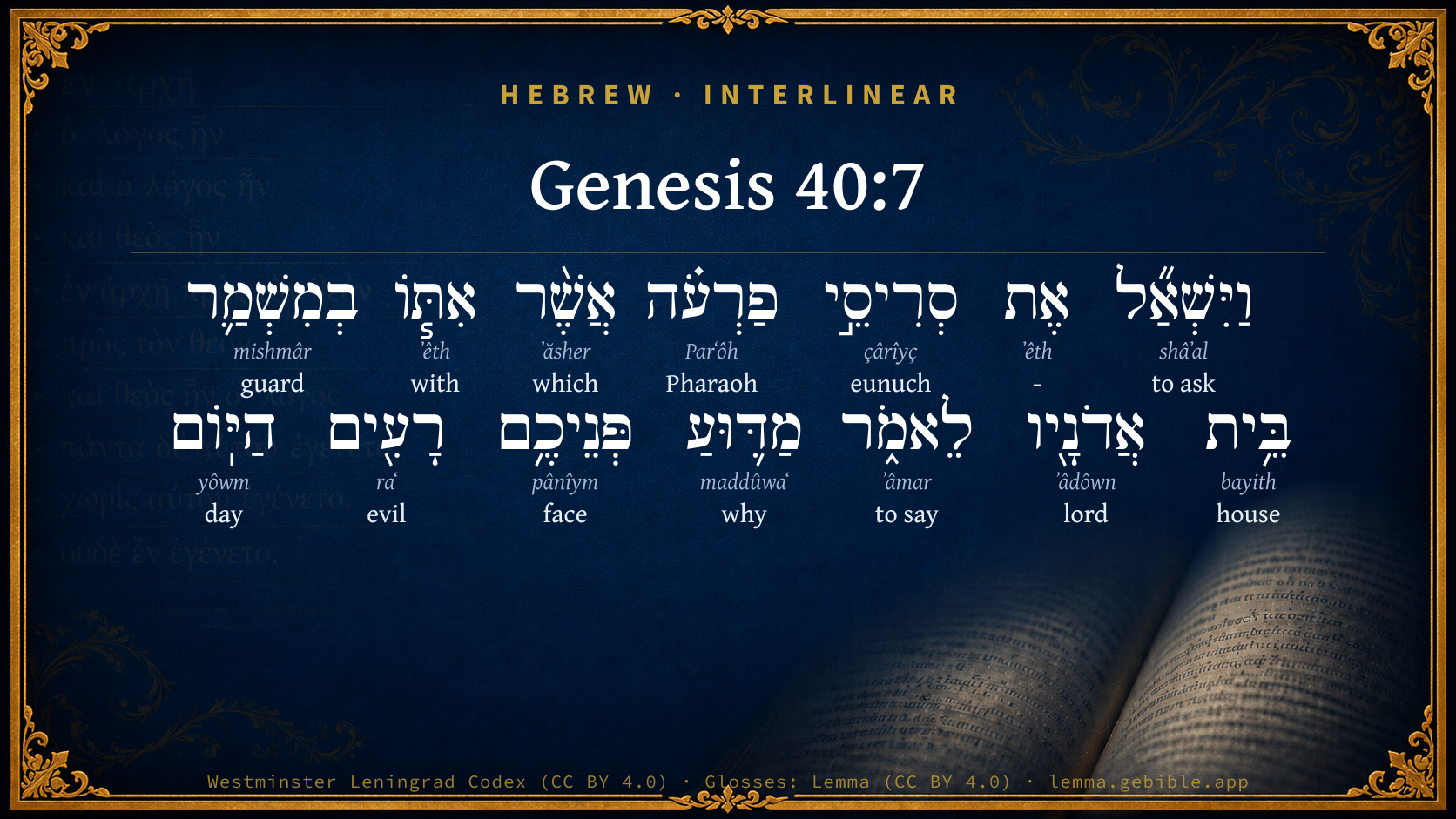
Hebrew (Westminster Leningrad Codex) Genesis 40:7 appears in the Hebrew Old Testament. The text above is from the Westminster Leningrad Codex. Each word links to its Strong’s number, a concise gloss, and parsing drawn from the Open Scriptures Hebrew Bible morphology. Click any word for its full Brown-Driver-Briggs (BDB) entry.
Download image
Cite this verse

Genesis 40:7 (World English Bible). Public Domain. Lemma interlinear Bible study tool, https://lemma.gebible.app/v/genesis/40/7.

Show BibTeX & RIS
BibTeX
RIS
English Translation
He asked Pharaoh's officers who were with him in custody in his master's house, saying, "Why do you look so sad today?"
World English Bible · Public Domain
Download a study sheet

One document with this verse’s original text, its word-by-word gloss line, the meaning frame, cross-references with their text, attributed commentary, and full source and license credits — printable, and it pastes into notes with its structure intact.

This verse Autodidact and up

Study sheet (.html) Plain text (.txt)

A passage Seminary Student

Up to 50 verses in one chapter. A passage sheet keeps up to 6 commentary sources and 12 cross-references per verse, in the order this page ranks them, and says so on the sheet whenever that leaves anything out. Ask for a single verse and you get the Autodidact verse sheet above.

Everything on this page stays free to read, with no account — the sheet is a download of what is already on screen, not access to it.

Want to remove ads? Support Godless Engineer
Compare translations 3

The same verse in 3 English versions, stacked beneath the original-language interlinear above. Click any original word for its lexicon entry.

Each is an independent rendering of the whole verse — the interlinear is not word-aligned to these translations.

Highlighted words mark where these versions differ — a whole-verse word diff, not a word-by-word alignment.

  • World English Bible Public Domain
    He asked Pharaoh's officers who were with him in custody in his master's house, saying, "Why do you look so sad today?"
  • King James Version Public Domain
    And he asked Pharaoh's officers that were with him in the ward of his lord's house, saying, Wherefore look ye so sadly to day?
  • unfoldingWord Literal Text CC BY-SA 4.0
    So he asked Pharaoh’s officials who with him in custody the house of his master, saying, “Why your faces sad today?”

unfoldingWord Literal Text — © unfoldingWord, licensed CC BY-SA 4.0. Word-aligned USFM3 via Door43 (git.door43.org/unfoldingWord/en_ult).

Versions to compare (up to 4)

3 of 4 selected

Show all 18 translations

Every available English version of this verse, each an independent rendering of the whole verse.

  • World English Bible Public Domain
    He asked Pharaoh's officers who were with him in custody in his master's house, saying, "Why do you look so sad today?"
  • Berean Standard Bible Public Domain
    So he asked the officials of Pharaoh who were in custody with him in his master’s house, “Why are your faces so downcast today?”
  • Majority Standard Bible Public Domain
    So he asked the officials of Pharaoh who were in custody with him in his master’s house, “Why are your faces so downcast today?”
  • King James Version Public Domain
    And he asked Pharaoh's officers that were with him in the ward of his lord's house, saying, Wherefore look ye so sadly to day?
  • American Standard Version (1901) Public Domain
    And he asked Pharaoh's officers that were with him in ward in his master's house, saying, Wherefore look ye so sad to-day?
  • Revised Version (1885) Public Domain
    And he asked Pharaoh’s officers that were with him in ward in his master’s house, saying, Wherefore look ye so sadly to day?
  • Geneva Bible (1599) Public Domain
    And he asked Pharaohs officers, that were with him in his masters warde, saying, Wherefore looke ye so sadly to day?
  • Douay-Rheims (1899) Public Domain
    He asked them, saying: Why is your oountenance sadder to day than usual?
  • Young's Literal Translation Public Domain
    and he asketh Pharaoh's eunuchs who `are' with him in charge in the house of his lord, saying, `Wherefore `are' your faces sad to-day?'
  • Literal Standard Version CC BY-SA 4.0
    and he asks Pharaoh’s eunuchs who [are] with him in confinement in the house of his lord, saying, “Why [are] your faces sad today?”
  • Unlocked Literal Bible CC BY-SA 4.0
    He asked Pharaoh's officials who were with him in custody in his master's house, saying, “Why do you look so sad today?”
  • unfoldingWord Literal Text CC BY-SA 4.0
    So he asked Pharaoh’s officials who with him in custody the house of his master, saying, “Why your faces sad today?”
  • Darby Bible Public Domain
    And he asked Pharaoh's chamberlains that were with him in custody in his lord's house, saying, Why are your faces [so] sad to-day?
  • World Messianic Bible Public Domain
    He asked Pharaoh’s officers who were with him in custody in his master’s house, saying, “Why do you look so sad today?”
  • Webster's Bible Public Domain
    And he asked Pharaoh's officers that were with him in the ward of his lord's house, saying, Why look ye so sad to-day?
  • Free Bible Version CC BY-SA 4.0
    So he asked Pharaoh's officials who were imprisoned with him in his master's house, “Why are you looking so depressed?”
  • Bible in Basic English Public Domain
    And he said to the servants of Pharaoh who were in prison with him, Why are you looking so sad?
  • JPS Tanakh (1917) Public Domain
    And he asked Pharaoh's officers that were with him in the ward of his master's house, saying: 'Wherefore look ye so sad to-day?'

Literal Standard Version (2020), Covenant Press — licensed CC BY-SA 4.0. Text via the HelloAO Bible API (eBible.org). Unlocked Literal Bible (unfoldingWord) — licensed CC BY-SA 4.0. Text via the HelloAO Bible API (eBible.org). unfoldingWord Literal Text — © unfoldingWord, licensed CC BY-SA 4.0. Word-aligned USFM3 via Door43 (git.door43.org/unfoldingWord/en_ult). Free Bible Version, Dr. Jonathan Gallagher — licensed CC BY-SA 4.0. Text via the HelloAO Bible API (eBible.org).

Word by word

More ways to search: Search by grammar → Find every occurrence → Compare this word →

Practice this passage: Drill this verse → Learn its vocabulary →

בְמִשְׁמַ֛ר
mishmâr
H4929
“in/at · guard of”
Preposition + Noun, Common, Masculine, Singular, Construct
Part of Speech
Preposition + Noun
Type
Common
Gender
Masculine
Number
Singular
State
Construct
Full BDB Definition

Origin: from H8104

TWOT: 2414f

place of confinement, prison, guard, jail, guard post, watch, observance - jail, prison, guard-house - guard, guard post, act of guarding - observances
  1. וַיִּשְׁאַ֞ל shâʼal H7592 “and · to ask” Conjunction + Verb, Qal, Sequential Imperfect, 3rd Person, Masculine, Singular
  2. אֶת ʼêth H853 “-” Particle, Direct Object
  3. סְרִיסֵ֣י çârîyç H5631 “eunuchs of” Noun, Common, Masculine, Plural, Construct
  4. פַרְעֹ֗ה Parʻôh H6547 “Pharaoh” Noun, Proper
  5. אֲשֶׁ֨ר ʼăsher H834 “which” Particle, Relative
  6. אִתּ֧וֹ ʼêth H854 “with · him” Preposition + Suffix, Personal, 3rd Person, Masculine, Singular
  7. בֵּ֥ית bayith H1004 “house of” Noun, Common, Masculine, Singular, Construct
  8. אֲדֹנָ֖יו ʼâdôwn H113 “lords · his” Noun, Common, Masculine, Plural, Construct + Suffix, Personal, 3rd Person, Masculine, Singular
  9. לֵאמֹ֑ר ʼâmar H559 “to say” Preposition + Verb, Qal, Infinitive Construct
  10. מַדּ֛וּעַ maddûwaʻ H4069 “why” Particle, Interrogative
  11. פְּנֵיכֶ֥ם pânîym H6440 “face(s) · your” Noun, Common, Both, Plural, Construct + Suffix, Personal, 2nd Person, Masculine, Plural
  12. רָעִ֖ים raʻ H7451 “evil” Adjective, Adjective, Masculine, Plural, Absolute
  13. הַיּֽוֹם yôwm H3117 “the · day” Particle, Definite Article + Noun, Common, Masculine, Singular, Absolute

About this verse

These counts appear in no published source. They are computed here, from the morphology-tagged text and Lemma’s own curated glosses. What Lemma adds →

14
words
14
distinct lemmas
Pentateuch
section

Notable vocabulary

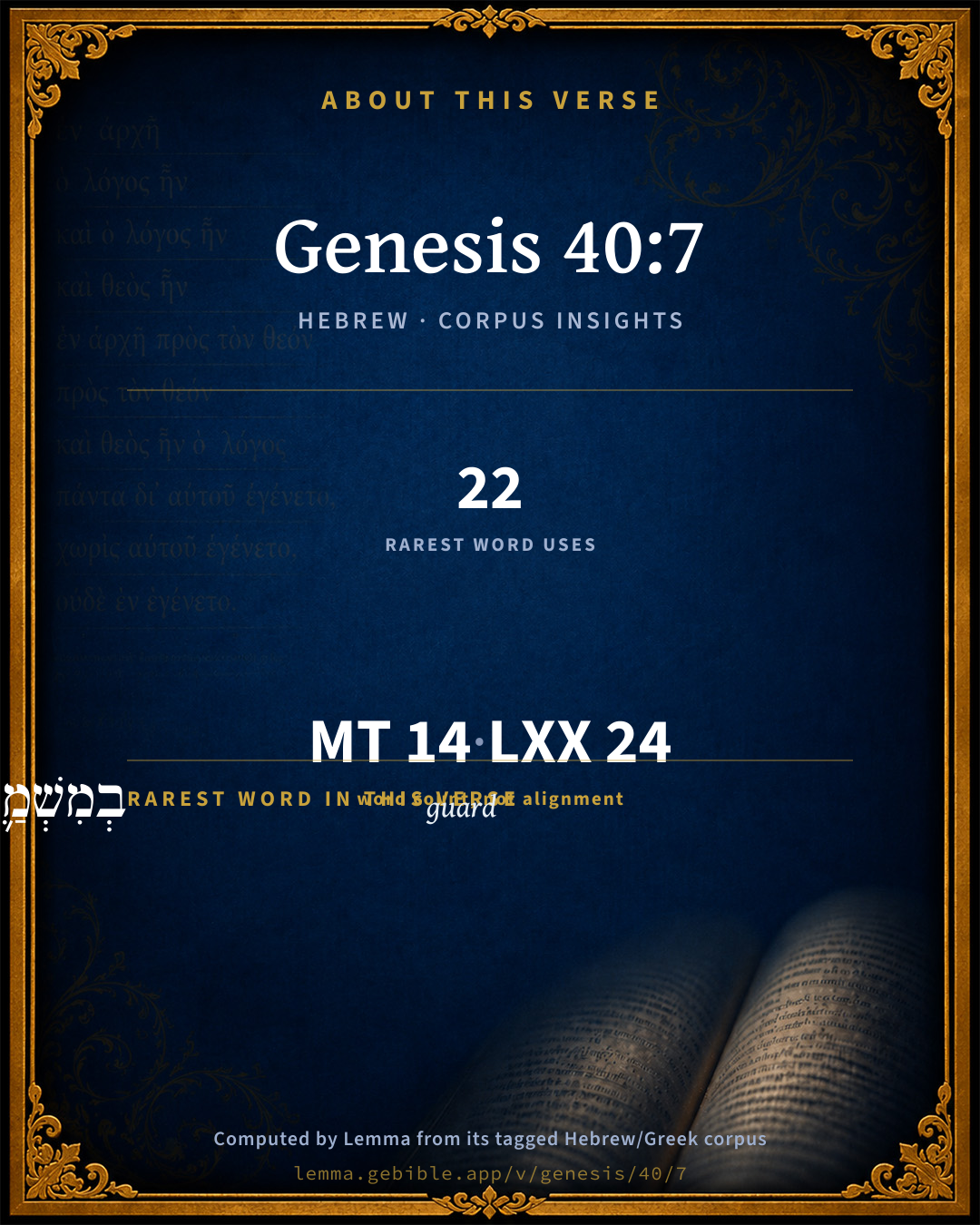
The rarest word here is בְמִשְׁמַ֛ר guard H4929 — appearing just 22 times in the whole Hebrew Bible.

Shared distinctive vocabulary

בְמִשְׁמַ֛ר guard H4929 occurs in 20 verses of the Hebrew Bible. Also found in:

Grammatical profile

  • 2 verbs
  • 7 nouns
  • 1 adjective
  • 1 preposition
  • 3 particles

Verb forms

  • וַיִּשְׁאַ֞ל Qal · Sequential Imperfect
  • לֵאמֹ֑ר Qal · Infinitive Construct

Hebrew & Septuagint length

In English translation the verse runs 22 words from the Hebrew and 27 from the Septuagint (LXX English) — closely comparable.

A rough comparison of the two English renderings, which tokenize alike — not a word-level alignment.

Word counts can differ between the Hebrew and the Greek without any difference in meaning — e.g. the Hebrew direct-object marker אֵת has no separate Greek word, and Greek often adds the article ὁ.

In the original languages it is 14 Hebrew tokens and 24 Greek tokens — but the two are counted differently (Hebrew bundles its prefixes and suffixes into one token; the Greek is in lemma form), so that isn’t a like-for-like length.

Cross-references

5

Topical passages linked to Genesis 40:7 in the Treasury of Scripture Knowledge — connected by theme and wording, ordered by reader-vote popularity; previews shown in the World English Bible.

  • Nehemiah 2:2 The king said to me, Why is your face sad, seeing you are not sick? this is nothing else but sorrow of heart. Then I was very sore afraid.
  • 1 Samuel 1:8 Elkanah her husband said to her, Hannah, why weep you? and why don't you eat? and why is your heart grieved? am I not better to you than ten sons?
  • Judges 18:24 He said, you have taken away my gods which I made, and the priest, and are gone away, and what have I more? and how then say you to me, What ails you?
  • 2 Samuel 13:4 He said to him, Why, son of the king, are you thus lean from day to day? Won't you tell me? Amnon said to him, I love Tamar, my brother Absalom's sister.
  • Luke 24:17 He said to them, "What are you talking about as you walk, and are sad?"

Cross-references courtesy of OpenBible.info (CC BY 4.0).

Hebrew and Greek witnesses Masoretic Hebrew ↔ Greek Septuagint

The same verse in the two great witnesses to the Old Testament, shown verse-for-verse.

These are two independent witnesses, not word-aligned to each other, and the Septuagint is shown in lemma (dictionary) form.

Hebrew Genesis 40:7 Masoretic · Westminster Leningrad Codex

וַיִּשְׁאַ֞ל אֶת סְרִיסֵ֣י פַרְעֹ֗ה אֲשֶׁ֨ר אִתּ֧וֹ בְמִשְׁמַ֛ר בֵּ֥ית אֲדֹנָ֖יו לֵאמֹ֑ר מַדּ֛וּעַ פְּנֵיכֶ֥ם רָעִ֖ים הַיּֽוֹם

He asked Pharaoh's officers who were with him in custody in his master's house, saying, "Why do you look so sad today?"

World English Bible · Public Domain

Greek LXX Genesis 40:7 Septuagint · lemma form

καί ἐρωτάω ὁ εὐνοῦχος φαραώ ὅς εἰμί μετά αὐτός ἐν ὁ φυλακή παρά ὁ κύριος αὐτός λέγω τίς ὅτι ὁ πρόσωπον σύ σκυθρωπός σήμερον

And he asked the eunuchs of Pharao who were with him in the prison with his master, saying, Why is it that your countenances are sad today?

LXX2012 (modern English Septuagint) · Public Domain

Hebrew: Westminster Leningrad Codex (CC BY 4.0). Greek: Septuagint (public domain); English from LXX2012 (modern English Septuagint) (Public Domain). How the Septuagint differs from the Hebrew →

Targum (Aramaic paraphrase)

2

The Targum is the ancient Jewish Aramaic paraphrase of the Hebrew Scriptures — an interpretive translation, not the Hebrew text itself. Onkelos (literal) and Pseudo-Jonathan (expansive) render the Torah, and Jonathan the Prophets. Coverage is partial: where no permissively-licensed English translation exists for a verse, only the Aramaic is shown. This is verse-level text, not a word-by-word alignment to the Hebrew.

  1. Targum Onkelos Torah (Genesis–Deuteronomy)
    וּשְׁאֵל יָת רַבְרְבֵי פַרְעֹה דִּי עִמֵּהּ בְּמַטְּרָא בֵּית רִבּוֹנֵהּ לְמֵימָר מָה דֵין אַפֵּיכוֹן בִּישִׁין יוֹמָא דֵּין

    (no public-domain English translation for this verse)

    Targum Onkelos — Aramaic: “Onkelos Genesis” (public domain); “Onkelos Exodus” (public domain); “Onkelos Leviticus” (public domain); “Onkelos Numbers” (public domain); “Onkelos Deuteronomy” (public domain). English: “Sefaria Community Translation” (CC0 1.0 (public-domain dedication)); “J.W. Etheridge. The Targums of Onkelos and Jonathan Ben Uzziel on the Pentateuch. London: Longmans, Green, 1862” (public domain). Text via Sefaria.

  2. Targum Pseudo-Jonathan Torah (Genesis–Deuteronomy)
    וּשְׁאַל יַת רַבְרְבֵי פַרְעה דְעִמֵיהּ בְּמַטְרַת בֵּיתָא דְרִבּוֹנֵיהּ לְמֵימָר מָדֵין סְבַר אַפֵּיכוֹן בִּיש יוֹמָא דֵין מִכָּל יוֹמַיָא דִהֲוֵיתוּן הָכָא

    And Joseph asked the chiefs of Pharoh who were with him in the custody of his master's house, saying, Why is the look of your faces more evil today than all the other days that you have been here?

    Targum Pseudo-Jonathan — Aramaic: “Targum Jonathan on Genesis” (public domain); “Targum Jonathan on Exodus” (public domain); “Targum Jonathan on Leviticus” (public domain); “Targum Jonathan on Numbers” (public domain); “Targum Jonathan on Deuteronomy” (public domain). English: “The Targum of Jonathan ben Uzziel, trans. J. W. Etheridge, London, 1862” (public domain). Text via Sefaria.

Commentary

Notes on Genesis 40:7 from classic Christian and Jewish commentators (each source and its license shown beneath its notes). The classic Christian expositions comment on the surrounding passage and are grouped to its opening verse, so a note may address several verses; the Jewish commentaries on the Tanakh (Rashi and others) are per-verse, so they appear only where the commentator wrote on this verse.

Lemma curates 59 commentaries, every one of them public domain or Creative Commons licensed, each selected and text-cleaned for this edition rather than reprinted as found. About our sources →

Trapp's Complete Commentary

John Trapp

Gen 40:7 And he asked Pharaoh’s officers that [were] with him in the ward of his lord’s house, saying, Wherefore look ye [so] sadly to day?

Ver. 7. And he asked Pharaoh’s officers, &c.] Vincula qui sensit, didicit succurrere vinctis. Joseph’s tender heart soon yearned toward them, upon the sight of their sadness: and, unasked, he offers himself to them; as our Saviour did to the widow of Nain, and to those two doubting disciples, Luk 24:17. Cyprian’s compassion is remarkable: Cum singulis pectus meum copulo, maeroris et funeris pondera luctuosa participo: cum plangentibus plunge, cum deflentibus defleo, &c. I weep with those that weep, and am like affected, as if like afflicted.

John Trapp, A Commentary or Exposition upon All the Books of the Old and New Testament (1647–1656) — public domain. Text from a community e-Sword module.

Geneva Bible (1599)

Geneva Bible translators

Hebrew, why are your faces evil?

Geneva Bible (1599) marginal notes — public domain. Text via Bolls.life.

The Cambridge Bible for Schools and Colleges

gen. ed. J. J. S. Perowne

7. look ye so sadly] Lit. “are your faces bad,” cf. Neh_2:2.

The Cambridge Bible for Schools and Colleges (gen. ed. J. J. S. Perowne; Cambridge University Press, 1878–1918) — public domain. Text from a community e-Sword module.

John Gill's Exposition

And he asked Pharaoh's officers that were with him,.... The chief butler and baker that were committed to his care, and with whom he now was:

in the ward of the lord's house; this seems to confirm what is before observed, that the captain of the guard that charged Joseph with them was Potiphar his master; though indeed the keeper of the prison that was under Potiphar, the captain of the guard, might be called Joseph's lord or master, but the house could not with so much propriety be called his:

saying, wherefore look ye so sadly today? as they were officers, who had been in lucrative places, they lived well and merrily, and expected very probably they should be released in a short time, nothing appearing against them; but now there was a strange alteration in them, which was very visible to Joseph, and for which he expresses a concern, being of a kind, tender, and benevolent disposition, as the question he puts to them shows.

John Gill's Exposition of the Whole Bible (1746–1763) — public domain (CC PDM 1.0). Text via the HelloAO Bible API.

Ramban (Nachmanides)

Rabbi Moshe ben Nachman (Ramban / Nachmanides)

AND HE ASKED PHARAOH’s OFFICERS THAT WERE WITH HIM IN THE WARD OF HIS MASTER’s HOUSE. It would be proper for Scripture to say; “And he asked them, saying.” Instead, Scripture speaks at length about it for its desire is to speak in praise of Joseph. Here is a servant lad who is enquiring of two great officers who are wards in the house of his master who hates him, him.” Ramban is here writing from the standpoint of the butler and the baker, who must have thought that Joseph’s master imprisoned him because he hated him, not being aware, as explained above, that he did so to protect his family’s reputation. and each of whom could command his hanging. Yet he was not afraid of them, and asked them their dreams and told them his opinion with respect to the interpretation because he trusted in his wisdom. Had the lord of the bakers been saved and restored to his position by the king, he would have hung him for his false interpretation.

Ramban (Nachmanides) on the Tanakh — English translation: “Commentary on the Torah by Ramban (Nachmanides). Translated and annotated by Charles B. Chavel. New York, Shilo Pub. House, 1971-1976” (CC BY 4.0). Text via Sefaria.

Radak

Rabbi David Kimhi (Radak)

וישאל, the Torah now adds the words סריסי פרעה, Pharaoh’s highly placed officials, although at the time אשר אתו, they were on a par with him, both in jail. When Joseph saw their pitiful state of mind, he felt he had to ask what caused such highly placed personages to be in such a depressed mood. After all, his superior, the warden had charged him with looking after the well being of these two special prisoners.

Radak on the Tanakh — English translations: “Sefaria Community Translation” (CC0 1.0 (public-domain dedication)); “Eliyahu Munk, HaChut Hameshulash” (CC BY 4.0); “Rabbi Mike Feuer, Jerusalem Anthology” (CC BY 4.0); and “R. David Kimhi on the first book of Psalms, Translated by R.G. Finch, London, 1919” (public domain). Text via Sefaria.

Lesson kit

Teaching starters — assembled from the data on this page, not authored interpretation. Every prompt links to the verse data it draws on. Edit before teaching.

Genesis, in the Pentateuch, opens this verse with 14 words (14 distinct Hebrew lemmas). Its most distinctive word is mishmâr (“guard”). A historical commentator’s framing appears above. Read the whole chapter for the surrounding context.

Discussion questions

  1. The word mishmâr carries the sense “guard.” How does it shape the verse?
  2. How does Genesis 40:3, which shares the word «guard», read alongside this verse?
  3. These translations render this verse differently; the difference is in the English rendering, not the original. What questions does that raise?
  4. «וַיִּשְׁאַ֞ל» is a Qal Sequential Imperfect verb. How does that grammatical form shape the action described?
  5. Compare how Trapp's Complete Commentary and Geneva Bible (1599) read this verse. Where do they agree or differ?

Things to notice

Reading settings

Reading text

Shown beneath each verse's original-language words.

Old Testament
Old Testament edition

Read the OT as the Masoretic Hebrew (MT) or the Greek Septuagint (LXX).

English shown for the Greek Septuagint (in the Hebrew ↔ Greek comparison).

Comparing translations? Open the Compare panel on any verse page to stack up to four side by side.