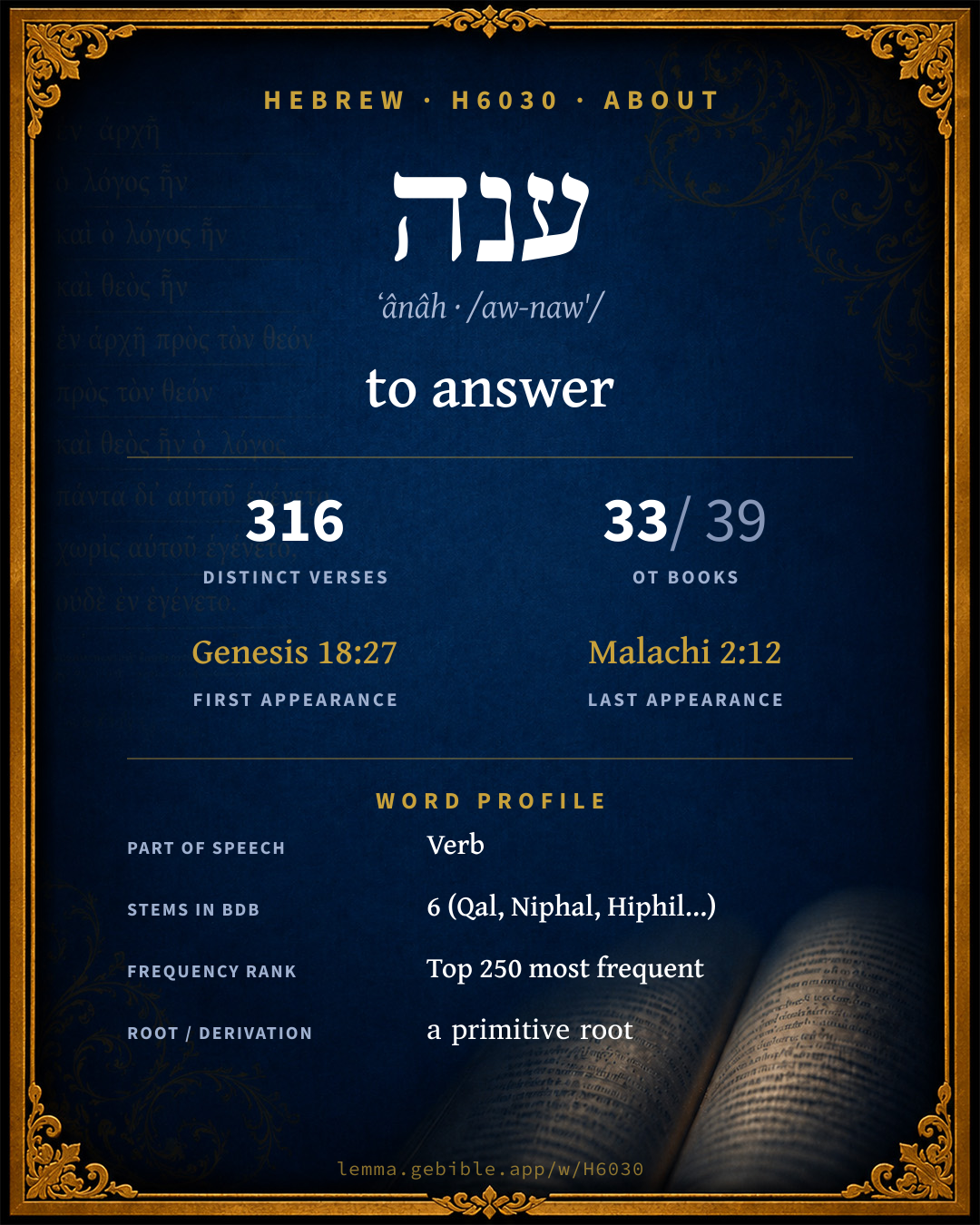
עָנָה
to answer
also: respond, testify, speak, shout fuller range ↓
Full lexicon entry — Brown-Driver-Briggs (BDB)
From Brown-Driver-Briggs (BDB)
Where this word appears
See every Qal verb in the Hebrew Bible →
Grammar key — what these labels mean
Part of speech
- Verb
- An action or state-of-being word.
Stem
- Qal
- The basic, simple active stem — the plain form of the verb (“he wrote”). Here: ‘answer’
- Niphal
- Usually the simple passive or reflexive of the Qal (“he was written”). Here: ‘make answer’
- Piel
- An intensive or resultative active stem. Here: ‘humble’
Form
- Sequential Imperfect
- An imperfect with prefixed waw — the standard past-narrative form (waw-consecutive imperfect).
- Imperfect
- An incomplete, ongoing, or future action (“he will / would write”).
- Imperative
- A direct command (“write!”).
- Perfect
- A completed action or state — Hebrew marks aspect (completeness) more than strict tense (“he wrote”).
- Participle Active
- A verbal adjective expressing ongoing or characteristic action (“writing / one who writes”).
- Infinitive Construct
- A bound verbal noun, frequently with prepositions (“to write / in writing”).
- Sequential Perfect
- A perfect with prefixed waw continuing a preceding imperfect or command (waw-consecutive perfect).
- Cohortative
- A first-person volitional form expressing wish or resolve (“let me / let us write”).
- Jussive
- A third- or second-person volitional form expressing wish or command (“let him write”).
State
- Absolute
- The independent form of a noun, not bound to a following word.
- Construct
- A noun bound to a following noun in a possessive / “of” relationship (the construct chain).
Person
- 3rd Person
- The one spoken about (“he / she / it / they”).
- 2nd Person
- The one addressed (“you”).
- 1st Person
- The speaker (“I / we”).
Gender
- Masculine
- Grammatically masculine.
- Common
- Either gender — not distinguished for this form.
- Feminine
- Grammatically feminine.
Number
- Singular
- One.
- Plural
- More than one (in Hebrew, generally three or more).
Every verse where H6030 appears in the Book of Job — 60 distinct verses. Click any verse to open its interlinear word-by-word view. Verse text shown in the World English Bible for context — . Each verse’s Hebrew form is shown with its reference; the English is not keyword-highlighted, since the data carries no word-level English alignment. Use “Compare translations” on any verse to read it across multiple English versions. This concordance covers the Hebrew Bible; Septuagint (Greek Old Testament) occurrences are not indexed here.
Job
- Job 1:7 וַ/יַּ֨עַן conj + Qal wimpf 3ms Yahweh said to Satan, "Where have you come from?" Then Satan answered Yahweh, and said, "From going back and forth in the earth, and from walking up and down in it."
- Job 1:9 וַ/יַּ֧עַן conj + Qal wimpf 3ms Then Satan answered Yahweh, and said, "Does Job fear God for nothing?
- Job 2:2 וַ/יַּ֨עַן conj + Qal wimpf 3ms Yahweh said to Satan, "Where have you come from?" Satan answered Yahweh, and said, "From going back and forth in the earth, and from walking up and down in it."
- Job 2:4 וַ/יַּ֧עַן conj + Qal wimpf 3ms Satan answered Yahweh, and said, "Skin for skin. Yes, all that a man has will he give for his life.
- Job 3:2 וַ/יַּ֥עַן conj + Qal wimpf 3ms Job answered:
- Job 4:1 וַ֭/יַּעַן conj + Qal wimpf 3ms Then Eliphaz the Temanite answered,
- Job 5:1 עוֹנֶ֑/ךָּ Qal ptcp.act ms cs + sfx pers 2ms "Call now; is there any who will answer you? To which of the holy ones will you turn?
- Job 6:1 וַ/יַּ֥עַן conj + Qal wimpf 3ms Then Job answered,
- Job 8:1 וַ֭/יַּעַן conj + Qal wimpf 3ms Then Bildad the Shuhite answered,
- Job 9:1 וַ/יַּ֥עַן conj + Qal wimpf 3ms Then Job answered,
- Job 9:3 יַ֝עֲנֶ֗/נּוּ Qal impf 3ms + sfx pers 3ms If he is pleased to contend with him, He can't answer him one time in a thousand.
- Job 9:14 אֶֽעֱנֶ֑/נּוּ Qal impf 1cs + sfx pers 3ms How much less shall I answer him, Choose my words to argue with him?
- Job 9:15 אֶעֱנֶ֑ה Qal impf 1cs Whom, though I were righteous, yet would I not answer. I would make supplication to my judge.
- Job 9:16 וַֽ/יַּעֲנֵ֑/נִי conj + Qal wimpf 3ms + sfx pers 1cs If I had called, and he had answered me, Yet would I not believe that he listened to my voice.
- Job 9:32 אֶֽעֱנֶ֑/נּוּ Qal impf 1cs + sfx pers 3ms For he is not a man, as I am, that I should answer him, That we should come together in judgment.
- Job 11:1 וַ֭/יַּעַן conj + Qal wimpf 3ms Then Zophar, the Naamathite, answered,
- Job 11:2 יֵעָנֶ֑ה Niphal impf 3ms "Shouldn't the multitude of words be answered? Should a man full of talk be justified?
- Job 12:1 וַ/יַּ֥עַן conj + Qal wimpf 3ms Then Job answered,
- Job 12:4 וַֽ/יַּעֲנֵ֑/הוּ conj + Qal wimpf 3ms + sfx pers 3ms I am like one who is a joke to his neighbor, I, who called on God, and he answered. The just, the blameless man is a joke.
- Job 13:22 אֶֽעֱנֶ֑ה Qal impf 1cs Then call, and I will answer; Or let me speak, and you answer me.
- Job 14:15 אֶֽעֱנֶ֑/ךָּ Qal impf 1cs + sfx pers 2ms You would call, and I would answer you. You would have a desire to the work of your hands.
- Job 15:1 וַ֭/יַּעַן conj + Qal wimpf 3ms Then Eliphaz the Temanite answered,
- Job 15:2 יַעֲנֶ֥ה Qal impf 3ms "Should a wise man answer with vain knowledge, And fill himself with the east wind?
- Job 15:6 יַעֲנוּ Qal impf 3mp Your own mouth condemns you, and not I; Yes, your own lips testify against you.
- Job 16:1 וַ/יַּ֥עַן conj + Qal wimpf 3ms Then Job answered,
- Job 16:3 תַעֲנֶֽה Qal impf 2ms Shall vain words have an end? Or what provokes you that you answer?
- Job 16:8 יַעֲנֶֽה Qal impf 3ms You have shriveled me up. This is a witness against me. My leanness rises up against me, It testifies to my face.
- Job 18:1 וַ֭/יַּעַן conj + Qal wimpf 3ms Then Bildad the Shuhite answered,
- Job 19:1 וַ/יַּ֥עַן conj + Qal wimpf 3ms Then Job answered,
- Job 19:7 אֵעָנֶ֑ה Niphal impf 1cs "Behold, I cry out of wrong, but I am not heard: I cry for help, but there is no justice.
- Job 19:16 יַעֲנֶ֑ה Qal impf 3ms I call to my servant, and he gives me no answer; I beg him with my mouth.
- Job 20:1 וַ֭/יַּעַן conj + Qal wimpf 3ms Then Zophar the Naamathite answered,
- Job 20:3 יַעֲנֵֽ/נִי Qal impf 3ms + sfx pers 1cs I have heard the reproof which puts me to shame; The spirit of my understanding answers me.
- Job 21:1 וַ/יַּ֥עַן conj + Qal wimpf 3ms Then Job answered,
- Job 22:1 וַ֭/יַּעַן conj + Qal wimpf 3ms Then Eliphaz the Temanite answered,
- Job 23:1 וַ/יַּ֥עַן conj + Qal wimpf 3ms Then Job answered,
- Job 23:5 יַעֲנֵ֑/נִי Qal impf 3ms + sfx pers 1cs I would know the words which he would answer me, And understand what he would tell me.
- Job 25:1 וַ֭/יַּעַן conj + Qal wimpf 3ms Then Bildad the Shuhite answered,
- Job 26:1 וַ/יַּ֥עַן conj + Qal wimpf 3ms Then Job answered,
- Job 30:20 תַעֲנֵ֑/נִי Qal impf 2ms + sfx pers 1cs I cry to you, and you do not answer me. I stand up, and you gaze at me.
- Job 31:35 יַעֲנֵ֑/נִי Qal impf 3ms + sfx pers 1cs Oh that I had one to hear me! (Behold, here is my signature, let the Almighty answer me); Let the accuser write my indictment!
- Job 32:1 מֵ/עֲנ֣וֹת prep + Qal inf.cs So these three men ceased to answer Job, because he was righteous in his own eyes.
- Job 32:6 וַ/יַּ֤עַן conj + Qal wimpf 3ms Elihu the son of Barachel the Buzite answered, "I am young, and you are very old; Therefore I held back, and didn't dare show you my opinion.
- Job 32:12 עוֹנֶ֖ה Qal ptcp.act ms Yes, I gave you my full attention, But there was no one who convinced Job, Or who answered his words, among you.
- Job 32:15 עָ֣נוּ Qal pf 3cp "They are amazed. They answer no more. They don't have a word to say.
- Job 32:16 עָ֥נוּ Qal pf 3cp Shall I wait, because they don't speak, Because they stand still, and answer no more?
- Job 32:17 אַעֲנֶ֣ה Qal impf 1cs I also will answer my part, And I also will show my opinion.
- Job 32:20 וְ/אֶֽעֱנֶֽה conj + Qal impf 1cs I will speak, that I may be refreshed. I will open my lips and answer.
- Job 33:12 אֶעֱנֶ֑/ךָּ Qal impf 1cs + sfx pers 2ms "Behold, I will answer you. In this you are not just; For God is greater than man.
- Job 33:13 יַעֲנֶֽה Qal impf 3ms Why do you strive against him, Because he doesn't give account of any of his matters?
- Job 34:1 וַ/יַּ֥עַן conj + Qal wimpf 3ms Moreover Elihu answered,
- Job 35:1 וַ/יַּ֥עַן conj + Qal wimpf 3ms Moreover Elihu answered,
- Job 35:12 יַעֲנֶ֑ה Qal impf 3ms There they cry, but none gives answer, Because of the pride of evil men.
- Job 38:1 וַ/יַּֽעַן conj + Qal wimpf 3ms Then Yahweh answered Job out of the whirlwind,
- Job 40:1 וַ/יַּ֖עַן conj + Qal wimpf 3ms Moreover Yahweh answered Job,
- Job 40:2 יַעֲנֶֽ/נָּה Qal juss 3ms + sfx pers 3fs "Shall he who argues contend with the Almighty? He who argues with God, let him answer it."
- Job 40:3 וַ/יַּ֖עַן conj + Qal wimpf 3ms Then Job answered Yahweh,
- Job 40:5 אֶֽעֱנֶ֑ה Qal impf 1cs I have spoken once, and I will not answer; Yes, twice, but I will proceed no further."
- Job 40:6 וַ/יַּֽעַן conj + Qal wimpf 3ms Then Yahweh answered Job out of the whirlwind,
- Job 42:1 וַ/יַּ֖עַן conj + Qal wimpf 3ms Then Job answered Yahweh,
About this entry
At a glance — auto-summarized from this page’s data, not written by a person. Every figure links to its source below. This summary describes the numbers; it doesn’t interpret them.
ענה — transliterated ʻânâh — is a Hebrew verb carrying the sense “to answer.” The verb spans 6 stems, from Qal to Niphal. The Hebrew Bible uses it across 316 verses — common. It first appears in Genesis 18:27. Related forms include מען, מענה and ענה. Each statement above links to its evidence; the full detail follows below.
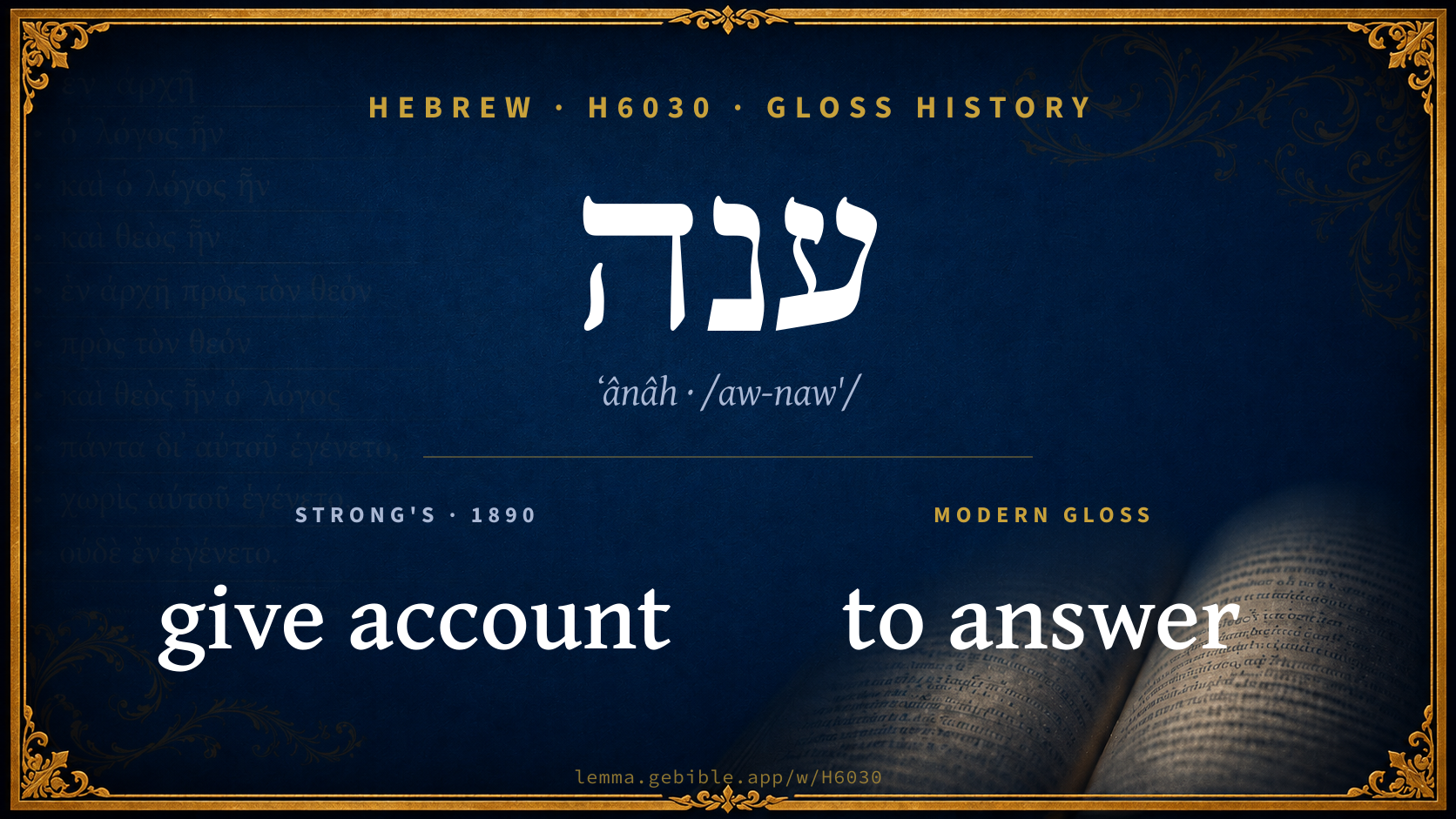
Gloss history
Strong's 1890 vs modern scholarship
About this word
Strong's H6030 catalogs a Hebrew word from the Hebrew Old Testament.
These counts are not copied from any lexicon or concordance. They are computed here, from the morphology-tagged Hebrew Old Testament. What Lemma adds →
- 316
- distinct verses
- The word appears in 316 distinct verses.
- 33 / 39
- OT books
- The word appears in 33 of 39 Old Testament books.
- #150
- by frequency
- Top 250 most frequent Hebrew words (rank 150 of 8,640 Hebrew words by occurrence).
View all 316 occurrences in the concordance →
By section of the Old Testament
By traditional corpus
Conventional, traditional groupings — biblical authorship is debated, so this is a traditional corpus grouping, not an authorship claim. Each share is this word’s portion of its verses in that division of the Hebrew canon. Each figure is a share of the word’s 316 distinct verses.
- Prophets (Nevi'im) 149 verses · 47%
- Writings (Ketuvim) 122 verses · 39%
- Torah (Pentateuch) 45 verses · 14%
How translations render this word
Counts come from each version’s own published word-to-Strong’s tagging or interlinear alignment — an approximate guide to how each version renders this word, not a word-level alignment the data otherwise carries. Because each total is that version’s own tagged count, the per-version totals vary from one another and need not match the appearance or distinct-verse counts above. These counts may also differ from a printed concordance because Lemma counts each distinctly tagged rendering and does not collapse phrase taggings into a single head-word total. This is a fixed set of word-tagged versions (KJV, ASV, BSB, ULT) and does not change with the reading translation you choose elsewhere. Each version’s license is shown beside its name below (and on Sources).
BDB lists this Strong’s number as 5 distinct words (homographs). Each count above pools all of them and is not split by sense — see the Senses section below. A low-frequency rendering may belong to a different one of those words, not the primary meaning.
- King James Version†: Answered 142×, Answer 17×, Hear 15×
- American Standard Version†: Answered 133×, Answer 24×, He answered 10×
- Berean Standard Bible†: Answered 51×, Replied 47×, Answer 24×
- unfoldingWord Literal Text†: Answered 115×, And 104×, Answer 25×
King James Version Public Domain
Renders H6030 across 329† tagged occurrences — most commonly:
Plus other, less common renderings. Plus 84 renderings that appear only once — usually multi-word phrases or single function words the recovered tagging swept in, not distinct renderings. Not rendered by a distinct English word in 1 further occurrence.
American Standard Version Public Domain
Renders H6030 across 329† tagged occurrences — most commonly:
Plus other, less common renderings. Plus 88 renderings that appear only once — usually multi-word phrases or single function words the recovered tagging swept in, not distinct renderings.
Berean Standard Bible Public Domain
Renders H6030 across 317† tagged occurrences — most commonly:
Plus other, less common renderings. Plus 70 renderings that appear only once — usually multi-word phrases or single function words the recovered tagging swept in, not distinct renderings. Not rendered by a distinct English word in 14 further occurrences.
unfoldingWord Literal Text CC BY-SA 4.0
Renders H6030 across 498† tagged occurrences — most commonly:
Plus other, less common renderings. Plus 62 renderings that appear only once — usually multi-word phrases or single function words the recovered tagging swept in, not distinct renderings.
40 senses and sub-senses in the full BDB
Hebrew verbs can shift meaning by stem (binyan): Qal is the basic action, Niphal is often passive or reflexive, Piel often intensifies or makes it factitive, and Hiphil is typically causative. The senses below are grouped under the stem BDB assigns to each. This entry also uses Pual (the passive of Piel) and Hithpael (reflexive or reciprocal).
What do BDB’s symbols mean?
BDB uses these scholarly abbreviations:
| Symbol | Meaning |
|---|---|
| 𝔊 | the Septuagint (the ancient Greek translation, LXX) |
| 𝔙 | the Vulgate (the Latin translation) |
| 𝔖 | the Syriac version (the Peshitta) |
| 𝔗 | the Targum (the Aramaic translation) |
| ψ | the Psalms |
| √ | root (the underlying root or stem) |
| ‖ | parallel passage (a synonymous or contrasted parallel) |
| † | the dagger: every passage where the word occurs is cited |
The 40 senses and sub-senses the full Brown-Driver-Briggs lexicon distinguishes for this word, in lexicon order (not ranked by frequency), with BDB’s own verbatim wording and sub-sense lettering. Shown in Hebrew script with BDB’s own scholarly abbreviations. The condensed entry is in the Lexicon Entry tab. See also the Forms in the corpus table below.
ענה I dwell (prob.
Qal
- Pf. 3 fs. consec. וְעָנָה֫ (read וְעָ֫נָה?) Is 13:22 and jackals shall dwell, etc. (on agreement v. Ges§ 145 k; ‖ שׁכן v 21), so 𝔊 Buhl; CheHeb. Hpt.. 124 וְשָֽׁכְנוּ; > 𝔖 𝔗 𝔙 al. √ IV. ענה.—ψ 87:7 v. מַעְיָן. e.g. Isaiah 13:22
ענה II answer, respond (NH id., respond, make response
Qal
- Pf. 3 ms. ע׳ Mi 6:5 +; sf. עָנַנִי 1 S 28:15 +, עָנָךְ Is 30:19; Je 23:37, עָנָהוּ 1 S 9:17 +; 1 s. עָנִיתִי Ho 14:9, etc.; Impf. 3 ms. יַעֲנֶה Gn 41:16 +, וַיַּעַן Am 7:14 +, sf. יַעֲנֵנִי Jb 20:3 +, etc.; Imv. עֲנֵה Mi 6:3; Pr 26:5 etc.; Inf. cstr. עֲנוֹת Gn 45:3 + [2 S 22:36 v. עֲנָוָה]; Pt. עֹנֶה Ju 19:28 +, etc.;— e.g. Micah 6:5
- 1. answer, respond to sthg. said, actual or implied, Ju 8:8; 1 S 4:20; Jb 9:15 +; especially e.g. Judges 8:8
- a. of men, c. acc. pers. Gn 45:3 (E), Ju 5:29; 2 K 18:36 = Is 36:21; Jb 5:1 + very often (c. 110 times); specif. be responsive, i.e. answer kindly, grant request 1 K 12:7 (sf. pers.); = be amenable, docile (toward י׳) Ho 2:17 (of Isr. in fig.); seldom and late, c. acc. of thing replied to, Jb 32:12; 33:13 (De Di Bu), 40:2. e.g. Genesis 45:3
- b. of God answering (graciously): usually c. acc. pers.; by oracle 1 S 14:37; 28:6, 15 +, fig. Hb 2:11; by deed 1 S 7:9; 1 K 18:37(×2), cf. בָּאֵשׁ v 24; 1 Ch 21:26, and especially Ho 2:23, 24; 14:9, v. also Mi 3:4 Is 41:17; 49:8 Je 33:3; Jb 12:4 +, especially ψψ, e.g. 3:5; 4:2; 20:2 + 33 times, etc. (in all c. 77 times); e.g. 1 Samuel 14:37
- c. rarely c. acc., or cl., of answer: אלהים יַע׳ אֶת־שְׁלוֹם פַּרְעֹה Gn 41:16; Jb 15:2; Pr 18:23; Ne 8:6 they responded, Amen! 2 S 19:43 they made reply against Isr. (c. עַל against, only here), + quoted answer; c. acc. pers. + answer 1 S 20:28 Jonathan answered Saul, David asked leave, etc.; c. 2 acc. (c. 20 times) 2 K 18:36 = Is 36:21; Jb 23:5 +; so = grant, vouchsafe to, נוֹרָאוֹת תַּעֲנֵנוּ ψ 65:6 terrible things dost thou [י׳] vouchsafe to us. e.g. Genesis 41:16
- d. often + אָמַר Gn 18:27 Abr. answered and said, Ex 4:1 (J), 19:8 (E), Jb 4:1; 6:1 etc.; + אָמַר אֶל־ Gn 27:39 + 16 times; + א׳ לְ v 37 + 8 times; ע׳ + acc. pers. + אמר, 1 S 9:8 he answered Saul and said, + 23 times (in all c. 130 times); seldom + לֵאמֹר †Nu 32:31 (P), ע׳ + acc. pers. + לא׳ Gn 23:5, 10, 14 (P), 41:16; 42:22 (E), Jos 1:16 (D) e.g. Genesis 18:27
- e. seldom + דִּבֶּר Jos 22:21 (P), 2 K 1:10, 11, 12; ע׳ + acc. pers. + ד׳ Gn 34:13 (P). e.g. Joshua 22:21
- 2.
- a. respond to an occasion, speak in view of circumstances: 1 S 9:17 (acc. pers. + quot.), Ju 18:14 (+ אָמַר), Nu 11:28 (JE; + id.), 2 K 1:11 (+ id.), + 19 times e.g. 1 Samuel 9:17
- b. fig. יַעֲנֶה אֶת־הַכֹּל Ec 10:19 money meets all demands. e.g. Ecclesiastes 10:19
- 3.
- a. specif. respond as a witness, testify, so perhaps pt. עֹנֶה (abs.) Mal 2:12 (in good sense); c. בְּ pers. = in the case of = for Gn 30:33; usually against, 1 S 12:3; 2 S 1:16; Is 3:9; 59:12; Mi 6:3; Je 14:7; Jb 15:6; Nu 35:30 (P), Ru 1:21 (> Be be occupied with; Vrss Luth KitKau עִנָּה humiliate); c. בְּפָנָיו Ho 5:5; 7:10; Jb 16:8; c. לְפָנָיו Dt 31:21 (+ לְעֵד as witness); c. בְּ pers. + acc. of charge, סָרָה 19:16, of false witness שֶׁקֶר v 18, עֵד־שֶׁקֶר Ex 20:16 (Ginsb v 13), ‖ Dt 5:17, Pr 25:18: abs. (bad implic.) Ex 23:2 (E; עַל concerning). e.g. Malachi 2:12
- b. less often make response as one accused (respondent) Jb 9:14, 15. e.g. Job 9:14
Niphal
- 1. make answer, subj. י׳, c. ל pers., Pf. 1 s. נַעֲנֵיתִי Ez 14:4; Pt. נַעֲנֶה v 7 (Qal not in Ez). e.g. Ezekiel 14:4
- 2. be answered: Impf. 3 ms. יֵעָנֶה,
- a. Jb 11:2 (subj. words). e.g. Job 11:2
- b. of man = receive answer Pr 21:13, so 1 s. אֵעָנֶה Jb 19:7. e.g. Proverbs 21:13
Hiphil
- Pt. מַעֲנֶה בְּשִׂמְחַת לִבּוֹ Ec 5:19, wholly dub.; Hi (God) cause (all things) to respond in the joy of his heart; De answers to the joy, etc.; de Jong Wild occupies him (II. עָנָה with the joy, etc. e.g. Ecclesiastes 5:19
ענה III be occupied, busied with (ב), only Ec (perhaps Aramaic loan-word
Qal
- Inf. עֲנוֹת Ec 1:13; 3:10. e.g. Ecclesiastes 1:13
ענה IV be bowed down, afflicted (NH id.
Qal
- Pf. 1 s. עָנִיתִי ψ 116:10; Impf. 3 ms. יַעֲנֶה Is 25:5; 31:4, etc.;— e.g. Psalms 116:10
- 1. be put down or become low, of song of triumph Is 25:5 (others as Hiph. he putteth down, ‖ תַּכְנִיעַ). e.g. Isaiah 25:5
- 2. be depressed, downcast Is 31:4 (of lion; ‖ יֵחָ֑ת). e.g. Isaiah 31:4
- 3. be afflicted ψ 116:10; 119:67; Zc 10:2. e.g. Psalms 116:10
Niphal
- Pf. 1 s. נַעֲנֵיתִי ψ 119:107; Inf. cstr. לֵעָנֹת (perhaps read as Qal Ges§ 51 l) Ex 10:3; Pt. נַעֲנֶה 53:7; fs. נַעֲנָה 58:10;— e.g. Psalms 119:107
- 1. humble oneself מִפְּנֵי Ex 10:3. e.g. Exodus 10:3
- 2. be afflicted ψ 119:107 Is 53:7; 58:10. e.g. Psalms 119:107
Piel
- Pf. 3 ms. עִנָּה Dt 22:24 + 5 times; 2 ms. עִנִּיתָ ψ 88:8; 1 s. עִנֵּיתִי ψ 35:13, sf. וְעִנִּתִךְ consec. Na 1:12, etc.; Impf. יְעַנֶּה Jb 37:23, etc.; Imv. עַנּוּ Ju 19:24; Inf. abs. עַנֵּה Ex 22:22; cstr. עַנּוֹת Is 58:5 +, etc.; Pt. pl. sf. מְעַנַּיִךְ Is 60:14 Zp 3:19;— e.g. Deuteronomy 22:24
- 1. humble, mishandle, afflict: individual Gn 16:6; 31:50 (J) Ex 22:21, 22(×2) (E) Jb 30:11; by imprisonment and bonds Ju 16:5, 6, 19 ψ 105:18; a nation by way or in bondage Gn 15:13 (J) Ex 1:11, 12; Nu 24:24(×2) (E) Dt 26:6; 1 S 12:8 (inserting וַיְעַנּוּם מִצְרַיִם, so 𝔊 Dr Bu Kit HPS (cf. Th We]), 2 S 7:10; 2 K 17:20 ψ 94:5; Is 60:14; Zp 3:19; dynasty of David ψ 89:23. e.g. Genesis 16:6
- 2. humble, a woman by cohabit., Gn 34:2 (J) Dt 21:14; 22:24, 29; Ju 19:24; 20:5 2 S 13:12, 14, 22, 32; Ez 22:10, 11; La 5:11. e.g. Genesis 34:2
- 3. afflict as a discipline (God agent) Dt 8:2, 3, 16; 1 K 11:39 ψ 88:8; 90:15; 119:75; Is 64:11 Na 1:12(×2) La 3:33. e.g. Deuteronomy 8:2
- 4. humble, weaken, obj. כֹּחַ ψ 102:24; משׁפט Jb 37:23 (cf. Talm עִנָּה דִּין); נֶפֶשׁ oneself, by fasting Lv 16:29, 31; 23:27, 32; Nu 29:7 (P) ψ 35:13; Is 58:3, 5; by an oath Nu 30:14 (P). e.g. Psalms 102:24
Pual
- Pf. 1 s. עֻנֵּיתִי ψ 119:71; Impf. 3 fs. תְּעֻנֶּה Lv 23:29; Inf. cstr. sf. עֻנּוֹתוֹ ψ 132:1; Pt. מְעֻנֶּה Is 53:4;— e.g. Psalms 119:71
- 1. be afflicted, in discipline by God ψ 119:71; 132:1 Is 53:4. e.g. Psalms 119:71
- 2. be humbled by fasting Lv 23:29 (P). e.g. Leviticus 23:29
Hiphil
- Impf. 2 ms. sf. תַּעֲנֵם 1 K 8:35 = 2 Ch 6:26 afflict, in discipline. e.g. 1 Kings 8:35
Hithpael
- Pf. 3 ms. הִתְעַנָּה 1 K 2:26; 2 ms. הִתְעַנִּיתָ v 26; Impf. 3 mpl. יִתְעַנּוּ ψ 107:17; Imv. הִתְעַנִּי Gn 16:9; Inf. cstr. הִתְעַנּוֹת Ez 8:21 Dn 10:12;— e.g. 1 Kings 2:26
- 1. humble oneself (c. תַּחַת יָדֶיהָ Gn 16:9 (J). e.g. Genesis 16:9
- 2. be afflicted, by men 1 K 2:26(×2) by God in discipline ψ 107:17. e.g. 1 Kings 2:26
- 3. humble oneself in fasting Ezr 8:21 Dn 10:12. e.g. Ezra 8:21
ענה V sing (Arabic عَنَّى sing, chant, غِنَآءٌ singing, chanting, etc.
Qal
- Pf. 3 ms. וְעָנוּ consec. Je 51:14; Impf. 3 ms. יַעֲנֶה Je 25:30; 3 fs. וַתַּעַן Ex 15:21; 3 fpl. וַתַּעֲנֶינָה 1 S 18:7, etc.; Imv. עֱנוּ Nu 21:17 ψ 147:7; Inf. cstr. עֲנוֹת Ex 32:18(×2);—sing, utter tunefully, Ex 15:21 (E) and Miriam sang to (ל) them; of uttering shout (הֵידָד), as in vintage Je 25:30 (י׳ subj.; + אֶל־ pers.), in attack 51:14 (+ עַל־ pers.); קוֹל עֲנוֹתגְּבוּרָה(חֲלוּשָׁה) Ex 32:18(×2) (E) Ho 2:17; c. ל rei v. pers. laudat. Nu 21:17 (JE; well); ψ 147:7 (י׳; ‖ זַמְּרוּ), Ezr 3:11; + אָמַר 1 S 18:7 the women sang, and said; יַעֲגוּ בַמְּחֹלוֹת לֵאמֹר 21:12; 29:5; c. acc. rei laudat. ψ 119:172 (cf. ‖ v 171).—Is 13:22 v. עון. e.g. Jeremiah 51:14
Piel
- intens.: Imv. עַנּוּ־לַהּ Is 27:2 sing sweetly of it; Inf. קוֹל עַנּוֹת Ex 32:18 (E) the sound of distinct singing; cf. לְעַנּוֹת ψ 88:1. e.g. Isaiah 27:2
Senses from the full Brown-Driver-Briggs lexicon (Brown, Driver, Briggs; Oxford 1906 — public domain), digitized via Sefaria, supplemented by the OpenScriptures HebrewLexicon (CC BY 4.0). Full attribution on Sources.
Word origin
I. vb. dwell (prob.; √ of foll.; Arabic عون, عَانَ is support, help, v. especially FlKl.Schr. i. 87 ff.);—
I. vb. answer, respond (NH id., respond, make response; 𝔗 עֲנָא; Syriac ܥܢܳܐ; Old Aramaic Palm. ענה; cf. Arabic عنى, عَنَا intend by saying);—
II. vb. be occupied, busied with (ב), only Ec (perhaps Aramaic loan-word; Syriac ܥܢܳܐ be occupied with, ܥܶܢܝܳܢ occupation, affair; cf. Arabic عنى, عَنَا concern one, also be occupied by; Ecclus 42:8 margin);—
III. vb. be bowed down, afflicted (NH id.; MI Pi. ויענו l5, אענו l6; Assyrian enû, thwart, frustrate, do violence to; Arabic عنو, عَنَا be lowly, submissive, v. Rahlfsעָנִי und עָנָו in d. Psalmen (1892), 67 ff.; 𝔗 עַנִּי Pa. oppress; Syriac Ethpe. humble oneself, and deriv.);—
IV. vb. sing (Arabic عَنَّى sing, chant, غِنَآءٌ singing, chanting, etc.; Syriac ܥܰܢܺܝ sing responsively, ܥܽܘܢܺܝܬܳܐ hymn, refrain; poss. Assyrian enû, resound (?); Egyptian anni is loan-word according to Bondi80);—
— Brown-Driver-Briggs (Oxford 1906, public domain), digitized via Sefaria, supplemented by the OpenScriptures HebrewLexicon (CC BY 4.0). See Sources.
Origin: a primitive root
Jastrow Dictionary
A second Hebrew/Aramaic lexicon for comparison, covering Aramaic and post-biblical (Talmudic, Targumic, Midrashic) usage that the biblical-Hebrew BDB does not. Matched by lemma rather than by Strong’s number, so a lemma may carry more than one Jastrow headword (shown separately below), and the entries cover usage well beyond the Bible.
עָנָה
- , v. עני h. a. ch.
עני
- (b. h.) [to turn, come out in turn,] to begin to speak; to respond; to speak or sing in chorus; to answer. Tem. 16ᵃ ע̇תנ̇יא̇ל̇ שעֲנָאו̇ א̇ל̇ he was surnamed Othniel, because God answered his prayer (ref. to I Chr. IV, 10). Y. Sot. V, 20ᶜ top והן עוֹנִין אחריו על כל דבר ודבר and they (the class) repeat each sentence after him; משה … והן עונין אחריו אשירה Moses said, I will sing &c., and they repeated in chorus, I will sing &c. Ib. משה אמר עזי והן עונין וכ׳ Moses said, My strength &c., and they responded, I will sing &c. Tosef. ib. VI, 2 ועונין על כל עינין ועינין and they (the class) repeat each sentence. Ib. 3 ועונין אחריו עינין ראשון and they (the people) always repeated the first sentence (as refrain). Succ. 38ᵇ מצוה לַעֲנוֹת הללויה it is proper to say in response Halleluiah. M. Kat. III, 9 כולן עוֹנוֹת כאחת all start the dirge at once; אחת מדברת וכולן עונות אחריה one speaks, and all repeat in chorus after her, v. עִינּוּי I. Ber. 47ᵃ עד שיכלה אמן מפי העוֹנִים until the Amen of the responding company is finished. Pes. 36ᵃ לחם שעונין וכ׳, v. עוֹנִי. Y. Succ. III, 54ᵃ top אם בירכך גוי עֲנֵה אחריו אמן if a gentile blesses thee, say after him Amen; a. fr. e.g. 1 Chronicles 4:10
- 1. to be answered, to have one’s prayer granted. Sabb. 30ᵃ וכשאמר זכור … מיד נ׳ but when he said, Remember &c. (Ex. XXXII, 13), his prayer was at once granted. R. Hash. 18ᵃ זה התפלל ונ׳ וכ׳ one prays and is heard, another prays and is not heard; Koh. R. to IX, 11, v. פָּגַע. Gen. R. s. 60 [read:] שלשה הם שנַעֲנוּ במענה פיהם three persons (mentioned in the Scriptures) were answered as soon as they had uttered their prayer; Yalk. ib. 108; a. fr. e.g. Exodus 32:13
- 2. to be called upon to speak; to answer, to deliver an opinion. Kidd. 40ᵇ נ׳ ר"ט ואמר וכ׳ R. Ṭ. (being asked his opinion) answered saying &c.; נַעֲנוּ כולם ואמרו וכ׳ all of them in turn answered saying &c.; Sifré Deut. 41; M. Kat. 28ᵇ (at a mourner’s house); a. fr.
- 3. [to be made to respond Amen,] to be sworn; to promise allegiance. Y. Dem. II, 23ᵃ top הוא נ׳ לחבורה … נַעֲנִין לו he (the head of the house) promises allegiance to the order (v. חֲבֵרוּת), and the members of his house make the promise to him.
- to speak or sing in chorus, esp. to lament. M. Kat. III, 9, מְעַנּוֹת, v. עִינּוּי I.
עֲנֵי
- Targ. II Esth. VI, 10. Targ. I Kings XII, 7.—Targ. Ps. XXXIV, 5 (Ms. עַנְיָינִי). Ib. CII, 3; a. fr.—Y. Succ. III, 54ᵃ top מה נַעְנֵי what shall we say in response? Ib. ר׳ יונה ע׳ הכין והכין R. J. responded, so be it, and so be it. Ab. Zar. 18ᵃ bot. אימא אלהא דמאיר עֲנֵנִי say, O God of Meïr, hear me; a. fr.—[Men. 17ᵃ עני מרי, v. עֲנֵי II.]
- to speak or sing in chorus; to respond. Targ. O. Ex. XV, 21. Targ. II Esth. VI, 11.
- 1. to be answered. Targ. O. Ex. XIX, 19. Targ. Prov. XXI, 13 נתעני ed. Wil. (ed. Lag. נַעֲנוֹי will answer him; h. text יֵעָנֶה).—
- *2. (euphem.) to be gratified, be eased. Y. Shebi. III, 34ᶜ bot. ההן דאזיל ולא מִתְעַנֵּי … he who went out to ease his bowels without success; [perhaps to be read מתפני, v. פְּנֵי?]
A Dictionary of the Targumim, the Talmud Babli and Yerushalmi, and the Midrashic Literature (Marcus Jastrow; London, Luzac, 1903) — Public Domain. Digitized via Sefaria. Digitized via Sefaria. Full attribution on Sources.
Forms in the corpus
The 186 distinct written forms H6030 takes in the Hebrew Bible, most frequent first — each parse links to that stem’s occurrences in the concordance. Hebrew forms include their vowel points and cantillation, so a single lemma takes many written forms.
The 60 most common forms are shown; 126 rarer forms follow in the full concordance.
Same root — word family
Other BDB entries built from the same root as H6030, grouped by Strong’s listed origin. These share a root / origin per the lexicon — not necessarily a shared meaning. Each links to that word’s own entry.
Derived from this word
- מען maʻan H4616 for the sake of
- מענה maʻăneh H4617 answer
- ענה ʻânâh H6031 to afflict
- ענה ʻănâh H6032 to answer
Proper names from this root
People and places named from this root — a name, not an additional meaning of the word.
Compare all same-root words → Showing 4 of 8 — not the complete family. 3 of the same-root words are proper names (people or places). They share a root, not necessarily a meaning.
Septuagint verse parallels
This word appears in 300 verses that also exist in the Greek Old Testament (Septuagint), out of the 316 Hebrew verses it occurs in. You can read those verses in Greek by switching the Old Testament edition to the Septuagint.
Read these verses in the Septuagint
- Genesis 18:27
- Exodus 4:1
- Numbers 11:28
- Deuteronomy 1:14
- Joshua 1:16
- Judges 5:29
- Ruth 1:21
- 1 Samuel 1:15
- 2 Samuel 1:16
- 1 Kings 1:28
- 2 Kings 1:10
- 1 Chronicles 12:17
This is a verse-level parallel only — the same verses exist in both the Hebrew and Greek Old Testaments. No word-level Hebrew↔Greek correspondence is claimed: the data carries no such alignment, so no Greek word is shown as this Hebrew word’s translation. Coverage is not total — the Septuagint omits the deuterocanon and renumbers the Psalms, so some Hebrew verses have no direct Greek parallel.