
Job 32:20

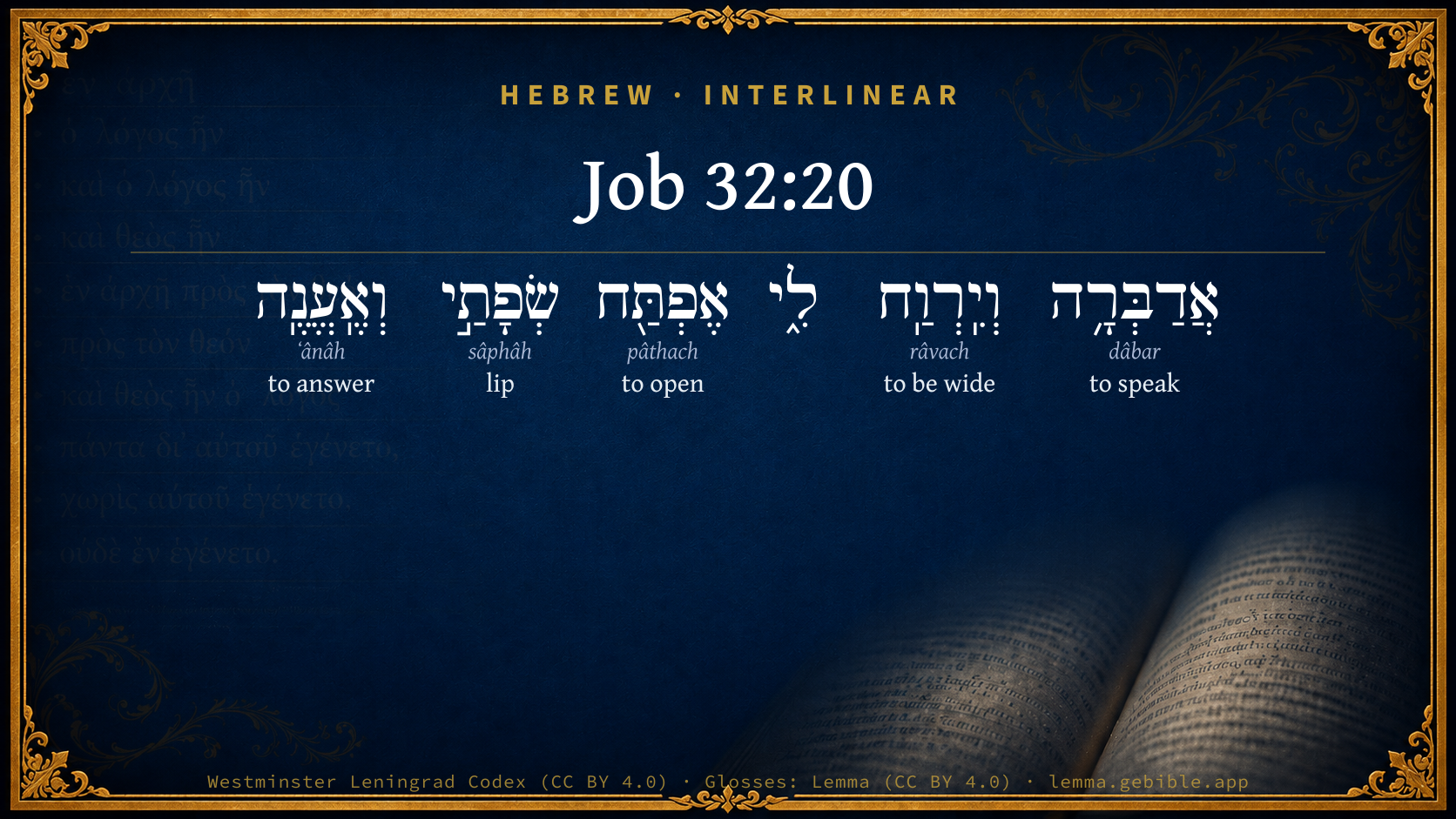
Hebrew (Westminster Leningrad Codex) Job 32:20 appears in the Hebrew Old Testament. The text above is from the Westminster Leningrad Codex. Each word links to its Strong’s number, a concise gloss, and parsing drawn from the Open Scriptures Hebrew Bible morphology. Click any word for its full Brown-Driver-Briggs (BDB) entry.
Download image
Cite this verse

Job 32:20 (World English Bible). Public Domain. Lemma interlinear Bible study tool, https://lemma.gebible.app/v/job/32/20.

Show BibTeX & RIS
BibTeX
RIS
English Translation
I will speak, that I may be refreshed. I will open my lips and answer.
World English Bible · Public Domain
Download a study sheet

One document with this verse’s original text, its word-by-word gloss line, the meaning frame, cross-references with their text, attributed commentary, and full source and license credits — printable, and it pastes into notes with its structure intact.

This verse Autodidact and up

Study sheet (.html) Plain text (.txt)

A passage Seminary Student

Up to 50 verses in one chapter. A passage sheet keeps up to 6 commentary sources and 12 cross-references per verse, in the order this page ranks them, and says so on the sheet whenever that leaves anything out. Ask for a single verse and you get the Autodidact verse sheet above.

Everything on this page stays free to read, with no account — the sheet is a download of what is already on screen, not access to it.

Want to remove ads? Support Godless Engineer
Compare translations 3

The same verse in 3 English versions, stacked beneath the original-language interlinear above. Click any original word for its lexicon entry.

Each is an independent rendering of the whole verse — the interlinear is not word-aligned to these translations.

Highlighted words mark where these versions differ — a whole-verse word diff, not a word-by-word alignment.

  • World English Bible Public Domain
    I will speak, that I may be refreshed. I will open my lips and answer.
  • King James Version Public Domain
    I will speak, that I may be refreshed: I will open my lips and answer.
  • unfoldingWord Literal Text CC BY-SA 4.0
    I will speak and refresh myself; I will open my lips and answer.

unfoldingWord Literal Text — © unfoldingWord, licensed CC BY-SA 4.0. Word-aligned USFM3 via Door43 (git.door43.org/unfoldingWord/en_ult).

Versions to compare (up to 4)

3 of 4 selected

Show all 18 translations

Every available English version of this verse, each an independent rendering of the whole verse.

  • World English Bible Public Domain
    I will speak, that I may be refreshed. I will open my lips and answer.
  • Berean Standard Bible Public Domain
    I must speak and find relief; I must open my lips and respond.
  • Majority Standard Bible Public Domain
    I must speak and find relief; I must open my lips and respond.
  • King James Version Public Domain
    I will speak, that I may be refreshed: I will open my lips and answer.
  • American Standard Version (1901) Public Domain
    I will speak, that I may be refreshed; I will open my lips and answer.
  • Revised Version (1885) Public Domain
    I will speak, that I may be refreshed; I will open my lips and answer.
  • Geneva Bible (1599) Public Domain
    Therefore will I speake, that I may take breath: I will open my lippes, and will answere.
  • Douay-Rheims (1899) Public Domain
    I will speak and take breath a little: I will open my lips, and will answer.
  • Young's Literal Translation Public Domain
    I speak, and there is refreshment to me, I open my lips and answer.
  • Literal Standard Version CC BY-SA 4.0
    I speak, and there is refreshment to me, || I open my lips and answer.
  • Unlocked Literal Bible CC BY-SA 4.0
    I will speak so that I may be refreshed; I will open my lips and answer.
  • unfoldingWord Literal Text CC BY-SA 4.0
    I will speak and refresh myself; I will open my lips and answer.
  • Darby Bible Public Domain
    I will speak, that I may find relief; I will open my lips and answer.
  • World Messianic Bible Public Domain
    I will speak, that I may be refreshed. I will open my lips and answer.
  • Webster's Bible Public Domain
    I will speak, that I may be refreshed: I will open my lips and answer.
  • Free Bible Version CC BY-SA 4.0
    I have to speak before I burst; I will open my lips to answer him.
  • Bible in Basic English Public Domain
    Let me say what is in my mind, so that I may get comfort; let me give answer with open mouth.
  • JPS Tanakh (1917) Public Domain
    I will speak, that I may find relief; I will open my lips and answer.

Literal Standard Version (2020), Covenant Press — licensed CC BY-SA 4.0. Text via the HelloAO Bible API (eBible.org). Unlocked Literal Bible (unfoldingWord) — licensed CC BY-SA 4.0. Text via the HelloAO Bible API (eBible.org). unfoldingWord Literal Text — © unfoldingWord, licensed CC BY-SA 4.0. Word-aligned USFM3 via Door43 (git.door43.org/unfoldingWord/en_ult). Free Bible Version, Dr. Jonathan Gallagher — licensed CC BY-SA 4.0. Text via the HelloAO Bible API (eBible.org).

Word by word

More ways to search: Search by grammar → Find every occurrence → Compare this word →

Practice this passage: Drill this verse → Learn its vocabulary →

וְיִֽרְוַֽח
râvach
H7304
“and · to be wide”
Conjunction + Verb, Qal, Imperfect, 3rd Person, Masculine, Singular
Part of Speech
Conjunction + Verb
Stem
Qal
Form
Imperfect
Person
3rd Person
Gender
Masculine
Number
Singular
Full BDB Definition

Origin: a primitive root [identical with H7306 ]

TWOT: 2132

to be wide, be spacious, breathe - (Qal) to breathe easily, be relieved - (Pual) spacious (participle)
  1. אֲדַבְּרָ֥ה dâbar H1696 “to speak” Verb, Piel, Cohortative, 1st Person, Common, Singular
  2. אֶפְתַּ֖ח pâthach H6605 “to open” Verb, Qal, Imperfect, 1st Person, Common, Singular
  3. שְׂפָתַ֣י sâphâh H8193 “lips · my” Noun, Common, Feminine, Dual, Construct + Suffix, Personal, 1st Person, Common, Singular
  4. וְאֶֽעֱנֶֽה ʻânâh H6030 “and · to answer” Conjunction + Verb, Qal, Imperfect, 1st Person, Common, Singular

About this verse

These counts appear in no published source. They are computed here, from the morphology-tagged text and Lemma’s own curated glosses. What Lemma adds →

6
words
5
distinct lemmas
Wisdom
section

Notable vocabulary

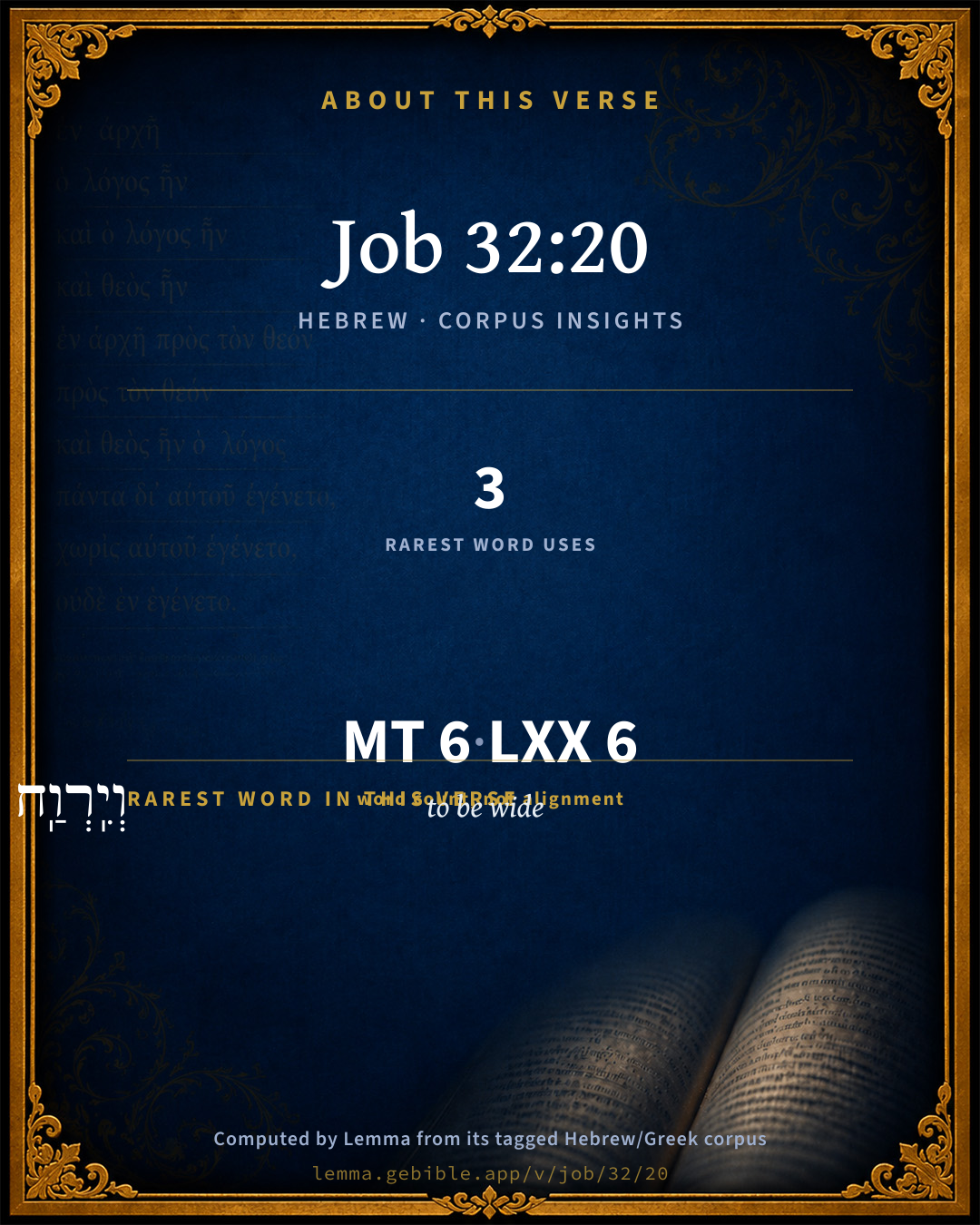
The rarest word here is וְיִֽרְוַֽח to be wide H7304 — appearing just 3 times in the whole Hebrew Bible.

Shared distinctive vocabulary

וְיִֽרְוַֽח to be wide H7304 occurs in 3 verses of the Hebrew Bible. Also found in:

Grammatical profile

  • 4 verbs
  • 1 noun
  • 1 preposition

Verb forms

  • אֲדַבְּרָ֥ה Piel · Cohortative
  • וְיִֽרְוַֽח Qal · Imperfect
  • אֶפְתַּ֖ח Qal · Imperfect
  • וְאֶֽעֱנֶֽה Qal · Imperfect

Hebrew & Septuagint length

In English translation the verse runs 15 words from the Hebrew and 12 from the Septuagint (LXX English) — closely comparable.

A rough comparison of the two English renderings, which tokenize alike — not a word-level alignment.

Word counts can differ between the Hebrew and the Greek without any difference in meaning — e.g. the Hebrew direct-object marker אֵת has no separate Greek word, and Greek often adds the article ὁ.

In the original languages it is 6 Hebrew tokens and 6 Greek tokens — but the two are counted differently (Hebrew bundles its prefixes and suffixes into one token; the Greek is in lemma form), so that isn’t a like-for-like length.

Cross-references

5

Topical passages linked to Job 32:20 in the Treasury of Scripture Knowledge — connected by theme and wording, ordered by reader-vote popularity; previews shown in the World English Bible.

  • Job 21:3 Allow me, and I also will speak; After I have spoken, mock on.
  • Job 13:13 "Be silent, leave me alone, that I may speak. Let come on me what will.
  • Job 13:19 Who is he who will contend with me? For then would I hold my peace and give up the spirit.
  • Job 20:2 "Therefore do my thoughts give answer to me, Even by reason of my haste that is in me.
  • Proverbs 8:6–7 Hear, for I will speak excellent things. The opening of my lips is for right things.

Cross-references courtesy of OpenBible.info (CC BY 4.0).

Hebrew and Greek witnesses Masoretic Hebrew ↔ Greek Septuagint

The same verse in the two great witnesses to the Old Testament, shown verse-for-verse.

These are two independent witnesses, not word-aligned to each other, and the Septuagint is shown in lemma (dictionary) form.

Hebrew Job 32:20 Masoretic · Westminster Leningrad Codex

אֲדַבְּרָ֥ה וְיִֽרְוַֽח לִ֑י אֶפְתַּ֖ח שְׂפָתַ֣י וְאֶֽעֱנֶֽה

I will speak, that I may be refreshed. I will open my lips and answer.

World English Bible · Public Domain

Greek LXX Job 32:20 Septuagint · lemma form

λαλέω ἵνα ἀναπαύω ἀναοἴγω ὁ χεῖλος

I will speak, that I may open my lips and relieve myself.

LXX2012 (modern English Septuagint) · Public Domain

Hebrew: Westminster Leningrad Codex (CC BY 4.0). Greek: Septuagint (public domain); English from LXX2012 (modern English Septuagint) (Public Domain). How the Septuagint differs from the Hebrew →

Commentary

Notes on Job 32:20 from classic Christian and Jewish commentators (each source and its license shown beneath its notes). The classic Christian expositions comment on the surrounding passage and are grouped to its opening verse, so a note may address several verses; the Jewish commentaries on the Tanakh (Rashi and others) are per-verse, so they appear only where the commentator wrote on this verse.

Lemma curates 59 commentaries, every one of them public domain or Creative Commons licensed, each selected and text-cleaned for this edition rather than reprinted as found. About our sources →

Trapp's Complete Commentary

John Trapp

Job 32:20 I will speak, that I may be refreshed: I will open my lips and answer.

Ver. 20. I will speak, that I may be refreshed] Heb. that I may breathe: this many martyrs did, though to the loss of their precious lives; as those that came to the tribunals, and cried out, Christiani sumus, We are Christians, hang us, burn us, stone us, &c., Modo Iesum nostrum nanciscamur, so that we may get our Jesus. And when they were told that they were put to death, Non pro fide, sed pro obstinatione, not for their religion, but for their obstinace, Tertullian answered, Pro hac obstinatione fidei morimur, For this religious obstinace we gladly die. As for those that made not a good confession, but either denied or dissembled their religion, for political respects, what a deal of unrest found they in their consciences, till they had better declared themselves, or revoked their recantations; as Bilney, Bainham, Benbridge, Abbes, Sharp, besides Origen, and all those of old? Let a man speak boldly and freely in a good cause when called to it, and he shall be refreshed; for as every flower hath its sweet smell, so hath every good word and work its comfort.

I will open my lips and answer] viz. Freely and fully, as Eph 6:19, with great alacrity of spirit and vehemence of speech. Some kind of answer a man may make, though he open not his lips; as he did, who, being asked what man’s life was? presently turned his back, and went his way. Theodoret also, upon Mat 5:2, observeth that our Saviour taught sometimes when yet he opened not his mouth; viz. by holy life and wondrous works.

John Trapp, A Commentary or Exposition upon All the Books of the Old and New Testament (1647–1656) — public domain. Text from a community e-Sword module.

Jamieson, Fausset & Brown

Robert Jamieson, A. R. Fausset & David Brown

refreshed--literally, "that there may be air to me" (Sa1 16:23).

Jamieson, Fausset & Brown — Commentary Critical and Explanatory on the Whole Bible (1871) — public domain (CC PDM 1.0). Text via the HelloAO Bible API.

Adam Clarke's Commentary

Verse 20. I will open my lips and answer.] In the preceding verse Elihu compares himself to a skin-bottle, in which the wine was in a state of fermentation, and the bottle ready to burst for want of vent. He carries on the metaphor in this verse: the bottle must be opened to save it from bursting; I will OPEN my mouth.

Adam Clarke's Commentary on the Bible (1810–1826) — public domain. Text from a community e-Sword/MySword module.

The Cambridge Bible for Schools and Colleges

gen. ed. J. J. S. Perowne

20. be refreshed] Rather, find relief; lit. get air or vent. The figure is still that of fermenting wine, Job_32:19.

The Cambridge Bible for Schools and Colleges (gen. ed. J. J. S. Perowne; Cambridge University Press, 1878–1918) — public domain. Text from a community e-Sword module.

John Gill's Exposition

I will speak, that I may be refreshed,.... That his mind might be made easy; the matter it was full of lay with much weight upon it, pressed him hard, and gave him pain; and therefore he determines to speak his mind, and disburden himself: so a minister of the word speaks sometimes to the refreshment of others, the Gospel being a word in season to weary souls, bread to the hungry, drink to the thirsty, even wine to them that are of an heavy heart; and especially it is refreshing when the love of God is shed abroad in the heart through it, and the presence of God is enjoyed under it; and sometimes he speaks to the refreshment of himself with others, Rom 15:32; and whether it be so, one or the other, yet a faithful minister eases his mind, discharges his conscience, and is clear from the blood of all, when he truly and fully declares the whole counsel of God, so far as he is acquainted with it:

I will open my lips and answer; speak freely and boldly what was upon his mind, and he had to say, and which he judged would be a sufficient answer to Job; the opening of his lips is a phrase used by him in allusion to the opening of a bottle, full of new wine, the metaphor before expressed by him.

John Gill's Exposition of the Whole Bible (1746–1763) — public domain (CC PDM 1.0). Text via the HelloAO Bible API.

Albert Barnes' Notes on the Bible

I will speak, that I may be refreshed - Margin, “breathe.” The meaning is, that he would then have room to breathe again; he would feel relieved.

Albert Barnes' Notes on the Bible (1834–1885) — public domain. Text from a community e-Sword/MySword module.

Matthew Poole's English Annotations

That I may be refreshed; that I may ease my mind of those thoughts which now oppress it.

I will open my lips and answer; I will not utter impertinent words, but solid answers, to Job’s arguments.

Matthew Poole's English Annotations on the Holy Bible (1683–1685) — public domain. Text from a community e-Sword/MySword module.

Whedon's Commentary on the Bible

Daniel D. Whedon

20. I will speak — He carries on the metaphor in this verse; the bottle must be opened to save it from bursting.

Be refreshed — The margin is more literal. In like manner, Young: —

“Good sense will stagnate: Thoughts shut up want air.”

The spirit within constraineth him. The precursor of the apostle Paul in enthusiasm, sincerity, and tenaciousness of the truth, he cannot resist the divine constraint. His inner nature burns with the truths he waits to deliver; one, for instance — the sinner’s justification through the mercy of God; “the quintessence of all his words,” thereby anticipating the apostle in the doctrine of justification by faith, even as the morn anticipates the day.

Daniel D. Whedon (gen. ed.), Commentary on the Old and New Testaments (1874–1909) — public domain. Text from a community e-Sword module.

The Pulpit Commentary

I will speak, that I may be refreshed; rather, that I may obtain relief; or, according to some, "that I may be able to breathe" (Cook, Rosenmuller). Elihu feels almost suffocated by conflicting feelings of rage (vers. 1-3), disappointment (vers. 11, 12), and anxiety to vindicate God"s honour (ver. 2). I will open my lips and answer. In the remainder of Elihu"s discourse the attempt is made to "answer" Job (see ch. 33-37), with what success will be considered elsewhere.

The refreshment of speech.

Elihu will speak that he may be refreshed. Let us consider some of the ways in which this refreshment may be experienced.

I THE SENSE OF RELIEF.

1. In utterance of what is strongly felt. It is difficult to restrain powerful emotions. Passion inspires speech. We long to tell out what burns in our hearts. Difficulty of utterance often arises from deadness of soul often, but not always, for many of the best men have no facility of speech. Still, the surest road to eloquence is through emotion.

2. In confession of what is deeply distressing. It is hard to hide a dark secret. Criminals have been known to confess their evil deeds simply because they could not endure to keep silence about them. Great sorrows find relief in utterance. While the sufferer suppresses himself in stony grief his reason is in danger; let him weep and speak, and the worst anguish or his soul will find some relief. Prayer in great distress is not only appealing to God for help; it is also relieving the overburdened soul by utterance. It is much to be able to unbosom one"s self to God, to open out sad secrets to Heaven.

II THE EXERCISE OF POWER. No doubt the lower motive of desiring to feel his power was influencing Elihu, though he would have been too vain to have admitted it. Some people delight to hear the sound of their own voices. The importance and publicity of speaking before others is found to be attractive. When the speaker discovers that he can move an audience by his eloquence, a new fascination lays hold of him, and if he can influence by means of speech, he will find a pleasure in wielding so powerful an instrument. But there is great danger in all this, lest the speaker should idolize his own eloquence, and try to influence others merely for the sake of making them feel the weight of his utterance. It must be remembered that there is great. responsibility in speech. A hasty utterance may be followed by a long repentance, when the speaker will give worlds to recover his mischievous words.

III THE ACHIEVEMENT OF GOOD. A good man will desire to speak for the profit of others. He who knows God"s truth will long to declare it to others. So great a treasure is not to be hidden. For Christ"s sake and for the world"s sake it must be made known far and wide. The Christian should feel that a serious obligation is upon him to lead others to share in those privileges of the gospel which all need, and which are designed for all. St. Paul felt an awful necessity laid on him, and exclaimed, "Woe is unto me if I preach not the gospel!". (1Co_9:16) The lepers of Samaria felt that they would be guilty of a great sin if they feasted in the camp of the Syrians, and did not let the starving city know that there was abundance of good outside the gates. (2Ki_7:9) But nor only is it a duty to preach Christ; it is a great joy. The body may be wearied by the effort, but the soul will be refreshed. There is a cheering and invigorating influence in making truth known; this is greatest when the work is to bring the knowledge of God"s love in Christ to sorrowing men and women. W.F.A.

The Pulpit Commentary (1880–1919), ed. H.D.M. Spence-Jones & Joseph S. Exell — public domain. Text from a community e-Sword module.

unfoldingWord translationNotes

Door43 World Missions Community

General Information:

Elihu continues speaking using parallelisms for emphasis.

I may be refreshed

This can be stated in active form. AT: "I may feel better" (See: Active or Passive)

open my lips

Here the "lips" represent the mouth. AT: "open my mouth" (See: Synecdoche)

neither will I give honorific titles to any man

"neither will I praise any man or give him titles of honor"

my Maker

This is a name referring to God. AT: "God who made me"

take me away

This means that he would destroy him. AT: "destroy me" (See: Euphemism)

translationWords

favor

honor

unfoldingWord translationNotes — © Distant Shores Media and the Door43 World Missions Community, licensed CC BY-SA 4.0. Source: git.door43.org/Door43/en_tn.

Lesson kit

Teaching starters — assembled from the data on this page, not authored interpretation. Every prompt links to the verse data it draws on. Edit before teaching.

Job, in the Wisdom, opens this verse with 6 words (5 distinct Hebrew lemmas). Its most distinctive word is râvach (“to be wide”). A historical commentator’s framing appears above. Read the whole chapter for the surrounding context.

Discussion questions

  1. The word râvach carries the sense “to be wide.” How does it shape the verse?
  2. 1 Samuel 16:23 shares the word «to be wide» with this verse. How do the two illuminate each other?
  3. These translations render this verse differently; the difference is in the English rendering, not the original. What questions does that raise?
  4. The verb «אֲדַבְּרָ֥ה» is Piel Cohortative. How does its form color the action?
  5. Reading how Trapp's Complete Commentary and Jamieson, Fausset & Brown read this verse, where do the two commentators agree and where do they part?

Things to notice

Reading settings

Reading text

Shown beneath each verse's original-language words.

Old Testament
Old Testament edition

Read the OT as the Masoretic Hebrew (MT) or the Greek Septuagint (LXX).

English shown for the Greek Septuagint (in the Hebrew ↔ Greek comparison).

Comparing translations? Open the Compare panel on any verse page to stack up to four side by side.