
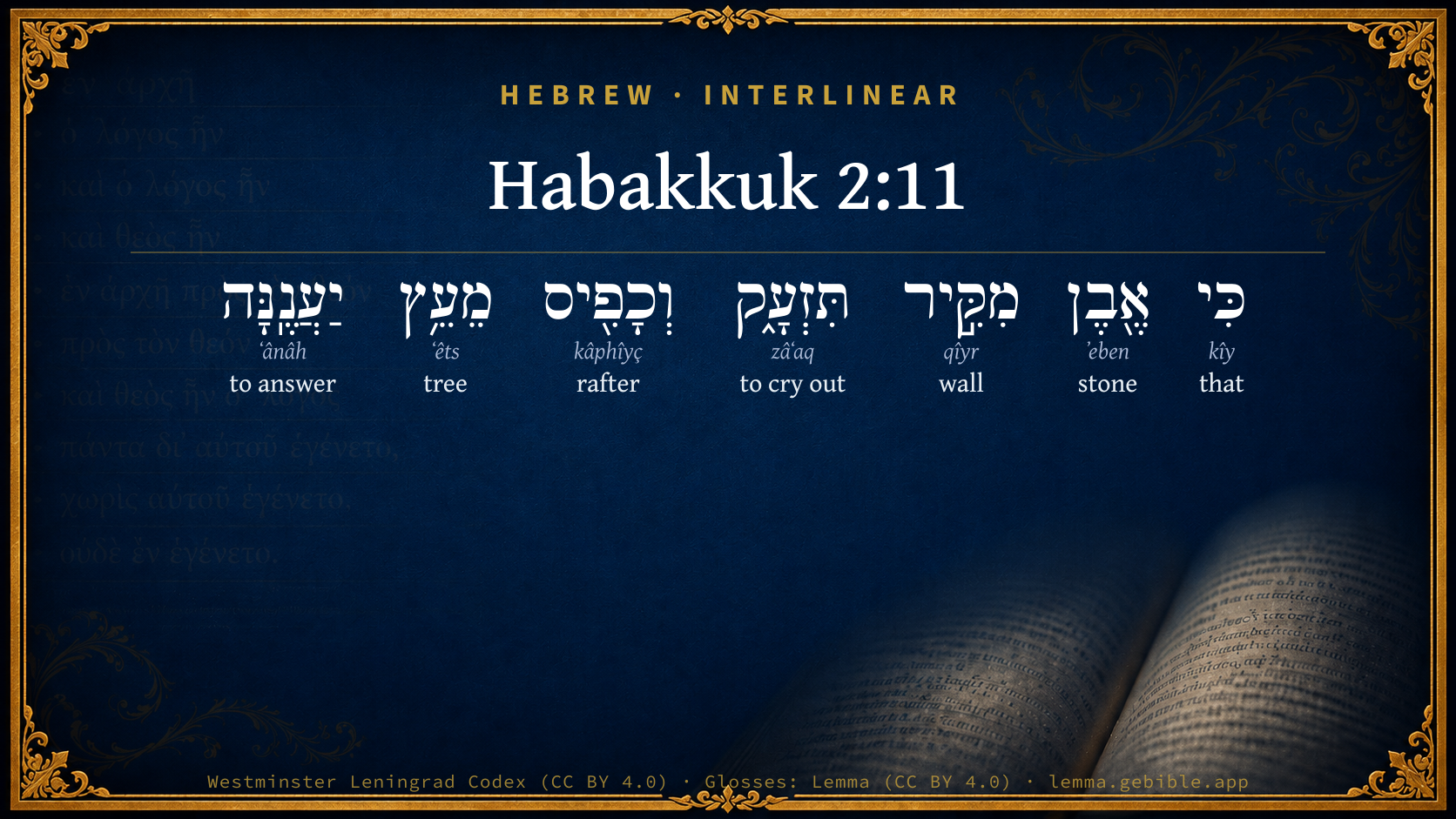
Habakkuk 2:11

Hebrew (Westminster Leningrad Codex) Habakkuk 2:11 appears in the Hebrew Old Testament. The text above is from the Westminster Leningrad Codex. Each word links to its Strong’s number, a concise gloss, and parsing drawn from the Open Scriptures Hebrew Bible morphology. Click any word for its full Brown-Driver-Briggs (BDB) entry.
Download image
Cite this verse

Habakkuk 2:11 (World English Bible). Public Domain. Lemma interlinear Bible study tool, https://lemma.gebible.app/v/habakkuk/2/11.

Show BibTeX & RIS
BibTeX
RIS
English Translation
For the stone will cry out of the wall, and the beam out of the woodwork will answer it.
World English Bible · Public Domain
Highlights
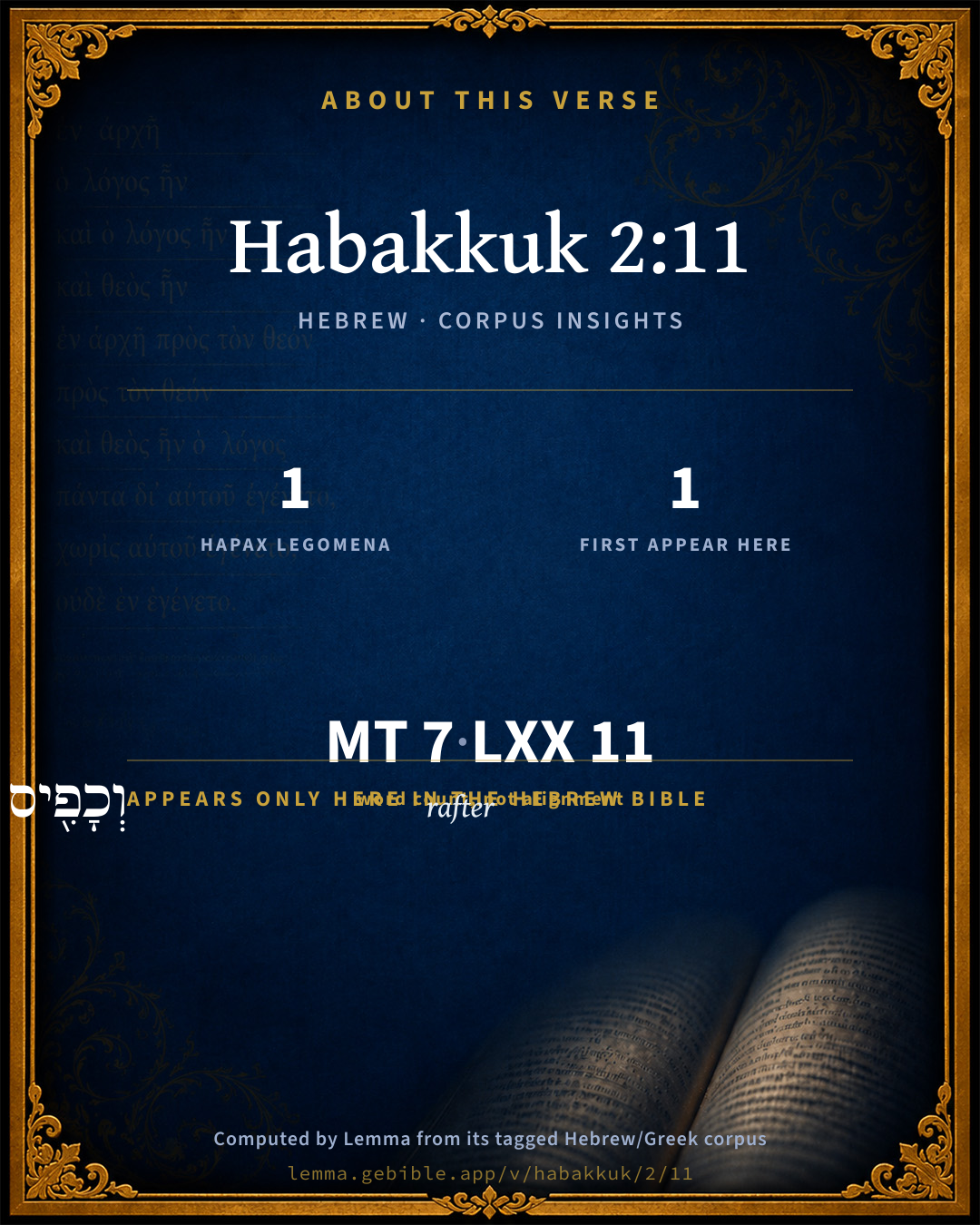
  • 1 hapax legomenon — only here in the Hebrew Bible
  • 1 first appearance in the Hebrew Bible
Full analysis ↓
Download a study sheet

One document with this verse’s original text, its word-by-word gloss line, the meaning frame, cross-references with their text, attributed commentary, and full source and license credits — printable, and it pastes into notes with its structure intact.

This verse Autodidact and up

Study sheet (.html) Plain text (.txt)

A passage Seminary Student

Up to 50 verses in one chapter. A passage sheet keeps up to 6 commentary sources and 12 cross-references per verse, in the order this page ranks them, and says so on the sheet whenever that leaves anything out. Ask for a single verse and you get the Autodidact verse sheet above.

Everything on this page stays free to read, with no account — the sheet is a download of what is already on screen, not access to it.

Want to remove ads? Support Godless Engineer
Compare translations 3

The same verse in 3 English versions, stacked beneath the original-language interlinear above. Click any original word for its lexicon entry.

Each is an independent rendering of the whole verse — the interlinear is not word-aligned to these translations.

Highlighted words mark where these versions differ — a whole-verse word diff, not a word-by-word alignment.

  • World English Bible Public Domain
    For the stone will cry out of the wall, and the beam out of the woodwork will answer it.
  • King James Version Public Domain
    For the stone shall cry out of the wall, and the beam out of the timber shall answer it.
  • unfoldingWord Literal Text CC BY-SA 4.0
    For a stone will cry out from the wall, and a beam from the wood will answer it,

unfoldingWord Literal Text — © unfoldingWord, licensed CC BY-SA 4.0. Word-aligned USFM3 via Door43 (git.door43.org/unfoldingWord/en_ult).

Versions to compare (up to 4)

3 of 4 selected

Show all 18 translations

Every available English version of this verse, each an independent rendering of the whole verse.

  • World English Bible Public Domain
    For the stone will cry out of the wall, and the beam out of the woodwork will answer it.
  • Berean Standard Bible Public Domain
    For the stones will cry out from the wall, and the rafters will echo it from the woodwork.
  • Majority Standard Bible Public Domain
    For the stones will cry out from the wall, and the rafters will echo it from the woodwork.
  • King James Version Public Domain
    For the stone shall cry out of the wall, and the beam out of the timber shall answer it.
  • American Standard Version (1901) Public Domain
    For the stone shall cry out of the wall, and the beam out of the timber shall answer it.
  • Revised Version (1885) Public Domain
    For the stone shall cry out of the wall, and the beam out of the timber shall answer it.
  • Geneva Bible (1599) Public Domain
    For the stone shall crie out of the wall, and the beame out of the timber shall answere it.
  • Douay-Rheims (1899) Public Domain
    For the stone shall cry out of the wall: and the timber that is between the joints of the building, shall answer.
  • Young's Literal Translation Public Domain
    For a stone from the wall doth cry out, And a holdfast from the wood answereth it.
  • Literal Standard Version CC BY-SA 4.0
    For a stone cries out from the wall, || And a beam from the wood answers it.
  • Unlocked Literal Bible CC BY-SA 4.0
    For the stones will cry out from the wall, and the rafters of timber will answer them,
  • unfoldingWord Literal Text CC BY-SA 4.0
    For a stone will cry out from the wall, and a beam from the wood will answer it,
  • Darby Bible Public Domain
    For the stone shall cry out of the wall, and the beam out of the timber shall answer it.
  • World Messianic Bible Public Domain
    For the stone will cry out of the wall, and the beam out of the woodwork will answer it.
  • Webster's Bible Public Domain
    For the stone shall cry out of the wall, and the beam out of the timber shall answer it.
  • Free Bible Version CC BY-SA 4.0
    Even the stones in the wall cry out in condemnation, and the wooden rafters join in too.
  • Bible in Basic English Public Domain
    For the stone will give a cry out of the wall, and it will be answered by the board out of the woodwork.
  • JPS Tanakh (1917) Public Domain
    For the stone shall cry out of the wall, and the beam out of the timber shall answer it.

Literal Standard Version (2020), Covenant Press — licensed CC BY-SA 4.0. Text via the HelloAO Bible API (eBible.org). Unlocked Literal Bible (unfoldingWord) — licensed CC BY-SA 4.0. Text via the HelloAO Bible API (eBible.org). unfoldingWord Literal Text — © unfoldingWord, licensed CC BY-SA 4.0. Word-aligned USFM3 via Door43 (git.door43.org/unfoldingWord/en_ult). Free Bible Version, Dr. Jonathan Gallagher — licensed CC BY-SA 4.0. Text via the HelloAO Bible API (eBible.org).

Word by word

More ways to search: Search by grammar → Find every occurrence → Compare this word →

Practice this passage: Drill this verse → Learn its vocabulary →

About this verse

These counts appear in no published source. They are computed here, from the morphology-tagged text and Lemma’s own curated glosses. What Lemma adds →

7
words
7
distinct lemmas
Prophets
section

Notable vocabulary

1 hapax legomenon — a word that appears only here in the entire Hebrew Bible:

  • וְכָפִ֖יס rafter H3714

First appearance in Scripture

This word makes its first canonical appearance in the Hebrew Bible here:

  • וְכָפִ֖יס rafter H3714

Grammatical profile

  • 2 verbs
  • 4 nouns
  • 1 conjunction

Verb forms

  • תִּזְעָ֑ק Qal · Imperfect
  • יַעֲנֶֽנָּה Qal · Imperfect

Hebrew & Septuagint length

In English translation the verse runs 19 words from the Hebrew and 18 from the Septuagint (LXX English) — closely comparable.

A rough comparison of the two English renderings, which tokenize alike — not a word-level alignment.

Word counts can differ between the Hebrew and the Greek without any difference in meaning — e.g. the Hebrew direct-object marker אֵת has no separate Greek word, and Greek often adds the article ὁ.

In the original languages it is 7 Hebrew tokens and 11 Greek tokens — but the two are counted differently (Hebrew bundles its prefixes and suffixes into one token; the Greek is in lemma form), so that isn’t a like-for-like length.

Cross-references

7

Topical passages linked to Habakkuk 2:11 in the Treasury of Scripture Knowledge — connected by theme and wording, ordered by reader-vote popularity; previews shown in the World English Bible.

  • Luke 19:40 He answered them, "I tell you that if these were silent, the stones would cry out."
  • Joshua 24:27 Joshua said to all the people, Behold, this stone shall be a witness against us; for it has heard all the words of Yahweh which he spoke to us: it shall be therefore a witness against you, lest you deny your God.
  • Job 31:38–40 If my land cries out against me, And the furrows of it weep together;
  • James 5:3–4 Your gold and your silver are corroded, and their corrosion will be for a testimony against you, and will eat your flesh like fire. You have laid up your treasure in the last days.
  • Genesis 4:10 Yahweh said, "What have you done? The voice of your brother's blood cries to me from the ground.
  • Hebrews 12:24 to Jesus, the mediator of a new covenant, and to the blood of sprinkling that speaks better than that of Abel.
  • Revelation 6:10 They cried with a loud voice, saying, "How long, Master, the holy and true, until you judge and avenge our blood on those who dwell on the earth?"

Cross-references courtesy of OpenBible.info (CC BY 4.0).

Hebrew and Greek witnesses Masoretic Hebrew ↔ Greek Septuagint

The same verse in the two great witnesses to the Old Testament, shown verse-for-verse.

These are two independent witnesses, not word-aligned to each other, and the Septuagint is shown in lemma (dictionary) form.

Hebrew Habakkuk 2:11 Masoretic · Westminster Leningrad Codex

כִּי אֶ֖בֶן מִקִּ֣יר תִּזְעָ֑ק וְכָפִ֖יס מֵעֵ֥ץ יַעֲנֶֽנָּה

For the stone will cry out of the wall, and the beam out of the woodwork will answer it.

World English Bible · Public Domain

Greek LXX Habakkuk 2:11 Septuagint · lemma form

διότι λίθος ἐκ τοῖχος βοάω καί κάνθαρος ἐκ ξύλον φθέγγομαι αὐτός

For the stone shall cry out of the wall, and the beetle out of the timber shall speak.

LXX2012 (modern English Septuagint) · Public Domain

On this verse, John Gill's Exposition discusses the Septuagint’s reading. Read the note in Commentary ↓

Hebrew: Westminster Leningrad Codex (CC BY 4.0). Greek: Septuagint (public domain); English from LXX2012 (modern English Septuagint) (Public Domain). How the Septuagint differs from the Hebrew →

Targum (Aramaic paraphrase)

1

The Targum is the ancient Jewish Aramaic paraphrase of the Hebrew Scriptures — an interpretive translation, not the Hebrew text itself. Onkelos (literal) and Pseudo-Jonathan (expansive) render the Torah, and Jonathan the Prophets. Coverage is partial: where no permissively-licensed English translation exists for a verse, only the Aramaic is shown. This is verse-level text, not a word-by-word alignment to the Hebrew.

  1. Targum Jonathan Prophets (Joshua–Malachi)
    אֲרֵי אַבְנָא מִכָּתְלָא צַוְחָא עַל דְאָנֵיס לֵיהּ וְשִׁפָּא מִגוֹ מְרֵישָׁא עָנֵי לֵיהּ:

    (no public-domain English translation for this verse)

    Targum Jonathan — Aramaic: “Mikraot Gedolot” (public domain). English: “Sefaria Community Translation” (CC0 1.0 (public-domain dedication)); “London "Chaldee Paraphrase," 1871” (public domain). Text via Sefaria.

Commentary

Notes on Habakkuk 2:11 from classic Christian and Jewish commentators (each source and its license shown beneath its notes). The classic Christian expositions comment on the surrounding passage and are grouped to its opening verse, so a note may address several verses; the Jewish commentaries on the Tanakh (Rashi and others) are per-verse, so they appear only where the commentator wrote on this verse.

Lemma curates 59 commentaries, every one of them public domain or Creative Commons licensed, each selected and text-cleaned for this edition rather than reprinted as found. About our sources →

Trapp's Complete Commentary

John Trapp

Hab 2:11 For the stone shall cry out of the wall, and the beam out of the timber shall answer it.

Ver. 11. For the stone shall cry out of the wall, and the beam out of the timber shall answer it] Here are woeful echoes; screech owls of woe cry aloud from the beams of the oppressors’ chambers, and make most hideous noises in the ears of their consciences. So that although none other should dare to mute against them, or accuse them of wrong dealing; yet their very houses, built by rapine and blood, shall testify against them; so shall other creatures that groan under their abuses, Rom 8:19-22. They seem all to say unto us those three words, saith Hugo, Accipe, Redde, Fuge; Accipe beneficium, Redde Officium, Fuge Supplicium (Lib. 2, de Ar. cap. 3). Receive, Return, Flee, Receive the favour, Return the honour, Flee Punishment. Now, if we hearken not to them, but do the contrary, they shall be one day as so many swift witnesses against us.

And the beam out of the timber shall answer it] Tignum e ligno respondet ei. An allusion to responsers, as in choirs and music; and perhaps the prophet here tacitly taxeth the Babylonian luxury in keeping choristers and musicians for their sinful delight. God, saith he, will fit you with other songsters shortly, that shall twit you by turns with your murders and ravages; for the stone shall cry out of the wall, Woe to him that buildeth a town with bloods! and the beam out of the timber shall answer it, And woe to him that stablisheth a city by iniquity!

John Trapp, A Commentary or Exposition upon All the Books of the Old and New Testament (1647–1656) — public domain. Text from a community e-Sword module.

The Biblical Illustrator

Joseph S. Exell

Hab_2:11

The stone shall cry out of the wall, and the beam out of the timber shall answer it.

Retribution

The prophet in this connection is declaring that the Chaldeans shall be punished for their cruel rapacity. Retribution is everywhere assumed as a great first-truth, which nature itself constantly teaches, and to which mans universal conscience as constantly responds.

I. The sin. What was the iniquity for which the Chaldean monarch is here so solemnly denounced? Not the mere outer act of building a great city, but in the manner and motive of his doing it. He had built his city in blood, and established it in iniquity. There was sin in the motive, for the monarch only built for his selfish aggrandisement. We perceive, then, glaring ungodliness in both manner and motive of this great work of Babylon.

II. The punishment. The Bible does not teach that men are punished eternally for the sins committed in time. Man goes on sinning for ever, and therefore is punished for ever. By a law of a mans own mental constitution, memory and conscience are summoning from the past both ministry and material of a righteous retribution. This is retribution--a punishment really more dreadful than any material imagery whereby the Bible sets it forth--a retribution which becomes, of itself, eternal torment. We do not say that in this is all of retribution. (Charles Wadsworth, D. D.)

The handwriting on the wall

Very startling was the vision which appeared to Belshazzar and his courtiers when their feasting and mirth were at their height. But not in terrible omens and supernatural visions alone do we see the Divine handwriting. To thoughtful men on every wall by the wayside appear mystic letters of profound significance. The hand itself is unseen behind the veil of nature, but the words are formed clear and distinct upon the stones of the wall, and they remain as if graven with a pen of iron. Botanists are familiar with a peculiar genus of lichen called Opegrapha, from the resemblance which the fructification of all its species bears to written characters. On the surface are numerous dark intricate lines, like Arabic, Hebrew, or Chinese letters. The likeness in some instances is remarkably close. Nature has thus mimicked in almost every wood, and on almost every rock and wall, the latest and highest result of mans civilisation; and in her humblest plant forms has written her wonderful runes. It can, indeed, be said in the highest sense of the whole family of lichens that they are Gods handwriting on the wall. Lichens form the nebulae, so to speak, of the firmament of life. Lichens are in the ocean of air that covers the dry land what seaweeds are in the ocean of waters that covers the depths of the sea. They are as the pioneers of vegetation, climbing the bare crag, and penetrating into the lonely wilderness, and planting there the flag of life. As elements in the picturesque, lichens have long held a high place in the estimation of all lovers of nature. What would a ruin be without them? Lichens run through the whole chromatic scale, and show what striking effects nature can produce by an harmonious combination of a few simple lines and hues. Not less worthy of examination is the specialised organ with which the lichen decks itself than the blossom of the brightest flower. Nothing is lost in nature. Gods handwriting on the wayside wall and the weather-beaten rock writes no sentence--Thou art weighed in the balances and art found wanting. (Hugh Macmillan, D. D.)

The Biblical Illustrator, edited by Joseph S. Exell (c. 1880s–1900s) — public domain. Text from a community e-Sword module.

Whedon's Commentary on the Bible

Daniel D. Whedon

Hab_2:11 gives the reason for the sentence announced in Hab_2:10. Jehovah cannot overlook the wrongdoing, for the very stones and beams in the house built with blood cry out against the violence practiced in procuring them.

Shall answer it — Shall re-echo the cry sent up by the stones.

Woe upon the building of cities with the blood and property of strangers, Hab_2:12-14.

The third woe is a continuation of the second; the latter refers to the building of the empire in general, the former to the extensive building enterprises throughout the land. “The prophet sees the city in process of extension, bands of captives, Jews and Gentiles, bleeding and dying under the blows of their drivers, and he realizes the fraudful dealings by which the treasures expended in the erection of enormous fortifications have been amassed.”

Daniel D. Whedon (gen. ed.), Commentary on the Old and New Testaments (1874–1909) — public domain. Text from a community e-Sword module.

Geneva Bible (1599)

Geneva Bible translators

The stones of the house shall cry, and say that they are built of blood, and the wood shall answer and say the same of itself.

Geneva Bible (1599) marginal notes — public domain. Text via Bolls.life.

Jamieson, Fausset & Brown

Robert Jamieson, A. R. Fausset & David Brown

stone . . . cry out--personification. The very stones of thy palace built by rapine shall testify against thee (Luk 19:40).

the beam out of the timber--the crossbeam or main rafter connecting the timbers in the walls.

shall answer it--namely, the stone. The stone shall begin and the crossbeam continue the cry against thy rapine.

Jamieson, Fausset & Brown — Commentary Critical and Explanatory on the Whole Bible (1871) — public domain (CC PDM 1.0). Text via the HelloAO Bible API.

Adam Clarke's Commentary

Verse 11. The stone shall cry out of the wall, and the beam out of the timber shall answer it.] This appears to refer to the ancient mode of building walls; two or three courses of stone, and then one course of timber. See 1Kg 6:36: thus was the palace of Solomon built. The splendid and costly buildings of Babylon have been universally celebrated. But how were these buildings erected? By the spoils of conquered nations, and the expense of the blood of multitudes; therefore the stones and the timber are represented as calling out for vengeance against this ruthless conqueror.

Adam Clarke's Commentary on the Bible (1810–1826) — public domain. Text from a community e-Sword/MySword module.

John Calvin's Commentaries

There is here introduced by the Prophet a new personification. He had before prepared a common song, which would be in the mouth of all. He now ascribes speech to stones and wood, of which buildings are formed. The stone, he says, shall cry from the wall, and the wood from the chamber; that is, there is no part of the building that will not cry out that it was built by plunder, by cruelty, and, in a word, by evil deeds. The Prophet not only ascribes speech to wood and stone, but he makes them also respond one to the other as in a chorus, as in lyrics there are voices which take up the song in turns. The stone, he says, shall cry from the wall, and the wood shall respond to it from the chamber; as though he said, “There will be a striking harmony in every part of the building; for the wall will begin and will utter its song, ‘Behold I have been built by blood and by iniquity;’ and the wood will utter the same, and will cry, ‘Woe;’ but all in due order; there will be no confused noise, but as music has distinct sounds, so also the stones will respond to the wood and the wood to the stones, so that there may be, as they say, corresponding voices.”

John Calvin's Commentaries (1540-1563) — public domain. Text from the Calvin Translation Society English edition (1840s-50s) via the Christian Classics Ethereal Library (ccel.org). Calvin's coverage is partial (roughly two-thirds of the Bible); uncommented books and verses are honest gaps, never fabricated. The 19th-century editor's footnotes and remarks are omitted so the notes are faithfully Calvin's own voice.

Ellicott's Commentary for English Readers

(11) The stone shall cry out.—Every stone in those giant walls reared by the enforced labour of captives cries aloud to accuse the Babylonian. Every spar out of the woodwork attests the charge.

A Bible Commentary for English Readers, edited by Charles John Ellicott (1878–1897) — public domain. Text from a community e-Sword module.

The Cambridge Bible for Schools and Colleges

gen. ed. J. J. S. Perowne

11. stone shall cry out of the wall] For the stone out of the wall shall cry out. The Chaldean gains evil gains to build his nest on high; the materials he uses, the stones and wood, shall cry out against the wrong and oppression perpetrated in procuring them. This sense is preferable to that assumed by Hitzig, that in his constructions the Chaldean kept back the hire of the labourers (Jer_22:13).

beam … answer it] i.e. reecho its cry of injustice.

The Cambridge Bible for Schools and Colleges (gen. ed. J. J. S. Perowne; Cambridge University Press, 1878–1918) — public domain. Text from a community e-Sword module.

John Gill's Exposition

For the stone shall cry out of the wall,.... Of their own house; some from among themselves, that truly feared God, seeing the evil practices done among them, and abhorring them, such as their covetousness, ambition, murders, excommunications, and anathemas, should cry out against them in their sermons and writings; such as were lively stones, eminent for religion and godliness, as Bernard, Wickliff, Huss, and others:

and the beam out of the timber shall answer it; such as were of eminent note in things civil, as beams and rafters in the house; emperors and governors of provinces, who observed the complaints of godly ministers and people, answered to them, and checked the evil bishops and clergy, and hindered them in the pursuit of their schemes, and so brought them to shame and confusion. Aben Ezra observes, that the word signifies the hard place in the wood; or the harder part of it, the knotty part, or the knot in it; and which is confirmed by the use of the word in the Arabic language, as Hottinger (g) observes; and so may have respect to such persons as were raised up at the beginning of the Reformation, who were of rough dispositions, and hardy spirits, fit to go through the work they were called to; such as Luther, and others, who answered and were correspondent to the doctrines of those before mentioned, who preceded them: for not a beetle, as the Septuagint version, which breeds, and lives not in wood, and so represents heretics, as Jerom; much better, as some other Greek versions, a "worm"; though rather the word may signify a brick, as it is used by the Talmudists (h) for one of a span and a half, which answers well enough to a stone in the former clause; nor is it unusual with heathen writers (i) to represent stones and timbers speaking, when any criminal silence is kept; see Luk 19:40.

(g) Smegma Orientale, l. 1. c. 7. p. 163. (h) T. Bava Metzia, fol. 117. 2. & Bathra, fol. 3. 1. (i) "----Secretum divitis ullum Esse putas? servi ut taceant, jumenta loquentur, Et canis, et postes, et marmora.----" Juvenal. Satyr. 9.

John Gill's Exposition of the Whole Bible (1746–1763) — public domain (CC PDM 1.0). Text via the HelloAO Bible API.

Albert Barnes' Notes on the Bible

For the stone shall cry out of the wall, and the beam out of the timber shall answer it - All things have a voice, in that they are . God’s works speak that, for which He made them Psa 19:1 : “The heavens declare the glory of God.” Psa 65:13 : “the valleys are clad with corn, they laugh, yea, they sing;” their very look speaks gladness. Cyril: “For the creation itself proclaims the glory of the Maker, in that it is admired as well made. Wherefore there are voices in things, although there are not words.” Man’s works speak of that in him, out of which and for which he made them. Works of mercy go up for a memorial before God, and plead there; great works, performed amid wrong and cruelty and for man’s ambition and pride, have a voice too, and cry out to God, calling down His vengeance on the oppressor. Here the stones of the wall, whereby the building is raised, and the beam, the tye-beam, out of the timber-work wherewith it is finished, and which, as it were, crowns the work, join, as in a chorus, answering one another, and in a deep solemn wailing, before God and the whole world, together chant “Woe, Woe.” Did not the blood and groans of men cry out to God, speechless things have a voice to appeal to Him (See Luk 19:40). Against Belshazzar the wall had, to the letter, words to speak.

Each three verses forming one stanza, as it were, of the dirge, the following words are probably not directly connected with the former, as if the woe, which follows, were, so to speak, the chant of these inanimate witnesses against the Chaldaeans; yet they stand connected with it. The dirge began with woe on the wrongful accumulation of wealth from the conquered and oppressed people: it continues with the selfish use of the wealth so won.

Albert Barnes' Notes on the Bible (1834–1885) — public domain. Text from a community e-Sword/MySword module.

Haydock's Catholic Bible Commentary

Timber. Hebrew, "caphis (Septuagint, the insect Greek: kantharos) from the wood shall answer." (Haydock) --- The signification of the Hebrew term is unknown. It was customary to place beams of wood after some courses of stone, to strengthen the building, 3 Kings vi. 36. (Calmet) --- The crimes were so crying, that if men were silent the very stones would publish them. (Menochius)

George Leo Haydock (1774–1849), Haydock's Catholic Family Bible and Commentary, 1859 edition — public domain. Excludes Psalms (Douay-Rheims chapter numbering differs from Protestant) and Deuterocanonical books (Catholic canon only).

Matthew Poole's English Annotations

For the stone, the strength of thy house, accuseth thee.

Shall cry out; as if it had a voice, it crieth to God for vengeance.

The beam, on which thy chambers are laid,

shall answer it; confirms the charge against thee; and that fabric cannot be long a safe or a beautiful habitation, whose stones and beams are shaken with the strong cries of innocent blood, and families ruined by the oppression of the builder.

Matthew Poole's English Annotations on the Holy Bible (1683–1685) — public domain. Text from a community e-Sword/MySword module.

The Pulpit Commentary

Even inanimate things shall raise their voice to denounce the Chaldeans" wickedness. The stone shall cry out of the wall. A proverbial expression to denote the horror with which their cruelty and oppression were regarded; it is particularly appropriate here, as these crimes had been perpetrated in connection with the buildings in which they prided them. selves, and which were raised by the enforced labour of miserable captives and adorned with the fruits of fraud and pillage. Compare another application of the expression in Luk_19:40. Jerome quotes Cicero, "Orat. pro Marcello," 10, "Parietes, medius fidius, ut mihi videntur, hujus curiae tibi gratias agere gestiunt, quod brevi tempore futura sit ilia auctoritas in his majorum suorum et suis sedibus" (comp. Eurip., "Hippol.," 418, Teremna t oi]kwn mh pote fqogghn ajfh: Ovid, "Metam.," 2:696, "Tutus eas: lapis iste prius tua furta loquetur"). Wordsworth sees a literal fulfilment of these words in the appalling circumstance at Belshazzar"s feast, when a hand wrote on the palace wall the doom of Babylon. (Da 5) And the beam out of the timber shall answer it. "The tie beam out of the timber work shall" take up the refrain, and "answer" the stone from the wall. The Hebrew word (Kaphis) rendered "beam" is an apax legomenon. It is explained as above by St. Jerome, being referred to a verb meaning "to bind." Thus Symmachus and Theodotion translate it by sundesmov. Henderson and others think it means "a half brick," and Aquila renders it by maza, "something baked." But we have no evidence that the Babylonians in their sumptuous edifices interlaced timber and half bricks (see Pusey, p. 419, note 23). The LXX gives, kanqarov ejk xulou, a beetle, a worm, from the wood. Hence, referring to Christ on the cross, St. Ambrose ("Orat. de Obit. Theod.," 46) writes, "Adoravit ilium qui pependit in ligno, illum inquam qui sicut scarabaeus clamavit, ut persecutoribus suis peccata condonaret." St. Cyril argues that tie beams were called kanqaroi from their clinging to and supporting wall or roof. Some reason for this supposition is gained by the fact that the word canterius, or cantherius, is used in Latin in the sense of "rafter."

The Pulpit Commentary (1880–1919), ed. H.D.M. Spence-Jones & Joseph S. Exell — public domain. Text from a community e-Sword module.

John Wesley's Explanatory Notes

Shall cry out - As if it had a voice, it cries to God for vengeance. Answer it - Confirm the charge against thee.

John Wesley, Explanatory Notes Upon the Whole Bible (1754–1765) — public domain. Text via the GEBible commentary corpus.

Rashi

Rabbi Shlomo Yitzchaki (Rashi)

For a stone For the stones that you stole shall cry from the wall.

and a chip of the wood shall answer it [the stone]. It shall answer aloud the stone that is opposite it; hence both of them cry.

and a chip shall answer it from a beam Jonathan renders: וְשִׁפָּא מִגּוֹ מָרֵישָׁא. שִׁפָּא is an expression of a chip; שְׁפָאִים in the language of the Sages; dokldours in O.F. - chips. מָרֵישׁ is a beam.

Rashi on the Tanakh — English translations: “The Judaica Press complete Tanach with Rashi, translated by A. J. Rosenberg” (CC BY 4.0); “Pentateuch with Rashi's commentary by M. Rosenbaum and A.M. Silbermann, 1929-1934” (public domain); “The Metsudah Tanach series, Lakewood, N.J” (CC BY 4.0); and “The Book of Joshua, Metsudah Publications, 1997” (CC BY 4.0). Text via Sefaria.

Lesson kit

Teaching starters — assembled from the data on this page, not authored interpretation. Every prompt links to the verse data it draws on. Edit before teaching.

Habakkuk, in the Prophets, opens this verse with 7 words (7 distinct Hebrew lemmas). Its most distinctive word is kâphîyç (“rafter”). A historical commentator’s framing appears above. Read the whole chapter for the surrounding context.

Discussion questions

  1. What does “rafter” (kâphîyç) contribute to the verse as a whole?
  2. This verse holds 1 word here found nowhere else in the Hebrew Bible. What might the rare word draw attention to?
  3. The word “rafter” first appears here in Scripture. What is being introduced at this debut?
  4. Luke 19:40 shares this passage’s theme. How do the two illuminate each other?
  5. The translations on this page render this verse differently — a whole-verse word diff, not a word-by-word alignment. What might account for the different wordings?
  6. The verb «תִּזְעָ֑ק» is Qal Imperfect. How does its form color the action?
  7. Reading how Trapp's Complete Commentary and The Biblical Illustrator read this verse, where do the two commentators agree and where do they part?

Things to notice

Reading settings

Reading text

Shown beneath each verse's original-language words.

Old Testament
Old Testament edition

Read the OT as the Masoretic Hebrew (MT) or the Greek Septuagint (LXX).

English shown for the Greek Septuagint (in the Hebrew ↔ Greek comparison).

Comparing translations? Open the Compare panel on any verse page to stack up to four side by side.