
1 Kings 2:30

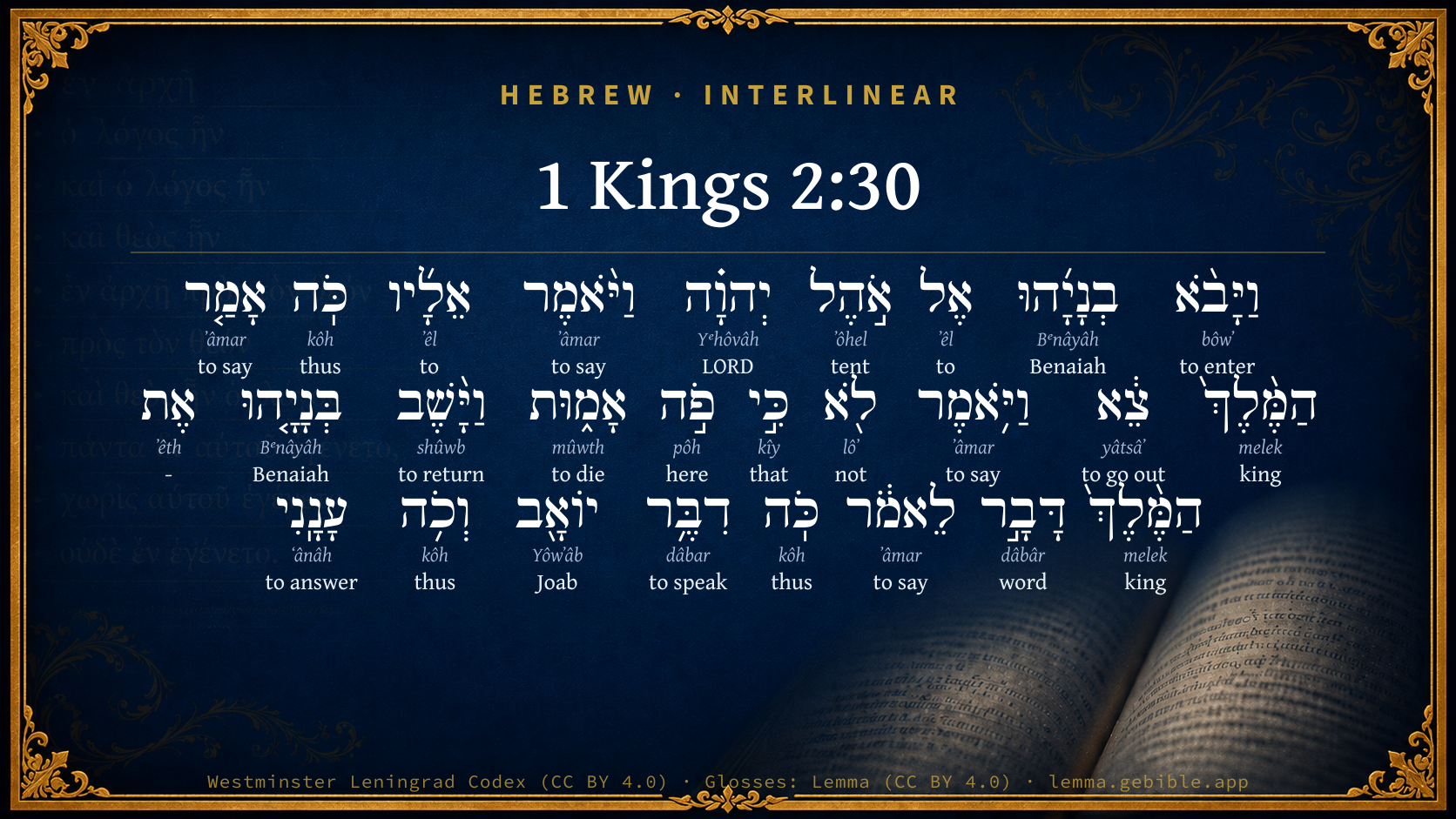
Hebrew (Westminster Leningrad Codex) 1 Kings 2:30 appears in the Hebrew Old Testament. The text above is from the Westminster Leningrad Codex. Each word links to its Strong’s number, a concise gloss, and parsing drawn from the Open Scriptures Hebrew Bible morphology. Click any word for its full Brown-Driver-Briggs (BDB) entry.
Download image
Cite this verse

1 Kings 2:30 (World English Bible). Public Domain. Lemma interlinear Bible study tool, https://lemma.gebible.app/v/1-kings/2/30.

Show BibTeX & RIS
BibTeX
RIS
English Translation
Benaiah came to the Tent of Yahweh, and said to him, Thus says the king, Come forth. He said, No; but I will die here. Benaiah brought the king word again, saying, Thus said Joab, and thus he answered me.
World English Bible · Public Domain
Download a study sheet

One document with this verse’s original text, its word-by-word gloss line, the meaning frame, cross-references with their text, attributed commentary, and full source and license credits — printable, and it pastes into notes with its structure intact.

This verse Autodidact and up

Study sheet (.html) Plain text (.txt)

A passage Seminary Student

Up to 50 verses in one chapter. A passage sheet keeps up to 6 commentary sources and 12 cross-references per verse, in the order this page ranks them, and says so on the sheet whenever that leaves anything out. Ask for a single verse and you get the Autodidact verse sheet above.

Everything on this page stays free to read, with no account — the sheet is a download of what is already on screen, not access to it.

Want to remove ads? Support Godless Engineer
Compare translations 3

The same verse in 3 English versions, stacked beneath the original-language interlinear above. Click any original word for its lexicon entry.

Each is an independent rendering of the whole verse — the interlinear is not word-aligned to these translations.

Highlighted words mark where these versions differ — a whole-verse word diff, not a word-by-word alignment.

  • World English Bible Public Domain
    Benaiah came to the Tent of Yahweh, and said to him, Thus says the king, Come forth. He said, No; but I will die here. Benaiah brought the king word again, saying, Thus said Joab, and thus he answered me.
  • King James Version Public Domain
    And Benaiah came to the tabernacle of the LORD, and said unto him, Thus saith the king, Come forth. And he said, Nay; but I will die here. And Benaiah brought the king word again, saying, Thus said Joab, and thus he answered me.
  • unfoldingWord Literal Text CC BY-SA 4.0
    And Benaiah came to the tent of Yahweh, and he said to him, “Thus says the king, ‘Come out!’” And he said, “No, for here I will die.” And Benaiah brought back word to the king, saying, “Thus Joab spoke, and thus he answered me.”

unfoldingWord Literal Text — © unfoldingWord, licensed CC BY-SA 4.0. Word-aligned USFM3 via Door43 (git.door43.org/unfoldingWord/en_ult).

Versions to compare (up to 4)

3 of 4 selected

Show all 18 translations

Every available English version of this verse, each an independent rendering of the whole verse.

  • World English Bible Public Domain
    Benaiah came to the Tent of Yahweh, and said to him, Thus says the king, Come forth. He said, No; but I will die here. Benaiah brought the king word again, saying, Thus said Joab, and thus he answered me.
  • Berean Standard Bible Public Domain
    And Benaiah entered the tent of the LORD and said to Joab, “The king says, ‘Come out!’” But Joab replied, “No, I will die here.” So Benaiah relayed the message to the king, saying, “This is how Joab answered me.”
  • Majority Standard Bible Public Domain
    And Benaiah entered the tent of the LORD and said to Joab, “The king says, ‘Come out!’” But Joab replied, “No, I will die here.” So Benaiah relayed the message to the king, saying, “This is how Joab answered me.”
  • King James Version Public Domain
    And Benaiah came to the tabernacle of the LORD, and said unto him, Thus saith the king, Come forth. And he said, Nay; but I will die here. And Benaiah brought the king word again, saying, Thus said Joab, and thus he answered me.
  • American Standard Version (1901) Public Domain
    And Benaiah came to the Tent of Jehovah, and said unto him, Thus saith the king, Come forth. And he said, Nay; but I will die here. And Benaiah brought the king word again, saying, Thus said Joab, and thus he answered me.
  • Revised Version (1885) Public Domain
    And Benaiah came to the Tent of the LORD, and said unto him, Thus saith the king, Come forth. And he said, Nay; but I will die here. And Benaiah brought the king word again, saying, Thus said Joab, and thus he answered me.
  • Geneva Bible (1599) Public Domain
    And Benaiah came to the Tabernacle of the Lord, and sayd vnto him, Thus sayth the King, Come out. And he sayde, Nay, but I will die here. Then Benaiah brought the King worde againe, saying, Thus sayd Ioab, and thus he answered me.
  • Douay-Rheims (1899) Public Domain
    And Banaias came to the tabernacle of the Lord, and said to him: Thus saith the king: Come forth. And he said: I will not come forth, but here I will die. Banaias brought word back to the king, saying: Thus saith Joab, and thus he answered me.
  • Young's Literal Translation Public Domain
    And Benaiah cometh in unto the tent of Jehovah, and saith unto him, `Thus said the king, Come out;' and he saith, `Nay, but here I die.' And Benaiah bringeth back the king word, saying, `Thus spake Joab, yea, thus he answered me.'
  • Literal Standard Version CC BY-SA 4.0
    And Benaiah comes into the tent of YHWH and says to him, “Thus said the king: Come out”; and he says, “No, but I die here.” And Benaiah brings back word [to] the king, saying, “Thus spoke Joab, indeed, thus he answered me.”
  • Unlocked Literal Bible CC BY-SA 4.0
    So Benaiah came to the tent of Yahweh and said to him, “The king says, 'Come out.'” Joab replied, “No, I will die here.” So Benaiah returned to the king, saying, “Joab said he wanted to die at the altar.”
  • unfoldingWord Literal Text CC BY-SA 4.0
    And Benaiah came to the tent of Yahweh, and he said to him, “Thus says the king, ‘Come out!’” And he said, “No, for here I will die.” And Benaiah brought back word to the king, saying, “Thus Joab spoke, and thus he answered me.”
  • Darby Bible Public Domain
    And Benaiah came to the tent of Jehovah and said to him, Thus saith the king: Come forth. And he said, No; for I will die here. And Benaiah brought the king word again, saying, Thus said Joab, and thus he answered me.
  • World Messianic Bible Public Domain
    Benaiah came to the LORD’s Tent, and said to him, “The king says, ‘Come out!’” He said, “No; but I will die here.” Benaiah brought the king word again, saying, “This is what Joab said, and this is how he answered me.”
  • Webster's Bible Public Domain
    And Benaiah came to the tabernacle of the LORD, and said to him, Thus saith the king, Come forth. And he said, No; but I will die here. And Benaiah brought the king word again, saying, Thus said Joab, and thus he answered me.
  • Free Bible Version CC BY-SA 4.0
    Benaiah went to the Lord's Tent and called to Joab, “The king orders you to come out!” “No! I'll die here!” Joab replied. Benaiah went back to the king and told him what Joab had said.
  • Bible in Basic English Public Domain
    And Benaiah came to the Tent of the Lord and said to him, The king says, Come out. And he said, No; but let death come to me here. And Benaiah went back to the king and gave him word of the answer which Joab had given.
  • JPS Tanakh (1917) Public Domain
    And Benaiah came to the Tent of the LORD, and said unto him: 'Thus saith the king: Come forth.' And he said: 'Nay; but I will die here.' And Benaiah brought back word unto the king, saying: 'Thus said Joab, and thus he answered me.'

Literal Standard Version (2020), Covenant Press — licensed CC BY-SA 4.0. Text via the HelloAO Bible API (eBible.org). Unlocked Literal Bible (unfoldingWord) — licensed CC BY-SA 4.0. Text via the HelloAO Bible API (eBible.org). unfoldingWord Literal Text — © unfoldingWord, licensed CC BY-SA 4.0. Word-aligned USFM3 via Door43 (git.door43.org/unfoldingWord/en_ult). Free Bible Version, Dr. Jonathan Gallagher — licensed CC BY-SA 4.0. Text via the HelloAO Bible API (eBible.org).

Word by word

More ways to search: Search by grammar → Find every occurrence → Compare this word →

Practice this passage: Drill this verse → Learn its vocabulary →

בְנָיָ֜הוּ
Bᵉnâyâh
H1141
“Benaiah”
Noun, Proper
Part of Speech
Noun
Type
Proper
Full BDB Definition

Origin: from H1129 and H3050

TWOT: None

Benaiah = "Jehovah has built" or " Yahweh has built up" - one of David's mighty warriors, son of Jehoiada the chief priest, a Levite, set by David over his bodyguard, later having remained faithful to Solomon during Adonijah's attempt on the crown, was raised into the place of Joab as commander-in-chief of the army - the Pirathonite, an Ephraimite, one of David's thirty mighty warriors, and the captain of the eleventh monthly course - a Simeonite, a prince of the families of Simeon - a Levite in the time of David who played with a psaltery on Alamoth - a priest in the time of David, appointed to blow the trumpet before the ark - a Levite of the sons of Asaph - a Levite in the time of Hezekiah - Four Israelites in the time of Ezra who had taken strange wives - the father of Pelatiah
  1. וַיָּבֹ֨א bôwʼ H935 “and · to enter” Conjunction + Verb, Qal, Sequential Imperfect, 3rd Person, Masculine, Singular
  2. אֶל ʼêl H413 “to” Preposition
  3. אֹ֣הֶל ʼôhel H168 “tent of” Noun, Common, Masculine, Singular, Construct
  4. יְהוָ֗ה Yᵉhôvâh H3068 “LORD” Noun, Proper
  5. וַיֹּ֨אמֶר ʼâmar H559 “and · to say” Conjunction + Verb, Qal, Sequential Imperfect, 3rd Person, Masculine, Singular
  6. אֵלָ֜יו ʼêl H413 “to · him” Preposition + Suffix, Personal, 3rd Person, Masculine, Singular
  7. כֹּֽה kôh H3541 “thus” Adverb
  8. אָמַ֤ר ʼâmar H559 “to say” Verb, Qal, Perfect, 3rd Person, Masculine, Singular
  9. הַמֶּ֨לֶךְ֙ melek H4428 “the · king” Particle, Definite Article + Noun, Common, Masculine, Singular, Absolute
  10. צֵ֔א yâtsâʼ H3318 “go out” Verb, Qal, Imperative, 2nd Person, Masculine, Singular
  11. וַיֹּ֥אמֶר ʼâmar H559 “and · to say” Conjunction + Verb, Qal, Sequential Imperfect, 3rd Person, Masculine, Singular
  12. לֹ֖א lôʼ H3808 “not” Particle, Negative
  13. כִּ֣י kîy H3588 “that” Conjunction
  14. פֹ֣ה pôh H6311 “here” Adverb
  15. אָמ֑וּת mûwth H4191 “to die” Verb, Qal, Imperfect, 1st Person, Common, Singular
  16. וַיָּ֨שֶׁב shûwb H7725 “and · to return” Conjunction + Verb, Hiphil, Sequential Imperfect, 3rd Person, Masculine, Singular
  17. בְּנָיָ֤הוּ Bᵉnâyâh H1141 “Benaiah” Noun, Proper
  18. אֶת ʼêth H853 “-” Particle, Direct Object
  19. הַמֶּ֨לֶךְ֙ melek H4428 “the · king” Particle, Definite Article + Noun, Common, Masculine, Singular, Absolute
  20. דָּבָ֣ר dâbâr H1697 “word” Noun, Common, Masculine, Singular, Absolute
  21. לֵאמֹ֔ר ʼâmar H559 “to say” Preposition + Verb, Qal, Infinitive Construct
  22. כֹּֽה kôh H3541 “thus” Adverb
  23. דִבֶּ֥ר dâbar H1696 “to speak” Verb, Piel, Perfect, 3rd Person, Masculine, Singular
  24. יוֹאָ֖ב Yôwʼâb H3097 “Joab” Noun, Proper
  25. וְכֹ֥ה kôh H3541 “and · thus” Conjunction + Adverb
  26. עָנָֽנִי ʻânâh H6030 “to answer · me” Verb, Qal, Perfect, 3rd Person, Masculine, Singular + Suffix, Personal, 1st Person, Common, Singular

About this verse

These counts appear in no published source. They are computed here, from the morphology-tagged text and Lemma’s own curated glosses. What Lemma adds →

27
words
19
distinct lemmas
Historical
section

Shared distinctive vocabulary

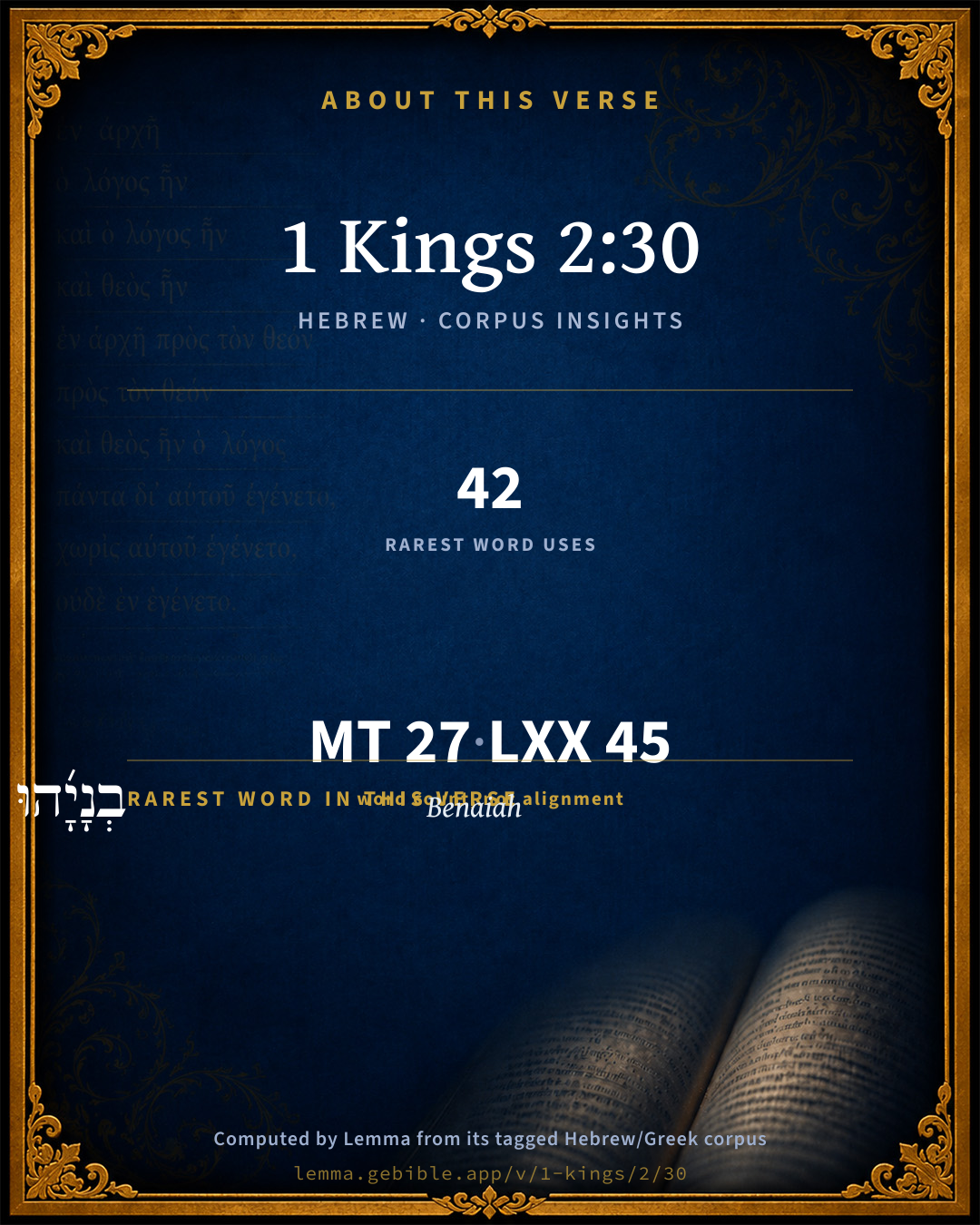
בְנָיָ֜הוּ Benaiah H1141 occurs in 41 verses of the Hebrew Bible. Also found in:

Grammatical profile

  • 10 verbs
  • 8 nouns
  • 2 prepositions
  • 1 conjunction
  • 4 adverbs
  • 2 particles

Verb forms

  • וַיָּבֹ֨א Qal · Sequential Imperfect
  • וַיֹּ֨אמֶר Qal · Sequential Imperfect
  • אָמַ֤ר Qal · Perfect
  • צֵ֔א Qal · Imperative
  • וַיֹּ֥אמֶר Qal · Sequential Imperfect
  • אָמ֑וּת Qal · Imperfect
  • וַיָּ֨שֶׁב Hiphil · Sequential Imperfect
  • לֵאמֹ֔ר Qal · Infinitive Construct
  • דִבֶּ֥ר Piel · Perfect
  • עָנָֽנִי Qal · Perfect

Repetition

Words recur within this verse — often emphatic in Hebrew:

  • וַיֹּ֨אמֶר to say H559 ×4
  • כֹּֽה thus H3541 ×3
  • בְנָיָ֜הוּ Benaiah H1141 ×2
  • הַמֶּ֨לֶךְ֙ king H4428 ×2
  • אֶל to H413 ×2

Hebrew & Septuagint length

In English translation the verse runs 40 words from the Hebrew and 59 from the Septuagint (LXX English) — the Septuagint runs noticeably longer here. See the side-by-side →

A rough comparison of the two English renderings, which tokenize alike — not a word-level alignment.

Word counts can differ between the Hebrew and the Greek without any difference in meaning — e.g. the Hebrew direct-object marker אֵת has no separate Greek word, and Greek often adds the article ὁ.

In the original languages it is 27 Hebrew tokens and 45 Greek tokens — but the two are counted differently (Hebrew bundles its prefixes and suffixes into one token; the Greek is in lemma form), so that isn’t a like-for-like length.

Hebrew and Greek witnesses Masoretic Hebrew ↔ Greek Septuagint

The same verse in the two great witnesses to the Old Testament, shown verse-for-verse.

Here the Septuagint runs noticeably longer than the Hebrew — LXX2012 (modern English Septuagint) 59 words vs World English Bible 40. A rough length comparison of the two English translations, not a word-level alignment — read both below.

These are two independent witnesses, not word-aligned to each other, and the Septuagint is shown in lemma (dictionary) form.

Hebrew 1 Kings 2:30 Masoretic · Westminster Leningrad Codex

וַיָּבֹ֨א בְנָיָ֜הוּ אֶל אֹ֣הֶל יְהוָ֗ה וַיֹּ֨אמֶר אֵלָ֜יו כֹּֽה אָמַ֤ר הַמֶּ֨לֶךְ֙ צֵ֔א וַיֹּ֥אמֶר לֹ֖א כִּ֣י פֹ֣ה אָמ֑וּת וַיָּ֨שֶׁב בְּנָיָ֤הוּ אֶת הַמֶּ֨לֶךְ֙ דָּבָ֣ר לֵאמֹ֔ר כֹּֽה דִבֶּ֥ר יוֹאָ֖ב וְכֹ֥ה עָנָֽנִי

Benaiah came to the Tent of Yahweh, and said to him, Thus says the king, Come forth. He said, No; but I will die here. Benaiah brought the king word again, saying, Thus said Joab, and thus he answered me.

World English Bible · Public Domain

Greek LXX 1 Kings 2:30 Septuagint · lemma form

καί ἔρχομαι βαναιας υἱός ιωδαε πρός ιωαβ εἰς ὁ σκηνή ὁ κύριος καί εἶπον αὐτός ὅδε λέγω ὁ βασιλεύς ἐκἔρχομαι καί εἶπον ιωαβ οὐ ἐκπορεύομαι ὅτι ὧδε ἀποθνήσκω καί ἀποστρέφω βαναιας υἱός ιωδαε καί εἶπον ὁ βασιλεύς λέγω ὅδε λαλέω ιωαβ καί ὅδε ἀποκρίνω ἐγώ

And Banaeas son of Jodae came to Joab to the tabernacle of the Lord, and said to him, Thus says the king, Come forth. And Joab said, I will not come forth, for I will die here. And Banaeas son of Jodae returned and spoke to the king, saying, Thus has Joab spoken, and thus has he answered me.

LXX2012 (modern English Septuagint) · Public Domain

Hebrew: Westminster Leningrad Codex (CC BY 4.0). Greek: Septuagint (public domain); English from LXX2012 (modern English Septuagint) (Public Domain). How the Septuagint differs from the Hebrew →

Targum (Aramaic paraphrase)

1

The Targum is the ancient Jewish Aramaic paraphrase of the Hebrew Scriptures — an interpretive translation, not the Hebrew text itself. Onkelos (literal) and Pseudo-Jonathan (expansive) render the Torah, and Jonathan the Prophets. Coverage is partial: where no permissively-licensed English translation exists for a verse, only the Aramaic is shown. This is verse-level text, not a word-by-word alignment to the Hebrew.

  1. Targum Jonathan Prophets (Joshua–Malachi)
    וַאֲתָא בְּנָיָהוּ לְמַשְׁכְּנָא דַייָ וַאֲמַר לֵיהּ כִדְנַן אֲמַר מַלְכָּא פוּק וַאֲמַר לָא אֲרֵי כָּא אִתְקְטֵיל וַאֲתֵיב בְּנָיָהוּ יַת מַלְכָּא פִּתְגָמָא לְמֵימַר כְּדֵין מַלֵיל יוֹאָב וּכְדֵין אֲתֵיבָנִי:

    (no public-domain English translation for this verse)

    Targum Jonathan — Aramaic: “Mikraot Gedolot” (public domain). English: “Sefaria Community Translation” (CC0 1.0 (public-domain dedication)); “London "Chaldee Paraphrase," 1871” (public domain). Text via Sefaria.

Commentary

Notes on 1 Kings 2:30 from classic Christian and Jewish commentators (each source and its license shown beneath its notes). The classic Christian expositions comment on the surrounding passage and are grouped to its opening verse, so a note may address several verses; the Jewish commentaries on the Tanakh (Rashi and others) are per-verse, so they appear only where the commentator wrote on this verse.

Lemma curates 59 commentaries, every one of them public domain or Creative Commons licensed, each selected and text-cleaned for this edition rather than reprinted as found. About our sources →

Trapp's Complete Commentary

John Trapp

1Ki 2:30 And Benaiah came to the tabernacle of the LORD, and said unto him, Thus saith the king, Come forth. And he said, Nay; but I will die here. And Benaiah brought the king word again, saying, Thus said Joab, and thus he answered me.

Ver. 30. Nay, but I will die here.] He dreamed not now of death; as hoping that his murdering of the two captains had been forgotten, and that for his conspiracy with Adonijah, the altar might secure him. But "the hypocrite’s hope is as the giving up of the ghost." {Job 27:8}

John Trapp, A Commentary or Exposition upon All the Books of the Old and New Testament (1647–1656) — public domain. Text from a community e-Sword module.

The Biblical Illustrator

Joseph S. Exell

1Ki_2:30-34

Nay; but I will die here.

A warriors death

The circumstances in which Joab uttered the words, Nay; but I will die here, were the outcome of a conspiracy which had been formed during the latter days of David to prevent Solomon, his son, reigning in his stead.

I. Joabs character. Joab as a man was somewhat like Esau, belligerent from his youth. As one of the sons of Zeruiah, of whom David complained that they were too hard for him, he readily acquired the character of a reckless soldier, and a most unscrupulous disposition. However brave or successful as a warrior, he was never known to forget an insult or to forgive an injury. He always waited for his enemies, real or supposed, as a bear robbed of her whelps, and would punish them without mercy. In some respects he was more cruel and vindictive than Nero, or any of the Roman Caesars. It was in cold blood that he assassinated Abner, and slew Absalom with his own hand. These and similar acts of cruelty, instead of checking his career, or making him more thoughtful, only paved his way for the commission of still greater crimes. He cared as little for the kings curse, on account of Abners assassination, as he cared for the kings grief over Absaloms death. For years he had been guilty of shedding the blood of innocents, and the king seems to have been powerless in checking him or punishing him for his enormous crimes. But on his death-bed he charged Solomon to deal with him, so that the innocent blood which he had shed might be purged from him and from his fathers house (1Ki_2:31). This was the character of Joab, the man who fled in terror to the tabernacle of the Lord, and laid hold upon the horns of the altar.

II. Joabs refuge. Why did Joab, in his extremity, run to the tabernacle? As a drowning man is said to catch at a straw, Joab ran to the tabernacle as his only hope of safety. It was the hour of his desperation; the pressure of destiny was upon his heart, the Nemesis of retribution had laid hold upon him; and rather than die like Judas, he would lay hold upon the horns of the altar as his only means of salvation. But he had no right to do so. He was one of those expressly forbidden by the law of Moses (Deu_19:12) to enter the tabernacle, or to lay hold upon the horns of the altar. As a murderer--as a murderer with guile, as a murderer with deliberate purpose--he had no right to take refuge in Gods sanctuary, or to lay hold upon the altar with his defiled hands. Solomon knew the law, and honoured it when he commanded Benaiah to drag him forth from the altar and have him slain (Exo_21:14). But what cares a sinner, who has lived all his days to outrage all law and order, when pressed by the shadows or pangs of despair, whether he enters in by the door or climbs up some other way? When he becomes, like Samson, a helpless creature--his eyes out, and sport for the Philistines--he will dare the most terrible things, if only he can be saved.

III. Joabs resolution. There he would die, and nowhere else. It has been said that soldiers, as a class, are not greatly concerned for religion. It was alleged by Dean Swift that no class of men had so little sense of religion as English soldiers. It is said that Pope Gregory the Great tried hard at one time to assure the Emperor that it was not a thing impossible to discover devout soldiers in the army. Gibbon, the historian, records the ease of a Roman general who as early as the year 398 a.d. spent most of his time in praying and fasting, and singing Psalms. But he has evidently more satisfaction in telling us of the soldier who, before some terrible battle, prayed thus, Oh God--if there be a God--save my soul--if I have a soul. Perhaps we ought to regard such men as Colonel Gardiner, Sir Henry Havelock, Captain Hedley Vicars, General Lee, General Gordon, and Gustavus Adolphus, as exceptions to what is common in military circles. But there is nothing necessarily antagonistic to a religious life in the army. It is not necessary that a soldier should be brutal in his character or a murderer in heart and action. But Joab was so. He was utterly regardless of human life, and lived far from God and righteousness. We may regard Joabs resolution as the outcome of nature, not of fear. It is the fashion of our foolish presumption, says Bishop Hall, to look for protection, under the pressure of necessity, when we have not cared to yield obedience. Even a Joab clings to Gods altar in the hour of his extremity, which in his prosperity ha regarded not. Necessity will drive the most profane and lawless men to God. When the Angel of Death comes to men in no unmistakable way, when, by ago or by accident, lingering sickness or the sorrows of bereavement, they seem to hear it said, Set thine house in order, for thou shalt die, and not live! or when, in some significant way, their doom is forecast, as Belshazzars doom was written upon his palace wall, they will waken up and cry out for a refuge in despair. But as there is a mirage in the spiritual as well as in the natural world, they may find that the harvest is past and the summer ended; they may find that prayers then extorted are in vain--the hour of mercy pearl Those who are saved at Gods altar are drawn to it, never driven. (J. K. Campbell, D. D.)

General Joab

1. Joab was a man of war. He delighted in battle, he scented it from afar, the thought of it was in his heart. He never saw the tragedy--the madness of it; or, if he did, he ignored it, as thousands of great soldiers have done. He was a man of blood and iron, a lesser Napoleon, who climbed to greatness, such aa it was, over a hecatomb of corpses. He was never happy but amid tumult and bloodshed; the sweetest music that over greeted his ear was the bugle call to charge the enemy. Empire-making was his life-work, but, fortunately, Davids ambition was limited to a small geographical area, and Joab had no standing army at his beck and call, or the peace of the world would not have been safe for a single day.

2. The havoc wrought by envy. Joab was Davids sisters son, a fact he never forgot himself, and never permitted others to forget. Davids brothers never quite forgave him being greater than themselves. Abner and the rest, could not forget that scene in the vale of Succoth, when David by one supreme act of faith and courage became the nations idol. Sauls was not the only heart which felt the pang of jealousy that day. Envy, that black imp of hell, was dancing in and out amid the troops of Israel, and he wrought great havoc in Jesses household. Only great natures can rejoice at the prosperity of others. A man had better take a nest of rattlesnakes into his bosom than envy into his heart. But among those who stood staunch and true to David was his nephew, Joab. He had his faults, but treachery was not one of them, and he was a courageous man, and could not only fight himself, but could inspire others; and he possessed that dogged perseverance that never knows when it is beaten, but rises out of the ashes of defeat to fight once more and to conquer. The battle is lost, sire, said a messenger to Napoleon one morning. Then, he said, pulling out his watch, there is time to win another. And that was Joab, too, a very glutton for a hard fight, who never admitted defeat, but just kept pounding away, as Wellington said, until the enemy yielded. But Joab had the defect of his qualities: he was selfish, ambitious, with a nature of stone and iron; there was no light and shade in his character; he never suffered himself to be thwarted, but bore all down by the violence of his temper. And David grew to be afraid of this imperious, loud-voiced, combative nephew of his, and perhaps to yield to him on occasions when it would have been better if he had not.

3. David plays the fool Joab was a great man, his own nephew, a very useful man when the kingdom was threatened, and so David made a tearful speech, and let the culprit go. And Joab from that day thought himself indispensable, and acted accordingly. And the time came when David played the fool, as he now played the coward. A beautiful woman bewitched him, and he fell so foully that we stand and gape in astonishment at the deed of wickedness David did. The saddest thing on earth is when a good man forgets himself, turns his back on God, and shakes hands with the devil. Do not mistake me, said saintly Jacob Behmen, the mystic, so beloved by Dr. Whyte, for my heart is as full as it can be of all malice, and all ill will. My heart is the very dunghill of the devil, and it is no easy matter to wrestle with him on his chosen ground. But wrestle with him on this ground of his I must, and that the whole of my life to the end. I have never read of a crime, says Goethe, which I might not have committed. And the lust of the eyes seized David, and he wrote a disgraceful letter to Joab, who, when he read it, gave a hoarse, derisive laugh, and felt glad in his heart, for there are hard, coarse natures who delight in the moral downfall of a better man. If Joab had been the friend of David he would have torn that letter into thousands of pieces, and he would have gone forth and remonstrated with the king, for he is our best friend who cannot bear to see stain upon our character, and who will risk giving offence rather than let us cheapen ourselves in the eyes of the world. But Joab kept the letter as a precious treasure, for use on another day.

4. Joab master of the situation. And Joab obeyed the letter, and put Uriah in the front of the battle, and the brave soldier fell fighting for the king who planned his death, and dreamt not that his general was the worst foe that he had that day. It was as shameful a deed as ever was committed on a battlefield. And from that hour Joab twisted the king round his little finger. David never lost his conscience, and it is the man who has a conscience who suffers. What a mental purgatory the spiritually minded man lives in who has fallen from grace. Hawthorne in The Scarlet Letter has shown us how a secret sin eats like a cancer at the heart until confession becomes, not only a necessity, but a relief. Joab could sleep as soundly as a child, and no vision of the slain Uriah came to haunt him. But David could not. Through many a sleepless hour he wailed out his broken-hearted penitence in psalm and prayer. This man could not go through a mire of sin and be merry over it, he could not forget, and forgetting is the sinners only refuge. Better a thousand times be David, with his tear-smitten face turned Godward, hating himself for the wrong done, than the sneering, self-complacent old warrior who found no place for repentance. Such men as Joab make hell a necessity of the future if ever justice is to be done, and right vindicated. Yes, I believe in hell, I cannot but believe in it, or there is no such thing as justice. It is awful to see the sinner when remorse has seized him. But I tell you what is far more awful, and that is to see the sinner going on cursing, laughing, unheeding to his doom, as indifferent as the fattened ox goes to the shambles. The best things in life are tenderness, sweetness, graciousness; and Joab never saw them, never knew them, but was always harsh, strident, and stern. (S. Horton.)

.

The Biblical Illustrator, edited by Joseph S. Exell (c. 1880s–1900s) — public domain. Text from a community e-Sword module.

Adam Clarke's Commentary

Verse 30. Nay; but I will die here.] The altars were so sacred among all the people, that, in general, even the vilest wretch found safety, if he once reached the altar. This led to many abuses, and the perversion of public justice; and at last it became a maxim that the guilty should be punished, should they even have taken refuge at the altars. God decreed that the presumptuous murderer who had taken refuge at the altar should be dragged thence, and put to death; see Ex 21:14. The heathens had the same kind of ordinance; hence Euripides: -

Εγω γαρ ὁστις μη δικαιος ων ανηρπ

Βωμον προσιζει, τον νομον χαιρειν εων,π

Προς την δικην αγοιμ ' αν, αυ τρεσας θεους·

Κακον γαρ ανδρα χρη κακως πασχειν αει.

EURIPID. Frag. 42. Edit. Musg.

"If an unrighteous man, availing himself of the law, should claim the protection of the altar, I would drag him to justice, nor fear the wrath of the gods; for it is necessary that every wicked man should suffer for his crimes."

Adam Clarke's Commentary on the Bible (1810–1826) — public domain. Text from a community e-Sword/MySword module.

The Cambridge Bible for Schools and Colleges

gen. ed. J. J. S. Perowne

30. Come forth] Benaiah would prefer, if it may be, to execute the sentence upon Joab elsewhere than within the precincts of the tabernacle.

I will die here] Joab is conscious of Benaiah’s errand, but perhaps hopes still to escape death if he remain at the altar.

brought the king word again] It seems from this that Solomon had thought it would be possible to bring Joab away from the altar. When this could not be done Benaiah feels that he may return for further orders.

The Cambridge Bible for Schools and Colleges (gen. ed. J. J. S. Perowne; Cambridge University Press, 1878–1918) — public domain. Text from a community e-Sword module.

John Gill's Exposition

And the king said unto him, do as he hath said, and fall upon him, and bury him,.... Let him die where he is, slay him upon the spot, and then bury him; not by the altar, but in his own sepulchre, as later related, that in, give orders to bury him there; for Benaiah being a priest, could not be concerned in the burial of him, and besides it was below the dignity of his office:

(, Ch1 27:2 where Gill advances resaons for Benaiah not being a priest. Editor.)

that thou mayest take away the innocent blood, which Joab shed, from me, and from the house of my father; which had been too long connived at, and had called for vengeance; and now here was a proper opportunity upon fresh sins committed to avenge it, and so remove the guilt, which lay upon him and his father's house, for not inflicting deserved punishment on him for it.

John Gill's Exposition of the Whole Bible (1746–1763) — public domain (CC PDM 1.0). Text via the HelloAO Bible API.

Haydock's Catholic Bible Commentary

Die, if my life must not be spared. (Haydock) --- He knew that the like precaution would not have been able to protect Adonias. It was not just that he, who had despised all that was sacred, should find an asylum at the altar itself.

George Leo Haydock (1774–1849), Haydock's Catholic Family Bible and Commentary, 1859 edition — public domain. Excludes Psalms (Douay-Rheims chapter numbering differs from Protestant) and Deuterocanonical books (Catholic canon only).

Matthew Poole's English Annotations

Thus saith the king, Come forth: that the king gave him this command, though it be not mentioned before, is evident, both from the nature of the thing; for Solomon would not pollute the altar without necessity; and from Benaiah’s affirmation of it; for why should he tell a lie without a cause? and from his return to the king for new orders upon Joab’s resolution not to come thence.

I will die here; for he supposed either that Solomon would not defile that place with his blood; or that he would spare him for his respect to it, as he had done Adonijah; or he had a superstitious conceit that his dying there might give his guilty and miserable soul some advantage.

Matthew Poole's English Annotations on the Holy Bible (1683–1685) — public domain. Text from a community e-Sword/MySword module.

Whedon's Commentary on the Bible

Daniel D. Whedon

30. Come forth — Such criminals as Joab even the altar would not defend, but the law required that they be taken from the altar to be slain. “If a man come presumptuously on his neighbour to slay him with guile, thou shalt take him from mine altar that he may die.” Exo_21:14.

Nay; but I will die here — He knew that to leave that sacred spot was to go to certain death, and he seems to have hoped that Solomon’s reverence for the altar would prevent his being slain there. But his bloodguiltiness was, in Solomon’s mind, too great to admit him to the least compassion. Compare Num_35:30-33 and Deu_19:13.

Daniel D. Whedon (gen. ed.), Commentary on the Old and New Testaments (1874–1909) — public domain. Text from a community e-Sword module.

The Pulpit Commentary

And Benaiah came to the tabernacle of the Lord, and said unto him Benaiah evidently "hesitated to stain the altar with blood." It was only the sanctity of the altar which made it an asylum. There was strictly no "right of sanctuary", Thus saith the king, Come forth. Probably Solomon bad directed that Joab should, if possible, be induced to leave the altar. Every Jew would dread its profanation by strife and bloodshed. And he said, Nay; but I will die here. Heb. here will I die. Joab may possibly have thought that Solomon would hardly venture to put him to death there, and that so he might somehow escape with his life. But it is more probable that he counted on death, and that a feeling of superstition, or of defiance, had decided him to meet his doom there. It should be borne in mind that gross superstition not uncommonly accompanies irreligion and brutality; and it is quite conceivable that Joab hoped for some indefinable benefit from the shadow of the altar, much as the poor Polish Jew expects from burial in Jerusalem. Or his motive may have been defiance, thinking he would "render Solomon odious to the people, as a profaner of the Holy Place" (M. Henry). It can hardly have been to put off forever so short a time the execution, as Bishop Hall imagines.

The Pulpit Commentary (1880–1919), ed. H.D.M. Spence-Jones & Joseph S. Exell — public domain. Text from a community e-Sword module.

John Wesley's Explanatory Notes

He said, Nay, &c. - For he supposed, either, that Solomon would not defile that place with his blood, but would spare him for his respect to it, as he had done Adonijah: or, he had a superstitious conceit, that his dying there might give his guilty and miserable soul some advantage.

John Wesley, Explanatory Notes Upon the Whole Bible (1754–1765) — public domain. Text via the GEBible commentary corpus.

unfoldingWord translationNotes

Door43 World Missions Community

General Information:

Benaiah goes to execute Joab.

bury him so that you may take away from me and from my father's house the blood that Joab shed without cause

Here "house" stands for the descendants of David while "blood" represents guilt. AT: "bury him and so remove from me and my family the guilt for the murders Joab committed without cause" or "bury him. Do that so Yahweh will not hold me and my father's house guilty because Joab murdered people for no reason" (See: Metonymy)

translationWords

Benaiah

king

die

bury

ancestor

house

blood

unfoldingWord translationNotes — © Distant Shores Media and the Door43 World Missions Community, licensed CC BY-SA 4.0. Source: git.door43.org/Door43/en_tn.

Rashi

Rabbi Shlomo Yitzchaki (Rashi)

And he said, “No.” Two [punishments] I will not accept upon myself. The curses that your father Dovid cursed me at the death of Avner, as it is stated, “They shall fall upon the head of Yo’av.” let Shlomo accept them upon himself, and afterward I will go.

Rashi on the Tanakh — English translations: “The Judaica Press complete Tanach with Rashi, translated by A. J. Rosenberg” (CC BY 4.0); “Pentateuch with Rashi's commentary by M. Rosenbaum and A.M. Silbermann, 1929-1934” (public domain); “The Metsudah Tanach series, Lakewood, N.J” (CC BY 4.0); and “The Book of Joshua, Metsudah Publications, 1997” (CC BY 4.0). Text via Sefaria.

Lesson kit

Teaching starters — assembled from the data on this page, not authored interpretation. Every prompt links to the verse data it draws on. Edit before teaching.

1 Kings, in the Historical, opens this verse with 27 words (19 distinct Hebrew lemmas). Its most distinctive word is Bᵉnâyâh (“Benaiah”). The Greek Septuagint runs longer here. A historical commentator’s framing appears above. Read the whole chapter for the surrounding context.

Discussion questions

  1. The word Bᵉnâyâh carries the sense “Benaiah.” How does it shape the verse?
  2. 2 Samuel 8:18 shares the word «Benaiah» with this verse. How do the two illuminate each other?
  3. “to say” occurs 4× in this one verse. What is the effect of the repetition?
  4. Compared with the Hebrew, the Septuagint runs longer here. What questions does that raise?
  5. These translations render this verse differently; the difference is in the English rendering, not the original. What questions does that raise?
  6. The verb «וַיָּבֹ֨א» is Qal Sequential Imperfect. How does its form color the action?
  7. Reading how Trapp's Complete Commentary and The Biblical Illustrator read this verse, where do the two commentators agree and where do they part?

Things to notice

Reading settings

Reading text

Shown beneath each verse's original-language words.

Old Testament
Old Testament edition

Read the OT as the Masoretic Hebrew (MT) or the Greek Septuagint (LXX).

English shown for the Greek Septuagint (in the Hebrew ↔ Greek comparison).

Comparing translations? Open the Compare panel on any verse page to stack up to four side by side.