
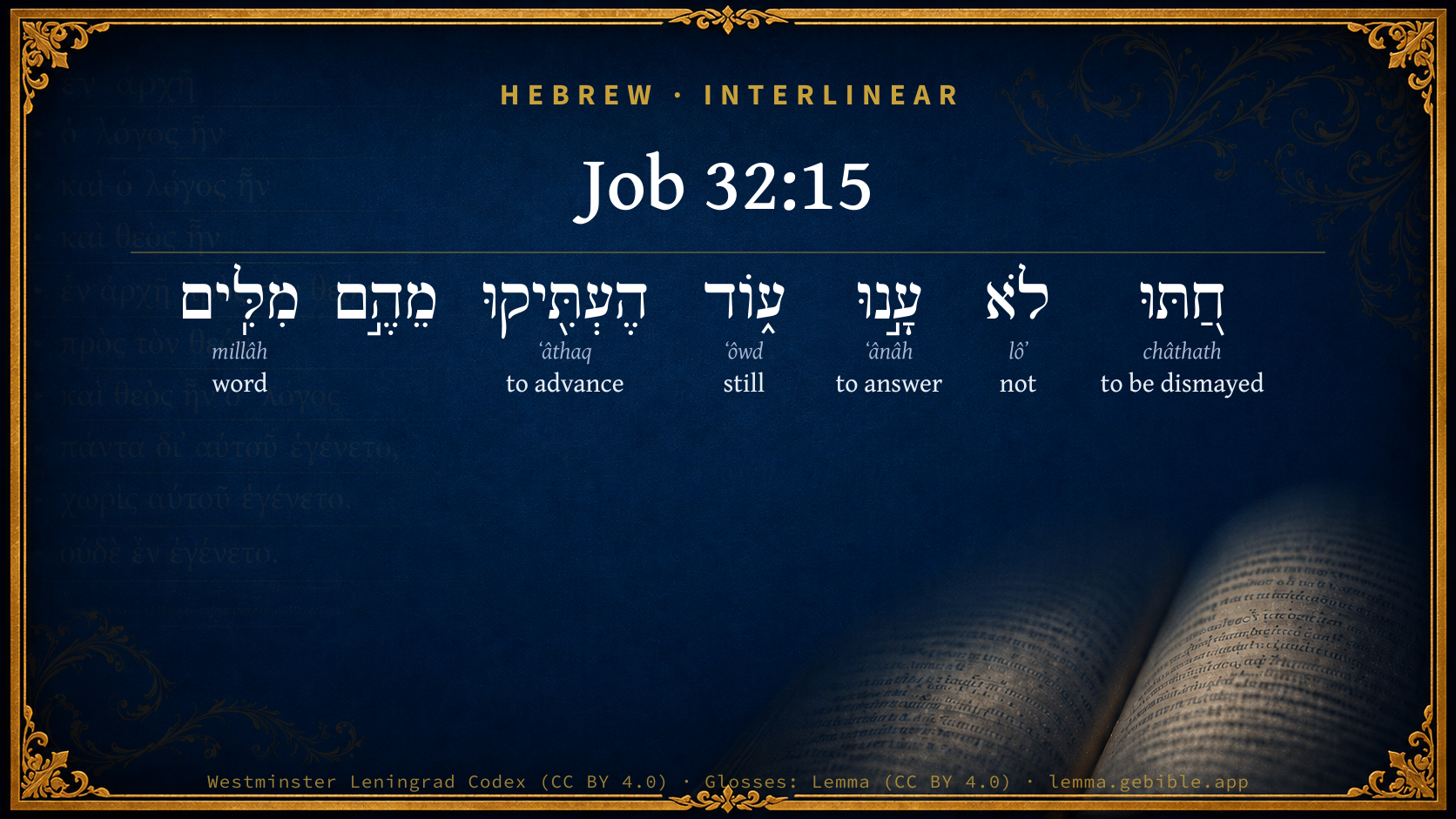
Job 32:15

Hebrew (Westminster Leningrad Codex) Job 32:15 appears in the Hebrew Old Testament. The text above is from the Westminster Leningrad Codex. Each word links to its Strong’s number, a concise gloss, and parsing drawn from the Open Scriptures Hebrew Bible morphology. Click any word for its full Brown-Driver-Briggs (BDB) entry.
Download image
Cite this verse

Job 32:15 (World English Bible). Public Domain. Lemma interlinear Bible study tool, https://lemma.gebible.app/v/job/32/15.

Show BibTeX & RIS
BibTeX
RIS
English Translation
"They are amazed. They answer no more. They don't have a word to say.
World English Bible · Public Domain
Download a study sheet

One document with this verse’s original text, its word-by-word gloss line, the meaning frame, cross-references with their text, attributed commentary, and full source and license credits — printable, and it pastes into notes with its structure intact.

This verse Autodidact and up

Study sheet (.html) Plain text (.txt)

A passage Seminary Student

Up to 50 verses in one chapter. A passage sheet keeps up to 6 commentary sources and 12 cross-references per verse, in the order this page ranks them, and says so on the sheet whenever that leaves anything out. Ask for a single verse and you get the Autodidact verse sheet above.

Everything on this page stays free to read, with no account — the sheet is a download of what is already on screen, not access to it.

Want to remove ads? Support Godless Engineer
Compare translations 3

The same verse in 3 English versions, stacked beneath the original-language interlinear above. Click any original word for its lexicon entry.

Each is an independent rendering of the whole verse — the interlinear is not word-aligned to these translations.

Highlighted words mark where these versions differ — a whole-verse word diff, not a word-by-word alignment.

  • World English Bible Public Domain
    "They are amazed. They answer no more. They don't have a word to say.
  • King James Version Public Domain
    They were amazed, they answered no more: they left off speaking.
  • unfoldingWord Literal Text CC BY-SA 4.0
    They are dismayed; they do not answer any longer; words have gone from them.

unfoldingWord Literal Text — © unfoldingWord, licensed CC BY-SA 4.0. Word-aligned USFM3 via Door43 (git.door43.org/unfoldingWord/en_ult).

Versions to compare (up to 4)

3 of 4 selected

Show all 18 translations

Every available English version of this verse, each an independent rendering of the whole verse.

  • World English Bible Public Domain
    "They are amazed. They answer no more. They don't have a word to say.
  • Berean Standard Bible Public Domain
    Job’s friends are dismayed, with no more to say; words have escaped them.
  • Majority Standard Bible Public Domain
    Job’s friends are dismayed, with no more to say; words have escaped them.
  • King James Version Public Domain
    They were amazed, they answered no more: they left off speaking.
  • American Standard Version (1901) Public Domain
    They are amazed, they answer no more: They have not a word to say.
  • Revised Version (1885) Public Domain
    They are amazed, they answer no more: they have not a word to say.
  • Geneva Bible (1599) Public Domain
    Then they fearing, answered no more, but left off their talke.
  • Douay-Rheims (1899) Public Domain
    They were afraid, and answered no more, and they left off speaking.
  • Young's Literal Translation Public Domain
    (They have broken down, They have not answered again, They removed from themselves words.
  • Literal Standard Version CC BY-SA 4.0
    (They have broken down, || They have not answered again, || They removed words from themselves.
  • Unlocked Literal Bible CC BY-SA 4.0
    These three men are dumbfounded; they can answer Job no longer; they have not a word more to say.
  • unfoldingWord Literal Text CC BY-SA 4.0
    They are dismayed; they do not answer any longer; words have gone from them.
  • Darby Bible Public Domain
    They were amazed, they answered no more; words failed them.
  • World Messianic Bible Public Domain
    “They are amazed. They answer no more. They don’t have a word to say.
  • Webster's Bible Public Domain
    They were amazed, they answered no more: they left off speaking.
  • Free Bible Version CC BY-SA 4.0
    You sit there speechless with nothing left to say.
  • Bible in Basic English Public Domain
    Fear has overcome them, they have no more answers to give; they have come to an end of words.
  • JPS Tanakh (1917) Public Domain
    They are amazed, they answer no more; words are departed from them.

Literal Standard Version (2020), Covenant Press — licensed CC BY-SA 4.0. Text via the HelloAO Bible API (eBible.org). Unlocked Literal Bible (unfoldingWord) — licensed CC BY-SA 4.0. Text via the HelloAO Bible API (eBible.org). unfoldingWord Literal Text — © unfoldingWord, licensed CC BY-SA 4.0. Word-aligned USFM3 via Door43 (git.door43.org/unfoldingWord/en_ult). Free Bible Version, Dr. Jonathan Gallagher — licensed CC BY-SA 4.0. Text via the HelloAO Bible API (eBible.org).

Word by word

More ways to search: Search by grammar → Find every occurrence → Compare this word →

Practice this passage: Drill this verse → Learn its vocabulary →

הֶעְתִּ֖יקוּ
ʻâthaq
H6275
“to advance”
Verb, Hiphil, Perfect, 3rd Person, Common, Plural
Part of Speech
Verb
Stem
Hiphil
Form
Perfect
Person
3rd Person
Gender
Common
Number
Plural
Full BDB Definition

Origin: a primitive root

TWOT: 1721

to move, proceed, advance, move on, become old, be removed - (Qal) - to move - to advance (in years), grow old and weak - (Hiphil) - to move forward, proceed, move on - to remove - to transcribe
  1. חַ֭תּוּ châthath H2865 “to be dismayed” Verb, Qal, Perfect, 3rd Person, Common, Plural
  2. לֹא lôʼ H3808 “not” Particle, Negative
  3. עָ֣נוּ ʻânâh H6030 “to answer” Verb, Qal, Perfect, 3rd Person, Common, Plural
  4. ע֑וֹד ʻôwd H5750 “still” Adverb
  5. מִלִּֽים millâh H4405 “words” Noun, Common, Feminine, Plural, Absolute

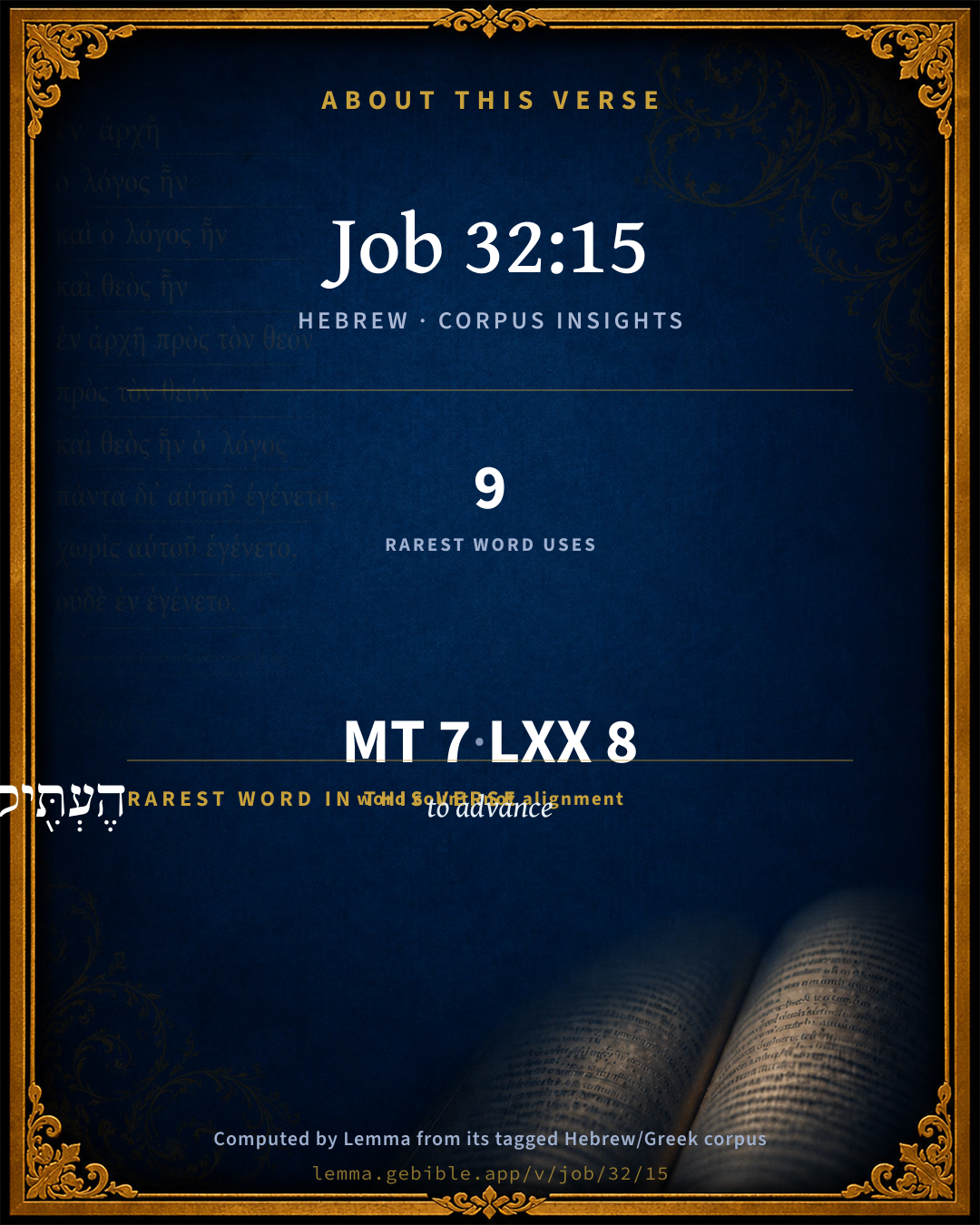
About this verse

These counts appear in no published source. They are computed here, from the morphology-tagged text and Lemma’s own curated glosses. What Lemma adds →

7
words
6
distinct lemmas
Wisdom
section

Notable vocabulary

The rarest word here is הֶעְתִּ֖יקוּ to advance H6275 — appearing just 9 times in the whole Hebrew Bible.

Shared distinctive vocabulary

הֶעְתִּ֖יקוּ to advance H6275 occurs in 9 verses of the Hebrew Bible. Also found in:

Grammatical profile

  • 3 verbs
  • 1 noun
  • 1 preposition
  • 1 adverb
  • 1 particle

Verb forms

  • חַ֭תּוּ Qal · Perfect
  • עָ֣נוּ Qal · Perfect
  • הֶעְתִּ֖יקוּ Hiphil · Perfect

Hebrew & Septuagint length

In English translation the verse runs 14 words from the Hebrew and 12 from the Septuagint (LXX English) — closely comparable.

A rough comparison of the two English renderings, which tokenize alike — not a word-level alignment.

Word counts can differ between the Hebrew and the Greek without any difference in meaning — e.g. the Hebrew direct-object marker אֵת has no separate Greek word, and Greek often adds the article ὁ.

In the original languages it is 7 Hebrew tokens and 8 Greek tokens — but the two are counted differently (Hebrew bundles its prefixes and suffixes into one token; the Greek is in lemma form), so that isn’t a like-for-like length.

Cross-references

7

Topical passages linked to Job 32:15 in the Treasury of Scripture Knowledge — connected by theme and wording, ordered by reader-vote popularity; previews shown in the World English Bible.

  • Job 6:24–25 "Teach me, and I will hold my peace; Cause me to understand wherein I have erred.
  • Job 29:22 After my words they didn't speak again; My speech fell on them.
  • Matthew 7:23 Then I will tell them, 'I never knew you. Depart from me, you who work iniquity.'
  • Matthew 22:22 When they heard it, they marveled, and left him, and went away.
  • Matthew 22:26 In like manner the second also, and the third, to the seventh.
  • Matthew 22:34 But the Pharisees, when they heard that he had put the Sadducees to silence, gathered themselves together.
  • Matthew 22:46 No one was able to answer him a word, neither dared any man from that day forth ask him any more questions.

Cross-references courtesy of OpenBible.info (CC BY 4.0).

Hebrew and Greek witnesses Masoretic Hebrew ↔ Greek Septuagint

The same verse in the two great witnesses to the Old Testament, shown verse-for-verse.

These are two independent witnesses, not word-aligned to each other, and the Septuagint is shown in lemma (dictionary) form.

Hebrew Job 32:15 Masoretic · Westminster Leningrad Codex

חַ֭תּוּ לֹא עָ֣נוּ ע֑וֹד הֶעְתִּ֖יקוּ מֵהֶ֣ם מִלִּֽים

"They are amazed. They answer no more. They don't have a word to say.

World English Bible · Public Domain

Greek LXX Job 32:15 Septuagint · lemma form

πτοέω οὐ ἀποκρίνω ἔτι παλαιόω ἐκ αὐτός λόγος

They were afraid, they answered no longer; they gave up their speaking.

LXX2012 (modern English Septuagint) · Public Domain

On this verse, Keil & Delitzsch discusses the Septuagint’s reading. Read the note in Commentary ↓

Hebrew: Westminster Leningrad Codex (CC BY 4.0). Greek: Septuagint (public domain); English from LXX2012 (modern English Septuagint) (Public Domain). How the Septuagint differs from the Hebrew →

Commentary

Notes on Job 32:15 from classic Christian and Jewish commentators (each source and its license shown beneath its notes). The classic Christian expositions comment on the surrounding passage and are grouped to its opening verse, so a note may address several verses; the Jewish commentaries on the Tanakh (Rashi and others) are per-verse, so they appear only where the commentator wrote on this verse.

Lemma curates 59 commentaries, every one of them public domain or Creative Commons licensed, each selected and text-cleaned for this edition rather than reprinted as found. About our sources →

Matthew Henry's Commentary

Three things here apologize for Elihu's interposing as he does in this controversy which had already been canvassed by such acute and learned disputants: -

1. That the stage was clear, and he did not break in upon any of the managers on either side: They were amazed (Job 32:15); they stood still, and answered no more, Job 32:16. They not only left off speaking themselves, but they stood still, to hear if any of the company would speak their minds, so that (as we say) he had room and fair play given him. They seemed not fully satisfied themselves with what they had said, else they would have adjourned the court, and not have stood still, expecting what might further be offered. And therefore I said (Job 32:17), "I will answer also my part. I cannot pretend to give a definitive sentence; no, the judgment is the Lord's, and by him it must be determined who is in the right and who is in the wrong; but, since you have each of you shown your opinion, I also will show mine, and let it take its fate with the rest." When what is offered, even by the meanest, is offered thus modestly, it is a pity but it should be fairly heard and considered. I see no inconvenience in supposing that Elihu here discovers himself to be the penman of this book, and that he here writes as an historian, relating the matter of fact, that, after he had bespoken their attention in the foregoing verses, they were amazed, they left off whispering among themselves, did not gainsay the liberty of speech he desired, but stood still to hear what he would say, being much surprised at the admirable mixture of boldness and modesty that appeared in his preface.

2. That he was uneasy, and even in pain, to be delivered of his thoughts upon this matter. They must give him leave to speak, for he cannot forbear; while he is musing the fire burns (Psa 39:3), shut up in his bones, as the prophet speaks, Jer 20:9. Never did nurse, when her breasts were gorged, so long to have them drawn as Elihu did to deliver his mind concerning Job's case, Job 32:18-20. If any of the disputants had hit that which he thought was the right joint, he would contentedly have been silent; but, when he thought they all missed it, he was eager to be trying his hand at it. He pleads, (1.) That he had a great deal to say: "I am full of matter, having carefully attended to all that has hitherto been said, and made my own reflections upon it." When aged men are drawn dry, and have spent their stock, in discoursing of the divine Providence, God can raise up others, even young men, and fill them with matter for the edifying of his church; for it is a subject that can never be exhausted, though those that speak upon it may. (2.) That he was under a necessity of saying it: "The spirit within me not only instructs me what to say, but puts me on to say it; so that if I have not vent (such a ferment are my thoughts in) I shall burst like bottles of new wine when it is working," Job 32:19. See what a great grief it is to a good minister to be silenced and thrust into a corner; he is full of matter, full of Christ, full of heaven, and would speak of these things for the good of others, but he may not. (3.) That it would be an ease and satisfaction to himself to deliver his mind (Job 32:20): I will speak, that I may be refreshed, not only that I may be eased of the pain of stifling my thoughts, but that I may have the pleasure of endeavouring, according to my place and capacity, to do good. It is a great refreshment to a good man to have liberty to speak for the glory of God and the edification of others.

3. That he was resolved to speak, with all possible freedom and sincerity, what he thought was true, not what he thought would please (Job 32:21, Job 32:22): "Let me not accept any man's person, as partial judges do, that aim to enrich themselves, not to do justice. I am resolved to flatter no man." He would not speak otherwise than he thought, either, (1.) In compassion to Job, because he was poor and in affliction, would not make his case better than he really took it to be, for fear of increasing his grief; "but, let him bear it as he can, he shall be told the truth." Those that are in affliction must not be flattered, but dealt faithfully with. When trouble is upon any it is foolish pity to suffer sin upon them too (Lev 19:17), for that is the worst addition that can be to their trouble. Thou shalt not countenance, any more than discountenance, a poor man in his cause (Exo 23:3), nor regard a sad look any more than a big look, so as, for the sake of it, to pervert justice, for that is accepting persons. Or, (2.) In compliment to Job's friends, because they were in prosperity and reputation. Let them not expect that he should say as they said, any further than he was convinced that they say right, nor applaud their dictates for the sake of their dignities. No, though Elihu is a young man, and upon his preferment, he will not dissemble truth to court the favour of great men. It is a good resolution he has taken up - "I know not to give flattering titles to men; I never used myself to flattering language;" and it is a good reason he gives for that resolution - in so doing my Maker would soon take my away. It is good to keep ourselves in awe with a holy fear of God's judgments. He that made us will take us away in his wrath is we do not conduct ourselves as we should. He hates all dissimulation and flattery, and will soon put lying lips to silence and cut off flattering lips, Psa 12:3. The more closely we eye the majesty of God as our Maker, and the more we dread his wrath and justice, the less danger shall we be in of a sinful fearing or flattering of men.

Matthew Henry's Commentary on the Whole Bible (1708–1710) — public domain (CC PDM 1.0). Text via the HelloAO Bible API.

Trapp's Complete Commentary

John Trapp

Job 32:15 They were amazed, they answered no more: they left off speaking.

Ver. 15. They were amazed] As if they had seen Medusa’s head, {Gr. Myth. One of the three Gorgons whose head, with snakes for hair, turned him who looked upon it into stone; she was slain by Perseus, and her head fixed on the ægis or shield of Athene.} or some such terrible spectacle, that had rendered them dumb. Talkative enough they have been when there was no such necessity; but now that they might speak to some purpose they stand like stocks, and are mute as fishes, whereby they bewray their ignorance and folly. Silence in some cases is sepes sapientiae, as the Rabbis speak (Pirkeaboth), the fruit and sense of wisdom, Amo 5:13; {See Trapp on "Amo 5:13"} But in addition there is a sinful silence, which Luther wished never to be found guilty of, Modo impii silentii non arguar. And it is the devil, doubtless, that gaggeth people when being called to speak of, or for, God, as these friends of Job were at this time, they answer no more.

They leave speaking] They desert a good cause, or betray it by a cowardly silence. It may be feared the spirit of faith is no indweller, where the door of the lips move not right, 2Co 4:13. He speaks thus of those three seniors in a third person, by way of irony and contempt, turning his talk to the bystanders, whereof it is likely there were many; or (as Tremellius thinketh) to Job, with whom he seeketh to ingratiate.

John Trapp, A Commentary or Exposition upon All the Books of the Old and New Testament (1647–1656) — public domain. Text from a community e-Sword module.

Joseph Benson's Commentary

Job 32:15-16. They were amazed — Job’s three friends stood mute, like persons amazed, not knowing what to reply to his arguments, and wondering at his bold and confident assertions concerning his integrity, and his interest in the favour of God, under such terrible and manifest tokens, as they thought them, of God’s just displeasure against him. They answered no more — Although Job gave them just occasion to confute and reprove him for his intemperate speeches, and his presumptuous and irreverent expressions concerning God. When I had waited they spake not, &c. — Which he repeats as a strange and unreasonable thing, that they should be silent when they had such obligations to speak for the vindication both of God’s justice, and of their own truth and reputation.

Joseph Benson's Commentary on the Old and New Testaments (1811–1818) — public domain. Text from a community e-Sword module.

Whedon's Commentary on the Bible

Daniel D. Whedon

Third section — He now turns and addresses another auditory, (probably the silent one from which he has so recently come, whom it is important also to conciliate, see note on Job_32:4,) and gives in detail his reasons for speaking: 1) The complete discomfiture of the friends. 2) The divine and irresistible afflatus within him. 3) The spirit of impartiality by which he is animated. 4) An abiding sense of God’s fear, Job_32:15-22.

15. They were amazed — The three friends are confounded.

Daniel D. Whedon (gen. ed.), Commentary on the Old and New Testaments (1874–1909) — public domain. Text from a community e-Sword module.

Keil & Delitzsch

C. F. Keil & F. Delitzsch

15 They are amazed, they answer no more,

Words have fled from them.

16 And I waited, for they spake not,

For they stand still, they answer no more.

17 Therefore I also will answer for my part,

I will declare my knowledge, even I.

In order to give a more rapid movement and an emotional force to the speech, the figure asyndeton is introduced in Job 32:15, as perhaps in Jer 15:7, Ew. 349, a. Most expositors render העתּיקוּ passively, according to the sense: they have removed from them, i.e., are removed from them; but why may העתיק not signify, like Gen 12:8; Gen 26:22, to move away, viz., the tent = to wander on (Schlottm.)? The figure: words are moved away (as it were according to an encampment broken up) from them, i.e., as we say: they have left them, is quite in accordance with the figurative style of this section. It is unnecessary to take והוחלתּי, Job 32:16, with Ew. (342, c) 2 and Hirz. as perf. consec. and interrogative: and should I wait, because they speak no more? Certainly the interrog. part. sometimes disappears after the Waw of consequence, e.g., Eze 18:13, Eze 18:24 (and will he live?); but by what would והוחלתי be distinguished as perf. consec. here? Hahn's interpretation: I have waited, until they do not speak, for they stand ... , also does not commend itself; the poet would have expressed this by עד לא ידברו, while the two כי, especially with the poet's predilection for repetition, appear to be co-ordinate. Elihu means to say that he has waited a long time, surprised that the three did not speak further, and that they stand still without speaking again. Therefore he thinks the time is come for him also to answer Job. אענה cannot be fut. Kal, since where the 1 fut. Kal and Hiph. cannot be distinguished by the vowel within the word (as in the Ayin Awa and double Ayin verbs), the former has an inalienable Segol; it is therefore 1 fut. Hiph., but not as in Ecc 5:19 in the signification to employ labour upon anything (lxx περισπᾶν), but in an intensive Kal signification (as הזעיק for זעק, Job 35:9, comp. on Job 31:18): to answer, to give any one an answer when called upon. Ewald's supposedly proverbial: I also plough my field! (192, c, Anm. 2) does unnecessary violence to the usage of the language, which is unacquainted with this הענה, to plough. It is perfectly consistent with Elihu's diction, that חלקי beside אני as permutative signifies, "I, my part," although it might also be an acc. of closer definition (as pro parte mea, for my part), or even - which is, however, less probable - acc. of the obj. (my part). Elihu speaks more in the scholastic tone of controversy than the three.

Keil & Delitzsch — Biblical Commentary on the Old Testament (1861–1891) — public domain (CC PDM 1.0). Text via the HelloAO Bible API. (Old Testament only.)

Tyndale Open Study Notes

Tyndale Open Resources

32:15-16 As translated, the phrase you sit there . . . you are silent is addressed to Job’s friends. An alternate translation is they sit there . . . they are silent, in which case Elihu is speaking to Job about his friends.

Tyndale Open Study Notes — © Tyndale Open Resources, licensed CC BY-SA 4.0. Text via the HelloAO Bible API.

Jamieson, Fausset & Brown

Robert Jamieson, A. R. Fausset & David Brown

Here Elihu turns from the friends to Job: and so passes from the second person to the third; a transition frequent in a rebuke (Job 18:3-4).

they left off--Words were taken from them.

Jamieson, Fausset & Brown — Commentary Critical and Explanatory on the Whole Bible (1871) — public domain (CC PDM 1.0). Text via the HelloAO Bible API.

Adam Clarke's Commentary

Verse 15. They were amazed] Mr. Good translates: "They (the speeches) are dissipated; they no longer produce effect; the words have flirted away from them." Your words, being without proper reference and point, are scattered into thin air: there is nothing but sound in them; they are quite destitute of sense. But I prefer the words as spoken of Job's friends. They took their several parts in the controversy as long as they could hope to maintain their ground: for a considerable time they had been able to bring nothing new; at last, weary of their own repetitions, they gave up the contest.

Adam Clarke's Commentary on the Bible (1810–1826) — public domain. Text from a community e-Sword/MySword module.

Ellicott's Commentary for English Readers

(15) They were amazed.—The force is given better by substituting the present tense, “They are amazed, they answer no more: they have not a word to say.”

A Bible Commentary for English Readers, edited by Charles John Ellicott (1878–1897) — public domain. Text from a community e-Sword module.

The Cambridge Bible for Schools and Colleges

gen. ed. J. J. S. Perowne

15. they left off speaking] lit. words have removed, or, are gone from them (Gen_12:8)—they are reduced to silence.

15–22. Turning from the three friends Elihu seems to speak in soliloquy and present to his own mind the singular situation: the three friends are discomfited before Job and reduced to silence; this should not be; therefore he will express his convictions. His breast is filled with thoughts and emotions that will not be repressed: he must speak, that he may find relief. And he will speak fearlessly and in sincerity, not regarding the person of any man.

The Cambridge Bible for Schools and Colleges (gen. ed. J. J. S. Perowne; Cambridge University Press, 1878–1918) — public domain. Text from a community e-Sword module.

John Gill's Exposition

They were amazed,.... They were like persons thunderstruck, quite surprised and astonished to hear a young man talk after this manner:

they answered no more; as they had ceased to answer Job, they did not undertake to answer Elihu, who had plainly told them their arguments were not convincing, their answers were no answers, and that they had done a wrong thing in condemning Job without proof; and that which they thought their greatest wisdom, and strongest argument, had no wisdom nor strength in it; namely, which was taken from his sore afflictions by the hand of God:

they left off speaking; or words departed from them, as Jarchi; their speech left them, they seemed deprived of it: Mr. Broughton renders the whole,

"they shrink away, do speak no more, speeches be departed from them.''

John Gill's Exposition of the Whole Bible (1746–1763) — public domain (CC PDM 1.0). Text via the HelloAO Bible API.

Albert Barnes' Notes on the Bible

They were amazed - There also are the words of Elihu, and are designed to express his astonishment that the three friends of Job did not answer him. He says that they were completely silenced, and he repeats this to call attention to the remarkable fact that men who began so confidently, and who still held on to their opinion, had not one word more to say. There is some reason to suppose, from the change of person here from the second to the third, that Elihu turned from them to those who were present, and called their attention to the fact that the friends of Job were completely silenced. This supposition, however, is not absolutely necessary, for it is not uncommon in Hebrew poetry to change from the second person to the third, especially where there is any censure or rebuke implied; compare Job 18:4.

They left off speaking - Margin, “removed speeches from themselves.” The marginal reading accords with the Hebrew. The sense is the same as in the common version, though the Hebrew is more poetic. It is not merely that they ceased to speak, but that they put words at a great distance from them. They could say absolutely nothing. This fact, that they were wholly silent, furnished an ample apology for Elihu to take up the subject.

Albert Barnes' Notes on the Bible (1834–1885) — public domain. Text from a community e-Sword/MySword module.

Haydock's Catholic Bible Commentary

They. Eliu speaks thus contemptuously of the three friends, as if they had been absent. In the former verse he spoke to them: now he turns to Job. Hebrew, "they were amazed." (Haydock)

George Leo Haydock (1774–1849), Haydock's Catholic Family Bible and Commentary, 1859 edition — public domain. Excludes Psalms (Douay-Rheims chapter numbering differs from Protestant) and Deuterocanonical books (Catholic canon only).

Matthew Poole's English Annotations

They, i.e. Job’s three friends, of whom he speaks some times, in the second, and here in the third person, directing his speech to Job and the auditors of this disputation.

Were amazed; they stood mute, like persons amazed, not knowing what to reply to Job’s arguments, and wondering at his bold and confident assertions of his integrity, and of his interest in God, under such sad and manifest tokens of God’s just displeasure against him.

They answered no more, although Job gave them just occasion to reprove and confute him for his intemperate speeches and presumptuous and irreverent expressions concerning God.

Matthew Poole's English Annotations on the Holy Bible (1683–1685) — public domain. Text from a community e-Sword/MySword module.

The Pulpit Commentary

They were amazed, they answered no more. A change from the second to the third person, possibly as seeming less disrespectful. Or perhaps Elihu turns from the three friends at this point, as Professor Lee supposes, and addresses himself to Job. Job"s "comforters," he says, "were amazed" by his last speech, and could find nothing to say in reply to it. Consequently, they left off speaking.

The Pulpit Commentary (1880–1919), ed. H.D.M. Spence-Jones & Joseph S. Exell — public domain. Text from a community e-Sword module.

unfoldingWord translationNotes

Door43 World Missions Community

General Information:

Elihu continues speaking.

dumbfounded

amazed, unable to speak

Should I wait because they are not speaking, because they stand there silent and answer no more?

Elihu uses a question to emphasize that he will not wait any longer to speak. Elihu answers this question himself in the next verse. AT: But because you do not speak, I certainly will not wait any longer; you merely stand there and do not reply anymore. (See: Rhetorical Question)

unfoldingWord translationNotes — © Distant Shores Media and the Door43 World Missions Community, licensed CC BY-SA 4.0. Source: git.door43.org/Door43/en_tn.

Rashi

Rabbi Shlomo Yitzchaki (Rashi)

have removed themselves Words have turned away from them.

Rashi on the Tanakh — English translations: “The Judaica Press complete Tanach with Rashi, translated by A. J. Rosenberg” (CC BY 4.0); “Pentateuch with Rashi's commentary by M. Rosenbaum and A.M. Silbermann, 1929-1934” (public domain); “The Metsudah Tanach series, Lakewood, N.J” (CC BY 4.0); and “The Book of Joshua, Metsudah Publications, 1997” (CC BY 4.0). Text via Sefaria.

Lesson kit

Teaching starters — assembled from the data on this page, not authored interpretation. Every prompt links to the verse data it draws on. Edit before teaching.

Job, in the Wisdom, opens this verse with 7 words (6 distinct Hebrew lemmas). Its most distinctive word is ʻâthaq (“to advance”). A historical commentator’s framing appears above. Read the whole chapter for the surrounding context.

Discussion questions

  1. What does “to advance” (ʻâthaq) contribute to the verse as a whole?
  2. Genesis 12:8 shares the word «to advance» with this verse. How do the two illuminate each other?
  3. These translations render this verse differently. What is at stake in choosing one wording over another?
  4. The verb «חַ֭תּוּ» is Qal Perfect. How does its form color the action?
  5. Reading how Matthew Henry's Commentary and Trapp's Complete Commentary read this verse, where do the two commentators agree and where do they part?

Things to notice

Reading settings

Reading text

Shown beneath each verse's original-language words.

Old Testament
Old Testament edition

Read the OT as the Masoretic Hebrew (MT) or the Greek Septuagint (LXX).

English shown for the Greek Septuagint (in the Hebrew ↔ Greek comparison).

Comparing translations? Open the Compare panel on any verse page to stack up to four side by side.