
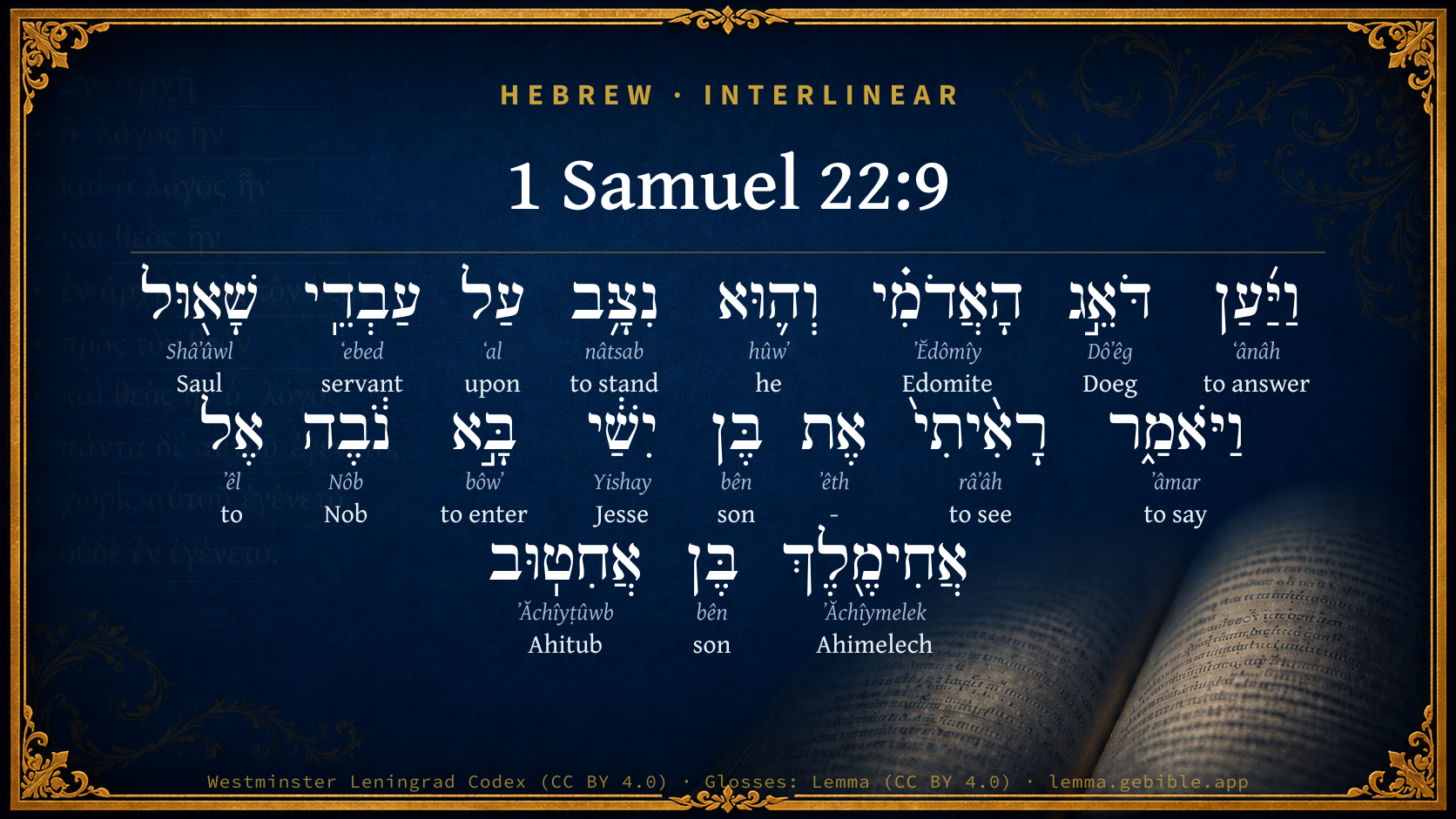
1 Samuel 22:9

Hebrew (Westminster Leningrad Codex) 1 Samuel 22:9 appears in the Hebrew Old Testament. The text above is from the Westminster Leningrad Codex. Each word links to its Strong’s number, a concise gloss, and parsing drawn from the Open Scriptures Hebrew Bible morphology. Click any word for its full Brown-Driver-Briggs (BDB) entry.
Download image
Cite this verse

1 Samuel 22:9 (World English Bible). Public Domain. Lemma interlinear Bible study tool, https://lemma.gebible.app/v/1-samuel/22/9.

Show BibTeX & RIS
BibTeX
RIS
English Translation
Then answered Doeg the Edomite, who stood by the servants of Saul, and said, I saw the son of Jesse coming to Nob, to Ahimelech the son of Ahitub.
World English Bible · Public Domain
Download a study sheet

One document with this verse’s original text, its word-by-word gloss line, the meaning frame, cross-references with their text, attributed commentary, and full source and license credits — printable, and it pastes into notes with its structure intact.

This verse Autodidact and up

Study sheet (.html) Plain text (.txt)

A passage Seminary Student

Up to 50 verses in one chapter. A passage sheet keeps up to 6 commentary sources and 12 cross-references per verse, in the order this page ranks them, and says so on the sheet whenever that leaves anything out. Ask for a single verse and you get the Autodidact verse sheet above.

Everything on this page stays free to read, with no account — the sheet is a download of what is already on screen, not access to it.

Want to remove ads? Support Godless Engineer
Compare translations 3

The same verse in 3 English versions, stacked beneath the original-language interlinear above. Click any original word for its lexicon entry.

Each is an independent rendering of the whole verse — the interlinear is not word-aligned to these translations.

Highlighted words mark where these versions differ — a whole-verse word diff, not a word-by-word alignment.

  • World English Bible Public Domain
    Then answered Doeg the Edomite, who stood by the servants of Saul, and said, I saw the son of Jesse coming to Nob, to Ahimelech the son of Ahitub.
  • King James Version Public Domain
    Then answered Doeg the Edomite, which was set over the servants of Saul, and said, I saw the son of Jesse coming to Nob, to Ahimelech the son of Ahitub.
  • unfoldingWord Literal Text CC BY-SA 4.0
    And Doeg the Edomite answered (now he had stationed himself beside the servants of Saul) and said, “I saw the son of Jesse coming to Nob, to Ahimelech, the son of Ahitub.

unfoldingWord Literal Text — © unfoldingWord, licensed CC BY-SA 4.0. Word-aligned USFM3 via Door43 (git.door43.org/unfoldingWord/en_ult).

Versions to compare (up to 4)

3 of 4 selected

Show all 18 translations

Every available English version of this verse, each an independent rendering of the whole verse.

  • World English Bible Public Domain
    Then answered Doeg the Edomite, who stood by the servants of Saul, and said, I saw the son of Jesse coming to Nob, to Ahimelech the son of Ahitub.
  • Berean Standard Bible Public Domain
    But Doeg the Edomite, who had stationed himself with Saul’s servants, answered: “I saw the son of Jesse come to Ahimelech son of Ahitub at Nob.
  • Majority Standard Bible Public Domain
    But Doeg the Edomite, who had stationed himself with Saul’s servants, answered: “I saw the son of Jesse come to Ahimelech son of Ahitub at Nob.
  • King James Version Public Domain
    Then answered Doeg the Edomite, which was set over the servants of Saul, and said, I saw the son of Jesse coming to Nob, to Ahimelech the son of Ahitub.
  • American Standard Version (1901) Public Domain
    Then answered Doeg the Edomite, who stood by the servants of Saul, and said, I saw the son of Jesse coming to Nob, to Ahimelech the son of Ahitub.
  • Revised Version (1885) Public Domain
    Then answered Doeg the Edomite, which stood by the servants of Saul, and said, I saw the son of Jesse coming to Nob, to Ahimelech the son of Ahitub.
  • Geneva Bible (1599) Public Domain
    Then answered Doeg the Edomite (who was appoynted ouer the seruants of Saul) and sayd, I saw the sonne of Ishai when he came to Nob, to Ahimelech the sonne of Ahitub,
  • Douay-Rheims (1899) Public Domain
    And Doeg the Edomite who stood by, and was the chief among the servants of Saul, answering, said: I saw the son of Isai, in Nobe with Achimelech the son of Achitob the priest.
  • Young's Literal Translation Public Domain
    And answer doth Doeg the Edomite, who is set over the servants of Saul, and saith, `I have seen the son of Jesse coming in to Nob, unto Ahimelech son of Ahitub,
  • Literal Standard Version CC BY-SA 4.0
    And Doeg the Edomite answers, who is set over the servants of Saul, and says, “I have seen the son of Jesse coming to Nob, to Ahimelech son of Ahitub,
  • Unlocked Literal Bible CC BY-SA 4.0
    Then Doeg the Edomite, who stood by the servants of Saul, answered, “I saw the son of Jesse come to Nob, to Ahimelech son of Ahitub.
  • unfoldingWord Literal Text CC BY-SA 4.0
    And Doeg the Edomite answered (now he had stationed himself beside the servants of Saul) and said, “I saw the son of Jesse coming to Nob, to Ahimelech, the son of Ahitub.
  • Darby Bible Public Domain
    Then answered Doeg the Edomite, who was set over the servants of Saul, and said, I saw the son of Jesse coming to Nob, to Ahimelech the son of Ahitub.
  • World Messianic Bible Public Domain
    Then Doeg the Edomite, who stood by the servants of Saul, answered and said, “I saw the son of Jesse coming to Nob, to Ahimelech the son of Ahitub.
  • Webster's Bible Public Domain
    Then answered Doeg the Edomite, who was set over the servants of Saul, and said, I saw the son of Jesse coming to Nob, to Ahimelech the son of Ahitub.
  • Free Bible Version CC BY-SA 4.0
    Doeg the Edomite, who was standing there with Saul's officers, spoke up, saying, “I saw the son of Jesse visit Ahimelech, son of Ahitub, at Nob.
  • Bible in Basic English Public Domain
    Then Doeg, the Edomite, who was by the side of the servants of Saul, in answer said, I saw the son of Jesse coming to Nob, to Ahimelech, the son of Ahitub.
  • JPS Tanakh (1917) Public Domain
    Then answered Doeg the Edomite, who was set over the servants of Saul, and said: 'I saw the son of Jesse coming to Nob, to Ahimelech the son of Ahitub.

Literal Standard Version (2020), Covenant Press — licensed CC BY-SA 4.0. Text via the HelloAO Bible API (eBible.org). Unlocked Literal Bible (unfoldingWord) — licensed CC BY-SA 4.0. Text via the HelloAO Bible API (eBible.org). unfoldingWord Literal Text — © unfoldingWord, licensed CC BY-SA 4.0. Word-aligned USFM3 via Door43 (git.door43.org/unfoldingWord/en_ult). Free Bible Version, Dr. Jonathan Gallagher — licensed CC BY-SA 4.0. Text via the HelloAO Bible API (eBible.org).

Word by word

More ways to search: Search by grammar → Find every occurrence → Compare this word →

Practice this passage: Drill this verse → Learn its vocabulary →

נֹ֔בֶה
Nôb
H5011
“Nob · toward”
Noun, Proper + Suffix, Demonstrative
Part of Speech
Noun
Type
Proper
Full BDB Definition

Origin: the same as H5108

TWOT: None

Nob = "high place" - a priestly city in the Benjamin situated on some eminence north but near Jerusalem
  1. וַיַּ֜עַן ʻânâh H6030 “and · to answer” Conjunction + Verb, Qal, Sequential Imperfect, 3rd Person, Masculine, Singular
  2. דֹּאֵ֣ג Dôʼêg H1673 “Doeg” Noun, Proper
  3. הָאֲדֹמִ֗י ʼĔdômîy H130 “the · Edomite” Particle, Definite Article + Noun, Gentilic, Masculine, Singular, Absolute
  4. וְה֛וּא hûwʼ H1931 “and · he” Conjunction + Pronoun, Personal, 3rd Person, Masculine, Singular
  5. נִצָּ֥ב nâtsab H5324 “standing” Verb, Niphal, Participle Active, Masculine, Singular, Absolute
  6. עַל ʻal H5921 “upon” Preposition
  7. עַבְדֵֽי ʻebed H5650 “servants of” Noun, Common, Masculine, Plural, Construct
  8. שָׁא֖וּל Shâʼûwl H7586 “Saul” Noun, Proper
  9. וַיֹּאמַ֑ר ʼâmar H559 “and · to say” Conjunction + Verb, Qal, Sequential Imperfect, 3rd Person, Masculine, Singular
  10. רָאִ֨יתִי֙ râʼâh H7200 “to see” Verb, Qal, Perfect, 1st Person, Common, Singular
  11. אֶת ʼêth H853 “-” Particle, Direct Object
  12. בֶּן bên H1121 “son of” Noun, Common, Masculine, Singular, Construct
  13. יִשַׁ֔י Yishay H3448 “Jesse” Noun, Proper
  14. בָּ֣א bôwʼ H935 “entering” Verb, Qal, Participle Active, Masculine, Singular, Absolute
  15. אֶל ʼêl H413 “to” Preposition
  16. אֲחִימֶ֖לֶךְ ʼĂchîymelek H288 “Ahimelech” Noun, Proper
  17. בֶּן bên H1121 “son of” Noun, Common, Masculine, Singular, Construct
  18. אֲחִטֽוּב ʼĂchîyṭûwb H285 “Ahitub” Noun, Proper

About this verse

These counts appear in no published source. They are computed here, from the morphology-tagged text and Lemma’s own curated glosses. What Lemma adds →

19
words
18
distinct lemmas
Historical
section

Notable vocabulary

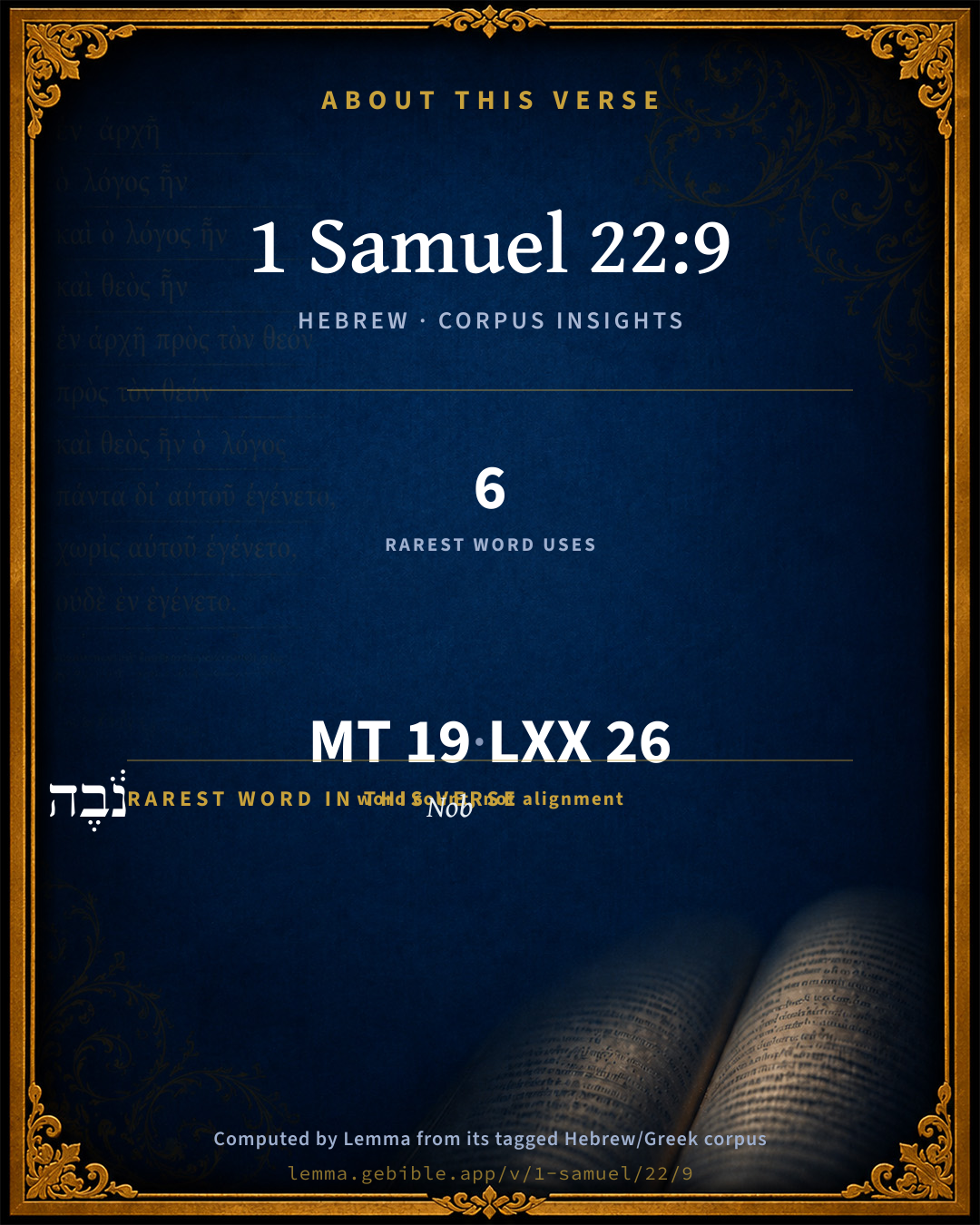
The rarest word here is נֹ֔בֶה Nob H5011 — appearing just 6 times in the whole Hebrew Bible.

Shared distinctive vocabulary

נֹ֔בֶה Nob H5011 occurs in 6 verses of the Hebrew Bible. Also found in:

Grammatical profile

  • 5 verbs
  • 10 nouns
  • 1 pronoun
  • 2 prepositions
  • 1 particle

Verb forms

  • וַיַּ֜עַן Qal · Sequential Imperfect
  • נִצָּ֥ב Niphal · Participle Active
  • וַיֹּאמַ֑ר Qal · Sequential Imperfect
  • רָאִ֨יתִי֙ Qal · Perfect
  • בָּ֣א Qal · Participle Active

Repetition

A word recurs within this verse — often emphatic in Hebrew:

Hebrew & Septuagint length

In English translation the verse runs 29 words from the Hebrew and 32 from the Septuagint (LXX English) — closely comparable.

A rough comparison of the two English renderings, which tokenize alike — not a word-level alignment.

Word counts can differ between the Hebrew and the Greek without any difference in meaning — e.g. the Hebrew direct-object marker אֵת has no separate Greek word, and Greek often adds the article ὁ.

In the original languages it is 19 Hebrew tokens and 26 Greek tokens — but the two are counted differently (Hebrew bundles its prefixes and suffixes into one token; the Greek is in lemma form), so that isn’t a like-for-like length.

Cross-references

7

Topical passages linked to 1 Samuel 22:9 in the Treasury of Scripture Knowledge — connected by theme and wording, ordered by reader-vote popularity; previews shown in the World English Bible.

  • Psalms 52:1–9 Why do you boast of mischief, mighty man? God's loving kindness endures continually.
  • 1 Samuel 14:3 and Ahijah, the son of Ahitub, Ichabod's brother, the son of Phinehas, the son of Eli, the priest of Yahweh in Shiloh, wearing an ephod. The people didn't know that Jonathan was gone.
  • 1 Samuel 21:1–15 Then came David to Nob to Ahimelech the priest: and Ahimelech came to meet David trembling, and said to him, Why are you alone, and no man with you?
  • Proverbs 19:5 A false witness shall not be unpunished. He who pours out lies shall not go free.
  • Proverbs 29:12 If a ruler listens to lies, All of his officials are wicked.
  • Ezekiel 22:9 Slanderous men have been in you to shed blood; and in you they have eaten on the mountains: in the midst of you they have committed lewdness.
  • Matthew 26:59–61 Now the chief priests, the elders, and the whole council sought false testimony against Jesus, that they might put him to death;

Cross-references courtesy of OpenBible.info (CC BY 4.0).

Hebrew and Greek witnesses Masoretic Hebrew ↔ Greek Septuagint

The same verse in the two great witnesses to the Old Testament, shown verse-for-verse.

These are two independent witnesses, not word-aligned to each other, and the Septuagint is shown in lemma (dictionary) form.

Hebrew 1 Samuel 22:9 Masoretic · Westminster Leningrad Codex

וַיַּ֜עַן דֹּאֵ֣ג הָאֲדֹמִ֗י וְה֛וּא נִצָּ֥ב עַל עַבְדֵֽי שָׁא֖וּל וַיֹּאמַ֑ר רָאִ֨יתִי֙ אֶת בֶּן יִשַׁ֔י בָּ֣א נֹ֔בֶה אֶל אֲחִימֶ֖לֶךְ בֶּן אֲחִטֽוּב

Then answered Doeg the Edomite, who stood by the servants of Saul, and said, I saw the son of Jesse coming to Nob, to Ahimelech the son of Ahitub.

World English Bible · Public Domain

Greek LXX 1 Samuel 22:9 Septuagint · lemma form

καί ἀποκρίνω δωηκ ὁ σύρος ὁ καταἵστημι ἐπί ὁ ἡμίονος σαούλ καί εἶπον ὁράω ὁ υἱός ιεσσαι παραγίγνομαι εἰς νομβα πρός αβιμελεχ υἱός αχιτωβ ὁ ἱερεύς

And Doec the Syrian who was over the mules of Saul answered and said, I saw the son of Jessae as he came to Nomba to Abimelech son of Achitob the priest.

LXX2012 (modern English Septuagint) · Public Domain

On this verse, Jamieson, Fausset & Brown discusses the Septuagint’s reading. Read the note in Commentary ↓

Hebrew: Westminster Leningrad Codex (CC BY 4.0). Greek: Septuagint (public domain); English from LXX2012 (modern English Septuagint) (Public Domain). How the Septuagint differs from the Hebrew →

Targum (Aramaic paraphrase)

1

The Targum is the ancient Jewish Aramaic paraphrase of the Hebrew Scriptures — an interpretive translation, not the Hebrew text itself. Onkelos (literal) and Pseudo-Jonathan (expansive) render the Torah, and Jonathan the Prophets. Coverage is partial: where no permissively-licensed English translation exists for a verse, only the Aramaic is shown. This is verse-level text, not a word-by-word alignment to the Hebrew.

  1. Targum Jonathan Prophets (Joshua–Malachi)
    וַאֲתֵיב דוֹאֵג אֱדוֹמָאָה וְהוּא מְמַנָא עַל עַבְדֵי שָׁאוּל וַאֲמַר חַזֵיתִי יַת בַּר יִשַׁי אֲתָא לְנוֹב לְוַת אֲחִימֶלֶךְ בַּר אֲחִיטוּב:

    (no public-domain English translation for this verse)

    Targum Jonathan — Aramaic: “Mikraot Gedolot” (public domain). English: “Sefaria Community Translation” (CC0 1.0 (public-domain dedication)); “London "Chaldee Paraphrase," 1871” (public domain). Text via Sefaria.

Commentary

Notes on 1 Samuel 22:9 from classic Christian and Jewish commentators (each source and its license shown beneath its notes). The classic Christian expositions comment on the surrounding passage and are grouped to its opening verse, so a note may address several verses; the Jewish commentaries on the Tanakh (Rashi and others) are per-verse, so they appear only where the commentator wrote on this verse.

Lemma curates 59 commentaries, every one of them public domain or Creative Commons licensed, each selected and text-cleaned for this edition rather than reprinted as found. About our sources →

Jamieson, Fausset & Brown

Robert Jamieson, A. R. Fausset & David Brown

DOEG ACCUSES AHIMELECH. (Sa1 22:9-16)

Doeg . . . set over the servants--Septuagint, "the mules of Saul."

Jamieson, Fausset & Brown — Commentary Critical and Explanatory on the Whole Bible (1871) — public domain (CC PDM 1.0). Text via the HelloAO Bible API.

Trapp's Complete Commentary

John Trapp

1Sa 22:9 Then answered Doeg the Edomite, which was set over the servants of Saul, and said, I saw the son of Jesse coming to Nob, to Ahimelech the son of Ahitub.

Ver. 9. Then answered Doeg.] So soon as ever the word was out of Saul’s mouth, concerning the preferring of such as should inform him against David, Doeg answered, snapping at that bait, and not sparing maliciously and slanderously to traduce an innocent, and one that so well deserved of the public. Thus was Scipio dealt with by Carbo, Alcibiades by Hyperbolus, Cicero by Clodius, &c. Habuerunt et suos cuculos omnes docti et heroici quolibet tempore. Every Zopyrus is sure to have his Zoilus, every David his Doeg, that will seek to raise himself upon the ruins of another.

Which was set over the servants of Saul.] That is, Over his herdsmen; but that seemed to him to be too low a place. Ambition, like the crocodile, groweth as long as it liveth.

I saw the son of Jesse.] This language he had learned of his master, Saul, whom he striveth to humour: as princes are never without their Aiones and Negones, that will say as they say, and not stick to lick up their very spittle.

Coming to Nob, to Ahimelech.] With this Ahimelech Doeg had been, in pretence of great piety, not long before, "detained before the Lord." {1Sa 21:7} {See Trapp on "1Sa 21:7"} Now he impeacheth him of high treason, making the worst of everything he said or did, as done by way of conspiracy with David against Saul; whose false suspicion of David he hereby confirmed, and is therefore rightly reputed a liar, {Psa 52:3} and because, though he told the truth, yet he wrested it to an evil intention. He is no better than a slanderer, who uttereth the truth, not for any love to it, nor for respect to justice, nor for the bettering of the hearer or the delinquent, but only to disgrace the one and to incense the other.

John Trapp, A Commentary or Exposition upon All the Books of the Old and New Testament (1647–1656) — public domain. Text from a community e-Sword module.

Adam Clarke's Commentary

Verse 9. Doeg the Edomite, which was set over the servants of Saul] In 1Sa 21:7 he is said to be the chiefest of the herdmen that belonged to Saul, and the Septuagint intimate that he was over the mules of Saul. Probably he was what we call the king's equery or groom.

Adam Clarke's Commentary on the Bible (1810–1826) — public domain. Text from a community e-Sword/MySword module.

Ellicott's Commentary for English Readers

(9) Then answered Doeg the Edomite.—This Doeg has already been mentioned in the preceding chapter. His presence in this council meeting under the tamarisk of Gibeah, among the famous Benjamito chieftains, and the previous notice which speaks of him as the officer superintending the royal herds, indicates that he was a personage of no small importance at the Court of Saul. He occupies too a considerable position in the Psalmodic literature. (See, for instance, Psalms 52)

Here he is spoken of as a wicked and unscrupulous character. Jewish tradition tells us this Doeg was skilled in all the learning of his time. Doeg the Edomite, and Ahitophel (whose counsel was as the oracle of God) are represented in the Talmud as the most learned men of their time. “The Holy One, blessed be He! said to wicked Doeg, what hast thou to do to declare my statutes (Psalms 52)? When thou comest to the chapter on murderers and on spreading evil reports, what dost thou make of them?”—Sanhedrin, fol. 106, Colossians 2.

It is strange that this renowned man, whom evidently David looked upon as the evil genius of Saul at the period when he wrote the sad, bitter words of Psalms 52, and spoke of the tongue of this Doeg as being like a sharp razor, and dwelt with singular persistence on the wickedness, falsehood, and calumny of this relentless enemy, should have gone down among the noteworthy Talmudical traditions as “the greatest Rabbinist (i.e., the most deeply learned in the Mosaic Law, and in its interpretation) of his time.

Which was set over the servants of Saul.—This statement would be a puzzling one were it the correct rendering. It would be unlikely in the highest degree that Saul would set a foreigner—however able and devoted—over his faithful Benjamite chieftains. The accurate translation is “who stood with the servants of Saul.” In 1Sa_22:6 we read, in the description of the council meeting under the tamarisk of Gibeah, all his servants (that is, his chief dignitaries) stood by (around) him (Saul), and with these, his peers, stood Doeg the Edomite, the hero of the terrible scene which followed.

(9) Then answered Doeg.—“Far better,” quaintly writes Seb Schmid, “did Saul’s other servants who kept silence.” The Edomite’s witness had the more effect on Saul because he related no hearsay evidence, but what he had absolutely seen.

A Bible Commentary for English Readers, edited by Charles John Ellicott (1878–1897) — public domain. Text from a community e-Sword module.

The Cambridge Bible for Schools and Colleges

gen. ed. J. J. S. Perowne

9. Then answered Doeg] The title of Psalms 52 states that it was composed by David in reference to this occasion. 1Sa_22:1-4 describe such a character as we may well suppose Doeg to have been. His tongue was “a false tongue,” because, though the facts he reported were true, he helped to confirm Saul in a false and cruel suspicion. It “devised destruction,” and “loved devouring words,” for his story was told with malicious intent and fatal result.

which was set over the servants of Saul] Or, for he was standing with the servants of Saul. The presence of the foreigner Doeg among the Benjamites is specially noticed. The Sept. (cp. 1Sa_21:7) reads, “Doeg the Syrian who was set over Saul’s mules.”

The Cambridge Bible for Schools and Colleges (gen. ed. J. J. S. Perowne; Cambridge University Press, 1878–1918) — public domain. Text from a community e-Sword module.

John Gill's Exposition

Then answered Doeg the Edomite,.... Josephus (d) calls him a Syrian, and so the Septuagint version; see Sa1 21:7; being full of enmity to David, and willing to curry favour with Saul, and eager of further preferment, which Saul seemed to promise; and being more forward than the rest of his servants, prevented them and spoke first:

(which was set over the servants of Saul): over his herdsmen; see Sa1 21:7,

and said, I saw the son of Jesse coming to Nob to Ahimelech the son of Ahitub; in imitation of Saul, he calls David by way of contempt the son of Jesse; and signifies that what he had to say of him was not by report, but he himself was an eyewitness of his coming to Nob, a city of the priests, and to Ahimelech the high priest there, and of what passed between them.

(d) Antiqu. l. 6. c. 12. sect. 1, 4.

John Gill's Exposition of the Whole Bible (1746–1763) — public domain (CC PDM 1.0). Text via the HelloAO Bible API.

Haydock's Catholic Bible Commentary

Servants, or herdsmen, chap. xxi. 7. Septuagint, "the Syrian, who was set over the mules of Saul." (Haydock) --- Informers are a set of men destructive to the public," says Tacitius, Hist. i. 4.

George Leo Haydock (1774–1849), Haydock's Catholic Family Bible and Commentary, 1859 edition — public domain. Excludes Psalms (Douay-Rheims chapter numbering differs from Protestant) and Deuterocanonical books (Catholic canon only).

Matthew Poole's English Annotations

See Poole "1Sa 21:7".

Matthew Poole's English Annotations on the Holy Bible (1683–1685) — public domain. Text from a community e-Sword/MySword module.

Whedon's Commentary on the Bible

Daniel D. Whedon

9. Doeg the Edomite — Already introduced to us by anticipation in chap.

1Sa_21:7. He was evidently a dark-hearted man, having no sympathy for injured innocence, and a ready instrument to execute Saul’s bloody purposes. He readily embraces this opportunity to ingratiate himself with his king; and even goes so far as to stain his hands with the blood of the priests, and of all the inhabitants of Nob. 1Sa_22:18-19.

Daniel D. Whedon (gen. ed.), Commentary on the Old and New Testaments (1874–1909) — public domain. Text from a community e-Sword module.

The Pulpit Commentary

Vers. 9, 10. Doeg the Edomite, which was set over the servants of Saul. This translation is entirely wrong, nor would Saul"s Benjamites have endured to have an Edomite set over them. The verb is that used in ver. 6, and refers simply to Doeg"s place in the circle of attendants standing round Saul. The words mean, "Doeg the Edomite, who stood there with the servants of Saul." As chief herdsman he was present as a person of some importance, but far below "the captains of thousands and the captains of hundreds." I saw the son of Jesse, etc. As Saul was in a dangerous state of excite. sent, bordering on insanity, Doeg"s statement was probably made with the evil intent of turning the king"s suspicions from the courtiers to the priests. His assertion that the high priest enquired of Jehovah for David was possibly true (see on ver. 15).

The Pulpit Commentary (1880–1919), ed. H.D.M. Spence-Jones & Joseph S. Exell — public domain. Text from a community e-Sword module.

Keil & Delitzsch

C. F. Keil & F. Delitzsch

The Edomite Doeg could not refrain from yielding to this appeal, and telling Saul what he had seen when staying at Nob; namely, that Ahimelech had inquired of God for David, and given him food as well as Goliath's sword. For the fact itself, see Sa1 21:1-10, where there is no reference indeed to his inquiring of God; though it certainly took place, as Ahimelech (Sa1 22:15) does not disclaim it. Doeg is here designated נצּב, "the superintendent of Saul's servants," so that apparently he had been invested with the office of marshal of the court.

Keil & Delitzsch — Biblical Commentary on the Old Testament (1861–1891) — public domain (CC PDM 1.0). Text via the HelloAO Bible API. (Old Testament only.)

unfoldingWord translationNotes

Door43 World Missions Community

Doeg the Edomite

man's name. See how you translated this in 1 Samuel 21:7. (See: How to Translate Names)

Nob ... Ahimelech

place name and man's name. See how you translated this in 1 Samuel 21:1. (See: How to Translate Names)

Ahitub

man's name (See: How to Translate Names)

He prayed to Yahweh that he might help him, and he gave him

Ahitub prayed to Yahweh that Yahweh might help David, and Ahitub gave David

translationWords

Edom

Saul (OT)

pray

Yahweh

sword

Goliath

Philistines

unfoldingWord translationNotes — © Distant Shores Media and the Door43 World Missions Community, licensed CC BY-SA 4.0. Source: git.door43.org/Door43/en_tn.

Lesson kit

Teaching starters — assembled from the data on this page, not authored interpretation. Every prompt links to the verse data it draws on. Edit before teaching.

1 Samuel, in the Historical, opens this verse with 19 words (18 distinct Hebrew lemmas). Its most distinctive word is Nôb (“Nob”). A historical commentator’s framing appears above. Read the whole chapter for the surrounding context.

Discussion questions

  1. How does “Nob” (Nôb) shape what this verse is saying?
  2. How does 1 Samuel 21:1, which shares the word «Nob», read alongside this verse?
  3. What does the repetition of “son” (2× in this one verse) do in this verse?
  4. These translations render this verse differently; the difference is in the English rendering, not the original. What questions does that raise?
  5. «וַיַּ֜עַן» is a Qal Sequential Imperfect verb. How does that grammatical form shape the action described?
  6. Compare how Jamieson, Fausset & Brown and Trapp's Complete Commentary read this verse. Where do they agree or differ?

Things to notice

Reading settings

Reading text

Shown beneath each verse's original-language words.

Old Testament
Old Testament edition

Read the OT as the Masoretic Hebrew (MT) or the Greek Septuagint (LXX).

English shown for the Greek Septuagint (in the Hebrew ↔ Greek comparison).

Comparing translations? Open the Compare panel on any verse page to stack up to four side by side.