

Job 1:7

Hebrew (Westminster Leningrad Codex) Job 1:7 appears in the Hebrew Old Testament. The text above is from the Westminster Leningrad Codex. Each word links to its Strong’s number, a concise gloss, and parsing drawn from the Open Scriptures Hebrew Bible morphology. Click any word for its full Brown-Driver-Briggs (BDB) entry.
Download image
Cite this verse

Job 1:7 (World English Bible). Public Domain. Lemma interlinear Bible study tool, https://lemma.gebible.app/v/job/1/7.

Show BibTeX & RIS
BibTeX
RIS
English Translation
Yahweh said to Satan, "Where have you come from?" Then Satan answered Yahweh, and said, "From going back and forth in the earth, and from walking up and down in it."
World English Bible · Public Domain
Download a study sheet

One document with this verse’s original text, its word-by-word gloss line, the meaning frame, cross-references with their text, attributed commentary, and full source and license credits — printable, and it pastes into notes with its structure intact.

This verse Autodidact and up

Study sheet (.html) Plain text (.txt)

A passage Seminary Student

Up to 50 verses in one chapter. A passage sheet keeps up to 6 commentary sources and 12 cross-references per verse, in the order this page ranks them, and says so on the sheet whenever that leaves anything out. Ask for a single verse and you get the Autodidact verse sheet above.

Everything on this page stays free to read, with no account — the sheet is a download of what is already on screen, not access to it.

Want to remove ads? Support Godless Engineer
Compare translations 3

The same verse in 3 English versions, stacked beneath the original-language interlinear above. Click any original word for its lexicon entry.

Each is an independent rendering of the whole verse — the interlinear is not word-aligned to these translations.

Highlighted words mark where these versions differ — a whole-verse word diff, not a word-by-word alignment.

  • World English Bible Public Domain
    Yahweh said to Satan, "Where have you come from?" Then Satan answered Yahweh, and said, "From going back and forth in the earth, and from walking up and down in it."
  • King James Version Public Domain
    And the LORD said unto Satan, Whence comest thou? Then Satan answered the LORD, and said, From going to and fro in the earth, and from walking up and down in it.
  • unfoldingWord Literal Text CC BY-SA 4.0
    And Yahweh said to the adversary, “From where have you come?” And the adversary answered Yahweh and said, “From wandering on the earth and from going back and forth on it.”

unfoldingWord Literal Text — © unfoldingWord, licensed CC BY-SA 4.0. Word-aligned USFM3 via Door43 (git.door43.org/unfoldingWord/en_ult).

Versions to compare (up to 4)

3 of 4 selected

Show all 18 translations

Every available English version of this verse, each an independent rendering of the whole verse.

  • World English Bible Public Domain
    Yahweh said to Satan, "Where have you come from?" Then Satan answered Yahweh, and said, "From going back and forth in the earth, and from walking up and down in it."
  • Berean Standard Bible Public Domain
    “Where have you come from?” said the LORD to Satan. “From roaming through the earth,” he replied, “and walking back and forth in it.”
  • Majority Standard Bible Public Domain
    “Where have you come from?” said the LORD to Satan. “From roaming through the earth,” he replied, “and walking back and forth in it.”
  • King James Version Public Domain
    And the LORD said unto Satan, Whence comest thou? Then Satan answered the LORD, and said, From going to and fro in the earth, and from walking up and down in it.
  • American Standard Version (1901) Public Domain
    And Jehovah said unto Satan, Whence comest thou? Then Satan answered Jehovah, and said, From going to and fro in the earth, and from walking up and down in it.
  • Revised Version (1885) Public Domain
    And the LORD said unto Satan, Whence comest thou? Then Satan answered the LORD, and said, From going to and fro in the earth, and from walking up and down in it.
  • Geneva Bible (1599) Public Domain
    Then the Lord sayde vnto Satan, Whence commest thou? And Satan answered the Lord, saying, From compassing the earth to and from, and from walking in it.
  • Douay-Rheims (1899) Public Domain
    And the Lord said to him: Whence comest thou? And he answered and said: I have gone round about the earth, and walked through it.
  • Young's Literal Translation Public Domain
    And Jehovah saith unto the Adversary, `Whence comest thou?' And the Adversary answereth Jehovah and saith, `From going to and fro in the land, and from walking up and down on it.'
  • Literal Standard Version CC BY-SA 4.0
    And YHWH says to Satan, “Where do you come from?” And Satan answers YHWH and says, “From going to and fro in the land, and from walking up and down on it.”
  • Unlocked Literal Bible CC BY-SA 4.0
    Yahweh said to Satan, “From where have you come?” Then Satan answered Yahweh and said, “From wandering on the earth, from going back and forth on it.”
  • unfoldingWord Literal Text CC BY-SA 4.0
    And Yahweh said to the adversary, “From where have you come?” And the adversary answered Yahweh and said, “From wandering on the earth and from going back and forth on it.”
  • Darby Bible Public Domain
    And Jehovah said to Satan, Whence comest thou? And Satan answered Jehovah and said, From going to and fro in the earth, and from walking up and down in it.
  • World Messianic Bible Public Domain
    The LORD said to Satan, “Where have you come from?” Then Satan answered the LORD, and said, “From going back and forth in the earth, and from walking up and down in it.”
  • Webster's Bible Public Domain
    And the LORD said to Satan, Whence comest thou? Then Satan answered the LORD, and said, From going to and fro on the earth, and from walking up and down upon it.
  • Free Bible Version CC BY-SA 4.0
    The Lord asked Satan, “What have you been doing?” “Traveling around on earth, going here and there,” Satan replied.
  • Bible in Basic English Public Domain
    And the Lord said to the Satan, Where do you come from? And the Satan said in answer, From wandering this way and that on the earth, and walking about on it.
  • JPS Tanakh (1917) Public Domain
    And the LORD said unto Satan: 'Whence comest thou?' Then Satan answered the LORD, and said: 'From going to and fro in the earth, and from walking up and down in it.'

Literal Standard Version (2020), Covenant Press — licensed CC BY-SA 4.0. Text via the HelloAO Bible API (eBible.org). Unlocked Literal Bible (unfoldingWord) — licensed CC BY-SA 4.0. Text via the HelloAO Bible API (eBible.org). unfoldingWord Literal Text — © unfoldingWord, licensed CC BY-SA 4.0. Word-aligned USFM3 via Door43 (git.door43.org/unfoldingWord/en_ult). Free Bible Version, Dr. Jonathan Gallagher — licensed CC BY-SA 4.0. Text via the HelloAO Bible API (eBible.org).

Word by word

More ways to search: Search by grammar → Find every occurrence → Compare this word →

Practice this passage: Drill this verse → Learn its vocabulary →

מִשּׁ֣וּט
shûwṭ
H7751
“from · to go about”
Preposition + Verb, Qal, Infinitive Construct
Part of Speech
Preposition + Verb
Stem
Qal
Form
Infinitive Construct
Full BDB Definition

Origin: a primitive root

TWOT: 2344 , 2344d

to go, go or rove about, go to and fro - (Qal) to go or rove about - (Polel) to go to and fro, go eagerly or quickly to and fro - (Hithpolel) to run to and fro - to row
  1. וַיֹּ֧אמֶר ʼâmar H559 “and · to say” Conjunction + Verb, Qal, Sequential Imperfect, 3rd Person, Masculine, Singular
  2. יְהוָ֛ה Yᵉhôvâh H3068 “LORD” Noun, Proper
  3. אֶל ʼêl H413 “to” Preposition
  4. הַשָּׂטָ֖ן sâṭân H7854 “the · adversary” Particle, Definite Article + Noun, Common, Masculine, Singular, Absolute
  5. מֵאַ֣יִן ʼayin H370 “from · where” Preposition + Particle, Interrogative
  6. תָּבֹ֑א bôwʼ H935 “to enter” Verb, Qal, Imperfect, 2nd Person, Masculine, Singular
  7. וַיַּ֨עַן ʻânâh H6030 “and · to answer” Conjunction + Verb, Qal, Sequential Imperfect, 3rd Person, Masculine, Singular
  8. הַשָּׂטָ֤ן sâṭân H7854 “the · adversary” Particle, Definite Article + Noun, Common, Masculine, Singular, Absolute
  9. אֶת ʼêth H853 “-” Particle, Direct Object
  10. יְהוָה֙ Yᵉhôvâh H3068 “LORD” Noun, Proper
  11. וַיֹּאמַ֔ר ʼâmar H559 “and · to say” Conjunction + Verb, Qal, Sequential Imperfect, 3rd Person, Masculine, Singular
  12. בָּאָ֔רֶץ ʼerets H776 “in/at the · land” Preposition, Determined + Noun, Common, Both, Singular, Absolute
  13. וּמֵֽהִתְהַלֵּ֖ךְ hâlak H1980 “and · from · to walk” Conjunction + Preposition + Verb, Hithpael, Infinitive Construct

About this verse

These counts appear in no published source. They are computed here, from the morphology-tagged text and Lemma’s own curated glosses. What Lemma adds →

15
words
11
distinct lemmas
Wisdom
section

Notable vocabulary

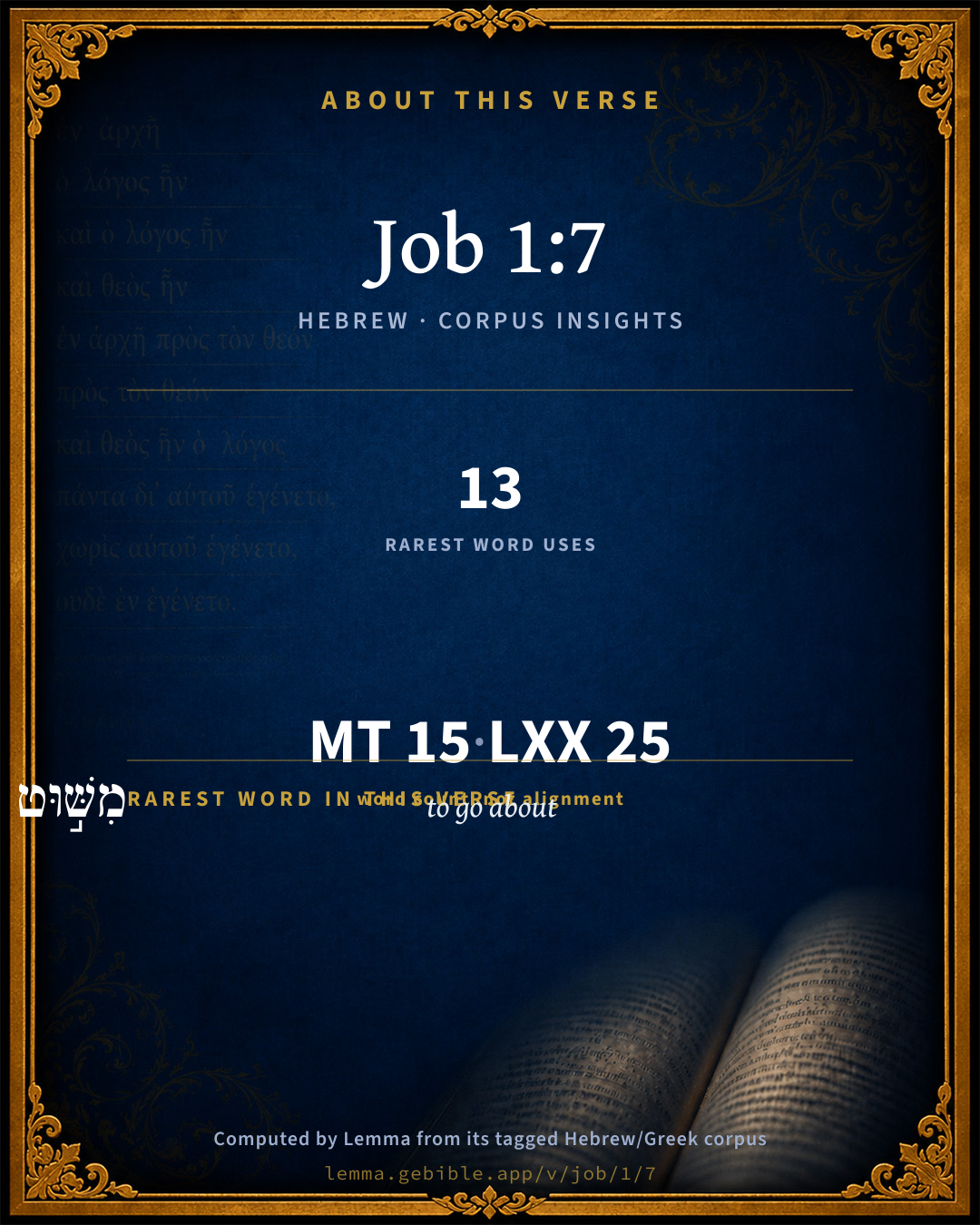
The rarest word here is מִשּׁ֣וּט to go about H7751 — appearing just 13 times in the whole Hebrew Bible.

Shared distinctive vocabulary

מִשּׁ֣וּט to go about H7751 occurs in 13 verses of the Hebrew Bible. Also found in:

Grammatical profile

  • 6 verbs
  • 5 nouns
  • 2 prepositions
  • 2 particles

Verb forms

  • וַיֹּ֧אמֶר Qal · Sequential Imperfect
  • תָּבֹ֑א Qal · Imperfect
  • וַיַּ֨עַן Qal · Sequential Imperfect
  • וַיֹּאמַ֔ר Qal · Sequential Imperfect
  • מִשּׁ֣וּט Qal · Infinitive Construct
  • וּמֵֽהִתְהַלֵּ֖ךְ Hithpael · Infinitive Construct

Repetition

Words recur within this verse — often emphatic in Hebrew:

  • וַיֹּ֧אמֶר to say H559 ×2
  • יְהוָ֛ה LORD H3068 ×2
  • הַשָּׂטָ֖ן adversary H7854 ×2

Hebrew & Septuagint length

In English translation the verse runs 31 words from the Hebrew and 34 from the Septuagint (LXX English) — closely comparable.

A rough comparison of the two English renderings, which tokenize alike — not a word-level alignment.

Word counts can differ between the Hebrew and the Greek without any difference in meaning — e.g. the Hebrew direct-object marker אֵת has no separate Greek word, and Greek often adds the article ὁ.

In the original languages it is 15 Hebrew tokens and 25 Greek tokens — but the two are counted differently (Hebrew bundles its prefixes and suffixes into one token; the Greek is in lemma form), so that isn’t a like-for-like length.

Cross-references

9

Topical passages linked to Job 1:7 in the Treasury of Scripture Knowledge — connected by theme and wording, ordered by reader-vote popularity; previews shown in the World English Bible.

  • 1 Peter 5:8 Be sober and self-controlled. Be watchful. Your adversary the devil, walks around like a roaring lion, seeking whom he may devour.
  • Job 2:2 Yahweh said to Satan, "Where have you come from?" Satan answered Yahweh, and said, "From going back and forth in the earth, and from walking up and down in it."
  • Matthew 12:43 But the unclean spirit, when he is gone out of the man, passes through waterless places, seeking rest, and doesn't find it.
  • Revelation 12:12–17 Therefore rejoice, heavens, and you who dwell in them. Woe to the earth and to the sea, because the devil has gone down to you, having great wrath, knowing that he has but a short time."
  • Revelation 12:9 The great dragon was thrown down, the old serpent, he who is called the devil and Satan, the deceiver of the whole world. He was thrown down to the earth, and his angels were thrown down with him.
  • Revelation 20:8 and he will come out to deceive the nations which are in the four corners of the earth, Gog and Magog, to gather them together to the war; the number of whom is as the sand of the sea.
  • 2 Kings 5:25 But he went in, and stood before his master. Elisha said to him, Whence come you, Gehazi? He said, Your servant went no where.
  • Zechariah 1:10–11 The man who stood among the myrtle trees answered, "They are the ones Yahweh has sent to go back and forth through the earth."
  • Zechariah 6:7 The strong went out, and sought to go that they might walk back and forth through the earth: and he said, "Go around and through the earth!" So they walked back and forth through the earth.

Cross-references courtesy of OpenBible.info (CC BY 4.0).

Hebrew and Greek witnesses Masoretic Hebrew ↔ Greek Septuagint

The same verse in the two great witnesses to the Old Testament, shown verse-for-verse.

These are two independent witnesses, not word-aligned to each other, and the Septuagint is shown in lemma (dictionary) form.

Hebrew Job 1:7 Masoretic · Westminster Leningrad Codex

וַיֹּ֧אמֶר יְהוָ֛ה אֶל הַשָּׂטָ֖ן מֵאַ֣יִן תָּבֹ֑א וַיַּ֨עַן הַשָּׂטָ֤ן אֶת יְהוָה֙ וַיֹּאמַ֔ר מִשּׁ֣וּט בָּאָ֔רֶץ וּמֵֽהִתְהַלֵּ֖ךְ בָּֽהּ

Yahweh said to Satan, "Where have you come from?" Then Satan answered Yahweh, and said, "From going back and forth in the earth, and from walking up and down in it."

World English Bible · Public Domain

Greek LXX Job 1:7 Septuagint · lemma form

καί εἶπον ὁ κύριος ὁ διάβολος πόθεν παραγίγνομαι καί ἀποκρίνω ὁ διάβολος ὁ κύριος εἶπον περιἔρχομαι ὁ γῆ καί ἐν περιπατέω ὁ ὑπό οὐρανός παραεἰμί

And the Lord said to the devil, Whence are you come? And the devil answered the Lord, and said, I am come from compassing the earth, and walking up and down in the world.

LXX2012 (modern English Septuagint) · Public Domain

On this verse, Adam Clarke's Commentary discusses the Septuagint’s reading. Read the note in Commentary ↓

Hebrew: Westminster Leningrad Codex (CC BY 4.0). Greek: Septuagint (public domain); English from LXX2012 (modern English Septuagint) (Public Domain). How the Septuagint differs from the Hebrew →

Commentary

Notes on Job 1:7 from classic Christian and Jewish commentators (each source and its license shown beneath its notes). The classic Christian expositions comment on the surrounding passage and are grouped to its opening verse, so a note may address several verses; the Jewish commentaries on the Tanakh (Rashi and others) are per-verse, so they appear only where the commentator wrote on this verse.

Lemma curates 59 commentaries, every one of them public domain or Creative Commons licensed, each selected and text-cleaned for this edition rather than reprinted as found. About our sources →

Trapp's Complete Commentary

John Trapp

Job 1:7 And the LORD said unto Satan, Whence comest thou? Then Satan answered the LORD, and said, From going to and fro in the earth, and from walking up and down in it.

Ver. 7. And the Lord said unto Satan] Either by forming and creating a voice in the air, as Mat 3:17 Job 12:25, or by an inward word, after an unspeakable manner; manifesting his will, as he willed, to Satan. The schoolmen have great disputes about the speech of spirits, but this they agree in, that the intention of one spirit is as plain an expression of his mind by another spirit (when he hath a will that the other should understand it) as the voice of one man is to another.

Whence comest thou?] This the Lord asketh not as if he were ignorant; for he knows all things, and that from eternity, neither is there any creature that is not manifest in his sight, but all things are naked and open before his eyes, Heb 4:13; yea, in him all things subsist, Col 1:17, so that there can be no motion of the creature without his privity: God, therefore, thus interrogateth Satan, that he might show himself to be his judge, and that he might exact a confession out of his own mouth.

Then Satan answered the Lord] The word signifieth to speak in witness bearing, Exo 20:16.

From going to and fro in the earth] He saith not, from instigating men to all manner of wickedness, from ranging up and down as a roaring lion, to devour souls, from sinning that sin against the Holy Ghost every moment, &c. All this he cunningly dissembleth, and saith, in effect, as once Gehazi did, Thy servant was nowhere, or for no hurt to any, when as he is never but doing mischief; as Pliny saith of the scorpion, that there is not one minute wherein it doth not put forth the sting. Is not the hand of Joab in this business? So, is not Satan in all the sins of the wicked, and in most of the troubles of the godly? Heu quam furit Satan, et impellit securos homines ad horrenda flagitia! &c., saith Luther. Oh how doth Satan range and rage, that he may glut himself with the blood of souls! In prosperity he makes men lay their hearts too near it, in adversity to lay it too near their hearts. Upon Job he tried both these stratagems.

And from walking up and down in it] A great peripatetic he is, and he walks the rounds; for he is yet a prisoner at large, only he hath his fetters upon his heels, Jdg 1:6, and in them he frisketh up and down, and fetcheth a circuit to spy faults, and to take advantages. Mr Broughton rendereth it, from searching to and fro in the earth, &c. Non dormitat semper vigil ille synagogae suae Episcopus, saith one, he is vigilant and diligent, restless and unquiet, as Cain (whom Amama calleth the devil’s patriarch) could settle nowhere, but ran up and down as a fugitive and a vagabond, Gen 4:12. It is said, Mat 12:45, that this unclean spirit walketh in dry places seeking rest and finding none. Not but that dry and wet are all one with him, but it importeth his restlessness. See the like Jer 17:5, to run to and fro is the condition and curse of those that are once departed from God. "Take heed, brethren," saith the apostle, "lest there be in any of you an evil heart of unbelief in departing from the living God," and wandering after worldly vanities, Heb 3:12. Take heed of giving, way to wilful distractions in holy duties. Men’s hearts are oft so divided and dissipated, that if after any duty they should put this question that God doth here to Satan, Whence comest thou? the answer should be, From compassing the earth, &c.

John Trapp, A Commentary or Exposition upon All the Books of the Old and New Testament (1647–1656) — public domain. Text from a community e-Sword module.

Joseph Benson's Commentary

Job 1:7. The Lord said unto Satan, &c. — As we are not to suppose from the preceding verse that Satan entered into heaven among the angels of God, uncalled; so, neither are we so to understand what is here said, as if the Great and Holy One really entered into a conversation with that apostate spirit. But, as we have stated above, the whole is parabolical and emblematical. Whence comest thou? — God, being here represented as Judge, begins with an inquiry as the ground of his further proceedings, as he did with our first parents, Gen 3:9, and with Cain, Gen 4:9. Satan answered the Lord, From going to and fro in the earth — Where, by thy permission, I range about, observing, with great diligence, all the dispositions and actions of men, and working in them and among them, as far as I have liberty and opportunity. The Targum, after the words, from going to and fro in the earth, very significantly adds, to try the works of the children of men. From which it appears, that the ancient Jews understood this account of the temptation of Job in a literal sense. This representation teaches us, that Satan, the great apostate spirit, is entirely under the dominion of the sovereign Lord of all things, and not suffered to act without control; and that he is chiefly confined to the limits of this earth; agreeably to which he is called, in the New Testament, the Prince of this world, Joh 12:31. And from this and many other passages in Scripture, we may learn that it is his employment to seek for all opportunities to delude the human race. The New Testament frequently mentions the temptations, wiles, and snares of the devil. And St. Peter describes him as doing the same thing which he is here said to do, namely, walking about as an adversary to man, seeking whom he may devour; roving to and fro with an evil intention, and a determined resolution of doing mischief.

Joseph Benson's Commentary on the Old and New Testaments (1811–1818) — public domain. Text from a community e-Sword module.

Geneva Bible (1599)

Geneva Bible translators

This question is asked for our infirmity: for God knew whence he came.

Herein is described the nature of Satan, which is ever ranging for his prey, 1 Pet. 5:8.

Geneva Bible (1599) marginal notes — public domain. Text via Bolls.life.

Jamieson, Fausset & Brown

Robert Jamieson, A. R. Fausset & David Brown

going to and fro--rather, "hurrying rapidly to and fro." The original idea in Arabic is the heat of haste (Mat 12:43; Pe1 5:8). Satan seems to have had some peculiar connection with this earth. Perhaps he was formerly its ruler under God. Man succeeded to the vice royalty (Gen 1:26; Psa 8:6). Man then lost it and Satan became prince of this world. The Son of man (Psa 8:4) --the representative man, regains the forfeited inheritance (Rev 11:15). Satan's replies are characteristically curt and short. When the angels appear before God, Satan is among them, even as there was a Judas among the apostles.

Jamieson, Fausset & Brown — Commentary Critical and Explanatory on the Whole Bible (1871) — public domain (CC PDM 1.0). Text via the HelloAO Bible API.

Adam Clarke's Commentary

Verse 7. From going to and fro in the earth] The translation of the Septuagint is curious: Περιελθων την γην και εμπεριπατησας την ὑπ' ουρανον, παρειμι; "Having gone round the earth, and walked over all that is under heaven, I am come hither." The Chaldee says, "I am come from going round the earth to examine the works of the children of men; and from walking through it." Coverdale, who generally hits the sense, translates thus: I have gone aboute the londe ond walked thorow it. Mr. Good has it, from roaming round the earth, and walking about it.

St. Peter, as has been already stated, 1Pe 5:8, refers to this: Be sober, be vigilant; for your ADVERSARY the DEVIL GOETH ABOUT, as a roaring lion, seeking whom he may devour. I rather think, with Coverdale, that ארץ arets here signifies rather that land, than the habitable globe. The words are exceedingly emphatic; and the latter verb התהלך hithhallech being in the hithpael conjugation shows how earnest and determined the devil is in his work: he sets himself to walk; he is busily employed in it; he is seeking the destruction of men; and while they sleep, he wakes-while they are careless, he is alert. The spirit of this saying is often expressed by the simple inhabitants of the country: when they perceive a man plotting mischief, and frequent in transgression, they say, The devil is BUSY with him.

Adam Clarke's Commentary on the Bible (1810–1826) — public domain. Text from a community e-Sword/MySword module.

Ellicott's Commentary for English Readers

(7) From going to and fro . . .—Compare our Lord’s words in Mat_13:25 : “and went his way.” St. Peter evidently had this passage in mind (1Pe_5:8, “walketh about”).

A Bible Commentary for English Readers, edited by Charles John Ellicott (1878–1897) — public domain. Text from a community e-Sword module.

The Cambridge Bible for Schools and Colleges

gen. ed. J. J. S. Perowne

7. From going to and fro] As the word is used by the Satan of himself there is, naturally, no shade of self-condemnation in it: rather the reverse, he speaks with a certain consciousness of his assiduous faithfulness. The term is used of “the eyes of the Lord, that go to and fro,” 2Ch_16:9. What is suggested is the swiftness and ubiquity of his survey of men. Similarly walking up and down is said of those benevolent emissaries sent forth from heaven in the interest of the suffering righteous of the earth, Zec_1:10-11; Zec_6:7. The growing light of revelation cast the figure of Satan into deeper shade, and his restless activity receives a corresponding deepness of tint, “Your adversary, as a roaring lion, walketh about, seeking whom he may devour,” 1Pe_5:8.

The Cambridge Bible for Schools and Colleges (gen. ed. J. J. S. Perowne; Cambridge University Press, 1878–1918) — public domain. Text from a community e-Sword module.

John Gill's Exposition

And the Lord said unto Satan, whence comest thou?.... This question is put, not as ignorant of the place from whence he came; for the omniscient God knows all persons and things, men and angels, and these good and bad, where they are, from whence they come, and what they do, see Gen 3:9 but it is put either as being angry with him, and resenting his coming among the sons of God, and chiding him for it, as having no proper business there, like the question in Mat 22:12, or rather in order to lead on to another, and to bring out from him what he intended to have expressed by him, of what he had seen and taken notice of in the place from whence he came, and particularly concerning Job: how God and spirits converse together we are not able to say; but no doubt there is a way in which God talks with spirits, even with evil ones, as well as good ones, and in which they speak to him; and so this does not at all affect the reality of this narrative:

then Satan answered the Lord and said, from going to and fro in the earth, and from walking up and down in it; this he said as swaggering and boasting, as if he was indeed the God of the whole world, the Prince and King of it, and had and exercised a sovereign dominion over it, and as such had been making a tour through it, and taking a survey of it, see Mat 4:8, and as if he was at full liberty to go where he pleased, and was under no control, when he was in chains of darkness, and could go nowhere, nor do anything, without divine permission; could not touch Job, nor his substance, nor, as in the days of Christ, so much as enter into a herd of swine without leave: likewise this may denote the disquietude and restlessness of this evil spirit, who could not abide long in a place, but moving to and fro, seeking rest, but finding none, Mat 12:43, as also his diligence and indefatigableness in doing and seeking to do mischief, going about like a roaring lion, seeking whom he may devour, taking all opportunities of doing injury, sowing his tares while men are asleep and off their guard, Pe1 5:8, and so the first word here used signifies a diligent search, and is rendered by some, and particularly by Mr. Broughton, "from searching about the earth" (o), "and from walking in it"; and so the Targum,

from going about in the earth, to search the works of the children of men, and from walking in it; and it points at the place of Satan's abode, the earth, with the circumambient air, Eph 2:2 and the extent of his influence, which reaches not to heaven, and to the saints there, out of which he is cast, and can never reenter, but to the earth only, and men on it; and here no place is free from him; he and his angels are roving about everywhere, city and country; public and private places, men's own houses, or the house of God, are not exempt from them; and therefore all here need to watch and pray, lest they enter into temptation, Mat 26:41. Schultens interprets the word of Satan going through the earth with great force and violence, whipping and scourging miserable mortals.

(o) So Rambam and Ben Melech.

John Gill's Exposition of the Whole Bible (1746–1763) — public domain (CC PDM 1.0). Text via the HelloAO Bible API.

Albert Barnes' Notes on the Bible

And the Lord said unto Satan, Whence comest thou? - This inquiry does not appear to have been made as if it was improper that Satan should have appeared there, for no blame seems to have been attached to him for this. He came as a spirit that was subject to the control of yahweh; he came with others, not to mingle in their society, and partake of their happiness, but to give an account of what he had done, and of what he had observed. The poetic idea is, that this was done periodically, and that “all” the spirits employed by yahweh to dispense blessings to mortals, to inflict punishment, or to observe their conduct, came and stood before him. Why the inquiry is directed particularly to “Satan,” is not specified. Perhaps it is not meant that there was any “special” inquiry made of him, but that, as he was to have so important an agency in the transactions which follow, the inquiry that was made of him only is recorded In respect to the others, nothing occurred pertaining to Job, and their examination is not adverted to. Or it may be, that, as Satan was known to be malignant, suspicious, and disposed to think evil of the servants of God, the design was to direct his attention particularly to Job as an illustrious and indisputable example of virtue and piety.

From going to and fro in the earth - Dr. Good renders this, “from roaming round.” Noyes, “from wandering over.” The word which is here used (שׁוּט shûṭ) means properly,

(1.) to whip, to scourge, to lash;

(2.) to row, that is, to lash the sea with oars;

(3.) to run up and down, to go here and there, or to and fro, so as to lash the air with one’s arms as with oars, and hence, to travel over a land, or to go through it in order to see it, 2Sa 24:2, 2Sa 24:8.

Dr. Good, in conformity with the interpretation proposed by Schultens, says that “the word imports, not so much the act of going forward and backward, as of making a circuit or circumference; of going round about. The Hebrew verb is still in use among the Arabic writers, and in every instance implies the same idea of gyration or circumambulation.” In Arabic, according to Castell, the word means “to heat, to burn, to cause to boil, to consume:” then to propel to weariness, as e. g. a horse, and then to make a circuit, to go about at full speed, to go with diligence and activity. Thus, in Carnuso, as quoted by Schultens, “a course made at one impulse to the goal is called שׁוט shôṭ. In 2Sa 24:2, the word is used in the sense of passing around through different places for the purpose of taking a census. “Go now (Margin, “compass”) through all the tribes of Israel.” In Num 11:8, it is applied to the Israelites going about to collect manna, passing rapidly and busily in the places where it fell for the purpose of gathering it.

In Zec 4:10, it is applied to “the eyes of Yahweh,” which are said to “run to and fro through the earth,” that is, he surveys all things as one does whose eye passes rapidly from object to object. The same phrase occurs in 2Ch 16:9. In Jer 5:1, it is applied to the action of a man passing rapidly through the streets of a city. “Run ye to and fro through the streets of Jerusalem “compare Jer 49:3. From these passages it is clear that the idea is not that of going “in a circuit” or circle, but it is that of passing rapidly; of moving with alacrity and in a hurry; and it is not improbable that the “original” idea is that suggested in the Arabic of “heat” - and thence applied to a whip or scourge because it produces a sensation like burning, and also to a rapid journey or motion, because it produces heat or a glow. It means that Satan had been active and diligent in passing from place to place in the earth to survey it. The Chaldee adds to this, “to examine into the works of the sons of men.”

And from walking - That is, to investigate human affairs. On this verse it is observed by Rosenmullcr, that in the life of Zoroaster (see Zendavesta by John G. Kleukner, vol. 3: p. 11,) the prince of the evil demons, the angel of death, whose name is “Engremeniosch,” is said to go far and near through the world for the purpose of injuring and opposing good people.

Albert Barnes' Notes on the Bible (1834–1885) — public domain. Text from a community e-Sword/MySword module.

Matthew Poole's English Annotations

God being here represented as Judge, rightly begins with an inquiry, as the ground of his further proceedings, as he did Gen 3:9; 4:9.

From going to and fro in the earth; where by thy permission I range about, observing with great diligence all the dispositions and actions of men, and working in them and among them as far as I have liberty and opportunity.

Matthew Poole's English Annotations on the Holy Bible (1683–1685) — public domain. Text from a community e-Sword/MySword module.

Whedon's Commentary on the Bible

Daniel D. Whedon

7. Whence comest thou — According to the tenor of the Scriptures it is not unworthy of God to hold converse with any of his intelligent creatures, even though they be fallen; as is illustrated in the scenes subsequent to the sin of Adam, the murder of Abel, and in the conversation of Christ with the tempter.

From going to and fro — The Chaldee paraphrase here adds, “to examine into the works of the sons of men.” The word שׁושׂis best translated, as by Dr. Good, “roaming around,” which accords with Ewald and Dillmann. His course has been, not on paths divinely ordered, but here and there, as has been pleasing to himself. In like manner Peter: “Your adversary the devil, as a roaring lion, walketh about [περιπατει — peripatetic,] seeking whom he may devour.” The rendering of Umbreit, “to whip through,” “as if Satan sped along in storm like a destructive wind,” may be in part accepted. See Job_5:21. It is apparently the law of all sinful beings severed from “the Lord of peace” to be unceasingly restless. The reply is curt and tart, that of a ruined spirit who has nothing to hope — not unlike that of Cain when arraigned. Among the Arabs the devil is called el-hharith — the active, busy, industrious one. The olden Greeks represented Ate, who had been hurled from heaven, as a malicious deity traveling to and fro over the earth with great rapidity, always intent on doing injury to mankind.

Daniel D. Whedon (gen. ed.), Commentary on the Old and New Testaments (1874–1909) — public domain. Text from a community e-Sword module.

The Pulpit Commentary

And the Lord said unto Satan, Whence comest thou? God condescends to address the evil spirit, and asks him questions not that anything could be added to his own knowledge, but that the angels, who were present (ver. 6), might hear and have their attention called to the doings of Satan, which would need to be watched by them, and sometimes to be restrained or (it may be) prevented. (comp. 1Ki_22:20, where again the colloquy is opened by God asking a question) Then Satan answered the Lord, and said, From going to and fro in the earth, and from walking up and down in it. Satan, therefore, is not himself, like the bulk of his evil angels, "reserved in everlasting chains under darkness to the judgment of the last day". (Jud_1:6) He searches the whole earth continually, never passing, never resting, but "going about," as St. Peter, (1Pe_5:8) "like a roaring lion, seeking whom he may devour," waiting till the coming of the "thousand years," when an angel will "bind him with a great chain, and cast him into the bottom-less pit". (Rev_20:1, Rev_20:2) It will be a happy day for the earth when that time comes.

A sermon on Satan.

I THE CHARACTER OF SATAN"S PERSON. The question implies:

1. The existence and personality of the spirit of evil.

2. His angelic nature.

3. His incessant activity.

4. His unwearied vigilance.

5. The restlessness of his wicked heart.

II THE SPHERE OF SATAN"S ACTION.

1. Generally, the earth as opposed to heaven.

2. Particularly,

a. the human heart;

b. the human family;

c. the Christian Church;

d. the heathen world.

III THE MODE OF SATAN"S WORKING.

1. By temptation.

2. By accusation.

Learn:

1. The necessity of watchfulness.

2. The value of prayer.

3. The importance of putting on the Christian armour.

4. The advantage of Christian work.

Satan"s wanderings.

Here Satan appears in a very prominent and privileged position. He is the accuser rather than the tempter. At all events, he has a range of influence which suggests most terrible possibilities. We must remember that we are perhaps reading a symbolical drama, and must not take every line of it with dry literal exactness, as necessarily descriptive of actual historical events. Nevertheless, it suggests truths of great and lasting importance.

I SATAN IS AT LARGE. He was at large in the days of Job, and he is so now. The days have not yet come when Satan is to be completely bound and made quite powerless for harm. We need therefore to be watching, for when we are most off our guard he is most likely to appear.

II SATAN IS IN MOTION. "Going to and fro in the earth." He is not always tempting us. He left Christ "for a season" after the great forty days" temptation. (Luk_4:13) But if he leaves us for a time, it is to return again no one can say how soon. One of his devices is to surprise us with novel temptations.

III SATAN IS WATCHFUL. His eye was on Job. He had found that perfect and upright man, studied him, and laid deep plans for attacking him. Satan is indeed the old serpent, cunning and capable. There is no weak place in the armour that can possibly escape the vigilance of our horrible foe.

IV SATAN IS SUBJECT TO GOD"S JUDGMENT. He appears in Job as privileged to present himself among the sons of God. The complete rebellion and utter fall of the prince of evil is not yet seen. But even where that is recognized, as in the New Testament, the Judge of all the earth must be able to call his rebellious creature to account.

V SATAN IS NOW RESTRICTED BY CHRIST"S VICTORY. He cannot range at large so freely as before. Jesus Christ lived on earth, wrestled with him, and flung the foul fiend to the earth. Our Lord has bound the strong man, and robbed his house. (Mar_3:27) It is true that the bondage is not yet complete. But the powers of evil are crippled wherever the light of Christ shines.

VI SATAN"S RANGE DOES NOT EXTEND ABOVE THE EARTH. He wanders to and fro in the earth. A wide range, but limited. Here we are tempted by the spirit of evil But no temptations can enter heaven. We have but to hold out faithfully through our earthly pilgrimage, and there will be rest from the assaults of our great enemy when we pass to the home of the victorious.

VII SATAN"S RANGE SHOULD BE EQUALLED BY THAT OF THE MESSENGERS OF THE GOSPEL. If he thus wanders, so should the Christian missionaries. Wherever the bite of the serpent is found, there should the healing balm be sent. Sin is world-wide, so also are the grace and power of Christ. W.F.A.

The Pulpit Commentary (1880–1919), ed. H.D.M. Spence-Jones & Joseph S. Exell — public domain. Text from a community e-Sword module.

Keil & Delitzsch

C. F. Keil & F. Delitzsch

7 Then Jehovah said to Satan, Whence comest thou? Satan answered Jehovah, and said, From going to and fro in the earth, and from walking up and down in it.

The fut. follows מאין in the signification of the praes., Whence comest thou? the perf. would signify, Whence hast thou come? (Ges. 127, 2). Cocceius subtly observes: Notatur Satanas velut Deo nescio h.e. non adprobante res suas agere. It is implied in the question that his business is selfish, arbitrary, and has no connection with God. In his answer, בּ שׁוּט, as Sa2 24:2, signifies rapid passing from one end to the other; התלּך, an observant roaming forth. Peter also says of Satan, περιπατεῖ (Pe1 5:8.).

(Note: Among the Arabs the devil is called 'l-ḥârt, el-hharith - the active, busy, industrious one.)

He answers at first generally, as expecting a more particular question, which Jehovah now puts to him.

Keil & Delitzsch — Biblical Commentary on the Old Testament (1861–1891) — public domain (CC PDM 1.0). Text via the HelloAO Bible API. (Old Testament only.)

Rashi

Rabbi Shlomo Yitzchaki (Rashi)

“Where are you coming from?” Scripture speaks of etiquette, that the greater one speaks first and permits the smaller one to reply.

“From going to and fro on the earth” As is explained above, and it is in the homiletic section of the chapter [that begins], “The partners.”

“From going to and fro on the earth and from walking in it.” So is my wont to go to and fro, to see the evil ones and the good ones. Now I went to and fro throughout the entire earth and I did not find anyone like Abraham, about whom it is said (Gen. 13:17): “Rise, go to and fro in the land.” The Sages of blessed memory (Baba Bathra 16a) said that the Adversary meant this for the sake of Heaven, in order that Abraham’s merit not be forgotten by our God.

Rashi on the Tanakh — English translations: “The Judaica Press complete Tanach with Rashi, translated by A. J. Rosenberg” (CC BY 4.0); “Pentateuch with Rashi's commentary by M. Rosenbaum and A.M. Silbermann, 1929-1934” (public domain); “The Metsudah Tanach series, Lakewood, N.J” (CC BY 4.0); and “The Book of Joshua, Metsudah Publications, 1997” (CC BY 4.0). Text via Sefaria.

Lesson kit

Teaching starters — assembled from the data on this page, not authored interpretation. Every prompt links to the verse data it draws on. Edit before teaching.

Job, in the Wisdom, opens this verse with 15 words (11 distinct Hebrew lemmas). Its most distinctive word is shûwṭ (“to go about”). A historical commentator’s framing appears above. Read the whole chapter for the surrounding context.

Discussion questions

  1. The word shûwṭ carries the sense “to go about.” How does it shape the verse?
  2. How does Numbers 11:8, which shares the word «to go about», read alongside this verse?
  3. What does the repetition of “to say” (2× in this one verse) do in this verse?
  4. These translations render this verse differently; the difference is in the English rendering, not the original. What questions does that raise?
  5. «וַיֹּ֧אמֶר» is a Qal Sequential Imperfect verb. How does that grammatical form shape the action described?
  6. Compare how Trapp's Complete Commentary and Joseph Benson's Commentary read this verse. Where do they agree or differ?

Things to notice

Reading settings

Reading text

Shown beneath each verse's original-language words.

Old Testament
Old Testament edition

Read the OT as the Masoretic Hebrew (MT) or the Greek Septuagint (LXX).

English shown for the Greek Septuagint (in the Hebrew ↔ Greek comparison).

Comparing translations? Open the Compare panel on any verse page to stack up to four side by side.