
Job 14:15

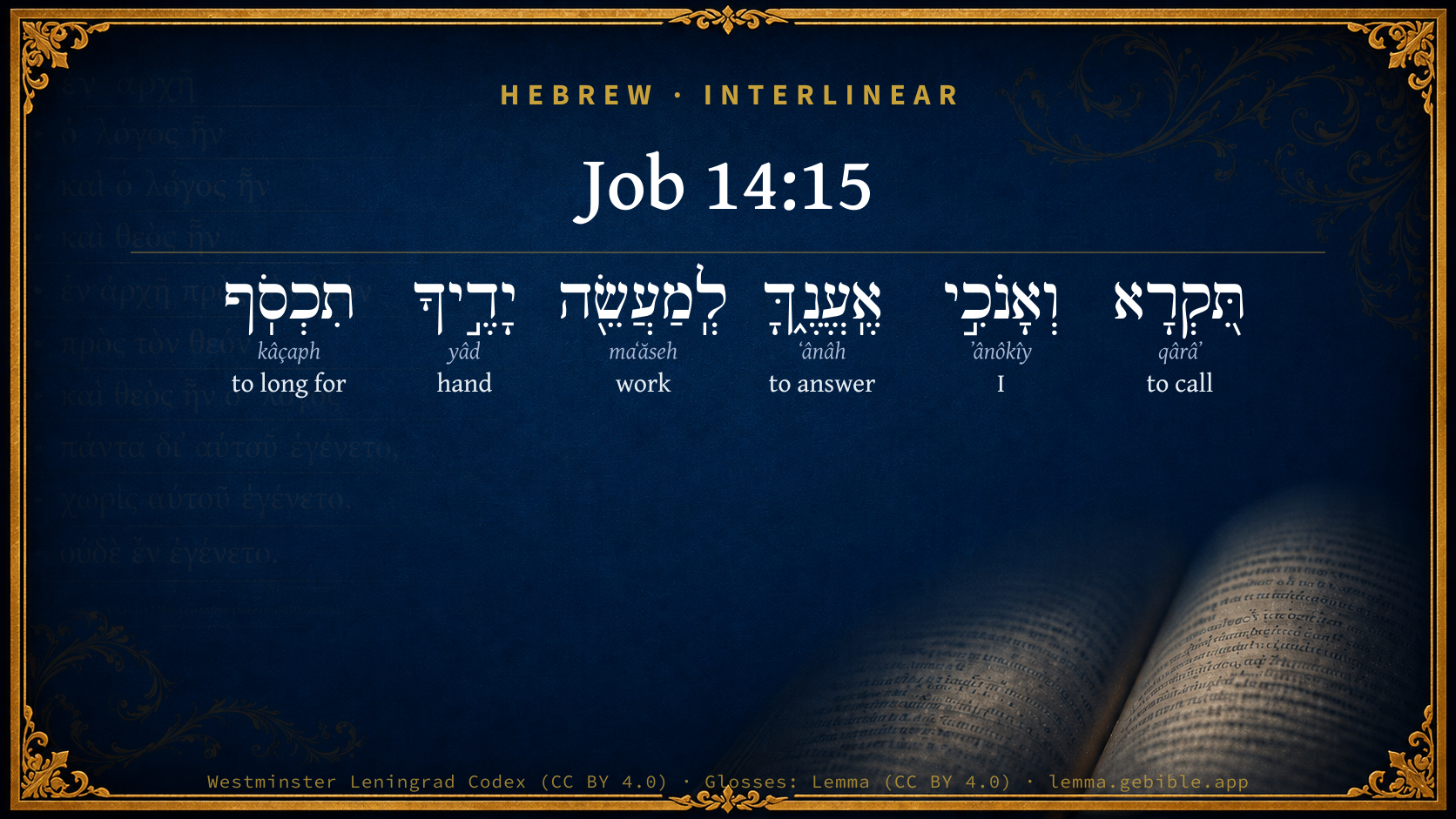
Hebrew (Westminster Leningrad Codex) Job 14:15 appears in the Hebrew Old Testament. The text above is from the Westminster Leningrad Codex. Each word links to its Strong’s number, a concise gloss, and parsing drawn from the Open Scriptures Hebrew Bible morphology. Click any word for its full Brown-Driver-Briggs (BDB) entry.
Download image
Cite this verse

Job 14:15 (World English Bible). Public Domain. Lemma interlinear Bible study tool, https://lemma.gebible.app/v/job/14/15.

Show BibTeX & RIS
BibTeX
RIS
English Translation
You would call, and I would answer you. You would have a desire to the work of your hands.
World English Bible · Public Domain
Download a study sheet

One document with this verse’s original text, its word-by-word gloss line, the meaning frame, cross-references with their text, attributed commentary, and full source and license credits — printable, and it pastes into notes with its structure intact.

This verse Autodidact and up

Study sheet (.html) Plain text (.txt)

A passage Seminary Student

Up to 50 verses in one chapter. A passage sheet keeps up to 6 commentary sources and 12 cross-references per verse, in the order this page ranks them, and says so on the sheet whenever that leaves anything out. Ask for a single verse and you get the Autodidact verse sheet above.

Everything on this page stays free to read, with no account — the sheet is a download of what is already on screen, not access to it.

Want to remove ads? Support Godless Engineer
Compare translations 3

The same verse in 3 English versions, stacked beneath the original-language interlinear above. Click any original word for its lexicon entry.

Each is an independent rendering of the whole verse — the interlinear is not word-aligned to these translations.

Highlighted words mark where these versions differ — a whole-verse word diff, not a word-by-word alignment.

  • World English Bible Public Domain
    You would call, and I would answer you. You would have a desire to the work of your hands.
  • King James Version Public Domain
    Thou shalt call, and I will answer thee: thou wilt have a desire to the work of thine hands.
  • unfoldingWord Literal Text CC BY-SA 4.0
    You would call, and I would answer you. You would desire the work of your hands.

unfoldingWord Literal Text — © unfoldingWord, licensed CC BY-SA 4.0. Word-aligned USFM3 via Door43 (git.door43.org/unfoldingWord/en_ult).

Versions to compare (up to 4)

3 of 4 selected

Show all 18 translations

Every available English version of this verse, each an independent rendering of the whole verse.

  • World English Bible Public Domain
    You would call, and I would answer you. You would have a desire to the work of your hands.
  • Berean Standard Bible Public Domain
    You will call, and I will answer; You will desire the work of Your hands.
  • Majority Standard Bible Public Domain
    You will call, and I will answer; You will desire the work of Your hands.
  • King James Version Public Domain
    Thou shalt call, and I will answer thee: thou wilt have a desire to the work of thine hands.
  • American Standard Version (1901) Public Domain
    Thou wouldest call, and I would answer thee: Thou wouldest have a desire to the work of thy hands.
  • Revised Version (1885) Public Domain
    Thou shouldest call, and I would answer thee: thou wouldest have a desire to the work of thine hands.
  • Geneva Bible (1599) Public Domain
    Thou shalt call me, and I shall answere thee: thou louest the worke of thine own hands.
  • Douay-Rheims (1899) Public Domain
    Thou shalt call me, and I will answer thee: to the work of thy hands thou shalt reach out thy right hand.
  • Young's Literal Translation Public Domain
    Thou dost call, and I -- I answer Thee; To the work of Thy hands Thou hast desire.
  • Literal Standard Version CC BY-SA 4.0
    You call, and I answer You; To the work of Your hands You have desire.
  • Unlocked Literal Bible CC BY-SA 4.0
    You would call, and I would answer you. You would have a desire for the work of your hands.
  • unfoldingWord Literal Text CC BY-SA 4.0
    You would call, and I would answer you. You would desire the work of your hands.
  • Darby Bible Public Domain
    Thou wouldest call, and I would answer thee; thou wouldest have a desire after the work of thy hands.
  • World Messianic Bible Public Domain
    You would call, and I would answer you. You would have a desire for the work of your hands.
  • Webster's Bible Public Domain
    Thou shalt call, and I will answer thee: thou wilt have a desire to the work of thy hands.
  • Free Bible Version CC BY-SA 4.0
    You would call and I would answer you; you would long for me, the being that you made.
  • Bible in Basic English Public Domain
    At the sound of your voice I would give an answer, and you would have a desire for the work of your hands.
  • JPS Tanakh (1917) Public Domain
    Thou wouldest call, and I would answer Thee; Thou wouldest have a desire to the work of Thy hands.

Literal Standard Version (2020), Covenant Press — licensed CC BY-SA 4.0. Text via the HelloAO Bible API (eBible.org). Unlocked Literal Bible (unfoldingWord) — licensed CC BY-SA 4.0. Text via the HelloAO Bible API (eBible.org). unfoldingWord Literal Text — © unfoldingWord, licensed CC BY-SA 4.0. Word-aligned USFM3 via Door43 (git.door43.org/unfoldingWord/en_ult). Free Bible Version, Dr. Jonathan Gallagher — licensed CC BY-SA 4.0. Text via the HelloAO Bible API (eBible.org).

Word by word

More ways to search: Search by grammar → Find every occurrence → Compare this word →

Practice this passage: Drill this verse → Learn its vocabulary →

About this verse

These counts appear in no published source. They are computed here, from the morphology-tagged text and Lemma’s own curated glosses. What Lemma adds →

6
words
6
distinct lemmas
Wisdom
section

Notable vocabulary

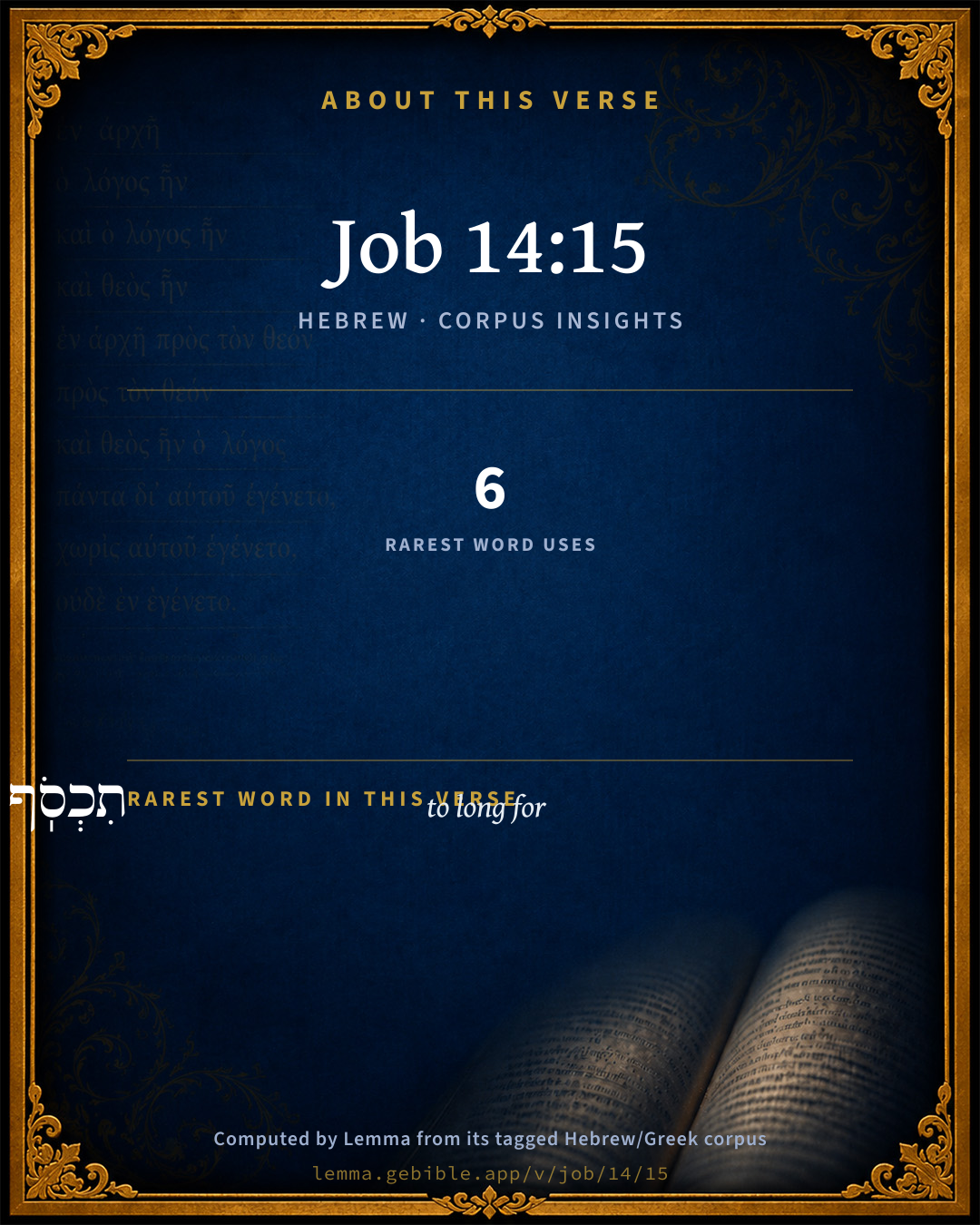
The rarest word here is תִכְסֹֽף to long for H3700 — appearing just 6 times in the whole Hebrew Bible.

Shared distinctive vocabulary

תִכְסֹֽף to long for H3700 occurs in 5 verses of the Hebrew Bible. Also found in:

Grammatical profile

  • 3 verbs
  • 2 nouns
  • 1 pronoun

Verb forms

  • תִּ֭קְרָא Qal · Imperfect
  • אֶֽעֱנֶ֑ךָּ Qal · Imperfect
  • תִכְסֹֽף Qal · Imperfect

Hebrew & Septuagint length

In English translation the verse runs 19 words from the Hebrew and 20 from the Septuagint (LXX English) — closely comparable.

A rough comparison of the two English renderings, which tokenize alike — not a word-level alignment.

Word counts can differ between the Hebrew and the Greek without any difference in meaning — e.g. the Hebrew direct-object marker אֵת has no separate Greek word, and Greek often adds the article ὁ.

Cross-references

9

Topical passages linked to Job 14:15 in the Treasury of Scripture Knowledge — connected by theme and wording, ordered by reader-vote popularity; previews shown in the World English Bible.

  • Job 13:22 Then call, and I will answer; Or let me speak, and you answer me.
  • Psalms 138:8 Yahweh will fulfill that which concerns me; Your loving kindness, Yahweh, endures forever. Don't forsake the works of your own hands.
  • Job 7:21 Why do you not pardon my disobedience, and take away my iniquity? For now shall I lie down in the dust. You will seek me diligently, but I shall not be."
  • Job 10:3 Is it good to you that you should oppress, That you should despise the work of your hands, And smile on the counsel of the wicked?
  • Job 10:8 'Your hands have framed me and fashioned me altogether; Yet you destroy me.
  • 1 Peter 4:19 Therefore let them also who suffer according to the will of God in doing good entrust their souls to him, as to a faithful Creator.
  • 1 John 2:28 Now, little children, remain in him, that when he appears, we may have boldness, and not be ashamed before him at his coming.
  • Psalms 50:4–5 He calls to the heavens above, To the earth, that he may judge his people:
  • 1 Thessalonians 4:17 then we who are alive, who are left, will be caught up together with them in the clouds, to meet the Lord in the air. So we will be with the Lord forever.

Cross-references courtesy of OpenBible.info (CC BY 4.0).

Hebrew and Greek witnesses Masoretic Hebrew ↔ Greek Septuagint

The same verse in the two great witnesses to the Old Testament, shown verse-for-verse.

These are two independent witnesses, not word-aligned to each other, and the Septuagint is shown in lemma (dictionary) form.

Hebrew Job 14:15 Masoretic · Westminster Leningrad Codex

תִּ֭קְרָא וְאָנֹכִ֣י אֶֽעֱנֶ֑ךָּ לְֽמַעֲשֵׂ֖ה יָדֶ֣יךָ תִכְסֹֽף

You would call, and I would answer you. You would have a desire to the work of your hands.

World English Bible · Public Domain

Greek LXX Job 14:15 Septuagint · lemma form

εἶτα καλέω ἐγώ δέ σύ ὑποἀκούω ὁ δέ ἔργον ὁ χείρ σύ μή ἀποποιέω

Then shall you call, and I will listen to you: but do not you reject the work of your hands.

LXX2012 (modern English Septuagint) · Public Domain

Hebrew: Westminster Leningrad Codex (CC BY 4.0). Greek: Septuagint (public domain); English from LXX2012 (modern English Septuagint) (Public Domain). How the Septuagint differs from the Hebrew →

Commentary

Notes on Job 14:15 from classic Christian and Jewish commentators (each source and its license shown beneath its notes). The classic Christian expositions comment on the surrounding passage and are grouped to its opening verse, so a note may address several verses; the Jewish commentaries on the Tanakh (Rashi and others) are per-verse, so they appear only where the commentator wrote on this verse.

Lemma curates 59 commentaries, every one of them public domain or Creative Commons licensed, each selected and text-cleaned for this edition rather than reprinted as found. About our sources →

Trapp's Complete Commentary

John Trapp

Job 14:15 Thou shalt call, and I will answer thee: thou wilt have a desire to the work of thine hands.

Ver. 15. Thou shalt call, and I will answer thee] At the resurrection of the just thou shalt call me out of the grave by thine all powerful voice, uttered by that archangel, with the trump of God, 1Th 4:16 1Co 15:52 Psa 50:3-4, and thou shalt not need to call twice; for as I shall not need then to fear (as the hypocrites will) to show my face, so I will readily answer, Here I am; yea (as that dying saint did so), I will say, I come, I come, I come. I will even leap out of the grave to obey thine orders; and I doubt not but, to draw me out of that dark prison, thou wilt lend me that hand of thine whereof I have the honour to be the workmanship.

Thou wilt have a desire to the work of thine hands] I know that thou thyself (for the love thou bearest me, of thy goodness, who am thy creature, and on whom thou hast shown favour, and reprinted thine image) wilt long after the consummation of my happiness; for then I shall be like unto thee (more like than ever), for I shall see thee as thou art, and appear with thee in glory, Col 3:4, being next unto thee, Luk 22:30; yea, one with thee, Joh 17:21, and so above the most glorious angels, Heb 1:14. The King shall greatly desire my beauty, Psa 45:11, and rejoice over me, as the bridegroom doth over his bride, Isa 62:5; Isa 10:3. The word here rendered thou wilt have a desire signifieth thou wilt desire as men do after silver. The Lord seemed to deal by Job as men do by dross, to put him away as wicked, Psa 119:119; nevertheless, he believed that he would look upon him as silver: and although he now crushed him together, and brake him to pieces, as the silversmith doth an old piece of plate which he means to melt; yet that he would in the grave, as in a furnace, refine him, and at the resurrection bring him out of a new fashion. Lo, this is the right logic of faith, to make conclusions of life in death, and of light in darkness, to gather one contrary out of another.

John Trapp, A Commentary or Exposition upon All the Books of the Old and New Testament (1647–1656) — public domain. Text from a community e-Sword module.

The Biblical Illustrator

Joseph S. Exell

Job_14:15

Thou shalt call, and I will answer Thee.

God calling in death

Mr. Moody used to say, Some day you will read in the papers that Dwight L. Moody is dead. Dont you believe it. When they say I am dead, I shalt be more alive than I ever was before. Now, it is very easy to say that when one is well and strong, but the last hours Mr. Moody had on earth he lay looking death right in the eye without a quiver. Early in the morning of his last day on earth, before daylight, his son Will, who was keeping watch beside his bed, heard him whispering something, and leaning over the bed, caught the words, Earth is receding, heaven is opening, God is calling! Will was disturbed, and called the other members of the family into the room. No, no, father, he said; not so bad as that. His father opened his eyes, and, seeing the family gathered round, said, I have been within the gates. I have seen the childrens faces--those of his two grandchildren who had died during the summer and spring. In a little while he sank into unconsciousness again, but again became conscious, and opened his eyes and said, Is this death? This is not bad. There is no valley. This is bliss!--this is sweet!--this is glorious! Then his daughter, with breaking heart, said, Father, dont leave us! Oh, he replied, Emma, I am not going to throw my life away. If God wants me to live, I will live; but if God is calling me, I must up and off! A little while later, someone tried to arouse him; but he said faintly, God is calling me; dont call me back. This is my Coronation Day; I have long looked for it! And so he went up for his coronation! (A. R. Torrey, D. D.)

Thou wilt have a desire to the work of Thine hands.--

Confidence in the Creator

The Book of Job seems to me the most daring of poems; from a position of the most vantageless realism it assaults the very citadel of the ideal. Job is the instance type of humanity in the depths of its misery. Seated in the heart of a leaden despair Job cries aloud to the might unseen, scarce known, which yet he regards as the God of his life. But no more than that of a slave is his cry. Before the Judge he asserts his innocence, and will not grovel--knowing, indeed, that to bear himself so would be to insult the holy. He feels he has not deserved such suffering, and will neither tell nor listen to lies for God. Prometheus is more stoutly patient than Job. Prometheus has to do with a tyrant whom he despises. Job is the more troubled, because it is He who is at the head and the heart, who is the beginning and the end of things, that has laid His hand upon him. He cannot, will not, believe Him a tyrant. He dares not think God unjust; but not, therefore, can he allow that he has done anything to merit the treatment he is receiving at His hands. Hence is he of necessity in profoundest perplexity, for how can the two things be reconciled? The thought has not yet come to him, that that which it would be unfair to lay upon him as punishment, may yet be laid upon him as a favour. Had Job been Calvinist or Lutheran the Book of Job would have been very different. His perplexity would then have been--how God, being just, could require of a man more than he could do, and punish him as if his sin were that of a perfect being, who chose to do the evil of which he knew all the enormity. From a soul whose very consciousness is contradiction, we must not look for logic; misery is rarely logical; it is itself a discord. Feeling as if God had wronged him, Job yearns for the sight of God, strains into His presence, longs to stand face to face with Him. He would confront the One. Look closer at Jobs way of thinking and speaking about God, and directly to God. Such words are pleasing in the ear of the Father of spirits. He is not a God to accept the flattery which declares Him above obligation to His creatures. Job is confident of receiving justice. God speaks not a word of rebuke to Job for the freedom of his speech. The grandeur of the poem is that Job pleads his cause with God against all the remonstrance of religious authority, recognising no one but God, and justified therein. And the grandest of all is this, that he implies, if he does not actually say, that God owes something to His creature. This is the beginning of the greatest discovery of all--that God owes Himself to the creature He has made in His image, for so He has made him incapable of living without Him. It is not easy at first to see wherein God gives Job any answer. I cannot find that He offers him the least explanation of wily He has so afflicted him. He justifies him in his words. The answers are addressed to Job himself, not to his intellect; to the revealing, Godlike imagination in the man, and to no logical faculty whatever. The argument implied, not expressed, in the poems seems to be this--that Job, seeing God so far before him in power, and His works so far beyond his understanding, ought to have reasoned that He who could work so grandly beyond his understanding, must certainly use wisdom in things that touched him nearer, though they came no nearer his understanding. The true child, the righteous man, will trust absolutely, against all appearances, the God who has created in him the love of righteousness. God does not tell Job why He had afflicted him; He rouses his child heart to trust. (George Macdonald, D. D.)

The believers confidence

It would seem as if in using these words Job had reference to the resurrection of the body. We may regard them, in a more general way, as an assertion of the patriarchs confidence in God; of his assurance that he should be kept unto everlasting life. Believers are invariably witnesses that the more cause a man has to be full of hope and of confidence, the more diligent will he be in the use of appointed means of grace. The privileges of true religion have no tendency to the generating presumption. The man who has the strongest scriptural warrant for feeling sure of heaven is always the man who is striving most earnestly for the attainment of heaven. Never venture to appropriate to yourselves the rich assurances which are found in the Bible, unless you have good reason to believe that you are growing in hatred of sin, and in strivings after holiness. Fear not to take to yourselves all the promises made by God to His Church, so long as it is your honest desire, and your hearty endeavour, to become more conformed to the image of your Saviour.

1. The language of confidence. Thou wilt call, and I will answer thee. Remember in how many ways God calls. Jobs words indicate great confidence of final salvation. We should greatly rejoice to know that you had all been able to cast away doubt and suspicion, and to feel yourselves begotten again to an inheritance incorruptible and undefiled. But we do dread your resting your assurance on insufficient grounds. These are two great features of genuine piety--the not being content with present acquirements, and the resting for the future on the assistances of God.

2. Job strengthens himself in the persuasion that God will have a desire to the work of His hands. Amid all the reasons which Job might have urged why God should watch over him, he selects that of his being the work of Gods hands. There is, however, a second creation more marvellous, more indicative of Divine love, than the first; and on this, probably, it was that Jobs thoughts were turned. The human soul was formed originally in the image of God, but lost that image through the transgression of Adam. So marvellous is its restoration, so far beyond all power but the Divine, that it is spoken of as actually a new creation, when reimpressed with the forfeited features. (Henry Melvill, B. D.)

The rights of creation

Such a chapter as this does not stand by any means alone in the Old Testament. Nature then, as now, lent but ugly dreams to the inquirer after immortality. For one hint from nature, which tells in favour of immortality, you may find a hundred from the same quarter which tell against it. In his search for a solid ground upon which to build some hope, however scanty, for the unknown future beyond death, the writer is driven at last to the simplest and most solid ground of all--the fact of creation, and what is involved in creation. Every chapter of his work is pervaded with the feeling of mystery, vastness, and awe, whenever he speaks of God. But he holds firmly by his faith in a Creator, whose creature--made in His likeness--he himself is. His argument is this--The creature simply as a creature, by virtue of creation, has a Claim upon the Creator, which the Creator will be the first to avow. It may, perhaps, sound bold to speak thus of creation, as giving a title to the Creators care. If the Creator were an unfaithful, an unrighteous Creator, there would indeed be no limit to the power of dealing with, and disposing of His creatures. It is our happiness to know that might is not right with Him; that the Almighty is also the All-righteous and the All-merciful. Every created thing or person has certain rights and claims as towards the Creator. These rights and claims are determined by his or its capacities. Man is capable of knowing and doing his Creators wilt He who is capable of fellowship with God will never be suffered by the Creator to perish in death. We are in the hands of a Father, a Creator, who knows what He would do with us, knows what we are capable of, knows what He created us for; and who assuredly will not leave us until He hath done that which He hath spoken to us of. Jobs confidence in God was justified to the uttermost. (D. J. Vaughan, M. A.)

The Biblical Illustrator, edited by Joseph S. Exell (c. 1880s–1900s) — public domain. Text from a community e-Sword module.

Joseph Benson's Commentary

Job 14:15. Thou shalt call and I will answer thee — 1st, At death, thou shalt call my body to the grave and my soul to thyself, and I will cheerfully answer, Here I am. Gracious souls readily answer death’s summons, and appear to his writ. Their spirits are not forcibly required of them, as was that of the rich man, Luk 12:20, but willingly resigned by them, and the earthly tabernacle not violently pulled down, but voluntarily laid down. 2d, At the resurrection thou shalt call me out of the grave by the voice of the archangel, and I will answer and come at thy call. For thou wilt have a desire to the work of thy hands — A love for the soul, which thou hast made, and new-made by thy grace; and for the body, which is also the work of thy hands, and to which thou wilt have a desire, having prepared glory for it in a world of glory.

Joseph Benson's Commentary on the Old and New Testaments (1811–1818) — public domain. Text from a community e-Sword module.

Geneva Bible (1599)

Geneva Bible translators

Though I be afflicted in this life, yet in the resurrection I shall feel thy mercies and answer when thou callest me.

Geneva Bible (1599) marginal notes — public domain. Text via Bolls.life.

Jamieson, Fausset & Brown

Robert Jamieson, A. R. Fausset & David Brown

namely, at the resurrection (Joh 5:28; Psa 17:15).

have a desire to--literally, "become pale with anxious desire:" the same word is translated "sore longedst after" (Gen 31:30; Psa 84:2), implying the utter unlikelihood that God would leave in oblivion the "creature of His own hands so fearfully and wonderfully made." It is objected that if Job knew of a future retribution, he would make it the leading topic in solving the problem of the permitted afflictions of the righteous. But, (1) He did not intend to exceed the limits of what was clearly revealed; the doctrine was then in a vague form only; (2) The doctrine of God's moral government in this life, even independently of the future, needed vindication.

Jamieson, Fausset & Brown — Commentary Critical and Explanatory on the Whole Bible (1871) — public domain (CC PDM 1.0). Text via the HelloAO Bible API.

Adam Clarke's Commentary

Verse 15. Thou shalt call] Thou shalt say There shall be time no longer: Awake, ye dead! and come to judgment!

And I will answer thee] My dissolved frame shall be united at thy call; and body and soul shall be rejoined.

Thou wilt have a desire] תכסף tichsoph, "Thou wilt pant with desire;" or, "Thou wilt yearn over the work of thy hands." God has subjected the creature to vanity, in hope; having determined the resurrection. Man is one of the noblest works of God. He has exhibited him as a master-piece of his creative skill, power, and goodness. Nothing less than the strongest call upon justice could have induced him thus to destroy the work of his hands. No wonder that he has an earnest desire towards it; and that although man dies, and is as water spilt upon the ground that cannot be gathered up again; yet doth he devise means that his banished be not expelled from him. Even God is represented as earnestly longing for the ultimate reviviscence of the sleeping dust. He cannot, he will not, forget the work of his hands.

Adam Clarke's Commentary on the Bible (1810–1826) — public domain. Text from a community e-Sword/MySword module.

John Gill's Exposition

Thou shall call, and I will answer thee,.... Either at death, when the soul of than is required of him, and he is summoned out of time into eternity, and has sometimes previous notice of it; though not by a prophet, or express messenger from the Lord, as Hezekiah had, yet by some disease and distemper or another, which has a voice, a call in it to expect a remove shortly; and a good man that is prepared for it, he answers to this call readily and cheerfully; death is no king of terrors to him, he is not reluctant to it, yea, desirous of it; entreats his dismission in peace, and even longs for it, and rejoices and triumphs in the views of it: or else at the resurrection, when Christ shall call to the dead, as he did to Lazarus, and say, Come forth; and when they shall hear his voice, even the voice of the archangel, and shall answer to it, and come forth out of their graves, the sea, death, and the grave, being obliged to deliver up the dead that are therein; though some think this refers to God's call unto him in a judicial way, and his answers to it by way of defence, as in Job 13:22; but the other sense seems more agreeable to the context:

thou wilt have a desire to the work of thine hands; meaning his body, which is the workmanship of God, and a curious piece of workmanship it is, wonderfully and fearfully made, Psa 139:14, and curiously wrought; and though it may seem to be marred and spoiled by death, yet God will have a desire to the restoration of it at the resurrection to a better condition; even the bodies of his people, and that because they are vessels chosen by him, given to his Son, redeemed by his blood, united to his person, and sanctified by his Spirit, whose temples they are, and in whom he dwells: wherefore upon these considerations it may be reasonably supposed that Father, Son, and Spirit, have a desire to the resurrection of the bodies of the saints, and in which they will have a concern; and from which it may be concluded it will be certainly effected, since God is a rock, and his work is perfect, or will be, both upon the bodies and souls of his people; and the work of sanctification will not be properly completed on them until their vile bodies are changed, and made like to the glorious body of Christ; which must be very desirable to him, who has such a special love for them, and delight in them. Some render the words with an interrogation, "wilt thou desire to destroy the work of thine hands" (e)? surely thou wilt not; or, as Ben Gersom,

"is it fit that thou shouldest desire to destroy the work of thine hands?''

surely it is not becoming, it cannot be thought that thou wilt do it; but the former sense is best.

(e) "perdere desiderabis?" Pagninus, Vatablus.

John Gill's Exposition of the Whole Bible (1746–1763) — public domain (CC PDM 1.0). Text via the HelloAO Bible API.

Albert Barnes' Notes on the Bible

Thou shalt call, and I will answer thee - This is language taken from courts of justice. It refers, probably, not to a future time, but to the present. “Call thou now, and I will respond.” It expresses a desire to come at once to trial; to have the matter adjusted before he should leave the world. He could not bear the idea of going out of the world under the imputations which were lying on him, and he asked for an opportunity to vindicate himself before his Maker; compare the notes at Job 9:16.

Thou wilt have a desire to the work of thine hands - To me, one of thy creatures. This should, with more propriety, be rendered in the imperative, “do thou have a desire.” It is the expression of an earnest wish that God would show an interest in him as one of his creatures, and would bring the matter to a speedy issue. The word here rendered, “have a desire” (תכסף tı̂kâsaph), means literally to be or become “pale” (from כסף keseph), “silver,” so called from its paleness, like the Greek ἄργυρος arguros from ἀγρός agros, white); and then the verb means to pine or long after anything, so as to become pale.

Albert Barnes' Notes on the Bible (1834–1885) — public domain. Text from a community e-Sword/MySword module.

Matthew Poole's English Annotations

I trust there is a time coming when thou wilt grant me the mercy which now thou deniest me, to wit, a favourable hearing, when thou wilt call to me to speak for myself, and I shall answer thee; which I know will be to thy satisfaction and my comfort. Compare this with Job 13:22, where the same words are used in this same sense. Or, Thou shalt call me out of the grave of my calamities, and I shall answer thee, and say, Here I am, raised out of the pit in which I was buried by thy powerful and gracious command. To the work of thine hands, i.e. to me, who am thy workmanship in divers respects, from whom thou now seemest to have an aversion and abhorrency; but I doubt not thou wilt have a desire, i.e. show thy affection or good will to me; or a desire to look upon me, and to deliver me. Nor is it strange that Job, who lately was upon the brink of despair, doth now breathe out words of hope; such ebbings and flowings being usual, both with Job elsewhere, as Job 13:15,16, and with David frequently in the Psalms, and with others of God’s people.

Matthew Poole's English Annotations on the Holy Bible (1683–1685) — public domain. Text from a community e-Sword/MySword module.

Whedon's Commentary on the Bible

Daniel D. Whedon

15. Have a desire — Pine or yearn for; primarily, become pale, (like silver,) as when, under strong emotion, the blood withdraws from the face. The figure is a forcible one to express the divine yearning over the dead, a yearning that culminates in their recall to life.

Thou shalt call — And that “call” shall penetrate into sheol.

The work of thine hands — The human body (comp. Job_10:9). This passage (Job_14:13-15) is one of prime significance in the olden theology of hope. Hitherto Job’s despair had surrounded the abode of the dead with the deepest gloom. To his disconsolate mind it was “a land of darkness, as darkness itself.” Job_10:22. But now, trembling rays of light arise from the distant horizon — from the other side of sheol. As in the total eclipse of the sun the opposite horizon is lighted up with the bright tints of an early dawn, so here, where there was apparently an entire extinction of hope, a dawn rises upon the sky. “The hope of eternal life,” says an old commentator, “is a flower which grows on the verge of the abyss.”

Daniel D. Whedon (gen. ed.), Commentary on the Old and New Testaments (1874–1909) — public domain. Text from a community e-Sword module.

The Pulpit Commentary

Thou shalt call, and I will answer thee; rather, thou shouldest call, and I would answer thee (see the Revised Version). In that case, when I quitted Hades, and renewed my life, thou wouldst assuredly summon me to thee, and I would respond to the summons. There would be sweet colloquy between us; for thou wilt (or, rather, wouldest) have a desire to the work of thine hands. (comp. Job_10:8-11) Job assumes that God must love whatever he has created, and be drawn towards it by a secret, strong desire.

The Pulpit Commentary (1880–1919), ed. H.D.M. Spence-Jones & Joseph S. Exell — public domain. Text from a community e-Sword module.

John Wesley's Explanatory Notes

Answer thee - Thou shalt call my soul to thyself: and I will cheerfully answer, Here I am: knowing thou wilt have a desire to the work of thy hands - A love for the soul which thou hast made, and new-made by thy grace.

John Wesley, Explanatory Notes Upon the Whole Bible (1754–1765) — public domain. Text via the GEBible commentary corpus.

unfoldingWord translationNotes

Door43 World Missions Community

General Information:

Job continues speaking to God.

I would answer

"I would respond"

You would have a desire for

The noun "desire" can be expressed with the verbs "desire" or "want." AT: "You would desire" or "You would want" (See: Abstract Nouns)

for the work of your hands

Here God's hands represent him making things. Job refers to himself as the work of God's hands. AT: "for me, whom you have made" (See: Metonymy and First, Second, or Third Person)

number and care for

These two verbs together express a single action. AT: "attentively care for" (See: Hendiadys)

my footsteps

Footsteps represent his life or what he does. AT: "my life" or "the things I do" (See: Metonymy)

you would not keep ... My transgression would be ... you would cover up

These three lines express the same thought and are used together to emphasize his confidence that God would forgive him. (See: Parallelism)

you would not keep track of my sin

Keeping track of Job's sin represents thinking about his sin. AT: "you would not look at my sin" or "you would not think about my sin" (See: Metaphor)

My transgression would be sealed up in a bag

Sealing transgression in a bag represents hiding it and refusing to think about it. This can be stated in active form. AT: "You would refuse to think about my transgression like someone who hides something in a bag" (See: Metaphor)

you would cover up my iniquity

Covering up someone's iniquity so that it cannot be seen represents refusing to think about it. AT: "you would hide my iniquity" or "you would ignore my iniquity" (See: Metaphor)

translationWords

call

works

sin

transgress

seal

iniquity

unfoldingWord translationNotes — © Distant Shores Media and the Door43 World Missions Community, licensed CC BY-SA 4.0. Source: git.door43.org/Door43/en_tn.

Rashi

Rabbi Shlomo Yitzchaki (Rashi)

Call This is a supplication. Call to me and I will answer you to prove my case.

You desire Heb. תִכְסֹף, You desire.

Rashi on the Tanakh — English translations: “The Judaica Press complete Tanach with Rashi, translated by A. J. Rosenberg” (CC BY 4.0); “Pentateuch with Rashi's commentary by M. Rosenbaum and A.M. Silbermann, 1929-1934” (public domain); “The Metsudah Tanach series, Lakewood, N.J” (CC BY 4.0); and “The Book of Joshua, Metsudah Publications, 1997” (CC BY 4.0). Text via Sefaria.

Lesson kit

Teaching starters — assembled from the data on this page, not authored interpretation. Every prompt links to the verse data it draws on. Edit before teaching.

Job, in the Wisdom, opens this verse with 6 words (6 distinct Hebrew lemmas). Its most distinctive word is kâçaph (“to long for”). A historical commentator’s framing appears above. Read the whole chapter for the surrounding context.

Discussion questions

  1. The word kâçaph carries the sense “to long for.” How does it shape the verse?
  2. Genesis 31:30 shares the word «to long for» with this verse. How do the two illuminate each other?
  3. The translations on this page render this verse differently — a whole-verse word diff, not a word-by-word alignment. What might account for the different wordings?
  4. The verb «תִּ֭קְרָא» is Qal Imperfect. How does its form color the action?
  5. Reading how Trapp's Complete Commentary and The Biblical Illustrator read this verse, where do the two commentators agree and where do they part?

Things to notice

Reading settings

Reading text

Shown beneath each verse's original-language words.

Old Testament
Old Testament edition

Read the OT as the Masoretic Hebrew (MT) or the Greek Septuagint (LXX).

English shown for the Greek Septuagint (in the Hebrew ↔ Greek comparison).

Comparing translations? Open the Compare panel on any verse page to stack up to four side by side.