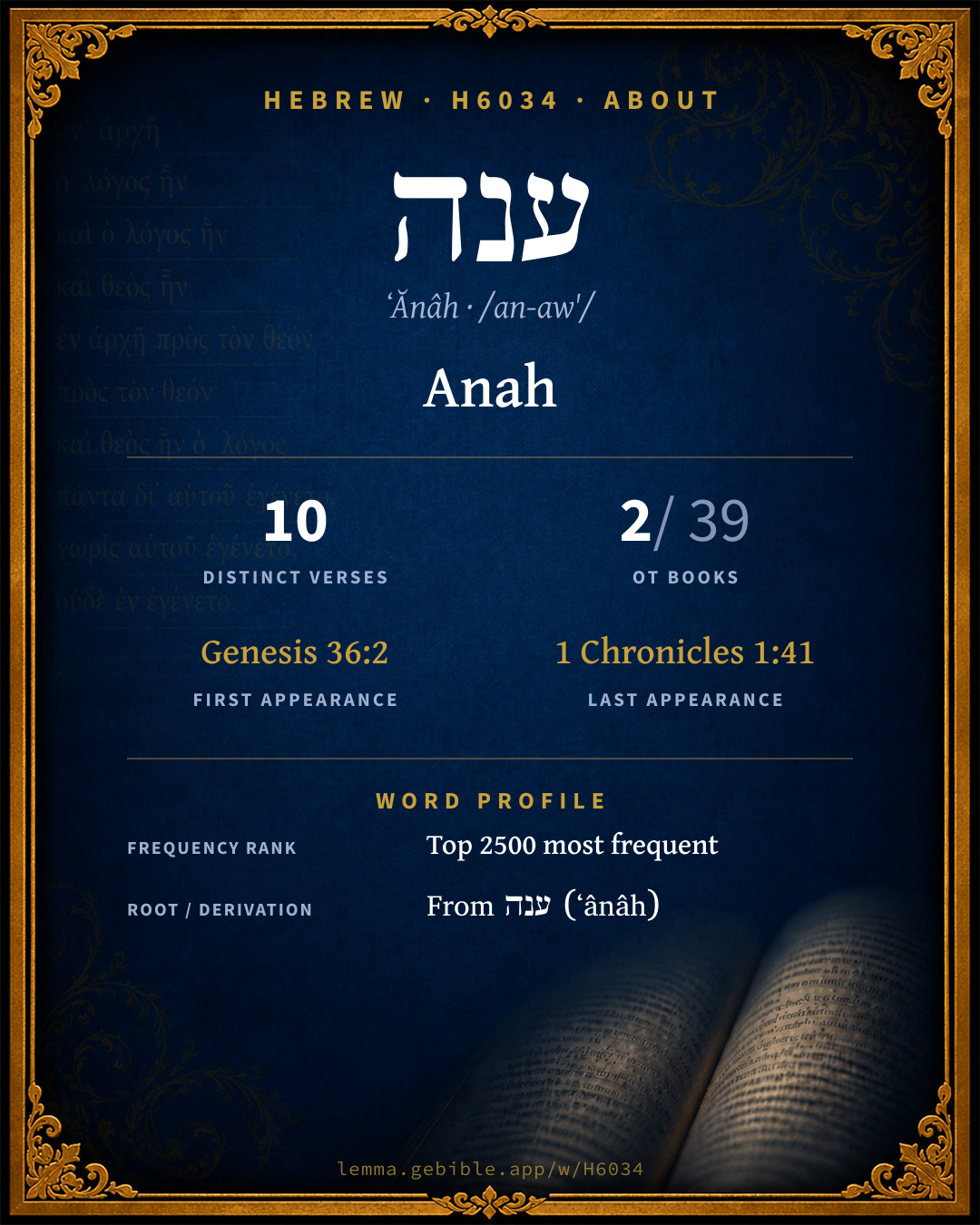
עֲנָה
Anah
BDB lists 4 entries for ‘Anah’ fuller range ↓
Full lexicon entry — Brown-Driver-Briggs (BDB)
From Brown-Driver-Briggs (BDB)
Where this word appears
Grammar key — what these labels mean
Part of speech
- Noun
- A naming word — a person, place, thing, or idea.
Noun type
- Proper
- A name of a specific person, place, or people (e.g. Abraham, Zion, Israel).
Every verse where H6034 appears — 10 distinct verses across 2 books. Click any verse to open its interlinear word-by-word view. Verse text shown in the World English Bible for context — . Each verse’s Hebrew form is shown with its reference; the English is not keyword-highlighted, since the data carries no word-level English alignment. Use “Compare translations” on any verse to read it across multiple English versions. This concordance covers the Hebrew Bible; Septuagint (Greek Old Testament) occurrences are not indexed here.
Genesis 7 verses
- Genesis 36:2 עֲנָ֔ה n Proper Esau took his wives from the daughters of Canaan: Adah the daughter of Elon, the Hittite; and Oholibamah the daughter of Anah, the daughter of Zibeon, the Hivite;
- Genesis 36:14 עֲנָ֛ה n Proper These were the sons of Oholibamah, the daughter of Anah, the daughter of Zibeon, Esau's wife: she bore to Esau Jeush, Jalam, and Korah.
- Genesis 36:18 עֲנָ֖ה n Proper These are the sons of Oholibamah, Esau's wife: chief Jeush, chief Jalam, chief Korah: these are the chiefs who came of Oholibamah the daughter of Anah, Esau's wife.
- Genesis 36:20 וַ/עֲנָֽה conj + n Proper These are the sons of Seir the Horite, the inhabitants of the land: Lotan, Shobal, Zibeon, Anah,
- Genesis 36:24 וַ/עֲנָ֑ה עֲנָ֗ה conj + n Proper n Proper These are the children of Zibeon: Aiah and Anah. This is Anah who found the hot springs in the wilderness, as he fed the donkeys of Zibeon his father.
- Genesis 36:25 עֲנָ֖ה עֲנָֽה n Proper n Proper These are the children of Anah: Dishon and Oholibamah, the daughter of Anah.
- Genesis 36:29 עֲנָֽה n Proper These are the chiefs who came of the Horites: chief Lotan, chief Shobal, chief Zibeon, chief Anah,
1 Chronicles 3 verses
- 1 Chronicles 1:38 וַֽ/עֲנָ֑ה conj + n Proper The sons of Seir: Lotan, and Shobal, and Zibeon, and Anah, and Dishon, and Ezer, and Dishan.
- 1 Chronicles 1:40 וַ/עֲנָֽה conj + n Proper The sons of Shobal: Alian, and Manahath, and Ebal, Shephi, and Onam. The sons of Zibeon: Aiah, and Anah.
- 1 Chronicles 1:41 עֲנָ֖ה n Proper The sons of Anah: Dishon. The sons of Dishon: Hamran, and Eshban, and Ithran, and Cheran.
About this entry
At a glance — auto-summarized from this page’s data, not written by a person. Every figure links to its source below. This summary describes the numbers; it doesn’t interpret them.
ענה — transliterated ʻĂnâh — is a Hebrew name carrying the sense “Anah.” More than two-thirds of its appearances fall in Genesis. The Hebrew Bible uses it across 10 verses — uncommon. Debuting at Genesis 36:2, it then recurs through the corpus. See 10-verse concordance and the renderings breakdown below.
Gloss history
Strong's 1890 vs modern scholarship
About this word
Strong's H6034 catalogs a Hebrew word from the Hebrew Old Testament.
These counts are not copied from any lexicon or concordance. They are computed here, from the morphology-tagged Hebrew Old Testament. What Lemma adds →
- 10
- distinct verses
- The word appears in 10 distinct verses.
- 2 / 39
- OT books
- The word appears in 2 of 39 Old Testament books.
- #2,101
- by frequency
- Top 2500 most frequent Hebrew words (rank 2,101 of 8,640 Hebrew words by occurrence).
View all 10 occurrences in the concordance →
Most concentrated in
- Genesis 7 verses 70%
- 1 Chronicles 3 verses 30%
By section of the Old Testament
By traditional corpus
Conventional, traditional groupings — biblical authorship is debated, so this is a traditional corpus grouping, not an authorship claim. Each share is this word’s portion of its verses in that division of the Hebrew canon. Each figure is a share of the word’s 10 distinct verses.
- Torah (Pentateuch) 7 verses · 70%
- Writings (Ketuvim) 3 verses · 30%
How translations render this word
Counts come from each version’s own published word-to-Strong’s tagging or interlinear alignment — an approximate guide to how each version renders this word, not a word-level alignment the data otherwise carries. Because each total is that version’s own tagged count, the per-version totals vary from one another and need not match the appearance or distinct-verse counts above. These counts may also differ from a printed concordance because Lemma counts each distinctly tagged rendering and does not collapse phrase taggings into a single head-word total. This is a fixed set of word-tagged versions (KJV, ASV, BSB, ULT) and does not change with the reading translation you choose elsewhere. Each version’s license is shown beside its name below (and on Sources).
- King James Version: Anah 11×
- American Standard Version: Anah 11×
- Berean Standard Bible: Anah 12×
- unfoldingWord Literal Text: Anah 12×
King James Version Public Domain
Renders H6034 across 12 tagged occurrences — most commonly:
Plus 1 rendering that appears only once — usually multi-word phrases or single function words the recovered tagging swept in, not distinct renderings.
American Standard Version Public Domain
Renders H6034 across 12 tagged occurrences — most commonly:
Plus 1 rendering that appears only once — usually multi-word phrases or single function words the recovered tagging swept in, not distinct renderings.
Berean Standard Bible Public Domain
Renders H6034 across 12 tagged occurrences — most commonly:
unfoldingWord Literal Text CC BY-SA 4.0
Renders H6034 across 12 tagged occurrences — most commonly:
Senses in the full BDB
What do BDB’s symbols mean?
BDB uses these scholarly abbreviations:
| Symbol | Meaning |
|---|---|
| 𝔊 | the Septuagint (the ancient Greek translation, LXX) |
| 𝔙 | the Vulgate (the Latin translation) |
| 𝔖 | the Syriac version (the Peshitta) |
| 𝔗 | the Targum (the Aramaic translation) |
| ψ | the Psalms |
| √ | root (the underlying root or stem) |
| ‖ | parallel passage (a synonymous or contrasted parallel) |
| † | the dagger: every passage where the word occurs is cited |
The 2 senses and sub-senses the full Brown-Driver-Briggs lexicon distinguishes for this word, in lexicon order (not ranked by frequency), with BDB’s own verbatim wording and sub-sense lettering. Shown in Hebrew script with BDB’s own scholarly abbreviations. The condensed entry is in the Lexicon Entry tab. See also the Forms in the corpus table below.
- 1. Gn 36:2 (read הַחֹרִי for הַחִוִּי v. Di) v 14, 18, 20, 25(×2), 29 = 1 Ch 1:38, 41. e.g. Genesis 36:2
- 2. (‘nephew’ of 1) Gn 36:24(×2) = 1 Ch 1:40.—Ανα, Α(ι)να(ν) (cf. n.pr.m. ען, Safa, HalJAs 7, x. 374). e.g. Genesis 36:24
Senses from the full Brown-Driver-Briggs lexicon (Brown, Driver, Briggs; Oxford 1906 — public domain), digitized via Sefaria, supplemented by the OpenScriptures HebrewLexicon (CC BY 4.0). Full attribution on Sources.
Word origin
Derived from ענה (ʻânâh) (H6030) — to answer.
Jastrow Dictionary
A second Hebrew/Aramaic lexicon for comparison, covering Aramaic and post-biblical (Talmudic, Targumic, Midrashic) usage that the biblical-Hebrew BDB does not. Matched by lemma rather than by Strong’s number, so a lemma may carry more than one Jastrow headword (shown separately below), and the entries cover usage well beyond the Bible.
עָנָה
- , v. עני h. a. ch.
עני
- (b. h.) [to turn, come out in turn,] to begin to speak; to respond; to speak or sing in chorus; to answer. Tem. 16ᵃ ע̇תנ̇יא̇ל̇ שעֲנָאו̇ א̇ל̇ he was surnamed Othniel, because God answered his prayer (ref. to I Chr. IV, 10). Y. Sot. V, 20ᶜ top והן עוֹנִין אחריו על כל דבר ודבר and they (the class) repeat each sentence after him; משה … והן עונין אחריו אשירה Moses said, I will sing &c., and they repeated in chorus, I will sing &c. Ib. משה אמר עזי והן עונין וכ׳ Moses said, My strength &c., and they responded, I will sing &c. Tosef. ib. VI, 2 ועונין על כל עינין ועינין and they (the class) repeat each sentence. Ib. 3 ועונין אחריו עינין ראשון and they (the people) always repeated the first sentence (as refrain). Succ. 38ᵇ מצוה לַעֲנוֹת הללויה it is proper to say in response Halleluiah. M. Kat. III, 9 כולן עוֹנוֹת כאחת all start the dirge at once; אחת מדברת וכולן עונות אחריה one speaks, and all repeat in chorus after her, v. עִינּוּי I. Ber. 47ᵃ עד שיכלה אמן מפי העוֹנִים until the Amen of the responding company is finished. Pes. 36ᵃ לחם שעונין וכ׳, v. עוֹנִי. Y. Succ. III, 54ᵃ top אם בירכך גוי עֲנֵה אחריו אמן if a gentile blesses thee, say after him Amen; a. fr. e.g. 1 Chronicles 4:10
- 1. to be answered, to have one’s prayer granted. Sabb. 30ᵃ וכשאמר זכור … מיד נ׳ but when he said, Remember &c. (Ex. XXXII, 13), his prayer was at once granted. R. Hash. 18ᵃ זה התפלל ונ׳ וכ׳ one prays and is heard, another prays and is not heard; Koh. R. to IX, 11, v. פָּגַע. Gen. R. s. 60 [read:] שלשה הם שנַעֲנוּ במענה פיהם three persons (mentioned in the Scriptures) were answered as soon as they had uttered their prayer; Yalk. ib. 108; a. fr. e.g. Exodus 32:13
- 2. to be called upon to speak; to answer, to deliver an opinion. Kidd. 40ᵇ נ׳ ר"ט ואמר וכ׳ R. Ṭ. (being asked his opinion) answered saying &c.; נַעֲנוּ כולם ואמרו וכ׳ all of them in turn answered saying &c.; Sifré Deut. 41; M. Kat. 28ᵇ (at a mourner’s house); a. fr.
- 3. [to be made to respond Amen,] to be sworn; to promise allegiance. Y. Dem. II, 23ᵃ top הוא נ׳ לחבורה … נַעֲנִין לו he (the head of the house) promises allegiance to the order (v. חֲבֵרוּת), and the members of his house make the promise to him.
- to speak or sing in chorus, esp. to lament. M. Kat. III, 9, מְעַנּוֹת, v. עִינּוּי I.
עֲנֵי
- Targ. II Esth. VI, 10. Targ. I Kings XII, 7.—Targ. Ps. XXXIV, 5 (Ms. עַנְיָינִי). Ib. CII, 3; a. fr.—Y. Succ. III, 54ᵃ top מה נַעְנֵי what shall we say in response? Ib. ר׳ יונה ע׳ הכין והכין R. J. responded, so be it, and so be it. Ab. Zar. 18ᵃ bot. אימא אלהא דמאיר עֲנֵנִי say, O God of Meïr, hear me; a. fr.—[Men. 17ᵃ עני מרי, v. עֲנֵי II.]
- to speak or sing in chorus; to respond. Targ. O. Ex. XV, 21. Targ. II Esth. VI, 11.
- 1. to be answered. Targ. O. Ex. XIX, 19. Targ. Prov. XXI, 13 נתעני ed. Wil. (ed. Lag. נַעֲנוֹי will answer him; h. text יֵעָנֶה).—
- *2. (euphem.) to be gratified, be eased. Y. Shebi. III, 34ᶜ bot. ההן דאזיל ולא מִתְעַנֵּי … he who went out to ease his bowels without success; [perhaps to be read מתפני, v. פְּנֵי?]
A Dictionary of the Targumim, the Talmud Babli and Yerushalmi, and the Midrashic Literature (Marcus Jastrow; London, Luzac, 1903) — Public Domain. Digitized via Sefaria. Digitized via Sefaria. Full attribution on Sources.
Forms in the corpus
The 8 distinct written forms H6034 takes in the Hebrew Bible, most frequent first — each parse links to that state’s occurrences in the concordance. Hebrew forms include their vowel points and cantillation, so a single lemma takes many written forms.
| Form | Parsing | Example | Uses |
|---|---|---|---|
| עֲנָ֖ה | Noun, Proper | Genesis 36:18 | 3 |
| וַ/עֲנָֽה | Noun, Proper | Genesis 36:20 | 2 |
| עֲנָֽה | Noun, Proper | Genesis 36:25 | 2 |
| וַ/עֲנָ֑ה | Noun, Proper | Genesis 36:24 | 1 |
| וַֽ/עֲנָ֑ה | Noun, Proper | 1 Chronicles 1:38 | 1 |
| עֲנָ֔ה | Noun, Proper | Genesis 36:2 | 1 |
| עֲנָ֗ה | Noun, Proper | Genesis 36:24 | 1 |
| עֲנָ֛ה | Noun, Proper | Genesis 36:14 | 1 |
Same root — word family
Other BDB entries built from the same root as H6034, grouped by Strong’s listed origin. These share a root / origin per the lexicon — not necessarily a shared meaning. Each links to that word’s own entry.
Derives from
Shares the same root
- מען maʻan H4616 for the sake of
- מענה maʻăneh H4617 answer
- ענה ʻânâh H6031 to afflict
- ענה ʻănâh H6032 to answer
Proper names from this root
People and places named from this root — a name, not an additional meaning of the word.
Compare all same-root words → Showing 4 of 8 — not the complete family. 2 of the same-root words are proper names (people or places). They share a root, not necessarily a meaning.
Bible dictionary
Public-domain dictionary articles matched to this entry by name (Anah). A biblical name can be shared by more than one person or place, so an article may treat several.
Easton's Bible Dictionary · M. G. Easton, 1897
Speech. (1.) One of the sons of Seir, and head of an Idumean tribe, called a Horite, as in course of time all the branches of this tribe were called from their dwelling in caves in Mount Seir (Gen. 36:20, 29; 1 Chr. 1:38).
(2.) One of the two sons of Zibeon the Horite, and father of Esau's wife Aholibamah (Gen. 36:18, 24).
Smith's Bible Dictionary · William Smith, 1863
(one who answers), the son of Zibeon and father of Aholibamah, one of Esau's wives. (Genesis 36:2,14,25) He is supposed to have discovered the "hot springs" (not "mules," as in the Authorized Version) in the desert as he fed the asses of Zibeon his father. (B.C. 1797.)
Hitchcock's Bible Names Dictionary · Roswell D. Hitchcock, 1869
one who answers; afflicted
Classic public-domain reference works; full attribution on Sources.
Septuagint verse parallels
This word appears in 10 verses that also exist in the Greek Old Testament (Septuagint), out of the 10 Hebrew verses it occurs in. You can read those verses in Greek by switching the Old Testament edition to the Septuagint.
Read these verses in the Septuagint
This is a verse-level parallel only — the same verses exist in both the Hebrew and Greek Old Testaments. No word-level Hebrew↔Greek correspondence is claimed: the data carries no such alignment, so no Greek word is shown as this Hebrew word’s translation. Coverage is not total — the Septuagint omits the deuterocanon and renumbers the Psalms, so some Hebrew verses have no direct Greek parallel.