
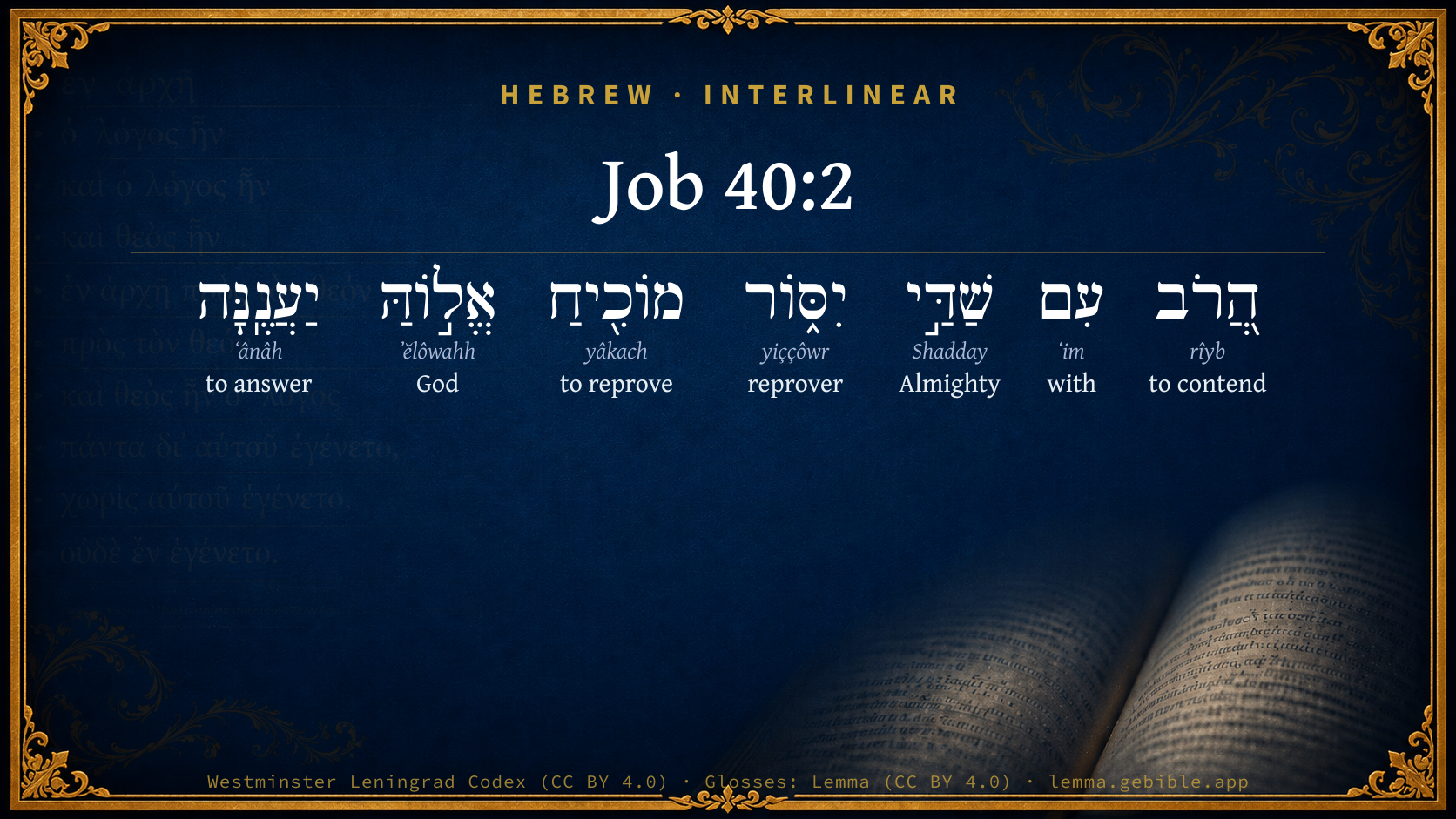
Job 40:2

Hebrew (Westminster Leningrad Codex) Job 40:2 appears in the Hebrew Old Testament. The text above is from the Westminster Leningrad Codex. Each word links to its Strong’s number, a concise gloss, and parsing drawn from the Open Scriptures Hebrew Bible morphology. Click any word for its full Brown-Driver-Briggs (BDB) entry.
Download image
Cite this verse

Job 40:2 (World English Bible). Public Domain. Lemma interlinear Bible study tool, https://lemma.gebible.app/v/job/40/2.

Show BibTeX & RIS
BibTeX
RIS
English Translation
"Shall he who argues contend with the Almighty? He who argues with God, let him answer it."
World English Bible · Public Domain
Highlights
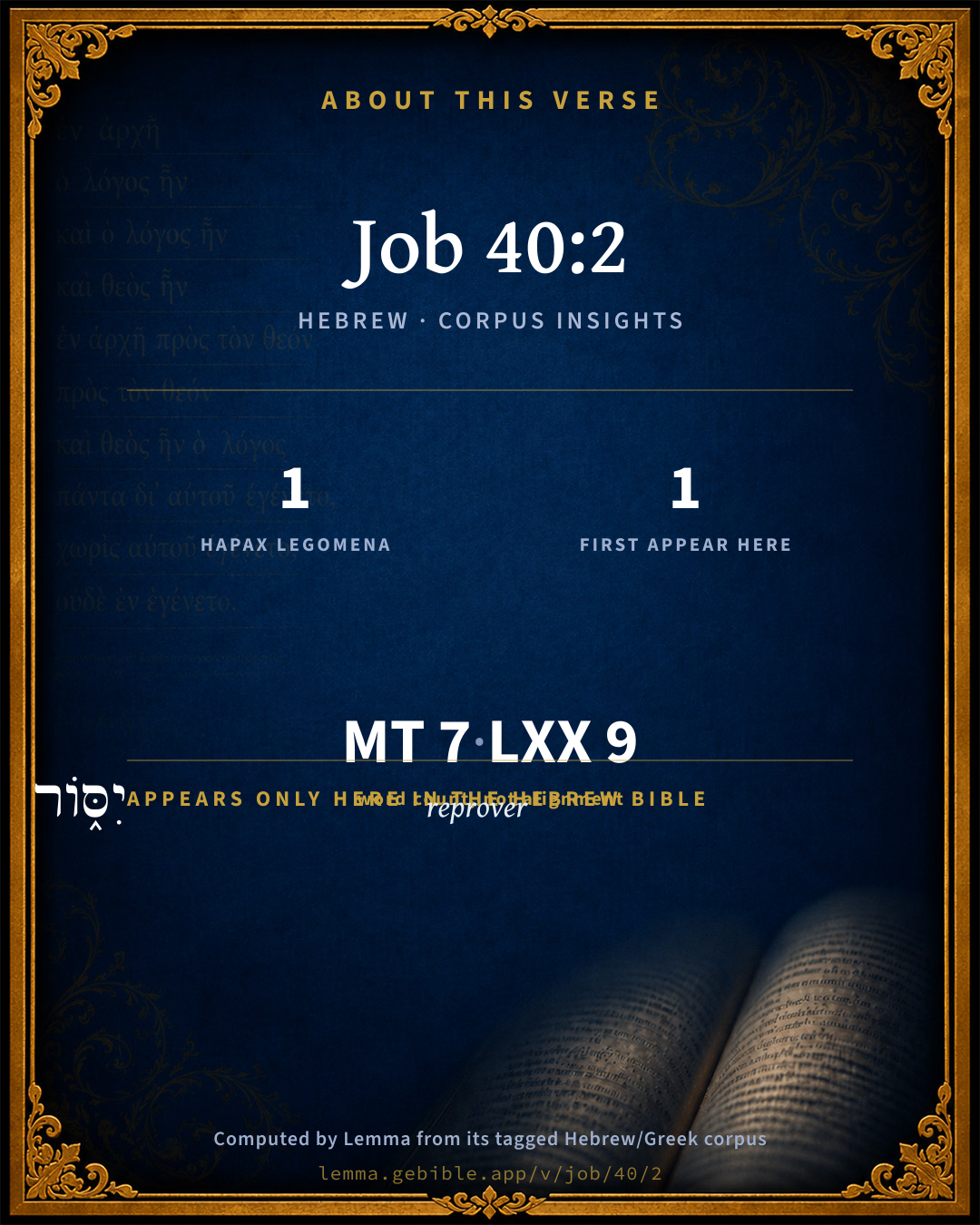
  • 1 hapax legomenon — only here in the Hebrew Bible
  • 1 first appearance in the Hebrew Bible
Full analysis ↓
Download a study sheet

One document with this verse’s original text, its word-by-word gloss line, the meaning frame, cross-references with their text, attributed commentary, and full source and license credits — printable, and it pastes into notes with its structure intact.

This verse Autodidact and up

Study sheet (.html) Plain text (.txt)

A passage Seminary Student

Up to 50 verses in one chapter. A passage sheet keeps up to 6 commentary sources and 12 cross-references per verse, in the order this page ranks them, and says so on the sheet whenever that leaves anything out. Ask for a single verse and you get the Autodidact verse sheet above.

Everything on this page stays free to read, with no account — the sheet is a download of what is already on screen, not access to it.

Want to remove ads? Support Godless Engineer
Compare translations 3

The same verse in 3 English versions, stacked beneath the original-language interlinear above. Click any original word for its lexicon entry.

Each is an independent rendering of the whole verse — the interlinear is not word-aligned to these translations.

Highlighted words mark where these versions differ — a whole-verse word diff, not a word-by-word alignment.

  • World English Bible Public Domain
    "Shall he who argues contend with the Almighty? He who argues with God, let him answer it."
  • King James Version Public Domain
    Shall he that contendeth with the Almighty instruct him? he that reproveth God, let him answer it.
  • unfoldingWord Literal Text CC BY-SA 4.0
    “ a reprover to contend with the Almighty? The one correcting God, let him answer it!”

unfoldingWord Literal Text — © unfoldingWord, licensed CC BY-SA 4.0. Word-aligned USFM3 via Door43 (git.door43.org/unfoldingWord/en_ult).

Versions to compare (up to 4)

3 of 4 selected

Show all 18 translations

Every available English version of this verse, each an independent rendering of the whole verse.

  • World English Bible Public Domain
    "Shall he who argues contend with the Almighty? He who argues with God, let him answer it."
  • Berean Standard Bible Public Domain
    “Will the faultfinder contend with the Almighty? Let him who argues with God give an answer.”
  • Majority Standard Bible Public Domain
    “Will the faultfinder contend with the Almighty? Let him who argues with God give an answer.”
  • King James Version Public Domain
    Shall he that contendeth with the Almighty instruct him? he that reproveth God, let him answer it.
  • American Standard Version (1901) Public Domain
    Shall he that cavilleth contend with the Almighty? He that argueth with God, let him answer it.
  • Revised Version (1885) Public Domain
    Shall he that cavilleth contend with the Almighty? he that argueth with God, let him answer it.
  • Geneva Bible (1599) Public Domain
    Girde vp now thy loynes like a man: I will demaunde of thee, and declare thou vnto me.
  • Douay-Rheims (1899) Public Domain
    Gird up thy loins like a man: I will ask thee, and do thou tell me.
  • Young's Literal Translation Public Domain
    Is the striver with the Mighty instructed? The reprover of God, let him answer it.
  • Literal Standard Version CC BY-SA 4.0
    “Is the striver with the Mighty instructed? The reprover of God, let him answer it.”
  • Unlocked Literal Bible CC BY-SA 4.0
    “Should anyone who wishes to criticize try to correct the Almighty? He who argues with God, let him answer.”
  • unfoldingWord Literal Text CC BY-SA 4.0
    “ a reprover to contend with the Almighty? The one correcting God, let him answer it!”
  • Darby Bible Public Domain
    Shall he that will contend with the Almighty instruct [him]? he that reproveth +God, let him answer it.
  • World Messianic Bible Public Domain
    “Shall he who argues contend with the Almighty? He who argues with God, let him answer it.”
  • Webster's Bible Public Domain
    \\40:7\\Gird up thy loins now like a man: I will demand of thee, and declare thou to me.
  • Free Bible Version CC BY-SA 4.0
    “Are you still going to fight with the Almighty and try to set him straight? Anyone who argues with God must give some answers.”
  • Bible in Basic English Public Domain
    Get your strength together like a man of war: I will put questions to you, and you will give me the answers.
  • JPS Tanakh (1917) Public Domain
    Shall he that reproveth contend with the Almighty? He that argueth with God, let him answer it.

Literal Standard Version (2020), Covenant Press — licensed CC BY-SA 4.0. Text via the HelloAO Bible API (eBible.org). Unlocked Literal Bible (unfoldingWord) — licensed CC BY-SA 4.0. Text via the HelloAO Bible API (eBible.org). unfoldingWord Literal Text — © unfoldingWord, licensed CC BY-SA 4.0. Word-aligned USFM3 via Door43 (git.door43.org/unfoldingWord/en_ult). Free Bible Version, Dr. Jonathan Gallagher — licensed CC BY-SA 4.0. Text via the HelloAO Bible API (eBible.org).

Word by word

More ways to search: Search by grammar → Find every occurrence → Compare this word →

Practice this passage: Drill this verse → Learn its vocabulary →

About this verse

These counts appear in no published source. They are computed here, from the morphology-tagged text and Lemma’s own curated glosses. What Lemma adds →

7
words
7
distinct lemmas
Wisdom
section

Notable vocabulary

1 hapax legomenon — a word that appears only here in the entire Hebrew Bible:

  • יִסּ֑וֹר reprover H3250

First appearance in Scripture

This word makes its first canonical appearance in the Hebrew Bible here:

  • יִסּ֑וֹר reprover H3250

Shared distinctive vocabulary

שַׁדַּ֣י Almighty H7706 occurs in 48 verses of the Hebrew Bible. Also found in:

Grammatical profile

  • 3 verbs
  • 3 nouns
  • 1 preposition

Verb forms

  • הֲ֭רֹב Qal · Infinitive Absolute
  • מוֹכִ֖יחַ Hiphil · Participle Active
  • יַעֲנֶֽנָּה Qal · Jussive

Hebrew & Septuagint length

In English translation the verse runs 17 words from the Hebrew and 19 from the Septuagint (LXX English) — closely comparable.

A rough comparison of the two English renderings, which tokenize alike — not a word-level alignment.

Word counts can differ between the Hebrew and the Greek without any difference in meaning — e.g. the Hebrew direct-object marker אֵת has no separate Greek word, and Greek often adds the article ὁ.

In the original languages it is 7 Hebrew tokens and 9 Greek tokens — but the two are counted differently (Hebrew bundles its prefixes and suffixes into one token; the Greek is in lemma form), so that isn’t a like-for-like length.

Cross-references

27

Topical passages linked to Job 40:2 in the Treasury of Scripture Knowledge — connected by theme and wording, ordered by reader-vote popularity; previews shown in the World English Bible.

  • 1 Corinthians 2:16 "For who has known the mind of the Lord, that he should instruct him?" But we have Christ's mind.
  • Isaiah 40:14 With whom took he counsel, and who instructed him, and taught him in the path of justice, and taught him knowledge, and shown to him the way of understanding?
  • Romans 11:34–36 "For who has known the mind of the Lord? Or who has been his counselor?"
  • Job 33:13 Why do you strive against him, Because he doesn't give account of any of his matters?
  • Isaiah 45:9–11 Woe to him who strives with his Maker--a potsherd among the potsherds of the earth! Shall the clay ask him who fashions it, "What are you making?" or your work, "He has no hands?"
  • Isaiah 50:8 He is near who justifies me; who will bring charges against me? Let us stand up together: who is my adversary? Let him come near to me.
  • Matthew 20:11 When they received it, they murmured against the master of the household,
  • Romans 9:19–23 You will say then to me, "Why does he still find fault? For who withstands his will?"
  • Job 9:3 If he is pleased to contend with him, He can't answer him one time in a thousand.
  • Ezekiel 18:2 What do you mean, that you use this proverb concerning the land of Israel, saying, The fathers have eaten sour grapes, and the children's teeth are set on edge?
  • Job 3:20 "Why is light given to him who is in misery, Life to the bitter in soul,
  • Job 3:23 Why is light given to a man whose way is hid, Whom God has hedged in?
  • Job 9:17–18 For he breaks me with a tempest, Multiplies my wounds without cause.
  • Job 10:3–7 Is it good to you that you should oppress, That you should despise the work of your hands, And smile on the counsel of the wicked?
  • Job 13:21–27 Withdraw your hand far from me; And don't let your terror make me afraid.
  • Job 14:16–17 But now you number my steps. Don't you watch over my sin?
  • Job 19:6–11 Know now that God has subverted me, And has surrounded me with his net.
  • Job 27:2 "As God lives, who has taken away my right, The Almighty, who has made my soul bitter.
  • 1 Corinthians 10:22 Or do we provoke the Lord to jealousy? Are we stronger than he?
  • Job 3:11–12 "Why didn't I die from the womb? Why didn't I give up the spirit when my mother bore me?
  • Job 7:12 Am I a sea, or a sea-monster, That you put a guard over me?
  • Job 7:19–21 How long will you not look away from me, Nor leave me alone until I swallow down my spittle?
  • Job 9:32–35 For he is not a man, as I am, that I should answer him, That we should come together in judgment.
  • Job 10:14–17 If I sin, then you mark me. You will not acquit me from my iniquity.
  • Job 16:11–21 God delivers me to the ungodly, And casts me into the hands of the wicked.
  • Job 30:21 You have turned to be cruel to me. With the might of your hand you persecute me.
  • Ecclesiastes 6:10 Whatever has been, its name was given long ago; and it is known what man is; neither can he contend with him who is mightier than he.

Cross-references courtesy of OpenBible.info (CC BY 4.0).

Hebrew and Greek witnesses Masoretic Hebrew ↔ Greek Septuagint

The same verse in the two great witnesses to the Old Testament, shown verse-for-verse.

These are two independent witnesses, not word-aligned to each other, and the Septuagint is shown in lemma (dictionary) form.

Hebrew Job 40:2 Masoretic · Westminster Leningrad Codex

הֲ֭רֹב עִם שַׁדַּ֣י יִסּ֑וֹר מוֹכִ֖יחַ אֱל֣וֹהַּ יַעֲנֶֽנָּה

"Shall he who argues contend with the Almighty? He who argues with God, let him answer it."

World English Bible · Public Domain

Greek LXX Job 40:2 Septuagint · lemma form

μή κρίσις μετά ἱκανός ἐκκλίνω ἐλέγχω θεός ἀποκρίνω αὐτός

Nay, gird up now your loins like a man; and I will ask you, and do you answer me.

LXX2012 (modern English Septuagint) · Public Domain

Hebrew: Westminster Leningrad Codex (CC BY 4.0). Greek: Septuagint (public domain); English from LXX2012 (modern English Septuagint) (Public Domain). How the Septuagint differs from the Hebrew →

Commentary

Notes on Job 40:2 from classic Christian and Jewish commentators (each source and its license shown beneath its notes). The classic Christian expositions comment on the surrounding passage and are grouped to its opening verse, so a note may address several verses; the Jewish commentaries on the Tanakh (Rashi and others) are per-verse, so they appear only where the commentator wrote on this verse.

Lemma curates 59 commentaries, every one of them public domain or Creative Commons licensed, each selected and text-cleaned for this edition rather than reprinted as found. About our sources →

Trapp's Complete Commentary

John Trapp

Job 40:2 Shall he that contendeth with the Almighty instruct [him]? he that reproveth God, let him answer it.

Ver. 2. Shall he that contendeth with the Almighty instruct him?] Or, Is it wisdom to contend with the Almighty? An disputare cum Omnipotente est eruditio? No, but the greatest folly and sottishness. Job might think otherwise, so long as he compared himself with others; but being once set by God in his super excellencies considered, he shall see his own nothingness, and sit down in silence and patience, though severely tried and sharply afflicted.

He that reproveth God, let him answer it] Answer it if he can, or else yield the cause. Praestat herbam dare quam turpiter pugnare. But if Job have yet further a mind to question and quarrel God in any his ways and works, let it be heard what answer he can return to what hath been already spoken.

John Trapp, A Commentary or Exposition upon All the Books of the Old and New Testament (1647–1656) — public domain. Text from a community e-Sword module.

The Biblical Illustrator

Joseph S. Exell

Job_40:2

Shall he that contendeth with the Almighty instruct Him?

The equality of Gods dealings

While Job is held up as the model of patience and resignation under Gods chastening hand, we are continually reminded of a certain irritability and restlessness which surprises and distresses us. But a similar difficulty is elsewhere found. David is the model of purity, while there is no saint whose memory is so stained with impurity. Moses is emphatically the type of meekness, while the salient point of his life which attracts our notice is extreme irritability. Manly straightforwardness is the leading feature in the character of Abraham, while a shuffling trick is the one fault by which his memory is marked. Examine this apparent inconsistency in Job. He is brought before our attention as a man deeply impressed with the sense of common fairness, and a dread at seeing success awarded to the wicked, and adversity to the good. His own ease fell under the latter clause, and with no selfish or interested view he makes his own position the opportunity of impugning Gods providence. The leading inconsistency which we have to reconcile is the fact that God should have suspended the law of His moral kingdom in Jobs case, and awarded suffering to the righteous. But if we look a little deeper, we shall see at once that the fairness and justice of God were vindicated and asserted, not infringed, in Jobs case. A challenge had been made by Satan which impugned the justice of Gods estimate of His servant in heaping upon him so many and such abundant blessings. No test could have been more severe than that to which Job was put, and in the end the entire and humble submission of the patriarch to the will of his Maker declared beyond controversy the justice of Gods estimate of His servant, and manifested before Satan and the world the power of saving grace. The object of God is not simply the reward of the good by prosperity, and the punishment of the wicked, but it is also the vindication of His grace and power by the subjection of man to His will, and the manifestation of the sanctity of His elect. There is a seeming inconsistency between Jobs actual life and the character given him. But it must be remembered that the character of the man is generally not the upper surface which catches the eye. It is not the irritated waves and billows of the sea, but that vast belt of waters which girdles the earth below the ever-moving and heaving bosom of the deep, which constitutes the nature of the ocean. That undercurrent of a mans will and ways is the result of many a contradiction to his natural disposition, and he does not deserve the title of a peculiar character until he has vindicated his right to it by overcoming the influences which are contradictory to it. The natural tendency of Job was that of patient trust in God; it needed the contradiction of circumstances most adverse to that disposition to test and confirm its tendency. Lessons--

1. We little know the reason and cause of Gods dealing with us; we see the handwriting on the wall, but we see not the hand. We know nothing of remote and hidden causes; we only shall know them and understand them, when, at the end of the world, the handwriting is interpreted. We are inclined to blame Gods fairness. But He is fair, He is just. But it is in the whole and complete fulfilment of His scheme that fairness is to be manifested--in the integrity of the drama, not in the isolated scenes.

2. Note the apparent inconsistency of Jobs own character. He began with implicit, unquestioning resignation; his after conduct betrays impatience, and an inclination to argue against those who were apparently pleading the cause of God. The key is found in the last chapter. At the end, his resignation was the result of deep experience, of profound humiliation, and of personal intercourse with God. It is so with us all. A mans character involves the whole octave--the highest note of it is played in youth, the deepest at the end of the journey of life; the whole is played together in the perfect harmony of heaven.

3. Where lay the fault of Jobs friends? They argued on false premises, and in an improper manner. Censoriousness and love of prejudging human actions are faults which interfere with Gods prerogative, and violate the spirit of true charity.

4. Learn the power of intercession.

5. Very beautiful is the end of Job. Job is a type of the resurrection. (E. Monte.)

Mystery in science and revelation

We may paraphrase the text as follows: Shall man, rebelling against the authority of God, assume to be wiser than the All-wise? Shall he pronounce the ways of God unequal in order to vindicate his own integrity? Is it wisdom in men, surrounded by mysteries and conscious of ill-desert, to fly in the face of heaven and lay their complaints against the God with whom they contend? In that ancient poem, the Book of Job, are embedded some of the profoundest discussions of the problems of life. Most of us are brought, at times, face to face with the question which troubled the man of Uz, Why is this world one of sin and death? Why is it that a loving and all-perfect God has permitted such wide-wasting woe? for the suffering is not limited to humankind, but reaches from the worm that crawls beneath our feet through all gradations of animal life, through human and angelic existences up to the right hand of the everlasting throne, where sitteth the crowned Sufferer who wept over Jerusalem, and is the exalted Lamb of Sacrifice, slain from eternity. The question, as I have said, is not new, but old as history. It has been turned over in unnumbered shapes. It has been answered by numberless sages, but reappears in the speculations of every thoughtful mind. It is the shadow that follows us toward the sun, and will disappear only when we walk into the sun, and know even as we are known. And I believe that sometimes nothing will quiet the mind, troubled by the perplexing riddles of evil and pain, so effectually as to consider why it is best for us not to know certain things, or to see how our ignorance in the department of moral evil is equalled by our ignorance in other spheres of truth. This is the lesson which the Lord taught Job. We are surrounded in this world by mysteries which baffle us, or, if we explain one, another lies back of it which defies explanation. These mysteries abound in the realm of science. Says Henry Drummond, A science without mystery is unknown; a religion without mystery is absurd. Modern investigation has answered many of the questions which the Lord put to Job; vast additions to human knowledge have been the spoils of hardy efforts; but the unknown is a vaster field now than even then. The circle of knowledge is surrounded by an ever-widening zone of mystery. Geology may have helped us to understand how the cornerstone of the earth was laid, but the question now is, What is that cornerstone? Whence came it? Every step backward leads us to mystery, where science closes her lips, and faith speaks out the name of God. Man thinks of the immensities of nature, and he is nothing. He thinks of the minuteness of atoms and molecules, and he seems almost everything. We trespass continually on the domain of the supernatural, the spiritual, the invisible, the Divine; and the Cross of Jesus may well be seen wherever His hand has wrought in the mysteries of creation. God does not think it best to give us completed knowledge, any more than He gives us complete bodily strength, or complete soul development. He demands work of us. Salvation is wrought out with fear and trembling, and we ought to thank God that we are not treated as some rich men treat their sons. God does not want spoiled and pampered children. (John H. Barrows, D. D.)

The Biblical Illustrator, edited by Joseph S. Exell (c. 1880s–1900s) — public domain. Text from a community e-Sword module.

Joseph Benson's Commentary

Job 40:2. Shall he that contendeth with the Almighty instruct him? — Shall Job, who presumeth to contend with me in judgment, and to dispute the reasonableness and equity of my proceedings, give me instructions or directions how to govern my creatures? The Hebrew, however, may be rendered, Is it instruction, or learning, or does it indicate instruction or erudition, to contend with the Almighty? An eruditi est? Buxtorf. Is it the part of a well-instructed and wise man? This agrees with Ab. Ezra’s comment, which is, Is it the way of instruction for a man to contend with the Almighty? The words are also capable of being translated, He that disputeth with the Almighty shall be chastised: thus Heath. God’s almightiness is fitly mentioned as an argument of his justice. For how can he be unjust, who, having boundless power and every other perfection in an infinite degree, must necessarily be all-sufficient within himself, and therefore can neither have any inclination to unrighteousness, which is an imperfection, nor any temptation to it, from any need he can have of it to accomplish his designs, which his own omnipotence is sufficient to accomplish, or from any advantage that can accrue to him by it? He that reproveth God — That boldly censureth his ways or works; let him answer it — Or, answer for it; or, he shall answer for it, that is, it is at his peril.

Joseph Benson's Commentary on the Old and New Testaments (1811–1818) — public domain. Text from a community e-Sword module.

Whedon's Commentary on the Bible

Daniel D. Whedon

JEHOVAH’S SECOND ADDRESS TO JOB, Job_40:1-2.

After a suitable pause, that the impression of the discourse may be deepened, during which humbled Job ventures no response, Jehovah makes a pointed application of the preceding discourse to Job himself, Job_40:2.

2. Shall he that contendeth — Will the censurer contend with the Almighty? Murmuring over the doings of God is nothing less than faultfinding with God himself. The censurer is summoned from his long-protracted silence by this terse and pungent, but kindly call, to answer the appeals of the Almighty. Job ought to be as ready to reason as he was to reprove; at least, to answer some one of the questions out of nature’s catechism. It is significant that the last words in this address. “let him answer,” are, in the original, the very verb that rang out so defiantly at the close of Job’s protracted defence (Job_31:35,) “Let the Almighty answer.” Compare Job_13:22; Job_23:5. He that reproveth — מוכיח, a hiphil form, is used in a forensic sense, and signifies to argue, (Pro_30:6,) prove; thence, in an offensive sense, to argue down, reprove, chastise. See note, Job_16:21; and for other forms of the verb, Job_6:25; Job_13:15; Job_19:5; Job_22:4; etc. Job, who at the outset bore the title in heaven of “God fearing,” (Job_1:1,) now hears the humiliating designation of “God’s accuser,” (Hitzig,) or “one that sets God right.” (Dillmann.)

Daniel D. Whedon (gen. ed.), Commentary on the Old and New Testaments (1874–1909) — public domain. Text from a community e-Sword module.

Jamieson, Fausset & Brown

Robert Jamieson, A. R. Fausset & David Brown

he that contendeth--as Job had so often expressed a wish to do. Or, rebuketh. Does Job now still (after seeing and hearing of God's majesty and wisdom) wish to set God right?

answer it--namely, the questions I have asked.

Jamieson, Fausset & Brown — Commentary Critical and Explanatory on the Whole Bible (1871) — public domain (CC PDM 1.0). Text via the HelloAO Bible API.

Adam Clarke's Commentary

Verse 2. He that reproveth God, let him answer it.] Let the man who has made so free with God and his government, answer to what he has now heard.

Adam Clarke's Commentary on the Bible (1810–1826) — public domain. Text from a community e-Sword/MySword module.

Ellicott's Commentary for English Readers

XL.

(2) Shall he that contendeth with the Almighty instruct him?—Rather, Can he that reproveth (e. g., Job) contend with the Almighty? or, Can the contending with the Almighty instruct Him? “Art thou prepared still to dispute and contend with God? or, if thou dost, is there any hope that thou wilt instruct (i.e., convince) Him in argument? Let him that argueth with God (i.e., Job) answer this question.” It might, perhaps, tend to make these verses (Job_40:4-5) more effective if we transposed them after Job_42:6, and regarded them as the very climax of the poem, as some have done. But this is not necessary, and is an arrangement that has no support from external evidence. If, however, it were adopted, Job’s resolution, “Once have I spoken; but I will speak no more: yea, twice; but I will not again” (Job_40:5), would not be literally inconsistent, as it now is, with what he says in Job_42:1-6.

A Bible Commentary for English Readers, edited by Charles John Ellicott (1878–1897) — public domain. Text from a community e-Sword module.

The Cambridge Bible for Schools and Colleges

gen. ed. J. J. S. Perowne

2. The verse means,

Will the reprover contend with the Almighty?

He that disputeth with God let him answer it.

The “reprover” or blamer is of course Job; and so is “he that disputeth,” or, “he that would dispute.” The word it refers to the foregoing display of God’s glory in creation, which Jehovah has set before Job. And the question means, Will Job now, having God in the manifoldness of His Being thus set before him, really enter on a contention with the Almighty?

The Cambridge Bible for Schools and Colleges (gen. ed. J. J. S. Perowne; Cambridge University Press, 1878–1918) — public domain. Text from a community e-Sword module.

John Gill's Exposition

Shall he that contendeth with the Almighty instruct him?.... Is he capable of it? He ought to be that takes upon him to dispute with God, to object or reply to him; that brings a charge against him, enters the debate, and litigates a point with him; which Job wanted to do. But could he or any other instruct him, who is the God of knowledge, the all wise and only wise God; who gives man wisdom, and teaches him knowledge? What folly is it to pretend to instruct him! Or can such an one be "instructed?" as the Targum: he is not in the way of instruction; he that submits to the chastising hand of God may be instructed thereby, but not he that contends with him; see Psa 94:12. Or should he be one that is instructed? no, he ought to be an instructor, and not one instructed; a teacher, and not one that is taught; he should be above all instruction from God or man that will dispute with the Almighty, The word for instruct has the signification of chastisement, because instruction sometimes comes that way; and then the sense either is, shall a man contend with the Almighty that chastises him? Does it become a son or a servant to strive against a parent or a master that corrects him? Or does not he deserve to be chastised that acts such a part? Some derive the word from one that signifies to remove or depart, and give the sense, shall the abundance, the all sufficiency of God, go from him to another, to a man; and so he, instead of God, be the all sufficient one? Or rather the meaning of the clause is, has there not been much, enough, and more than enough said, Job, to chastise thee, and convince thee of thy mistakes? must more be said? is there any need of it?

he that reproveth God, let him answer it; he that reproves God, for his words, or works, or ways, finding fault with either of them, ought to answer to the question now put; or to any or all of those in the preceding chapters, and not be silent as Job now was.

John Gill's Exposition of the Whole Bible (1746–1763) — public domain (CC PDM 1.0). Text via the HelloAO Bible API.

Albert Barnes' Notes on the Bible

Shall he that contendeth with the A mighty instruct him? - Gesenius renders this, “Contending shall the reprover of God contend with the Almighty?” Prof. Lee, “Shall one by contending with the Almighty correct this?” On the grammatical construction, see Gesenius on the word יסור yissôr, and Rosenmuller and Lee, in loc. The meaning seems to be this: “Will he who would enter into a controversy with the Almighty now presume to instruct him? He that was so desirous of arguing his cause with God, will he now answer?” All the language used here is taken from courts, and is such as I have had frequent occasion to explain in these notes. The reference is to the fact that Job had so often expressed a wish to carry his cause, as before a judicial tribunal, directly up to God. He had felt that if he could get it there, he could so argue it as to secure a verdict in his favor; that he could set arguments before the Almighty which would secure a reversal of the fearful sentence which had gone out against him, and which had caused him to be held as a guilty man. God now asks whether he who had been so anxious to have a legal argument, and to carry his cause himself before God - a man disposed to litigation before God (רוב rûb) - was still of the same mind, and felt himself qualified to take upon himself the office of an instructor, a corrector, an admonisher (יסור yissôr) of God? He had the opportunity now, and God here paused, after the sublime exhibition of his majesty and power in the previous chapters, to give him an opportunity, as he wished, to carry his cause directly before him. The result is stated in Job 40:3-4. Job had now nothing to say.

He that reproveth God - Or rather, “He that is disposed to carry his cause before God,” as Job had often expressed a wish to do. The word used here (יכח yâkach) is often employed, especially in the Hiphil, in a “forensic sense,” and means “to argue, to show, to prove” anything; then “to argue down, to confute, to convict;” see Job 6:25; Job 13:15; Job 19:5; Job 32:12; Pro 9:7-8; Pro 15:12; Pro 19:25. It is evidently used in that sense here - a Hiphil participle מוכיח môkiyach - and refers, not to any man in general who reproves God, but to Job in particular, as having expressed a wish to carry his cause before him, and to argue it there.

Let him answer it - Or rather, “Let him answer him.” That is, Is he now ready to answer? There is now an opportunity for him to carry his cause, as he wished, directly before God. Is he ready to embrace the opportunity, and to answer now what the Almighty has said? This does not mean, then, as the common version would seem to imply, that the man who reproves God must be held responsible for it, but that Job, who had expressed the wish to carry his cause before God, had now an opportunity to do so. That this is the meaning, is apparent from the next verses, where Job says that he was confounded, and had nothing to say.

Albert Barnes' Notes on the Bible (1834–1885) — public domain. Text from a community e-Sword/MySword module.

Matthew Poole's English Annotations

Shall Job, who presumed to contend with me in judgment, and to dispute the reasonableness and equity of my proceedings, give me instructions or directions how to manage my own affairs, and govern my creatures? He justly mentions his almightiness, as a convincing argument of his justice. For how can he be unjust to his creatures, who hath no obligation to them, and never did nor can receive any thing from them; and who hath an absolute, sovereign, and uncontrollable dominion over them; and who being infinitely and necessarily perfect, and all-sufficient within himself, can neither have any inclination to unrighteousness, which is an imperfection, nor any temptation to it from any need he hath of it to accomplish his designs, which he can do by his own omnipotence, or front any advantage accruing to him by it.

That reproveth God; that boldly censureth his ways or works; which thou hast done.

Let him answer it; let him answer my former and further questions at his peril.

Matthew Poole's English Annotations on the Holy Bible (1683–1685) — public domain. Text from a community e-Sword/MySword module.

John Wesley's Explanatory Notes

Reproveth - That boldly censureth his ways or works; it is at his peril.

John Wesley, Explanatory Notes Upon the Whole Bible (1754–1765) — public domain. Text via the GEBible commentary corpus.

Rashi

Rabbi Shlomo Yitzchaki (Rashi)

Will one who contends with the Almighty make himself master? May a man make himself master to contend with the Almighty?

He who argues with God, let him answer it He who comes to argue, let him answer his words.

Rashi on the Tanakh — English translations: “The Judaica Press complete Tanach with Rashi, translated by A. J. Rosenberg” (CC BY 4.0); “Pentateuch with Rashi's commentary by M. Rosenbaum and A.M. Silbermann, 1929-1934” (public domain); “The Metsudah Tanach series, Lakewood, N.J” (CC BY 4.0); and “The Book of Joshua, Metsudah Publications, 1997” (CC BY 4.0). Text via Sefaria.

Lesson kit

Teaching starters — assembled from the data on this page, not authored interpretation. Every prompt links to the verse data it draws on. Edit before teaching.

Job, in the Wisdom, opens this verse with 7 words (7 distinct Hebrew lemmas). Its most distinctive word is yiççôwr (“reprover”). A historical commentator’s framing appears above. Read the whole chapter for the surrounding context.

Discussion questions

  1. The word yiççôwr carries the sense “reprover.” How does it shape the verse?
  2. 1 word here appears nowhere else in the Hebrew Bible. Why might the author reach for such rare wording?
  3. This is the first place “reprover” appears in Scripture (first appears here). What does its debut here establish?
  4. How does Genesis 17:1, which shares the word «Almighty», read alongside this verse?
  5. These translations render this verse differently. What is at stake in choosing one wording over another?
  6. «הֲ֭רֹב» is a Qal Infinitive Absolute verb. How does that grammatical form shape the action described?
  7. Compare how Trapp's Complete Commentary and The Biblical Illustrator read this verse. Where do they agree or differ?

Things to notice

Reading settings

Reading text

Shown beneath each verse's original-language words.

Old Testament
Old Testament edition

Read the OT as the Masoretic Hebrew (MT) or the Greek Septuagint (LXX).

English shown for the Greek Septuagint (in the Hebrew ↔ Greek comparison).

Comparing translations? Open the Compare panel on any verse page to stack up to four side by side.