
Job 40:3

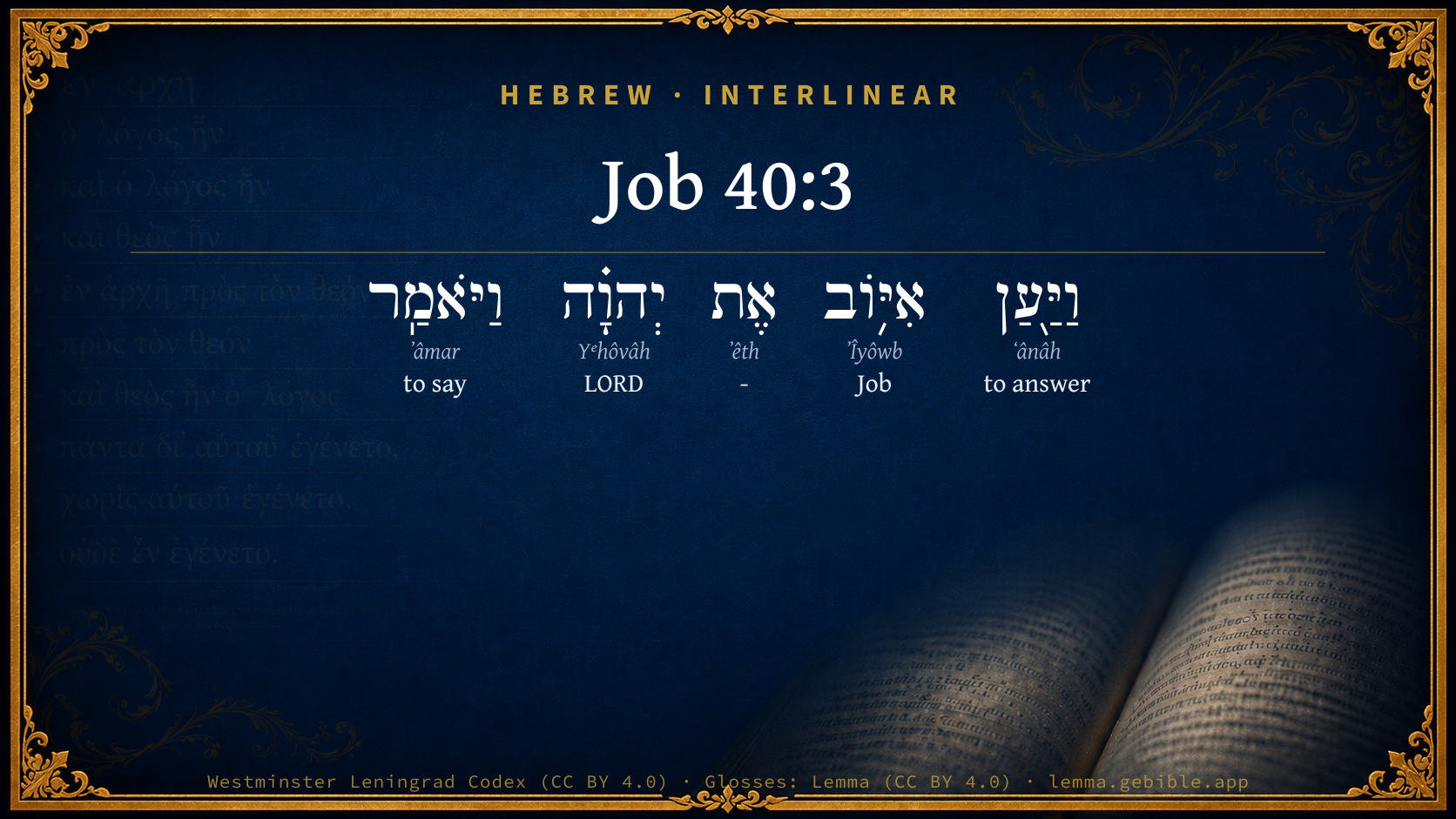
Hebrew (Westminster Leningrad Codex) Job 40:3 appears in the Hebrew Old Testament. The text above is from the Westminster Leningrad Codex. Each word links to its Strong’s number, a concise gloss, and parsing drawn from the Open Scriptures Hebrew Bible morphology. Click any word for its full Brown-Driver-Briggs (BDB) entry.
Download image
Cite this verse

Job 40:3 (World English Bible). Public Domain. Lemma interlinear Bible study tool, https://lemma.gebible.app/v/job/40/3.

Show BibTeX & RIS
BibTeX
RIS
English Translation
Then Job answered Yahweh,
World English Bible · Public Domain
Download a study sheet

One document with this verse’s original text, its word-by-word gloss line, the meaning frame, cross-references with their text, attributed commentary, and full source and license credits — printable, and it pastes into notes with its structure intact.

This verse Autodidact and up

Study sheet (.html) Plain text (.txt)

A passage Seminary Student

Up to 50 verses in one chapter. A passage sheet keeps up to 6 commentary sources and 12 cross-references per verse, in the order this page ranks them, and says so on the sheet whenever that leaves anything out. Ask for a single verse and you get the Autodidact verse sheet above.

Everything on this page stays free to read, with no account — the sheet is a download of what is already on screen, not access to it.

Want to remove ads? Support Godless Engineer
Compare translations 3

The same verse in 3 English versions, stacked beneath the original-language interlinear above. Click any original word for its lexicon entry.

Each is an independent rendering of the whole verse — the interlinear is not word-aligned to these translations.

Highlighted words mark where these versions differ — a whole-verse word diff, not a word-by-word alignment.

  • World English Bible Public Domain
    Then Job answered Yahweh,
  • King James Version Public Domain
    Then Job answered the LORD, and said,
  • unfoldingWord Literal Text CC BY-SA 4.0
    And Job answered Yahweh and said,

unfoldingWord Literal Text — © unfoldingWord, licensed CC BY-SA 4.0. Word-aligned USFM3 via Door43 (git.door43.org/unfoldingWord/en_ult).

Versions to compare (up to 4)

3 of 4 selected

Show all 18 translations

Every available English version of this verse, each an independent rendering of the whole verse.

  • World English Bible Public Domain
    Then Job answered Yahweh,
  • Berean Standard Bible Public Domain
    Then Job answered the LORD:
  • Majority Standard Bible Public Domain
    Then Job answered the LORD:
  • King James Version Public Domain
    Then Job answered the LORD, and said,
  • American Standard Version (1901) Public Domain
    Then Job answered Jehovah, and said,
  • Revised Version (1885) Public Domain
    Then Job answered the LORD, and said,
  • Geneva Bible (1599) Public Domain
    Wilt thou disanul my iudgement? or wilt thou condemne me, that thou mayst be iustified?
  • Douay-Rheims (1899) Public Domain
    Wilt thou make void my judgment: and condemn me, that thou mayst be justified?
  • Young's Literal Translation Public Domain
    And Job answereth Jehovah, and saith: --
  • Literal Standard Version CC BY-SA 4.0
    And Job answers YHWH and says:
  • Unlocked Literal Bible CC BY-SA 4.0
    Then Job answered Yahweh and said,
  • unfoldingWord Literal Text CC BY-SA 4.0
    And Job answered Yahweh and said,
  • Darby Bible Public Domain
    And Job answered Jehovah and said,
  • World Messianic Bible Public Domain
    Then Job answered the LORD,
  • Webster's Bible Public Domain
    \\40:8\\Wilt thou also disannul my judgment? wilt thou condemn me, that thou mayest be righteous?
  • Free Bible Version CC BY-SA 4.0
    Job answered the Lord,
  • Bible in Basic English Public Domain
    Will you even make my right of no value? will you say that I am wrong in order to make clear that you are right?
  • JPS Tanakh (1917) Public Domain
    Then Job answered the LORD, and said:

Literal Standard Version (2020), Covenant Press — licensed CC BY-SA 4.0. Text via the HelloAO Bible API (eBible.org). Unlocked Literal Bible (unfoldingWord) — licensed CC BY-SA 4.0. Text via the HelloAO Bible API (eBible.org). unfoldingWord Literal Text — © unfoldingWord, licensed CC BY-SA 4.0. Word-aligned USFM3 via Door43 (git.door43.org/unfoldingWord/en_ult). Free Bible Version, Dr. Jonathan Gallagher — licensed CC BY-SA 4.0. Text via the HelloAO Bible API (eBible.org).

Word by word

More ways to search: Search by grammar → Find every occurrence → Compare this word →

Practice this passage: Drill this verse → Learn its vocabulary →

About this verse

These counts appear in no published source. They are computed here, from the morphology-tagged text and Lemma’s own curated glosses. What Lemma adds →

5
words
5
distinct lemmas
Wisdom
section

Shared distinctive vocabulary

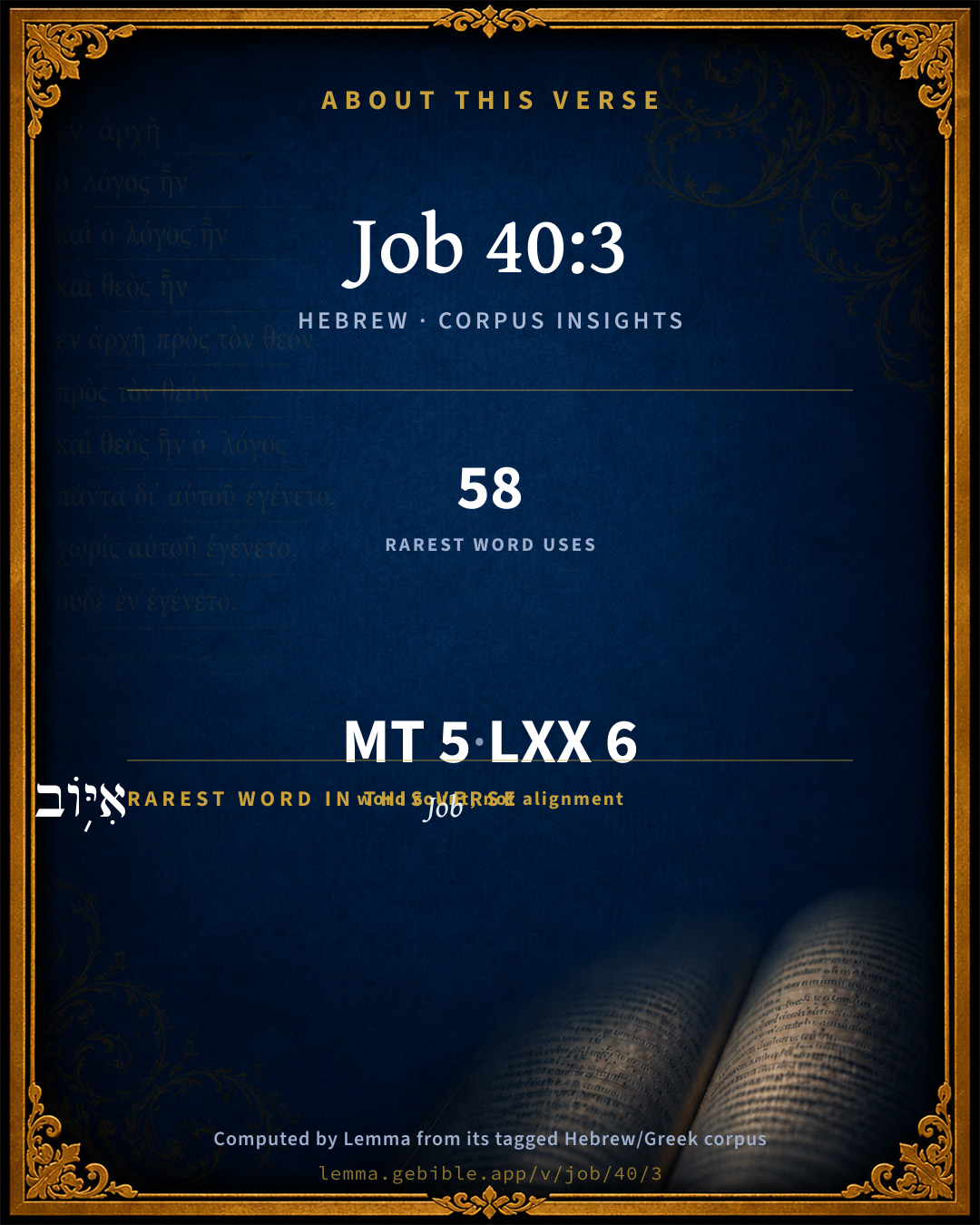
אִיּ֥וֹב Job H347 occurs in 52 verses of the Hebrew Bible. Also found in:

Grammatical profile

  • 2 verbs
  • 2 nouns
  • 1 particle

Verb forms

  • וַיַּ֖עַן Qal · Sequential Imperfect
  • וַיֹּאמַֽר Qal · Sequential Imperfect

Hebrew & Septuagint length

In English translation the verse runs 4 words from the Hebrew and 28 from the Septuagint (LXX English) — the Septuagint runs noticeably longer here. See the side-by-side →

A rough comparison of the two English renderings, which tokenize alike — not a word-level alignment.

Word counts can differ between the Hebrew and the Greek without any difference in meaning — e.g. the Hebrew direct-object marker אֵת has no separate Greek word, and Greek often adds the article ὁ.

In the original languages it is 5 Hebrew tokens and 6 Greek tokens — but the two are counted differently (Hebrew bundles its prefixes and suffixes into one token; the Greek is in lemma form), so that isn’t a like-for-like length.

Hebrew and Greek witnesses Masoretic Hebrew ↔ Greek Septuagint

The same verse in the two great witnesses to the Old Testament, shown verse-for-verse.

Here the Septuagint runs noticeably longer than the Hebrew — LXX2012 (modern English Septuagint) 28 words vs World English Bible 4. A rough length comparison of the two English translations, not a word-level alignment — read both below.

These are two independent witnesses, not word-aligned to each other, and the Septuagint is shown in lemma (dictionary) form.

Hebrew Job 40:3 Masoretic · Westminster Leningrad Codex

וַיַּ֖עַן אִיּ֥וֹב אֶת יְהוָ֗ה וַיֹּאמַֽר

Then Job answered Yahweh,

World English Bible · Public Domain

Greek LXX Job 40:3 Septuagint · lemma form

ὑπολαμβάνω δέ ιωβ λέγω ὁ κύριος

Do not set aside my judgment: and do you think that I have dealt with you in any other way, than that you might appear to be righteous?

LXX2012 (modern English Septuagint) · Public Domain

On this verse, Haydock's Catholic Bible Commentary discusses the Septuagint’s reading. Read the note in Commentary ↓

Hebrew: Westminster Leningrad Codex (CC BY 4.0). Greek: Septuagint (public domain); English from LXX2012 (modern English Septuagint) (Public Domain). How the Septuagint differs from the Hebrew →

Commentary

Notes on Job 40:3 from classic Christian and Jewish commentators (each source and its license shown beneath its notes). The classic Christian expositions comment on the surrounding passage and are grouped to its opening verse, so a note may address several verses; the Jewish commentaries on the Tanakh (Rashi and others) are per-verse, so they appear only where the commentator wrote on this verse.

Lemma curates 59 commentaries, every one of them public domain or Creative Commons licensed, each selected and text-cleaned for this edition rather than reprinted as found. About our sources →

Trapp's Complete Commentary

John Trapp

Job 40:3 Then Job answered the LORD, and said,

Ver. 3. Then Job answered the Lord, and said] It was time for him, if ever, to stoop to the Most High, so far condescending to his meanness, and to answer his expectation by acknowledging a fault, and promising amendment. Lo, this is the guise of a godly person: he may be out, but he will not usually be obstinate. A humble man will never be a heretic; convince him once, and he will yield: not so the obstinate and uncounselable person; he runs away with conviction, as the unruly horse doth with the bit between his teeth; and his wit will better serve to devise a thousand shifts to elude the truth than his pride will suffer him once to yield to it, and acknowledge his error.

John Trapp, A Commentary or Exposition upon All the Books of the Old and New Testament (1647–1656) — public domain. Text from a community e-Sword module.

The Biblical Illustrator

Joseph S. Exell

Job_40:3-4

Behold, I am vile.

A humbling confession

Self-examination is of unspeakable importance. The most useful knowledge of ourselves is not that which is physical, but that which is moral; not a knowledge of our worldly affairs, but of our spiritual condition.

I. The self-accusation. Behold, I am vile.

1. The quality acknowledged. Vileness. Behold, I am vile. Vile, says Johnson in his Dictionary, is base, mean, worthless, despicable, impure. There is nothing in the world to which this will so much apply as sin; and to sin Job referred when he said, Behold, I am vile. He does not call himself vile because he was a man reduced, poor, and needy; no man of sense ever would do so. Character intrinsically does not depend Upon adventitious circumstances. If poverty were vileness, as by their discourse some people seem to think, how vile must the apostles have been, who said, Even to this very hour, we hunger, and thirst, are naked, are destitute, and have no Certain dwelling place! How vile must that be which leads God to hate the work of His own hands; which leads a God of love to threaten to punish with everlasting destruction from His presence and His power, and which would not allow of His pardoning without the sacrifice of His own Son!

2. Who made this confession? Surely it was some very gross transgressor? No. It was some newly-awakened returning penitent? No. It was Job; a saint of no ordinary magnitude. What, then, do we learn from hence, but that the most eminent saints are the most remote from vain thoughts of themselves? We know that the nearer a man approaches to perfection in anything, the more sensible he becomes of his remaining deficiency, and the more hungry and thirsty he is after improvement. Take knowledge; advancement in knowledge is like sailing down a river; it widens as you proceed, till you are out at sea. A little knowledge puffs a man up, but Sir Isaac Newton was the most modest of men. Not that there is no difference between a saint and a sinner. Job does not mean to intimate that he loves sin, or that he lives in it. His friends accused him of this, which he denied, saying, in his address to God, Thou knowest that I am not wicked. Behold, my witness is in heaven, and my record is on high. But he knew that sin, though it did not reign in him, yet lived in him, yet opposed him, yet vexed him, yet defiled him; so that he could not do the thing that he would.

3. When was the acknowledgment here uttered, Behold, I am vile? It was immediately after Gods interview with him, Gods intercourse with him, Gods addressing him. Who is this that darkeneth counsel by words without knowledge? Gird up now thy loins like a man, for I will demand of thee, and answer thou Me. It was after God had further displayed Himself in the perfection of several of His works; it was then that Job answered the Lord, and said, Behold, I am vile. And what does this teach us but this--that the more we have to do with God, the more we shall see and feel our unworthiness. Those who have never been abroad to see great things are pleased with littleness, but travelling expands and enlarges the mind, furnishes it with superior objects and images; so that the man is no longer struck, upon his return, with the little rivulet and the little hill, which seemed to astonish him before he went from home, and during his infancy. And when a man has gone far enough, so to speak, to be introduced to God Himself, he will be sure to think afterward very little of himself. Yes, if anything can make us feel our littleness, it must be a view of His wisdom; if anything can make us sensible of our weakness, it must be the view of His almighty sovereignty; if anything can make us feel our depravity, it must be the view of His spotless purity,--the spotless purity of Him who is of purer eyes than to behold iniquity, and in whose sight the very heavens are not clean.

II. To observe how this conviction is produced. You will observe here, that, our inquiry is not after the fact itself. The fact itself is independent of our conviction, or of our belief. If we say that we have no sin, we deceive ourselves, and the truth is not in us; and the heavens will reveal our iniquity, and the earth will rise up against us. Yes, it is a truth, whether we acknowledge it or not, that we are vile; vile by nature, and vile by practice. Let us, therefore, remark the Author and medium alone of this discovery. As to the Author, we make no scruple to say, that it is the Spirit of the blessed God; according to our Saviours own declaration, When He, the Spirit of truth, is come, He shall convince the world of sin, because they believe not on Me. All that is really good in the souls of the children of men is from Him. From Him comes the first pulse of life. Now as to the medium, or instrumentalities, we would observe that these are, principally, the law and the Gospel. The law is one of the principal instrumentalities; for by the law is the knowledge of sin. Sin is the transgression of the law. The law is always to be used so; and for this purpose the Gospel also is equally instrumental with it. The Gospel teaches us the nature of our disease, by showing us the nature of our remedy. Now this being the Author, and this being the medium of the discovery, observe the mode in which it is accomplished. This is gradual. The thing does not take place all at once; it is effected by degrees. Usually, indeed, it begins with a charging home of one single sin upon the conscience of the man; the sin to which he has been peculiarly addicted, and by which his conscience, therefore, is now alarmed. It is increased by the various events, and by the various dispensations of providence. Little do we know of ourselves, indeed, until we are enlightened, until we meet with our own proper trial. The Christian often supposes that he is worse, because he is wiser than he was. Because he sees more of his inward corruptions, he thinks there are more. He resembles a man in a disagreeable, loathsome dungeon; before the light enters he sees nothing offensive; he knows not what there is there; but as the light enters he sees more and more. I have heard some people, says Mr. Newton, pray that God would show them all the wickedness of their hearts. I have said to myself, It is well that God will not hear their prayer; for if tie did, it would drive them to madness or despair; unless at the same time they had a proportionate view of the work, and the ability, and the love of their Lord and Saviour.

III. Let us observe the effects of this conviction.

1. One of these effects is evermore wonderment. As if a person had been born and bred up in a subterranean place, and had been raised up and placed upon the earth; the first emotion he would feel would be wonder. Peter tells us that God calls us out of darkness into His marvellous light. Not only light, but marvellous light; seeing as well as wondering. Nothing is more wonderful to the man than what he now sees of himself. That he should have acted in such an ungrateful, such a foolish, such a base manner as he has been doing!

2. Humiliation will be another result of this discovery. Ignorance is a pedestal upon which pride always stands. Self-complacency then will be at an end, and the man will abhor himself, repenting in dust and ashes. Self-justification will also be at an end, and the man will condemn himself.

3. The endearment of the Saviour is another result of this discovery. Why is it there ate so many to whom He has no form nor comeliness, nor any beauty that they should desire Him?--that they can read of Him, that they can hear of Him, that they can talk of Him without feeling any attachment to Him? Why is it, but that, to change the image, as Solomon says, the full soul loatheth an honeycomb; but to the hungry soul every bitter thing is sweet? Or, to use our Lords own words, They that are whole need not a physician.

4. Submission under afflictive dispensations of providence will be another effect of this discovery. I remember Bunyan says, Nothing surprised me more when I was first awakened and enlightened, than to see how men were affected by their outward troubles. Not that I was without my troubles, God knows I had enough of them; but what was everything else beside compared to the loss of my poor soul! So will it be with us if we have the same views and the same feelings. So it is, that an old divine says, When a sense of sin lies heavy upon the soul, the sense of trouble will be light.

5. Then gratitude will be another result of this discovery of our vileness. The proud are never grateful. Do what you will--heap whatever favours you please upon them--what reward have you? what thanks have you? They only think you are doing your duty; they think they are deserving of all this. But when a man feels that he is unworthy of the least of all his mercies, how will he feel with regard to the greatest of them?

6. Charity and tenderness towards the faults of others will be a result from this conviction. There is a knowledge of human nature that is far from being sanctified; so far from it that it is even an injury to him that possesses it. Read Mandevilles Fable of the Bees; read Rochefoucaulds Maxims; read some of Lord Byrons works: do you not perceive how they discover, how fully they discover, in a sense, the vileness of human nature? Yes, and they love to dwell upon it; they love to expose the nakedness of our common nature. They always speak of these things with complacency; never with regret; never with anything like reproach of themselves and others. But it is otherwise with the man who has been taught his depravity at the foot of the Cross; who has there been made to say, with Job, Behold, I am vile. Such a man will not look for perfection in others, because he is conscious he is destitute of it himself.

IV. The relief of this complaint. For I am persuaded there are persons who are saying, Well, whatever others may think of themselves, Jobs language is mine. I daily feel it. Whether I am alone or in company--whether I am in the sanctuary or at the table of the Lord--nothing fits my lips but this acknowledgment, Behold, I am vile. Is there any consolation for such? There is much every way.

1. Because God has commanded us, as ministers, to comfort you. We are to tell those whom He has thus made sad that God has commanded them to make merry. Because the joy of the Lord is their strength. They never feel gratitude so well as when they are walking in the comforts of the Holy Ghost. You do not remember that the Jews in their passage, when they crossed the Red Sea, came to Marah, where the waters were bitter, as well as to Elim, where there were twelve springs of water, and threescore and ten palm trees. You do not remember in the immortal Pilgrims Progress that there were in the way of the shining light the valley of humiliation and the valley of the shadow of death, as well as the delectable mountains.

2. Remember that this experience is a mercy, and a great mercy; that this experience is essential to all real religion; that it is previous to all true consolation; that it is a proof of the Divine agency in you. I will take away the heart of stone, and give you a heart of flesh.

3. Remember that all in you is not evil now. Beware, therefore, that you never depreciate not only what God has done for you, but what He has done in you. The work of His Holy Spirit is called a good work; and it is a good work.

4. As all is not vile in you now, so nothing will be vile in you long. No. The night is far spent, and the day is at hand; and your warfare will soon be accomplished. (W. Jay.)

Consciousness of sin the result of the manifestation of God

Jehovahs mode of dealing with Job is very remarkable. He did not enter at all upon the point about which the disputants could not agree. He said nothing whatever about the dispensations of His providence. Nor did He declare whom He chastened, and whom He left unchastened in the world. Of what, then, did He speak? Of the great mysteries of creation and nature, as displaying His glorious majesty, His creative power, His perfect wisdom. The result was striking. Job was strongly convinced of his own ignorance and sinfulness.

I. Jobs deep consciousness of sin. No words could express it more strongly than these, Behold, I am vile! It is just the most eminent saints--just those who are most advanced in the knowledge of God, who make use of such words. (See case of Isaiah; and Psa_51:3.) Behold, I am vile! is no exaggerated statement; it is a state and a feeling to which we ought all to be brought--a confession which we ought all to make. If we try to analyse the state of mind expressed by these words, it is quite evident that it is one in which the sinfulness of sin is most deeply felt--in which sin is regarded with great abhorrence, and the sinner views himself with deep self-abasement. There is a Scripture term that suits the idea--self-loathing (Eze_36:31). If we endeavour to go a little deeper into this state of mind, we shall find that there are two feelings, carefully to he distinguished from each other, which elicit this solemn confession. The one is remorse, the other is the consciousness of ingratitude towards God. There is a great difference between remorse and true repentance. Remorse may, and often does, lead to repentance, but very often it stops short of it. Remorse is repentance without grace--the working of the natural heart; whereas repentance is a change of mind, showing itself in real sorrow for sin. The chief difference between the two lies in the motives. Have you then felt the ingratitude of your heart? Have you realised that every act of sin in which you indulge is an act of ingratitude towards God?

II. The consequences of this deep consciousness of sin. One only is mentioned here--silence before God. The natural heart is very prone to arraign Gods ways. Never, in the language of the world, do you find such words as these, I will lay my hand upon my mouth. But the true Christian places authority on her right throne--in God, and not in man,--and aims continually at the grace of silent submission. If you wish to be submissive, pray that you may feel your utter sinfulness. You wish, it may be, to feel your utter sinfulness, pray that God may be manifested to you by the Spirit in Jesus Christ through His Word. (George Wagner.)

Indwelling sin

I. The fact that even the righteous have in them evil natures. Job said, Behold, I am vile. He did not always know it. All through the long controversy he had declared himself to be just and upright. But when God came to plead with him, he at once put his finger on his lips, would not answer God, but simply said, Behold, I am vile. How many daily proofs you have that corruption is still within you! Mark how easily you are surprised into sin. Observe how you find in your heart an awful tendency to evil, that it is as much as you can do to keep it in check, and say, Hitherto shalt thou come, but no further. Then how wrong it is, if any of us, from the fact of our possessing evil hearts, think to excuse our sins. Some Christians speak very lightly of sin. There was corruption still remaining, and therefore they said they could not help it. The truly loving child of God, though he knows sin is there, hates that sin.

II. What are the doings of this indwelling sin?

1. It exerts a checking power upon every good thing.

2. Indwelling sin not only prevents us from going forward, at times it assails us, and seeks to obstruct us. It is not merely that I fight indwelling sin; it is that indwelling sin makes an assault upon me.

3. The evil heart which still remaineth in the Christian, doth always, when it is not attacking or obstructing, still reign and dwell within him. My heart is just as bad when no evil emanates from it, as when it is all over vileness in its external developments.

III. The danger we are under from such evil hearts. It arises from the fact that the sin is within us. Remember how many backers thy evil nature hath. Remember also that this evil nature of thine is very strong and very powerful.

IV. The discovery of our corruption. To Job the discovery was unexpected. We find most of our failings when we have the greatest access to God.

V. If we are still vile, what are our duties? We must not suppose that all our work is done. How watchful we ought to be. And it is necessary that we should still exhibit faith in God. (C. H. Spurgeon.)

Self-abasement

On the whole, the design of this portion of Scripture is to teach men that, having a due respect to the corruption, infirmity, and ignorance of human nature, they are to lay aside all confidence in themselves, they are to labour continually after an unwavering and unsullied faith, which is the gift of God only, and to submit, with becoming reverence, to the trials which He may call them to endure in this their probationary state. In this book the state of man as a fallen creature is to be manifested. Jobs expressions prove him, at worst,, not to be an irreligious man, but a man possessed of integrity, and too confident in it. And they give peculiar interest to his deep self-abasement and repentance when convinced of sin . . . What further light, what directions, does the Gospel supply in doing this necessary work of repentance and self-humiliation? We are all in danger, while performing the very duties which we owe to God, of placing too great a reliance upon them. Our virtues may be a snare to us. We may misapply to the injury of our souls health those very things which are set forth for our good. The great scope and end of Christian doctrine is the consolation, not of those who are vainly puffed up with such fleshly conceits, but of those whose hearts are overcharged with the burden of their sins. There never was, nor is there, any mere man absolutely righteous and free from sin. If Christ hath paid the ransom for all, then were all captives and bondsmen of the great enemy, and under sentence of death. If one have died for all, then were all dead in sin, and none is able to justify himself. (J. C. Wigram, M. A.)

The Biblical Illustrator, edited by Joseph S. Exell (c. 1880s–1900s) — public domain. Text from a community e-Sword module.

Joseph Benson's Commentary

Job 40:3-5. Then Job answered — Job, whose confusion had made him silent, at length answered with great humility, and said, Behold I am vile — I am a mean, sinful, and wretched creature, and not worthy to speak unto thy majesty; nor do I know what to answer. I will lay my hand upon my mouth — I will, for the future, check and suppress all passionate thoughts that may arise in my mind, and, by keeping my mouth, as it were, with a bridle, will prevent them from breaking out in intemperate speeches. I will humbly and willingly submit myself to thee. Once have I spoken, but I will not answer — Or speak again. I confess my fault and folly, and will contend no more with thee. Yea, twice — That is, oft-times, or again and again, the definite number being used indefinitely. I will proceed no further — In such bold and presumptuous expressions, and accusations of thy providence toward me. Vain, therefore, are the excuses which some interpreters make for Job, as if he were faultless in his foregoing speeches, when both God charges him with blame therein, and Job himself confesses that he was blameable.

Joseph Benson's Commentary on the Old and New Testaments (1811–1818) — public domain. Text from a community e-Sword module.

Tyndale Open Study Notes

Tyndale Open Resources

40:3-5 Job’s brief and humble response does not acknowledge guilt, but it does admit his insignificance (40:4). He had previously thought that he could approach God like a prince (31:37) or even cross-examine him (13:22-23).

Tyndale Open Study Notes — © Tyndale Open Resources, licensed CC BY-SA 4.0. Text via the HelloAO Bible API.

Geneva Bible (1599)

Geneva Bible translators

Signifying that they that justify themselves, condemn God as unjust.

Geneva Bible (1599) marginal notes — public domain. Text via Bolls.life.

Jamieson, Fausset & Brown

Robert Jamieson, A. R. Fausset & David Brown

Lord--JEHOVAH.

Jamieson, Fausset & Brown — Commentary Critical and Explanatory on the Whole Bible (1871) — public domain (CC PDM 1.0). Text via the HelloAO Bible API.

The Cambridge Bible for Schools and Colleges

gen. ed. J. J. S. Perowne

3–5. Job’s answer: he will no more contend; he is silent before God.

The Cambridge Bible for Schools and Colleges (gen. ed. J. J. S. Perowne; Cambridge University Press, 1878–1918) — public domain. Text from a community e-Sword module.

John Gill's Exposition

Then Job answered the Lord,.... Finding that he was obliged to answer, he did, but with some reluctance:

and said; as follows:

John Gill's Exposition of the Whole Bible (1746–1763) — public domain (CC PDM 1.0). Text via the HelloAO Bible API.

Haydock's Catholic Bible Commentary

Judgment. Job had frequently acknowledged that God could not be in the wrong. But he had expressed himself in to forcible language, of which God makes him, as it were, ashamed. (Calmet) --- Septuagint, "rejectest thou not my decision? yea, dost thou think that I have judged thee in a different manner, in order that thou mayst appear just?" (Haydock)

George Leo Haydock (1774–1849), Haydock's Catholic Family Bible and Commentary, 1859 edition — public domain. Excludes Psalms (Douay-Rheims chapter numbering differs from Protestant) and Deuterocanonical books (Catholic canon only).

The Pulpit Commentary

Vers. 3, 4. Then Job answered, the Lord, and said, Behold, I am vile; literally, I am light; i.e. I am of small account (see the Revised Version). It would be absurd for one so weak and contemptible to attempt to argue with the Almighty. What shall I answer thee? or, What should I answer thee! What should I say, if I were to attempt a reply? I will lay mine hand upon my mouth. (see the comment on Job_21:5)

HOMILIES BY R. GREEN Vers. 3-5. Humility.

Job, unconvicted of a lack of integrity or willing departure from the law of rectitude, is nevertheless capable of self-humiliation, and, like all sensitive spiritual persons, is quick to mark his own faults in presence of a purer model. He is now bowed to the very earth. The Lord had spoken and showed Job his littleness and insignificance, and yet Job had ventured to defend himself in presence of the dealings of Jehovah. Now he is humbled and subdued. The process of the Divine discipline of the righteous is being unfolded. Job knows that though he can reply to his companions and friends, if he would contend with God "he cannot answer him one of a thousand." The voice of the Lord has brought Job to the dust. He is convicted of his error in pretending to justify himself in presence of the Lord"s dealings. He, not Jehovah, must have been in the wrong. Then, in the attitude of conscious sinfulness before the Holy One, he confesses himself "of no account." Henceforth he will "answer" no more, but lay his hand upon his mouth and keep silence. Job"s attitude of lowly humility before the Lord is another instructive feature in the drama. The man who could stand up before his fellow-men may welt bow down before the Lord. The attitude of humility before the Lord the true one for sinful man.

I IT IS AN ATTITUDE BECOMING MAN IN PRESENCE OF THE HOLINESS AND MAJESTY OF THE DIVINE NAME.

II IT IS AN ATTITUDE BECOMING TO THE SINFULNESS OF MAN. Where should the creature so full of imperfection be found but in the dust?

III IT IS AN ATTITUDE BECOMING ONE, WHO HAS A JUST ESTIMATE OF HIS RELATION OF DEPENDENCE UPON THE WISDOM AND POWER OF JEHOVAH. One so wholly frail and dependent a poor worm may well bow in lowly, humble prostration before the Lord of the whole earth.

IV IT IS AN ATTITUDE BECOMING TO HIM WHO HAS RIGHTLY REFLECTED UPON THE GREATNESS, MAJESTY, AND GLORY OF GOD, AND HIS OWN LITTLENESS AND INSIGNIFICANCE IN PRESENCE THEREOF. This was precisely Job"s case. And it is the precursor of that lifting up which is granted only to them who are truly bowed down. R.G.

The Pulpit Commentary (1880–1919), ed. H.D.M. Spence-Jones & Joseph S. Exell — public domain. Text from a community e-Sword module.

unfoldingWord translationNotes

Door43 World Missions Community

See, I am

"You are right when you say that I am" or "Look at me and you will see that I am"

I am insignificant

"I am not important"

how can I answer you?

Job uses this question to apologize for questioning God. AT: "I cannot answer you." (See: Rhetorical Question)

unfoldingWord translationNotes — © Distant Shores Media and the Door43 World Missions Community, licensed CC BY-SA 4.0. Source: git.door43.org/Door43/en_tn.

Lesson kit

Teaching starters — assembled from the data on this page, not authored interpretation. Every prompt links to the verse data it draws on. Edit before teaching.

Job, in the Wisdom, opens this verse with 5 words (5 distinct Hebrew lemmas). Its most distinctive word is ʼÎyôwb (“Job”). The Greek Septuagint runs longer here. A historical commentator’s framing appears above. Read the whole chapter for the surrounding context.

Discussion questions

  1. What does “Job” (ʼÎyôwb) contribute to the verse as a whole?
  2. Job 1:1 shares the word «Job» with this verse. How do the two illuminate each other?
  3. Compared with the Hebrew, the Septuagint runs longer here. What questions does that raise?
  4. The translations on this page render this verse differently — a whole-verse word diff, not a word-by-word alignment. What might account for the different wordings?
  5. The verb «וַיַּ֖עַן» is Qal Sequential Imperfect. How does its form color the action?
  6. Reading how Trapp's Complete Commentary and The Biblical Illustrator read this verse, where do the two commentators agree and where do they part?

Things to notice

Reading settings

Reading text

Shown beneath each verse's original-language words.

Old Testament
Old Testament edition

Read the OT as the Masoretic Hebrew (MT) or the Greek Septuagint (LXX).

English shown for the Greek Septuagint (in the Hebrew ↔ Greek comparison).

Comparing translations? Open the Compare panel on any verse page to stack up to four side by side.