
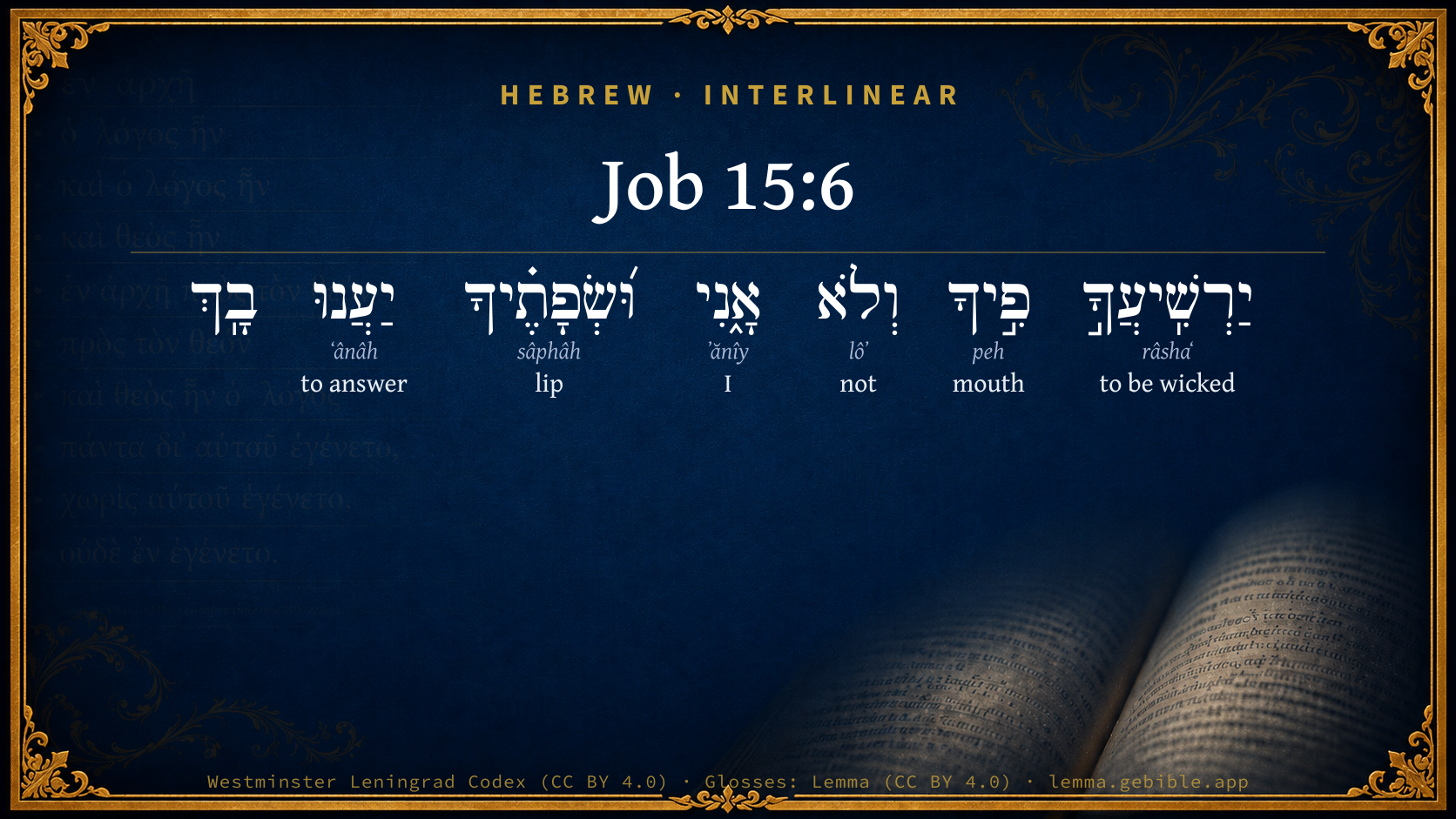
Job 15:6

Hebrew (Westminster Leningrad Codex) Job 15:6 appears in the Hebrew Old Testament. The text above is from the Westminster Leningrad Codex. Each word links to its Strong’s number, a concise gloss, and parsing drawn from the Open Scriptures Hebrew Bible morphology. Click any word for its full Brown-Driver-Briggs (BDB) entry.
Download image
Cite this verse

Job 15:6 (World English Bible). Public Domain. Lemma interlinear Bible study tool, https://lemma.gebible.app/v/job/15/6.

Show BibTeX & RIS
BibTeX
RIS
English Translation
Your own mouth condemns you, and not I; Yes, your own lips testify against you.
World English Bible · Public Domain
Download a study sheet

One document with this verse’s original text, its word-by-word gloss line, the meaning frame, cross-references with their text, attributed commentary, and full source and license credits — printable, and it pastes into notes with its structure intact.

This verse Autodidact and up

Study sheet (.html) Plain text (.txt)

A passage Seminary Student

Up to 50 verses in one chapter. A passage sheet keeps up to 6 commentary sources and 12 cross-references per verse, in the order this page ranks them, and says so on the sheet whenever that leaves anything out. Ask for a single verse and you get the Autodidact verse sheet above.

Everything on this page stays free to read, with no account — the sheet is a download of what is already on screen, not access to it.

Want to remove ads? Support Godless Engineer
Compare translations 3

The same verse in 3 English versions, stacked beneath the original-language interlinear above. Click any original word for its lexicon entry.

Each is an independent rendering of the whole verse — the interlinear is not word-aligned to these translations.

Highlighted words mark where these versions differ — a whole-verse word diff, not a word-by-word alignment.

  • World English Bible Public Domain
    Your own mouth condemns you, and not I; Yes, your own lips testify against you.
  • King James Version Public Domain
    Thine own mouth condemneth thee, and not I: yea, thine own lips testify against thee.
  • unfoldingWord Literal Text CC BY-SA 4.0
    Your mouth condemns you, and not I, and your lips testify against you.

unfoldingWord Literal Text — © unfoldingWord, licensed CC BY-SA 4.0. Word-aligned USFM3 via Door43 (git.door43.org/unfoldingWord/en_ult).

Versions to compare (up to 4)

3 of 4 selected

Show all 18 translations

Every available English version of this verse, each an independent rendering of the whole verse.

  • World English Bible Public Domain
    Your own mouth condemns you, and not I; Yes, your own lips testify against you.
  • Berean Standard Bible Public Domain
    Your own mouth, not mine, condemns you; your own lips testify against you.
  • Majority Standard Bible Public Domain
    Your own mouth, not mine, condemns you; your own lips testify against you.
  • King James Version Public Domain
    Thine own mouth condemneth thee, and not I: yea, thine own lips testify against thee.
  • American Standard Version (1901) Public Domain
    Thine own mouth condemneth thee, and not I; Yea, thine own lips testify against thee.
  • Revised Version (1885) Public Domain
    Thine own mouth condemneth thee, and not I; yea, thine own lips testify against thee.
  • Geneva Bible (1599) Public Domain
    Thine owne mouth condemneth thee, and not I, and thy lippes testifie against thee.
  • Douay-Rheims (1899) Public Domain
    Thy own mouth shall condemn thee, and not I: and thy own lips shall answer thee.
  • Young's Literal Translation Public Domain
    Thy mouth declareth thee wicked, and not I, And thy lips testify against thee.
  • Literal Standard Version CC BY-SA 4.0
    Your mouth declares you wicked, and not I, || And your lips testify against you.
  • Unlocked Literal Bible CC BY-SA 4.0
    Your own mouth condemns you, not mine; indeed, your own lips testify against you.
  • unfoldingWord Literal Text CC BY-SA 4.0
    Your mouth condemns you, and not I, and your lips testify against you.
  • Darby Bible Public Domain
    Thine own mouth condemneth thee, and not I; and thy lips testify against thee.
  • World Messianic Bible Public Domain
    Your own mouth condemns you, and not I. Yes, your own lips testify against you.
  • Webster's Bible Public Domain
    Thy own mouth condemneth thee, and not I: yes, thy own lips testify against thee.
  • Free Bible Version CC BY-SA 4.0
    Your own mouth is condemning you, not me; your own lips are testifying against you.
  • Bible in Basic English Public Domain
    It is by your mouth, even yours, that you are judged to be in the wrong, and not by me; and your lips give witness against you.
  • JPS Tanakh (1917) Public Domain
    Thine own mouth condemneth thee, and not I; yea, thine own lips testify against thee.

Literal Standard Version (2020), Covenant Press — licensed CC BY-SA 4.0. Text via the HelloAO Bible API (eBible.org). Unlocked Literal Bible (unfoldingWord) — licensed CC BY-SA 4.0. Text via the HelloAO Bible API (eBible.org). unfoldingWord Literal Text — © unfoldingWord, licensed CC BY-SA 4.0. Word-aligned USFM3 via Door43 (git.door43.org/unfoldingWord/en_ult). Free Bible Version, Dr. Jonathan Gallagher — licensed CC BY-SA 4.0. Text via the HelloAO Bible API (eBible.org).

Word by word

More ways to search: Search by grammar → Find every occurrence → Compare this word →

Practice this passage: Drill this verse → Learn its vocabulary →

יַרְשִֽׁיעֲךָ֣
râshaʻ
H7561
“to be wicked · you”
Verb, Hiphil, Imperfect, 3rd Person, Masculine, Singular + Suffix, Personal, 2nd Person, Masculine, Singular
Part of Speech
Verb
Stem
Hiphil
Form
Imperfect
Person
3rd Person
Gender
Masculine
Number
Singular
Full BDB Definition

Origin: a primitive root

TWOT: 2222

to be wicked, act wickedly - (Qal) - to be wicked, act wickedly - to be guilty, be condemned - (Hiphil) - to condemn as guilty (in civil relations) - to condemn as guilty (in ethical or religious relations) - to act wickedly (in ethics and religion)
  1. פִ֣יךָ peh H6310 “mouth · your” Noun, Common, Masculine, Singular, Construct + Suffix, Personal, 2nd Person, Masculine, Singular
  2. וְלֹא lôʼ H3808 “and · not” Conjunction + Particle, Negative
  3. אָ֑נִי ʼănîy H589 “I” Pronoun, Personal, 1st Person, Common, Singular
  4. וּ֝שְׂפָתֶ֗יךָ sâphâh H8193 “and · lips · your” Conjunction + Noun, Common, Feminine, Dual, Construct + Suffix, Personal, 2nd Person, Masculine, Singular
  5. יַעֲנוּ ʻânâh H6030 “to answer” Verb, Qal, Imperfect, 3rd Person, Masculine, Plural

About this verse

These counts appear in no published source. They are computed here, from the morphology-tagged text and Lemma’s own curated glosses. What Lemma adds →

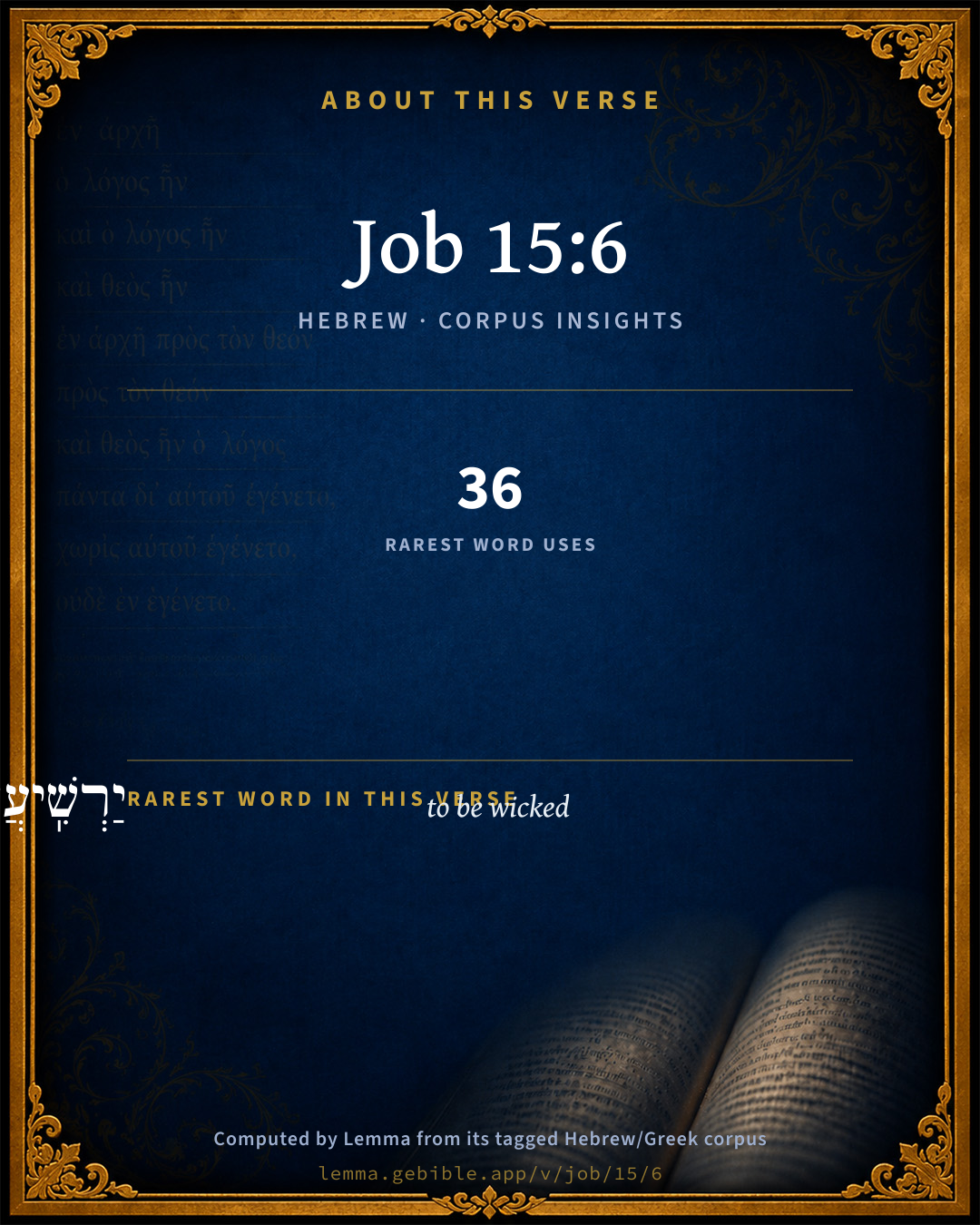
7
words
6
distinct lemmas
Wisdom
section

Shared distinctive vocabulary

יַרְשִֽׁיעֲךָ֣ to be wicked H7561 occurs in 35 verses of the Hebrew Bible. Also found in:

Grammatical profile

  • 2 verbs
  • 2 nouns
  • 1 pronoun
  • 1 preposition
  • 1 particle

Verb forms

  • יַרְשִֽׁיעֲךָ֣ Hiphil · Imperfect
  • יַעֲנוּ Qal · Imperfect

Hebrew & Septuagint length

In English translation the verse runs 15 words from the Hebrew and 16 from the Septuagint (LXX English) — closely comparable.

A rough comparison of the two English renderings, which tokenize alike — not a word-level alignment.

Word counts can differ between the Hebrew and the Greek without any difference in meaning — e.g. the Hebrew direct-object marker אֵת has no separate Greek word, and Greek often adds the article ὁ.

Cross-references

10

Topical passages linked to Job 15:6 in the Treasury of Scripture Knowledge — connected by theme and wording, ordered by reader-vote popularity; previews shown in the World English Bible.

  • Luke 19:22 "He said to him, 'Out of your own mouth will I judge you, you wicked servant! You knew that I am an exacting man, taking up that which I didn't lay down, and reaping that which I didn't sow.
  • Job 9:20 Though I am righteous, my own mouth shall condemn me. Though I am blameless, it shall prove me perverse.
  • Matthew 12:37 For by your words you will be justified, and by your words you will be condemned."
  • Job 33:8–12 "Surely you have spoken in my hearing, I have heard the voice of your words, saying,
  • Job 34:5–9 For Job has said, 'I am righteous, God has taken away my right:
  • Job 35:2–3 "Do you think this to be your right, Or do you say, 'My righteousness is more than God's,'
  • Job 40:8 Will you even annul my judgment? Will you condemn me, that you may be justified?
  • Job 42:3 You asked, 'Who is this who hides counsel without knowledge?' Therefore I have uttered that which I did not understand, Things too wonderful for me, which I didn't know.
  • Psalms 64:8 Their own tongues shall ruin them. All who see them will shake their heads.
  • Matthew 26:65 Then the high priest tore his clothing, saying, "He has spoken blasphemy! Why do we need any more witnesses? Behold, now you have heard his blasphemy.

Cross-references courtesy of OpenBible.info (CC BY 4.0).

Hebrew and Greek witnesses Masoretic Hebrew ↔ Greek Septuagint

The same verse in the two great witnesses to the Old Testament, shown verse-for-verse.

These are two independent witnesses, not word-aligned to each other, and the Septuagint is shown in lemma (dictionary) form.

Hebrew Job 15:6 Masoretic · Westminster Leningrad Codex

יַרְשִֽׁיעֲךָ֣ פִ֣יךָ וְלֹא אָ֑נִי וּ֝שְׂפָתֶ֗יךָ יַעֲנוּ בָֽךְ

Your own mouth condemns you, and not I; Yes, your own lips testify against you.

World English Bible · Public Domain

Greek LXX Job 15:6 Septuagint · lemma form

ἐλέγχω σύ ὁ σός στόμα καί μή ἐγώ ὁ δέ χεῖλος σύ καταμαρτυρέω σύ

Let your own mouth, and not me, reprove you: and your lips shall testify against you.

LXX2012 (modern English Septuagint) · Public Domain

Hebrew: Westminster Leningrad Codex (CC BY 4.0). Greek: Septuagint (public domain); English from LXX2012 (modern English Septuagint) (Public Domain). How the Septuagint differs from the Hebrew →

Commentary

Notes on Job 15:6 from classic Christian and Jewish commentators (each source and its license shown beneath its notes). The classic Christian expositions comment on the surrounding passage and are grouped to its opening verse, so a note may address several verses; the Jewish commentaries on the Tanakh (Rashi and others) are per-verse, so they appear only where the commentator wrote on this verse.

Lemma curates 59 commentaries, every one of them public domain or Creative Commons licensed, each selected and text-cleaned for this edition rather than reprinted as found. About our sources →

The Cambridge Bible for Schools and Colleges

gen. ed. J. J. S. Perowne

6. But in truth such utterances of his mouth clearly suggested the source which inspired them, other proof of his guilt than they was not needed. Thus in Job_15:5 Job’s language and sentiments are explained by his guilt, and in Job_15:6 his guilt is proved by his language; and both verses support the charge in Job_15:4 that he was doing away, breaking with, the fear of God.

The Cambridge Bible for Schools and Colleges (gen. ed. J. J. S. Perowne; Cambridge University Press, 1878–1918) — public domain. Text from a community e-Sword module.

Trapp's Complete Commentary

John Trapp

Job 15:6 Thine own mouth condemneth thee, and not I: yea, thine own lips testify against thee.

Ver. 6. Thine own mouth condemneth thee, and not I] Yes, you, and none but you. Job’s heart condemneth him not (and thence his confidence toward God, 1Jn 3:21), much less his mouth, had not his words been misconstrued. But as charity maketh a good sense of doubtful speeches and passages, so prejudice and displeasure takes all things (though well meant) at the worst, and as logicians do, Sequitur partem deteriorem. Eliphaz diggeth up evil, Pro 16:27, and is like Achilles, of whom Homer saith, that he was a great fault finder (Iliad, xi. 653).

Dεινος ανηρ, ταχα κεν και αναιτιον αιτιοωτο.

Yea, thine own lips testify against thee] Heb. Answer against thee. For witnesses ordinarily answer to interrogatories. So the pride of Israel (breaking forth as a great master pockmark in his forehead) testified to his face, Hos 5:5, and the heretic is contemned of himself, Tit 3:11. Virtually he doth so, though not formally. But Job did neither, good Eliphaz.

John Trapp, A Commentary or Exposition upon All the Books of the Old and New Testament (1647–1656) — public domain. Text from a community e-Sword module.

Tyndale Open Study Notes

Tyndale Open Resources

15:6 Your own mouth condemns you: Job feared that this would happen (9:20; see Matt 26:65).

Tyndale Open Study Notes — © Tyndale Open Resources, licensed CC BY-SA 4.0. Text via the HelloAO Bible API.

Jamieson, Fausset & Brown

Robert Jamieson, A. R. Fausset & David Brown

No pious man would utter such sentiments.

Jamieson, Fausset & Brown — Commentary Critical and Explanatory on the Whole Bible (1871) — public domain (CC PDM 1.0). Text via the HelloAO Bible API.

John Gill's Exposition

Thine own mouth condemneth thee, and not I,.... Or shows thee to be a wicked person, guilty of things charged upon thee; out of thine own mouth thou art convicted, there needs no other evidence to be brought against thee, that is sufficient: and thou savest me, and any other, the trouble of passing the sentence of condemnation upon thee; thou hast done it thyself, thine own mouth is judge and jury, and brings in the verdict, and pronounces it, as well as is the witness, as follows, and is instead of a thousand witnesses, Job 9:20;

yea, thine own lips testify against thee; and therefore there were no need of producing any other testimony; what he had said showed that his talk was vain and unprofitable, unbecoming a wise man, and tending to make null and void the fear of God among men, to discourage all religious exercises, and particularly prayer before God.

John Gill's Exposition of the Whole Bible (1746–1763) — public domain (CC PDM 1.0). Text via the HelloAO Bible API.

Albert Barnes' Notes on the Bible

Thine own mouth condemneth thee - That is, the sentiments which you have uttered show that you cannot be a pious man.

Albert Barnes' Notes on the Bible (1834–1885) — public domain. Text from a community e-Sword/MySword module.

Matthew Poole's English Annotations

My condemnation of thee is grounded upon thine own words.

Matthew Poole's English Annotations on the Holy Bible (1683–1685) — public domain. Text from a community e-Sword/MySword module.

The Pulpit Commentary

Thine own mouth condemneth thee. So of a greater than Job it was said, "He hath spoken blasphemy; what further need have we of witnesses? behold, now ye have heard his blasphemy. What think ye? They answered and said, He is guilty of death". (Mat_26:65, Mat_26:66) Malevolence delights in misunderstanding and misinterpreting the utterances of the righteous. And not I. A weak disclaimer! As if Job"s supposed guilt did not depend on the construction put upon his words. Yea, thine own lips testify against thee. Therefore, "what further need of witnesses?

A man condemned by his own mouth.

These words have a singular and quite unintentional application as they proceed from one of Job"s comforters. Eliphaz means them for his victim, but they rebound on their author. The three friends afford striking instances of men condemned by their own mouths. As we read their pretentious and unsympathetic sentences, we cannot but also read between the lines the self-condemnation of the speakers. The only safe way to use so dangerous a weapon as that which Eliphaz here employs is to turn it against ourselves. Let us each inquire how we may be condemned by our own mouths.

I BY CONFESSION.

1. The duty. This is the most obvious and direct method of self-condemnation, and it is the most honourable. It is shameful to sin, but it is more shameful to deny our guilt and try to hush up our evil-doing. There is something manly in daring to own one"s own wrong deeds. It would be better if we could do it more among men, confessing our faults one to another. (Jam_5:16) It is absolutely necessary that we should do it to God. Confession is the first condition of forgiveness.

2. The difficulty. Now, this confession is by no means so easy as it appears before we have attempted it for ourselves. Not only is there pride to be overcome and the fear of obloquy to be mastered, but the subtle self-deceit of the heart must be conquered. For we are always tempted to plead excuses and extenuating circumstances. Yet no confession is worth anything that keeps hack part of the guilt. Confession must be frank, unreserved, whole-hearted, or it will run into hypocrisy. It is better not to confess our sins at all than to try to make them appear in a good light. The true attitude of penitence is one of utter self-abandonment, one of profound self-abasement.

II BY ACCUSING OTHERS. Thus Eliphaz thought Job condemned himself by trying to bring a charge against God, and at the same time Eliphaz succeeded m condemning himself by accusing Job. The beam is never so visible in our own eye as when we are attempting to remove the mote from our brother"s eye. A censorious spirit brings a person into odious notoriety and invites criticism. He should be well able to stand a searching cross-examination who enters the witness-box against his neighbour. But further, the very spirit of censoriousness is evil, and the exhibition of such a spirit is self-condemnatory. While we condemn our brother for unorthodoxy, our very spirit and action condemn us for want of charity a much greater fault.

III BY ALL OUR SPEAKING. "Out of the abundance of the heart the mouth speaketh." We cannot be long with a person without some of his true character revealing itself. Men are not such inscrutable enigmas as they flatter themselves with being. The general conversation must reflect the normal tone of the life. Particular deeds of wickedness may be hidden in impenetrable silence, but the evil heart from which they spring cannot be thus hidden. Therefore we are to be judged by every idle word (Mat_12:36) not because careless speech is a great sin, but because our unreflecting language reveals our true selves. It is the straw that shows the set of the current. W.F.A.

The Pulpit Commentary (1880–1919), ed. H.D.M. Spence-Jones & Joseph S. Exell — public domain. Text from a community e-Sword module.

Rashi

Rabbi Shlomo Yitzchaki (Rashi)

Let your own mouth condemn you and not I That is to say: Give me an answer to my question; the result will be that your own mouth will condemn you, for it better for me that your mouth should condemn you and not I. Now this is my question:

Rashi on the Tanakh — English translations: “The Judaica Press complete Tanach with Rashi, translated by A. J. Rosenberg” (CC BY 4.0); “Pentateuch with Rashi's commentary by M. Rosenbaum and A.M. Silbermann, 1929-1934” (public domain); “The Metsudah Tanach series, Lakewood, N.J” (CC BY 4.0); and “The Book of Joshua, Metsudah Publications, 1997” (CC BY 4.0). Text via Sefaria.

Lesson kit

Teaching starters — assembled from the data on this page, not authored interpretation. Every prompt links to the verse data it draws on. Edit before teaching.

Job, in the Wisdom, opens this verse with 7 words (6 distinct Hebrew lemmas). Its most distinctive word is râshaʻ (“to be wicked”). A historical commentator’s framing appears above. Read the whole chapter for the surrounding context.

Discussion questions

  1. The word râshaʻ carries the sense “to be wicked.” How does it shape the verse?
  2. How does Exodus 22:9, which shares the word «to be wicked», read alongside this verse?
  3. These translations render this verse differently; the difference is in the English rendering, not the original. What questions does that raise?
  4. «יַרְשִֽׁיעֲךָ֣» is a Hiphil Imperfect verb. How does that grammatical form shape the action described?
  5. Compare how The Cambridge Bible for Schools and Colleges and Trapp's Complete Commentary read this verse. Where do they agree or differ?

Things to notice

Reading settings

Reading text

Shown beneath each verse's original-language words.

Old Testament
Old Testament edition

Read the OT as the Masoretic Hebrew (MT) or the Greek Septuagint (LXX).

English shown for the Greek Septuagint (in the Hebrew ↔ Greek comparison).

Comparing translations? Open the Compare panel on any verse page to stack up to four side by side.