
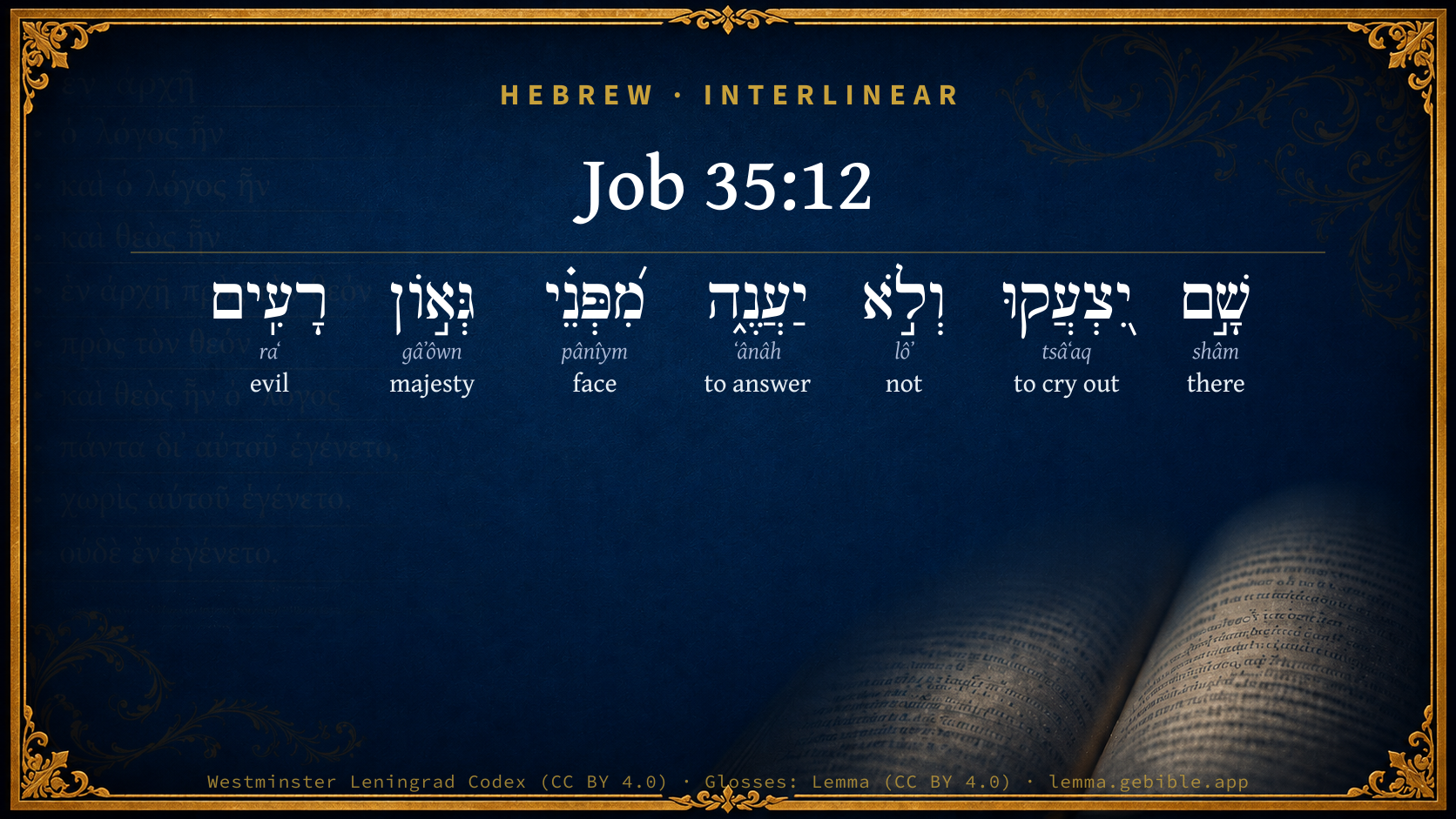
Job 35:12

Hebrew (Westminster Leningrad Codex) Job 35:12 appears in the Hebrew Old Testament. The text above is from the Westminster Leningrad Codex. Each word links to its Strong’s number, a concise gloss, and parsing drawn from the Open Scriptures Hebrew Bible morphology. Click any word for its full Brown-Driver-Briggs (BDB) entry.
Download image
Cite this verse

Job 35:12 (World English Bible). Public Domain. Lemma interlinear Bible study tool, https://lemma.gebible.app/v/job/35/12.

Show BibTeX & RIS
BibTeX
RIS
English Translation
There they cry, but none gives answer, Because of the pride of evil men.
World English Bible · Public Domain
Download a study sheet

One document with this verse’s original text, its word-by-word gloss line, the meaning frame, cross-references with their text, attributed commentary, and full source and license credits — printable, and it pastes into notes with its structure intact.

This verse Autodidact and up

Study sheet (.html) Plain text (.txt)

A passage Seminary Student

Up to 50 verses in one chapter. A passage sheet keeps up to 6 commentary sources and 12 cross-references per verse, in the order this page ranks them, and says so on the sheet whenever that leaves anything out. Ask for a single verse and you get the Autodidact verse sheet above.

Everything on this page stays free to read, with no account — the sheet is a download of what is already on screen, not access to it.

Want to remove ads? Support Godless Engineer
Compare translations 3

The same verse in 3 English versions, stacked beneath the original-language interlinear above. Click any original word for its lexicon entry.

Each is an independent rendering of the whole verse — the interlinear is not word-aligned to these translations.

Highlighted words mark where these versions differ — a whole-verse word diff, not a word-by-word alignment.

  • World English Bible Public Domain
    There they cry, but none gives answer, Because of the pride of evil men.
  • King James Version Public Domain
    There they cry, but none giveth answer, because of the pride of evil men.
  • unfoldingWord Literal Text CC BY-SA 4.0
    There they cry out, but he does not answer from the face of the pride of evil.

unfoldingWord Literal Text — © unfoldingWord, licensed CC BY-SA 4.0. Word-aligned USFM3 via Door43 (git.door43.org/unfoldingWord/en_ult).

Versions to compare (up to 4)

3 of 4 selected

Show all 18 translations

Every available English version of this verse, each an independent rendering of the whole verse.

  • World English Bible Public Domain
    There they cry, but none gives answer, Because of the pride of evil men.
  • Berean Standard Bible Public Domain
    There they cry out, but He does not answer, because of the pride of evil men.
  • Majority Standard Bible Public Domain
    There they cry out, but He does not answer, because of the pride of evil men.
  • King James Version Public Domain
    There they cry, but none giveth answer, because of the pride of evil men.
  • American Standard Version (1901) Public Domain
    There they cry, but none giveth answer, Because of the pride of evil men.
  • Revised Version (1885) Public Domain
    There they cry, but none giveth answer, because of the pride of evil men.
  • Geneva Bible (1599) Public Domain
    Then they crye because of the violence of the wicked, but he answereth not.
  • Douay-Rheims (1899) Public Domain
    There shall they cry, and he will not hear, because of the pride of evil men.
  • Young's Literal Translation Public Domain
    There they cry, and He doth not answer, Because of the pride of evil doers.
  • Literal Standard Version CC BY-SA 4.0
    There they cry, and He does not answer, || Because of the pride of evildoers.
  • Unlocked Literal Bible CC BY-SA 4.0
    There they cry out, but God gives no answer because of the pride of evil men.
  • unfoldingWord Literal Text CC BY-SA 4.0
    There they cry out, but he does not answer from the face of the pride of evil.
  • Darby Bible Public Domain
    There they cry, and he answereth not, because of the pride of evil men.
  • World Messianic Bible Public Domain
    There they cry, but no one answers, because of the pride of evil men.
  • Webster's Bible Public Domain
    There they cry, but none giveth answer, because of the pride of evil men.
  • Free Bible Version CC BY-SA 4.0
    When they call out for help, God doesn't answer them because they are proud and evil people.
  • Bible in Basic English Public Domain
    There they are crying out because of the pride of the evil-doers, but he gives them no answer.
  • JPS Tanakh (1917) Public Domain
    There they cry, but none giveth answer, because of the pride of evil men.

Literal Standard Version (2020), Covenant Press — licensed CC BY-SA 4.0. Text via the HelloAO Bible API (eBible.org). Unlocked Literal Bible (unfoldingWord) — licensed CC BY-SA 4.0. Text via the HelloAO Bible API (eBible.org). unfoldingWord Literal Text — © unfoldingWord, licensed CC BY-SA 4.0. Word-aligned USFM3 via Door43 (git.door43.org/unfoldingWord/en_ult). Free Bible Version, Dr. Jonathan Gallagher — licensed CC BY-SA 4.0. Text via the HelloAO Bible API (eBible.org).

Word by word

More ways to search: Search by grammar → Find every occurrence → Compare this word →

Practice this passage: Drill this verse → Learn its vocabulary →

About this verse

These counts appear in no published source. They are computed here, from the morphology-tagged text and Lemma’s own curated glosses. What Lemma adds →

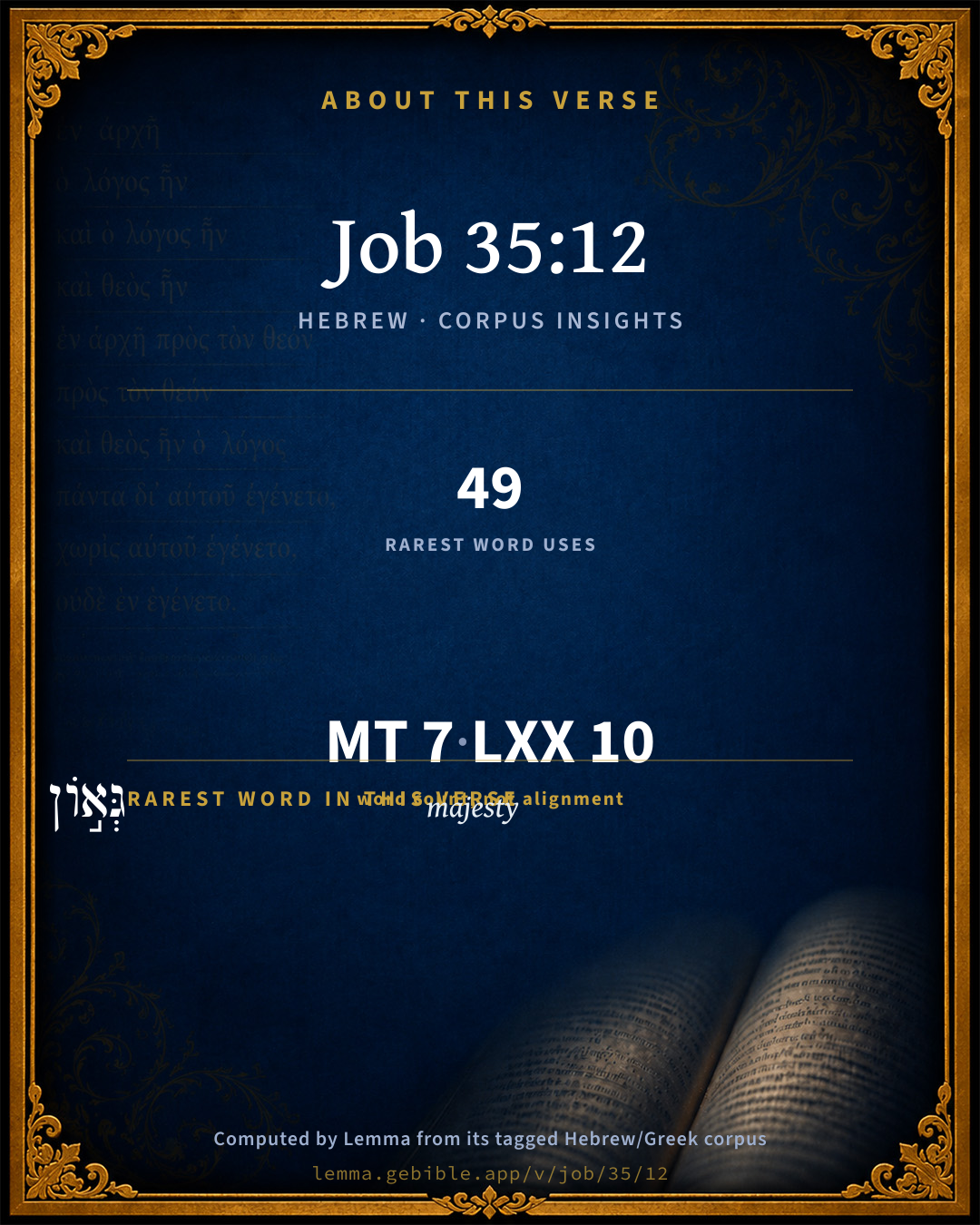
7
words
7
distinct lemmas
Wisdom
section

Shared distinctive vocabulary

גְּא֣וֹן majesty H1347 occurs in 45 verses of the Hebrew Bible. Also found in:

Grammatical profile

  • 2 verbs
  • 2 nouns
  • 1 adjective
  • 1 adverb
  • 1 particle

Verb forms

  • יִ֭צְעֲקוּ Qal · Imperfect
  • יַעֲנֶ֑ה Qal · Imperfect

Hebrew & Septuagint length

In English translation the verse runs 14 words from the Hebrew and 16 from the Septuagint (LXX English) — closely comparable.

A rough comparison of the two English renderings, which tokenize alike — not a word-level alignment.

Word counts can differ between the Hebrew and the Greek without any difference in meaning — e.g. the Hebrew direct-object marker אֵת has no separate Greek word, and Greek often adds the article ὁ.

In the original languages it is 7 Hebrew tokens and 10 Greek tokens — but the two are counted differently (Hebrew bundles its prefixes and suffixes into one token; the Greek is in lemma form), so that isn’t a like-for-like length.

Cross-references

6

Topical passages linked to Job 35:12 in the Treasury of Scripture Knowledge — connected by theme and wording, ordered by reader-vote popularity; previews shown in the World English Bible.

  • Proverbs 1:28 Then will they call on me, but I will not answer. They will seek me diligently, but they will not find me;
  • John 9:31 We know that God doesn't listen to sinners, but if anyone is a worshipper of God, and does his will, he listens to him.
  • Psalms 123:3–4 Have mercy on us, Yahweh, have mercy on us, For we have endured much contempt.
  • Psalms 18:41 They cried, but there was none to save; Even to Yahweh, but he didn't answer them.
  • Psalms 73:6–8 Therefore pride is like a chain around their neck. Violence covers them like a garment.
  • Isaiah 14:14–17 I will ascend above the heights of the clouds; I will make myself like the Most High.

Cross-references courtesy of OpenBible.info (CC BY 4.0).

Hebrew and Greek witnesses Masoretic Hebrew ↔ Greek Septuagint

The same verse in the two great witnesses to the Old Testament, shown verse-for-verse.

These are two independent witnesses, not word-aligned to each other, and the Septuagint is shown in lemma (dictionary) form.

Hebrew Job 35:12 Masoretic · Westminster Leningrad Codex

שָׁ֣ם יִ֭צְעֲקוּ וְלֹ֣א יַעֲנֶ֑ה מִ֝פְּנֵ֗י גְּא֣וֹן רָעִֽים

There they cry, but none gives answer, Because of the pride of evil men.

World English Bible · Public Domain

Greek LXX Job 35:12 Septuagint · lemma form

ἐκεῖ κράζω καί οὐ μή εἰςἀκούω καί ἀπό ὕβρις πονηρός

There they shall cry, and none shall listen, even because of the insolence of wicked men.

LXX2012 (modern English Septuagint) · Public Domain

Hebrew: Westminster Leningrad Codex (CC BY 4.0). Greek: Septuagint (public domain); English from LXX2012 (modern English Septuagint) (Public Domain). How the Septuagint differs from the Hebrew →

Commentary

Notes on Job 35:12 from classic Christian and Jewish commentators (each source and its license shown beneath its notes). The classic Christian expositions comment on the surrounding passage and are grouped to its opening verse, so a note may address several verses; the Jewish commentaries on the Tanakh (Rashi and others) are per-verse, so they appear only where the commentator wrote on this verse.

Lemma curates 59 commentaries, every one of them public domain or Creative Commons licensed, each selected and text-cleaned for this edition rather than reprinted as found. About our sources →

Trapp's Complete Commentary

John Trapp

Job 35:12 There they cry, but none giveth answer, because of the pride of evil men.

Ver. 12. There they cry, but none giveth answer] Cry they do, but not to the true God, Jon 1:5. The Papists have their he saints and she saints, for several uses. Or, if to the true God, yet not in a due manner; not in faith, and with remorse for their misdoings. And hence it is that either they are not heard and helped; or not in mercy, but for a further mischief, and to furnish out their indictment at the last day; and on their death beds God will not come to them, or be entreated by them, Pro 1:28 Psa 18:42.

Because of the pride of evil men] i.e. Because these oppressed ones that thus cry are not so poor as proud; humbled they are, but not humble; low, but not lowly. Plectuntur, sed non flectuntur; they have lost the fruit of their afflictions, and are not a button the better for all that they have suffered.

John Trapp, A Commentary or Exposition upon All the Books of the Old and New Testament (1647–1656) — public domain. Text from a community e-Sword module.

Joseph Benson's Commentary

Job 35:12. There they cry — Or then, as the Hebrew particle here used often means; that is, in that time or condition of trouble; but none giveth answer — The reason that God doth not deliver them is, because, though they lie crying under their afflictions, they continue to be evil, wicked, and impenitent; proud and unhumbled for those sins, on account of which God brought these miseries upon them.

Joseph Benson's Commentary on the Old and New Testaments (1811–1818) — public domain. Text from a community e-Sword module.

Geneva Bible (1599)

Geneva Bible translators

Because they pray not in faith, as feeling God’s mercies.

Geneva Bible (1599) marginal notes — public domain. Text via Bolls.life.

Jamieson, Fausset & Brown

Robert Jamieson, A. R. Fausset & David Brown

There--rather, "Then" (when none humbly casts himself on God, Job 35:10). They cry proudly against God, rather than humbly to God. So, as the design of affliction is to humble the sufferer, there can be no answer until "pride" gives place to humble, penitent prayer (Psa 10:4; Jer 13:17).

Jamieson, Fausset & Brown — Commentary Critical and Explanatory on the Whole Bible (1871) — public domain (CC PDM 1.0). Text via the HelloAO Bible API.

Adam Clarke's Commentary

Verse 12. There they cry] They bewail their calamities, but sorrow not for the cause of them; they cry against their oppressors, but they call not upon God.

Because of the pride of evil men.] Or מפני mippeney, from the face, presence, or influence, of the pride of wicked men. They cry for deliverance from the pride of wicked men; but they are not heard, because they cry not to God.

Adam Clarke's Commentary on the Bible (1810–1826) — public domain. Text from a community e-Sword/MySword module.

The Cambridge Bible for Schools and Colleges

gen. ed. J. J. S. Perowne

12. The first and last words of the verse are in connexion: “they cry because of the pride of evil men, but none giveth answer.” They remain unheard because their cry is “vanity” (Job_35:13).

The Cambridge Bible for Schools and Colleges (gen. ed. J. J. S. Perowne; Cambridge University Press, 1878–1918) — public domain. Text from a community e-Sword module.

John Gill's Exposition

There they cry,.... As brutes do, and as in, Job 35:9; by reason of their oppressions, but not under a due sense of the hand of God upon them, nor of his being their only helper, and saviour, and deliverer;

but none giveth answer; to them, either God or men, and they lie groaning and howling under their oppression;

because of the pride of evil men; this is either to be connected with "they cry", and then the sense is, that they cry by reason of the oppressions of wicked men, who, through the pride of their hearts, and to show their superior power and authority, persecute and distress them, Psa 10:2. And it is because of this they cry out, being distressed by them, and not through any sense of sin they have committed, as the reason of God's suffering them to be thus oppressed: or "with none give answer"; God gives them no answer to their cry, because pride is not withdrawn from them, which is one end he has in afflicting men; because they are not humbled under the mighty hand of God, and are not brought to a sense of sin and humiliation for it, and acknowledgment of it. And another reason follows:

John Gill's Exposition of the Whole Bible (1746–1763) — public domain (CC PDM 1.0). Text via the HelloAO Bible API.

Albert Barnes' Notes on the Bible

There they cry - They cry out in the language of complaint, but not for mercy.

Because of the pride of evil men - That is, of their own pride. The pride of men so rebellious, and so disposed to complain of God, is the reason why they do not appeal to him to sustain them and give them relief. This is still as true as it was in the time of Elihu. The pride of the heart, even in affliction, is the true reason with multitudes why they do not appeal to God, and why they do not pray. They have valued themselves on their independence of spirit. They have been accustomed to rely on their own resources. They have been unwilling to recognize their dependence on any being whatever. Even in their trials, the heart is too wicked to acknowledge God, and they would be ashamed to be known to do what they regard as so weak a thing as “to pray.” Hence, they complain in their afflictions; they linger on in their sufferings without consolation, and then die without hope. However inapplicable, therefore, this solution of the difficulty may have been to the case of Job, it is “not” inapplicable to the case of multitudes of sufferers. “Many of the afflicted have no peace or consolation in their trials - no ‘songs in the night’ - because they are too proud to pray!”

Albert Barnes' Notes on the Bible (1834–1885) — public domain. Text from a community e-Sword/MySword module.

Matthew Poole's English Annotations

There, or then, as this particle is used, Psa 14:5; Ecc 3:17; Zep 1:14; in that time or condition.

The pride of evil men; either

1. Of the oppressors. So this is the reason not of the last clause, why none answereth, but of the former, why they cry; the latter clause being therefore shut up within a parenthesis, and the words thus are to be transposed, as some place them,

There they cry, because of the pride of evil men, but none giveth answer; the reason whereof followeth in the next verse. Or rather,

2. Of the oppressed persons. And so there is no need of any parenthesis or transposition. And so these words contain one reason of the words immediately foregoing, which is most natural, and easy, and usual, to wit, why none giveth answer, i.e. why God doth not answer nor regard their cries, because of their pride, &c., because they are both evil, wicked and impenitent, and proud, unhumbled for those sins for which God brought these miseries upon them, and unsubdued to the obedience of God.

Matthew Poole's English Annotations on the Holy Bible (1683–1685) — public domain. Text from a community e-Sword/MySword module.

Whedon's Commentary on the Bible

Daniel D. Whedon

12. There — Or, under such circumstances.

None giveth answer — He answereth not these evil men (same as in Job_35:9) because of their pride. Elihu’s imagination sees a multitude of ingrates, in the midst of whom is Job with his complaints and murmurs. To astonished Job, who repined because God refused to hear him, Elihu points out his associates, his fellow sinners and sufferers, who also prayed when trouble came: — See! “there they cry!” and leaves him to draw his own moral. Like Aug. Comte, they would sooner pray to and worship “collective man” than God, and appeal to God only as a last resource. It is instructive to see a Herbert Spencer dismiss “the religion of humanity,” held by the great sceptic, “as countenanced neither by induction nor deduction;” in all probability destined himself to be dismissed in like manner by some leading sceptic of the future.

Daniel D. Whedon (gen. ed.), Commentary on the Old and New Testaments (1874–1909) — public domain. Text from a community e-Sword module.

The Pulpit Commentary

There they cry. "There," smitten by calamity, they do at last cry to God. But none giveth answer. They "ask, and receive not." Why? Because of the pride of evil men. Because, i.e. , they ask proudly, not humbly; they claim relief as a right, not as a favour; they approach God in a spirit that offends him and prevents him from granting their requests.

The Pulpit Commentary (1880–1919), ed. H.D.M. Spence-Jones & Joseph S. Exell — public domain. Text from a community e-Sword module.

John Wesley's Explanatory Notes

Because - God doth not answer their cries, because they are both evil, wicked and impenitent, and proud, unhumbled for those sins for which God brought these miseries upon them.

John Wesley, Explanatory Notes Upon the Whole Bible (1754–1765) — public domain. Text via the GEBible commentary corpus.

unfoldingWord translationNotes

Door43 World Missions Community

Connecting Statement:

Elihu continues speaking.

they cry out

"the oppressed people cry out"

How much less will he answer you ... that you are waiting for him!

Since God will not hear the prayers of prideful, evil men, it is even less likely that he will hear Job, who is complaining against him. AT: "So he certainly will not answer you ... that you are waiting for him!" (See: Exclamations)

that your case is before him

"you have presented your case to him"

you are waiting for him

"you are waiting for him to respond"

translationWords

fool

Almighty

unfoldingWord translationNotes — © Distant Shores Media and the Door43 World Missions Community, licensed CC BY-SA 4.0. Source: git.door43.org/Door43/en_tn.

Rashi

Rabbi Shlomo Yitzchaki (Rashi)

There they cry out And see that there the poor cry out because of the pride of those who oppress them, and He does not answer, for...

Rashi on the Tanakh — English translations: “The Judaica Press complete Tanach with Rashi, translated by A. J. Rosenberg” (CC BY 4.0); “Pentateuch with Rashi's commentary by M. Rosenbaum and A.M. Silbermann, 1929-1934” (public domain); “The Metsudah Tanach series, Lakewood, N.J” (CC BY 4.0); and “The Book of Joshua, Metsudah Publications, 1997” (CC BY 4.0). Text via Sefaria.

Lesson kit

Teaching starters — assembled from the data on this page, not authored interpretation. Every prompt links to the verse data it draws on. Edit before teaching.

Job, in the Wisdom, opens this verse with 7 words (7 distinct Hebrew lemmas). Its most distinctive word is gâʼôwn (“majesty”). A historical commentator’s framing appears above. Read the whole chapter for the surrounding context.

Discussion questions

  1. The word gâʼôwn carries the sense “majesty.” How does it shape the verse?
  2. Exodus 15:7 shares the word «majesty» with this verse. How do the two illuminate each other?
  3. The translations on this page render this verse differently — a whole-verse word diff, not a word-by-word alignment. What might account for the different wordings?
  4. The verb «יִ֭צְעֲקוּ» is Qal Imperfect. How does its form color the action?
  5. Reading how Trapp's Complete Commentary and Joseph Benson's Commentary read this verse, where do the two commentators agree and where do they part?

Things to notice

Reading settings

Reading text

Shown beneath each verse's original-language words.

Old Testament
Old Testament edition

Read the OT as the Masoretic Hebrew (MT) or the Greek Septuagint (LXX).

English shown for the Greek Septuagint (in the Hebrew ↔ Greek comparison).

Comparing translations? Open the Compare panel on any verse page to stack up to four side by side.