
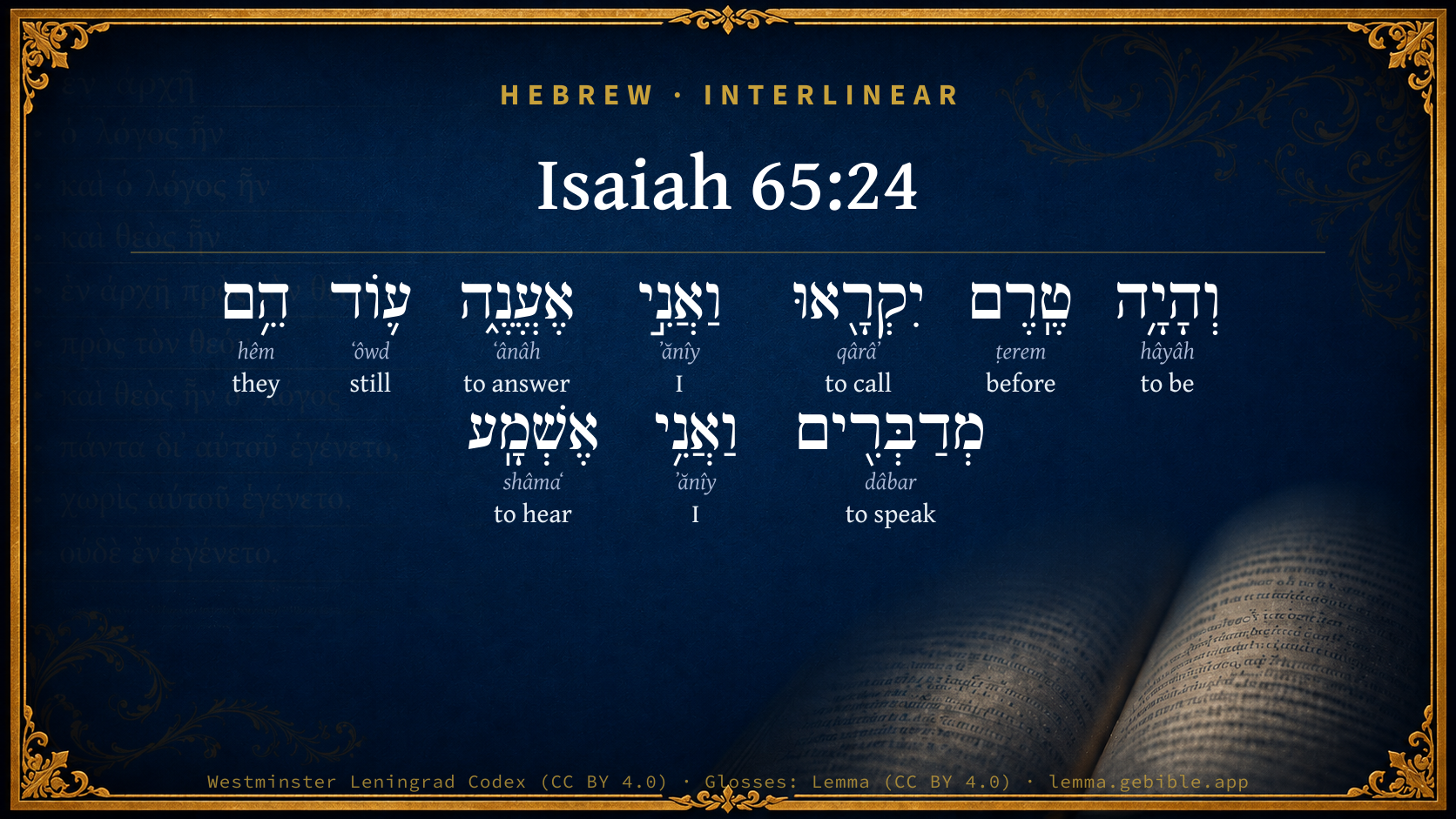
Isaiah 65:24

Hebrew (Westminster Leningrad Codex) Isaiah 65:24 appears in the Hebrew Old Testament. The text above is from the Westminster Leningrad Codex. Each word links to its Strong’s number, a concise gloss, and parsing drawn from the Open Scriptures Hebrew Bible morphology. Click any word for its full Brown-Driver-Briggs (BDB) entry.
Download image
Cite this verse

Isaiah 65:24 (World English Bible). Public Domain. Lemma interlinear Bible study tool, https://lemma.gebible.app/v/isaiah/65/24.

Show BibTeX & RIS
BibTeX
RIS
English Translation
It shall happen that, before they call, I will answer; and while they are yet speaking, I will hear.
World English Bible · Public Domain
Download a study sheet

One document with this verse’s original text, its word-by-word gloss line, the meaning frame, cross-references with their text, attributed commentary, and full source and license credits — printable, and it pastes into notes with its structure intact.

This verse Autodidact and up

Study sheet (.html) Plain text (.txt)

A passage Seminary Student

Up to 50 verses in one chapter. A passage sheet keeps up to 6 commentary sources and 12 cross-references per verse, in the order this page ranks them, and says so on the sheet whenever that leaves anything out. Ask for a single verse and you get the Autodidact verse sheet above.

Everything on this page stays free to read, with no account — the sheet is a download of what is already on screen, not access to it.

Want to remove ads? Support Godless Engineer
Compare translations 3

The same verse in 3 English versions, stacked beneath the original-language interlinear above. Click any original word for its lexicon entry.

Each is an independent rendering of the whole verse — the interlinear is not word-aligned to these translations.

Highlighted words mark where these versions differ — a whole-verse word diff, not a word-by-word alignment.

  • World English Bible Public Domain
    It shall happen that, before they call, I will answer; and while they are yet speaking, I will hear.
  • King James Version Public Domain
    And it shall come to pass, that before they call, I will answer; and while they are yet speaking, I will hear.
  • unfoldingWord Literal Text CC BY-SA 4.0
    And it will happen, before they call, that I, I will answer; they will still be speaking, and I, I will hear.

unfoldingWord Literal Text — © unfoldingWord, licensed CC BY-SA 4.0. Word-aligned USFM3 via Door43 (git.door43.org/unfoldingWord/en_ult).

Versions to compare (up to 4)

3 of 4 selected

Show all 18 translations

Every available English version of this verse, each an independent rendering of the whole verse.

  • World English Bible Public Domain
    It shall happen that, before they call, I will answer; and while they are yet speaking, I will hear.
  • Berean Standard Bible Public Domain
    Even before they call, I will answer, and while they are still speaking, I will hear.
  • Majority Standard Bible Public Domain
    Even before they call, I will answer, and while they are still speaking, I will hear.
  • King James Version Public Domain
    And it shall come to pass, that before they call, I will answer; and while they are yet speaking, I will hear.
  • American Standard Version (1901) Public Domain
    And it shall come to pass that, before they call, I will answer; and while they are yet speaking, I will hear.
  • Revised Version (1885) Public Domain
    And it shall come to pass that, before they call, I will answer; and while they are yet speaking, I will hear.
  • Geneva Bible (1599) Public Domain
    Yea, before they call, I will answere, and whiles they speake, I will heare.
  • Douay-Rheims (1899) Public Domain
    And it shall come to pass, that before they call, I will hear; as they are yet speaking, I will hear.
  • Young's Literal Translation Public Domain
    And it hath come to pass, They do not yet call, and I answer, They are yet speaking, and I hear.
  • Literal Standard Version CC BY-SA 4.0
    And it has come to pass, || They do not yet call, and I answer, || They are yet speaking, and I hear.
  • Unlocked Literal Bible CC BY-SA 4.0
    Before they call, I will answer; and while they are still speaking, I will hear.
  • unfoldingWord Literal Text CC BY-SA 4.0
    And it will happen, before they call, that I, I will answer; they will still be speaking, and I, I will hear.
  • Darby Bible Public Domain
    And it shall come to pass, that before they call, I will answer; while they are yet speaking, I will hear.
  • World Messianic Bible Public Domain
    It will happen that before they call, I will answer; and while they are yet speaking, I will hear.
  • Webster's Bible Public Domain
    And it shall come to pass, that before they call, I will answer; and while they are yet speaking, I will hear.
  • Free Bible Version CC BY-SA 4.0
    I will reply even before they ask me. While they are still speaking, I will answer them!
  • Bible in Basic English Public Domain
    And before they make their request I will give an answer, and while they are still making prayer to me, I will give ear.
  • JPS Tanakh (1917) Public Domain
    And it shall come to pass that, before they call, I will answer, and while they are yet speaking, I will hear.

Literal Standard Version (2020), Covenant Press — licensed CC BY-SA 4.0. Text via the HelloAO Bible API (eBible.org). Unlocked Literal Bible (unfoldingWord) — licensed CC BY-SA 4.0. Text via the HelloAO Bible API (eBible.org). unfoldingWord Literal Text — © unfoldingWord, licensed CC BY-SA 4.0. Word-aligned USFM3 via Door43 (git.door43.org/unfoldingWord/en_ult). Free Bible Version, Dr. Jonathan Gallagher — licensed CC BY-SA 4.0. Text via the HelloAO Bible API (eBible.org).

Word by word

More ways to search: Search by grammar → Find every occurrence → Compare this word →

Practice this passage: Drill this verse → Learn its vocabulary →

About this verse

These counts appear in no published source. They are computed here, from the morphology-tagged text and Lemma’s own curated glosses. What Lemma adds →

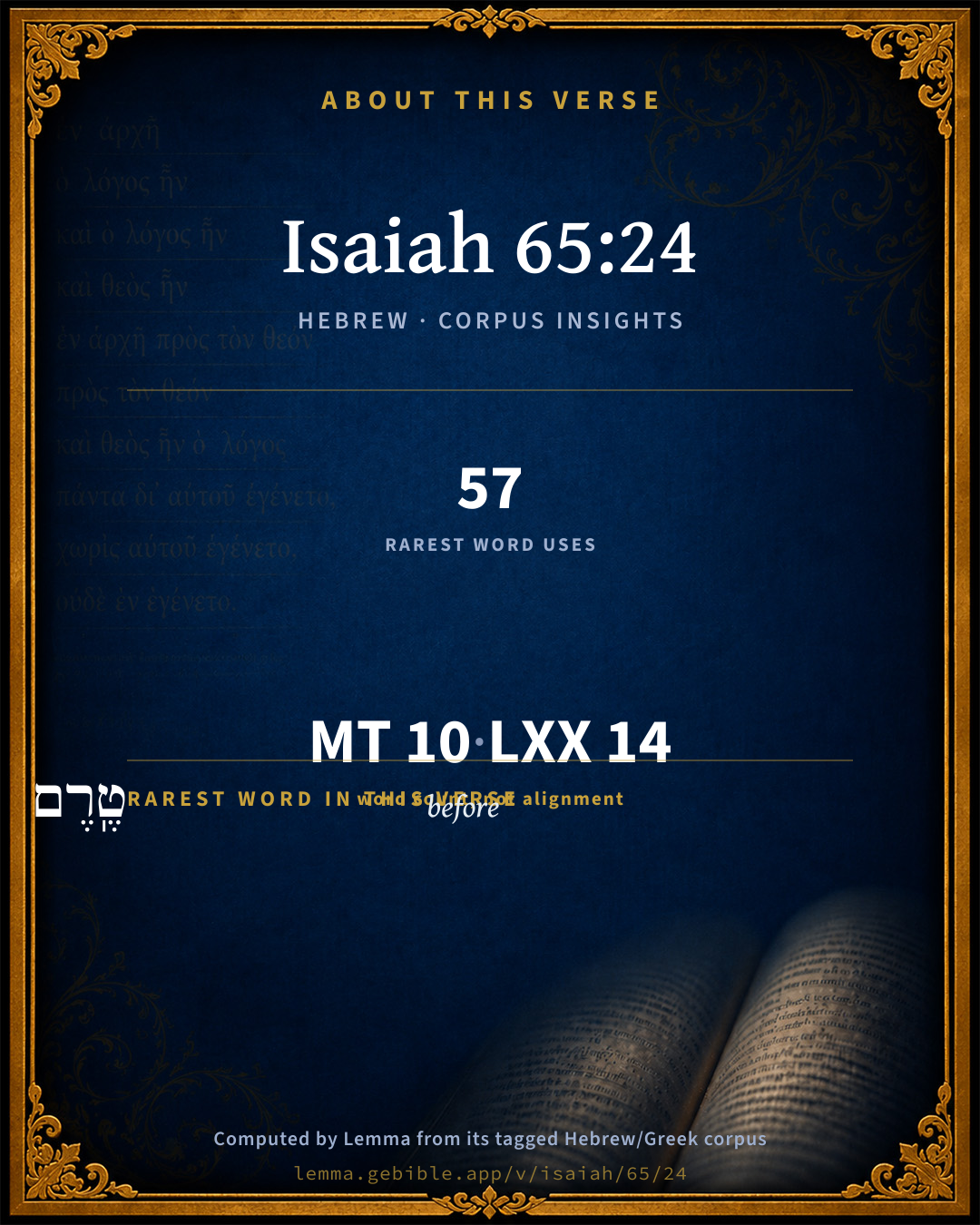
10
words
9
distinct lemmas
Prophets
section

Shared distinctive vocabulary

טֶֽרֶם before H2962 occurs in 50 verses of the Hebrew Bible. Also found in:

Grammatical profile

  • 5 verbs
  • 3 pronouns
  • 2 adverbs

Verb forms

  • וְהָיָ֥ה Qal · Sequential Perfect
  • יִקְרָ֖אוּ Qal · Imperfect
  • אֶעֱנֶ֑ה Qal · Imperfect
  • מְדַבְּרִ֖ים Piel · Participle Active
  • אֶשְׁמָֽע Qal · Imperfect

Repetition

A word recurs within this verse — often emphatic in Hebrew:

  • וַאֲנִ֣י I H589 ×2

Hebrew & Septuagint length

In English translation the verse runs 19 words from the Hebrew and 26 from the Septuagint (LXX English) — closely comparable.

A rough comparison of the two English renderings, which tokenize alike — not a word-level alignment.

Word counts can differ between the Hebrew and the Greek without any difference in meaning — e.g. the Hebrew direct-object marker אֵת has no separate Greek word, and Greek often adds the article ὁ.

In the original languages it is 10 Hebrew tokens and 14 Greek tokens — but the two are counted differently (Hebrew bundles its prefixes and suffixes into one token; the Greek is in lemma form), so that isn’t a like-for-like length.

Cross-references

13

Topical passages linked to Isaiah 65:24 in the Treasury of Scripture Knowledge — connected by theme and wording, ordered by reader-vote popularity; previews shown in the World English Bible.

  • Daniel 10:12 Then said he to me, Don't be afraid, Daniel; for from the first day that you did set your heart to understand, and to humble yourself before your God, your words were heard: and I am come for your words' sake.
  • 1 John 5:14–15 This is the boldness which we have toward him, that, if we ask anything according to his will, he listens to us.
  • Mark 11:24 Therefore I tell you, all things whatever you pray and ask for, believe that you receive them, and you shall have them.
  • Isaiah 58:9 Then shall you call, and Yahweh will answer; you shall cry, and he will say, Here I am. If you take away from the midst of you the yoke, the putting forth of the finger, and speaking wickedly;
  • Psalms 91:15 He will call on me, and I will answer him. I will be with him in trouble. I will deliver him, and honor him.
  • Psalms 50:15 Call on me in the day of trouble. I will deliver you, and you will honor me."
  • Isaiah 55:6 Seek you Yahweh while he may be found; call you on him while he is near:
  • Acts 4:31 When they had prayed, the place was shaken where they were gathered together. They were all filled with the Holy Spirit, and they spoke the word of God with boldness.
  • Acts 10:30–32 Cornelius said, "Four days ago, I was fasting until this hour, and at the ninth hour, I prayed in my house, and behold, a man stood before me in bright clothing,
  • Psalms 32:5 I acknowledged my sin to you. I didn't hide my iniquity. I said, I will confess my transgressions to Yahweh, And you forgave the iniquity of my sin. Selah.
  • Daniel 9:20–23 While I was speaking, and praying, and confessing my sin and the sin of my people Israel, and presenting my supplication before Yahweh my God for the holy mountain of my God;
  • Luke 15:18–20 I will get up and go to my father, and will tell him, "Father, I have sinned against heaven, and in your sight.
  • Acts 12:5–16 Peter therefore was kept in the prison, but constant prayer was made by the assembly to God for him.

Cross-references courtesy of OpenBible.info (CC BY 4.0).

Hebrew and Greek witnesses Masoretic Hebrew ↔ Greek Septuagint

The same verse in the two great witnesses to the Old Testament, shown verse-for-verse.

These are two independent witnesses, not word-aligned to each other, and the Septuagint is shown in lemma (dictionary) form.

Hebrew Isaiah 65:24 Masoretic · Westminster Leningrad Codex

וְהָיָ֥ה טֶֽרֶם יִקְרָ֖אוּ וַאֲנִ֣י אֶעֱנֶ֑ה ע֛וֹד הֵ֥ם מְדַבְּרִ֖ים וַאֲנִ֥י אֶשְׁמָֽע

It shall happen that, before they call, I will answer; and while they are yet speaking, I will hear.

World English Bible · Public Domain

Greek LXX Isaiah 65:24 Septuagint · lemma form

καί εἰμί πρίν κράζω αὐτός ἐγώ ἐπιἀκούω αὐτός ἔτι λαλέω αὐτός εἶπον τίς εἰμί

And it shall come to pass, that before they call, I will listen to them; while they are yet speaking, I will say, What is it?

LXX2012 (modern English Septuagint) · Public Domain

Hebrew: Westminster Leningrad Codex (CC BY 4.0). Greek: Septuagint (public domain); English from LXX2012 (modern English Septuagint) (Public Domain). How the Septuagint differs from the Hebrew →

Targum (Aramaic paraphrase)

1

The Targum is the ancient Jewish Aramaic paraphrase of the Hebrew Scriptures — an interpretive translation, not the Hebrew text itself. Onkelos (literal) and Pseudo-Jonathan (expansive) render the Torah, and Jonathan the Prophets. Coverage is partial: where no permissively-licensed English translation exists for a verse, only the Aramaic is shown. This is verse-level text, not a word-by-word alignment to the Hebrew.

  1. Targum Jonathan Prophets (Joshua–Malachi)
    וִיהֵי עַד לָא יִצְלוּן קֳדָמַי וַאֲנָא אֲקַבֵּל צְלוֹתְהוֹן עַד לָא יִבְעוֹן מִן קֳדָמַי אַעְבֵּיד בָּעוּתְהוֹן:

    And it shall come to pass, before they shall pray before me, that I will hear their prayer; and before they supplicate before me, I will grant their request.

    Targum Jonathan — Aramaic: “Mikraot Gedolot” (public domain). English: “Sefaria Community Translation” (CC0 1.0 (public-domain dedication)); “London "Chaldee Paraphrase," 1871” (public domain). Text via Sefaria.

Commentary

Notes on Isaiah 65:24 from classic Christian and Jewish commentators (each source and its license shown beneath its notes). The classic Christian expositions comment on the surrounding passage and are grouped to its opening verse, so a note may address several verses; the Jewish commentaries on the Tanakh (Rashi and others) are per-verse, so they appear only where the commentator wrote on this verse.

Lemma curates 59 commentaries, every one of them public domain or Creative Commons licensed, each selected and text-cleaned for this edition rather than reprinted as found. About our sources →

Trapp's Complete Commentary

John Trapp

Isa 65:24 And it shall come to pass, that before they call, I will answer; and while they are yet speaking, I will hear.

Ver. 24. And it shall come to pass, that before they call I will answer.] Mirabilis certe promissio, a wonderful promise, verily, saith Scultetus. The prayers of the saints do sooner pierce from their hearts to heaven, than they can find way from their hearts to their mouths. So David found it; {Psa 32:5} and Daniel; {Dan 10:12} and that prodigal. {Luk 15:18; Luk 15:20} Our Saviour, who came out of the bosom of the Father, gives two reasons (1.) "The Father himself loveth you," {Joh 16:27} and love is liberal; (2.) "The Father knoweth before ye ask, that ye have need of all these things." {Mat 6:32}

And while they are yet speaking, I will hear.] Thus he heard those praying Israelites at the meet at Mizpeh, {1Sa 7:6} David, {Psa 6:8-9} Daniel, {Dan 9:21} Cornelius, {Act 10:3} and his company; {Act 10:44} Luther, when he came leaping out of his study, where he had been praying, with Vicimus! vicimus! in his mouth; the day is ours, we shall carry the cause.

John Trapp, A Commentary or Exposition upon All the Books of the Old and New Testament (1647–1656) — public domain. Text from a community e-Sword module.

The Biblical Illustrator

Joseph S. Exell

Isa_65:24

And it shall come to pass, that before they call, I will answer.

The Church in harmony with Gods will

The will of the Church of the new Jerusalem will be Jehovahs will to such a degree that he already hears and fulfils the slightest movement of prayer in the heart, the prayer but half-uttered. (F. Delitzsch, D. D.)

The Divine willingness to hear prayer.

I. MAN NEEDS TO CALL UPON AND SPEAK TO GOD. What is mans greatest need? To him who believes in a future world--eternal life. To whom shall he go for this? He must call upon God. This is shown--

1. From the consciousness of an existing want which cannot be supplied.

(1) By himself.

(a) From within.

(b) From without.

(2) By the world.

(a) Its inhabitants.

(b) Its wealth.

(c) Its pleasures.

2. From the fact that light, pardon, guidance, comfort, heaven, can only be had from God.

II. MAN IS ENCOURAGED TO CALL UPON AND SPEAK UNTO GOD. This is shown by four considerations of Gods dealings with man--

1. Opening the way of approach to Himself by His Word.

2. Teaching the way by His servants.

3. Directing in the way by His Spirit.

4. Distinctly promising to bless all who come in the way. But from the text we learn explicitly that man is encouraged to call upon and speak unto God. Before they call, I will answer. God perceives and realizes the desires of the Christian heart. Amid all the complex movements of the universe, He sees the unfolding of the praying heart, and, swifter than the lightning flash, the answer comes. David found it so (Psa_32:5), so did Daniel (Dan_10:12), and we have found it so (Mat_6:8). And while they are yet speaking I will hear. God is willing to listen to the articulated wish of the Christian hearts. Amid the clash of nations strife, the busy hum of struggling humanity, the hoarse cries for sensual pleasure, the blasphemies of the lewd, the groans of the crushed and disappointed, He listens to the speaking of His children, and hears the faintest whispered want. Illustrations: The Israelites at Mizpeh (1Sa_7:1-17.); Davids triumph over his enemies (Psa_6:8-9); Daniel and the seventy weeks Dan_9:21); Cornelius (Act_10:3). (J. E. Hargreaves.)

The Biblical Illustrator, edited by Joseph S. Exell (c. 1880s–1900s) — public domain. Text from a community e-Sword module.

Joseph Benson's Commentary

Isa 65:24. Before they call I will answer — “Behold here,” says Vitringa, “a desirable blessing, the truest seal of divine favour and paternal love. The closest conjunction of heaven and earth, that is, of God and men, is expressed in this verse; seeing that God declares he will abundantly and immediately satisfy the desires of his people, which desires are here supposed to be just and conformable to his will; and that he will be of such goodness as of his own accord to prevent their requests, and even answer their prayers before they utter them.”

Joseph Benson's Commentary on the Old and New Testaments (1811–1818) — public domain. Text from a community e-Sword module.

The Preacher's Complete Homiletical Commentary

Joseph S. Exell (gen. ed.)

SPEEDY BLESSING

Isa_65:24. Before they call I will answer.

Divine generosity outruns human petitions. The promise here so graciously given is illustrated practically by many instances recorded in Scripture. And many devout Christians can attest a similar readiness.

I. The condition of speedy blessing. From the language of the text it is plain that the promise is limited to those who—

1. Are conscious of need; and

2. Recognise that such need can be supplied only from a Divine source.

II. The character, &c. The language used is very simple and very human. We are assured that when the petition and its spirit are acceptable, God will—

1. Hear. This is something more than a statement of the Divine Omniscience. He will hear as a king hears the suit of a favourite or the petition of a suppliant, i.e., with an attentive and favourable disposition.

2. Answer. This means not by words merely, but by acts. The assurance is given that God’s providence will supply a want, or His grace remit a sin, or His Spirit impart needed strength or guidance.

III. The explanation, &c. If a human benefactor were in question, there would be something paradoxical in this promise. But this disappears when it is remembered who He is who makes this wonderful promise.

1. The perfect acquaintance which the Divine Benefactor has with the wants of the suppliant.

2. The spontaneous and abounding benevolence of the Divine heart hastens to anticipate the wants, to outrun the requests of those who have petitions to present and blessings to implore.—The Homiletical Library, vol. ii. pp. 157, 158.

I. Man needs to call upon and speak to God. II. Man is encouraged to call upon and speak unto God.—Lay Preacher.

Isa_65:23.

1. The characters described. II. Their happiness. A blessing upon their toil. Upon their children.

Isa_65:25. I. Some types of human nature. II. Their harmonious combination. Altered feelings, tastes, habits—all harmonised. III. The power by which this change is to be effected. IV. The happy issue. Peace, love, righteouness. V. The signal contrast. In the serpent and his seed.—J. Lyth, D.D.

The Preacher's Complete Homiletical Commentary (gen. ed. Joseph S. Exell; Funk & Wagnalls, c. 1892) — public domain (pre-1929). A full-Bible homiletical/sermon-outline anthology covering 65 of 66 books (2 John is absent from the source module). Text from a community e-Sword module.

Tyndale Open Study Notes

Tyndale Open Resources

65:24 God will be present with his people (see also 19:22; 30:19; cp. 1:15; 59:2).

Tyndale Open Study Notes — © Tyndale Open Resources, licensed CC BY-SA 4.0. Text via the HelloAO Bible API.

Jamieson, Fausset & Brown

Robert Jamieson, A. R. Fausset & David Brown

Contrast Isa 64:7, "none . . . calleth," &c.; and see on Isa 65:12, "I called, ye did not answer." MAURER translates, "They shall hardly (literally, "not yet") call, when (literally, "and") I will answer; they shall be still speaking, when I will hear" (Psa 32:5; Dan 9:20-21).

Jamieson, Fausset & Brown — Commentary Critical and Explanatory on the Whole Bible (1871) — public domain (CC PDM 1.0). Text via the HelloAO Bible API.

Adam Clarke's Commentary

Verse 24. Before they call, I will answer] I will give them all they crave for, and more than they can desire.

Adam Clarke's Commentary on the Bible (1810–1826) — public domain. Text from a community e-Sword/MySword module.

Ellicott's Commentary for English Readers

(24) Before they call . . .—In man’s experience of men, often, as things are now, in his relations with God, there is an interval between prayer and the answer. In the new Jerusalem the two would be simultaneous, or the answer would anticipate the prayer.

A Bible Commentary for English Readers, edited by Charles John Ellicott (1878–1897) — public domain. Text from a community e-Sword module.

The Cambridge Bible for Schools and Colleges

gen. ed. J. J. S. Perowne

24. Cf. Dan_9:21.

The Cambridge Bible for Schools and Colleges (gen. ed. J. J. S. Perowne; Cambridge University Press, 1878–1918) — public domain. Text from a community e-Sword module.

John Gill's Exposition

And it shall come to pass, that before they call, I will answer,.... The sense is, should they be attacked by any enemy, or fear that they shall be disturbed by them, and so bethink themselves of making application to the Lord for help; while they are preparing for prayer, stirring up one another to it, and appointing a season for it, to meet together on that account; before they are able to put up one petition in a regular way, the Lord will appear for them, and give an answer of peace:

and while they are yet speaking, I will hear; while they are praying to him, he hears and answers, and grants their requests, and more, as he did Daniel. This shows the readiness of the Lord to help and assist his people in any time of trouble, or when they may fear an enemy; and is a great encouragement to attend the throne of grace constantly.

John Gill's Exposition of the Whole Bible (1746–1763) — public domain (CC PDM 1.0). Text via the HelloAO Bible API.

Albert Barnes' Notes on the Bible

Before they call, I will answer - That is, their desires shall be anticipated, God will see their needs, and he will impart to them the blessings which they need. He will not wait to be applied to for the blessing. How many such blessings do all his people receive at the hand of God! How ready is he to anticipate our needs! How watchful is he of our necessities; and how rich his benevolence in providing for us! Even the most faithful and prayerful of his people receive numerous favors and comforts at his hand for which they have not directly asked him. The prayer for the supply of our daily food, ‘Give us this day our daily bread,’ God had anticipated, and had prepared the means of answering it, long before, in the abundant harvest. Had he waited until the prayer was offered, it could not have been answered without a miracle. Ever watchful, he anticipates our necessities, and in his providence and grace lays the foundation for granting the favor long before we ask him.

And while they are yet speaking, I will hear - So it was with Daniel (Dan 9:20-21; compare Psa 32:5). So it was with the early disciples when they were assembled in an upper room in Jerusalem, and when the Spirit of God descended with great power on the day of Pentecost Act 2:1-2. So when Paul and Silas, in the prison at Philippi, ‘prayed and sang praises to God,’ he heard them and came for their rescue Act 16:25-26. So it has often been - and especially in revivals of religion. When his people have been deeply impressed with a sense of the languishing state of religion; when they have gone unitedly before God and implored a blessing; God has heard their prayers, and even while they were speaking has begun a work of grace. Hundreds of such instances have occurred, alike demonstrating the faithfulness of God to his promises, and suited to encourage his people, and to excite them to prayer. It is one of the precious promises pertaining to the blessings of the reign of the Messiah, that the answer of prayer shall be immediate - and for this his people should look, and this they should expect. God can as easily answer prayer at once as to delay it; and when the proper state of mind exists, he is as ready to answer it now as to defer it to a future time. What encouragement have we to pray! How faithful, how fervent should we be in our supplications! How full of guilt are we if one single blessing is witcheld from our world that might have been imparted if we had prayed as we ought; if one single soul shall be lost who might have been saved if we had not been unfaithful in prayer!

Albert Barnes' Notes on the Bible (1834–1885) — public domain. Text from a community e-Sword/MySword module.

Matthew Poole's English Annotations

God promised, Isa 58:9, to answer them when they called; here he promiseth to be so ready to answer, as to answer the words as soon as they should be formed in their hearts, before they should get them out of their lips, Psa 32:5; Dan 10:12; yea, while they were speaking, Dan 9:20,23; Ac 10:44. Nor doth God say only they shall have the things they would have, (for so wicked men may sometimes have from the bountiful hand of Divine Providence,) but they shall have them as an answer or return unto their prayers.

Matthew Poole's English Annotations on the Holy Bible (1683–1685) — public domain. Text from a community e-Sword/MySword module.

Whedon's Commentary on the Bible

Daniel D. Whedon

24. Before they call, I will answer — With unclouded consciousness of union with God, they shall realize certain possession of blessings, without need or occasion of calling for them. Such is the character of the faith of Christian adoption — a state covering the whole scope of ever-advancing religious life.

Daniel D. Whedon (gen. ed.), Commentary on the Old and New Testaments (1874–1909) — public domain. Text from a community e-Sword module.

The Pulpit Commentary

Before they call, I will answer. God is always "more ready to hear than we to pray." In the "new Jerusalem" he will be prompt to answer his people"s prayers almost before they are uttered. It is involved in this, as Delitzsch notes, that the will of the people shall be in harmony with the will of Jehovah, and that their prayers will therefore be acceptable prayers.

The Divine readiness.

Man is slow to respond.

1. His limited intelligence makes him slow to apprehend what is needed.

2. His imperfect sensibility makes him slow to feel the urgency of the need.

3. His feebleness of execution makes him slow to interpose and to effect. God is not under these limitations. His perfect readiness is seen in

I HIS ANTICIPATION OF OUR NECESSITIES. Providing this world for our habitation; preparing its soil and its seed; storing its coal and its metals, etc.; providing for our wants in sunshine and in rain, etc., which come without our asking for them; having all kinds of truth and knowledge ready for our inquiry; etc.

II HIS ANSWERS TO OUR PRAYERS.

1. Sometimes literally granting our requests at the very time of our asking. (Dan_9:20, Dan_9:21)

2. Always virtually meeting us with an immediate response; for when hedoes not grant us all we ask instantly, as he could not do with any regard to our real and spiritual interests, he does hear us and heed us, and determine in what way he will bless us.

III HIS RESPONSE TO OUR APPEAL IN SORROW AND IN PENITENCE. There are two things in regard to which the words of our text are emphatically true.

1. When in sorrow we ask for his sympathy. When the cares, anxieties, disappointments, losses, separations of life, overtake us, then the stricken heart of man turns and looks for the healing hand of God, then the troubled child goes to his heavenly Father; and never vainly. For in the very act of an appeal, while we are yet upon our knees, before we have left the sanctuary, God has laid his kind hand upon us, Jesus Christ has spoken "peace" to our agitated spirit.

2. When in penitence we ask for his pardon. When, away in the far country of unbelief, or of wrong-doing, or of irreligion, or of unfaithfulness and Backsliding, or of indecision and procrastination, we hear the summons from the Father"s home, and when we say, "I will arise and return," what happens then? A Divine readiness to receive us, even as the great Teacher has shown us. Then the Father of souls does not wait to be convinced, and to be induced to pardon and reinstate us. He comes forth to meet us; he anticipates our action; he breaks in upon our confession with his words of forgiving and accepting love; (Luk_15:21, Luk_15:22) he overwhelms us with the proofs of his Divine affection. C.

Swift answers to prayer.

The answer comes even when the prayer is but a thought, is only a sigh; for God is the Infinite Thought-reader. "Prayer is the burden of a sigh, The failing of a tear; The upward glancing of an eye. When none but God is near.

One of the wonderful revelations of the day that is coming will be God"s showing us the many answers he sent to prayers of ours that never took shape in human words, that were no more than the outlook and uplook of our souls. The point impressed by the prophet here is that, by reason of man"s sinfulness, delays in answering his prayers are often necessary, delay doing a very essential disciplinary and corrective work. But if a man were holy in fall harmony with God"s will there would never be any question about his prayers, never any need for delay in answering them. God could respond at once. "In man"s experience of men, often, as things are now, in his relations with God, there is an interval between prayer and answer. In the new Jerusalem the two would he simultaneous, or the answer would anticipate the prayer." God"s present method in relation to prayer may be illustrated from Dan_9:23 Luk_18:1-7 2Co_12:8.

I WHAT IS IT IN US THAT MAKES ANSWER TO PRAYER SLOW AND EVEN UNCERTAIN. It is certain that God is more willing to hear than we are to pray. He has made large and firm promises of answer if we pray; and yet sometimes his answer is a refusal, and at other times it is a delay, and at yet other times the gift of something which we did not desire. The explanation is in us; we either ask for wrong things, or else we ask in. a wrong spirit. We need rebuff, or we need correction. Art unanswered prayer should always set us upon "examining ourselves.

II WHAT IS IT IN US THAT MAKES ANSWER TO PRAYER. COME SWIFTLY? The conformity of our desires with God"s will, and the offering of ourselves in the spirit of submission, dependence, and trustful love, which becomes obedient children. "Lord, teach us how to pray aright. R.T.

The Pulpit Commentary (1880–1919), ed. H.D.M. Spence-Jones & Joseph S. Exell — public domain. Text from a community e-Sword module.

John Wesley's Explanatory Notes

Before they call - God promised, chap. lviii, 9, to answer them, when they called: here he promises to answer the words, as soon as they should be formed in their hearts before they could get them out of their lips. While - Yea, while they were speaking.

John Wesley, Explanatory Notes Upon the Whole Bible (1754–1765) — public domain. Text via the GEBible commentary corpus.

Keil & Delitzsch

C. F. Keil & F. Delitzsch

All prayer will be heard then. "And it will come to pass: before they call, I will answer; they are still speaking, and I already hear." The will of the church of the new Jerusalem will be so perfectly the will of Jehovah also, that He will hear the slightest emotion of prayer in the heart, the half-uttered prayer, and will at once fulfill it (cf., Isa 30:19).

Keil & Delitzsch — Biblical Commentary on the Old Testament (1861–1891) — public domain (CC PDM 1.0). Text via the HelloAO Bible API. (Old Testament only.)

J. A. Alexander on Isaiah

Joseph Addison Alexander

“And it shall be (or come to pass), that they shall not yet have called and I will answer, yet (shall) they (be) speaking and I will hear.” A strong expression of God’s readiness to hear and answer prayer, not a mere promise that it shall be heard (like that in Jer 29:12; Zec 13:9), but an assurance that it shall be granted before it is heard. The nearest parallel is Mat 6:8, where our Lord Himself says, ‘Your Father knoweth what things ye have need of, before ye ask Him.’ (Compare Isa 30:19; Isa 58:9; Psa 145:18-19).

Joseph Addison Alexander, The Prophecies of Isaiah (1846–1847; New York: Scribner, 1870–1878) — public domain. Text from a community e-Sword module.

unfoldingWord translationNotes

Door43 World Missions Community

General Information:

Yahweh continues speaking about his faithful people.

holy mountain

See how you translated this in Isaiah 11:9.

translationWords

call

wolf

lamb

lions

cow

serpent

holy

Yahweh

unfoldingWord translationNotes — © Distant Shores Media and the Door43 World Missions Community, licensed CC BY-SA 4.0. Source: git.door43.org/Door43/en_tn.

Ibn Ezra

Rabbi Abraham ibn Ezra

טרם I think that it means yet, and with the preposition ב before. The meaning of the passage is: I shall readily give them all that they shall ask of me.

Ibn Ezra on the Tanakh — English translations: “Sefaria Community Translation” (CC0 1.0 (public-domain dedication)); “Yalkut, Sifsei Chachomim Chumash, Metsudah Publications, 2009” (CC BY 4.0); and “Commentary of Ibn Ezra on Isaiah - trans. by M. Friedlander, 1873” (public domain). Text via Sefaria.

Lesson kit

Teaching starters — assembled from the data on this page, not authored interpretation. Every prompt links to the verse data it draws on. Edit before teaching.

Isaiah, in the Prophets, opens this verse with 10 words (9 distinct Hebrew lemmas). Its most distinctive word is ṭerem (“before”). A historical commentator’s framing appears above. Read the whole chapter for the surrounding context.

Discussion questions

  1. The word ṭerem carries the sense “before.” How does it shape the verse?
  2. Genesis 2:5 shares the word «before» with this verse. How do the two illuminate each other?
  3. “I” occurs 2× in this one verse. What is the effect of the repetition?
  4. These translations render this verse differently; the difference is in the English rendering, not the original. What questions does that raise?
  5. The verb «וְהָיָ֥ה» is Qal Sequential Perfect. How does its form color the action?
  6. Reading how Trapp's Complete Commentary and The Biblical Illustrator read this verse, where do the two commentators agree and where do they part?

Things to notice

Reading settings

Reading text

Shown beneath each verse's original-language words.

Old Testament
Old Testament edition

Read the OT as the Masoretic Hebrew (MT) or the Greek Septuagint (LXX).

English shown for the Greek Septuagint (in the Hebrew ↔ Greek comparison).

Comparing translations? Open the Compare panel on any verse page to stack up to four side by side.