Isaiah 25:5

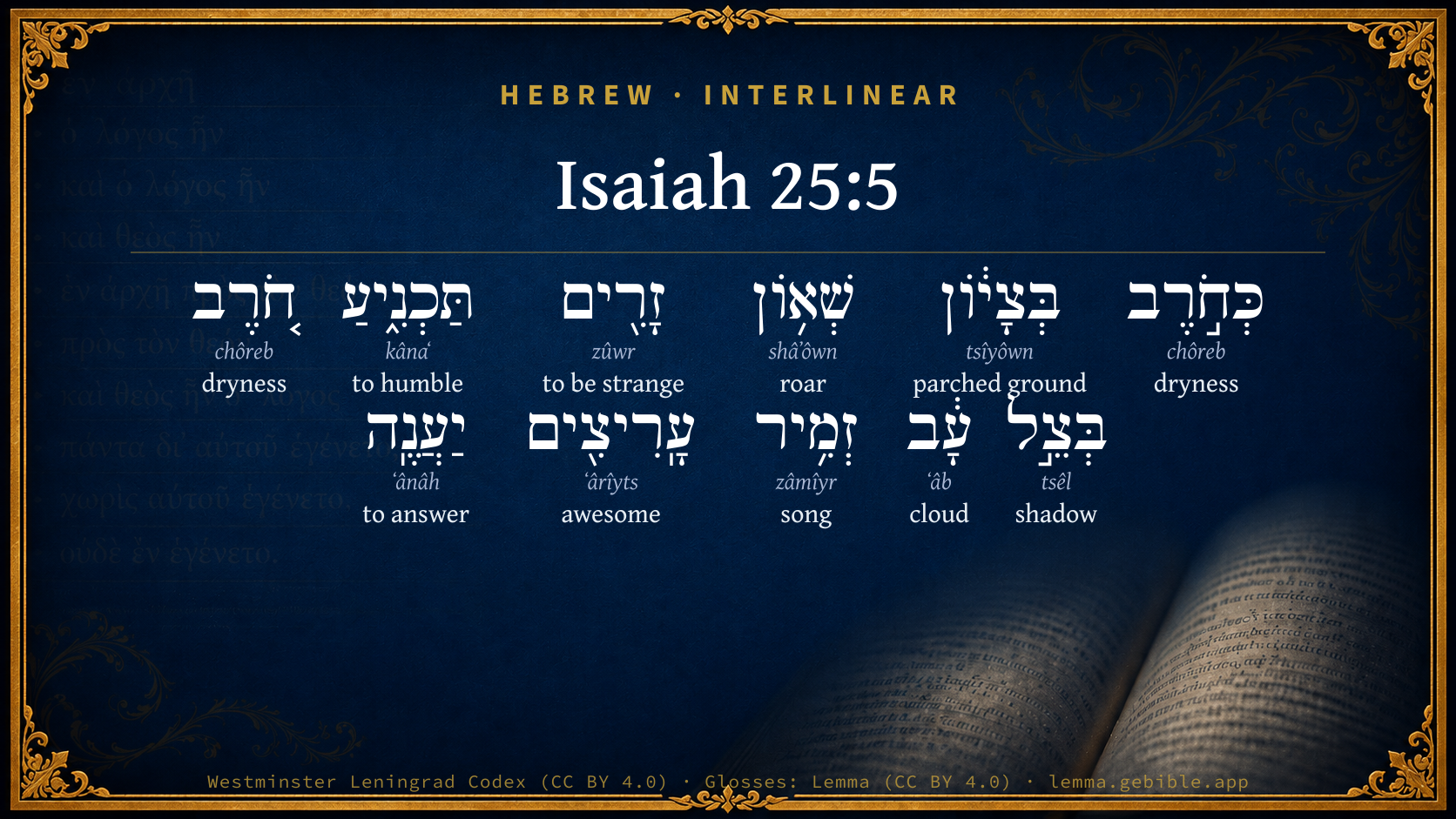
Hebrew (Westminster Leningrad Codex) Isaiah 25:5 appears in the Hebrew Old Testament. The text above is from the Westminster Leningrad Codex. Each word links to its Strong’s number, a concise gloss, and parsing drawn from the Open Scriptures Hebrew Bible morphology. Click any word for its full Brown-Driver-Briggs (BDB) entry.
Download image
Cite this verse

Isaiah 25:5 (World English Bible). Public Domain. Lemma interlinear Bible study tool, https://lemma.gebible.app/v/isaiah/25/5.

Show BibTeX & RIS
BibTeX
RIS
English Translation
As the heat in a dry place will you bring down the noise of strangers; as the heat by the shade of a cloud, the song of the awesome ones shall be brought low.
World English Bible · Public Domain
Highlights Full analysis ↓
Download a study sheet

One document with this verse’s original text, its word-by-word gloss line, the meaning frame, cross-references with their text, attributed commentary, and full source and license credits — printable, and it pastes into notes with its structure intact.

This verse Autodidact and up

Study sheet (.html) Plain text (.txt)

A passage Seminary Student

Up to 50 verses in one chapter. A passage sheet keeps up to 6 commentary sources and 12 cross-references per verse, in the order this page ranks them, and says so on the sheet whenever that leaves anything out. Ask for a single verse and you get the Autodidact verse sheet above.

Everything on this page stays free to read, with no account — the sheet is a download of what is already on screen, not access to it.

Want to remove ads? Support Godless Engineer
Compare translations 3

The same verse in 3 English versions, stacked beneath the original-language interlinear above. Click any original word for its lexicon entry.

Each is an independent rendering of the whole verse — the interlinear is not word-aligned to these translations.

Highlighted words mark where these versions differ — a whole-verse word diff, not a word-by-word alignment.

  • World English Bible Public Domain
    As the heat in a dry place will you bring down the noise of strangers; as the heat by the shade of a cloud, the song of the awesome ones shall be brought low.
  • King James Version Public Domain
    Thou shalt bring down the noise of strangers, as the heat in a dry place; even the heat with the shadow of a cloud: the branch of the terrible ones shall be brought low.
  • unfoldingWord Literal Text CC BY-SA 4.0
    like heat in a dry place. You will subdue the uproar of foreigners heat by the shadow of a cloud. He silences the song of the terrible. q1

unfoldingWord Literal Text — © unfoldingWord, licensed CC BY-SA 4.0. Word-aligned USFM3 via Door43 (git.door43.org/unfoldingWord/en_ult).

Versions to compare (up to 4)

3 of 4 selected

Show all 17 translations

Every available English version of this verse, each an independent rendering of the whole verse.

  • World English Bible Public Domain
    As the heat in a dry place will you bring down the noise of strangers; as the heat by the shade of a cloud, the song of the awesome ones shall be brought low.
  • Berean Standard Bible Public Domain
    like heat in a dry land. You subdue the uproar of foreigners. As the shade of a cloud cools the heat, so the song of the ruthless is silenced.
  • Majority Standard Bible Public Domain
    like heat in a dry land. You subdue the uproar of foreigners. As the shade of a cloud cools the heat, so the song of the ruthless is silenced.
  • King James Version Public Domain
    Thou shalt bring down the noise of strangers, as the heat in a dry place; even the heat with the shadow of a cloud: the branch of the terrible ones shall be brought low.
  • American Standard Version (1901) Public Domain
    As the heat in a dry place wilt thou bring down the noise of strangers; as the heat by the shade of a cloud, the song of the terrible ones shall be brought low.
  • Revised Version (1885) Public Domain
    As the heat in a dry place shalt thou bring down the noise of strangers; as the heat by the shadow of a cloud, the song of the terrible ones shall be brought low.
  • Geneva Bible (1599) Public Domain
    Thou shalt bring downe the noyse of the strangers, as the heate in a drie place: he wil bring downe the song of the mightie, as the heate in the shadowe of a cloude.
  • Young's Literal Translation Public Domain
    As heat in a dry place, The noise of strangers Thou humblest, Heat with the shadow of a thick cloud, The singing of the terrible is humbled.
  • Literal Standard Version CC BY-SA 4.0
    As heat in a dry place, || You humble the noise of strangers, || [As] heat with the shadow of a thick cloud, || The singing of the terrible is humbled.
  • Unlocked Literal Bible CC BY-SA 4.0
    and like heat in a dry land, you subdued the noise of foreigners, as the heat is subdued by the shade of a cloud, so the song of the ruthless ones is answered.
  • unfoldingWord Literal Text CC BY-SA 4.0
    like heat in a dry place. You will subdue the uproar of foreigners heat by the shadow of a cloud. He silences the song of the terrible. q1
  • Darby Bible Public Domain
    Thou hast subdued the tumult of strangers, as the heat in a dry place; [as] the heat, by the shadow of a cloud, [so] the song of the terrible ones is brought low.
  • World Messianic Bible Public Domain
    As the heat in a dry place you will bring down the noise of strangers; as the heat by the shade of a cloud, the song of the dreaded ones will be brought low.
  • Webster's Bible Public Domain
    Thou wilt bring down the noise of strangers, as the heat in a dry place; even the heat with the shade of a cloud: the branch of the terrible ones shall be brought low.
  • Free Bible Version CC BY-SA 4.0
    like heat in a desert. You end the noisy uprising of foreigners. In the same way that a cloud's shadow cools down the heat of the day, so the song sung by brutal people is silenced.
  • Bible in Basic English Public Domain
    As heat by the shade of a cloud, the noise of the men of pride has been made quiet by you; as heat by the shade of a cloud, the song of the cruel ones has been stopped.
  • JPS Tanakh (1917) Public Domain
    As the heat in a dry place, Thou didst subdue the noise of strangers; as the heat by the shadow of a cloud, the song of the terrible ones was brought low.

Literal Standard Version (2020), Covenant Press — licensed CC BY-SA 4.0. Text via the HelloAO Bible API (eBible.org). Unlocked Literal Bible (unfoldingWord) — licensed CC BY-SA 4.0. Text via the HelloAO Bible API (eBible.org). unfoldingWord Literal Text — © unfoldingWord, licensed CC BY-SA 4.0. Word-aligned USFM3 via Door43 (git.door43.org/unfoldingWord/en_ult). Free Bible Version, Dr. Jonathan Gallagher — licensed CC BY-SA 4.0. Text via the HelloAO Bible API (eBible.org).

Word by word

More ways to search: Search by grammar → Find every occurrence → Compare this word →

Practice this passage: Drill this verse → Learn its vocabulary →

בְּצָי֔וֹן
tsîyôwn
H6724
“in/at · parched ground”
Preposition + Noun, Common, Masculine, Singular, Absolute
Part of Speech
Preposition + Noun
Type
Common
Gender
Masculine
Number
Singular
State
Absolute
Full BDB Definition

Origin: from the same as H6723

TWOT: 1909b

dryness, parched land or ground
  1. כְּחֹ֣רֶב chôreb H2721 “like/as · dryness” Preposition + Noun, Common, Masculine, Singular, Absolute
  2. שְׁא֥וֹן shâʼôwn H7588 “roar of” Noun, Common, Masculine, Singular, Construct
  3. זָרִ֖ים zûwr H2114 “strange” Adjective, Adjective, Masculine, Plural, Absolute
  4. תַּכְנִ֑יעַ kânaʻ H3665 “to humble” Verb, Hiphil, Imperfect, 2nd Person, Masculine, Singular
  5. חֹ֚רֶב chôreb H2721 “dryness” Noun, Common, Masculine, Singular, Absolute
  6. בְּצֵ֣ל tsêl H6738 “in/at · shadow of” Preposition + Noun, Common, Masculine, Singular, Construct
  7. עָ֔ב ʻâb H5645 “cloud” Noun, Common, Both, Singular, Absolute
  8. זְמִ֥יר zâmîyr H2158 “song of” Noun, Common, Masculine, Singular, Construct
  9. עָֽרִיצִ֖ים ʻârîyts H6184 “awesome” Adjective, Adjective, Masculine, Plural, Absolute
  10. יַעֲנֶֽה ʻânâh H6030 “to answer” Verb, Qal, Imperfect, 3rd Person, Masculine, Singular

About this verse

These counts appear in no published source. They are computed here, from the morphology-tagged text and Lemma’s own curated glosses. What Lemma adds →

11
words
10
distinct lemmas
Prophets
section

Notable vocabulary

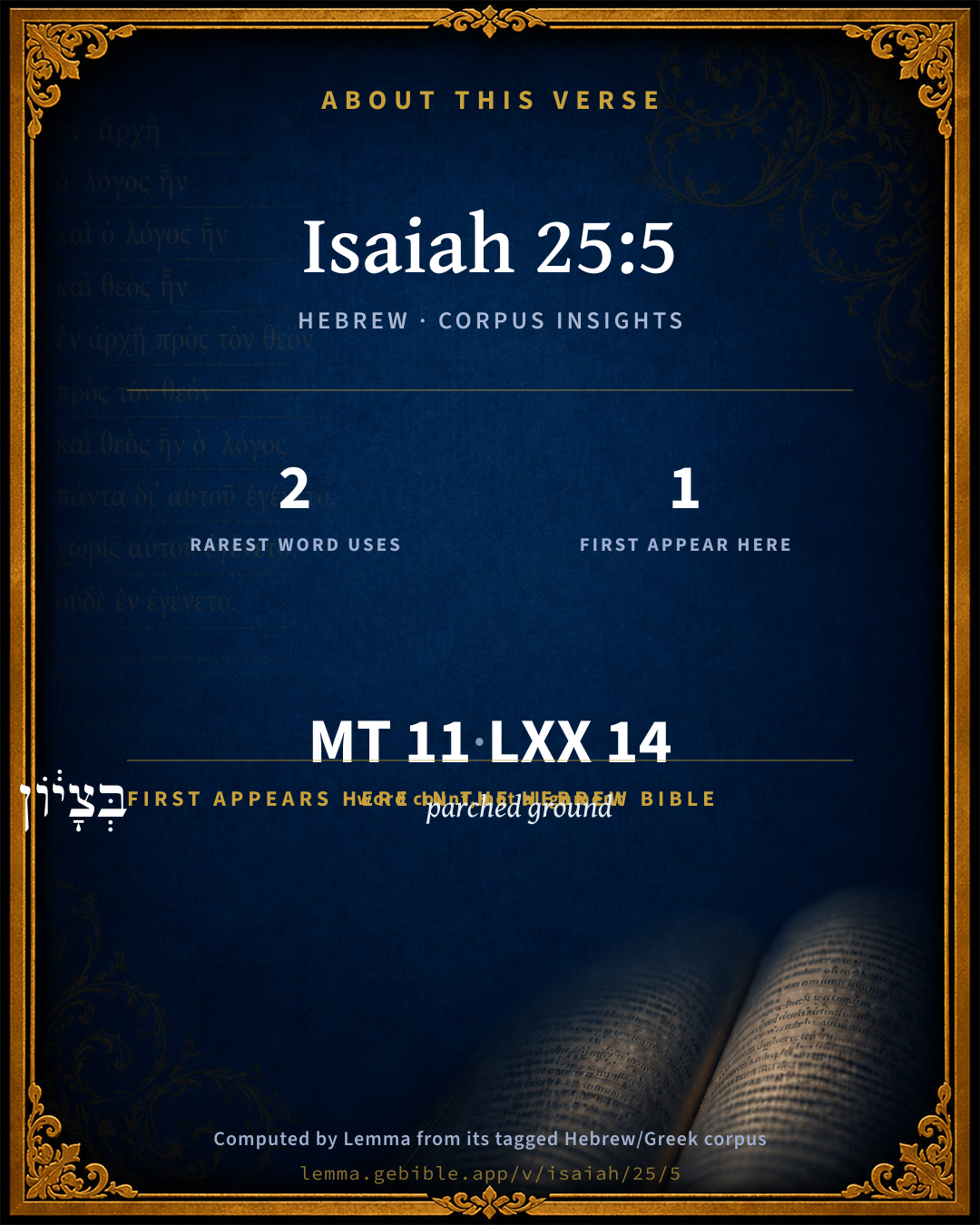
The rarest word here is בְּצָי֔וֹן parched ground H6724 — appearing just 2 times in the whole Hebrew Bible.

First appearance in Scripture

This word makes its first canonical appearance in the Hebrew Bible here:

  • בְּצָי֔וֹן parched ground H6724

Shared distinctive vocabulary

בְּצָי֔וֹן parched ground H6724 occurs in 2 verses of the Hebrew Bible. Also found in:

Grammatical profile

  • 2 verbs
  • 7 nouns
  • 2 adjectives

Verb forms

  • תַּכְנִ֑יעַ Hiphil · Imperfect
  • יַעֲנֶֽה Qal · Imperfect

Repetition

A word recurs within this verse — often emphatic in Hebrew:

  • כְּחֹ֣רֶב dryness H2721 ×2

Hebrew & Septuagint length

In English translation the verse runs 34 words from the Hebrew and 19 from the Septuagint (LXX English) — the Septuagint runs noticeably shorter here. See the side-by-side →

A rough comparison of the two English renderings, which tokenize alike — not a word-level alignment.

Word counts can differ between the Hebrew and the Greek without any difference in meaning — e.g. the Hebrew direct-object marker אֵת has no separate Greek word, and Greek often adds the article ὁ.

In the original languages it is 11 Hebrew tokens and 14 Greek tokens — but the two are counted differently (Hebrew bundles its prefixes and suffixes into one token; the Greek is in lemma form), so that isn’t a like-for-like length.

Cross-references

26

Topical passages linked to Isaiah 25:5 in the Treasury of Scripture Knowledge — connected by theme and wording, ordered by reader-vote popularity; previews shown in the World English Bible.

  • Job 8:16–19 He is green before the sun, His shoots go forth over his garden.
  • Psalms 74:3–23 Lift up your feet to the perpetual ruins, All the evil that the enemy has done in the sanctuary.
  • Psalms 79:10–12 Why should the nations say, "Where is their God?" Let it be known among the nations, before our eyes, That vengeance for your servants' blood is being poured out.
  • Psalms 105:39 He spread a cloud for a covering, Fire to give light in the night.
  • Isaiah 10:8–15 For he says, Aren't my princes all of them kings?
  • Isaiah 10:32–34 This very day shall he halt at Nob: he shakes his hand at the mountain of the daughter of Zion, the hill of Jerusalem.
  • Isaiah 13:11 I will punish the world for [their] evil, and the wicked for their iniquity: and I will cause the arrogance of the proud to cease, and will lay low the haughtiness of the terrible.
  • Isaiah 14:10–16 All they shall answer and tell you, Are you also become weak as we? are you become like us?
  • Isaiah 14:19 But you are cast forth away from your tomb like an abominable branch, clothed with the slain, who are thrust through with the sword, who go down to the stones of the pit; as a dead body trodden under foot.
  • Isaiah 17:12–14 Ah, the uproar of many peoples, who roar like the roaring of the seas; and the rushing of nations, that rush like the rushing of mighty waters!
  • Isaiah 18:4 For thus has Yahweh said to me, I will be still, and I will see in my dwelling-place, like clear heat in sunshine, like a cloud of dew in the heat of harvest.
  • Isaiah 30:30–33 Yahweh will cause his glorious voice to be heard, and will show the lighting down of his arm, with the indignation of [his] anger, and the flame of a devouring fire, with a blast, and tempest, and hailstones.
  • Isaiah 49:10 They shall not hunger nor thirst; neither shall the heat nor sun strike them: for he who has mercy on them will lead them, even by springs of water will he guide them.
  • Isaiah 49:25–26 But thus says Yahweh, Even the captives of the mighty shall be taken away, and the prey of the terrible shall be delivered; for I will contend with him who contends with you, and I will save your children.
  • Isaiah 54:15–17 Behold, they may gather together, but not by me: whoever shall gather together against you shall fall because of you.
  • Isaiah 64:1–2 Oh that you would tear the heavens, that you would come down, that the mountains might quake at your presence,
  • Jeremiah 50:11–15 Because you are glad, because you rejoice, O you who plunder my heritage, because you are wanton as a heifer that treads out [the grain], and neigh as strong horses;
  • Jeremiah 51:38–43 They shall roar together like young lions; they shall growl as lions' cubs.
  • Jeremiah 51:53–57 Though Babylon should mount up to the sky, and though she should fortify the height of her strength, yet from me shall destroyers come to her, says Yahweh.
  • Ezekiel 32:18–32 Son of man, wail for the multitude of Egypt, and cast them down, even her, and the daughters of the famous nations, to the lower parts of the earth, with those who go down into the pit.
  • Ezekiel 38:9–39:10 You shall ascend, you shall come like a storm, you shall be like a cloud to cover the land, you, and all your hordes, and many peoples with you.
  • Daniel 7:23–27 Thus he said, The fourth animal shall be a fourth kingdom on earth, which shall be diverse from all the kingdoms, and shall devour the whole earth, and shall tread it down, and break it in pieces.
  • Daniel 11:36–45 The king shall do according to his will; and he shall exalt himself, and magnify himself above every god, and shall speak marvelous things against the God of gods; and he shall prosper until the indignation be accomplished; for that which is determined shall be done.
  • Revelation 16:1–19 I heard a loud voice out of the temple, saying to the seven angels, "Go and pour out the seven bowls of the wrath of God on the earth!"
  • Revelation 20:8–9 and he will come out to deceive the nations which are in the four corners of the earth, Gog and Magog, to gather them together to the war; the number of whom is as the sand of the sea.
  • Jonah 4:5–6 Then Jonah went out of the city, and sat on the east side of the city, and there made himself a booth, and sat under it in the shade, until he might see what would become of the city.

Cross-references courtesy of OpenBible.info (CC BY 4.0).

Hebrew and Greek witnesses Masoretic Hebrew ↔ Greek Septuagint

The same verse in the two great witnesses to the Old Testament, shown verse-for-verse.

Here the Septuagint runs noticeably shorter than the Hebrew — LXX2012 (modern English Septuagint) 19 words vs World English Bible 34. A rough length comparison of the two English translations, not a word-level alignment — read both below.

These are two independent witnesses, not word-aligned to each other, and the Septuagint is shown in lemma (dictionary) form.

Hebrew Isaiah 25:5 Masoretic · Westminster Leningrad Codex

כְּחֹ֣רֶב בְּצָי֔וֹן שְׁא֥וֹן זָרִ֖ים תַּכְנִ֑יעַ חֹ֚רֶב בְּצֵ֣ל עָ֔ב זְמִ֥יר עָֽרִיצִ֖ים יַעֲנֶֽה

As the heat in a dry place will you bring down the noise of strangers; as the heat by the shade of a cloud, the song of the awesome ones shall be brought low.

World English Bible · Public Domain

Greek LXX Isaiah 25:5 Septuagint · lemma form

εὐλογέω σύ ὡς ἄνθρωπος ὀλιγόψυχος διψάω ἐν σιων ἀπό ἄνθρωπος ἀσεβής ὅς ἐγώ παραδίδωμι

We were as faint-hearted men thirsting in Sion, by reason of ungodly men to whom you did deliver us.

LXX2012 (modern English Septuagint) · Public Domain

On this verse, Ellicott's Commentary for English Readers discusses the Septuagint’s reading. Read the note in Commentary ↓

Hebrew: Westminster Leningrad Codex (CC BY 4.0). Greek: Septuagint (public domain); English from LXX2012 (modern English Septuagint) (Public Domain). How the Septuagint differs from the Hebrew →

Targum (Aramaic paraphrase)

1

The Targum is the ancient Jewish Aramaic paraphrase of the Hebrew Scriptures — an interpretive translation, not the Hebrew text itself. Onkelos (literal) and Pseudo-Jonathan (expansive) render the Torah, and Jonathan the Prophets. Coverage is partial: where no permissively-licensed English translation exists for a verse, only the Aramaic is shown. This is verse-level text, not a word-by-word alignment to the Hebrew.

  1. Targum Jonathan Prophets (Joshua–Malachi)
    כִּשְׁרָב בְּאַרְעָא צַחְיָא אִתְרְגוּשַׁת תַּקִיפִין תְּמָאֵיךְ בִּטְלַל כֵּיף מַקַר בְּאַרְעָא מְשַׁלְחַיָא כֵן נְיַח רְוָחָא לְצַדִיקַיָא כַּד יִמְאֲכוּן רַשִׁיעַיָא:

    As the scorching heat in a dry land thou shalt bring low the tumult of the mighty: as the shade of a cooling rock in a parched land, thus peace of mind shall be to the righteous, when the wicked shall be humbled.

    Targum Jonathan — Aramaic: “Mikraot Gedolot” (public domain). English: “Sefaria Community Translation” (CC0 1.0 (public-domain dedication)); “London "Chaldee Paraphrase," 1871” (public domain). Text via Sefaria.

Commentary

Notes on Isaiah 25:5 from classic Christian and Jewish commentators (each source and its license shown beneath its notes). The classic Christian expositions comment on the surrounding passage and are grouped to its opening verse, so a note may address several verses; the Jewish commentaries on the Tanakh (Rashi and others) are per-verse, so they appear only where the commentator wrote on this verse.

Lemma curates 59 commentaries, every one of them public domain or Creative Commons licensed, each selected and text-cleaned for this edition rather than reprinted as found. About our sources →

Trapp's Complete Commentary

John Trapp

Isa 25:5 Thou shalt bring down the noise of strangers, as the heat in a dry place; [even] the heat with the shadow of a cloud: the branch of the terrible ones shall be brought low.

Ver. 5. As the heat in a dry place.] Where the insolonce of these strangers from the life of God, the Antichristian rabble, the stir and ado they make, is resembled to a heat and drought that doth parch and scorch the godly; God’s protection of his to a thick shadow.

The branch of the terrible ones shall be brought low.] Some read the text thus: As the heat is abated with a thick shadow, so the song or chanting of the terrible ones was abased. Others the whole verse thus: As the heat in a drought, thou hast brought down the stir of the strangers; heat, I say, with the shadow of a cloud; which (heat) did answer (a life) to the branches of the terrible ones. That is, say they, served well their turn, and was most commodious for the wicked, who think their branches spread and flourish when the godly are scorched with calamities.

John Trapp, A Commentary or Exposition upon All the Books of the Old and New Testament (1647–1656) — public domain. Text from a community e-Sword module.

Joseph Benson's Commentary

Isa 25:5. Thou shall bring down the wise of strangers — The tumultuous noise, as the word properly signifies; the rage and furious attempts of those heathen nations that fought against God’s people. As the heat in a dry place — With as much ease as thou dost allay the heat of a dry place, by the shadow of thy clouds, or by the rain which falls from black and shadowy clouds. Here again, as in Isa 25:2, instead of strangers, Bishop Lowth reads, the proud. The branch of the terrible ones — Their arm or power, as a branch is the arm of a tree; shall be brought low — Shall be humbled and broken.

Joseph Benson's Commentary on the Old and New Testaments (1811–1818) — public domain. Text from a community e-Sword module.

Geneva Bible (1599)

Geneva Bible translators

As a cloud shadoweth from the heat of the sun, so shall God assuage the rejoicing of the wicked against the godly.

Meaning, that as the heat is abated by the rain, so shall God bring down the rage of the wicked.

Geneva Bible (1599) marginal notes — public domain. Text via Bolls.life.

Jamieson, Fausset & Brown

Robert Jamieson, A. R. Fausset & David Brown

Translate, "As the heat in a dry land (is brought down by the shadow of a cloud, so) thou shalt bring down the tumult (the shout of triumph over their enemies) of strangers (foreigners); and as the heat by the shadow of the cloud (is brought low), so the branch (the offspring) of the terrible ones shall be brought low." PARKHURST translates the Hebrew for "branch," the exulting song. JEROME translates the last clause, "And as when the heat burns under a cloud, thou shalt make the branch of the terrible ones to wither"; the branch withering even under the friendly shade of a cloud typifies the wicked brought to ruin, not for want of natural means of prosperity, but by the immediate act of God.

Jamieson, Fausset & Brown — Commentary Critical and Explanatory on the Whole Bible (1871) — public domain (CC PDM 1.0). Text via the HelloAO Bible API.

Adam Clarke's Commentary

Verse 5. Of strangers - "Of the proud"] The same mistake here as in Isa 25:2: see the note there. See Clarke on Isa 25:2. Here זדים zedim, the proud, is parallel to עריצים aritsim, the formidable: as in Ps 54:5, and Ps 86:14.

The heat with the shadow of a cloud - "As the heat by a thick cloud"] For חרב choreb, the Syriac, Chaldee, Vulgate, and two MSS. read כחרב kechoreb, which is a repetition of the beginning of the foregoing parallel line; and the verse taken out of the parallel form, and more fully expressed, would run thus: "As a thick cloud interposing tempers the heat of the sun on the burnt soil; so shalt thou, by the interposition of thy power, bring low and abate the tumult of the proud, and the triumph of the formidable."

Adam Clarke's Commentary on the Bible (1810–1826) — public domain. Text from a community e-Sword/MySword module.

Ellicott's Commentary for English Readers

(5) Thou shalt bring down the noise of strangers . . .—The thought of Isa_25:4 is reproduced with a variation of imagery, the scorching “heat” in a “dry” (or parched) “land.” This is deprived of its power to harm, by the presence of Jehovah, as the welcome shadow of a cloud hides the sun’s intolerable blaze. (Comp. Isa_32:2.) It is noticeable that the LXX. in both passages gives “Sion” for “dry place” (Heb. tsayôn), perhaps following a various reading, perhaps interpreting.

The branch of the terrible ones . . .—Better, the song. The Hebrew noun is a rare one, but is found in this sense in Song Son_2:12. The triumph song of the dread oppressors is thought of as blighting the world like a spell of evil; but this also is to be brought low, and hushed in silence.

A Bible Commentary for English Readers, edited by Charles John Ellicott (1878–1897) — public domain. Text from a community e-Sword module.

The Cambridge Bible for Schools and Colleges

gen. ed. J. J. S. Perowne

5. Render: As heat in a dry place (cf. Isa_32:2) Thou humblest the pride of aliens; (as) heat by the shadow of a cloud the song of the tyrants is brought low. The meaning is that as natural heat, however intense, is abated by an intervening cloud, so Jehovah has means of bringing to an end the fiercest oppression to which His people can be exposed.

The Cambridge Bible for Schools and Colleges (gen. ed. J. J. S. Perowne; Cambridge University Press, 1878–1918) — public domain. Text from a community e-Sword module.

John Gill's Exposition

Thou shalt bring down the noise of strangers,.... Such as are strangers to God and godliness, to Christ, his Gospel, and truths, to the Spirit and his operations of grace; the clamour and noise of such against true religion, and the professors of it, their persecuting rage and fury, this the Lord in his own time will bring down, and cause to cease, and it shall be heard no more:

as the heat in a dry place: which parches the earth, and burns and dries up the grass and fruits of it; to which persecution is compared:

even the heat with the shadow of a cloud; as that is brought down, and caused to cease by the shadow of a cloud, sheltering from the scorching beams of the sun, and by letting down rain, which moistens the earth; so the Lord protects his people from the fury of persecution, and abates it by the interposition of his power and providence; and at last puts an end to it:

the branch of the terrible ones shall be made low; meaning the most eminent of them; a branch being put for a most eminent person, Isa 4:2 perhaps the pope of Rome is meant, the head of the antichristian party, the principal of the terrible persecutors, who shall be brought low and destroyed by Christ, at his coming. Some render it, "the song of the terrible ones shall be brought low" (d); it will be brought a note lower; their triumphing will be at an end; the voice of harpers and musicians, of pipers and trumpeters, will be heard no more among them; but instead thereof weeping and howling, Rev 18:9.

(d) "cantus fortium humiliabitur, vel humiliabit se", Vatablus; see Cant. ii. 12.

John Gill's Exposition of the Whole Bible (1746–1763) — public domain (CC PDM 1.0). Text via the HelloAO Bible API.

Albert Barnes' Notes on the Bible

Thou shalt bring down the noise - The tumult; the sound which they make in entering into battle; or the note of triumph, and the sound of revelry. The phrase may refer either to their shout of exultation over their vanquished foes; or to the usual sound of revelry; or to the hum of business in a vast city.

Of strangers - Of foreigners (see the note at Isa 25:2).

As the heat in a dry place - The parallelism here requires that we should suppose the phrase ‘with the shadow of a cloud’ to be supplied in this hemistich, as it is obscurely expressed in our translation by the word ‘even,’ and it would then read thus:

As the beat in a dry place (by the shadow of a cloud),

The noise of the strangers shalt thou humble;

As the heat by the shadow of a cloud,

The exultation of the formidable ones shalt thou bring low.

The idea thus is plain. Heat pours down intensely on the earth, and if unabated would wither up every green thing, and dry up every stream and fountain. But a cloud intervenes, and checks the burning rays of the sun. So the wrath of the ‘terrible ones,’ the anger of the Babylonians, raged against the Jews. But the mercy of God interposed. It was like the intervening of a cloud to shut out the burning rays of the sun. It stayed the fury of their wrath, “and rendered them impotent to do injury, just as the intense burning rays of the sun are completely checked by an interposing cloud.

The branch of the terrible ones - This is a very unhappy translation. The word זמיר zâmiyr is indeed used to denote a branch, or bough, as derived from זמר zâmar, “to prune a vine;” but it also has the I sense of “a song;” a song of praise, or a song of exultation, from a second signification of זמר zâmar, “to sing; perhaps” from the song with which the work of the vineyard was usually accompanied. See the verb used in this sense in Jdg 5:3; Psa 9:12; Psa 30:5; Psa 47:7; and the word which occurs here (zamir) used in the sense of a song in Psa 119:54; 2Sa 23:1; Job 35:10. Here it is undoubtedly used in the sense of a song, meaning either a shout of victory or of revelry; and the idea of the prophet is, that this would be brought low by the destruction of Babylon, and by the return of the captive Jews to their own land.

Albert Barnes' Notes on the Bible (1834–1885) — public domain. Text from a community e-Sword/MySword module.

Haydock's Catholic Bible Commentary

Away. Cyrus (Calmet) shall reduce Babylon the great. (Haydock)

George Leo Haydock (1774–1849), Haydock's Catholic Family Bible and Commentary, 1859 edition — public domain. Excludes Psalms (Douay-Rheims chapter numbering differs from Protestant) and Deuterocanonical books (Catholic canon only).

Matthew Poole's English Annotations

The noise; the tumultuous noise, as the word properly signifies, which he called their blast in the foregoing verse; by which he means their rage and furious attempts, which are commonly managed with much noise and clamour.

Of strangers; of those strange and heathen nations that fought against God’s people.

Even the heat with the shadow of a cloud; with as much ease as thou dost in the course of thy common providence allay the heat of a dry season and place, either by the shadow of thy clouds, or by the rain which falleth from black and shadowy clouds.

The branch; the arm or power, as a branch is the arm of a tree. Or, the prince or commanders; for the word branch is sometimes put for a person of eminent place and power, as Psa 80:15; Isa 4:2; Zec 3:8; 6:12. But others render the word, the song, as it is used, Son 2:12, their jovial and triumphant song.

Matthew Poole's English Annotations on the Holy Bible (1683–1685) — public domain. Text from a community e-Sword/MySword module.

Whedon's Commentary on the Bible

Daniel D. Whedon

5. Noise of strangers — The roar of a battle engagement. The “strangers” are the hostile ones, probably Chaldeans, the same as the “terrible ones.” The branch, etc., should read the song (strange, it was rendered “branch”) of the terrible ones — their triumphal song of the battle. The parallelism here is peculiarly inverted and difficult. We may properly read it thus: “As heat with natural stillness comes down into a dry place, so shalt thou, Jehovah, bring down, or make more quiet, the battle roar; as heat is lessened by an overshadowing cloud, so wilt thou lessen the boasting song of victory.”

Daniel D. Whedon (gen. ed.), Commentary on the Old and New Testaments (1874–1909) — public domain. Text from a community e-Sword module.

The Pulpit Commentary

Thou shalt bring down. The past foreshadows the future. What God had done in "bringing down" the enemies of his saints, he would do again and again. He could as easily bring to naught the clamorous uprising of heathen nations (strangers) against his people, as temper the sun"s heat by the interposition of a thick cloud. The branch; rather, the song. (comp. Isa_24:16 Job_35:10 Psa_95:2 Psa_119:51) The exultant chant of triumph which the ungodly are sure to raise as they deem their victory over the people of God complete, will be stopped in mid-career, and "brought low," or reduced to silence, by the crushing overthrow predicted in Isaiah 24.

The Pulpit Commentary (1880–1919), ed. H.D.M. Spence-Jones & Joseph S. Exell — public domain. Text from a community e-Sword module.

John Wesley's Explanatory Notes

The noise - The tumultuous noise, as the word properly signifies; the rage and furious attempts of those Heathen nations that fought against God's people. As the heat - With as much ease as thou dost allay the heat of a dry place, by the shadow of thy clouds, or by the rain which falls from black and shadowy clouds. The branch - The arm or power, as a branch is the arm of a tree.

John Wesley, Explanatory Notes Upon the Whole Bible (1754–1765) — public domain. Text via the GEBible commentary corpus.

J. A. Alexander on Isaiah

Joseph Addison Alexander

“As the heat in a drought (or in a dry place), the noise of strangers wilt Thou bring down; (as) heat by the shadow of a cloud, (so) shall the song of the tyrants be brought low.” The sufferings of Israel under oppression shall be mitigated and relieved as easily and quietly as the intense heat of the sun by an intervening cloud. The noise mentioned in the first clause is probably the tumult of battle and conquest, and the song in the last clause the triumphal song of the victorious enemy. The meaning branch is more agreeable to usage, but not so appropriate in this connection.

Joseph Addison Alexander, The Prophecies of Isaiah (1846–1847; New York: Scribner, 1870–1878) — public domain. Text from a community e-Sword module.

Rashi

Rabbi Shlomo Yitzchaki (Rashi)

Like heat in the dry season In the dry season, when the seeds dry out to be cut off, so shall You humble the multitude of the strangers.

like heat with a thick cloud When the heavens thicken with thick clouds in the hot season, with which everyone rejoices, so will the song of the righteous be sung concerning the cutting down of the tyrants and their downfall.

the downfall of (lit., the cutting down of. זְמִיר). An expression related to (Lev. 25:4): “You shall not prune (תִזְמֹר).”

Rashi on the Tanakh — English translations: “The Judaica Press complete Tanach with Rashi, translated by A. J. Rosenberg” (CC BY 4.0); “Pentateuch with Rashi's commentary by M. Rosenbaum and A.M. Silbermann, 1929-1934” (public domain); “The Metsudah Tanach series, Lakewood, N.J” (CC BY 4.0); and “The Book of Joshua, Metsudah Publications, 1997” (CC BY 4.0). Text via Sefaria.

Ibn Ezra

Rabbi Abraham ibn Ezra

בציון In a dry place. Comp. בארץ ציה in a dry land (Jer. 2:6).

חורב בצל עב ונו׳ The heat in the shadow of a cloud, etc. Repetition of the same idea.

בצל עב In the shadow of a cloud, that is, in the shadow which hides the clouds and makes them invisible.

זמיר עריצים The song of the terrible ones. It is the same as שאון זרים; comp. זמירות songs (24:16).

יענה Shall be low. It is an intransitive verb of the same root as עני poor (Deut. 24:12); לענות to be humbled (Ex. 10:3)

Ibn Ezra on the Tanakh — English translations: “Sefaria Community Translation” (CC0 1.0 (public-domain dedication)); “Yalkut, Sifsei Chachomim Chumash, Metsudah Publications, 2009” (CC BY 4.0); and “Commentary of Ibn Ezra on Isaiah - trans. by M. Friedlander, 1873” (public domain). Text via Sefaria.

Lesson kit

Teaching starters — assembled from the data on this page, not authored interpretation. Every prompt links to the verse data it draws on. Edit before teaching.

Isaiah, in the Prophets, opens this verse with 11 words (10 distinct Hebrew lemmas). Its most distinctive word is tsîyôwn (“parched ground”). The Greek Septuagint runs shorter here. A historical commentator’s framing appears above. Read the whole chapter for the surrounding context.

Discussion questions

  1. The word tsîyôwn carries the sense “parched ground.” How does it shape the verse?
  2. This is the first place “parched ground” appears in Scripture (first appears here). What does its debut here establish?
  3. How does Isaiah 32:2, which shares the word «parched ground», read alongside this verse?
  4. What does the repetition of “dryness” (2× in this one verse) do in this verse?
  5. The Septuagint runs shorter here than the Hebrew. What might account for the difference?
  6. The translations on this page render this verse differently — a whole-verse word diff, not a word-by-word alignment. What might account for the different wordings?
  7. «תַּכְנִ֑יעַ» is a Hiphil Imperfect verb. How does that grammatical form shape the action described?
  8. Compare how Trapp's Complete Commentary and Joseph Benson's Commentary read this verse. Where do they agree or differ?

Things to notice

Reading settings

Reading text

Shown beneath each verse's original-language words.

Old Testament
Old Testament edition

Read the OT as the Masoretic Hebrew (MT) or the Greek Septuagint (LXX).

English shown for the Greek Septuagint (in the Hebrew ↔ Greek comparison).

Comparing translations? Open the Compare panel on any verse page to stack up to four side by side.