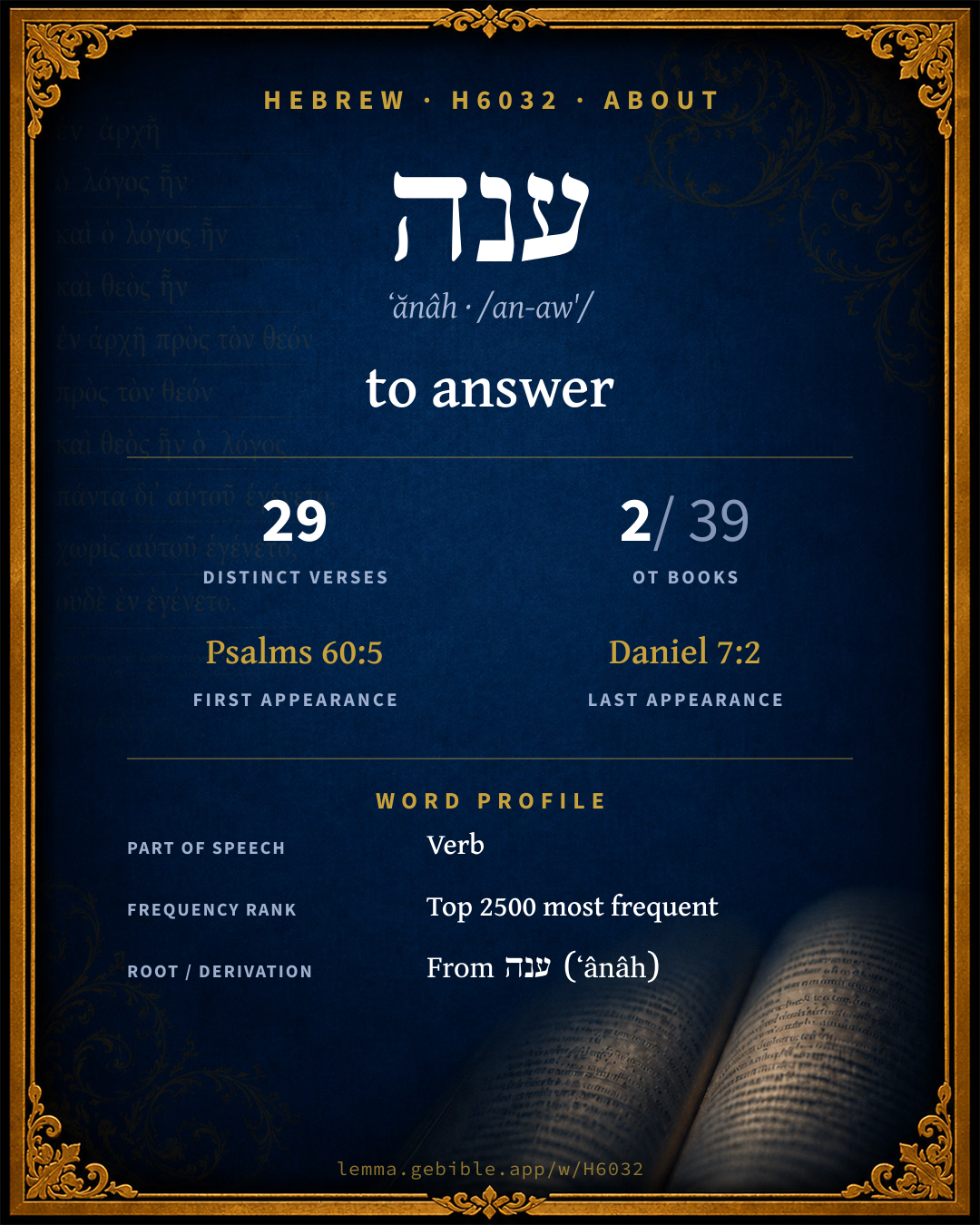
עֲנָה
to answer
‘to answer’ is one of 3 main senses fuller range ↓
Full lexicon entry — Brown-Driver-Briggs (BDB)
From Brown-Driver-Briggs (BDB)
Where this word appears
Grammar key — what these labels mean
Part of speech
- Verb
- An action or state-of-being word.
Stem
- Qal
- The basic, simple active stem — the plain form of the verb (“he wrote”).
Form
- Participle Active
- A verbal adjective expressing ongoing or characteristic action (“writing / one who writes”).
- Perfect
- A completed action or state — Hebrew marks aspect (completeness) more than strict tense (“he wrote”).
- Imperative
- A direct command (“write!”).
State
- Absolute
- The independent form of a noun, not bound to a following word.
Person
- 3rd Person
- The one spoken about (“he / she / it / they”).
- 2nd Person
- The one addressed (“you”).
Gender
- Masculine
- Grammatically masculine.
- Feminine
- Grammatically feminine.
Number
- Singular
- One.
- Plural
- More than one (in Hebrew, generally three or more).
Grammatical forms
- Verb, Qal, Participle Active, Masculine, Singular, Absolute 23 times (72%)
- Verb, Qal, Perfect, 3rd Person, Masculine, Plural 5 times (16%)
- Verb, Qal, Imperative, 2nd Person, Masculine, Singular 2 times (6%)
- Verb, Qal, Perfect, 3rd Person, Feminine, Singular 1 time (3%)
- Verb, Qal, Participle Active, Masculine, Plural, Absolute 1 time (3%)
Parsed forms decoded from the imported morphology (morphhb / Westminster Leningrad Codex — WLC text public domain, morphhb tagging CC BY 4.0), counted across 32 parsed occurrences — not distinct verses.
Every verse where H6032 appears — 29 distinct verses across 2 books. Click any verse to open its interlinear word-by-word view. Verse text shown in the World English Bible for context — . Each verse’s Hebrew form is shown with its reference; the English is not keyword-highlighted, since the data carries no word-level English alignment. Use “Compare translations” on any verse to read it across multiple English versions. This concordance covers the Hebrew Bible; Septuagint (Greek Old Testament) occurrences are not indexed here.
Psalms 1 verse
Daniel 28 verses
- Daniel 2:5 עָנֵ֤ה Qal ptcp.act ms The king answered the Chaldeans, The thing is gone from me: if you don't make known to me the dream and the interpretation of it, you shall be cut in pieces, and your houses shall be made a dunghill.
- Daniel 2:7 עֲנ֥וֹ Qal pf 3mp They answered the second time and said, Let the king tell his servants the dream, and we will show the interpretation.
- Daniel 2:8 עָנֵ֤ה Qal ptcp.act ms The king answered, I know of a certainty that you would gain time, because you see the thing is gone from me.
- Daniel 2:10 עֲנ֨וֹ Qal pf 3mp The Chaldeans answered before the king, and said, There is not a man on the earth who can show the king's matter, because no king, lord, or ruler, has asked such a thing of any magician, or enchanter, or Chaldean.
- Daniel 2:15 עָנֵ֣ה Qal ptcp.act ms he answered Arioch the king's captain, Why is the decree so urgent from the king? Then Arioch made the thing known to Daniel.
- Daniel 2:20 עָנֵ֤ה Qal ptcp.act ms Daniel answered, Blessed be the name of God forever and ever; for wisdom and might are his.
- Daniel 2:26 עָנֵ֤ה Qal ptcp.act ms The king answered Daniel, whose name was Belteshazzar, Are you able to make known to me the dream which I have seen, and the interpretation of it?
- Daniel 2:27 עָנֵ֧ה Qal ptcp.act ms Daniel answered before the king, and said, The secret which the king has demanded can neither wise men, enchanters, magicians, nor soothsayers, show to the king;
- Daniel 2:47 עָנֵה֩ Qal ptcp.act ms The king answered to Daniel, and said, Of a truth your God is the God of gods, and the Lord of kings, and a revealer of secrets, seeing you have been able to reveal this secret.
- Daniel 3:9 עֲנוֹ֙ Qal pf 3mp They answered Nebuchadnezzar the king, O king, live for ever.
- Daniel 3:14 עָנֵ֤ה Qal ptcp.act ms Nebuchadnezzar answered them, Is it on purpose, Shadrach, Meshach, and Abednego, that you don't serve my god, nor worship the golden image which I have set up?
- Daniel 3:16 עֲנ֗וֹ Qal pf 3mp Shadrach, Meshach, and Abednego answered the king, Nebuchadnezzar, we have no need to answer you in this matter.
- Daniel 3:19 עָנֵ֤ה Qal ptcp.act ms Then was Nebuchadnezzar full of fury, and the form of his visage was changed against Shadrach, Meshach, and Abednego: [therefore] he spoke, and commanded that they should heat the furnace seven times more than it was wont to be heated.
- Daniel 3:24 עָנֵ֨ה עָנַ֤יִן Qal ptcp.act ms Qal ptcp.act mp Then Nebuchadnezzar the king was astonished, and rose up in haste: he spoke and said to his counselors, Didn't we cast three men bound into the midst of the fire? They answered the king, True, O king.
- Daniel 3:25 עָנֵ֣ה Qal ptcp.act ms He answered, Look, I see four men loose, walking in the midst of the fire, and they have no hurt; and the aspect of the fourth is like a son of the gods.
- Daniel 3:26 עָנֵ֣ה Qal ptcp.act ms Then Nebuchadnezzar came near to the mouth of the burning fiery furnace: he spoke and said, Shadrach, Meshach, and Abednego, you servants of the Most High God, come forth, and come here. Then Shadrach, Meshach, and Abednego came forth out of the midst of the fire.
- Daniel 3:28 עָנֵ֨ה Qal ptcp.act ms Nebuchadnezzar spoke and said, Blessed be the God of Shadrach, Meshach, and Abednego, who has sent his angel, and delivered his servants who trusted in him, and have changed the king's word, and have yielded their bodies, that they might not serve nor worship any god, except their own God.
- Daniel 4:19 עָנֵ֨ה עָנֵ֤ה Qal ptcp.act ms Qal ptcp.act ms Then Daniel, whose name was Belteshazzar, was stricken mute for a while, and his thoughts troubled him. The king answered, Belteshazzar, don't let the dream, or the interpretation, trouble you. Belteshazzar answered, My lord, the dream be to those who hate you, and the interpretation of it to your adversaries.
- Daniel 4:30 עָנֵ֤ה Qal ptcp.act ms The king spoke and said, Is not this great Babylon, which I have built for the royal dwelling-place, by the might of my power and for the glory of my majesty?
- Daniel 5:7 עָנֵ֨ה Qal ptcp.act ms The king cried aloud to bring in the enchanters, the Chaldeans, and the soothsayers. The king spoke and said to the wise men of Babylon, Whoever shall read this writing, and show me the interpretation of it, shall be clothed with purple, and have a chain of gold about his neck, and shall be the third ruler in the kingdom.
- Daniel 5:10 עֲנָ֨ת Qal pf 3fs [Now] the queen by reason of the words of the king and his lords came into the banquet house: the queen spoke and said, O king, live forever; don't let your thoughts trouble you, nor let your face be changed.
- Daniel 5:13 עָנֵ֨ה Qal ptcp.act ms Then was Daniel brought in before the king. The king spoke and said to Daniel, Are you that Daniel, who are of the children of the captivity of Judah, whom the king my father brought out of Judah?
- Daniel 5:17 עָנֵ֣ה Qal ptcp.act ms Then Daniel answered before the king, Let your gifts be to yourself, and give your rewards to another; nevertheless I will read the writing to the king, and make known to him the interpretation.
- Daniel 6:12 עָנֵ֨ה Qal ptcp.act ms Then they came near, and spoke before the king concerning the king's interdict: Haven't you signed an interdict, that every man who shall make petition to any god or man within thirty days, save to you, O king, shall be cast into the den of lions? The king answered, The thing is true, according to the law of the Medes and Persians, which doesn't alter.
- Daniel 6:13 עֲנ֣וֹ Qal pf 3mp Then answered they and said before the king, That Daniel, who is of the children of the captivity of Judah, doesn't regard you, O king, nor the interdict that you have signed, but makes his petition three times a day.
- Daniel 6:16 עָנֵ֤ה Qal ptcp.act ms Then the king commanded, and they brought Daniel, and cast him into the den of lions. [Now] the king spoke and said to Daniel, Your God whom you serve continually, he will deliver you.
- Daniel 6:20 עָנֵ֨ה Qal ptcp.act ms When he came near to the den to Daniel, he cried with a lamentable voice; the king spoke and said to Daniel, Daniel, servant of the living God, is your God, whom you serve continually, able to deliver you from the lions?
- Daniel 7:2 עָנֵ֤ה Qal ptcp.act ms Daniel spoke and said, I saw in my vision by night, and, behold, the four winds of the sky broke forth on the great sea.
About this entry
At a glance — auto-summarized from this page’s data, not written by a person. Every figure links to its source below. This summary describes the numbers; it doesn’t interpret them.
At its core, ענה (ʻănâh) means “to answer.” The word gravitates to Daniel (97%), then Psalms. It appears 29 verses across 2 books of the Hebrew Bible, among its moderately common vocabulary. Carrying more than one sense, it rewards its full sense range. Where the King James Version says “answered,” newer translations reach for “replied” (Berean Standard Bible); the renderings breakdown has the detail. Each statement above links to its evidence; the full detail follows below.
Gloss history
Strong's 1890 vs modern scholarship
About this word
Strong's H6032 catalogs a Hebrew word from the Hebrew Old Testament.
These counts are not copied from any lexicon or concordance. They are computed here, from the morphology-tagged Hebrew Old Testament. What Lemma adds →
- 29
- distinct verses
- The word appears in 29 distinct verses.
- 2 / 39
- OT books
- The word appears in 2 of 39 Old Testament books.
- #1,086
- by frequency
- Top 2500 most frequent Hebrew words (rank 1,086 of 8,640 Hebrew words by occurrence).
View all 29 occurrences in the concordance →
By traditional corpus
Conventional, traditional groupings — biblical authorship is debated, so this is a traditional corpus grouping, not an authorship claim. Each share is this word’s portion of its verses in that division of the Hebrew canon. Each figure is a share of the word’s 29 distinct verses.
- Writings (Ketuvim) 29 verses · 100%
How translations render this word
Counts come from each version’s own published word-to-Strong’s tagging or interlinear alignment — an approximate guide to how each version renders this word, not a word-level alignment the data otherwise carries. Because each total is that version’s own tagged count, the per-version totals vary from one another and need not match the appearance or distinct-verse counts above. These counts may also differ from a printed concordance because Lemma counts each distinctly tagged rendering and does not collapse phrase taggings into a single head-word total. This is a fixed set of word-tagged versions (KJV, ASV, BSB, ULT) and does not change with the reading translation you choose elsewhere. Each version’s license is shown beside its name below (and on Sources).
- King James Version: Answered 12×, Spake 12×, He answered 2×
- American Standard Version: Answered 12×, Spake 8×, They answered 3×
- Berean Standard Bible: Replied 5×, Said 3×, Answered 2×
- unfoldingWord Literal Text: Answered 14×, He answered 3×, Responded 3×
King James Version Public Domain
Renders H6032 across 30 tagged occurrences — most commonly:
Plus 2 renderings that appear only once — usually multi-word phrases or single function words the recovered tagging swept in, not distinct renderings.
American Standard Version Public Domain
Renders H6032 across 30 tagged occurrences — most commonly:
Plus 3 renderings that appear only once — usually multi-word phrases or single function words the recovered tagging swept in, not distinct renderings.
Berean Standard Bible Public Domain
Renders H6032 across 20 tagged occurrences — most commonly:
Plus 8 renderings that appear only once — usually multi-word phrases or single function words the recovered tagging swept in, not distinct renderings. Not rendered by a distinct English word in 9 further occurrences.
unfoldingWord Literal Text CC BY-SA 4.0
Renders H6032 across 31 tagged occurrences — most commonly:
Plus 6 renderings that appear only once — usually multi-word phrases or single function words the recovered tagging swept in, not distinct renderings.
Senses in the full BDB
What do BDB’s symbols mean?
BDB uses these scholarly abbreviations:
| Symbol | Meaning |
|---|---|
| 𝔊 | the Septuagint (the ancient Greek translation, LXX) |
| 𝔙 | the Vulgate (the Latin translation) |
| 𝔖 | the Syriac version (the Peshitta) |
| 𝔗 | the Targum (the Aramaic translation) |
| ψ | the Psalms |
| √ | root (the underlying root or stem) |
| ‖ | parallel passage (a synonymous or contrasted parallel) |
| † | the dagger: every passage where the word occurs is cited |
The 2 senses and sub-senses the full Brown-Driver-Briggs lexicon distinguishes for this word, in lexicon order (not ranked by frequency), with BDB’s own verbatim wording and sub-sense lettering. Shown in Hebrew script with BDB’s own scholarly abbreviations. The condensed entry is in the Lexicon Entry tab. See also the Forms in the corpus table below.
- 1. Gn 36:2 (read הַחֹרִי for הַחִוִּי v. Di) v 14, 18, 20, 25(×2), 29 = 1 Ch 1:38, 41. e.g. Genesis 36:2
- 2. (‘nephew’ of 1) Gn 36:24(×2) = 1 Ch 1:40.—Ανα, Α(ι)να(ν) (cf. n.pr.m. ען, Safa, HalJAs 7, x. 374). e.g. Genesis 36:24
Senses from the full Brown-Driver-Briggs lexicon (Brown, Driver, Briggs; Oxford 1906 — public domain), digitized via Sefaria, supplemented by the OpenScriptures HebrewLexicon (CC BY 4.0). Full attribution on Sources.
Word origin
Derived from ענה (ʻânâh) (H6030) — to answer.
Jastrow Dictionary
A second Hebrew/Aramaic lexicon for comparison, covering Aramaic and post-biblical (Talmudic, Targumic, Midrashic) usage that the biblical-Hebrew BDB does not. Matched by lemma rather than by Strong’s number, so a lemma may carry more than one Jastrow headword (shown separately below), and the entries cover usage well beyond the Bible.
עָנָה
- , v. עני h. a. ch.
עני
- (b. h.) [to turn, come out in turn,] to begin to speak; to respond; to speak or sing in chorus; to answer. Tem. 16ᵃ ע̇תנ̇יא̇ל̇ שעֲנָאו̇ א̇ל̇ he was surnamed Othniel, because God answered his prayer (ref. to I Chr. IV, 10). Y. Sot. V, 20ᶜ top והן עוֹנִין אחריו על כל דבר ודבר and they (the class) repeat each sentence after him; משה … והן עונין אחריו אשירה Moses said, I will sing &c., and they repeated in chorus, I will sing &c. Ib. משה אמר עזי והן עונין וכ׳ Moses said, My strength &c., and they responded, I will sing &c. Tosef. ib. VI, 2 ועונין על כל עינין ועינין and they (the class) repeat each sentence. Ib. 3 ועונין אחריו עינין ראשון and they (the people) always repeated the first sentence (as refrain). Succ. 38ᵇ מצוה לַעֲנוֹת הללויה it is proper to say in response Halleluiah. M. Kat. III, 9 כולן עוֹנוֹת כאחת all start the dirge at once; אחת מדברת וכולן עונות אחריה one speaks, and all repeat in chorus after her, v. עִינּוּי I. Ber. 47ᵃ עד שיכלה אמן מפי העוֹנִים until the Amen of the responding company is finished. Pes. 36ᵃ לחם שעונין וכ׳, v. עוֹנִי. Y. Succ. III, 54ᵃ top אם בירכך גוי עֲנֵה אחריו אמן if a gentile blesses thee, say after him Amen; a. fr. e.g. 1 Chronicles 4:10
- 1. to be answered, to have one’s prayer granted. Sabb. 30ᵃ וכשאמר זכור … מיד נ׳ but when he said, Remember &c. (Ex. XXXII, 13), his prayer was at once granted. R. Hash. 18ᵃ זה התפלל ונ׳ וכ׳ one prays and is heard, another prays and is not heard; Koh. R. to IX, 11, v. פָּגַע. Gen. R. s. 60 [read:] שלשה הם שנַעֲנוּ במענה פיהם three persons (mentioned in the Scriptures) were answered as soon as they had uttered their prayer; Yalk. ib. 108; a. fr. e.g. Exodus 32:13
- 2. to be called upon to speak; to answer, to deliver an opinion. Kidd. 40ᵇ נ׳ ר"ט ואמר וכ׳ R. Ṭ. (being asked his opinion) answered saying &c.; נַעֲנוּ כולם ואמרו וכ׳ all of them in turn answered saying &c.; Sifré Deut. 41; M. Kat. 28ᵇ (at a mourner’s house); a. fr.
- 3. [to be made to respond Amen,] to be sworn; to promise allegiance. Y. Dem. II, 23ᵃ top הוא נ׳ לחבורה … נַעֲנִין לו he (the head of the house) promises allegiance to the order (v. חֲבֵרוּת), and the members of his house make the promise to him.
- to speak or sing in chorus, esp. to lament. M. Kat. III, 9, מְעַנּוֹת, v. עִינּוּי I.
עֲנֵי
- Targ. II Esth. VI, 10. Targ. I Kings XII, 7.—Targ. Ps. XXXIV, 5 (Ms. עַנְיָינִי). Ib. CII, 3; a. fr.—Y. Succ. III, 54ᵃ top מה נַעְנֵי what shall we say in response? Ib. ר׳ יונה ע׳ הכין והכין R. J. responded, so be it, and so be it. Ab. Zar. 18ᵃ bot. אימא אלהא דמאיר עֲנֵנִי say, O God of Meïr, hear me; a. fr.—[Men. 17ᵃ עני מרי, v. עֲנֵי II.]
- to speak or sing in chorus; to respond. Targ. O. Ex. XV, 21. Targ. II Esth. VI, 11.
- 1. to be answered. Targ. O. Ex. XIX, 19. Targ. Prov. XXI, 13 נתעני ed. Wil. (ed. Lag. נַעֲנוֹי will answer him; h. text יֵעָנֶה).—
- *2. (euphem.) to be gratified, be eased. Y. Shebi. III, 34ᶜ bot. ההן דאזיל ולא מִתְעַנֵּי … he who went out to ease his bowels without success; [perhaps to be read מתפני, v. פְּנֵי?]
A Dictionary of the Targumim, the Talmud Babli and Yerushalmi, and the Midrashic Literature (Marcus Jastrow; London, Luzac, 1903) — Public Domain. Digitized via Sefaria. Digitized via Sefaria. Full attribution on Sources.
Forms in the corpus
The 14 distinct written forms H6032 takes in the Hebrew Bible, most frequent first — each parse links to that stem’s occurrences in the concordance. Hebrew forms include their vowel points and cantillation, so a single lemma takes many written forms.
| Form | Parsing | Example | Uses |
|---|---|---|---|
| עָנֵ֤ה | Verb, Qal, Participle Active, Masculine, Singular, Absolute | Daniel 2:5 | 10 |
| עָנֵ֨ה | Verb, Qal, Participle Active, Masculine, Singular, Absolute | Daniel 3:24 | 7 |
| עָנֵ֣ה | Verb, Qal, Participle Active, Masculine, Singular, Absolute | Daniel 2:15 | 4 |
| ו/ענ/נו | Verb, Qal, Imperative, 2nd Person, Masculine, Singular | Psalms 60:5 | 1 |
| וַ/עֲנֵֽ/נִי | Verb, Qal, Imperative, 2nd Person, Masculine, Singular | Psalms 60:5 | 1 |
| עֲנ֗וֹ | Verb, Qal, Perfect, 3rd Person, Masculine, Plural | Daniel 3:16 | 1 |
| עֲנ֣וֹ | Verb, Qal, Perfect, 3rd Person, Masculine, Plural | Daniel 6:13 | 1 |
| עֲנ֥וֹ | Verb, Qal, Perfect, 3rd Person, Masculine, Plural | Daniel 2:7 | 1 |
| עֲנ֨וֹ | Verb, Qal, Perfect, 3rd Person, Masculine, Plural | Daniel 2:10 | 1 |
| עֲנָ֨ת | Verb, Qal, Perfect, 3rd Person, Feminine, Singular | Daniel 5:10 | 1 |
| עֲנוֹ֙ | Verb, Qal, Perfect, 3rd Person, Masculine, Plural | Daniel 3:9 | 1 |
| עָנֵ֧ה | Verb, Qal, Participle Active, Masculine, Singular, Absolute | Daniel 2:27 | 1 |
| עָנֵה֩ | Verb, Qal, Participle Active, Masculine, Singular, Absolute | Daniel 2:47 | 1 |
| עָנַ֤יִן | Verb, Qal, Participle Active, Masculine, Plural, Absolute | Daniel 3:24 | 1 |
Same root — word family
Other BDB entries built from the same root as H6032, grouped by Strong’s listed origin. These share a root / origin per the lexicon — not necessarily a shared meaning. Each links to that word’s own entry.
Derives from
Shares the same root
Proper names from this root
People and places named from this root — a name, not an additional meaning of the word.
Compare all same-root words → Showing 4 of 8 — not the complete family. 3 of the same-root words are proper names (people or places). They share a root, not necessarily a meaning.
Septuagint verse parallels
This word appears in 28 verses that also exist in the Greek Old Testament (Septuagint), out of the 29 Hebrew verses it occurs in. You can read those verses in Greek by switching the Old Testament edition to the Septuagint.
Read these verses in the Septuagint
This is a verse-level parallel only — the same verses exist in both the Hebrew and Greek Old Testaments. No word-level Hebrew↔Greek correspondence is claimed: the data carries no such alignment, so no Greek word is shown as this Hebrew word’s translation. Coverage is not total — the Septuagint omits the deuterocanon and renumbers the Psalms, so some Hebrew verses have no direct Greek parallel.