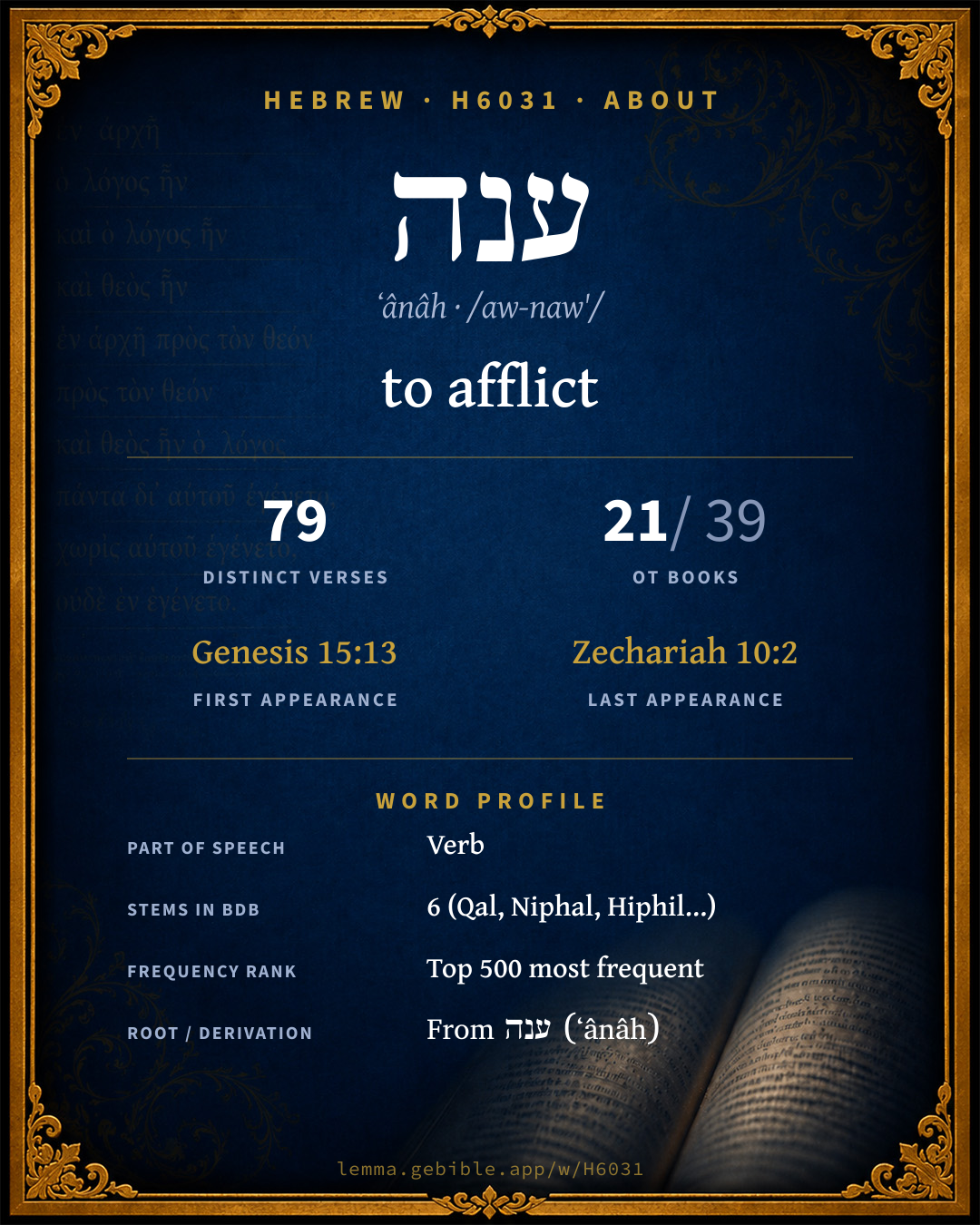
עָנָה
to afflict
‘to afflict’ is one of 2 main senses fuller range ↓
Full lexicon entry — Brown-Driver-Briggs (BDB)
From Brown-Driver-Briggs (BDB)
Where this word appears
See every Piel verb in the Hebrew Bible →
Grammar key — what these labels mean
Part of speech
- Verb
- An action or state-of-being word.
Stem
- Piel
- An intensive or resultative active stem. Here: ‘humble’
- Qal
- The basic, simple active stem — the plain form of the verb (“he wrote”). Here: ‘answer’
- Hiphil
- The causative active stem (“he caused / brought about”).
- Hithpael
- The reflexive or reciprocal stem (the subject acts on itself). Here: ‘humble oneself’
- Pual
- The passive counterpart of the Piel. Here: ‘be afflicted’
- Niphal
- Usually the simple passive or reflexive of the Qal (“he was written”). Here: ‘make answer’
Form
- Perfect
- A completed action or state — Hebrew marks aspect (completeness) more than strict tense (“he wrote”).
- Sequential Perfect
- A perfect with prefixed waw continuing a preceding imperfect or command (waw-consecutive perfect).
- Infinitive Construct
- A bound verbal noun, frequently with prepositions (“to write / in writing”).
- Sequential Imperfect
- An imperfect with prefixed waw — the standard past-narrative form (waw-consecutive imperfect).
- Imperfect
- An incomplete, ongoing, or future action (“he will / would write”).
- Participle Active
- A verbal adjective expressing ongoing or characteristic action (“writing / one who writes”).
- Participle Passive
- A verbal adjective expressing action received (“written”).
- Infinitive Absolute
- An unbound verbal noun, often intensifying or standing in for a finite verb.
- Imperative
- A direct command (“write!”).
- Jussive
- A third- or second-person volitional form expressing wish or command (“let him write”).
State
- Construct
- A noun bound to a following noun in a possessive / “of” relationship (the construct chain).
- Absolute
- The independent form of a noun, not bound to a following word.
Person
- 3rd Person
- The one spoken about (“he / she / it / they”).
- 2nd Person
- The one addressed (“you”).
- 1st Person
- The speaker (“I / we”).
Gender
- Masculine
- Grammatically masculine.
- Common
- Either gender — not distinguished for this form.
- Feminine
- Grammatically feminine.
Number
- Singular
- One.
- Plural
- More than one (in Hebrew, generally three or more).
Grammatical forms 40 distinct
- Verb, Piel, Infinitive Construct 10 times (12%)
- Verb, Piel, Perfect, 3rd Person, Masculine, Singular 6 times (7%)
- Verb, Piel, Perfect, 3rd Person, Common, Plural 5 times (6%)
- Verb, Piel, Sequential Imperfect, 3rd Person, Masculine, Singular 5 times (6%)
- Verb, Piel, Sequential Perfect, 2nd Person, Masculine, Plural 4 times (5%)
- Verb, Piel, Perfect, 2nd Person, Masculine, Singular 4 times (5%)
- Verb, Qal, Infinitive Construct 3 times (4%)
- Verb, Piel, Imperfect, 2nd Person, Masculine, Singular 3 times (4%)
+32 more forms (43 occurrences)
Parsed forms decoded from the imported morphology (morphhb / Westminster Leningrad Codex — WLC text public domain, morphhb tagging CC BY 4.0), counted across 83 parsed occurrences — not distinct verses.
Every verse where H6031 appears — 79 distinct verses across 21 books. Click any verse to open its interlinear word-by-word view. Verse text shown in the World English Bible for context — . Each verse’s Hebrew form is shown with its reference; the English is not keyword-highlighted, since the data carries no word-level English alignment. Use “Compare translations” on any verse to read it across multiple English versions. This concordance covers the Hebrew Bible; Septuagint (Greek Old Testament) occurrences are not indexed here.
Genesis 5 verses
- Genesis 15:13 וְ/עִנּ֣וּ conj + Piel pf 3cp He said to Abram, "Know for sure that your seed will live as foreigners in a land that is not theirs, and will serve them. They will afflict them four hundred years.
- Genesis 16:6 וַ/תְּעַנֶּ֣/הָ conj + Piel wimpf 3fs + sfx pers 3fs But Abram said to Sarai, "Behold, your maid is in your hand. Do to her whatever is good in your eyes." Sarai dealt harshly with her, and she fled from her face.
- Genesis 16:9 וְ/הִתְעַנִּ֖י conj + Hithpael impv 2fs The angel of Yahweh said to her, "Return to your mistress, and submit yourself under her hands."
- Genesis 31:50 תְּעַנֶּ֣ה Piel impf 2ms If you will afflict my daughters, and if you will take wives besides my daughters, no man is with us; behold, God is witness between me and you."
- Genesis 34:2 וַ/יְעַנֶּֽ/הָ conj + Piel wimpf 3ms + sfx pers 3fs Shechem the son of Hamor the Hivite, the prince of the land, saw her. He took her, lay with her, and humbled her.
Exodus 5 verses
- Exodus 1:11 עַנֹּת֖/וֹ Piel inf.cs + sfx pers 3ms Therefore they set taskmasters over them to afflict them with their burdens. They built storage cities for Pharaoh: Pithom and Raamses.
- Exodus 1:12 יְעַנּ֣וּ Piel impf 3mp But the more they afflicted them, the more they multiplied and the more they spread out. They were grieved because of the children of Israel.
- Exodus 10:3 לֵ/עָנֹ֖ת prep + Niphal inf.cs Moses and Aaron went in to Pharaoh, and said to him, "This is what Yahweh, the God of the Hebrews, says: 'How long will you refuse to humble yourself before me? Let my people go, that they may serve me.
- Exodus 22:22 תְעַנּֽוּ/ן Piel impf 2mp + sfx n "You shall not take advantage of any widow or fatherless child.
- Exodus 22:23 עַנֵּ֥ה תְעַנֶּ֖ה Piel inf.abs Piel impf 2ms If you take advantage of them at all, and they cry at all to me, I will surely hear their cry;
Leviticus 5 verses
- Leviticus 16:29 תְּעַנּ֣וּ Piel impf 2mp "It shall be a statute to you forever: in the seventh month, on the tenth day of the month, you shall afflict your souls, and shall do no manner of work, the native-born, or the stranger who lives as a foreigner among you:
- Leviticus 16:31 וְ/עִנִּיתֶ֖ם conj + Piel wpf 2mp It is a Sabbath of solemn rest to you, and you shall afflict your souls; it is a statute forever.
- Leviticus 23:27 וְ/עִנִּיתֶ֖ם conj + Piel wpf 2mp "However on the tenth day of this seventh month is the day of atonement: it shall be a holy convocation to you, and you shall afflict yourselves; and you shall offer an offering made by fire to Yahweh.
- Leviticus 23:29 תְעֻנֶּ֔ה Pual impf 3fs For whoever it is who shall not deny himself in that same day; shall be cut off from his people.
- Leviticus 23:32 וְ/עִנִּיתֶ֖ם conj + Piel wpf 2mp It shall be a Sabbath of solemn rest for you, and you shall deny yourselves. In the ninth day of the month at evening, from evening to evening, you shall keep your Sabbath."
Numbers 3 verses
- Numbers 24:24 וְ/עִנּ֥וּ וְ/עִנּוּ conj + Piel wpf 3cp conj + Piel wpf 3cp But ships [shall come] from the coast of Kittim, They shall afflict Asshur, and shall afflict Eber; He also shall come to destruction.
- Numbers 29:7 וְ/עִנִּיתֶ֖ם conj + Piel wpf 2mp On the tenth day of this seventh month you shall have a holy convocation; and you shall afflict your souls: you shall do no manner of work;
- Numbers 30:13 לְ/עַנֹּ֣ת prep + Piel inf.cs Every vow, and every binding oath to afflict the soul, her husband may establish it, or her husband may make it void.
Deuteronomy 7 verses
- Deuteronomy 8:2 עַנֹּֽתְ/ךָ֜ Piel inf.cs + sfx pers 2ms You shall remember all the way which Yahweh your God has led you these forty years in the wilderness, that he might humble you, to prove you, to know what was in your heart, whether you would keep his commandments, or not.
- Deuteronomy 8:3 וַֽ/יְעַנְּ/ךָ֮ conj + Piel wimpf 3ms + sfx pers 2ms He humbled you, and allowed you to hunger, and fed you with manna, which you didn't know, neither did your fathers know; that he might make you know that man does not live by bread only, but by everything that proceeds out of the mouth of Yahweh does man live.
- Deuteronomy 8:16 עַנֹּֽתְ/ךָ֗ Piel inf.cs + sfx pers 2ms who fed you in the wilderness with manna, which your fathers didn't know; that he might humble you, and that he might prove you, to do you good at your latter end:
- Deuteronomy 21:14 עִנִּיתָֽ/הּ Piel pf 2ms + sfx pers 3fs It shall be, if you have no delight in her, then you shall let her go where she will; but you shall not sell her at all for money, you shall not deal with her as a slave, because you have humbled her.
- Deuteronomy 22:24 עִנָּ֖ה Piel pf 3ms then you shall bring them both out to the gate of that city, and you shall stone them to death with stones; the lady, because she didn't cry, being in the city; and the man, because he has humbled his neighbor's wife: so you shall put away the evil from the midst of you.
- Deuteronomy 22:29 עִנָּ֔/הּ Piel pf 3ms + sfx pers 3fs then the man who lay with her shall give to the lady's father fifty [shekels] of silver, and she shall be his wife, because he has humbled her; he may not put her away all his days.
- Deuteronomy 26:6 וַ/יְעַנּ֑וּ/נוּ conj + Piel wimpf 3mp + sfx pers 1cp The Egyptians dealt ill with us, and afflicted us, and laid on us hard bondage:
Judges 5 verses
- Judges 16:5 לְ/עַנֹּת֑/וֹ prep + Piel inf.cs + sfx pers 3ms The lords of the Philistines came up to her, and said to her, Entice him, and see in which his great strength lies, and by what means we may prevail against him, that we may bind him to afflict him: and we will each give you of us eleven hundred [pieces] of silver.
- Judges 16:6 לְ/עַנּוֹתֶֽ/ךָ prep + Piel inf.cs + sfx pers 2ms Delilah said to Samson, Tell me, Please, in which your great strength lies, and with which you might be bound to afflict you.
- Judges 16:19 לְ/עַנּוֹת֔/וֹ prep + Piel inf.cs + sfx pers 3ms She made him sleep on her knees; and she called for a man, and shaved off the seven locks of his head; and she began to afflict him, and his strength went from him.
- Judges 19:24 וְ/עַנּ֣וּ conj + Piel impv 2mp Behold, here is my daughter a virgin, and his concubine; them I will bring out now, and humble you them, and do with them what seems good to you: but to this man don't do any such folly.
- Judges 20:5 עִנּ֖וּ Piel pf 3cp The men of Gibeah rose against me, and beset the house round about me by night; me they thought to have slain, and my concubine they forced, and she is dead.
2 Samuel 6 verses
- 2 Samuel 7:10 לְ/עַנּוֹת֔/וֹ prep + Piel inf.cs + sfx pers 3ms I will appoint a place for my people Israel, and will plant them, that they may dwell in their own place, and be moved no more; neither shall the children of wickedness afflict them any more, as at the first,
- 2 Samuel 13:12 תְּעַנֵּ֔/נִי Piel juss 2ms + sfx pers 1cs She answered him, No, my brother, do not force me; for no such thing ought to be done in Israel. Don't you do this folly.
- 2 Samuel 13:14 וַ/יְעַנֶּ֔/הָ conj + Piel wimpf 3ms + sfx pers 3fs However he would not listen to her voice; but being stronger than she, he forced her, and lay with her.
- 2 Samuel 13:22 עִנָּ֔ה Piel pf 3ms Absalom spoke to Amnon neither good nor bad; for Absalom hated Amnon, because he had forced his sister Tamar.
- 2 Samuel 13:32 עַנֹּת֔/וֹ Piel inf.cs + sfx pers 3ms Jonadab, the son of Shimeah, David's brother, answered, Don't let my lord suppose that they have killed all the young men the king's sons; for Amnon only is dead; for by the appointment of Absalom this has been determined from the day that he forced his sister Tamar.
- 2 Samuel 22:36 וַ/עֲנֹתְ/ךָ֖ conj + Qal inf.cs + sfx pers 2ms You have also given me the shield of your salvation; Your gentleness has made me great.
1 Kings 3 verses
- 1 Kings 2:26 הִתְעַנִּ֔יתָ הִתְעַנָּ֖ה Hithpael pf 2ms Hithpael pf 3ms To Abiathar the priest said the king, Get you to Anathoth, to your own fields; for you are worthy of death: but I will not at this time put you to death, because you bear the ark of the Lord Yahweh before David my father, and because you were afflicted in all in which my father was afflicted.
- 1 Kings 8:35 תַעֲנֵֽ/ם Hiphil impf 2ms + sfx pers 3mp When the sky is shut up, and there is no rain, because they have sinned against you; if they pray toward this place, and confess your name, and turn from their sin, when you do afflict them:
- 1 Kings 11:39 וַֽ/אעַנֶּ֛ה conj + Piel impf 1cs I will for this afflict the seed of David, but not forever.
2 Kings 1 verse
2 Chronicles 1 verse
Ezra 1 verse
Job 2 verses
Psalms 16 verses
- Psalms 35:13 עִנֵּ֣יתִי Piel pf 1cs But as for me, when they were sick, my clothing was sackcloth. I afflicted my soul with fasting. My prayer returned into my own bosom.
- Psalms 55:19 וְֽ/יַעֲנֵ/ם֮ conj + Qal impf 3ms + sfx pers 3mp God, who is enthroned forever, Will hear, and answer them. Selah. They never change, Who don't fear God.
- Psalms 88:1 לְ/עַנּ֑וֹת conj + Piel inf.abs Yahweh, the God of my salvation, I have cried day and night before you.
- Psalms 88:7 עִנִּ֥יתָ Piel pf 2ms Your wrath lies heavily on me. You have afflicted me with all your waves. Selah.
- Psalms 89:22 יְעַנֶּֽ/נּוּ Piel impf 3ms + sfx pers 3ms No enemy will tax him. No wicked man will oppress him.
- Psalms 90:15 עִנִּיתָ֑/נוּ Piel pf 2ms + sfx pers 1cp Make us glad for as many days as you have afflicted us, For as many years as we have seen evil.
- Psalms 94:5 יְעַנּֽוּ Piel impf 3mp They break your people in pieces, Yahweh, And afflict your heritage.
- Psalms 102:23 עִנָּ֖ה Piel pf 3ms He weakened my strength along the course. He shortened my days.
- Psalms 105:18 עִנּ֣וּ Piel pf 3cp They bruised his feet with shackles. His neck was locked in irons,
- Psalms 107:17 יִתְעַנּֽוּ Hithpael impf 3mp Fools are afflicted because of their disobedience, And because of their iniquities.
- Psalms 116:10 עָנִ֥יתִי Qal pf 1cs I believed, therefore I said, "I was greatly afflicted."
- Psalms 119:67 אֶ֭עֱנֶה Qal impf 1cs Before I was afflicted, I went astray; But now I observe your word.
- Psalms 119:71 עֻנֵּ֑יתִי Pual pf 1cs It is good for me that I have been afflicted, That I may learn your statutes.
- Psalms 119:75 עִנִּיתָֽ/נִי Piel pf 2ms + sfx pers 1cs Yahweh, I know that your judgments are righteous, That in faithfulness you have afflicted me.
- Psalms 119:107 נַעֲנֵ֥יתִי Niphal pf 1cs I am afflicted very much. Revive me, Yahweh, according to your word.
- Psalms 132:1 עֻנּוֹתֽ/וֹ Pual inf.cs + sfx pers 3ms Yahweh, remember David and all his affliction,
Ecclesiastes 3 verses
- Ecclesiastes 1:13 לַ/עֲנ֥וֹת prep + Qal inf.cs I applied my heart to seek and to search out by wisdom concerning all that is done under the sky. It is a heavy burden that God has given to the sons of men to be afflicted with.
- Ecclesiastes 3:10 לַ/עֲנ֥וֹת prep + Qal inf.cs I have seen the burden which God has given to the sons of men to be afflicted with.
- Ecclesiastes 5:20 מַעֲנֶ֖ה Hiphil ptcp.act ms For he shall not often reflect on the days of his life; because God occupies him with the joy of his heart.
Isaiah 8 verses
- Isaiah 31:4 יַֽעֲנֶ֑ה Qal impf 3ms For thus says Yahweh to me, As the lion and the young lion growling over his prey, if a multitude of shepherds are called forth against him, will not be dismayed at their voice, nor abase himself for the noise of them: so will Yahweh of Hosts come down to fight on Mount Zion, and on the hill of it.
- Isaiah 53:4 וּ/מְעֻנֶּֽה conj + Pual ptcp.pass ms Surely he has borne our sickness, and carried our suffering; yet we considered him plagued, struck by God, and afflicted.
- Isaiah 53:7 נַעֲנֶה֮ Niphal ptcp.act ms He was oppressed, yet when he was afflicted he didn't open his mouth; as a lamb that is led to the slaughter, and as a sheep that before its shearers is mute, so he didn't open his mouth.
- Isaiah 58:3 עִנִּ֥ינוּ Piel pf 1cp Why have we fasted, [say they], and you don't see? [why] have we afflicted our soul, and you take no knowledge? Behold, in the day of your fast you find [your own] pleasure, and exact all your labors.
- Isaiah 58:5 עַנּ֥וֹת Piel inf.cs Is such the fast that I have chosen? the day for a man to afflict his soul? Is it to bow down his head as a rush, and to spread sackcloth and ashes under him? will you call this a fast, and an acceptable day to Yahweh?
- Isaiah 58:10 נַעֲנָ֖ה Niphal ptcp.act fs and if you draw out your soul to the hungry, and satisfy the afflicted soul: then shall your light rise in darkness, and your obscurity be as the noonday;
- Isaiah 60:14 מְעַנַּ֔יִ/ךְ Piel ptcp.act mp cs + sfx pers 2fs The sons of those who afflicted you shall come bending to you; and all those who despised you shall bow themselves down at the soles of your feet; and they shall call you The city of Yahweh, The Zion of the Holy One of Israel.
- Isaiah 64:12 וּ/תְעַנֵּ֖/נוּ conj + Piel impf 2ms + sfx pers 1cp Will you refrain yourself for these things, Yahweh? will you hold your peace, and afflict us very sore?
Lamentations 2 verses
Ezekiel 2 verses
- Ezekiel 22:10 עִנּוּ Piel pf 3cp In you have they uncovered their fathers' nakedness; in you have they humbled her who was unclean in her impurity.
- Ezekiel 22:11 עִנָּה Piel pf 3ms One has committed abomination with his neighbor's wife; and another has lewdly defiled his daughter-in-law; and another in you has humbled his sister, his father's daughter.
Daniel 1 verse
Nahum 1 verse
Zephaniah 1 verse
Zechariah 1 verse
About this entry
At a glance — auto-summarized from this page’s data, not written by a person. Every figure links to its source below. This summary describes the numbers; it doesn’t interpret them.
“to afflict” is the headline sense of the Hebrew verb ענה (ʻânâh). Read the stem: it spans 6 stems, including Qal and Niphal. With 79 verses in 21 books, it is a moderately common word in the Hebrew Bible. Scripture first uses it in Genesis 15:13. From the same root come ענה, מען and מענה. See the sense tree, 79-verse concordance, and the renderings breakdown below.
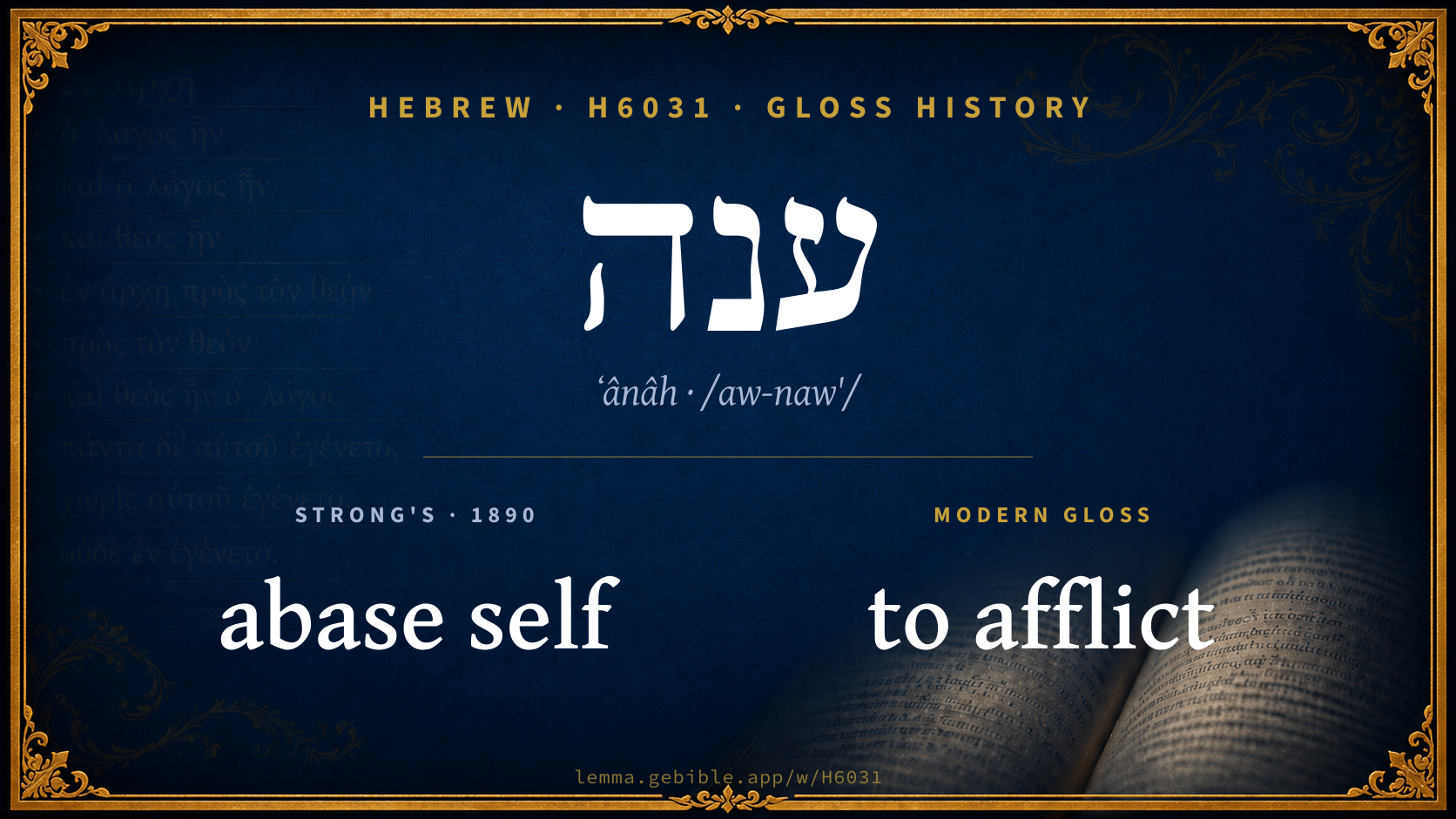
Gloss history
Strong's 1890 vs modern scholarship
About this word
Strong's H6031 catalogs a Hebrew word from the Hebrew Old Testament.
These counts are not copied from any lexicon or concordance. They are computed here, from the morphology-tagged Hebrew Old Testament. What Lemma adds →
- 79
- distinct verses
- The word appears in 79 distinct verses.
- 21 / 39
- OT books
- The word appears in 21 of 39 Old Testament books.
- #485
- by frequency
- Top 500 most frequent Hebrew words (rank 485 of 8,640 Hebrew words by occurrence).
View all 79 occurrences in the concordance →
Most concentrated in
- Psalms 16 verses 20%
- Isaiah 8 verses 10%
- Deuteronomy 7 verses 9%
By section of the Old Testament
By traditional corpus
Conventional, traditional groupings — biblical authorship is debated, so this is a traditional corpus grouping, not an authorship claim. Each share is this word’s portion of its verses in that division of the Hebrew canon. Each figure is a share of the word’s 79 distinct verses.
- Prophets (Nevi'im) 28 verses · 35%
- Writings (Ketuvim) 26 verses · 33%
- Torah (Pentateuch) 25 verses · 32%
How translations render this word
Counts come from each version’s own published word-to-Strong’s tagging or interlinear alignment — an approximate guide to how each version renders this word, not a word-level alignment the data otherwise carries. Because each total is that version’s own tagged count, the per-version totals vary from one another and need not match the appearance or distinct-verse counts above. These counts may also differ from a printed concordance because Lemma counts each distinctly tagged rendering and does not collapse phrase taggings into a single head-word total. This is a fixed set of word-tagged versions (KJV, ASV, BSB, ULT) and does not change with the reading translation you choose elsewhere. Each version’s license is shown beside its name below (and on Sources).
BDB lists this Strong’s number as 4 distinct words (homographs). Each count above pools all of them and is not split by sense — see the Senses section below. A low-frequency rendering may belong to a different one of those words, not the primary meaning.
- King James Version†: Afflict 10×, Afflicted 7×, Ye shall afflict 3×
- American Standard Version†: Afflict 7×, Afflicted 6×, Ye shall afflict 3×
- Berean Standard Bible†: Afflicted 5×, You shall humble 3×, Deny 2×
- unfoldingWord Literal Text†: You shall humble 4×, Afflict 3×, Afflict him 2×
King James Version Public Domain
Renders H6031 across 84† tagged occurrences — most commonly:
Plus 52 renderings that appear only once — usually multi-word phrases or single function words the recovered tagging swept in, not distinct renderings.
American Standard Version Public Domain
Renders H6031 across 82† tagged occurrences — most commonly:
Plus 56 renderings that appear only once — usually multi-word phrases or single function words the recovered tagging swept in, not distinct renderings.
Berean Standard Bible Public Domain
Renders H6031 across 80† tagged occurrences — most commonly:
Plus 62 renderings that appear only once — usually multi-word phrases or single function words the recovered tagging swept in, not distinct renderings. Not rendered by a distinct English word in 2 further occurrences.
unfoldingWord Literal Text CC BY-SA 4.0
Renders H6031 across 93† tagged occurrences — most commonly:
Plus 70 renderings that appear only once — usually multi-word phrases or single function words the recovered tagging swept in, not distinct renderings.
39 senses and sub-senses in the full BDB
Hebrew verbs can shift meaning by stem (binyan): Qal is the basic action, Niphal is often passive or reflexive, Piel often intensifies or makes it factitive, and Hiphil is typically causative. The senses below are grouped under the stem BDB assigns to each. This entry also uses Pual (the passive of Piel) and Hithpael (reflexive or reciprocal).
What do BDB’s symbols mean?
BDB uses these scholarly abbreviations:
| Symbol | Meaning |
|---|---|
| 𝔊 | the Septuagint (the ancient Greek translation, LXX) |
| 𝔙 | the Vulgate (the Latin translation) |
| 𝔖 | the Syriac version (the Peshitta) |
| 𝔗 | the Targum (the Aramaic translation) |
| ψ | the Psalms |
| √ | root (the underlying root or stem) |
| ‖ | parallel passage (a synonymous or contrasted parallel) |
| † | the dagger: every passage where the word occurs is cited |
The 39 senses and sub-senses the full Brown-Driver-Briggs lexicon distinguishes for this word, in lexicon order (not ranked by frequency), with BDB’s own verbatim wording and sub-sense lettering. Shown in Hebrew script with BDB’s own scholarly abbreviations. The condensed entry is in the Lexicon Entry tab. See also the Forms in the corpus table below.
ענה I answer, respond (NH id., respond, make response
Qal
- Pf. 3 ms. ע׳ Mi 6:5 +; sf. עָנַנִי 1 S 28:15 +, עָנָךְ Is 30:19; Je 23:37, עָנָהוּ 1 S 9:17 +; 1 s. עָנִיתִי Ho 14:9, etc.; Impf. 3 ms. יַעֲנֶה Gn 41:16 +, וַיַּעַן Am 7:14 +, sf. יַעֲנֵנִי Jb 20:3 +, etc.; Imv. עֲנֵה Mi 6:3; Pr 26:5 etc.; Inf. cstr. עֲנוֹת Gn 45:3 + [2 S 22:36 v. עֲנָוָה]; Pt. עֹנֶה Ju 19:28 +, etc.;— e.g. Micah 6:5
- 1. answer, respond to sthg. said, actual or implied, Ju 8:8; 1 S 4:20; Jb 9:15 +; especially e.g. Judges 8:8
- a. of men, c. acc. pers. Gn 45:3 (E), Ju 5:29; 2 K 18:36 = Is 36:21; Jb 5:1 + very often (c. 110 times); specif. be responsive, i.e. answer kindly, grant request 1 K 12:7 (sf. pers.); = be amenable, docile (toward י׳) Ho 2:17 (of Isr. in fig.); seldom and late, c. acc. of thing replied to, Jb 32:12; 33:13 (De Di Bu), 40:2. e.g. Genesis 45:3
- b. of God answering (graciously): usually c. acc. pers.; by oracle 1 S 14:37; 28:6, 15 +, fig. Hb 2:11; by deed 1 S 7:9; 1 K 18:37(×2), cf. בָּאֵשׁ v 24; 1 Ch 21:26, and especially Ho 2:23, 24; 14:9, v. also Mi 3:4 Is 41:17; 49:8 Je 33:3; Jb 12:4 +, especially ψψ, e.g. 3:5; 4:2; 20:2 + 33 times, etc. (in all c. 77 times); e.g. 1 Samuel 14:37
- c. rarely c. acc., or cl., of answer: אלהים יַע׳ אֶת־שְׁלוֹם פַּרְעֹה Gn 41:16; Jb 15:2; Pr 18:23; Ne 8:6 they responded, Amen! 2 S 19:43 they made reply against Isr. (c. עַל against, only here), + quoted answer; c. acc. pers. + answer 1 S 20:28 Jonathan answered Saul, David asked leave, etc.; c. 2 acc. (c. 20 times) 2 K 18:36 = Is 36:21; Jb 23:5 +; so = grant, vouchsafe to, נוֹרָאוֹת תַּעֲנֵנוּ ψ 65:6 terrible things dost thou [י׳] vouchsafe to us. e.g. Genesis 41:16
- d. often + אָמַר Gn 18:27 Abr. answered and said, Ex 4:1 (J), 19:8 (E), Jb 4:1; 6:1 etc.; + אָמַר אֶל־ Gn 27:39 + 16 times; + א׳ לְ v 37 + 8 times; ע׳ + acc. pers. + אמר, 1 S 9:8 he answered Saul and said, + 23 times (in all c. 130 times); seldom + לֵאמֹר †Nu 32:31 (P), ע׳ + acc. pers. + לא׳ Gn 23:5, 10, 14 (P), 41:16; 42:22 (E), Jos 1:16 (D) e.g. Genesis 18:27
- e. seldom + דִּבֶּר Jos 22:21 (P), 2 K 1:10, 11, 12; ע׳ + acc. pers. + ד׳ Gn 34:13 (P). e.g. Joshua 22:21
- 2.
- a. respond to an occasion, speak in view of circumstances: 1 S 9:17 (acc. pers. + quot.), Ju 18:14 (+ אָמַר), Nu 11:28 (JE; + id.), 2 K 1:11 (+ id.), + 19 times e.g. 1 Samuel 9:17
- b. fig. יַעֲנֶה אֶת־הַכֹּל Ec 10:19 money meets all demands. e.g. Ecclesiastes 10:19
- 3.
- a. specif. respond as a witness, testify, so perhaps pt. עֹנֶה (abs.) Mal 2:12 (in good sense); c. בְּ pers. = in the case of = for Gn 30:33; usually against, 1 S 12:3; 2 S 1:16; Is 3:9; 59:12; Mi 6:3; Je 14:7; Jb 15:6; Nu 35:30 (P), Ru 1:21 (> Be be occupied with; Vrss Luth KitKau עִנָּה humiliate); c. בְּפָנָיו Ho 5:5; 7:10; Jb 16:8; c. לְפָנָיו Dt 31:21 (+ לְעֵד as witness); c. בְּ pers. + acc. of charge, סָרָה 19:16, of false witness שֶׁקֶר v 18, עֵד־שֶׁקֶר Ex 20:16 (Ginsb v 13), ‖ Dt 5:17, Pr 25:18: abs. (bad implic.) Ex 23:2 (E; עַל concerning). e.g. Malachi 2:12
- b. less often make response as one accused (respondent) Jb 9:14, 15. e.g. Job 9:14
Niphal
- 1. make answer, subj. י׳, c. ל pers., Pf. 1 s. נַעֲנֵיתִי Ez 14:4; Pt. נַעֲנֶה v 7 (Qal not in Ez). e.g. Ezekiel 14:4
- 2. be answered: Impf. 3 ms. יֵעָנֶה,
- a. Jb 11:2 (subj. words). e.g. Job 11:2
- b. of man = receive answer Pr 21:13, so 1 s. אֵעָנֶה Jb 19:7. e.g. Proverbs 21:13
Hiphil
- Pt. מַעֲנֶה בְּשִׂמְחַת לִבּוֹ Ec 5:19, wholly dub.; Hi (God) cause (all things) to respond in the joy of his heart; De answers to the joy, etc.; de Jong Wild occupies him (II. עָנָה with the joy, etc. e.g. Ecclesiastes 5:19
ענה II be occupied, busied with (ב), only Ec (perhaps Aramaic loan-word
Qal
- Inf. עֲנוֹת Ec 1:13; 3:10. e.g. Ecclesiastes 1:13
ענה III be bowed down, afflicted (NH id.
Qal
- Pf. 1 s. עָנִיתִי ψ 116:10; Impf. 3 ms. יַעֲנֶה Is 25:5; 31:4, etc.;— e.g. Psalms 116:10
- 1. be put down or become low, of song of triumph Is 25:5 (others as Hiph. he putteth down, ‖ תַּכְנִיעַ). e.g. Isaiah 25:5
- 2. be depressed, downcast Is 31:4 (of lion; ‖ יֵחָ֑ת). e.g. Isaiah 31:4
- 3. be afflicted ψ 116:10; 119:67; Zc 10:2. e.g. Psalms 116:10
Niphal
- Pf. 1 s. נַעֲנֵיתִי ψ 119:107; Inf. cstr. לֵעָנֹת (perhaps read as Qal Ges§ 51 l) Ex 10:3; Pt. נַעֲנֶה 53:7; fs. נַעֲנָה 58:10;— e.g. Psalms 119:107
- 1. humble oneself מִפְּנֵי Ex 10:3. e.g. Exodus 10:3
- 2. be afflicted ψ 119:107 Is 53:7; 58:10. e.g. Psalms 119:107
Piel
- Pf. 3 ms. עִנָּה Dt 22:24 + 5 times; 2 ms. עִנִּיתָ ψ 88:8; 1 s. עִנֵּיתִי ψ 35:13, sf. וְעִנִּתִךְ consec. Na 1:12, etc.; Impf. יְעַנֶּה Jb 37:23, etc.; Imv. עַנּוּ Ju 19:24; Inf. abs. עַנֵּה Ex 22:22; cstr. עַנּוֹת Is 58:5 +, etc.; Pt. pl. sf. מְעַנַּיִךְ Is 60:14 Zp 3:19;— e.g. Deuteronomy 22:24
- 1. humble, mishandle, afflict: individual Gn 16:6; 31:50 (J) Ex 22:21, 22(×2) (E) Jb 30:11; by imprisonment and bonds Ju 16:5, 6, 19 ψ 105:18; a nation by way or in bondage Gn 15:13 (J) Ex 1:11, 12; Nu 24:24(×2) (E) Dt 26:6; 1 S 12:8 (inserting וַיְעַנּוּם מִצְרַיִם, so 𝔊 Dr Bu Kit HPS (cf. Th We]), 2 S 7:10; 2 K 17:20 ψ 94:5; Is 60:14; Zp 3:19; dynasty of David ψ 89:23. e.g. Genesis 16:6
- 2. humble, a woman by cohabit., Gn 34:2 (J) Dt 21:14; 22:24, 29; Ju 19:24; 20:5 2 S 13:12, 14, 22, 32; Ez 22:10, 11; La 5:11. e.g. Genesis 34:2
- 3. afflict as a discipline (God agent) Dt 8:2, 3, 16; 1 K 11:39 ψ 88:8; 90:15; 119:75; Is 64:11 Na 1:12(×2) La 3:33. e.g. Deuteronomy 8:2
- 4. humble, weaken, obj. כֹּחַ ψ 102:24; משׁפט Jb 37:23 (cf. Talm עִנָּה דִּין); נֶפֶשׁ oneself, by fasting Lv 16:29, 31; 23:27, 32; Nu 29:7 (P) ψ 35:13; Is 58:3, 5; by an oath Nu 30:14 (P). e.g. Psalms 102:24
Pual
- Pf. 1 s. עֻנֵּיתִי ψ 119:71; Impf. 3 fs. תְּעֻנֶּה Lv 23:29; Inf. cstr. sf. עֻנּוֹתוֹ ψ 132:1; Pt. מְעֻנֶּה Is 53:4;— e.g. Psalms 119:71
- 1. be afflicted, in discipline by God ψ 119:71; 132:1 Is 53:4. e.g. Psalms 119:71
- 2. be humbled by fasting Lv 23:29 (P). e.g. Leviticus 23:29
Hiphil
- Impf. 2 ms. sf. תַּעֲנֵם 1 K 8:35 = 2 Ch 6:26 afflict, in discipline. e.g. 1 Kings 8:35
Hithpael
- Pf. 3 ms. הִתְעַנָּה 1 K 2:26; 2 ms. הִתְעַנִּיתָ v 26; Impf. 3 mpl. יִתְעַנּוּ ψ 107:17; Imv. הִתְעַנִּי Gn 16:9; Inf. cstr. הִתְעַנּוֹת Ez 8:21 Dn 10:12;— e.g. 1 Kings 2:26
- 1. humble oneself (c. תַּחַת יָדֶיהָ Gn 16:9 (J). e.g. Genesis 16:9
- 2. be afflicted, by men 1 K 2:26(×2) by God in discipline ψ 107:17. e.g. 1 Kings 2:26
- 3. humble oneself in fasting Ezr 8:21 Dn 10:12. e.g. Ezra 8:21
ענה IV sing (Arabic عَنَّى sing, chant, غِنَآءٌ singing, chanting, etc.
Qal
- Pf. 3 ms. וְעָנוּ consec. Je 51:14; Impf. 3 ms. יַעֲנֶה Je 25:30; 3 fs. וַתַּעַן Ex 15:21; 3 fpl. וַתַּעֲנֶינָה 1 S 18:7, etc.; Imv. עֱנוּ Nu 21:17 ψ 147:7; Inf. cstr. עֲנוֹת Ex 32:18(×2);—sing, utter tunefully, Ex 15:21 (E) and Miriam sang to (ל) them; of uttering shout (הֵידָד), as in vintage Je 25:30 (י׳ subj.; + אֶל־ pers.), in attack 51:14 (+ עַל־ pers.); קוֹל עֲנוֹתגְּבוּרָה(חֲלוּשָׁה) Ex 32:18(×2) (E) Ho 2:17; c. ל rei v. pers. laudat. Nu 21:17 (JE; well); ψ 147:7 (י׳; ‖ זַמְּרוּ), Ezr 3:11; + אָמַר 1 S 18:7 the women sang, and said; יַעֲגוּ בַמְּחֹלוֹת לֵאמֹר 21:12; 29:5; c. acc. rei laudat. ψ 119:172 (cf. ‖ v 171).—Is 13:22 v. עון. e.g. Jeremiah 51:14
Piel
- intens.: Imv. עַנּוּ־לַהּ Is 27:2 sing sweetly of it; Inf. קוֹל עַנּוֹת Ex 32:18 (E) the sound of distinct singing; cf. לְעַנּוֹת ψ 88:1. e.g. Isaiah 27:2
Senses from the full Brown-Driver-Briggs lexicon (Brown, Driver, Briggs; Oxford 1906 — public domain), digitized via Sefaria, supplemented by the OpenScriptures HebrewLexicon (CC BY 4.0). Full attribution on Sources.
Word origin
I. vb. answer, respond (NH id., respond, make response; 𝔗 עֲנָא; Syriac ܥܢܳܐ; Old Aramaic Palm. ענה; cf. Arabic عنى, عَنَا intend by saying);—
II. vb. be occupied, busied with (ב), only Ec (perhaps Aramaic loan-word; Syriac ܥܢܳܐ be occupied with, ܥܶܢܝܳܢ occupation, affair; cf. Arabic عنى, عَنَا concern one, also be occupied by; Ecclus 42:8 margin);—
III. vb. be bowed down, afflicted (NH id.; MI Pi. ויענו l5, אענו l6; Assyrian enû, thwart, frustrate, do violence to; Arabic عنو, عَنَا be lowly, submissive, v. Rahlfsעָנִי und עָנָו in d. Psalmen (1892), 67 ff.; 𝔗 עַנִּי Pa. oppress; Syriac Ethpe. humble oneself, and deriv.);—
IV. vb. sing (Arabic عَنَّى sing, chant, غِنَآءٌ singing, chanting, etc.; Syriac ܥܰܢܺܝ sing responsively, ܥܽܘܢܺܝܬܳܐ hymn, refrain; poss. Assyrian enû, resound (?); Egyptian anni is loan-word according to Bondi80);—
— Brown-Driver-Briggs (Oxford 1906, public domain), digitized via Sefaria, supplemented by the OpenScriptures HebrewLexicon (CC BY 4.0). See Sources.
Derived from ענה (ʻânâh) (H6030) — to answer.
Jastrow Dictionary
A second Hebrew/Aramaic lexicon for comparison, covering Aramaic and post-biblical (Talmudic, Targumic, Midrashic) usage that the biblical-Hebrew BDB does not. Matched by lemma rather than by Strong’s number, so a lemma may carry more than one Jastrow headword (shown separately below), and the entries cover usage well beyond the Bible.
עָנָה
- , v. עני h. a. ch.
עני
- (b. h.) [to turn, come out in turn,] to begin to speak; to respond; to speak or sing in chorus; to answer. Tem. 16ᵃ ע̇תנ̇יא̇ל̇ שעֲנָאו̇ א̇ל̇ he was surnamed Othniel, because God answered his prayer (ref. to I Chr. IV, 10). Y. Sot. V, 20ᶜ top והן עוֹנִין אחריו על כל דבר ודבר and they (the class) repeat each sentence after him; משה … והן עונין אחריו אשירה Moses said, I will sing &c., and they repeated in chorus, I will sing &c. Ib. משה אמר עזי והן עונין וכ׳ Moses said, My strength &c., and they responded, I will sing &c. Tosef. ib. VI, 2 ועונין על כל עינין ועינין and they (the class) repeat each sentence. Ib. 3 ועונין אחריו עינין ראשון and they (the people) always repeated the first sentence (as refrain). Succ. 38ᵇ מצוה לַעֲנוֹת הללויה it is proper to say in response Halleluiah. M. Kat. III, 9 כולן עוֹנוֹת כאחת all start the dirge at once; אחת מדברת וכולן עונות אחריה one speaks, and all repeat in chorus after her, v. עִינּוּי I. Ber. 47ᵃ עד שיכלה אמן מפי העוֹנִים until the Amen of the responding company is finished. Pes. 36ᵃ לחם שעונין וכ׳, v. עוֹנִי. Y. Succ. III, 54ᵃ top אם בירכך גוי עֲנֵה אחריו אמן if a gentile blesses thee, say after him Amen; a. fr. e.g. 1 Chronicles 4:10
- 1. to be answered, to have one’s prayer granted. Sabb. 30ᵃ וכשאמר זכור … מיד נ׳ but when he said, Remember &c. (Ex. XXXII, 13), his prayer was at once granted. R. Hash. 18ᵃ זה התפלל ונ׳ וכ׳ one prays and is heard, another prays and is not heard; Koh. R. to IX, 11, v. פָּגַע. Gen. R. s. 60 [read:] שלשה הם שנַעֲנוּ במענה פיהם three persons (mentioned in the Scriptures) were answered as soon as they had uttered their prayer; Yalk. ib. 108; a. fr. e.g. Exodus 32:13
- 2. to be called upon to speak; to answer, to deliver an opinion. Kidd. 40ᵇ נ׳ ר"ט ואמר וכ׳ R. Ṭ. (being asked his opinion) answered saying &c.; נַעֲנוּ כולם ואמרו וכ׳ all of them in turn answered saying &c.; Sifré Deut. 41; M. Kat. 28ᵇ (at a mourner’s house); a. fr.
- 3. [to be made to respond Amen,] to be sworn; to promise allegiance. Y. Dem. II, 23ᵃ top הוא נ׳ לחבורה … נַעֲנִין לו he (the head of the house) promises allegiance to the order (v. חֲבֵרוּת), and the members of his house make the promise to him.
- to speak or sing in chorus, esp. to lament. M. Kat. III, 9, מְעַנּוֹת, v. עִינּוּי I.
עֲנֵי
- Targ. II Esth. VI, 10. Targ. I Kings XII, 7.—Targ. Ps. XXXIV, 5 (Ms. עַנְיָינִי). Ib. CII, 3; a. fr.—Y. Succ. III, 54ᵃ top מה נַעְנֵי what shall we say in response? Ib. ר׳ יונה ע׳ הכין והכין R. J. responded, so be it, and so be it. Ab. Zar. 18ᵃ bot. אימא אלהא דמאיר עֲנֵנִי say, O God of Meïr, hear me; a. fr.—[Men. 17ᵃ עני מרי, v. עֲנֵי II.]
- to speak or sing in chorus; to respond. Targ. O. Ex. XV, 21. Targ. II Esth. VI, 11.
- 1. to be answered. Targ. O. Ex. XIX, 19. Targ. Prov. XXI, 13 נתעני ed. Wil. (ed. Lag. נַעֲנוֹי will answer him; h. text יֵעָנֶה).—
- *2. (euphem.) to be gratified, be eased. Y. Shebi. III, 34ᶜ bot. ההן דאזיל ולא מִתְעַנֵּי … he who went out to ease his bowels without success; [perhaps to be read מתפני, v. פְּנֵי?]
A Dictionary of the Targumim, the Talmud Babli and Yerushalmi, and the Midrashic Literature (Marcus Jastrow; London, Luzac, 1903) — Public Domain. Digitized via Sefaria. Digitized via Sefaria. Full attribution on Sources.
Forms in the corpus
The 76 distinct written forms H6031 takes in the Hebrew Bible, most frequent first — each parse links to that stem’s occurrences in the concordance. Hebrew forms include their vowel points and cantillation, so a single lemma takes many written forms.
The 60 most common forms are shown; 16 rarer forms follow in the full concordance.
Same root — word family
Other BDB entries built from the same root as H6031, grouped by Strong’s listed origin. These share a root / origin per the lexicon — not necessarily a shared meaning. Each links to that word’s own entry.
Derives from
Shares the same root
Derived from this word
- מענה maʻănâh H4618 ploughing ground
- ענה ʻănâh H6033 poor
- ענו ʻânâv H6035 poor
- ענות ʻĕnûwth H6039 affliction
- עני ʻŏnîy H6040 affliction
- עני ʻânîy H6041 poor
- ענין ʻinyân H6045 occupation
- תענית taʻănîyth H8589 fasting
Proper names from this root
People and places named from this root — a name, not an additional meaning of the word.
- ענה ʻĂnâh H6034 Anah
- עניה ʻĂnâyâh H6043 Anaiah
- ענת ʻĂnâth H6067 Anath
- בענה Baʻănâh H1196 Baanah
- עני ʻUnnîy H6042 Unni
Compare all same-root words → Showing 4 of 18 — not the complete family. 5 of the same-root words are proper names (people or places). They share a root, not necessarily a meaning.
Septuagint verse parallels
This word appears in 67 verses that also exist in the Greek Old Testament (Septuagint), out of the 79 Hebrew verses it occurs in. You can read those verses in Greek by switching the Old Testament edition to the Septuagint.
Read these verses in the Septuagint
- Genesis 15:13
- Exodus 1:11
- Leviticus 16:29
- Numbers 24:24
- Deuteronomy 8:2
- Judges 16:5
- 2 Samuel 7:10
- 1 Kings 2:26
- 2 Kings 17:20
- 2 Chronicles 6:26
- Ezra 8:21
- Job 30:11
This is a verse-level parallel only — the same verses exist in both the Hebrew and Greek Old Testaments. No word-level Hebrew↔Greek correspondence is claimed: the data carries no such alignment, so no Greek word is shown as this Hebrew word’s translation. Coverage is not total — the Septuagint omits the deuterocanon and renumbers the Psalms, so some Hebrew verses have no direct Greek parallel.