
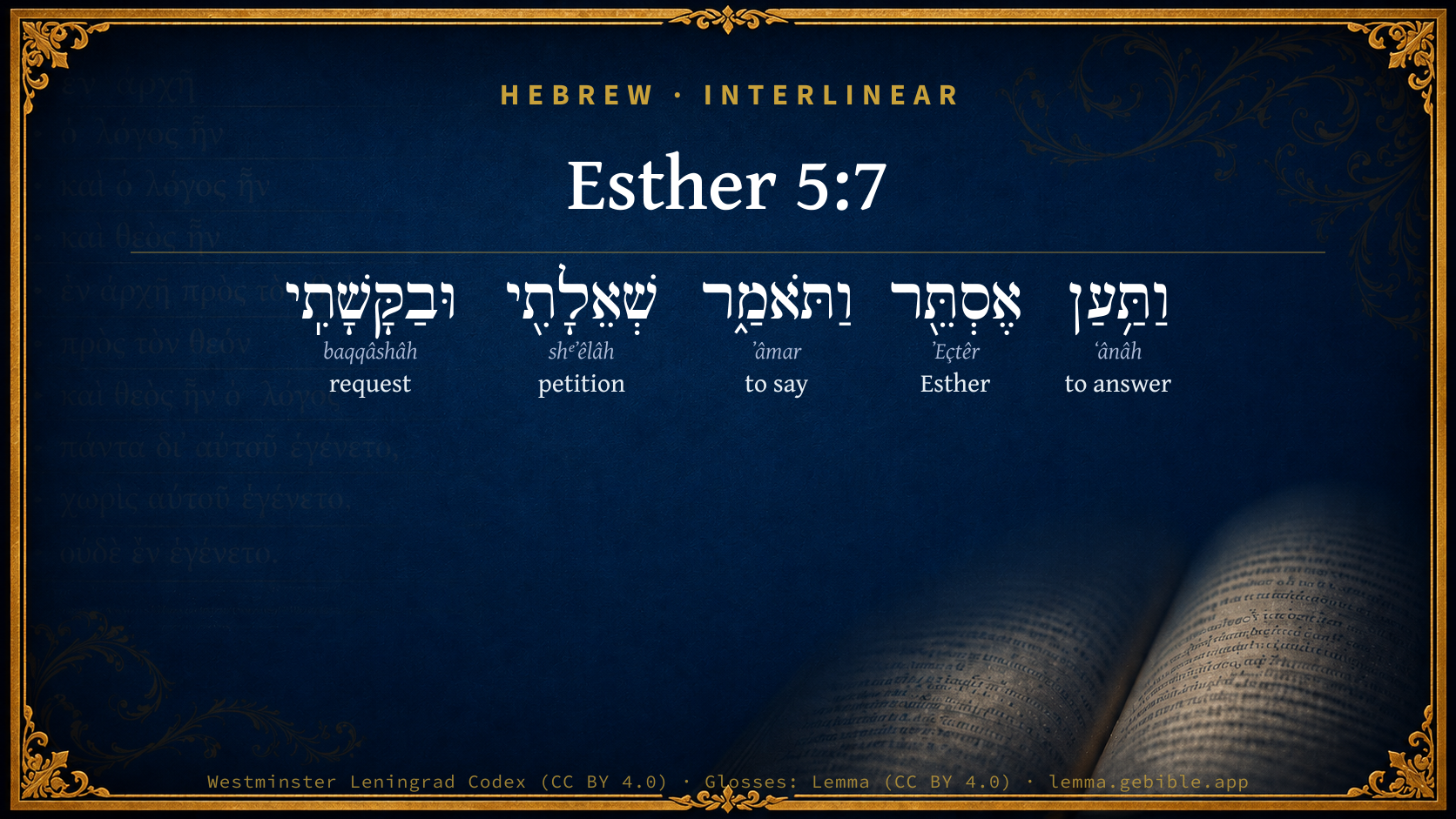
Esther 5:7

Hebrew (Westminster Leningrad Codex) Esther 5:7 appears in the Hebrew Old Testament. The text above is from the Westminster Leningrad Codex. Each word links to its Strong’s number, a concise gloss, and parsing drawn from the Open Scriptures Hebrew Bible morphology. Click any word for its full Brown-Driver-Briggs (BDB) entry.
Download image
Cite this verse

Esther 5:7 (World English Bible). Public Domain. Lemma interlinear Bible study tool, https://lemma.gebible.app/v/esther/5/7.

Show BibTeX & RIS
BibTeX
RIS
English Translation
Then answered Esther, and said, My petition and my request is:
World English Bible · Public Domain
Download a study sheet

One document with this verse’s original text, its word-by-word gloss line, the meaning frame, cross-references with their text, attributed commentary, and full source and license credits — printable, and it pastes into notes with its structure intact.

This verse Autodidact and up

Study sheet (.html) Plain text (.txt)

A passage Seminary Student

Up to 50 verses in one chapter. A passage sheet keeps up to 6 commentary sources and 12 cross-references per verse, in the order this page ranks them, and says so on the sheet whenever that leaves anything out. Ask for a single verse and you get the Autodidact verse sheet above.

Everything on this page stays free to read, with no account — the sheet is a download of what is already on screen, not access to it.

Want to remove ads? Support Godless Engineer
Compare translations 3

The same verse in 3 English versions, stacked beneath the original-language interlinear above. Click any original word for its lexicon entry.

Each is an independent rendering of the whole verse — the interlinear is not word-aligned to these translations.

Highlighted words mark where these versions differ — a whole-verse word diff, not a word-by-word alignment.

  • World English Bible Public Domain
    Then answered Esther, and said, My petition and my request is:
  • King James Version Public Domain
    Then answered Esther, and said, My petition and my request is;
  • unfoldingWord Literal Text CC BY-SA 4.0
    And Esther answered and said, “My petition and my request:

unfoldingWord Literal Text — © unfoldingWord, licensed CC BY-SA 4.0. Word-aligned USFM3 via Door43 (git.door43.org/unfoldingWord/en_ult).

Versions to compare (up to 4)

3 of 4 selected

Show all 18 translations

Every available English version of this verse, each an independent rendering of the whole verse.

  • World English Bible Public Domain
    Then answered Esther, and said, My petition and my request is:
  • Berean Standard Bible Public Domain
    Esther replied, “This is my petition and my request:
  • Majority Standard Bible Public Domain
    Esther replied, “This is my petition and my request:
  • King James Version Public Domain
    Then answered Esther, and said, My petition and my request is;
  • American Standard Version (1901) Public Domain
    Then answered Esther, and said, My petition and my request is:
  • Revised Version (1885) Public Domain
    Then answered Esther, and said, My petition and my request is;
  • Geneva Bible (1599) Public Domain
    Then answered Ester, and sayd, My petition and my request is,
  • Douay-Rheims (1899) Public Domain
    And Esther answered: My petition and request is this:
  • Young's Literal Translation Public Domain
    And Esther answereth and saith, `My petition and my request `is':
  • Literal Standard Version CC BY-SA 4.0
    And Esther answers and says, “My petition and my request [is]:
  • Unlocked Literal Bible CC BY-SA 4.0
    Esther answered, “My petition and my request is this,
  • unfoldingWord Literal Text CC BY-SA 4.0
    And Esther answered and said, “My petition and my request:
  • Darby Bible Public Domain
    And Esther answered and said, My petition and my request is,
  • World Messianic Bible Public Domain
    Then Esther answered and said, “My petition and my request is this.
  • Webster's Bible Public Domain
    Then answered Esther, and said, My petition and my request is:
  • Free Bible Version CC BY-SA 4.0
    Esther answered, “This is what I'm asking for, and this is what I want.
  • Bible in Basic English Public Domain
    Then Esther said in answer, My prayer and my request is this:
  • JPS Tanakh (1917) Public Domain
    Then answered Esther, and said: 'My petition and my request is —

Literal Standard Version (2020), Covenant Press — licensed CC BY-SA 4.0. Text via the HelloAO Bible API (eBible.org). Unlocked Literal Bible (unfoldingWord) — licensed CC BY-SA 4.0. Text via the HelloAO Bible API (eBible.org). unfoldingWord Literal Text — © unfoldingWord, licensed CC BY-SA 4.0. Word-aligned USFM3 via Door43 (git.door43.org/unfoldingWord/en_ult). Free Bible Version, Dr. Jonathan Gallagher — licensed CC BY-SA 4.0. Text via the HelloAO Bible API (eBible.org).

Word by word

More ways to search: Search by grammar → Find every occurrence → Compare this word →

Practice this passage: Drill this verse → Learn its vocabulary →

About this verse

These counts appear in no published source. They are computed here, from the morphology-tagged text and Lemma’s own curated glosses. What Lemma adds →

5
words
5
distinct lemmas
Historical
section

Notable vocabulary

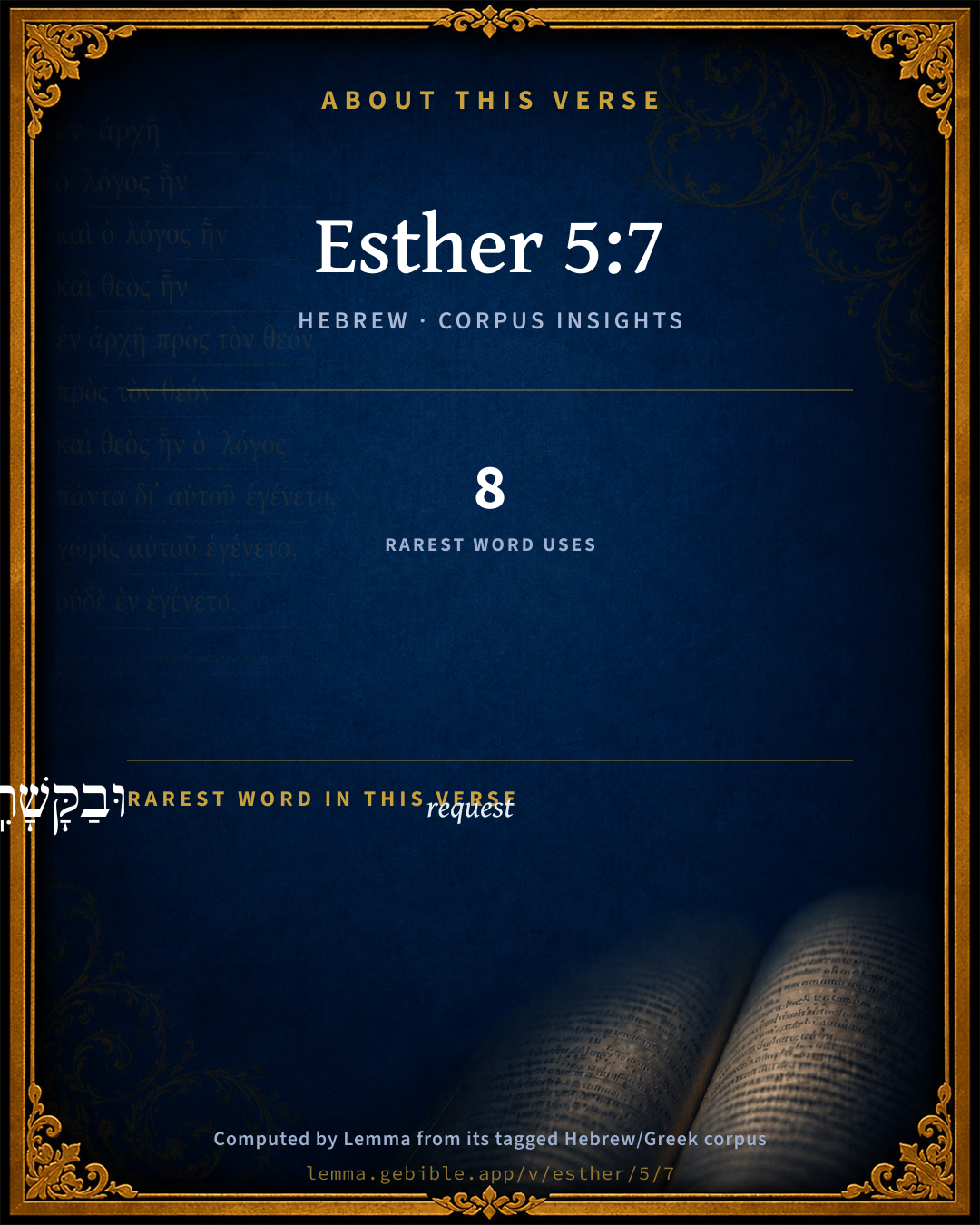
The rarest word here is וּבַקָּשָׁתִֽי request H1246 — appearing just 8 times in the whole Hebrew Bible.

Shared distinctive vocabulary

וּבַקָּשָׁתִֽי request H1246 occurs in 8 verses of the Hebrew Bible. Also found in:

Grammatical profile

  • 2 verbs
  • 3 nouns

Verb forms

  • וַתַּ֥עַן Qal · Sequential Imperfect
  • וַתֹּאמַ֑ר Qal · Sequential Imperfect

Hebrew & Septuagint length

In English translation the verse runs 11 words from the Hebrew and 9 from the Septuagint (LXX English) — closely comparable.

A rough comparison of the two English renderings, which tokenize alike — not a word-level alignment.

Word counts can differ between the Hebrew and the Greek without any difference in meaning — e.g. the Hebrew direct-object marker אֵת has no separate Greek word, and Greek often adds the article ὁ.

Hebrew and Greek witnesses Masoretic Hebrew ↔ Greek Septuagint

The same verse in the two great witnesses to the Old Testament, shown verse-for-verse.

These are two independent witnesses, not word-aligned to each other, and the Septuagint is shown in lemma (dictionary) form.

Hebrew Esther 5:7 Masoretic · Westminster Leningrad Codex

וַתַּ֥עַן אֶסְתֵּ֖ר וַתֹּאמַ֑ר שְׁאֵלָתִ֖י וּבַקָּשָׁתִֽי

Then answered Esther, and said, My petition and my request is:

World English Bible · Public Domain

Greek LXX Esther 5:7 Septuagint · lemma form

καί ἐκἔρχομαι ὁ αμαν ἀπό ὁ βασιλεύς ὑπερχαρής εὐφραίνω ἐν δέ ὁ ὁράω αμαν μαρδοχαῖος ὁ ἰουδαῖος ἐν ὁ αὐλή θυμόω σφόδρα

And she said, My request and my petition are:

LXX2012 (modern English Septuagint) · Public Domain

Hebrew: Westminster Leningrad Codex (CC BY 4.0). Greek: Septuagint (public domain); English from LXX2012 (modern English Septuagint) (Public Domain). How the Septuagint differs from the Hebrew →

Commentary

Notes on Esther 5:7 from classic Christian and Jewish commentators (each source and its license shown beneath its notes). The classic Christian expositions comment on the surrounding passage and are grouped to its opening verse, so a note may address several verses; the Jewish commentaries on the Tanakh (Rashi and others) are per-verse, so they appear only where the commentator wrote on this verse.

Lemma curates 59 commentaries, every one of them public domain or Creative Commons licensed, each selected and text-cleaned for this edition rather than reprinted as found. About our sources →

Trapp's Complete Commentary

John Trapp

Est 5:7 Then answered Esther, and said, My petition and my request [is];

Ver. 7. My petition and my request is] She speaks to the king in his own very words: and so must we if we mean to speed in heaven. Take unto you words, and say, Take away all iniquity, and give good, &c. Produce God’s own words in prayer, and say, as she did to Judah, "Whose are these?" Gen 38:25. He loves to be set upon in his own words, to be pressed with his promise, to be sued upon his bond. This David knew, and therefore cries, Psa 86:11, "Unite my heart to fear thy name": it is as if he should say, Thou hast promised, Lord, to give me one heart, Eze 11:19; behold, I find mine heart divided, my thoughts dissipated, and myself disabled for duty (for Anima dispersa fit minor), Unite it, I beseech thee, &c. This is the way to make our prayers to be nigh the Lord day and night, as Solomon phraseth it, 1Ki 8:59.

John Trapp, A Commentary or Exposition upon All the Books of the Old and New Testament (1647–1656) — public domain. Text from a community e-Sword module.

The Cambridge Bible for Schools and Colleges

gen. ed. J. J. S. Perowne

7, 8. Esther’s form of reply suggests that for the moment she meant to declare her grief, but suddenly breaks off for some reason which remains hidden from the reader. She virtually acknowledges, however, that she has a weighty petition to present, and promises that, if her two guests will repeat their visit under similar circumstances next day, she will postpone no longer.

The Cambridge Bible for Schools and Colleges (gen. ed. J. J. S. Perowne; Cambridge University Press, 1878–1918) — public domain. Text from a community e-Sword module.

John Gill's Exposition

Then answered Esther and said, my petition and my request is. What she should for the present make; the principal one she had to ask, for wise reasons, she still deferred.

Then answered Esther and said, my petition and my request is. What she should for the present make; the principal one she had to ask, for wise reasons, she still deferred.

Esther 5:8

est 5:8

est 5:8

est 5:8If I have found favour in the sight of the king,.... Or, seeing she had; for it was a clear case she had, both by his holding out the golden sceptre to her, and by accepting her invitation to her banquet:

and if it please the king to grant my petition, and to perform my request; as he had been so gracious as to promise in such a large and liberal manner as before expressed:

let the king and Haman come to the banquet that I shall prepare for them; the Targum says, in the evening; but from Est 5:12, it appears to be on the morrow; and which agrees with what follows:

and I will do tomorrow as the king hath said; make her petition and request to him; which she had deferred, partly in hope of still increasing his affection to her, and partly to prepare him to expect something of moment and importance to be asked of him. Jarchi restrains this to what he supposes the king had often importuned her to tell, namely, who were her people and her kindred.

John Gill's Exposition of the Whole Bible (1746–1763) — public domain (CC PDM 1.0). Text via the HelloAO Bible API.

The Pulpit Commentary

My petition and my request is. Esther still hesitates to prefer her real request. We are not likely to be able in the nineteenth century to understand all the motives that actuated her, or all the workings of her mind. Perhaps nothing kept her back but the natural fear of a repulse, and a desire to defer the evil day; perhaps she saw some real advantage in putting off the determination of the matter. At any rate, she again declined to declare herself, and merely gave her two guests a second invitation for the ensuing evening. She concludes, however, with a promise that she will ask no further respite. I will do to-morrow as the king hath said. i.e. I will prefer my real request; I will ask the favour which was in my thoughts when I adventured myself in the inner court without having received an invitation.

The Pulpit Commentary (1880–1919), ed. H.D.M. Spence-Jones & Joseph S. Exell — public domain. Text from a community e-Sword module.

unfoldingWord translationNotes

Door43 World Missions Community

My petition and my request

The words "petition" and "request" mean the same thing. She probably used these words together as a way of speaking very formally and respectfully to the king. (See: Doublet)

if I have found favor in the eyes of the king and if it pleases the king

In order to show respect to a king, people sometimes did not call him "you." This can be translated with the word "you" along with other words that show respect. AT: "if you are pleased with me, O King, and if it pleases you" (See: First, Second, or Third Person)

if I have found favor in the eyes of the king

"Find favor" here is an idiom that means be approved of or that he is pleased with her. "In the eyes of the king" is a metaphor representing his evaluation. AT: "if the king evaluates me and approves" or "if the king is pleased with me" (See: Idiom and Metaphor)

let the king and Haman come

This can be translated with the word "you" along with other words that show respect. AT: "please come and bring Haman" or "please come and let Haman come with you" (See: First, Second, or Third Person)

I will answer the king's question

This can be translated with the word "you" along with other words that show respect. AT: "I will answer your question" (See: First, Second, or Third Person)

translationWords

favor

honor

unfoldingWord translationNotes — © Distant Shores Media and the Door43 World Missions Community, licensed CC BY-SA 4.0. Source: git.door43.org/Door43/en_tn.

Lesson kit

Teaching starters — assembled from the data on this page, not authored interpretation. Every prompt links to the verse data it draws on. Edit before teaching.

Esther, in the Historical, opens this verse with 5 words (5 distinct Hebrew lemmas). Its most distinctive word is baqqâshâh (“request”). A historical commentator’s framing appears above. Read the whole chapter for the surrounding context.

Discussion questions

  1. How does “request” (baqqâshâh) shape what this verse is saying?
  2. How does Ezra 7:6, which shares the word «request», read alongside this verse?
  3. «וַתַּ֥עַן» is a Qal Sequential Imperfect verb. How does that grammatical form shape the action described?
  4. Compare how Trapp's Complete Commentary and The Cambridge Bible for Schools and Colleges read this verse. Where do they agree or differ?

Reading settings

Reading text

Shown beneath each verse's original-language words.

Old Testament
Old Testament edition

Read the OT as the Masoretic Hebrew (MT) or the Greek Septuagint (LXX).

English shown for the Greek Septuagint (in the Hebrew ↔ Greek comparison).

Comparing translations? Open the Compare panel on any verse page to stack up to four side by side.