Jeremiah 51:14

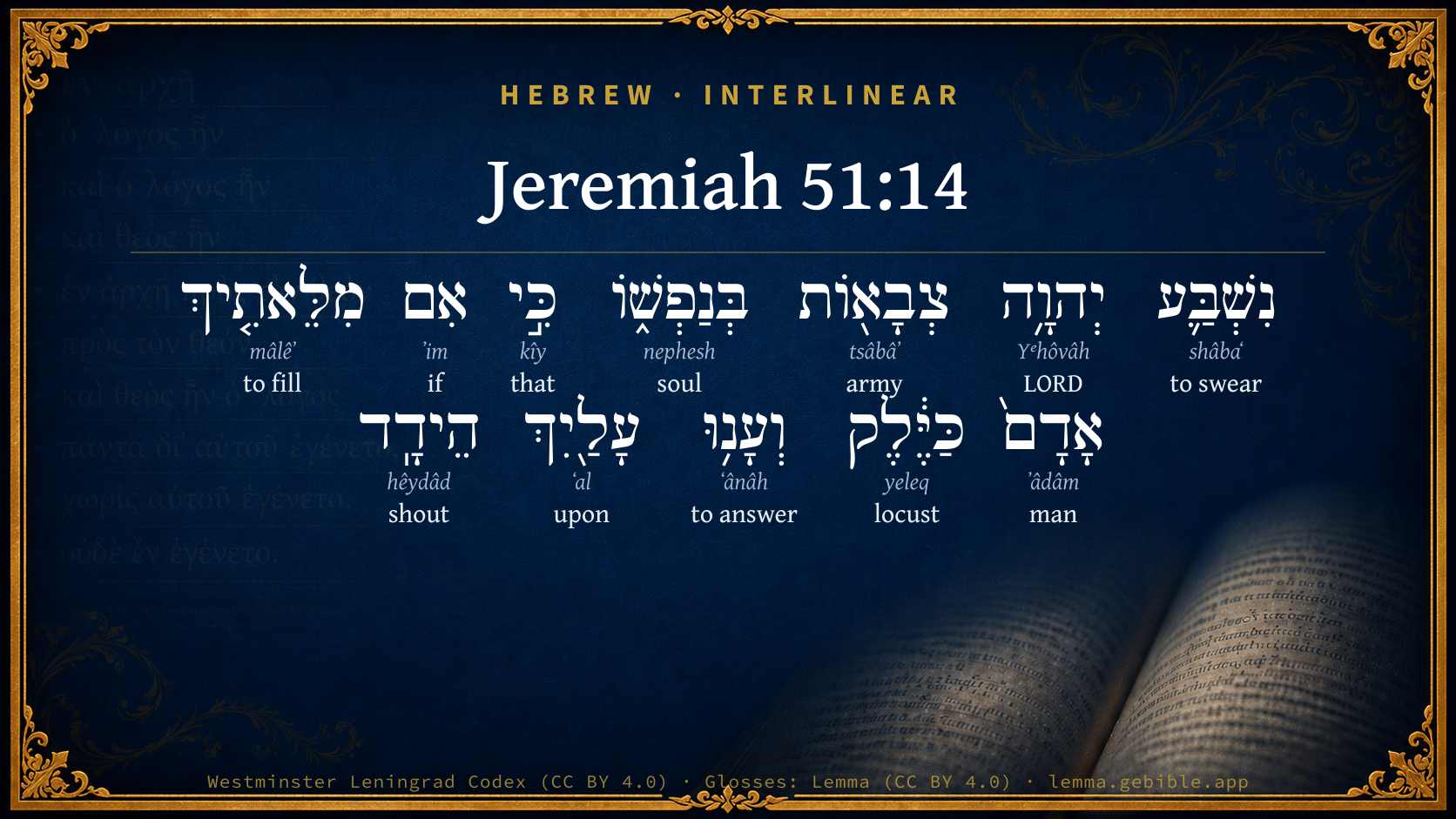
Hebrew (Westminster Leningrad Codex) Jeremiah 51:14 appears in the Hebrew Old Testament. The text above is from the Westminster Leningrad Codex. Each word links to its Strong’s number, a concise gloss, and parsing drawn from the Open Scriptures Hebrew Bible morphology. Click any word for its full Brown-Driver-Briggs (BDB) entry.
Download image
Cite this verse

Jeremiah 51:14 (World English Bible). Public Domain. Lemma interlinear Bible study tool, https://lemma.gebible.app/v/jeremiah/51/14.

Show BibTeX & RIS
BibTeX
RIS
English Translation
Yahweh of Hosts has sworn by himself, [saying], Surely I will fill you with men, as with the canker-worm; and they shall lift up a shout against you.
World English Bible · Public Domain
Download a study sheet

One document with this verse’s original text, its word-by-word gloss line, the meaning frame, cross-references with their text, attributed commentary, and full source and license credits — printable, and it pastes into notes with its structure intact.

This verse Autodidact and up

Study sheet (.html) Plain text (.txt)

A passage Seminary Student

Up to 50 verses in one chapter. A passage sheet keeps up to 6 commentary sources and 12 cross-references per verse, in the order this page ranks them, and says so on the sheet whenever that leaves anything out. Ask for a single verse and you get the Autodidact verse sheet above.

Everything on this page stays free to read, with no account — the sheet is a download of what is already on screen, not access to it.

Want to remove ads? Support Godless Engineer
Compare translations 3

The same verse in 3 English versions, stacked beneath the original-language interlinear above. Click any original word for its lexicon entry.

Each is an independent rendering of the whole verse — the interlinear is not word-aligned to these translations.

Highlighted words mark where these versions differ — a whole-verse word diff, not a word-by-word alignment.

  • World English Bible Public Domain
    Yahweh of Hosts has sworn by himself, [saying], Surely I will fill you with men, as with the canker-worm; and they shall lift up a shout against you.
  • King James Version Public Domain
    The LORD of hosts hath sworn by himself, saying, Surely I will fill thee with men, as with caterpillers; and they shall lift up a shout against thee.
  • unfoldingWord Literal Text CC BY-SA 4.0
    Yahweh of hosts has sworn by his own life, ‘I will fill you with men, like a swarm of locusts, and they will raise a battle cry against you.’

unfoldingWord Literal Text — © unfoldingWord, licensed CC BY-SA 4.0. Word-aligned USFM3 via Door43 (git.door43.org/unfoldingWord/en_ult).

Versions to compare (up to 4)

3 of 4 selected

Show all 18 translations

Every available English version of this verse, each an independent rendering of the whole verse.

  • World English Bible Public Domain
    Yahweh of Hosts has sworn by himself, [saying], Surely I will fill you with men, as with the canker-worm; and they shall lift up a shout against you.
  • Berean Standard Bible Public Domain
    The LORD of Hosts has sworn by Himself: “Surely I will fill you up with men as with locusts, and they will shout in triumph over you.”
  • Majority Standard Bible Public Domain
    The LORD of Hosts has sworn by Himself: “Surely I will fill you up with men as with locusts, and they will shout in triumph over you.”
  • King James Version Public Domain
    The LORD of hosts hath sworn by himself, saying, Surely I will fill thee with men, as with caterpillers; and they shall lift up a shout against thee.
  • American Standard Version (1901) Public Domain
    Jehovah of hosts hath sworn by himself, `saying', Surely I will fill thee with men, as with the canker-worm; and they shall lift up a shout against thee.
  • Revised Version (1885) Public Domain
    The LORD of hosts hath sworn by himself, saying, Surely I will fill thee with men, as with the cankerworm; and they shall lift up a shout against thee.
  • Geneva Bible (1599) Public Domain
    The Lord of hostes hath sworne by him selfe, saying, Surely I will fill thee with men, as with caterpillers, and they shall cry and shoute against thee.
  • Douay-Rheims (1899) Public Domain
    The Lord of hosts hath sworn by himself, saying: I will fill thee with men as with locusts, and they shall lift up a joyful shout against thee.
  • Young's Literal Translation Public Domain
    Sworn hath Jehovah of Hosts by Himself, That, Surely I have filled thee `with' men as the cankerworm, And they have cried against thee -- shouting.
  • Literal Standard Version CC BY-SA 4.0
    YHWH of Hosts has sworn by Himself, || That, Surely I have filled you [with] men as the cankerworm, || And they have cried against you—shouting.
  • Unlocked Literal Bible CC BY-SA 4.0
    Yahweh of hosts has sworn by his own life, 'I will fill you with men, like a swarm of locusts, and they will raise a battle cry against you.'
  • unfoldingWord Literal Text CC BY-SA 4.0
    Yahweh of hosts has sworn by his own life, ‘I will fill you with men, like a swarm of locusts, and they will raise a battle cry against you.’
  • Darby Bible Public Domain
    Jehovah of hosts hath sworn by himself, I will assuredly fill thee with men, as with caterpillars; and they shall raise a shout against thee.
  • World Messianic Bible Public Domain
    The LORD of Hosts has sworn by himself, saying, ‘Surely I will fill you with men, as with locusts, and they will lift up a shout against you.’
  • Webster's Bible Public Domain
    The LORD of hosts hath sworn by himself, saying, Surely I will fill thee with men, as with caterpillars; and they shall raise a shout against thee.
  • Free Bible Version CC BY-SA 4.0
    The Lord Almighty vowed by his own life, saying, I'm going to make sure to fill you with so many enemy soldiers they'll be like locusts. They will shout as they celebrate their victory over you.
  • Bible in Basic English Public Domain
    The Lord of armies has taken an oath by himself, saying, Truly, I will make you full with men as with locusts, and their voices will be loud against you.
  • JPS Tanakh (1917) Public Domain
    The LORD of hosts hath sworn by Himself: Surely I will fill thee with men, as with the canker-worm, and they shall lift up a shout against thee.

Literal Standard Version (2020), Covenant Press — licensed CC BY-SA 4.0. Text via the HelloAO Bible API (eBible.org). Unlocked Literal Bible (unfoldingWord) — licensed CC BY-SA 4.0. Text via the HelloAO Bible API (eBible.org). unfoldingWord Literal Text — © unfoldingWord, licensed CC BY-SA 4.0. Word-aligned USFM3 via Door43 (git.door43.org/unfoldingWord/en_ult). Free Bible Version, Dr. Jonathan Gallagher — licensed CC BY-SA 4.0. Text via the HelloAO Bible API (eBible.org).

Word by word

More ways to search: Search by grammar → Find every occurrence → Compare this word →

Practice this passage: Drill this verse → Learn its vocabulary →

הֵידָֽד
hêydâd
H1959
“shout”
Noun, Common, Masculine, Singular, Absolute
Part of Speech
Noun
Type
Common
Gender
Masculine
Number
Singular
State
Absolute
Full BDB Definition

Origin: from an unused root (meaning to shout)

TWOT: 471a

a shout, cheer, shouting - shouting - shout (of the foe)
  1. נִשְׁבַּ֛ע shâbaʻ H7650 “to swear” Verb, Niphal, Perfect, 3rd Person, Masculine, Singular
  2. יְהוָ֥ה Yᵉhôvâh H3068 “LORD” Noun, Proper
  3. צְבָא֖וֹת tsâbâʼ H6635 “armies” Noun, Common, Both, Plural, Absolute
  4. בְּנַפְשׁ֑וֹ nephesh H5315 “in/at · soul · his” Preposition + Noun, Common, Both, Singular, Construct + Suffix, Personal, 3rd Person, Masculine, Singular
  5. כִּ֣י kîy H3588 “that” Conjunction
  6. אִם ʼim H518 “if” Conjunction
  7. מִלֵּאתִ֤יךְ mâlêʼ H4390 “to fill · you” Verb, Piel, Perfect, 1st Person, Common, Singular + Suffix, Personal, 2nd Person, Feminine, Singular
  8. אָדָם֙ ʼâdâm H120 “man” Noun, Common, Masculine, Singular, Absolute
  9. כַּיֶּ֔לֶק yeleq H3218 “like/as the · locust” Preposition, Determined + Noun, Common, Masculine, Singular, Absolute
  10. וְעָנ֥וּ ʻânâh H6030 “and · to answer” Conjunction + Verb, Qal, Sequential Perfect, 3rd Person, Common, Plural
  11. עָלַ֖יִךְ ʻal H5921 “upon · you” Preposition + Suffix, Personal, 2nd Person, Feminine, Singular

About this verse

These counts appear in no published source. They are computed here, from the morphology-tagged text and Lemma’s own curated glosses. What Lemma adds →

12
words
12
distinct lemmas
Prophets
section

Notable vocabulary

The rarest word here is הֵידָֽד shout H1959 — appearing just 7 times in the whole Hebrew Bible.

Shared distinctive vocabulary

הֵידָֽד shout H1959 occurs in 5 verses of the Hebrew Bible. Also found in:

Grammatical profile

  • 3 verbs
  • 6 nouns
  • 1 preposition
  • 2 conjunctions

Verb forms

  • נִשְׁבַּ֛ע Niphal · Perfect
  • מִלֵּאתִ֤יךְ Piel · Perfect
  • וְעָנ֥וּ Qal · Sequential Perfect

Cross-references

11

Topical passages linked to Jeremiah 51:14 in the Treasury of Scripture Knowledge — connected by theme and wording, ordered by reader-vote popularity; previews shown in the World English Bible.

  • Jeremiah 49:13 For I have sworn by myself, says Yahweh, that Bozrah shall become an astonishment, a reproach, a waste, and a curse; and all the cities of it shall be perpetual wastes.
  • Jeremiah 50:15 Shout against her round about: she has submitted herself; her bulwarks are fallen, her walls are thrown down; for it is the vengeance of Yahweh: take vengeance on her; as she has done, do to her.
  • Joel 2:25 I will restore to you the years that the swarming locust has eaten, The great locust, the grasshopper, and the caterpillar, My great army, which I sent among you.
  • Amos 6:8 "The Lord Yahweh has sworn by himself," says Yahweh, the God of hosts: "I abhor the pride of Jacob, And detest his fortresses. Therefore I will deliver up the city with all that is in it.
  • Judges 6:5 For they came up with their cattle and their tents; they came in as locusts for multitude; both they and their camels were without number: and they came into the land to destroy it.
  • Jeremiah 46:23 They shall cut down her forest, says Yahweh, though it can't be searched; because they are more than the locusts, and are innumerable.
  • Jeremiah 51:27 Set up a standard in the land, blow the trumpet among the nations, prepare the nations against her, call together against her the kingdoms of Ararat, Minni, and Ashkenaz: appoint a marshal against her; cause the horses to come up as the rough canker-worm.
  • Joel 1:4–7 What the swarming locust has left, the great locust has eaten. What the great locust has left, the grasshopper has eaten. What the grasshopper has left, the caterpillar has eaten.
  • Joel 2:3–4 A fire devours before them, And behind them, a flame burns. The land is as the garden of Eden before them, And behind them, a desolate wilderness. Yes, and no one has escaped them.
  • Nahum 3:15–17 There the fire will devour you. The sword will cut you off. It will devour you like the grasshopper. Multiply like grasshoppers. Multiply like the locust.
  • Hebrews 6:13 For when God made a promise to Abraham, since he could swear by none greater, he swore by himself,

Cross-references courtesy of OpenBible.info (CC BY 4.0).

Hebrew and Greek witnesses Masoretic Hebrew ↔ Greek Septuagint

The same verse in the two great witnesses to the Old Testament, shown verse-for-verse.

These are two independent witnesses, not word-aligned to each other, and the Septuagint is shown in lemma (dictionary) form.

Hebrew Jeremiah 51:14 Masoretic · Westminster Leningrad Codex

נִשְׁבַּ֛ע יְהוָ֥ה צְבָא֖וֹת בְּנַפְשׁ֑וֹ כִּ֣י אִם מִלֵּאתִ֤יךְ אָדָם֙ כַּיֶּ֔לֶק וְעָנ֥וּ עָלַ֖יִךְ הֵידָֽד

Yahweh of Hosts has sworn by himself, [saying], Surely I will fill you with men, as with the canker-worm; and they shall lift up a shout against you.

World English Bible · Public Domain

Greek LXX Structure differs

In the Septuagint, Jeremiah is about an eighth shorter than the Hebrew and arranges its material differently — the Oracles Against the Nations (Hebrew chapters 46–51) appear in the middle of the Greek book, after 25:13. Because the chapter and verse boundaries do not line up, a verse-for-verse comparison with the Hebrew is not shown.

A verse-for-verse comparison isn’t shown here because the chapters and verses don’t line up. Switch to the LXX edition with the MT / LXX toggle above to read the Greek directly.

On this verse, Haydock's Catholic Bible Commentary discusses the Septuagint’s reading. Read the note in Commentary ↓

Hebrew: Westminster Leningrad Codex (CC BY 4.0). Greek: Septuagint (public domain); English from a public-domain English Septuagint. How the Septuagint differs from the Hebrew →

Targum (Aramaic paraphrase)

1

The Targum is the ancient Jewish Aramaic paraphrase of the Hebrew Scriptures — an interpretive translation, not the Hebrew text itself. Onkelos (literal) and Pseudo-Jonathan (expansive) render the Torah, and Jonathan the Prophets. Coverage is partial: where no permissively-licensed English translation exists for a verse, only the Aramaic is shown. This is verse-level text, not a word-by-word alignment to the Hebrew.

  1. Targum Jonathan Prophets (Joshua–Malachi)
    קַיָם יְיָ צְבָאוֹת בְּמֵימְרֵיהּ אֱלָהֵין אֲמַלִינִיךְ מַשִׁרְיַת עַמְמִין סַגִיאִין כְּזַחֲלָא וִירִימוּן עֲלָךְ קָלְהוֹן:

    (no public-domain English translation for this verse)

    Targum Jonathan — Aramaic: “Mikraot Gedolot” (public domain). English: “Sefaria Community Translation” (CC0 1.0 (public-domain dedication)); “London "Chaldee Paraphrase," 1871” (public domain). Text via Sefaria.

Commentary

Notes on Jeremiah 51:14 from classic Christian and Jewish commentators (each source and its license shown beneath its notes). The classic Christian expositions comment on the surrounding passage and are grouped to its opening verse, so a note may address several verses; the Jewish commentaries on the Tanakh (Rashi and others) are per-verse, so they appear only where the commentator wrote on this verse.

Lemma curates 59 commentaries, every one of them public domain or Creative Commons licensed, each selected and text-cleaned for this edition rather than reprinted as found. About our sources →

Trapp's Complete Commentary

John Trapp

Jer 51:14 The LORD of hosts hath sworn by himself, [saying], Surely I will fill thee with men, as with caterpillers; and they shall lift up a shout against thee.

Ver. 14. Surely I will fill thee with men as with caterpillers.] So they shall seem both for multitude and humming noise, barritu militari.

They shall lift up a shout against thee.] As peasants did at their harvest home. See Jer 48:33.

John Trapp, A Commentary or Exposition upon All the Books of the Old and New Testament (1647–1656) — public domain. Text from a community e-Sword module.

Geneva Bible (1599)

Geneva Bible translators

Hebrew, his soul.

Geneva Bible (1599) marginal notes — public domain. Text via Bolls.life.

Jamieson, Fausset & Brown

Robert Jamieson, A. R. Fausset & David Brown

by himself--literally, "by His soul" (Sa2 15:21; Heb 6:13).

fill . . . with caterpillars--locusts (Nah 3:15). Numerous as are the citizens of Babylon, the invaders shall be more numerous.

Jamieson, Fausset & Brown — Commentary Critical and Explanatory on the Whole Bible (1871) — public domain (CC PDM 1.0). Text via the HelloAO Bible API.

Adam Clarke's Commentary

Verse 14. I will fill thee with men] By means of these very waters through the channel of thy boasted river, thou shalt be filled with men, suddenly appearing as an army of locusts; and, without being expected, shall lift up a terrific cry, as soon as they have risen from the channel of the river.

Adam Clarke's Commentary on the Bible (1810–1826) — public domain. Text from a community e-Sword/MySword module.

John Calvin's Commentaries

The Prophet more fully confirms what he had said by introducing God as making an oath; and it is the most solemn manner of confirmation when God swears by his own name. But he speaks of God in the language of men when he says that he swears by his own soul; for it is a kind of protestation when men swear by their own souls, as though they laid down or pledged their own life. Whoever then swears by his own soul, means that as his own life is dear to him, he thus lays it down as a pledge, that were he to deceive by perjury, God would be an avenger and take it away. This is suitable to men, not to God; but what does not properly belong to God is transferred to him; nor is this uncommon, as we have seen it in other places. And the more familiar is the manner of speaking adopted by God, the more it ought to touch men when he makes himself like them, and in a manner assumes their person as though he lived in the midst of them.

But we must still remember why the Prophet introduces God as making an oath, even that all doubtfulness might be removed, and that more credit might be given to his prophecy; for it not only proceeded from God, but was also sealed by an oath. If I shall not fill Babylon, he says, with men as with locusts

The multitude of enemies is here opposed to the multitude of the citizens, which was very large. For we have said elsewhere that Babylon surpassed all other cities, nor was it less populous than if it were all extensive country. As then it was full of so many defenders, it might have been objected and said, “Whence can come such a number of enemies as can be sufficient to put to flight the inhabitants? for were a large army to enter, it would yet be in great danger in contending with so vast a multitude.” But the Prophet compares here the Persians and the Medes to locusts; and we know that Cyrus collected from various nations a very large army, nay, many armies. Fulfilled then was what had been predicted by the Prophet, for Cyrus made up his forces not only from one people, but he brought with him almost all the Medes, and also led many troops from other barbarous nations. Hence then it happened, that what had been said by Jeremiah was proved by the event.

He also adds, that they would be victorious; for by the vintage song, or shout, he no doubt means a song or shout of triumph. But this song, הידד, eidad, was then in use among the Jews. Then as they did after vintage sing in token of joy, so also conquerors, exulting after victory over their enemies, had a triumphant song. And the Greek translators have rendered it κέλευσμα, or κελευμα, which is properly the song of sailors; when they see the harbor they exult with joy and sing, because they have been delivered from the dangers of the Sea, and also have completed their sailing, which is always perilous, and have come to the harbor where they more fully enjoy life, where they have pleasant air, wholesome water, and other advantages. But the simple meaning of the Prophet is, that when the Persians and the Medes entered Babylon, they would become immediately victorious, so that they would exult without a contest and without any toil, and sing a song of triumph. The Prophet now confirms his prophecy in another way, even by extolling the power of God, —

John Calvin's Commentaries (1540-1563) — public domain. Text from the Calvin Translation Society English edition (1840s-50s) via the Christian Classics Ethereal Library (ccel.org). Calvin's coverage is partial (roughly two-thirds of the Bible); uncommented books and verses are honest gaps, never fabricated. The 19th-century editor's footnotes and remarks are omitted so the notes are faithfully Calvin's own voice.

Ellicott's Commentary for English Readers

(14) The Lord of hosts hath sworn by himself.—This is, as in Jer_49:13; Amo_6:8, the most solemn form of affirmation. Compare Heb_6:13, and Note on Jer_49:13.

Surely I will fill thee with men, as with Caterpillers.—Better, with grasshoppers or locusts, the fullest type of the swarms of the destroyer (Nah_3:15). The “Surely” answers to the Hebrew “For if,” as giving the condition on which the shouting depends.

They shall lift up a shout against thee.—The thought is the same as in Jer_25:30. The “shout” is that of those who tread the grapes in the wine-press, and that, as in Isa_63:2-3, is the received symbol of conquest and destruction.

A Bible Commentary for English Readers, edited by Charles John Ellicott (1878–1897) — public domain. Text from a community e-Sword module.

The Cambridge Bible for Schools and Colleges

gen. ed. J. J. S. Perowne

14. I will fill, etc.] rather, Though I have filled thee (better, thou art filled) with men (i.e. innumerable inhabitants), as with locusts (viz. in point of numbers), they (the assailants) shall lift up, etc.

cankerworm] the locust in its early (pupa) stage. Cp. Jer_51:27, where see note.

a shout] the vintage song, See on Jer_25:30.

The Cambridge Bible for Schools and Colleges (gen. ed. J. J. S. Perowne; Cambridge University Press, 1878–1918) — public domain. Text from a community e-Sword module.

John Gill's Exposition

The Lord hath sworn by himself, saying,.... Or, "by his soul" or "life" (q); which is himself, than which he cannot swear by a greater, Heb 6:13; and the certain performance of what he swears unto need not be doubted of; and indeed the design of the oath is to assure of the truth of the thing, about which, after this, there ought to be no hesitation:

surely I fill thee with men as with caterpillars; or "locusts" (r); march in vast numbers, and make sad desolation where they come; and to which a numerous army may fitly be compared; and which are here meant, even the army of Cyrus, that should enter Babylon, and fill it, as it did. So the Targum,

"the Lord of hosts hath sworn by his word, if I fill them with armies of many people as locusts:''

and they shall lift up a shout against thee; as soldiers, when they make the onset in battle; or as besiegers, when they make their attack on a city; or as when grape gatherers bring in their vintage, or tread out their wine, to which the allusion is: it signifies that her enemies should get an entire victory, and triumph over her.

(q) "per animam suam", Pagninus, Cocceius, Schmidt. (r) "ut, vel quasi brucho", V. L. Cocceius, Montanus, Grotius, Schmidt.

John Gill's Exposition of the Whole Bible (1746–1763) — public domain (CC PDM 1.0). Text via the HelloAO Bible API.

Albert Barnes' Notes on the Bible

Rather, “Surely I have filled thee with men as with locusts, and they shall sing over thee the vintage-song.” The vintage-shout suggests the idea of trampling Babylon under foot, as the vintagers trample the grapes; a metaphor of the divine wrath.

Albert Barnes' Notes on the Bible (1834–1885) — public domain. Text from a community e-Sword/MySword module.

Haydock's Catholic Bible Commentary

Himself. Septuagint, "his hand" lifted up, or by his power. --- Locusts. Their ravages were equally dreaded, Joel ii. 4., and Judges vi. 5.

George Leo Haydock (1774–1849), Haydock's Catholic Family Bible and Commentary, 1859 edition — public domain. Excludes Psalms (Douay-Rheims chapter numbering differs from Protestant) and Deuterocanonical books (Catholic canon only).

Matthew Poole's English Annotations

The Lord, that is able to bring to pass what he saith, hath sworn by his life, or by himself; see the like phrase Jer 22:5; 44:26; 49:13 Amo 4:2; 6:8; Isa 45:23; that is, the thing next mentioned shall come to pass as certainly as that there is a God in heaven, or that God liveth.

Surely I will fill thee with men, as with caterpillars; I will bring against thee a great army, that shall be like a swarm of caterpillars, and shall come against thee in such numbers as caterpillars use to come, and for the same end, to eat thee up and destroy thee; and as soldiers use do when they go on to fight their enemies, or to assault cities, they shall make a great shout against thee.

Matthew Poole's English Annotations on the Holy Bible (1683–1685) — public domain. Text from a community e-Sword/MySword module.

Whedon's Commentary on the Bible

Daniel D. Whedon

14. The Lord of hosts hath sworn — The solemnity of oathtaking is employed in announcing this destruction.

By himself — The margin is more exactly literal and more expressive, by his soul.

Caterpillars — Rather, locusts.

Shall lift up a shout — Literally, the vintage song. The “vintage song” is, in the nature of the case, a battle song, and suggests that the men with which Babylon is filled, trample her under foot, thus executing the wrath of God upon her.

Daniel D. Whedon (gen. ed.), Commentary on the Old and New Testaments (1874–1909) — public domain. Text from a community e-Sword module.

The Pulpit Commentary

Surely I will fill thee, etc. This is the rendering of Hitzig and Graf; the enemies are compared to locusts, as in Jer_46:23. But the expression, "to fill a city with men," is more naturally taken of the increase of the population of the city; and it is better to render, with Ewald and Keil, "Even though or, "Surely even though I have filled thee with men, as with locusts, they shall raise over thee the cheer of the vintage;" i.e. the millions of Babylon"s population will not save her from the most utter ruin. For the vintage cheer, see on Jer_25:30; and for the figures, see especially, Isa_63:1-6.

The Pulpit Commentary (1880–1919), ed. H.D.M. Spence-Jones & Joseph S. Exell — public domain. Text from a community e-Sword module.

Rashi

Rabbi Shlomo Yitzchaki (Rashi)

by Himself (en soi meme in French.)

indeed Heb. כי אם, an expression of ‘in truth.’

I have...filled you with men I will fill you with camps of peoples, as many as locusts.

and they shall raise a battle- cry against you And they shall raise their voice against you.

Rashi on the Tanakh — English translations: “The Judaica Press complete Tanach with Rashi, translated by A. J. Rosenberg” (CC BY 4.0); “Pentateuch with Rashi's commentary by M. Rosenbaum and A.M. Silbermann, 1929-1934” (public domain); “The Metsudah Tanach series, Lakewood, N.J” (CC BY 4.0); and “The Book of Joshua, Metsudah Publications, 1997” (CC BY 4.0). Text via Sefaria.

Lesson kit

Teaching starters — assembled from the data on this page, not authored interpretation. Every prompt links to the verse data it draws on. Edit before teaching.

Jeremiah, in the Prophets, opens this verse with 12 words (12 distinct Hebrew lemmas). Its most distinctive word is hêydâd (“shout”). A historical commentator’s framing appears above. Read the whole chapter for the surrounding context.

Discussion questions

  1. How does “shout” (hêydâd) shape what this verse is saying?
  2. Isaiah 16:9 shares the word «shout» with this verse. How do the two illuminate each other?
  3. These translations render this verse differently; the difference is in the English rendering, not the original. What questions does that raise?
  4. The verb «נִשְׁבַּ֛ע» is Niphal Perfect. How does its form color the action?
  5. Reading how Trapp's Complete Commentary and Geneva Bible (1599) read this verse, where do the two commentators agree and where do they part?

Things to notice

Reading settings

Reading text

Shown beneath each verse's original-language words.

Old Testament
Old Testament edition

Read the OT as the Masoretic Hebrew (MT) or the Greek Septuagint (LXX).

English shown for the Greek Septuagint (in the Hebrew ↔ Greek comparison).

Comparing translations? Open the Compare panel on any verse page to stack up to four side by side.