

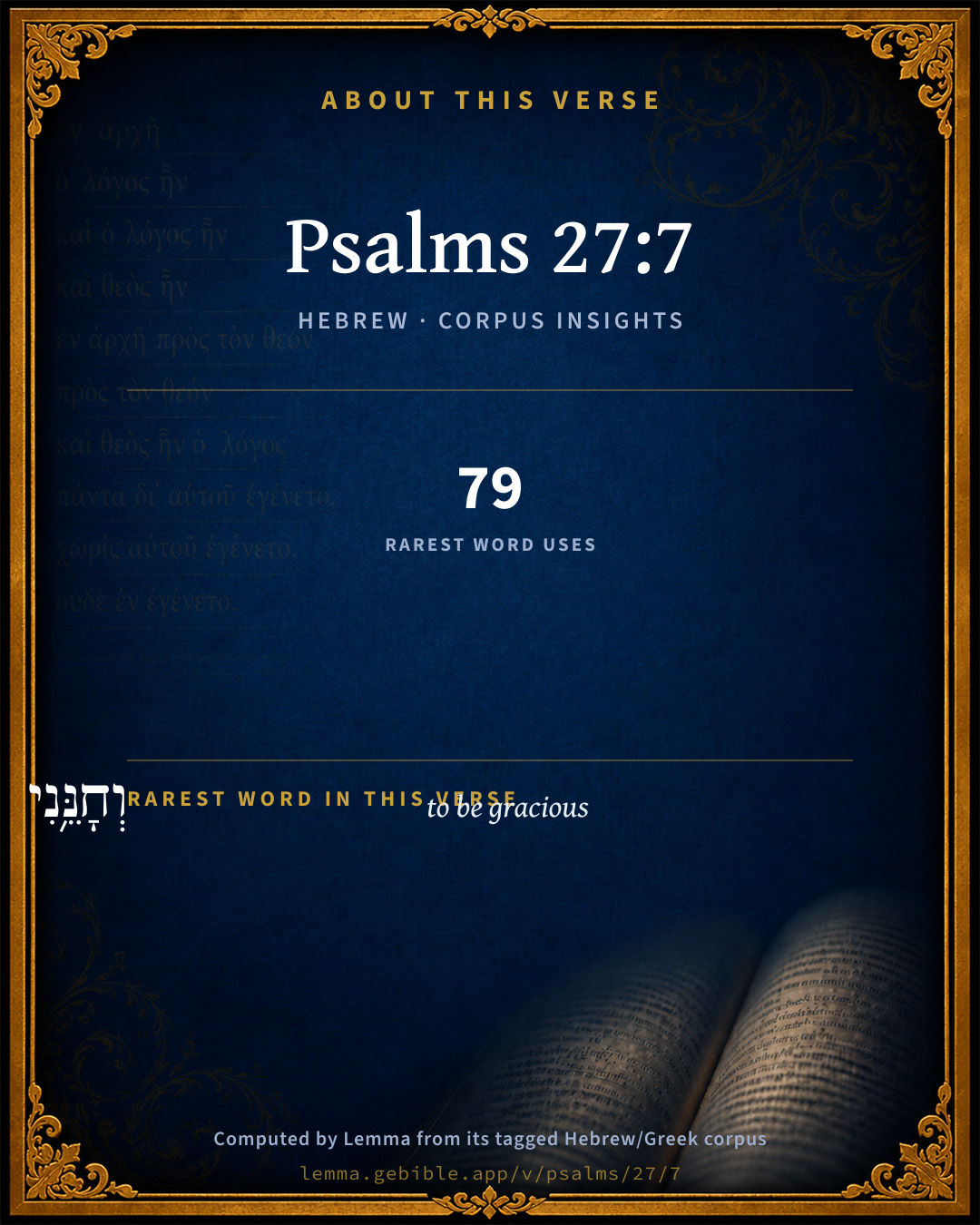
Psalms 27:7

Hebrew (Westminster Leningrad Codex) Psalms 27:7 appears in the Hebrew Old Testament. The text above is from the Westminster Leningrad Codex. Each word links to its Strong’s number, a concise gloss, and parsing drawn from the Open Scriptures Hebrew Bible morphology. Click any word for its full Brown-Driver-Briggs (BDB) entry.
Download image
Cite this verse

Psalms 27:7 (World English Bible). Public Domain. Lemma interlinear Bible study tool, https://lemma.gebible.app/v/psalms/27/7.

Show BibTeX & RIS
BibTeX
RIS
English Translation
Hear, Yahweh, when I cry with my voice. Have mercy also on me, and answer me.
World English Bible · Public Domain
Download a study sheet

One document with this verse’s original text, its word-by-word gloss line, the meaning frame, cross-references with their text, attributed commentary, and full source and license credits — printable, and it pastes into notes with its structure intact.

This verse Autodidact and up

Study sheet (.html) Plain text (.txt)

A passage Seminary Student

Up to 50 verses in one chapter. A passage sheet keeps up to 6 commentary sources and 12 cross-references per verse, in the order this page ranks them, and says so on the sheet whenever that leaves anything out. Ask for a single verse and you get the Autodidact verse sheet above.

Everything on this page stays free to read, with no account — the sheet is a download of what is already on screen, not access to it.

Want to remove ads? Support Godless Engineer
Compare translations 3

The same verse in 3 English versions, stacked beneath the original-language interlinear above. Click any original word for its lexicon entry.

Each is an independent rendering of the whole verse — the interlinear is not word-aligned to these translations.

Highlighted words mark where these versions differ — a whole-verse word diff, not a word-by-word alignment.

  • World English Bible Public Domain
    Hear, Yahweh, when I cry with my voice. Have mercy also on me, and answer me.
  • King James Version Public Domain
    Hear, O LORD, when I cry with my voice: have mercy also upon me, and answer me.
  • unfoldingWord Literal Text CC BY-SA 4.0
    Hear, Yahweh, my voice I cry out, and be gracious to me, and answer me.

unfoldingWord Literal Text — © unfoldingWord, licensed CC BY-SA 4.0. Word-aligned USFM3 via Door43 (git.door43.org/unfoldingWord/en_ult).

Versions to compare (up to 4)

3 of 4 selected

Show all 18 translations

Every available English version of this verse, each an independent rendering of the whole verse.

  • World English Bible Public Domain
    Hear, Yahweh, when I cry with my voice. Have mercy also on me, and answer me.
  • Berean Standard Bible Public Domain
    Hear, O LORD, my voice when I call; be merciful and answer me.
  • Majority Standard Bible Public Domain
    Hear, O LORD, my voice when I call; be merciful and answer me.
  • King James Version Public Domain
    Hear, O LORD, when I cry with my voice: have mercy also upon me, and answer me.
  • American Standard Version (1901) Public Domain
    Hear, O Jehovah, when I cry with my voice: Have mercy also upon me, and answer me.
  • Revised Version (1885) Public Domain
    Hear, O LORD, when I cry with my voice: have mercy also upon me, and answer me.
  • Geneva Bible (1599) Public Domain
    Hearken vnto my voyce, O Lord, when I crie: haue mercie also vpon mee and heare mee.
  • Douay-Rheims (1899) Public Domain
    Hear, O Lord, my voice, with which I have cried to thee: have mercy on me and hear me.
  • Young's Literal Translation Public Domain
    Hear, O Jehovah, my voice -- I call, And favour me, and answer me.
  • Literal Standard Version CC BY-SA 4.0
    Hear, O YHWH, my voice—I call, || And favor me, and answer me.
  • Unlocked Literal Bible CC BY-SA 4.0
    Hear, Yahweh, my voice when I cry out! Have mercy on me, and answer me!
  • unfoldingWord Literal Text CC BY-SA 4.0
    Hear, Yahweh, my voice I cry out, and be gracious to me, and answer me.
  • Darby Bible Public Domain
    Hear, Jehovah; with my voice do I call; be gracious unto me, and answer me.
  • World Messianic Bible Public Domain
    Hear, LORD, when I cry with my voice. Have mercy also on me, and answer me.
  • Webster's Bible Public Domain
    Hear, O LORD, when I cry with my voice: have mercy also upon me, and answer me.
  • Free Bible Version CC BY-SA 4.0
    Listen to me, Lord, when I call for help. Be gracious and answer me.
  • Bible in Basic English Public Domain
    O Lord, let the voice of my cry come to your ears: have mercy on me, and give me an answer.
  • JPS Tanakh (1917) Public Domain
    Hear, O LORD, when I call with my voice, and be gracious unto me, and answer me.

Literal Standard Version (2020), Covenant Press — licensed CC BY-SA 4.0. Text via the HelloAO Bible API (eBible.org). Unlocked Literal Bible (unfoldingWord) — licensed CC BY-SA 4.0. Text via the HelloAO Bible API (eBible.org). unfoldingWord Literal Text — © unfoldingWord, licensed CC BY-SA 4.0. Word-aligned USFM3 via Door43 (git.door43.org/unfoldingWord/en_ult). Free Bible Version, Dr. Jonathan Gallagher — licensed CC BY-SA 4.0. Text via the HelloAO Bible API (eBible.org).

Word by word

More ways to search: Search by grammar → Find every occurrence → Compare this word →

Practice this passage: Drill this verse → Learn its vocabulary →

וְחָנֵּ֥נִי
chânan
H2603
“and · be gracious · me”
Conjunction + Verb, Qal, Imperative, 2nd Person, Masculine, Singular + Suffix, Personal, 1st Person, Common, Singular
Part of Speech
Conjunction + Verb
Stem
Qal
Form
Imperative
Person
2nd Person
Gender
Masculine
Number
Singular
Full BDB Definition

Origin: a primitive root [compare H2583 ]

TWOT: 694 , 695

to be gracious, show favour, pity - (Qal) to show favour, be gracious - (Niphal) to be pitied - (Piel) to make gracious, make favourable, be gracious - (Poel) to direct favour to, have mercy on - (Hophal) to be shown favour, be shown consideration - (Hithpael) to seek favour, implore favour - to be loathsome
  1. שְׁמַע shâmaʻ H8085 “hear” Verb, Qal, Imperative, 2nd Person, Masculine, Singular
  2. יְהוָ֖ה Yᵉhôvâh H3068 “LORD” Noun, Proper
  3. קוֹלִ֥י qôwl H6963 “voice · my” Noun, Common, Masculine, Singular, Construct + Suffix, Personal, 1st Person, Common, Singular
  4. אֶקְרָ֗א qârâʼ H7121 “to call” Verb, Qal, Imperfect, 1st Person, Common, Singular
  5. וַעֲנֵֽנִי ʻânâh H6030 “and · answer · me” Conjunction + Verb, Qal, Imperative, 2nd Person, Masculine, Singular + Suffix, Personal, 1st Person, Common, Singular

About this verse

These counts appear in no published source. They are computed here, from the morphology-tagged text and Lemma’s own curated glosses. What Lemma adds →

6
words
6
distinct lemmas
Wisdom
section

Grammatical profile

  • 4 verbs
  • 2 nouns

Verb forms

  • שְׁמַע Qal · Imperative
  • אֶקְרָ֗א Qal · Imperfect
  • וְחָנֵּ֥נִי Qal · Imperative
  • וַעֲנֵֽנִי Qal · Imperative

Hebrew & Septuagint length

In English translation the verse runs 16 words from the Hebrew and 16 from the Septuagint (LXX English) — the same length.

A rough comparison of the two English renderings, which tokenize alike — not a word-level alignment.

Word counts can differ between the Hebrew and the Greek without any difference in meaning — e.g. the Hebrew direct-object marker אֵת has no separate Greek word, and Greek often adds the article ὁ.

Cross-references

5

Topical passages linked to Psalms 27:7 in the Treasury of Scripture Knowledge — connected by theme and wording, ordered by reader-vote popularity; previews shown in the World English Bible.

  • Psalms 130:2–4 Lord, hear my voice. Let your ears be attentive to the voice of my petitions.
  • Psalms 5:2 Listen to the voice of my cry, my King and my God; For to you do I pray.
  • Psalms 13:3 Behold, and answer me, Yahweh, my God. Give light to my eyes, lest I sleep in death;
  • Psalms 4:1 Answer me when I call, God of my righteousness. Give me relief from my distress. Have mercy on me, and hear my prayer.
  • Psalms 143:1–2 Hear my prayer, Yahweh. Listen to my petitions. In your faithfulness and righteousness, relieve me.

Cross-references courtesy of OpenBible.info (CC BY 4.0).

Hebrew and Greek witnesses Masoretic Hebrew ↔ Greek Septuagint

The same verse in the two great witnesses to the Old Testament, shown verse-for-verse.

You’re reading Greek Psalm 26 (Hebrew Psalm 27). The Septuagint counts the superscription, so verse numbers can differ from the Hebrew — chapter-level alignment, not verse-by-verse. Numbering follows Rahlfs.

These are two independent witnesses, not word-aligned to each other, and the Septuagint is shown in lemma (dictionary) form.

Hebrew Psalms 27:7 Masoretic · Westminster Leningrad Codex

שְׁמַע יְהוָ֖ה קוֹלִ֥י אֶקְרָ֗א וְחָנֵּ֥נִי וַעֲנֵֽנִי

Hear, Yahweh, when I cry with my voice. Have mercy also on me, and answer me.

World English Bible · Public Domain

Greek LXX Greek Psalm 26:7 Septuagint · lemma form

εἰςἀκούω κύριος ὁ φωνή ἐγώ ὅς ἐκκράζω ἐλεέω ἐγώ καί εἰςἀκούω ἐγώ

Hear, O Lord, my voice which I have uttered aloud: pity me, and listen to me.

LXX2012 (modern English Septuagint) · Public Domain

Hebrew: Westminster Leningrad Codex (CC BY 4.0). Greek: Septuagint (public domain); English from LXX2012 (modern English Septuagint) (Public Domain). How the Septuagint differs from the Hebrew →

Commentary

Notes on Psalms 27:7 from classic Christian and Jewish commentators (each source and its license shown beneath its notes). The classic Christian expositions comment on the surrounding passage and are grouped to its opening verse, so a note may address several verses; the Jewish commentaries on the Tanakh (Rashi and others) are per-verse, so they appear only where the commentator wrote on this verse.

Lemma curates 59 commentaries, every one of them public domain or Creative Commons licensed, each selected and text-cleaned for this edition rather than reprinted as found. About our sources →

Matthew Henry's Commentary

David in these verses expresses,

I. His desire towards God, in many petitions. If he cannot now go up to the house of the Lord, yet, wherever he is, he can find a way to the throne of grace by prayer.

1. He humbly bespeaks, because he firmly believes he shall have, a gracious audience: "Hear, O Lord, when I cry, not only with my heart, but, as one in earnest, with my voice too." He bespeaks also an answer of peace, which he expects, not from his own merit, but God's goodness: Have mercy upon me, and answer me, Psa 27:7. If we pray and believe, God will graciously hear and answer.

2. He takes hold of the kind invitation God had given him to this duty, Psa 27:8. It is presumption for us to come into the presence of the King of kings uncalled, nor can we draw near with any assurance unless he hold forth to us the golden sceptre. David therefore going to pray fastens, in his thoughts, upon the call God had given him to the throne of his grace, and reverently touches, as it were, the top of the golden sceptre which was thereby held out to him. My heart said unto thee (so it begins in the original) or of thee, Seek you my face; he first revolved that, and preached that over again to himself (and that is the best preaching: it is hearing twice what God speaks once) - Thou saidst (so it may be supplied), Seek you my face; and then he returns what he had so meditated upon, in this pious resolution, Thy face, Lord, will I seek. Observe here, (1.) The true nature of religious worship; it is seeking the face of God. This it is in God's precept: Seek you my face; he would have us seek him for himself, and make his favour our chief good; and this it is in the saint's purpose and desire: "Thy face, Lord, will I seek, and nothing less will I take up with." The opening of his hand will satisfy the desire of other living things (Psa 145:16), but it is only the shining of his face that will satisfy the desire of a living soul, Psa 4:6, Psa 4:7. (2.) The kind of invitation of a gracious God to this duty: Thou saidst, Seek you my face; it is not only permission, but a precept; and his commanding us to seek implies a promise of finding; for he is too kind to say, Seek you me in vain. God calls us to seek his face in our conversion to him and in our converse with him. He calls us, by the whispers of his Spirit to and with our spirits, to seek his face; he calls us by his word, by the stated returns of opportunities for his worship, and by special providences, merciful and afflictive. When we are foolishly making our court to lying vanities God is, in love to us, calling us in him to seek our own mercies. (3.) The ready compliance of a gracious soul with this invitation. The call is immediately returned: My heart answered, Thy face, Lord, will I seek. The call was general; "Seek you my face;" but, like David, we must apply it to ourselves, "I will seek it." The word does us no good when we transfer it to others, and do not ourselves accept the exhortation. The call was, Seek you my face; the answer is express, Thy face, Lord, will I seek; like that (Jer 3:22), Behold, we come unto thee. A gracious heart readily echoes to the call of a gracious God, being made willing in the day of his power.

3. He is very particular in his requests. (1.) For the favour of God, that he might not be shut out from that (Psa 27:9): "Thy face, Lord, will I seek, in obedience to thy command; therefore hide not thy face from me; let me never want the reviving sense of the favour; love me, and let me know that thou lovest me; put not thy servant away in anger." He owns he had deserved God's displeasure, but begs that, however God might correct him, he would not cast him away from his presence; for what is hell but that? (2.) For the continuance of his presence with him: "Thou hast been my help formerly, and thou are the God of my salvation; and therefore whither shall I go but to thee? O leave me not, neither forsake me; withdraw not the operations of they power from me, for then I am helpless; withdraw not the tokens of thy good-will to me, for then I am comfortless." (3.) For the benefit of divine guidance (Psa 27:11): "Teach me thy way, O Lord! give me to understand the meaning of thy providences towards me and make them plain to me; and give me to know my duty in every doubtful case, that I may not mistake it, but may walk rightly, and that I may not do it with hesitation, but may walk surely." It is not policy, but plainness (that is, downright honesty) that will direct us into and keep us in the way of our duty. He begs to be guided in a plain path, because of his enemies, or (as the margin reads it) his observers. His enemies watched for his halting, that they may find occasion against him. Saul eyed David, Sa1 18:9. This quickened him to pray, "Lord, lead me in a plain path, that they may have nothing ill, or nothing that looks ill, to lay to my charge." (4.) For the benefit of a divine protection (Psa 27:12): "Deliver me not over to the will of my enemies. Lord, let them not gain their point, for it aims at my life, and no less, and in such a way as that I have no fence against them, but thy power over their consciences; for false witnesses have risen up against me, that aim further than to take away my reputation or estate, for they breathe out cruelty; it is the blood, the precious blood, they thirst after." Herein David was a type of Christ; for false witnesses rose up against him, and such as breathed out cruelty; but though he was delivered into their wicked hands, he was not delivered over to their will, for they could not prevent his exaltation.

II. He expresses his dependence upon God,

1. That he would help and succour him when all other helps and succours failed him (Psa 27:10): "When my father and my mother forsake me, the nearest and dearest friends I have in the world, from whom I may expect most relief and with most reason, when they die, or are at a distance from me, or are disabled to help me in time of need, or are unkind to me or unmindful of me, and will not help me, when I am as helpless as ever poor orphan was that was left fatherless and motherless, then I know the Lord will take me up, as a poor wandering sheep is taken up, and saved from perishing." His time to help those that trust in him is when all other helpers fail, when it is most for his honour and their comfort. With him the fatherless find mercy. This promise has often been fulfilled in the letter of it. Forsaken orphans have been taken under the special care of the divine Providence, which has raised up relief and friends for them in a way that one would not have expected. God is a surer and better friend than our earthly parents are or can be.

2. That in due time he should see the displays of his goodness, Psa 27:13. He believed he should see the goodness of the Lord in the land of the living; and, if he had not done so, he would have fainted under his afflictions. Even the best saints are subject to faint when their troubles become grievous and tedious, their spirits are overwhelmed, and their flesh and heart fail. But then faith is a sovereign cordial; it keeps them from desponding under their burden and from despairing of relief, keeps them hoping, and praying, and waiting, and keeps up in them good thoughts of God, and the comfortable enjoyment of themselves. But what was it the belief of which kept David from fainting? - that he should see the goodness of the Lord, which now seemed at a distance. Those that walk by faith in the goodness of the Lord shall in due time walk in the sight of that goodness. This he hopes to see in the land of the living, that is, (1.) In this world, that he should outlive his troubles and not perish under them. It is his comfort, not so much that he shall see the land of the living as that he shall see the goodness of God in it; for that is the comfort of all creature-comforts to a gracious soul. (2.) In the land of Canaan, and in Jerusalem where the lively oracles were. In comparison with the heathen, that were dead in sin, the land of Israel might fitly be called the land of the living; there God was known, and there David hoped to see his goodness; see Sa2 15:25, Sa2 15:26. Or, (3.), In heaven. It is that alone that may truly be called the land of the living, where there is no more death. This earth is the land of the dying. There is nothing like the believing hope of eternal life, the foresights of that glory, and foretastes of those pleasures, to keep us from fainting under all the calamities of this present time.

3. That in the mean time he should be strengthened to bear up under his burdens (Psa 27:14); whether he says it to himself, or to his friends, it comes all to one; this is that which encourages him: He shall strengthen thy heart, shall sustain thy spirit, and then the spirit shall sustain the infirmity. In that strength, (1.) Keep close to God and to your duty. Wait on the Lord by faith, and prayer, and a humble resignation to his will; wait, I say, on the Lord; whatever you do, grow not remiss in your attendance upon God. (2.) Keep up your spirits in the midst of the greatest dangers and difficulties: Be of good courage; let your hearts be fixed, trusting in God, and your minds stayed upon him, and then let none of these things move you. Those that wait upon the Lord have reason to be of good courage.

Matthew Henry's Commentary on the Whole Bible (1708–1710) — public domain (CC PDM 1.0). Text via the HelloAO Bible API.

Ellicott's Commentary for English Readers

(7) The change of tone so marked here, from the warlike to the plaintive, leads to the supposition that Psa_27:7-12 are interpolated from another song of quite another kind in contents, art, and period.

I cry with my voice—i.e., aloud.

A Bible Commentary for English Readers, edited by Charles John Ellicott (1878–1897) — public domain. Text from a community e-Sword module.

Trapp's Complete Commentary

John Trapp

Psa 27:7 Hear, O LORD, [when] I cry with my voice: have mercy also upon me, and answer me.

Ver. 7. Hear, O Lord, when I cry] This was his form of prayer, or to this effect, when he was in any distress or danger. As a good soldier of Jesus Christ, he had weapons, not only defensive (the shield of faith, helmet of hope, breastplate of righteousness, &c., as Eph 6:14-18), but also offensive, viz. the darts of prayer, as here, and the sword of the Spirit, the word of God, as in the next.

John Trapp, A Commentary or Exposition upon All the Books of the Old and New Testament (1647–1656) — public domain. Text from a community e-Sword module.

The Biblical Illustrator

Joseph S. Exell

Psa_27:7-14

Hear, O Lord, when I cry with my voice.

A prayer of desire and dependence

David here expresses--

I. his desire towards God. If he cannot now go up to the house of the Lord, yet, wherever he is, he can find a way to the throne of grace by prayer.

1. He humbly bespeaks, because he firmly believes he shall have, a gracious audience (verse7).

2. He takes hold of the kind invitation God had given him to this duty (Psa_27:8).

(1) The true nature of religious worship. Seeking the face of God. The opening of His hand will satisfy the desire of other living things (Psa_145:16), but it is only the shining of His face that will satisfy the desire of a living soul (Psa_4:6-7).

(2) The kind invitation of a gracious God to this duty. He calls us by the whispers of His Spirit, to and with our spirits, to seek His face; calls us by His Word, by the stated returns of opportunities for His worship, and by special providences, merciful and afflictive.

(3) The ready compliance of a gracious soul with this invitation. A gracious heart readily echoes to the call of a gracious God, being made willing in the day of His power.

3. He is very particular in his requests.

(1) For the favour of God, that he might not be shut out from that.

(2) For the continuance of His presence with him.

(3) For the benefit of a Divine conduct (Psa_27:11).

(4) For the benefit of a Divine protection (Psa_27:12).

II. his dependence upon God.

1. That He would help and succour him, when all other helps and succours failed him (Psa_27:10). God is a surer and better friend than our earthly parents are or can be.

2. That in due time he should see the displays of His goodness (verse 18). Even the best saints are subject to faint when their troubles become grievous and tedious. Their spirits are overwhelmed, and their flesh and heart fail; but their faith is a sovereign cordial. They that walk by faith in the goodness of the Lord, shall in due time walk in the sight of that goodness.

3. That in the meantime he should be strengthened to bear up under his burden (Psa_27:14). Whether he said it to himself or to his friends, it comes all to one. He shall strengthen thy heart, shall sustain the spirit, and then the spirit shall sustain the infirmity. In that strength--

(1) Keep close to God, and to your duty.

(2) Keep up your spirits in the midst of the greatest danger and difficulties. (Matthew Henry, D. D.)

Davids prayer for audience and answer

I. what David prayed for. The audience which David prays for is not the bare act of hearing, in taking notice of what he said in prayer, for he knew well that would never be wanting in God towards man. But by hearing, he means Gods favourable act of audience, testified by gracious answers (Psa_143:1).

1. He knew that God did often, for just causes, deny to give such gracious answers, even to the prayers of His servants.

(1) When He would bumble them, and correct them for their sins (Psa_66:18).

(2) When He would stir them up to more zeal and fervency in prayer (Mat_15:22, etc.).

(3) When He will exercise them under some affliction (Psa_22:1-2).

II. the manner of Davids praying. He cried with his voice; which notes great fervency, zeal and earnestness.

1. Prayer is a good thing, and zealous affection in a good thing is always commendable (Gal_4:18).

2. Zeal and fervency in prayer is very moving (Jam_5:16; Luk_11:8; Luk_18:1-5).

3. Gods mercies, testified by gracious promises and answerable performances, notably encouraged him to be zealous and earnest in prayer (Psa_22:4-5; Psa_107:6; Psa_107:13; Psa_107:19; Psa_6:8-9).

4. His own necessities urged him (Psa_18:4-6).

III. Davids esteem of this work of God, when he gives audience and answers to his prayers. The reason is, because he, as every other man, stood guilty of sin, which separates between God and us (Psa_59:2). (T. Pierson.)

Prayer, a childs cry to God

Telephones have been fixed near the cots of sleeping infants, that when they awake and begin to cry the mother may hear them at once and fly to comfort them. Prayer is a childs cry, and God is always listening for it. (R. Brewin.)

The Biblical Illustrator, edited by Joseph S. Exell (c. 1880s–1900s) — public domain. Text from a community e-Sword module.

J. A. Alexander on Psalms

Joseph Addison Alexander

7. (Psa 27:7) Hear, O Jehovah! (with) my voice I will call, and do thou have mercy on me and answer me. The Psalmist here descends from the tone of confident assurance to that of strong desire, prompted by a sense of urgent need.—With my voice, not merely with my mind, but audibly, aloud. See above, on Psa 3:5 (4).

Joseph Addison Alexander, The Psalms Translated and Explained (1850) — public domain. Text from a community e-Sword module.

Tyndale Open Study Notes

Tyndale Open Resources

27:7-12 The psalmist requests the Lord’s mercy, presence, and instruction. God is the psalmist’s greatest good; enemies and other circumstances are peripheral.

27:7-8 Unlike the wicked (10:4), who only want a temporary advantage (78:34-36), the godly search for the Lord as a thirsty person searches for water in the desert (63:1; 105:4; 119:2, 10; Matt 6:33). They act wisely (Ps 34:10, 14) while waiting for the Lord to resolve their crisis (34:4; 69:6; 77:2; 119:58).

Tyndale Open Study Notes — © Tyndale Open Resources, licensed CC BY-SA 4.0. Text via the HelloAO Bible API.

Jamieson, Fausset & Brown

Robert Jamieson, A. R. Fausset & David Brown

Still pressing need extorts prayer for help.

cry with my voice--denotes earnestness. Other things equal, Christians in earnest pray audibly, even in secret.

Jamieson, Fausset & Brown — Commentary Critical and Explanatory on the Whole Bible (1871) — public domain (CC PDM 1.0). Text via the HelloAO Bible API.

Adam Clarke's Commentary

Verse 7. Hear, O Lord, when I cry] This is the utmost that any man of common sense can expect - to be heard when he cries. But there are multitudes who suppose God will bless them whether they cry or not; and there are others, and not a few, who although they listlessly pray and cry not, yet imagine God must and will hear them! God will answer them that pray and cry; those who do not are most likely to be without the blessings which they so much need.

Adam Clarke's Commentary on the Bible (1810–1826) — public domain. Text from a community e-Sword/MySword module.

John Calvin's Commentaries

7. Hear, O Jehovah! my voice. The Psalmist returns again to prayer, and in doing so, he declares with what armor he was furnished to break through his temptations. By the word cry, he expresses his vehemence, as I have elsewhere said, that he may thereby move God the sooner to help him. For the same purpose, also, he a little after mentions his misery, because the more the faithful are oppressed, the more does their very need induce God to extend his favor towards them.

John Calvin's Commentaries (1540-1563) — public domain. Text from the Calvin Translation Society English edition (1840s-50s) via the Christian Classics Ethereal Library (ccel.org). Calvin's coverage is partial (roughly two-thirds of the Bible); uncommented books and verses are honest gaps, never fabricated. The 19th-century editor's footnotes and remarks are omitted so the notes are faithfully Calvin's own voice.

The Cambridge Bible for Schools and Colleges

gen. ed. J. J. S. Perowne

7. Have mercy] Be gracious.

7–14. The tone of the Psalm changes abruptly to plaintive and anxious supplication. God seems to be on the point of hiding His face.

The Cambridge Bible for Schools and Colleges (gen. ed. J. J. S. Perowne; Cambridge University Press, 1878–1918) — public domain. Text from a community e-Sword module.

John Gill's Exposition

Hear, O Lord, when I cry with my voice,.... Which is to be understood of prayer, and that in the time of distress; and of vocal prayer, as distinguished from mental prayer; and the phrase denotes the vehemency and intenseness of it: and the request is, that the Lord would hear it; not only as he is omniscient and omnipresent, and so hears the prayers of all, good and bad; but as a God gracious and merciful, who sometimes very quickly hears, and answers in a gracious way, and sometimes seems to turn a deaf car, to shut out the prayers of his people, and cover himself with a cloud, that they should not pass through, or, however, defers an answer to it for a little while; yet, sooner or later, he always shows himself a God hearing prayer;

have mercy also upon me; by delivering him out of his temporal distresses, and by forgiving his iniquities;

and answer me; by speaking a word in season; commanding off the affliction he lay under, and by saying to him that his sins were forgiven him.

John Gill's Exposition of the Whole Bible (1746–1763) — public domain (CC PDM 1.0). Text via the HelloAO Bible API.

Albert Barnes' Notes on the Bible

Hear, O Lord, when I cry with my voice - This earnest prayer seems to have been prompted by a returning sense of danger. He had had assurance of the divine favor. He had found God ready to help him. He did not doubt but that He would aid him; yet all this did not prevent his calling upon Him for the aid which he needed, but rather stimulated him to do it. With all the deep-felt conviction of his heart that God was ready and willing to assist him, he still felt that he had no reason to hope for His aid unless he called upon Him. The phrase “when I cry with my voice” refers to the fact that he prayed audibly or aloud. It was not mental prayer, but that which found expression in the language of earnest entreaty.

Albert Barnes' Notes on the Bible (1834–1885) — public domain. Text from a community e-Sword/MySword module.

The Treasury of David

Charles H. Spurgeon

Ver. 7. Hear, O Lord, when I cry with my voice. The pendulum of spirituality swings from prayer to praise. The voice which in the last verse was tuned to music is here turned to crying. As a good soldier, David knew how to handle his weapons, and found himself much at home with the weapon of "all prayer." Note his anxiety to be heard. Pharisees care not a fig for the Lord's hearing them, so long as they are heard of men, or charm their own pride with their sounding devotions; but with a genuine man, the Lord's ear is everything. The voice may be profitably used even in private prayer; for though it is unnecessary, it is often helpful, and aids in preventing distractions. Have mercy also upon me. Mercy is the hope of sinners and the refuge of saints. All acceptable petitioners dwell much upon this attribute. And answer me. We may expect answers to prayer, and should not be easy without them any more than we should be if we had written a letter to a friend upon important business, and had received no reply.

None.

Ver. 7. Prayer. To whom addressed? How? Cry, etc. When? Left indefinite. On what is it based? Mercy. What it needs? Hear, answer.

Psalms 27:8*

Charles H. Spurgeon's The Treasury of David (1869–1885) — public domain. Psalms only. Text from a community e-Sword/MySword module.

The Pulpit Commentary

Vers. 7-14. The strain now entirely changes. The rhythm alters from a jubilant double beat to a slow and mournful cadence. A cry is raised for mercy and pity the wrath of God is deprecated rejection and desertion are contemplated and prayed against (vers. 7-10). The danger from the enemy appears great and formidable (vers. 11, 12). With an effort of faith, the writer just saves himself from despair (ver. 14), and then, in brave words, braces himself up for further endurance.

Hear, O Lord, when I cry with my voice: have mercy also upon me, and answer me. There is no "when" in the original. The clauses are short, and broken, "Hear, O Lord; with my voice I call; pity me, and answer me.

Vers. 7-12. Strengthened in God.

"While strengthening himself in God (in the former part of the psalm), he is, perhaps, seized by some sudden fear lest he should be forsaken, or be overcome by the craft or malice of his enemies. Till now the danger which threatens him is as prominent an object as the salvation and defence were before." He earnestly prays now for that in which he had just boasted. And these are the grounds on which he bases the prayer.

I HE HAD DIVINE WARRANT. The tenor of God"s whole Word to man is, "Seek ye my face;" equivalent to "Come unto me for rest, for protection, for salvation." We are but obeying the Divine voice within and without us when we seek for refuge and an escape from all evil in God. Christ emphasized this truth when he cried, "Come unto me, all ye that labour," etc.

II BECAUSE THERE WAS AN ABIDING RELATION BETWEEN HIM AND GOD. (Ver. 9) He was God"s servant; God had been his Help. The good Master would not cast the servant away in anger. Masters and servants were knit more closely together in early times than now; and the psalmist pleads this relation between them. Then God had helped him in former troubles, and God was too constant to change suddenly and to cast him away. How strong is our claim upon God in Christi He is our Father for ever, and we his children.

III BECAUSE GOD DRAWS NEARER WHEN THE DEAREST EARTHLY FRIENDS FORSAKE US. (Ver. 10) Father and mother had forsaken him, and God had taken him up. Trouble often cools the love of human relations, but only increases the Divine pity, and attracts God the more closely to us. The psalmist knew this as a fact of experience, and he could urge it as a plea now in his present distress. Difference between human love, however strong, and the Divine love. No.grain or taint of selfishness in the Divine love, which clings to us steadfastly, through all our sins and sorrows.

IV BECAUSE HE WAS IN DANGER FROM TWO CLASSES OF ENEMIES. (Vers. 11, 12)

1. The cunning and deceitful. More dangerous than open and violent enemies. Just as we are in more danger from those sins which try to look like virtues, than from sins which we know to be sins. Avarice is thought prudence; pride is self-respect; cruelty claims to be justice, etc.

2. Those who employ open violence. This is dangerous, because urged on by unrestrained passion. Our passions, yielded to and indulged, are dangerous enemies. We have need to pray, "Teach me thy way, and lead me in an even path. S.

The Pulpit Commentary (1880–1919), ed. H.D.M. Spence-Jones & Joseph S. Exell — public domain. Text from a community e-Sword module.

Keil & Delitzsch

C. F. Keil & F. Delitzsch

Vows of thanksgiving on the assumption of the answering of the prayer and the fulfilment of the thing supplicated, are very common at the close of Psalms. But in this Psalm the prayer is only just beginning at this stage. The transition is brought about by the preceding conception of the danger that threatens him from the side of his foes who are round about him. The reality, which, in the first part, is overcome and surmounted by his faith, makes itself consciously felt here. It is not to be rendered, as has been done by the Vulgate, Exaudi Domine vocem qua clamavi (rather, clamo) ad te (the introit of the Dominica exspectationis in the interval of preparation between Ascension and Pentecost). שׁמע has Dechמ, and accordingly קולי אקרא, voce mea (as in Psa 3:5) clamo, is an adverbial clause equivalent to voce mea clamante me. In Psa 27:8 לך cannot possibly be so rendered that ל is treated as Lamed auctoris (Dathe, Olshausen): Thine, saith my heart, is (the utterance:) seek ye may face. The declaration is opposed to this sense, thus artificially put upon it. לך אמר are undoubtedly to be construed together; and what the heart says to Jahve is not: Seek ye my face, but by reason of this, and as its echo (Calvin: velut Deo succinens): I will therefore seek Thy face. Just as in Job 42:3, a personal inference is drawn from a directly quoted saying of God. In the periodic style it would be necessary to transpose בּקּשׁוּ פּני thus: since Thou hast permitted and exhorted us, or in accordance with Thy persuasive invitation, that we should seek Thy face, I do seek Thy face (Hupfeld). There is no retrospective reference to any particular passage in the Tפra, such as Deu 4:29. The prayer is not based upon any single passage of Scripture, but upon God's commands and promises in general.

Keil & Delitzsch — Biblical Commentary on the Old Testament (1861–1891) — public domain (CC PDM 1.0). Text via the HelloAO Bible API. (Old Testament only.)

unfoldingWord translationNotes

Door43 World Missions Community

Hear, Yahweh, my voice

The "voice" often represents a person who speak or calls out. AT: "Yahweh, hear me" (See: Metonymy)

answer me

This implies that Yahweh hears the writer's prayer and Yahweh will do what the writer asks. AT: "answer my prayer" or "do what I request of you" (See: Assumed Knowledge and Implicit Information)

My heart says

Here "heart" represents a person's mind or thoughts. AT: "In my heart I say" or "I say to myself" (See: Metonymy)

Seek his face

A person going to the temple to pray to Yahweh is spoken of as if the person were seeking to find Yahweh. Here "face" represents all of God. AT: "Go and pray to Yahweh" (See: Metaphor and Synecdoche)

I seek your face, Yahweh

A person going to the temple to pray to Yahweh is spoken of as if the person were seeking to find Yahweh. Here "face" represents all of God. AT: "I will come to your temple to pray to you" (See: Metaphor and Synecdoche)

translationWords

voice

cry

mercy

heart

seek

face

unfoldingWord translationNotes — © Distant Shores Media and the Door43 World Missions Community, licensed CC BY-SA 4.0. Source: git.door43.org/Door43/en_tn.

Lesson kit

Teaching starters — assembled from the data on this page, not authored interpretation. Every prompt links to the verse data it draws on. Edit before teaching.

Psalms, in the Wisdom, opens this verse with 6 words (6 distinct Hebrew lemmas). Its most distinctive word is chânan (“to be gracious”). A historical commentator’s framing appears above. Read the whole chapter for the surrounding context.

Discussion questions

  1. The word chânan carries the sense “to be gracious.” How does it shape the verse?
  2. Psalms 130:2–4 shares this passage’s theme. How do the two illuminate each other?
  3. These translations render this verse differently; the difference is in the English rendering, not the original. What questions does that raise?
  4. The verb «שְׁמַע» is Qal Imperative. How does its form color the action?
  5. Reading how Matthew Henry's Commentary and Ellicott's Commentary for English Readers read this verse, where do the two commentators agree and where do they part?

Things to notice

Reading settings

Reading text

Shown beneath each verse's original-language words.

Old Testament
Old Testament edition

Read the OT as the Masoretic Hebrew (MT) or the Greek Septuagint (LXX).

English shown for the Greek Septuagint (in the Hebrew ↔ Greek comparison).

Comparing translations? Open the Compare panel on any verse page to stack up to four side by side.