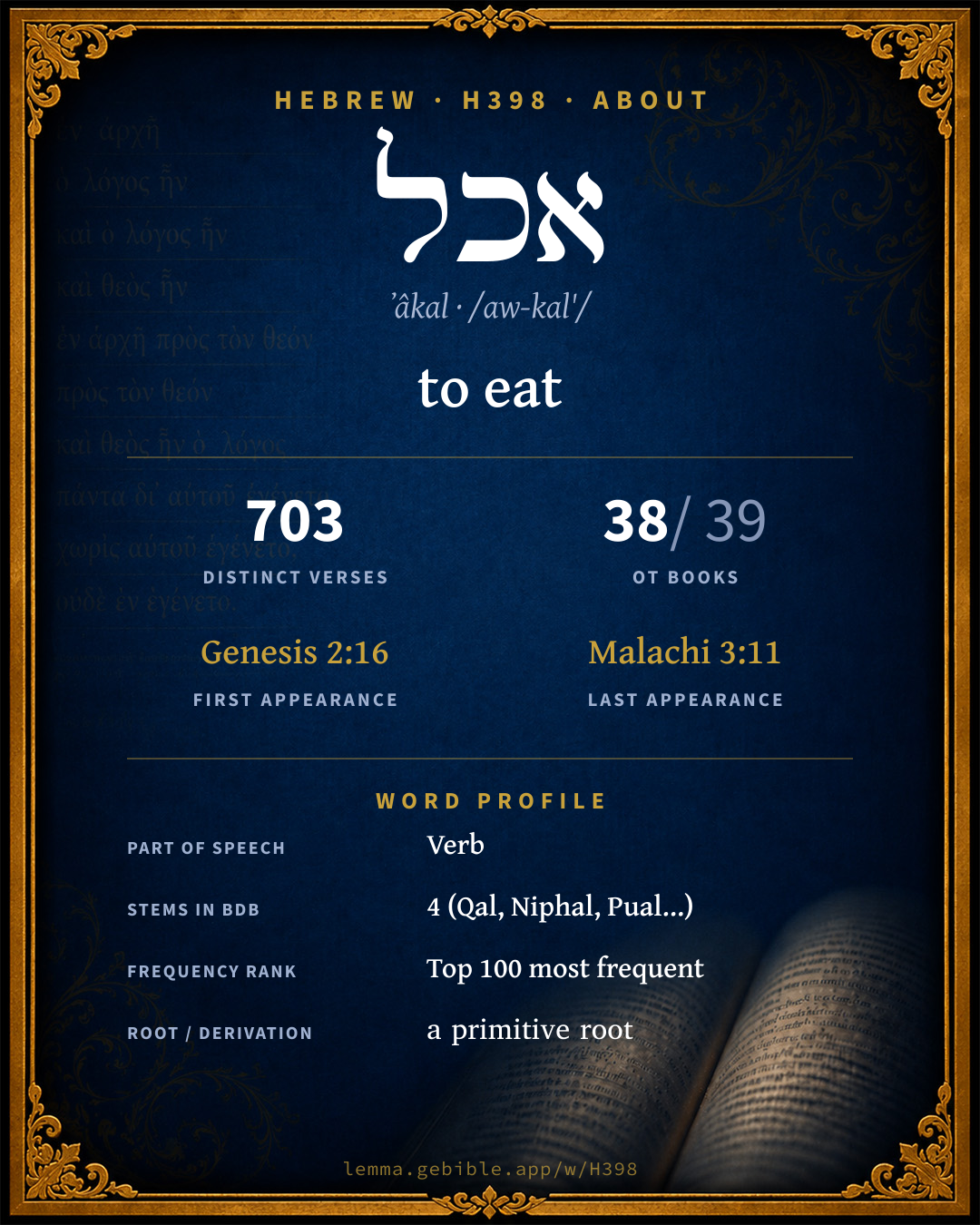
אָכַל
to eat
also: devour, burn up, feed fuller range ↓
Full lexicon entry — Brown-Driver-Briggs (BDB)
From Brown-Driver-Briggs (BDB)
Where this word appears
See every Qal verb in the Hebrew Bible →
Grammar key — what these labels mean
Part of speech
- Verb
- An action or state-of-being word.
Stem
- Qal
- The basic, simple active stem — the plain form of the verb (“he wrote”). Here: ‘eat’
- Niphal
- Usually the simple passive or reflexive of the Qal (“he was written”). Here: ‘be eaten by man Ex 12’
- Qal Passive
- An archaic passive of the Qal, preserved in a few forms.
- Hiphil
- The causative active stem (“he caused / brought about”). Here: ‘cause to eat’
- Piel
- An intensive or resultative active stem.
Form
- Infinitive Construct
- A bound verbal noun, frequently with prepositions (“to write / in writing”).
- Imperfect
- An incomplete, ongoing, or future action (“he will / would write”).
- Sequential Imperfect
- An imperfect with prefixed waw — the standard past-narrative form (waw-consecutive imperfect).
- Perfect
- A completed action or state — Hebrew marks aspect (completeness) more than strict tense (“he wrote”).
- Sequential Perfect
- A perfect with prefixed waw continuing a preceding imperfect or command (waw-consecutive perfect).
- Infinitive Absolute
- An unbound verbal noun, often intensifying or standing in for a finite verb.
- Participle Active
- A verbal adjective expressing ongoing or characteristic action (“writing / one who writes”).
- Imperative
- A direct command (“write!”).
- Cohortative
- A first-person volitional form expressing wish or resolve (“let me / let us write”).
- Jussive
- A third- or second-person volitional form expressing wish or command (“let him write”).
- Participle Passive
- A verbal adjective expressing action received (“written”).
State
- Absolute
- The independent form of a noun, not bound to a following word.
- Construct
- A noun bound to a following noun in a possessive / “of” relationship (the construct chain).
Person
- 3rd Person
- The one spoken about (“he / she / it / they”).
- 2nd Person
- The one addressed (“you”).
- 1st Person
- The speaker (“I / we”).
Gender
- Masculine
- Grammatically masculine.
- Feminine
- Grammatically feminine.
- Common
- Either gender — not distinguished for this form.
Number
- Singular
- One.
- Plural
- More than one (in Hebrew, generally three or more).
Every verse where H398 appears in the Book of 2 Samuel — 22 distinct verses. Click any verse to open its interlinear word-by-word view. Verse text shown in the World English Bible for context — . Each verse’s Hebrew form is shown with its reference; the English is not keyword-highlighted, since the data carries no word-level English alignment. Use “Compare translations” on any verse to read it across multiple English versions. This concordance covers the Hebrew Bible; Septuagint (Greek Old Testament) occurrences are not indexed here.
2 Samuel
- 2 Samuel 2:26 תֹּ֣אכַל Qal impf 3fs Then Abner called to Joab, and said, "Shall the sword devour forever? Don't you know that it will be bitterness in the latter end? How long shall it be then, before you bid the people return from following their brothers?"
- 2 Samuel 9:7 תֹּ֥אכַל Qal impf 2ms David said to him, "Don't be afraid of him; for I will surely show you kindness for Jonathan your father's sake, and will restore you all the land of Saul your father; and you shall eat bread at my table continually."
- 2 Samuel 9:10 וַ/אֲכָל֔/וֹ יֹאכַ֥ל conj + Qal wpf 3ms + sfx pers 3ms Qal impf 3ms You shall till the land for him, you, and your sons, and your servants; and you shall bring in [the fruits], that your master's son may have bread to eat: but Mephibosheth your master's son shall eat bread always at my table." Now Ziba had fifteen sons and twenty servants.
- 2 Samuel 9:11 אֹכֵל֙ Qal ptcp.act ms Then said Ziba to the king, According to all that my lord the king commands his servant, so shall your servant do. As for Mephibosheth, [said the king], he shall eat at my table, as one of the king's sons.
- 2 Samuel 9:13 אֹכֵ֑ל Qal ptcp.act ms So Mephibosheth lived in Jerusalem; for he ate continually at the king's table. He was lame in both his feet.
- 2 Samuel 11:11 לֶ/אֱכֹ֥ל prep + Qal inf.cs Uriah said to David, The ark, and Israel, and Judah, abide in booths; and my lord Joab, and the servants of my lord, are encamped in the open field; shall I then go into my house, to eat and to drink, and to lie with my wife? as you live, and as your soul lives, I will not do this thing.
- 2 Samuel 11:13 וַ/יֹּ֧אכַל conj + Qal wimpf 3ms When David had called him, he ate and drink before him; and he made him drunk: and at even he went out to lie on his bed with the servants of his lord, but didn't go down to his house.
- 2 Samuel 11:25 תֹּאכַ֣ל Qal impf 3fs Then David said to the messenger, Thus shall you tell Joab, Don't let this thing displease you, for the sword devours one as well as another; make your battle more strong against the city, and overthrow it: and encourage you him.
- 2 Samuel 12:3 תֹאכַ֜ל Qal impf 3fs but the poor man had nothing, except one little ewe lamb, which he had bought and raised. It grew up together with him, and with his children. It ate of his own food, drank of his own cup, and lay in his bosom, and was to him like a daughter.
- 2 Samuel 12:20 וַ/יֹּאכַֽל conj + Qal wimpf 3ms Then David arose from the earth, and washed, and anointed himself, and changed his clothing; and he came into the house of Yahweh, and worshiped: then he came to his own house; and when he required, they set bread before him, and he ate.
- 2 Samuel 12:21 וַ/תֹּ֥אכַל conj + Qal wimpf 2ms Then said his servants to him, What thing is this that you have done? you did fast and weep for the child, while it was alive; but when the child was dead, you did rise and eat bread.
- 2 Samuel 13:5 וְ/אָכַלְתִּ֖י conj + Qal wpf 1cs Jonadab said to him, Lay you down on your bed, and feign yourself sick: and when your father comes to see you, tell him, Please let my sister Tamar come and give me bread to eat, and dress the food in my sight, that I may see it, and eat it from her hand.
- 2 Samuel 13:9 לֶ/אֱכ֑וֹל prep + Qal inf.cs She took the pan, and poured them out before him; but he refused to eat. Amnon said, Have out all men from me. They went out every man from him.
- 2 Samuel 13:11 לֶֽ/אֱכֹ֑ל prep + Qal inf.cs When she had brought them near to him to eat, he took hold of her, and said to her, Come, lie with me, my sister.
- 2 Samuel 16:2 לֶ/אֱכ֣וֹל prep + Qal inf.cs The king said to Ziba, What do you mean by these? Ziba said, The donkeys are for the king's household to ride on; and the bread and summer fruit for the young men to eat; and the wine, that such as are faint in the wilderness may drink.
- 2 Samuel 17:29 לֶ/אֱכ֑וֹל prep + Qal inf.cs and honey, and butter, and sheep, and cheese of the herd, for David, and for the people who were with him, to eat: for they said, The people are hungry, and weary, and thirsty, in the wilderness.
- 2 Samuel 18:8 לֶ/אֱכֹ֣ל אָכְלָ֛ה prep + Qal inf.cs Qal pf 3fs For the battle was there spread over the surface of all the country; and the forest devoured more people that day than the sword devoured.
- 2 Samuel 19:28 בְּ/אֹכְלֵ֖י prep + Qal ptcp.act mp cs For all my father's house were but dead men before my lord the king; yet you set your servant among those who ate at your own table. What right therefore have I yet that I should cry any more to the king?
- 2 Samuel 19:35 אֹכַל֙ Qal impf 1cs I am this day eighty years old: can I discern between good and bad? can your servant taste what I eat or what I drink? can I hear any more the voice of singing men and singing women? why then should your servant be yet a burden to my lord the king?
- 2 Samuel 19:42 הֶ/אָכ֤וֹל אָכַ֨לְנוּ֙ ptcl inter + Qal inf.abs Qal pf 1cp All the men of Judah answered the men of Israel, Because the king is a close relative to us: why then are you angry for this matter? have we eaten at all at the king's cost? or has he given us any gift?
- 2 Samuel 22:9 תֹּאכֵ֑ל Qal impf 3fs There went up a smoke out of his nostrils, Fire out of his mouth devoured: Coals were kindled by it.
- 2 Samuel 22:39 וָ/אֲכַלֵּ֥/ם conj + Piel wimpf 1cs + sfx pers 3mp I have consumed them, and struck them through, so that they can't arise: Yes, they are fallen under my feet.
About this entry
At a glance — auto-summarized from this page’s data, not written by a person. Every figure links to its source below. This summary describes the numbers; it doesn’t interpret them.
“to eat” is the headline sense of the Hebrew verb אכל (ʼâkal). Different stems carry different senses — BDB groups them under 4 stems, among them Qal and Niphal. With 703 verses in 38 books, it is one of the most common word in the Hebrew Bible. Scripture first uses it in Genesis 2:16. From the same root come אכילה, אכל and אכל. The sections below give every sense, occurrence, and version rendering.
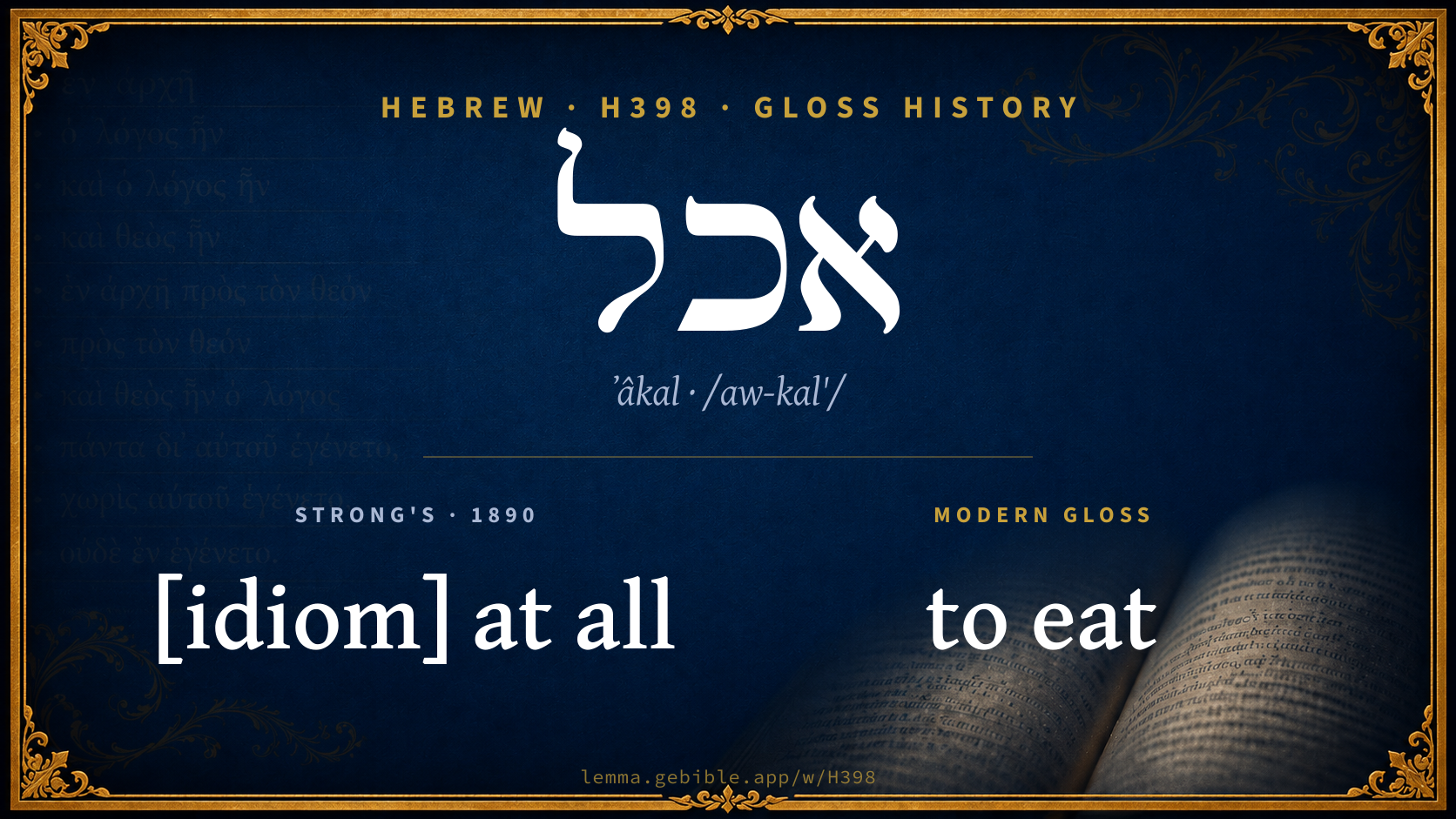
Gloss history
Strong's 1890 vs modern scholarship
About this word
Strong's H398 catalogs a Hebrew word from the Hebrew Old Testament.
These counts are not copied from any lexicon or concordance. They are computed here, from the morphology-tagged Hebrew Old Testament. What Lemma adds →
- 703
- distinct verses
- The word appears in 703 distinct verses.
- 38 / 39
- OT books
- The word appears in 38 of 39 Old Testament books.
- #57
- by frequency
- Top 100 most frequent Hebrew words (rank 57 of 8,640 Hebrew words by occurrence).
View all 703 occurrences in the concordance →
Most concentrated in
- Leviticus 81 verses 12%
- Deuteronomy 71 verses 10%
- Genesis 54 verses 8%
By section of the Old Testament
By traditional corpus
Conventional, traditional groupings — biblical authorship is debated, so this is a traditional corpus grouping, not an authorship claim. Each share is this word’s portion of its verses in that division of the Hebrew canon. Each figure is a share of the word’s 703 distinct verses.
- Prophets (Nevi'im) 317 verses · 45%
- Torah (Pentateuch) 274 verses · 39%
- Writings (Ketuvim) 112 verses · 16%
How translations render this word
Counts come from each version’s own published word-to-Strong’s tagging or interlinear alignment — an approximate guide to how each version renders this word, not a word-level alignment the data otherwise carries. Because each total is that version’s own tagged count, the per-version totals vary from one another and need not match the appearance or distinct-verse counts above. These counts may also differ from a printed concordance because Lemma counts each distinctly tagged rendering and does not collapse phrase taggings into a single head-word total. This is a fixed set of word-tagged versions (KJV, ASV, BSB, ULT) and does not change with the reading translation you choose elsewhere. Each version’s license is shown beside its name below (and on Sources).
- King James Version: Eat 128×, Shall eat 38×, Ye shall eat 30×
- American Standard Version: Eat 105×, Ye shall eat 28×, Shall eat 26×
- Berean Standard Bible: Eat 166×, Ate 21×, Consumed 20×
- unfoldingWord Literal Text: Eat 175×, Will eat 39×, You shall eat 36×
King James Version Public Domain
Renders H398 across 809 tagged occurrences — most commonly:
Plus other, less common renderings. Plus 164 renderings that appear only once — usually multi-word phrases or single function words the recovered tagging swept in, not distinct renderings. Not rendered by a distinct English word in 1 further occurrence.
American Standard Version Public Domain
Renders H398 across 808 tagged occurrences — most commonly:
Plus other, less common renderings. Plus 204 renderings that appear only once — usually multi-word phrases or single function words the recovered tagging swept in, not distinct renderings.
Berean Standard Bible Public Domain
Renders H398 across 784 tagged occurrences — most commonly:
Plus other, less common renderings. Plus 155 renderings that appear only once — usually multi-word phrases or single function words the recovered tagging swept in, not distinct renderings. Not rendered by a distinct English word in 25 further occurrences.
unfoldingWord Literal Text CC BY-SA 4.0
Renders H398 across 946 tagged occurrences — most commonly:
Plus other, less common renderings. Plus 134 renderings that appear only once — usually multi-word phrases or single function words the recovered tagging swept in, not distinct renderings.
15 senses and sub-senses in the full BDB
Hebrew verbs can shift meaning by stem (binyan): Qal is the basic action, Niphal is often passive or reflexive, Piel often intensifies or makes it factitive, and Hiphil is typically causative. The senses below are grouped under the stem BDB assigns to each. This entry also uses Pual (the passive of Piel).
What do BDB’s symbols mean?
BDB uses these scholarly abbreviations:
| Symbol | Meaning |
|---|---|
| 𝔊 | the Septuagint (the ancient Greek translation, LXX) |
| 𝔙 | the Vulgate (the Latin translation) |
| 𝔖 | the Syriac version (the Peshitta) |
| 𝔗 | the Targum (the Aramaic translation) |
| ψ | the Psalms |
| √ | root (the underlying root or stem) |
| ‖ | parallel passage (a synonymous or contrasted parallel) |
| † | the dagger: every passage where the word occurs is cited |
The 15 senses and sub-senses the full Brown-Driver-Briggs lexicon distinguishes for this word, in lexicon order (not ranked by frequency), with BDB’s own verbatim wording and sub-sense lettering. Shown in Hebrew script with BDB’s own scholarly abbreviations. The condensed entry is in the Lexicon Entry tab. See also the Forms in the corpus table below.
Qal
- Pf. אָכַל Ex 34:28 +; אָֽכְלָה Nu 21:28 +, etc. Impf. יֹאכַל Gn 49:27 +; וַיֹּא֫כַל Gn 25:34 +; וַיֹּאכַ֑ל Gn 3:6 +; יֹאכֵ֑ל Lv 21:22 +; אֹכַל Gn 24:33 +; וָֽאֹכַ֫ל 27:33; וְאֹכֵ֑ל Is 44:19; וָֽאֹכֵל Gn 3:12, 13; 3 pl. יֹאכְלוּ Gn 32:33 +; יֹאכֵ֑לוּ Dt 18:8 +; etc. (for יוֹכְלוּ Ez 42:5 rd. יוצלו, יאצלו 𝔊 Ew Co); sf. יֹאכְלֶנּוּ Lv 7:6 +; תֹּאכַלְכֶם Is 33:11, etc., prob. also תְּאָכְלֵהוּ Jb 20:26, either as secondary form fr. תֹּא׳ (Ew§ 253 Di) or text. error (Ges§ 68. 1) > Pi., Thes KöI, 389; or Poʿel, Ki De MV; Imv. אֱכוֹל 1 K 18:41 +, etc.; Inf. abs. אָכוֹל Gn 2:16 +; cstr. אֲכֹל Nu 26:10 + 2 textual; לֶאֱכֹל Gn 24:33 +; לְאָכְלָה Je 12:9; Pt. אֹכֵל (אוֹכֵל) Gn 39:6 +, אֹכֶלֶת Ex 24:17 +, etc.— e.g. Exodus 34:28
- 1. eat, human subject Gn 3:11, 18 + oft.; mostly c. acc. Ex 16:35 +; also sq. מִן־ (eat of,—some of,—or from) Ex 34:15 Ru 2:14 +; sq. בְּ (eat of or at) Ex 12:43 f; abs. Dt 2:6 +; as act of worship Gn 31:54 (cf. 46:1) Ex 18:12; 24:11; 34:15 Dt 12:7, 18; 14:23, 26 Ju 9:27 +; of priests Ex 29:32 Lv 10:13 +; cf. אָכַל אֶל־הֶהָרִים Ez 18:6, 11, 15; 22:9 + 33:25 עַל־הַדָּם Co עַל־הֶהָרִים; (but RSRel. Sem.. i. 324 N would emend first 4 by last); eat up, finish eating Gn 43:2 (c. כלה) 1 K 13:28 +; אָכַל לֶחֶם = take a meal Gn 43:25 Ex 2:20 1 S 20:24 Je 41:1 +; so א׳ alone Gn 43:16 1 S 20:5 +; א׳ לֶחֶם = eat, get food Gn 3:19 2 K 4:8 +; Am 7:12 (i.e. spend one’s life) cf. Ec 5:16; לֹא א׳ ל׳ i.e. fast 1 S 28:20; 30:12 Ezr 10:6 cf. Dn 10:3; fig. א׳ אֶת־בְּשָׂרוֹ Ec 4:5 (i.e. waste away); eat words Je 15:16 (i.e. eagerly receive); of adultery, Pr 30:20 אָֽכְלָה וּמָֽחֲתָה פִּ֑יהָ וְאָֽמְרָה לֹא־פָעַלְתִּי אָֽוֶן׃; eat (taste) good fortune, א׳ בַּטּוֹבָה Jb 21:25; לְפִי אָכְלוֹ according to his eating, i.e. acc. to his needs in eating Ex 12:4; 16:16, 18 also v 21; cf. Jb 20:21 & sub אָכְלָה; אָכַל הַפְּרִי 2 K 19:29 Am 9:14, of peaceful enjoyment of results of labour; fig. of receiving consequences of action, good or bad Pr 1:31; 18:21 Ho 10:13 cf. וַיֹּאכַל גַּם־אָכוֹל אֶת־כַּסְפֵּנוּ Gn 31:15 i.e. he has reaped all the benefit, cf. Ho 7:9; fig. of mourner, אֵפֶר כַּלֶּחֶם אָכָ֑לְתִּי ψ 102:10 (cf. 80:6 Hiph., & As. akâl al âkul, bikîtum kurmatî = food I ate not, weeping (was) my refreshment HptASKT 166 f. Obv. l, 21, 22 ZimBP 34, 42); of gods, partaking of sacrifices Dt 32:38; fig. = destroy Dt 7:16 (cf. Nu 14:9); cf. Je 10:25; 30:16; 50:7 Ho 7:7. e.g. Genesis 3:11
- 2. of beasts, birds, etc., eat, devour; Gn 37:20, 33; 40:17, 19 1 K 13:28; 14:11; 16:4; 21:23, 24 Ho 2:14 +; specif. of locusts Jo 1:4; 2:25 2 Ch 7:13 cf. Am 4:9; moth Jb 13:28; flies ψ 78:45; worms Dt 28:39; also Ez 19:3, 6 (of Isr. under fig. of lion), cf. Je 50:7, 17; 51:34; also Ho 13:8 (of י׳ under fig. of lion), Ez 22:25 (נֶפֶשׁ אָכָ֑לוּ, of false proph. under fig. of lion). e.g. Genesis 37:20
- 3. fig. of fire, devour, consume Lv 6:3 (sq. 2 acc. consume offering to ashes) Na 3:13 Is 5:24 (in sim.), partic. of fire fr. י׳ Lv 10:2; 16:25 Ju 9:15 f 1 K 18:38 2 K 1:10, 12, 14 2 Ch 7:1; cf. Am. 1:4, 7, 10, 12, 14; 2:2, 5; 5:6 +; Dt 5:22 of fire at Sinai; of י׳ as fire (in judgment) Dt 4:24 כִּי י׳ אֱלֹהֶיךָ אֵשׁ אֹכְלָה הוּא cf. Dt 9:3 Is 10:17 (‖ בּער) 30:27, 30; 33:14 (‖ מוֹקְדֵי עוֹלָם). e.g. Leviticus 6:3
- 4. of sword, devour, slay Dt 32:42 2 S 2:26; 11:25; 18:8 Ho 11:6 Je 2:30 12:12; cf. of devastation of land Is 1:7 Je 8:16. e.g. Deuteronomy 32:42
- 5. in genl. devour, consume, destroy (inanim. subj.) of drought Gn 31:40; of pestilence Ez 7:15; of forest 2 S 18:8; cf. Lv 26:38 וְאָֽכְלָה אֶתְכֶם אֶרֶץ אֹיְבֵיכֶם; of הַבֹּשֶׁת Je 3:24 (v. בֹּשֶׁת). e.g. Genesis 31:40
- 6. fig. of oppression, devour the poor, etc. Pr 30:14 Hb 3:14 cf. ψ 14:4; of bitter enmity לֶאֱכֹל אֶת־בְּשָׂרִי ψ 27:2. (cf. Jb 19:22). e.g. Proverbs 30:14
Niphal
- Pf. וְנֶאֱכַל cons. Ex 22:5 Impf. יֵאָכֵל Gn 6:21 +; וַיֵּאָכֵ֫ל Nu 12:12 etc.; Inf. abs. הֵאָכֹל Lv 7:18; 19:7; Pt. f. נֶאֱכֶ֫לֶת Lv 11:47;— e.g. Exodus 22:5
- 1. be eaten by man Ex 12:46; 13:3, 7; 21:28; 29:34 Lv 6:9, 16, 19, 23; 7:6, 15, 16(×2), 18; 11:41; 19:6, 7, 23; 22:30 Nu 28:17 Ez 45:21; of custom, usage Gn 6:21 Ex 12:16 Dt 12:22 Jb 6:6; of permission to eat Lv 7:19; 11:13, 34, 47(×2); 17:13; c. neg. be uneatable Je 24:2, 3, 8; 29:17. e.g. Exodus 12:46
- 2. be devoured by fire, consumed Zp 1:18; 3:8 Zc 9:4 Ez 23:25. e.g. Zephaniah 1:18
- 3. be wasted, destroyed, of flesh Nu 12:12 Je 30:16. e.g. Numbers 12:12
Pual
- Pf. אֻכְּלוּ be consumed with fire Ne 2:3, 13 cf. Na 1:10 (fig.); so Pt. אֻכָּל (= מְאֻכָּל Ew§ 169 d) Ex 3:2; by sword Is 1:20 תְּאֻכְּלוּ. e.g. Nehemiah 2:3
Hiphil
- Pf. 2 ms. sf. הֶאֱכַלְתָּם ψ 80:6, וְהַאֲכַלְתִּ֫י Is 49:26; sf. וְהַאֲכַלְתִּיךָ cons. Is 58:14; הֶאֱכַלְתִּיךְ Ez 16:19; וְהַאֲכַלְתִּים cons. Je 19:9; Impf. sf. יַאֲכִלֵנוּ Nu 11:4, 18, etc.; 2 ms. js. תַּאֲכֵל Eze 3:3; 1 s. אוֹכִיל Ho 11:4(?); Imv. הַאֲכִילֵהוּ Pr 25:21. etc.; Inf. לִהָכִיל Ez 21:33 (but Co לההל); Pt. מַאֲכִיל Je 23:15, etc.;— e.g. Psalms 80:6
- 1. cause to eat, feed with, sq. 2 acc. subj. mostly י׳; Ex 16:32 Dt 8:3, 16 Ez 3:2 Je 19:9; abs. Ho 11:4; cf. Nu 11:4, 18; fig. Je 9:14; 23:15 Is 49:26; 58:14 Ez 16:19; also ψ 80:6 הֶאֱכַלְתָּם לֶחֶם דִּמְעָ֑ה (cf. 102:10 Qal supr.); sq. acc. pers. + מן ψ 81:17, but also subj. man Pr 25:21; 1 K 22:27 2 Ch 18:26 וְהַאֲכִלֻהוּ לֶהֶם לַ֫חַץ of prison fare; sq. acc. pers. only 2 Ch 28:15, cf. Ez 3:3. e.g. Exodus 16:32
- 2. cause to devour, obj. sword Ez 21:23 (but on text vid. Co). e.g. Ezekiel 21:23
Senses from the full Brown-Driver-Briggs lexicon (Brown, Driver, Briggs; Oxford 1906 — public domain), digitized via Sefaria, supplemented by the OpenScriptures HebrewLexicon (CC BY 4.0). Full attribution on Sources.
Word origin
vb. eat (Aramaic أَكَلَ, As. akâlu DlW, Aramaic אֲכַל, ܐܶܟܰܠ )—
— Brown-Driver-Briggs (Oxford 1906, public domain), digitized via Sefaria, supplemented by the OpenScriptures HebrewLexicon (CC BY 4.0). See Sources.
Origin: a primitive root
Jastrow Dictionary
A second Hebrew/Aramaic lexicon for comparison, covering Aramaic and post-biblical (Talmudic, Targumic, Midrashic) usage that the biblical-Hebrew BDB does not. Matched by lemma rather than by Strong’s number, so a lemma may carry more than one Jastrow headword (shown separately below), and the entries cover usage well beyond the Bible.
אָכַל
- √אך to rub,
- 1. to gnaw, eat, consume. Inf. in Y. freq. לוֹכַל = לֶאֱכוֹל. Ber. I, 1; a. v. fr.
- 2. trnsf. to absorb, occupy, take away. Y. Shebu. VII, 38ᵃ בשרבית אוֹכֶלֶת בו when interests gnaw on (absorb) the property. Y. Erub. IV, 21ᵈ bot. ד׳ אמות אוֹכְלוֹת וכ׳ four cubits entering into the area of Tiberias. Num. R. s. 4 כמה לוחות אוֹכְלוֹת how much space did the tablets occupy &c.? B. Bath. 14ᵃ (interchanging with איגרות, Var. אוגדות, v. Rabb. D. S. a. l. note 5, 6).
- 3. (euphem.) to sleep with. Keth. V, 9, differ. of opin. ib. 65ᵇ; Y. ib. 30ᵇ top a. bot.
- to be eaten &c. Zeb. I, 3; Ber. I, 1; a. fr.
- to consume, burn. Tam. I, 4 המְאוּכָּלוֹת הפנימיות (Talm. ed. המעו׳) the thoroughly lighted coals in the centre; Y. Yoma II, 39ᶜ
- to give to eat, cause to eat. Keth. V, 3 היבם אינו מַאֵכִיל וכ׳ the Yabam does not transfer the privilege of eating T’rumah to his sister-in-law. Kidd. 31ᵃ יש מאכיל וכ׳ one may feed his father on pheasants &c.; a. fr.
- 1. to be consumed, burnt up, digested. Ber. VIII, 7 עד כדי שיִתְאַכֵּל וכ׳ Ar. (ed. שיתע׳) until the food is digested (or absorbed) in his bowels. Tam. II, 1; a. e.
- 2. to be worn off, spent. Snh. VI, 12 Y. ed. נתא׳ הבשר (Mish. ib. VI, 6 נתע׳) when the flesh of the corpse was gone. Cant. R. to IV, 4 שלא נתא׳ אחת מהן none of them was worn off. Kidd. 59ᵃ נתא׳ המעות the money was spent; a. e.
אֲכַל
- 1. same.—Inf. מֵיכַל, מֵיכוּל. Targ. Gen. II, 16; a. fr.—Y. Ter. VIII, 46ᵃ כד אתון יֵיכלון when they came and were about eating; ib. (more corr.) אתון מיכל; a. fr.
- 2. with קרצי prop. to eat (the bread of) destruction, eat the informer’s bread, hence to inform against. Dan. III, 8; VI, 25.—Targ. Ps. XV, 3; a. fr.—Gitt. 56ᵃ איכול בהו קו׳; Lam. R. to IV, 2 איכול קרצהון I will inform against them. e.g. Daniel 3:8
- to give to eat, to support. Y. Ter. X, 47ᵇ bot. אוכלה ליה he gave it to him to eat. Gen. R. s. 48, end (read:) אוכלית אשקית לוי hast thou given (thy guest) to eat? to drink? do escort him, i.e. perform thy duties fully. Y. Kidd. I, 61ᵇ הוה מייכל לאבוי וכ׳ fed his father on &c.; a. fr.
- , אִתְאָכִיל to be eaten, consumed. Targ. Ps. LXVIII, 23; a. fr. Tanḥ. Emor, 6 ומה דהבא מִתְאֲכִיל וכ׳; Lev. R. s. 27 ומה זה וכ׳ what is this? do they eat gold &c.? Kidd. 59ᵃ קא מתאכלי were eaten up (spent). [אכלי Af. of כלי to cry, v. כלי.]
אֲכַל II
- (sec. r. of כול) to measure. Ned. 51ᵃ ליכיל לי מר please measure for me. Ruth R. introd. 2. הא … סאה תקום אכול (read סאתה קום) here is the bag and here the measure, get up and fill it; v. כּוּל.
אֹכֶל
- , v. אוֹכֶל
A Dictionary of the Targumim, the Talmud Babli and Yerushalmi, and the Midrashic Literature (Marcus Jastrow; London, Luzac, 1903) — Public Domain. Digitized via Sefaria. Digitized via Sefaria. Full attribution on Sources.
Forms in the corpus
The 494 distinct written forms H398 takes in the Hebrew Bible, most frequent first — each parse links to that stem’s occurrences in the concordance. Hebrew forms include their vowel points and cantillation, so a single lemma takes many written forms.
The 60 most common forms are shown; 434 rarer forms follow in the full concordance.
Same root — word family
Other BDB entries built from the same root as H398, grouped by Strong’s listed origin. These share a root / origin per the lexicon — not necessarily a shared meaning. Each links to that word’s own entry.
Derived from this word
- אכילה ʼăkîylâh H396 food
- אכל ʼăkal H399 to eat
- אכל ʼôkel H400 food
- מאכל maʼăkâl H3978 food
- מאכלת maʼăkeleth H3979 knife
- מאכלת maʼăkôleth H3980 fuel
- מכלת makkôleth H4361 food
Proper names from this root
People and places named from this root — a name, not an additional meaning of the word.
Compare all same-root words → Showing 4 of 9 — not the complete family. 1 of the same-root words is a proper name (a person or place). They share a root, not necessarily a meaning.
Septuagint verse parallels
This word appears in 670 verses that also exist in the Greek Old Testament (Septuagint), out of the 703 Hebrew verses it occurs in. You can read those verses in Greek by switching the Old Testament edition to the Septuagint.
Read these verses in the Septuagint
- Genesis 2:16
- Exodus 2:20
- Leviticus 3:17
- Numbers 6:3
- Deuteronomy 2:6
- Joshua 5:11
- Judges 6:21
- Ruth 2:14
- 1 Samuel 1:7
- 2 Samuel 2:26
- 1 Kings 1:25
- 2 Kings 1:10
This is a verse-level parallel only — the same verses exist in both the Hebrew and Greek Old Testaments. No word-level Hebrew↔Greek correspondence is claimed: the data carries no such alignment, so no Greek word is shown as this Hebrew word’s translation. Coverage is not total — the Septuagint omits the deuterocanon and renumbers the Psalms, so some Hebrew verses have no direct Greek parallel.