Ezekiel 45:21

Hebrew (Westminster Leningrad Codex) Ezekiel 45:21 appears in the Hebrew Old Testament. The text above is from the Westminster Leningrad Codex. Each word links to its Strong’s number, a concise gloss, and parsing drawn from the Open Scriptures Hebrew Bible morphology. Click any word for its full Brown-Driver-Briggs (BDB) entry.
Download image
Cite this verse

Ezekiel 45:21 (World English Bible). Public Domain. Lemma interlinear Bible study tool, https://lemma.gebible.app/v/ezekiel/45/21.

Show BibTeX & RIS
BibTeX
RIS
English Translation
In the first [month], in the fourteenth day of the month, you shall have the Passover, a feast of seven days; unleavened bread shall be eaten.
World English Bible · Public Domain
Download a study sheet

One document with this verse’s original text, its word-by-word gloss line, the meaning frame, cross-references with their text, attributed commentary, and full source and license credits — printable, and it pastes into notes with its structure intact.

This verse Autodidact and up

Study sheet (.html) Plain text (.txt)

A passage Seminary Student

Up to 50 verses in one chapter. A passage sheet keeps up to 6 commentary sources and 12 cross-references per verse, in the order this page ranks them, and says so on the sheet whenever that leaves anything out. Ask for a single verse and you get the Autodidact verse sheet above.

Everything on this page stays free to read, with no account — the sheet is a download of what is already on screen, not access to it.

Want to remove ads? Support Godless Engineer
Compare translations 3

The same verse in 3 English versions, stacked beneath the original-language interlinear above. Click any original word for its lexicon entry.

Each is an independent rendering of the whole verse — the interlinear is not word-aligned to these translations.

Highlighted words mark where these versions differ — a whole-verse word diff, not a word-by-word alignment.

  • World English Bible Public Domain
    In the first [month], in the fourteenth day of the month, you shall have the Passover, a feast of seven days; unleavened bread shall be eaten.
  • King James Version Public Domain
    In the first month, in the fourteenth day of the month, ye shall have the passover, a feast of seven days; unleavened bread shall be eaten.
  • unfoldingWord Literal Text CC BY-SA 4.0
    In the first month on the fourteenth day of the month, there will be for you a festival, a seven-day festival. You will eat unleavened bread.

unfoldingWord Literal Text — © unfoldingWord, licensed CC BY-SA 4.0. Word-aligned USFM3 via Door43 (git.door43.org/unfoldingWord/en_ult).

Versions to compare (up to 4)

3 of 4 selected

Show all 18 translations

Every available English version of this verse, each an independent rendering of the whole verse.

  • World English Bible Public Domain
    In the first [month], in the fourteenth day of the month, you shall have the Passover, a feast of seven days; unleavened bread shall be eaten.
  • Berean Standard Bible Public Domain
    On the fourteenth day of the first month you are to observe the Passover, a feast of seven days, during which unleavened bread shall be eaten.
  • Majority Standard Bible Public Domain
    On the fourteenth day of the first month you are to observe the Passover, a feast of seven days, during which unleavened bread shall be eaten.
  • King James Version Public Domain
    In the first month, in the fourteenth day of the month, ye shall have the passover, a feast of seven days; unleavened bread shall be eaten.
  • American Standard Version (1901) Public Domain
    In the first `month', in the fourteenth day of the month, ye shall have the passover, a feast of seven days; unleavened bread shall be eaten.
  • Revised Version (1885) Public Domain
    In the first month, in the fourteenth day of the month, ye shall have the passover, a feast of seven days; unleavened bread shall be eaten.
  • Geneva Bible (1599) Public Domain
    In the first moneth in the foureteenth day of the moneth, ye shall haue the Passeouer, a feast of seuen dayes, and ye shall eate vnleauened bread.
  • Douay-Rheims (1899) Public Domain
    In the first month, the fourteenth day of the month, you shall observe the solemnity of the pasch: seven days unleavened bread shall be eaten.
  • Young's Literal Translation Public Domain
    `In the first `month', in the fourteenth day of the month, ye have the passover, a feast of seven days, unleavened food is eaten.
  • Literal Standard Version CC BY-SA 4.0
    In the first [month], on the fourteenth day of the month, you have the Passover, a celebration of seven days, unleavened bread is eaten.
  • Unlocked Literal Bible CC BY-SA 4.0
    In the first month on the fourteenth day of the month, there will be for you a festival, a seven-day festival. You will eat unleavened bread.
  • unfoldingWord Literal Text CC BY-SA 4.0
    In the first month on the fourteenth day of the month, there will be for you a festival, a seven-day festival. You will eat unleavened bread.
  • Darby Bible Public Domain
    In the first [month], on the fourteenth day of the month, ye shall have the passover, a feast of seven days: unleavened bread shall be eaten.
  • World Messianic Bible Public Domain
    “‘“In the first month, on the fourteenth day of the month, you shall have the Passover, a feast of seven days; unleavened bread shall be eaten.
  • Webster's Bible Public Domain
    In the first month, in the fourteenth day of the month, ye shall have the passover, a feast of seven days; unleavened bread shall be eaten.
  • Free Bible Version CC BY-SA 4.0
    You are to keep the Passover on the fourteenth day of the first month. This is a religious festival that lasts seven days, during which time bread made without yeast is to be eaten.
  • Bible in Basic English Public Domain
    In the first month, on the fourteenth day of the month, you are to have the Passover, a feast of seven days; unleavened bread is to be your food.
  • JPS Tanakh (1917) Public Domain
    In the first month, in the fourteenth day of the month, ye shall have the passover; a feast of seven days; unleavened bread shall be eaten.

Literal Standard Version (2020), Covenant Press — licensed CC BY-SA 4.0. Text via the HelloAO Bible API (eBible.org). Unlocked Literal Bible (unfoldingWord) — licensed CC BY-SA 4.0. Text via the HelloAO Bible API (eBible.org). unfoldingWord Literal Text — © unfoldingWord, licensed CC BY-SA 4.0. Word-aligned USFM3 via Door43 (git.door43.org/unfoldingWord/en_ult). Free Bible Version, Dr. Jonathan Gallagher — licensed CC BY-SA 4.0. Text via the HelloAO Bible API (eBible.org).

Word by word

More ways to search: Search by grammar → Find every occurrence → Compare this word →

Practice this passage: Drill this verse → Learn its vocabulary →

שְׁבֻע֣וֹת
shâbûwaʻ
H7620
“weeks of”
Noun, Common, Masculine, Plural, Construct
Part of Speech
Noun
Type
Common
Gender
Masculine
Number
Plural
State
Construct
Full BDB Definition

Origin: properly, pass part of H7650 as a denom. of H7651

TWOT: 2318d

seven, period of seven (days or years), heptad, week - period of seven days, a week - Feast of Weeks - heptad, seven (of years)
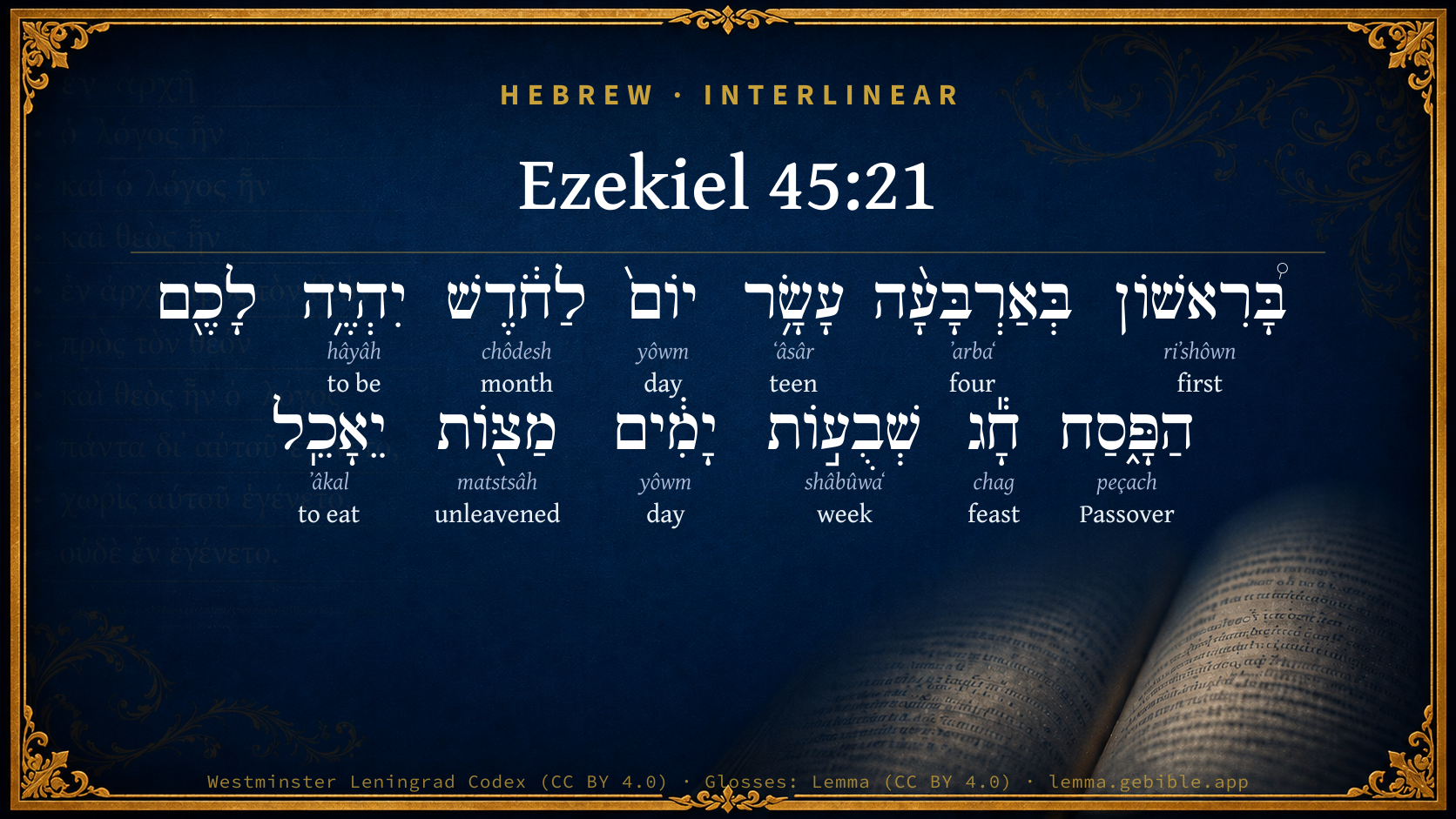
  1. בָּ֠רִאשׁוֹן riʼshôwn H7223 “in/at the · first” Preposition, Determined + Adjective, Adjective, Masculine, Singular, Absolute
  2. בְּאַרְבָּעָ֨ה ʼarbaʻ H702 “in/at · four” Preposition + Adjective, Cardinal number, Masculine, Singular, Absolute
  3. עָשָׂ֥ר ʻâsâr H6240 “teen” Adjective, Cardinal number, Masculine, Singular, Absolute
  4. יוֹם֙ yôwm H3117 “day” Noun, Common, Masculine, Singular, Absolute
  5. לַחֹ֔דֶשׁ chôdesh H2320 “to/for the · month” Preposition, Determined + Noun, Common, Masculine, Singular, Absolute
  6. יִהְיֶ֥ה hâyâh H1961 “to be” Verb, Qal, Imperfect, 3rd Person, Masculine, Singular
  7. הַפָּ֑סַח peçach H6453 “the · Passover” Particle, Definite Article + Noun, Common, Masculine, Singular, Absolute
  8. חָ֕ג chag H2282 “feast” Noun, Common, Masculine, Singular, Absolute
  9. יָמִ֔ים yôwm H3117 “days” Noun, Common, Masculine, Plural, Absolute
  10. מַצּ֖וֹת matstsâh H4682 “unleavened bread” Noun, Common, Feminine, Plural, Absolute
  11. יֵאָכֵֽל ʼâkal H398 “to eat” Verb, Niphal, Imperfect, 3rd Person, Masculine, Singular

About this verse

These counts appear in no published source. They are computed here, from the morphology-tagged text and Lemma’s own curated glosses. What Lemma adds →

13
words
11
distinct lemmas
Prophets
section

Notable vocabulary

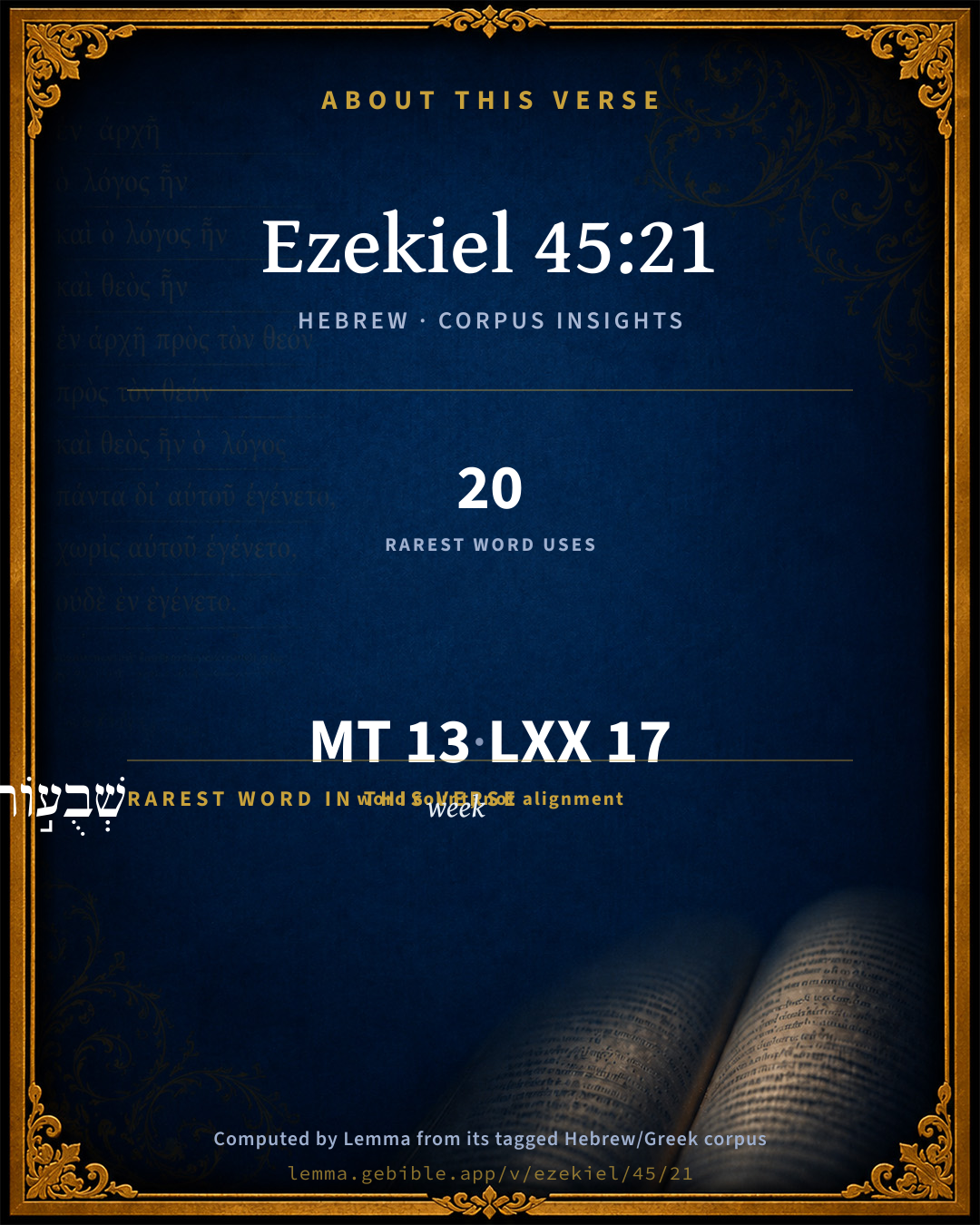
The rarest word here is שְׁבֻע֣וֹת week H7620 — appearing just 20 times in the whole Hebrew Bible.

Shared distinctive vocabulary

שְׁבֻע֣וֹת week H7620 occurs in 17 verses of the Hebrew Bible. Also found in:

Grammatical profile

  • 2 verbs
  • 7 nouns
  • 3 adjectives
  • 1 preposition

Verb forms

  • יִהְיֶ֥ה Qal · Imperfect
  • יֵאָכֵֽל Niphal · Imperfect

Repetition

A word recurs within this verse — often emphatic in Hebrew:

  • יוֹם֙ day H3117 ×2

Hebrew & Septuagint length

In English translation the verse runs 26 words from the Hebrew and 27 from the Septuagint (LXX English) — closely comparable.

A rough comparison of the two English renderings, which tokenize alike — not a word-level alignment.

Word counts can differ between the Hebrew and the Greek without any difference in meaning — e.g. the Hebrew direct-object marker אֵת has no separate Greek word, and Greek often adds the article ὁ.

In the original languages it is 13 Hebrew tokens and 17 Greek tokens — but the two are counted differently (Hebrew bundles its prefixes and suffixes into one token; the Greek is in lemma form), so that isn’t a like-for-like length.

Cross-references

6

Topical passages linked to Ezekiel 45:21 in the Treasury of Scripture Knowledge — connected by theme and wording, ordered by reader-vote popularity; previews shown in the World English Bible.

  • Leviticus 23:5–8 In the first month, on the fourteenth day of the month in the evening, is Yahweh's Passover.
  • Exodus 12:1–51 Yahweh spoke to Moses and Aaron in the land of Egypt, saying,
  • Numbers 9:2–14 "Moreover let the children of Israel keep the Passover in its appointed season.
  • Numbers 28:16–25 In the first month, on the fourteenth day of the month, is Yahweh's Passover.
  • Deuteronomy 16:1–8 Observe the month of Abib, and keep the Passover to Yahweh your God; for in the month of Abib Yahweh your God brought you forth out of Egypt by night.
  • 1 Corinthians 5:7–8 Purge out the old yeast, that you may be a new lump, even as you are unleavened. For indeed Christ, our Passover, has been sacrificed in our place.

Cross-references courtesy of OpenBible.info (CC BY 4.0).

Hebrew and Greek witnesses Masoretic Hebrew ↔ Greek Septuagint

The same verse in the two great witnesses to the Old Testament, shown verse-for-verse.

These are two independent witnesses, not word-aligned to each other, and the Septuagint is shown in lemma (dictionary) form.

Hebrew Ezekiel 45:21 Masoretic · Westminster Leningrad Codex

בָּ֠רִאשׁוֹן בְּאַרְבָּעָ֨ה עָשָׂ֥ר יוֹם֙ לַחֹ֔דֶשׁ יִהְיֶ֥ה לָכֶ֖ם הַפָּ֑סַח חָ֕ג שְׁבֻע֣וֹת יָמִ֔ים מַצּ֖וֹת יֵאָכֵֽל

In the first [month], in the fourteenth day of the month, you shall have the Passover, a feast of seven days; unleavened bread shall be eaten.

World English Bible · Public Domain

Greek LXX Ezekiel 45:21 Septuagint · lemma form

καί ἐν ὁ πρῶτος μήν οςτεσσαρεσκαιδέκατ ὁ μήν εἰμί σύ ὁ πασχα ἑορτή ἑπτά ἡμέρα ἄζυμος ἐσθίω

And in the first month, on the fourteenth day of the month, you⌃ shall have the feast of the passover; seven days shall you⌃ eat unleavened bread.

LXX2012 (modern English Septuagint) · Public Domain

Hebrew: Westminster Leningrad Codex (CC BY 4.0). Greek: Septuagint (public domain); English from LXX2012 (modern English Septuagint) (Public Domain). How the Septuagint differs from the Hebrew →

Targum (Aramaic paraphrase)

1

The Targum is the ancient Jewish Aramaic paraphrase of the Hebrew Scriptures — an interpretive translation, not the Hebrew text itself. Onkelos (literal) and Pseudo-Jonathan (expansive) render the Torah, and Jonathan the Prophets. Coverage is partial: where no permissively-licensed English translation exists for a verse, only the Aramaic is shown. This is verse-level text, not a word-by-word alignment to the Hebrew.

  1. Targum Jonathan Prophets (Joshua–Malachi)
    בְּנִיסָן בְּאַרְבְּעָא עַסְרָא יוֹמָא לְיַרְחָא יְהֵי לְכוֹן פִּסְחָא חַגָא שַׁבְעָא יוֹמִין פַּטִירַיָא יִתְאֲכֵיל:

    (no public-domain English translation for this verse)

    Targum Jonathan — Aramaic: “Mikraot Gedolot” (public domain). English: “Sefaria Community Translation” (CC0 1.0 (public-domain dedication)); “London "Chaldee Paraphrase," 1871” (public domain). Text via Sefaria.

Commentary

Notes on Ezekiel 45:21 from classic Christian and Jewish commentators (each source and its license shown beneath its notes). The classic Christian expositions comment on the surrounding passage and are grouped to its opening verse, so a note may address several verses; the Jewish commentaries on the Tanakh (Rashi and others) are per-verse, so they appear only where the commentator wrote on this verse.

Lemma curates 59 commentaries, every one of them public domain or Creative Commons licensed, each selected and text-cleaned for this edition rather than reprinted as found. About our sources →

Trapp's Complete Commentary

John Trapp

Eze 45:21 In the first [month], in the fourteenth day of the month, ye shall have the passover, a feast of seven days; unleavened bread shall be eaten.

Ver. 21. In the fourteenth day.] Upon that very day, not duly observed then by the Jews, was "Christ our passover sacrificed for us." {1Co 5:7}

John Trapp, A Commentary or Exposition upon All the Books of the Old and New Testament (1647–1656) — public domain. Text from a community e-Sword module.

Whedon's Commentary on the Bible

Daniel D. Whedon

21-25. It is commanded that on the fourteenth day of Abib (compare Exo_12:6) the passover shall be celebrated (Eze_45:21) and the prince “shall provide” (Eze_45:22-23; compare Eze_45:17) the sin offering and burnt offering. While the Levitical law required only two bullocks, one ram, and seven lambs as the daily offering, this most holy symbolic legislation requires seven bullocks and seven rams, and considerably more flour and oil. In the feast of tabernacles (Eze_45:25; compare Lev_23:33, etc.; Num_29:13, etc.) he shall offer the same sacrifices as in the passover feast. This divergence from the Levitical legislation is either because the Levitical law, as we now possess it, represents a later and more complex ceremonial than that of Ezekiel, or because there was a symbolic meaning, and therefore spiritual instruction, in these deviations from a well-known and ancient law. That every one of these ceremonial observances pictured visibly some spiritual lesson no one doubts; but just what lesson each sacrifice and offering taught we are not able to tell. (Yet compare notes Eze_43:10-12.)

Daniel D. Whedon (gen. ed.), Commentary on the Old and New Testaments (1874–1909) — public domain. Text from a community e-Sword module.

Keil & Delitzsch

C. F. Keil & F. Delitzsch

Sacrifices at the Passover and Feast of Tabernacles

Eze 45:21. In the first (month), on the fourteenth day of the month, ye shall keep the Passover, a feast of a full week; unleavened shall be eaten. Eze 45:22. And the prince shall prepare on that day for himself and for all the people of the land a bullock as a sin-offering. Eze 45:23. And for the seven days of the feast he shall prepare as a burnt-offering for Jehovah seven bullocks and seven rams without blemish daily, the seven days, and as a sin-offering a he-goat daily. Eze 45:24. And as a meat-offering, he shall prepare an ephah for the bullock, and an ephah for the ram, and a hin of oil for the ephah. Eze 45:25. In the seventh (month), on the fifteenth day of the month, at the feast he shall do the same for seven days with regard to the sin-offering, as also the burnt-offering, and the meat-offering, as also the oil. - In the words, "shall the Passover be to you," there lies the thought that the Passover is to be celebrated in the manner appointed in Ex 12, with the paschal meal in the evening of the 14th Abib. - There is considerable difficulty connected with the following words, חג שׁבעות ימים, which all the older translators have rendered "a feast of seven days." שׁבעות ".syad neves fo signifies periods of seven days or weeks. A feast of heptads of days, or weeks of days, cannot possibly mean a feast which lasted only seven days, or a week. חג שׁבעות is used elsewhere for the feast of weeks (Exo 34:22; Deu 16:10), because they were to reckon seven weeks from the second day of the Passover, the day of the sheaf of first-fruits, and then to keep the feast of the loaves of first-fruits, or the feast of harvest (Deu 16:9). Kliefoth retains this well-established meaning of the words in this passage also, and give the following explanation: If the words חג stood alone without ימים, it would mean that in future the Passover was to be kept like the feast of seven weeks, as the feast of the loaves of first-fruits. But the addition of ימים, which is to be taken in the same sense as in Dan 10:2-3; Gen 29:14, etc., gives this turn to the thought, that in future the Passover is to be kept as a feast of seven weeks long, "a feast lasting seven weeks." According to this explanation, the meaning of the regulation is, "that in future not only the seven days of sweet loaves, but the whole of the seven weeks intervening between the feast of the wave-sheaf and the feast of the wave-loaves, was to be kept as a Passover, that the whole of the quinquagesima should be one Easter חג, and the feast of weeks be one with the Passover." To this there is appended the further regulation, that unleavened bread is to be eaten, not merely for the seven days therefore, but for the whole of the seven weeks, till the feast of the loaves of first-fruits. This explanation is a very sagacious one, and answers to the Christian view of the Easter-tide. But it is open to objections which render it untenable. In the first place, that ימים, when used in the sense of lasting for days, is not usually connected with the preceding noun in the construct state, but is attached as an adverbial accusative; compare שׁלשׁה in Dan 10:2-3, and שׁנתים ימים in Gen 41:1; Jer 28:3, Jer 28:11, etc. But a still more important objection is the circumstance that the words שׁבעת ימי החג in Eze 45:23 unquestionably point back to חג שׁבעות ימים, as there is no other way in which the article in החג ni elcitra eht h can be explained, just as בּיּום ההוּא in Eze 45:22 points back to the fourteenth day mentioned in Eze 45:21 as the time of the pesach feast. It follows from this, however, that שׁבעות ימים can only signify a seven days' feast. It is true that the plural שׁבעות appears irreconcilable with this; for Kimchi's opinion, that שׁבעות is a singular, written with Cholem instead of Patach, is purely a result of perplexity, and the explanation given by Gussetius, that Ezekiel speaks in the plural of weeks, because the reference is "to the institution of the Passover as an annual festival to be celebrated many times in the series of times and ages," is no better. The plural שׁבעות must rather be taken as a plural of genus, as in ערי, Gen 13:12 and Jdg 12:7; בּהן, Gen 19:29; or בּנים, Gen 21:7; Isa 37:3; so that Ezekiel speaks indefinitely of heptads of days, because he assumes that the fact is well known that the feast only lasted one heptad of days, as he expressly states in Eze 45:23. If this explanation of the plural does not commend itself, we must take שׁבעות as a copyist's error for שׁבעת, feast of a heptad of days, i.e., a feast lasting a full week, and attribute the origin of this copyist's error to the fact that חג שׁבעת naturally suggested the thought of חג שׁבעות, feast of weeks, or Pentecost, not merely because the feast of Pentecost is always mentioned in the Pentateuch along with the feasts of Passover and tabernacles, but also because the only singular form of שׁבעות that we meet with elsewhere is שׁבוּע (Dan 9:27), or in the construct state שׁבע (Gen 29:27), not שׁבעה and שׁבעת.

The word הפּסח is used here as in Deu 16:1-2, so that it includes the seven days' feast of unleavened bread. The Niphal יאכל is construed with the accusative in the olden style: mazzoth shall men eat. - In Eze 45:22 and Eze 45:23 there follow the regulations concerning the sacrifices of this festival, and first of all concerning the sin-offering to be presented on the fourteenth day, on the evening of which the paschal lamb was slaughtered and the paschal meal was held (Eze 45:22). The Mosaic legislation makes no allusion to this, but simply speaks of festal sacrifices for the seven days of mazzoth, the 15th to the 21st Abib (Lev 23:5-8; Num 28:16-25), with regard to which fresh regulations are also given here. The Mosaic law prescribes for each of these seven days as burnt-offerings two bullocks, a ram, and seven yearling lambs, as a meat-offering; three-tenths of an ephah of meal mixed with oil for each bullock, two-tenths for the ram, and one-tenth for each lamb, and a he-goat for the sin-offering (Num 28:19-22). The new law for the feasts, on the other hand, also requires, it is true, only one he-goat daily for a sin-offering on the seven feast days, but for the daily burnt-offerings seven bullocks and seven rams reach; and for the meat-offering, an ephah of meal and a hin of oil for every bullock, and for every ram. In the new thorah, therefore, the burnt-offerings and meat-offerings are much richer and more copious, and the latter in far greater measure than the former. - Eze 45:25. The same number of sacrifices is to be offered throughout the feast of seven days falling upon the fifteenth day of the seventh month. This feast is the feast of tabernacles, but the name is not mentioned, doubtless because the practice of living in tabernacles (booths) would be dropped in the time to come. And even with regard to the sacrifices of this feast, the new thorah differs greatly from the old. According to the Mosaic law, there were to be offered, in addition to the daily sin-offering of a he-goat, seventy bullocks in all as burnt-offerings for the seven days; and these were to be so distributed that on the first day thirteen were to be offered, and the number was to be reduced by one on each of the following days, so that there would be only seven bullocks upon the seventh day; moreover, every day two rams and fourteen yearling lambs were to be offered, together with the requisite quantity of meal and oil for a meat-offering according to the number of the animals (Num 29:12-34). According to Ezekiel, on the other hand, the quantity of provision made for the sacrifices remained the same as that appointed for the feast of Passover; so that the whole cost of the burnt-offerings and meat-offerings did not reach the amount required by the Mosaic law. In addition to all this, there was an eighth day observed as a closing festival in the Mosaic feast of tabernacles, with special sacrifices; and this also is wanting in Ezekiel. - But the following is still more important than the points of difference just mentioned: Ezekiel only mentions the two yearly feats of seven days in the first and seventh months, and omits not only the Pentecost, or feast of weeks, but also the day of trumpets, on the first of the seventh month, and the day of atonement on the tenth; from which we must infer that the Israeli of the future would keep only the two first named of all the yearly feasts. The correctness of this conclusion is placed beyond the reach of doubt by the fact that he practically transfers the feasts of the day of trumpets and of the day of atonement, which were preparatory to the feast of tabernacles, to the first month, by the appointment of special sin-offerings for the first and seventh days of that month (Eze 45:18-20), and of a sin-offering on the day of the paschal meal (Eze 45:22). This essentially transforms the idea which lies at the foundation of the cycle of Mosaic feasts, as we intend subsequently to show, when discussing the meaning and significance of the whole picture of the new kingdom of God, as shown in Ezekiel 40-48.

Keil & Delitzsch — Biblical Commentary on the Old Testament (1861–1891) — public domain (CC PDM 1.0). Text via the HelloAO Bible API. (Old Testament only.)

Tyndale Open Study Notes

Tyndale Open Resources

45:21-25 Like the offerings, the annual festivals in the new Temple had a purifying purpose. Instead of the three distinctive festivals of the Mosaic order (the feasts of Passover, Harvest, and Shelters), there were now only two virtually identical festivals, Passover and Shelters, spaced six months apart. The Passover feast still took place on the fourteenth day of the first month and resembled the earlier festival in many ways, though the number of sacrificial offerings was significantly higher than those prescribed in Num 28. The Festival of Shelters, however, is not even explicitly named in the Hebrew text and has lost anything distinctive about its celebration except for the provision that the prince will provide the same sacrifices as for the Passover. It still occurs in the seventh month. The land’s constant purification from sin emerges as a central theme.

Tyndale Open Study Notes — © Tyndale Open Resources, licensed CC BY-SA 4.0. Text via the HelloAO Bible API.

Jamieson, Fausset & Brown

Robert Jamieson, A. R. Fausset & David Brown

As a new solemnity, the feast of consecration is to prepare for the passover; so the passover itself is to have different sacrifices from those of the Mosaic law. Instead of one ram and seven lambs for the daily burnt offering, there are to be seven bullocks and seven rams. So also whereas the feast of tabernacles had its own offerings, which diminished as the days of the feast advanced, here the same are appointed as on the passover. Thus it is implied that the letter of the law is to give place to its spirit, those outward rites of Judaism having no intrinsic efficacy, but symbolizing the spiritual truths of Messiah's kingdom, as for instance the perfect holiness which is to characterize it. Compare Co1 5:7-8, as to our spiritual "passover," wherein, at the Lord's supper, we feed on Christ by faith, accompanied with "the unleavened bread of sincerity and truth." Literal ordinances, though not slavishly bound to the letter of the law, will set forth the catholic and eternal verities of Messiah's kingdom.

Next: Ezekiel Chapter 46

Jamieson, Fausset & Brown — Commentary Critical and Explanatory on the Whole Bible (1871) — public domain (CC PDM 1.0). Text via the HelloAO Bible API.

The Cambridge Bible for Schools and Colleges

gen. ed. J. J. S. Perowne

21. The feasts. The passover on the fourteenth of the first month

feast of seven days] So no doubt Heb. should be read, with the ancient versions. At present it reads: a feast of weeks of days. Ezekiel omits all ref. to the so-called feast of weeks, i.e. pentecost, seven weeks after the unleavened bread, when the sickle was put into the grain.

The Cambridge Bible for Schools and Colleges (gen. ed. J. J. S. Perowne; Cambridge University Press, 1878–1918) — public domain. Text from a community e-Sword module.

John Gill's Exposition

In the first month, in the fourteenth day of the month,.... Of the month Nisan, that day fortnight from the cleansing of the sanctuary; and that day week from the expiation of the house, and the recovery and reception of backsliders:

ye shall have the passover; Christ the passover sacrificed for us; held forth in the ministry of the word, and in the ordinance of the Lord's supper; for the passover was a type of Christ: his purity and strength were signified by the lamb without blemish, a male of the first year; his separation to his office, his death, and the time of it, by the taking of this lamb from the flock some time before, and by slaying it between the two evenings; the manner of feeding on him, with fervent faith, and as a whole Saviour, attended with true repentance, and being willing also to suffer for him, by the lamb being eaten not raw, nor sodden, but roasted, and all of it, and with bitter herbs; and the security of his people by his blood from wrath and ruin, through the sprinkling it upon their consciences, by the sprinkling the blood of the passover on the lintel and door posts of the Israelites, which the Lord seeing passed by, and destroyed them not; and the new rules of keeping this passover, after observed, show that this respects not the type, but the antitype:

a feast of seven days; kept a whole week; and indeed Christ the passover is by faith to be lived upon throughout the week, as well as on Lord's days, and indeed in every week:

unleavened bread shall be eaten; and not leavened; with reference to which the Gospel feast is to be kept, not with old leaven, with the leaven of malice and wickedness, but with the unleavened bread of sincerity and truth, Co1 5:7.

John Gill's Exposition of the Whole Bible (1746–1763) — public domain (CC PDM 1.0). Text via the HelloAO Bible API.

Matthew Poole's English Annotations

In the first month; Nisan, which is part of March and part of April with us.

The fourteenth day; as was appointed of old by Moses, Exo 12 at large.

Ye shall have; have, and slay, for so Exo 12:6.

The passover; the lamb, which was to be eaten with thanksgiving for God’s sparing the Jewish children, their first-born, when he slew the chief of the strength of Egypt, and for bringing the whole house of Israel out of Egypt.

A feast of seven days: see the institution, Exo 12.

Unleavened bread shall be eaten: though here is an ellipsis, yet the thing clearly speaks itself; through the whole feast unleavened bread was to be eaten under great penalty, Exo 12:18,19. These things no doubt concerned the returned captives, though they have a mystical meaning also.

Matthew Poole's English Annotations on the Holy Bible (1683–1685) — public domain. Text from a community e-Sword/MySword module.

The Pulpit Commentary

With the fourteenth day of the month, the day appointed by the Law of Moses for the killing of the Paschal lamb, (Exo_12:6) the Passover (hspj with the article, the well-known festival of that name) should commence. Though the selection of the lamb upon the tenth day of the first month is not specified, it may be assumed that this would be implied in the appointment of a Passover which should begin on the day already legalized by the Mosaic Torah. According to Wellhausen and Smend, the first mention of the Passover occurs in Deu_16:2, Deu_16:5, Deu_16:6, and the next in 2Ki_23:22; but this can only be maintained by declaring Exo_34:25, which occurs in the so-called "Book of the Covenant a pre-Deuteronomic work gloss," and by relegating Ex 12 to the "priest-code" for no other reason than that it alludes to the Passover (vers. 11, 21, 27, 43) a principle of easy application, and capable of being used to prove anything. Smend likewise regards it as strange that the Passover should be made to commence on the fourteenth of the month, and not, as the autumn feast, on the fifteenth (ver. 25); and suggests that the original reading, which he supposes was the fifteenth, may have been corrected subsequently in accordance with the priest, code. But if the priest-cede was posterior to and modeled after Ezekiel. Why should it have ordained the fourteenth instead of that which its master recommended, viz. the fifteenth? A sufficient explanation of the differing dates in Ezekiel is supplied if Ezekiel, in fixing them, may be held to have followed the so-called priest-cede. A feast of seven days; literally, a feast of hebdomad of days ( twObuv gj). By almost all interpreters this is understood to mean "a feast of a full week, the exact duration of the Feast of Unleavened Bread, which began with the eating of the Paschal lamb. (Exo_12:8, Exo_12:15-20; Lev_23:6; Num_9:11; Deu_16:3, Deu_16:4) At the same time, it is frankly admitted that, to extract this sense from the words, twObuv must be changed into tbv. As the words stand, they can only signify a feast of weeks of days. twObuv gj, Exo_34:22 and Deu_16:10, is applied to the Feast of Pentecost, which was called "a Feast of Hebdomads," from the seven weeks which intervened between the Passover and it. Hence Kliefoth, adhering to the legitimate sense of the expression, understands the prophet to say that the whole period of seven weeks between the first Passover and Pentecost should be celebrated in the new dispensation as a Feast of Unleavened Bread. In support of this Kliefoth cites a similar use of the word "days" in Gen_29:14 Gen_41:1; Deu_21:13; 2Ki_15:13; Jer_28:3, Jer_28:11; Dan_10:2, Dan_10:3; and certainly no objection can be taken to a Passover of seven weeks, if Ezekiel may be supposed to have been merely expressing analogically spiritual conceptions, and not furnishing actual legislation to be afterwards put in operation. Against this translation, however, Keil urges that the expression, "seven days of the feast" (ver. 23), appears to mark the duration of the festival; but this is not so convincing as its author imagines, since the prophet may be held as describing, in vers. 23, 24, the procedure of each seven days without intending to unsay what he had already stated, that the feast should continue seven weeks of days. A second objection pressed by Keil, that "is not usually connected with the preceding noun in the construct state, but is attached as an adverbial accusative," as in the above-cited passages, is sufficiently disposed of by Kliefoth"s statement that the punctuation might easily be altered so as to read twObuv; Upon the whole, while not free from difficulty, the view of Kliefoth seems best supported by argument.

The moral of the Passover.

This great feast, which was so solemnly though hastily inaugurated, and so solemnly and joyously renewed after a discreditable lapse, (Ex 12 2Ch 30) had n historical and also a religious aspect.

I ITS HISTORICAL SIGNIFICANCE. It recalled one great event of surpassing national interest; it brought back to memory the pitiless cruelty, the blind obduracy, the false confidence of Egypt, and, at the same time, the sad sufferings and the trembling hopes of Israel. "With what solemn awe and yet with what thrilling expectation did their forefathers in the land of bondage partake of that strange meal! With what eager carefulness did they see that the saving blood-stream marked the lintels of the door which would shut in their dear ones! And what a morning on the morrow! What joyous congratulations in each Hebrew family when they all met, in life and health, on that memorable march! And what terrible consternation in those Egyptian homes where the angel of death had not passed by but had struck his fearful stroke! It was the hour of Jehovah"s most signal interposition; it was the hour of national redemption. They might well remember it "in all their dwellings through all their generations.

II ITS SPIRITUAL SIGNIFICANCE. The keeping of the Passover was fitted to exert a most invaluable influence in two ways.

1. It was calculated to bind the nation together and so to preserve its unity; or, when that unity was broken, to induce a kinder or more brotherly feeling between the separated communities, and to prevent further dissolution. For nothing is a stronger tie than common sacred memories the vivid recollection of scenes, of sufferings, of struggles, through which common ancestors have passed. Such memories allay ill feeling and strengthen existing "cords of love.

2. It was calculated to preserve their allegiance to their Divine Deliverer. For the slaying and eating of the lamb in their homes:

(1) Spoke to their hearts of the vast and the immeasurable obligation under which they stood to the Lord their God; it presented him to their minds as the Lord their Redeemer, who had with a mighty hand rescued them from tyranny and oppression, and placed them in the land of plenty, in homes of peace.

(2) Summoned them to the liveliest gratitude for such signal mercy, for such abounding and abiding goodness.

(3) Charged them to live that life of purity and of separateness from heathen iniquity of which the unleavened bread spoke to them while the feast lasted. (see homily in loc., in Lev_23:4-8)

1. It is well to signalize individual mercies; it is well, by some wise habit or institution, to call to remembrance, for renewed gratitude and consecration, some special deliverance granted us by the God of our life during our past career.

2. It is well to commemorate common, national favors; to recall, with thankfulness and devotion, the goodness of God shown in great national conjunctures.

3. It is best to perpetuate the one great, surpassing redemption of our race; to join in the commemoration of that supreme event when the Lamb of God was slain for the sins of the world. C.

The Pulpit Commentary (1880–1919), ed. H.D.M. Spence-Jones & Joseph S. Exell — public domain. Text from a community e-Sword module.

John Wesley's Explanatory Notes

In the first month - Nisan, which is part of March, and part of April with us.

John Wesley, Explanatory Notes Upon the Whole Bible (1754–1765) — public domain. Text via the GEBible commentary corpus.

Scofield Reference Notes

C. I. Scofield

first month

i.e. April. Exo 12:18; Num 9:2; Num 9:3; Num 28:16; Num 28:17; Deu 16:1.

The Scofield Reference Bible (1917 edition), notes by C. I. Scofield — public domain. Text from a community e-Sword module.

unfoldingWord translationNotes

Door43 World Missions Community

General Information:

Yahweh continues giving Ezekiel his message to the princes of Israel.

In the first month on the fourteenth day of the month

This is the first month of the Hebrew calendar. The fourteenth day is near the beginning of April. (See: Hebrew Months and Ordinal Numbers)

for you

The word "you" is plural and refers to the prince and the rest of the people of the house of Israel. (See: Forms of You)

translationWords

day

festival

unleavened bread

prince

sin offering

unfoldingWord translationNotes — © Distant Shores Media and the Door43 World Missions Community, licensed CC BY-SA 4.0. Source: git.door43.org/Door43/en_tn.

Rashi

Rabbi Shlomo Yitzchaki (Rashi)

seven days [Lit. weeks of days,] because they commence from it to count seven weeks.

unleavened bread shall be eaten and unleavened bread shall be eaten on that festival.

Rashi on the Tanakh — English translations: “The Judaica Press complete Tanach with Rashi, translated by A. J. Rosenberg” (CC BY 4.0); “Pentateuch with Rashi's commentary by M. Rosenbaum and A.M. Silbermann, 1929-1934” (public domain); “The Metsudah Tanach series, Lakewood, N.J” (CC BY 4.0); and “The Book of Joshua, Metsudah Publications, 1997” (CC BY 4.0). Text via Sefaria.

Lesson kit

Teaching starters — assembled from the data on this page, not authored interpretation. Every prompt links to the verse data it draws on. Edit before teaching.

Ezekiel, in the Prophets, opens this verse with 13 words (11 distinct Hebrew lemmas). Its most distinctive word is shâbûwaʻ (“week”). A historical commentator’s framing appears above. Read the whole chapter for the surrounding context.

Discussion questions

  1. What does “week” (shâbûwaʻ) contribute to the verse as a whole?
  2. How does Genesis 29:27, which shares the word «week», read alongside this verse?
  3. What does the repetition of “day” (2× in this one verse) do in this verse?
  4. These translations render this verse differently. What is at stake in choosing one wording over another?
  5. «יִהְיֶ֥ה» is a Qal Imperfect verb. How does that grammatical form shape the action described?
  6. Compare how Trapp's Complete Commentary and Whedon's Commentary on the Bible read this verse. Where do they agree or differ?

Things to notice

Reading settings

Reading text

Shown beneath each verse's original-language words.

Old Testament
Old Testament edition

Read the OT as the Masoretic Hebrew (MT) or the Greek Septuagint (LXX).

English shown for the Greek Septuagint (in the Hebrew ↔ Greek comparison).

Comparing translations? Open the Compare panel on any verse page to stack up to four side by side.