
Leviticus 25:19

Hebrew (Westminster Leningrad Codex) Leviticus 25:19 appears in the Hebrew Old Testament. The text above is from the Westminster Leningrad Codex. Each word links to its Strong’s number, a concise gloss, and parsing drawn from the Open Scriptures Hebrew Bible morphology. Click any word for its full Brown-Driver-Briggs (BDB) entry.
Download image
Cite this verse

Leviticus 25:19 (World English Bible). Public Domain. Lemma interlinear Bible study tool, https://lemma.gebible.app/v/leviticus/25/19.

Show BibTeX & RIS
BibTeX
RIS
English Translation
The land shall yield its fruit, and you shall eat your fill, and dwell therein in safety.
World English Bible · Public Domain
Download a study sheet

One document with this verse’s original text, its word-by-word gloss line, the meaning frame, cross-references with their text, attributed commentary, and full source and license credits — printable, and it pastes into notes with its structure intact.

This verse Autodidact and up

Study sheet (.html) Plain text (.txt)

A passage Seminary Student

Up to 50 verses in one chapter. A passage sheet keeps up to 6 commentary sources and 12 cross-references per verse, in the order this page ranks them, and says so on the sheet whenever that leaves anything out. Ask for a single verse and you get the Autodidact verse sheet above.

Everything on this page stays free to read, with no account — the sheet is a download of what is already on screen, not access to it.

Want to remove ads? Support Godless Engineer
Compare translations 3

The same verse in 3 English versions, stacked beneath the original-language interlinear above. Click any original word for its lexicon entry.

Each is an independent rendering of the whole verse — the interlinear is not word-aligned to these translations.

Highlighted words mark where these versions differ — a whole-verse word diff, not a word-by-word alignment.

  • World English Bible Public Domain
    The land shall yield its fruit, and you shall eat your fill, and dwell therein in safety.
  • King James Version Public Domain
    And the land shall yield her fruit, and ye shall eat your fill, and dwell therein in safety.
  • unfoldingWord Literal Text CC BY-SA 4.0
    And the land shall give its fruit, and you shall eat to satisfaction, and you shall dwell in security on it.

unfoldingWord Literal Text — © unfoldingWord, licensed CC BY-SA 4.0. Word-aligned USFM3 via Door43 (git.door43.org/unfoldingWord/en_ult).

Versions to compare (up to 4)

3 of 4 selected

Show all 18 translations

Every available English version of this verse, each an independent rendering of the whole verse.

  • World English Bible Public Domain
    The land shall yield its fruit, and you shall eat your fill, and dwell therein in safety.
  • Berean Standard Bible Public Domain
    Then the land will yield its fruit, so that you can eat your fill and dwell in safety in the land.
  • Majority Standard Bible Public Domain
    Then the land will yield its fruit, so that you can eat your fill and dwell in safety in the land.
  • King James Version Public Domain
    And the land shall yield her fruit, and ye shall eat your fill, and dwell therein in safety.
  • American Standard Version (1901) Public Domain
    And the land shall yield its fruit, and ye shall eat your fill, and dwell therein in safety.
  • Revised Version (1885) Public Domain
    And the land shall yield her fruit, and ye shall eat your fill, and dwell therein in safety.
  • Geneva Bible (1599) Public Domain
    And the lande shall giue her fruite, and ye shall eate your fill, and dwell therein in safetie.
  • Douay-Rheims (1899) Public Domain
    And the ground may yield you its fruits, of which you may eat your fill, fearing no mall's invasion.
  • Young's Literal Translation Public Domain
    and the land hath given its fruit, and ye have eaten to satiety, and have dwelt confidently on it.
  • Literal Standard Version CC BY-SA 4.0
    and the land has given its fruit, and you have eaten to satiety, and have dwelt confidently on it.
  • Unlocked Literal Bible CC BY-SA 4.0
    The land will yield its produce, and you will eat your fill and live there in safety.
  • unfoldingWord Literal Text CC BY-SA 4.0
    And the land shall give its fruit, and you shall eat to satisfaction, and you shall dwell in security on it.
  • Darby Bible Public Domain
    And the land shall yield its fruit, and ye shall eat and be satisfied, and dwell therein securely.
  • World Messianic Bible Public Domain
    The land shall yield its fruit, and you shall eat your fill, and dwell therein in safety.
  • Webster's Bible Public Domain
    And the land shall yield her fruit, and ye shall eat your fill, and dwell in it in safety.
  • Free Bible Version CC BY-SA 4.0
    Then the land will produce good harvests, so you will have plenty to eat and live in safety there.
  • Bible in Basic English Public Domain
    And the land will give her fruit, and you will have food in full measure and be safe in the land.
  • JPS Tanakh (1917) Public Domain
    And the land shall yield her fruit, and ye shall eat until ye have enough, and dwell therein in safety.

Literal Standard Version (2020), Covenant Press — licensed CC BY-SA 4.0. Text via the HelloAO Bible API (eBible.org). Unlocked Literal Bible (unfoldingWord) — licensed CC BY-SA 4.0. Text via the HelloAO Bible API (eBible.org). unfoldingWord Literal Text — © unfoldingWord, licensed CC BY-SA 4.0. Word-aligned USFM3 via Door43 (git.door43.org/unfoldingWord/en_ult). Free Bible Version, Dr. Jonathan Gallagher — licensed CC BY-SA 4.0. Text via the HelloAO Bible API (eBible.org).

Word by word

More ways to search: Search by grammar → Find every occurrence → Compare this word →

Practice this passage: Drill this verse → Learn its vocabulary →

לָשֹׂ֑בַע
sôbaʻ
H7648
“to/for · abundance”
Preposition + Noun, Common, Masculine, Singular, Absolute
Part of Speech
Preposition + Noun
Type
Common
Gender
Masculine
Number
Singular
State
Absolute
Full BDB Definition

Origin: from H7646

TWOT: 2231a

satiety, abundance, fulness - satiety - abundance
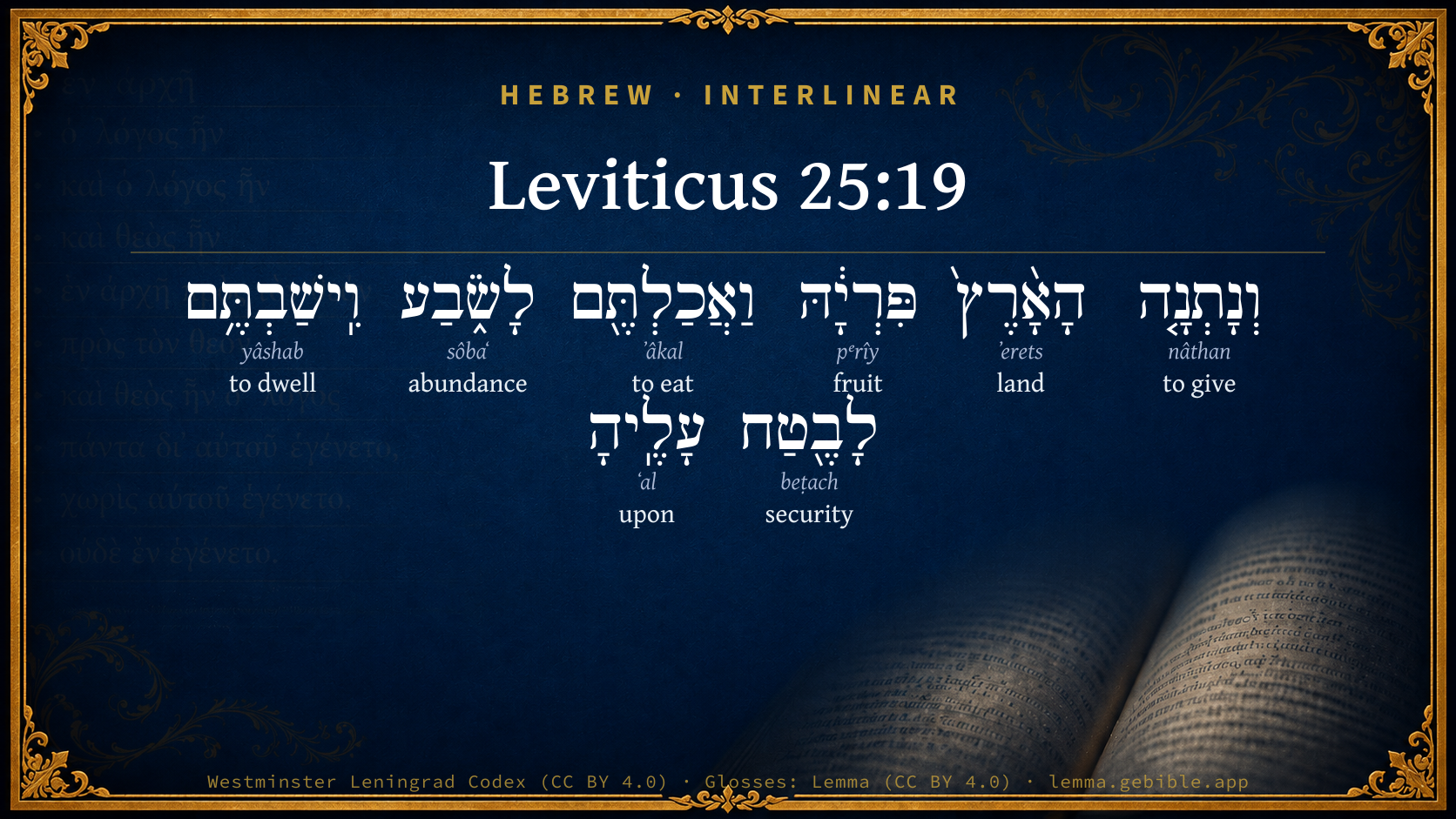
  1. וְנָתְנָ֤ה nâthan H5414 “and · to give” Conjunction + Verb, Qal, Sequential Perfect, 3rd Person, Feminine, Singular
  2. הָאָ֨רֶץ֙ ʼerets H776 “the · land” Particle, Definite Article + Noun, Common, Both, Singular, Absolute
  3. פִּרְיָ֔הּ pᵉrîy H6529 “fruit · her” Noun, Common, Masculine, Singular, Construct + Suffix, Personal, 3rd Person, Feminine, Singular
  4. וַאֲכַלְתֶּ֖ם ʼâkal H398 “and · to eat” Conjunction + Verb, Qal, Sequential Perfect, 2nd Person, Masculine, Plural
  5. וִֽישַׁבְתֶּ֥ם yâshab H3427 “and · to dwell” Conjunction + Verb, Qal, Sequential Perfect, 2nd Person, Masculine, Plural
  6. לָבֶ֖טַח beṭach H983 “to/for · security” Preposition + Noun, Common, Masculine, Singular, Absolute
  7. עָלֶֽיהָ ʻal H5921 “upon · her” Preposition + Suffix, Personal, 3rd Person, Feminine, Singular

About this verse

These counts appear in no published source. They are computed here, from the morphology-tagged text and Lemma’s own curated glosses. What Lemma adds →

8
words
8
distinct lemmas
Pentateuch
section

Notable vocabulary

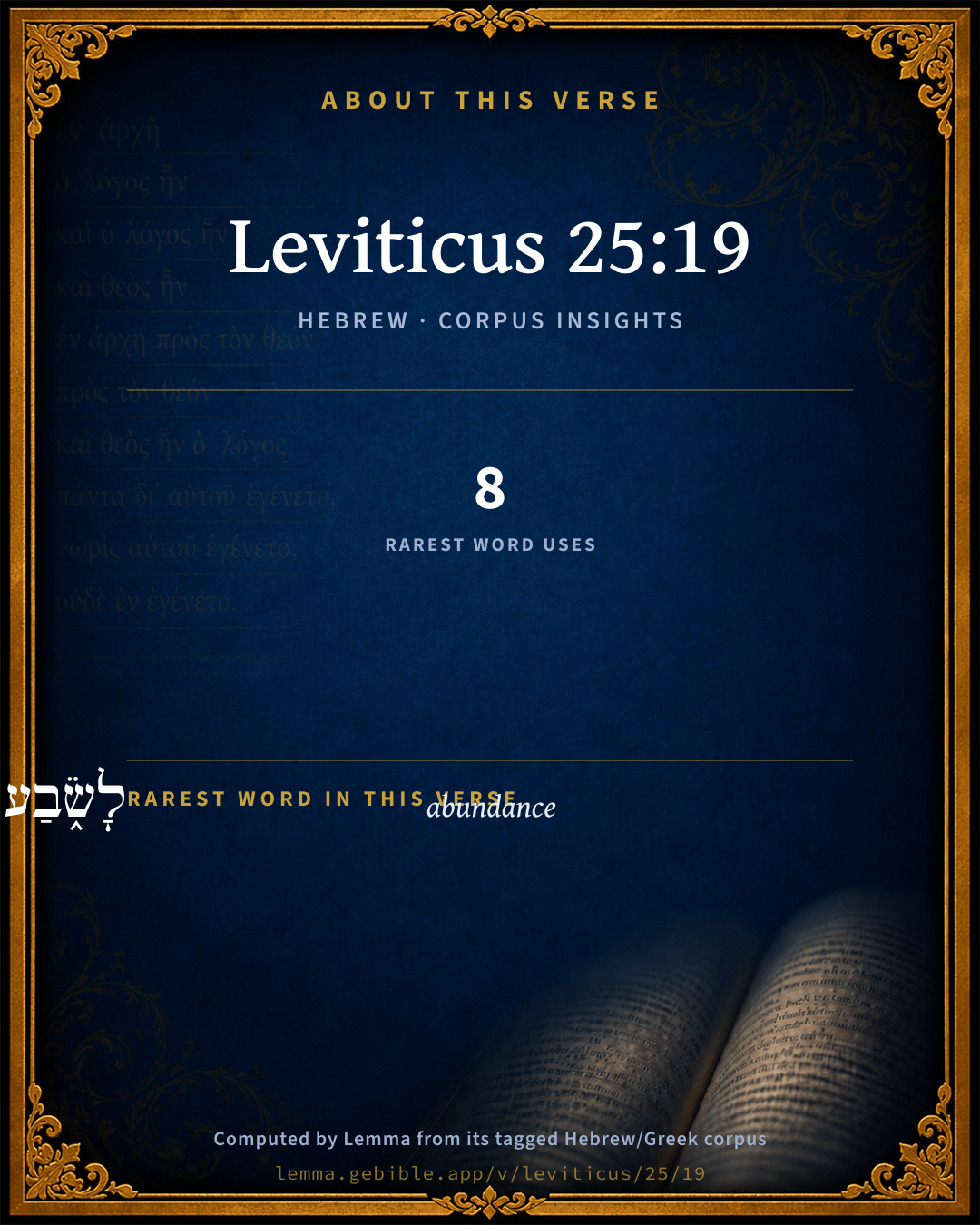
The rarest word here is לָשֹׂ֑בַע abundance H7648 — appearing just 8 times in the whole Hebrew Bible.

Shared distinctive vocabulary

לָשֹׂ֑בַע abundance H7648 occurs in 8 verses of the Hebrew Bible. Also found in:

Grammatical profile

  • 3 verbs
  • 4 nouns
  • 1 preposition

Verb forms

  • וְנָתְנָ֤ה Qal · Sequential Perfect
  • וַאֲכַלְתֶּ֖ם Qal · Sequential Perfect
  • וִֽישַׁבְתֶּ֥ם Qal · Sequential Perfect

Hebrew & Septuagint length

In English translation the verse runs 17 words from the Hebrew and 19 from the Septuagint (LXX English) — closely comparable.

A rough comparison of the two English renderings, which tokenize alike — not a word-level alignment.

Word counts can differ between the Hebrew and the Greek without any difference in meaning — e.g. the Hebrew direct-object marker אֵת has no separate Greek word, and Greek often adds the article ὁ.

Cross-references

9

Topical passages linked to Leviticus 25:19 in the Treasury of Scripture Knowledge — connected by theme and wording, ordered by reader-vote popularity; previews shown in the World English Bible.

  • Psalms 85:12 Yes, Yahweh will give that which is good. Our land will yield its increase.
  • Joel 2:26 You will have plenty to eat, and be satisfied, And will praise the name of Yahweh, your God, Who has dealt wondrously with you; And my people will never again be disappointed.
  • Leviticus 26:5 Your threshing shall reach to the vintage, and the vintage shall reach to the sowing time; and you shall eat your bread to the full, and dwell in your land safely.
  • Psalms 67:6 The earth has yielded its increase. God, even our own God, will bless us.
  • Isaiah 30:23 He will give the rain for your seed, with which you shall sow the ground; and bread of the increase of the ground, and it shall be fat and plenteous. In that day shall your cattle feed in large pastures;
  • Isaiah 65:21–22 They shall build houses, and inhabit them; and they shall plant vineyards, and eat the fruit of them.
  • Ezekiel 34:25–28 I will make with them a covenant of peace, and will cause evil animals to cease out of the land; and they shall dwell securely in the wilderness, and sleep in the woods.
  • Ezekiel 36:30 I will multiply the fruit of the tree, and the increase of the field, that you may receive no more the reproach of famine among the nations.
  • Joel 2:24 The threshing floors will be full of wheat, And the vats will overflow with new wine and oil.

Cross-references courtesy of OpenBible.info (CC BY 4.0).

Hebrew and Greek witnesses Masoretic Hebrew ↔ Greek Septuagint

The same verse in the two great witnesses to the Old Testament, shown verse-for-verse.

These are two independent witnesses, not word-aligned to each other, and the Septuagint is shown in lemma (dictionary) form.

Hebrew Leviticus 25:19 Masoretic · Westminster Leningrad Codex

וְנָתְנָ֤ה הָאָ֨רֶץ֙ פִּרְיָ֔הּ וַאֲכַלְתֶּ֖ם לָשֹׂ֑בַע וִֽישַׁבְתֶּ֥ם לָבֶ֖טַח עָלֶֽיהָ

The land shall yield its fruit, and you shall eat your fill, and dwell therein in safety.

World English Bible · Public Domain

Greek LXX Leviticus 25:19 Septuagint · lemma form

καί δίδωμι ὁ γῆ ὁ ἐκφόριον αὐτός καί ἐσθίω εἰς πλησμονή καί καταοἰκέω πείθω ἐπί αὐτός

And the land shall yield her increase, and you⌃ shall eat to fullness, and shall dwell securely in it.

LXX2012 (modern English Septuagint) · Public Domain

Hebrew: Westminster Leningrad Codex (CC BY 4.0). Greek: Septuagint (public domain); English from LXX2012 (modern English Septuagint) (Public Domain). How the Septuagint differs from the Hebrew →

Targum (Aramaic paraphrase)

2

The Targum is the ancient Jewish Aramaic paraphrase of the Hebrew Scriptures — an interpretive translation, not the Hebrew text itself. Onkelos (literal) and Pseudo-Jonathan (expansive) render the Torah, and Jonathan the Prophets. Coverage is partial: where no permissively-licensed English translation exists for a verse, only the Aramaic is shown. This is verse-level text, not a word-by-word alignment to the Hebrew.

  1. Targum Onkelos Torah (Genesis–Deuteronomy)
    וְתִתֵּן אַרְעָא אִבַּהּ וְתֵיכְלוּן לְמִשְׂבָּע וְתֵיתְבוּן לְרָחֲצָן עֲלַהּ

    (no public-domain English translation for this verse)

    Targum Onkelos — Aramaic: “Onkelos Genesis” (public domain); “Onkelos Exodus” (public domain); “Onkelos Leviticus” (public domain); “Onkelos Numbers” (public domain); “Onkelos Deuteronomy” (public domain). English: “Sefaria Community Translation” (CC0 1.0 (public-domain dedication)); “J.W. Etheridge. The Targums of Onkelos and Jonathan Ben Uzziel on the Pentateuch. London: Longmans, Green, 1862” (public domain). Text via Sefaria.

  2. Targum Pseudo-Jonathan Torah (Genesis–Deuteronomy)
    וְתִתֵּן אַרְעָא אִיבָּהּ וְתֵיכְלוּן וְתִשְבְּעוּן וְתֵיתְבוּן עַל אַרְעָא לְרוֹחֲצָן

    And the land will yield her produce, and you shall eat and be satisfied, and dwell upon the land in security.

    Targum Pseudo-Jonathan — Aramaic: “Targum Jonathan on Genesis” (public domain); “Targum Jonathan on Exodus” (public domain); “Targum Jonathan on Leviticus” (public domain); “Targum Jonathan on Numbers” (public domain); “Targum Jonathan on Deuteronomy” (public domain). English: “The Targum of Jonathan ben Uzziel, trans. J. W. Etheridge, London, 1862” (public domain). Text via Sefaria.

Commentary

Notes on Leviticus 25:19 from classic Christian and Jewish commentators (each source and its license shown beneath its notes). The classic Christian expositions comment on the surrounding passage and are grouped to its opening verse, so a note may address several verses; the Jewish commentaries on the Tanakh (Rashi and others) are per-verse, so they appear only where the commentator wrote on this verse.

Lemma curates 59 commentaries, every one of them public domain or Creative Commons licensed, each selected and text-cleaned for this edition rather than reprinted as found. About our sources →

John Gill's Exposition

And the land shall yield her fruit,.... That is, continually, and even in the seventh year, the sabbath of rest; for the land, though not manured, ploughed, and sowed, nor the vines, olives, and fig trees pruned, yet shall yield fruit as in other years, the Israelites observing the statutes and judgments of God:

and ye shall eat your fill; feel no want of provisions, but have fulness of everything as at other times, and never make a scanty meal, having sufficiency and plenty of all things:

and dwell therein in safety; not fearing enemies, nor being disturbed by them, nor carried captive.

John Gill's Exposition of the Whole Bible (1746–1763) — public domain (CC PDM 1.0). Text via the HelloAO Bible API.

The Pulpit Commentary

HOMILIES BY S.R. ALDRIDGE Vers. 19-21. The sabbatical year.

All the Divine institutions are marked by practical wisdom, and doubtless subserved many purposes which are not distinctly mentioned in the Law. To celebrate a year of abstinence from agricultural labour must have benefited the ground itself, as well as tended to produce a spirit of brotherhood amongst all classes of the people. For in that year the natural uncultivated produce of the soil was free to be partaken of by the poorest. But we shall concern ourselves chiefly with the reasons given in the Law for the observance of the sabbatical year.

I THE PROPRIETORSHIP OF THE LAND IS CLAIMED BY GOD. "The land is mine" (verse 23). As proprietors occasionally shut up a path for a day in order to prevent its being claimed as public property, so God refuses every seventh year to let the Israelites do what they please with the land, in order to remind them of the fact that he is the real owner whose grace bestowed the tenancy on them. Men are but stewards. God"s dominion is universal over their persons and possessions. Nothing that man is or has can be exempted from the need of consecration. The conditions of tenancy must be complied with. If the people were unwilling to observe the terms, let them quit their holding, and start somewhere for themselves. But where shall we procure aught by our own exertions apart from the favour of the Almighty? Our very existence is due to him. Useless, then, is it to quarrel with the lease of our premises.

II MAN IS TAUGHT THAT HE HAS OTHER DUTIES THAN THAT OF PROVIDING FOR HIS PHYSICAL WANTS. Work is the fundamental necessity, the burden laid upon us by the declaration, "In the sweat of thy face thou shalt eat bread." Mere idleness is disgraceful. Yet by this command of the text God asserts that rest is a duty as well as toil The one does indeed fit us for the other. Recreation is by no means sinful, and that is a narrow, false view which deems it so. God"s rest after the work of creation has for ever hallowed legitimate relaxation. Rest from servile labour may be properly employed in holy service. It was during this sabbatical year that the Law was to be read in the bearing of the entire people. Man does not find his noblest end in the industrial pursuit of his daily occupation. He is not always to be surveying the same span of earth. He may lift up his head, and rejoice in upward thoughts and wider prospects. This world is not man"s final home. So we may without violence interpret the statement, "Ye are strangers and sojourners with me." It refers primarily to the placing of Israel in a land which did not belong to them, but it conveys a deeper lesson, one of pertinent application to modern circumstances. Many fancy that if they diligently attend to their business and pay their way, they do all that can be demanded of them. Such low-thoughted action is here rebuked.

III TIMID FORETHOUGHT INQUIRES AS TO THE FEASIBILITY OF COMPLIANCE WITH THE ENACTMENT. "What shall we eat the seventh year?" Man is expected to use his reason, and to anticipate the future. Ushered into the world the most helpless of animals, he is enabled to surround himself with ample might and resources. One harvest suffices to fill his granaries till they are replenished by the stores of another year. Is he to run in the teeth of prudence, and to neglect the usual tillage operations? The requirement of the Law is superior to such scruples. It may seem unreasonable conduct, unbelief may suggest terrible eventualities, but if the wilt of God has been clearly expressed, the devout Israelite dares not falter. There are many Divine precepts which appear to impose trying obligations upon the faith of God"s people. Some have feared to risk the loss involved in renouncing Sunday trading. Some have refused to sacrifice any portion of their time or profits to engage in religious work. The livelihood of themselves and families has been the one prominent object. Too often the necessary provision is rated too high, and luxuries are included among the essentials. There are others to whom the question suggests itself, "How can I compete with my rivals if I adhere to moral laws and discountenance all practices savouring of dishonesty? To make a profession of Christianity may entail the loss of position and worldly esteem.

IV GOD PROMISES THAT NOTHING SHALL BE LOST THROUGH OBEDIENCE TO his STATUTES. "I will command my blessing upon you." The sixth year shall bring forth fruit for three years. Of course, this supposes a supernatural association of conduct and prosperity which is not to be looked for in the ordinary course of providence. Yet the promise of blessing upon the faithful is for every generation. There is a full recompense guaranteed for all tribulation endured in the service of righteousness. Nor are the instances few in number where men have in modern times experienced the truth of the assertion that God withholds no good thing from them that walk uprightly, that the righteous are not forsaken, nor have their poor been obliged to beg for bread.

Recently a Greek newspaper owned that since it had discontinued its Sunday issue, its profits had increased rather than diminished. This, at least, is certain, that he makes a good investment who takes shares in God"s companies formed for righteous purposes. Such shall realize the double assurance of" safety" and "abundance" (verse 19). Note our Lord"s reply to Peter asking, "What shall we have then?" Moses esteemed "the reproach of Christ greater riches than the treasures in Egypt." Let the promises of God"s Word scatter all doubt and hesitation! His counsel may appear strange as it did to King Zedekiah, (Jer_38:20) but the result shall verify his wisdom. "What shall it profit a man, if he gain the whole world and lose his own soul?" In keeping his commandments there is great reward. It is good for this life, and even better for the life to come. S.R.A.

The Pulpit Commentary (1880–1919), ed. H.D.M. Spence-Jones & Joseph S. Exell — public domain. Text from a community e-Sword module.

Rashi

Rabbi Shlomo Yitzchaki (Rashi)

ונתנה הארץ וגו' וישבתם לבטח עליה AND THE LAND SHALL YIELD [HER PRODUCE AND YE SHALL EAT YOUR FILL], AND ABIDE THEREIN IN SAFETY — The latter words imply that ye shall not have to worry about years (lit., a year) of drought.

ואכלתם לשבע AND YE SHALL EAT YOUR FILL — [even if you eat only a little — cf. Rashi on Leviticus 26:5] it will be blessed in your stomach.

Rashi on the Tanakh — English translations: “The Judaica Press complete Tanach with Rashi, translated by A. J. Rosenberg” (CC BY 4.0); “Pentateuch with Rashi's commentary by M. Rosenbaum and A.M. Silbermann, 1929-1934” (public domain); “The Metsudah Tanach series, Lakewood, N.J” (CC BY 4.0); and “The Book of Joshua, Metsudah Publications, 1997” (CC BY 4.0). Text via Sefaria.

Sforno

Rabbi Ovadia Sforno

And you will eat your fill. The produce will be abundant in nourishment, as it was with the omer [of manna], which was enough for a grown-up just as for a child, as the Sages said: “One eats a little and there will be a blessing in one’s stomach.” The produce of the sixth year will be sufficient for the seventh year as well. And you will live securely on it.

You will not bear the humiliation of hunger among the nations of the world, for you will not need to travel to other countries to buy produce.

Sforno on the Tanakh — English translation: “Yalkut, Sifsei Chachomim Chumash, Metsudah Publications, 2009” (CC BY 4.0). Text via Sefaria.

Lesson kit

Teaching starters — assembled from the data on this page, not authored interpretation. Every prompt links to the verse data it draws on. Edit before teaching.

Leviticus, in the Pentateuch, opens this verse with 8 words (8 distinct Hebrew lemmas). Its most distinctive word is sôbaʻ (“abundance”). A historical commentator’s framing appears above. Read the whole chapter for the surrounding context.

Discussion questions

  1. What does “abundance” (sôbaʻ) contribute to the verse as a whole?
  2. How does Exodus 16:3, which shares the word «abundance», read alongside this verse?
  3. The translations on this page render this verse differently — a whole-verse word diff, not a word-by-word alignment. What might account for the different wordings?
  4. «וְנָתְנָ֤ה» is a Qal Sequential Perfect verb. How does that grammatical form shape the action described?
  5. Compare how John Gill's Exposition and The Pulpit Commentary read this verse. Where do they agree or differ?

Things to notice

Reading settings

Reading text

Shown beneath each verse's original-language words.

Old Testament
Old Testament edition

Read the OT as the Masoretic Hebrew (MT) or the Greek Septuagint (LXX).

English shown for the Greek Septuagint (in the Hebrew ↔ Greek comparison).

Comparing translations? Open the Compare panel on any verse page to stack up to four side by side.