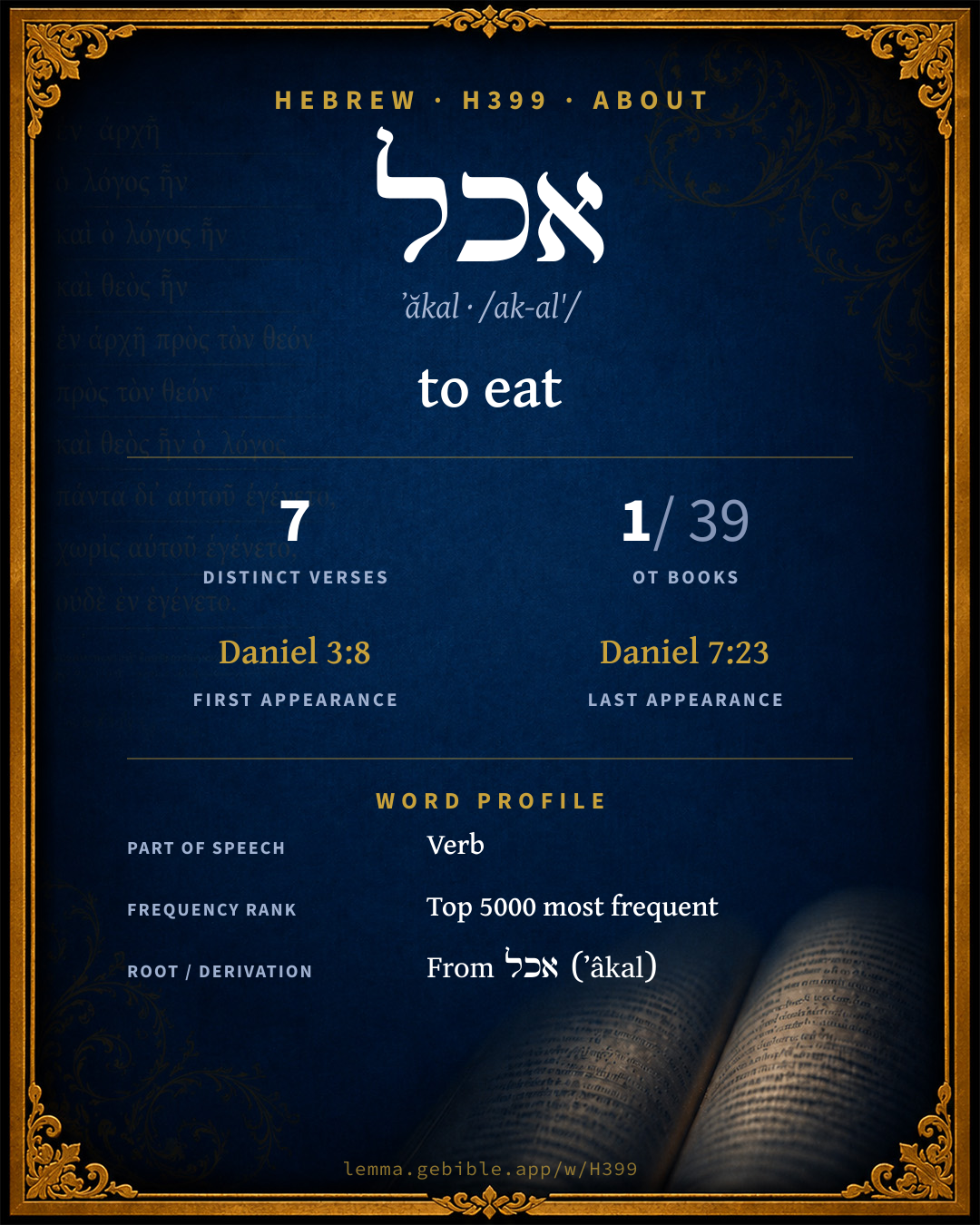
אֲכַל
to eat
‘to eat’ is one of 4 main senses fuller range ↓
Full lexicon entry — Brown-Driver-Briggs (BDB)
From Brown-Driver-Briggs (BDB)
Where this word appears
Grammar key — what these labels mean
Part of speech
- Verb
- An action or state-of-being word.
Stem
- Qal
- The basic, simple active stem — the plain form of the verb (“he wrote”).
Form
- Participle Active
- A verbal adjective expressing ongoing or characteristic action (“writing / one who writes”).
- Imperfect
- An incomplete, ongoing, or future action (“he will / would write”).
- Perfect
- A completed action or state — Hebrew marks aspect (completeness) more than strict tense (“he wrote”).
- Imperative
- A direct command (“write!”).
State
- Absolute
- The independent form of a noun, not bound to a following word.
Person
- 3rd Person
- The one spoken about (“he / she / it / they”).
- 2nd Person
- The one addressed (“you”).
Gender
- Feminine
- Grammatically feminine.
- Masculine
- Grammatically masculine.
Number
- Singular
- One.
- Plural
- More than one (in Hebrew, generally three or more).
Grammatical forms
- Verb, Qal, Participle Active, Feminine, Singular, Absolute 2 times (29%)
- Verb, Qal, Perfect, 3rd Person, Masculine, Plural 2 times (29%)
- Verb, Qal, Imperfect, 3rd Person, Feminine, Singular 1 time (14%)
- Verb, Qal, Imperfect, 3rd Person, Masculine, Singular 1 time (14%)
- Verb, Qal, Imperative, 2nd Person, Feminine, Singular 1 time (14%)
Parsed forms decoded from the imported morphology (morphhb / Westminster Leningrad Codex — WLC text public domain, morphhb tagging CC BY 4.0), counted across 7 parsed occurrences — not distinct verses.
Every verse where H399 appears — 7 distinct verses across 1 book. Click any verse to open its interlinear word-by-word view. Verse text shown in the World English Bible for context — . Each verse’s Hebrew form is shown with its reference; the English is not keyword-highlighted, since the data carries no word-level English alignment. Use “Compare translations” on any verse to read it across multiple English versions. This concordance covers the Hebrew Bible; Septuagint (Greek Old Testament) occurrences are not indexed here.
Daniel 7 verses
- Daniel 3:8 וַ/אֲכַ֥לוּ conj + Qal pf 3mp Therefore at that time certain Chaldeans came near, and brought accusation against the Jews.
- Daniel 4:33 יֵאכֻ֔ל Qal impf 3ms The same hour was the thing fulfilled on Nebuchadnezzar: and he was driven from men, and ate grass as oxen, and his body was wet with the dew of the sky, until his hair was grown like eagles' [feathers], and his nails like birds' [claws].
- Daniel 6:24 אֲכַ֤לוּ Qal pf 3mp The king commanded, and they brought those men who had accused Daniel, and they cast them into the den of lions, them, their children, and their wives; and the lions had the mastery of them, and broke all their bones in pieces, before they came to the bottom of the den.
- Daniel 7:5 אֲכֻ֖לִי Qal impv 2fs Behold, another animal, a second, like a bear; and it was raised up on one side, and three ribs were in its mouth between its teeth: and they said thus to it, Arise, devour much flesh.
- Daniel 7:7 אָֽכְלָ֣ה Qal ptcp.act fs After this I saw in the night-visions, and, behold, a fourth animal, awesome and powerful, and strong exceedingly; and it had great iron teeth; it devoured and broke in pieces, and stamped the residue with its feet: and it was diverse from all the animals that were before it; and it had ten horns.
- Daniel 7:19 אָֽכְלָ֣ה Qal ptcp.act fs Then I desired to know the truth concerning the fourth animal, which was diverse from all of them, exceedingly terrible, whose teeth were of iron, and its nails of brass; which devoured, broke in pieces, and stamped the residue with its feet;
- Daniel 7:23 וְ/תֵאכֻל֙ conj + Qal impf 3fs Thus he said, The fourth animal shall be a fourth kingdom on earth, which shall be diverse from all the kingdoms, and shall devour the whole earth, and shall tread it down, and break it in pieces.
About this entry
At a glance — auto-summarized from this page’s data, not written by a person. Every figure links to its source below. This summary describes the numbers; it doesn’t interpret them.
אכל (ʼăkal) is a Hebrew verb most often rendered “to eat.” Daniel dominates its distribution — 7 of 7 verses. Spanning 7 verses in 1 book, it ranks among the uncommon words of the Hebrew Bible. Scripture first uses it in Daniel 3:8. Ranging over 4 senses, it is not a single-sense word. For the data behind this summary, explore the sense tree and the renderings breakdown below.
Gloss history
Strong's 1890 vs modern scholarship
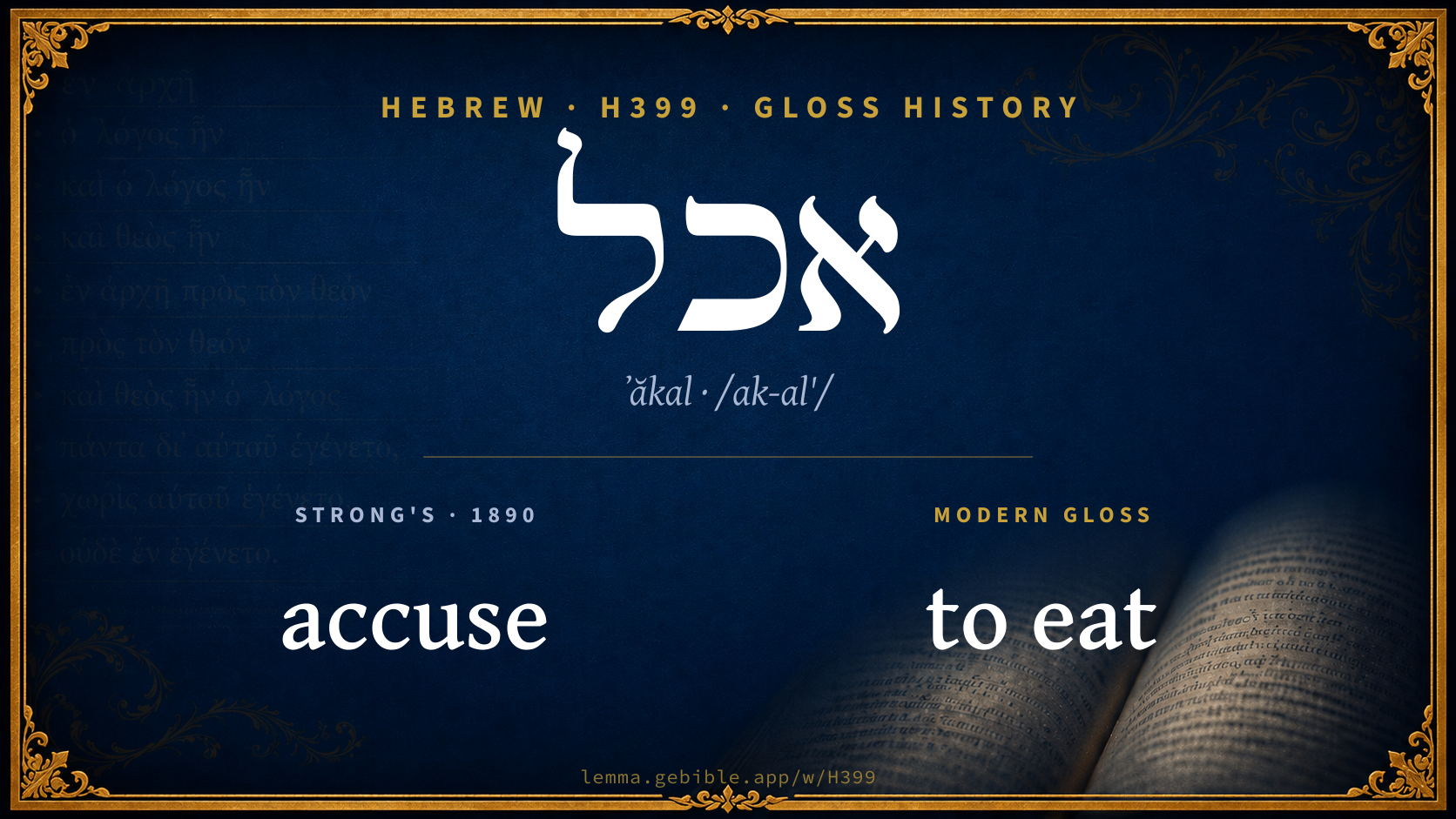
About this word
Strong's H399 catalogs a Hebrew word from the Hebrew Old Testament.
These counts are not copied from any lexicon or concordance. They are computed here, from the morphology-tagged Hebrew Old Testament. What Lemma adds →
- 7
- distinct verses
- The word appears in 7 distinct verses.
- 1 / 39
- OT books
- The word appears in 1 of 39 Old Testament books.
- #2,835
- by frequency
- Top 5000 most frequent Hebrew words (rank 2,835 of 8,640 Hebrew words by occurrence).
View all 7 occurrences in the concordance →
Most concentrated in
- Daniel 7 verses 100%
By section of the Old Testament
By traditional corpus
Conventional, traditional groupings — biblical authorship is debated, so this is a traditional corpus grouping, not an authorship claim. Each share is this word’s portion of its verses in that division of the Hebrew canon. Each figure is a share of the word’s 7 distinct verses.
- Writings (Ketuvim) 7 verses · 100%
How translations render this word
Counts come from each version’s own published word-to-Strong’s tagging or interlinear alignment — an approximate guide to how each version renders this word, not a word-level alignment the data otherwise carries. Because each total is that version’s own tagged count, the per-version totals vary from one another and need not match the appearance or distinct-verse counts above. These counts may also differ from a printed concordance because Lemma counts each distinctly tagged rendering and does not collapse phrase taggings into a single head-word total. This is a fixed set of word-tagged versions (KJV, ASV, BSB, ULT) and does not change with the reading translation you choose elsewhere. Each version’s license is shown beside its name below (and on Sources).
- King James Version: Devoured 2×
- American Standard Version: Devoured 2×
- Berean Standard Bible: Devoured 1×, Devouring 1×, Gorge yourself 1×
- unfoldingWord Literal Text: Devoured 2×
King James Version Public Domain
Renders H399 across 6 tagged occurrences — most commonly:
Plus 4 renderings that appear only once — usually multi-word phrases or single function words the recovered tagging swept in, not distinct renderings. Not rendered by a distinct English word in 1 further occurrence.
American Standard Version Public Domain
Renders H399 across 6 tagged occurrences — most commonly:
Plus 4 renderings that appear only once — usually multi-word phrases or single function words the recovered tagging swept in, not distinct renderings.
Berean Standard Bible Public Domain
Renders H399 across 7 tagged occurrences — most commonly:
unfoldingWord Literal Text CC BY-SA 4.0
Renders H399 across 7 tagged occurrences — most commonly:
Plus 5 renderings that appear only once — usually multi-word phrases or single function words the recovered tagging swept in, not distinct renderings.
Senses in BDB
The 4 senses BDB distinguishes for this word, in lexicon order (not ranked by frequency or importance). The full entry — with sub-senses — is in the Lexicon Entry tab.
- to eat, devour
(Peal)
- to eat (of beasts)
- to devour
- eat their pieces (in a phrase, that is, slander them)
Word origin
[ אֲכַל ] vb. eat, devour
— Brown-Driver-Briggs (Oxford 1906, public domain), digitized via Sefaria, supplemented by the OpenScriptures HebrewLexicon (CC BY 4.0). See Sources.
Derived from אכל (ʼâkal) (H398) — to eat.
Jastrow Dictionary
A second Hebrew/Aramaic lexicon for comparison, covering Aramaic and post-biblical (Talmudic, Targumic, Midrashic) usage that the biblical-Hebrew BDB does not. Matched by lemma rather than by Strong’s number, so a lemma may carry more than one Jastrow headword (shown separately below), and the entries cover usage well beyond the Bible.
אָכַל
- √אך to rub,
- 1. to gnaw, eat, consume. Inf. in Y. freq. לוֹכַל = לֶאֱכוֹל. Ber. I, 1; a. v. fr.
- 2. trnsf. to absorb, occupy, take away. Y. Shebu. VII, 38ᵃ בשרבית אוֹכֶלֶת בו when interests gnaw on (absorb) the property. Y. Erub. IV, 21ᵈ bot. ד׳ אמות אוֹכְלוֹת וכ׳ four cubits entering into the area of Tiberias. Num. R. s. 4 כמה לוחות אוֹכְלוֹת how much space did the tablets occupy &c.? B. Bath. 14ᵃ (interchanging with איגרות, Var. אוגדות, v. Rabb. D. S. a. l. note 5, 6).
- 3. (euphem.) to sleep with. Keth. V, 9, differ. of opin. ib. 65ᵇ; Y. ib. 30ᵇ top a. bot.
- to be eaten &c. Zeb. I, 3; Ber. I, 1; a. fr.
- to consume, burn. Tam. I, 4 המְאוּכָּלוֹת הפנימיות (Talm. ed. המעו׳) the thoroughly lighted coals in the centre; Y. Yoma II, 39ᶜ
- to give to eat, cause to eat. Keth. V, 3 היבם אינו מַאֵכִיל וכ׳ the Yabam does not transfer the privilege of eating T’rumah to his sister-in-law. Kidd. 31ᵃ יש מאכיל וכ׳ one may feed his father on pheasants &c.; a. fr.
- 1. to be consumed, burnt up, digested. Ber. VIII, 7 עד כדי שיִתְאַכֵּל וכ׳ Ar. (ed. שיתע׳) until the food is digested (or absorbed) in his bowels. Tam. II, 1; a. e.
- 2. to be worn off, spent. Snh. VI, 12 Y. ed. נתא׳ הבשר (Mish. ib. VI, 6 נתע׳) when the flesh of the corpse was gone. Cant. R. to IV, 4 שלא נתא׳ אחת מהן none of them was worn off. Kidd. 59ᵃ נתא׳ המעות the money was spent; a. e.
אֲכַל
- 1. same.—Inf. מֵיכַל, מֵיכוּל. Targ. Gen. II, 16; a. fr.—Y. Ter. VIII, 46ᵃ כד אתון יֵיכלון when they came and were about eating; ib. (more corr.) אתון מיכל; a. fr.
- 2. with קרצי prop. to eat (the bread of) destruction, eat the informer’s bread, hence to inform against. Dan. III, 8; VI, 25.—Targ. Ps. XV, 3; a. fr.—Gitt. 56ᵃ איכול בהו קו׳; Lam. R. to IV, 2 איכול קרצהון I will inform against them. e.g. Daniel 3:8
- to give to eat, to support. Y. Ter. X, 47ᵇ bot. אוכלה ליה he gave it to him to eat. Gen. R. s. 48, end (read:) אוכלית אשקית לוי hast thou given (thy guest) to eat? to drink? do escort him, i.e. perform thy duties fully. Y. Kidd. I, 61ᵇ הוה מייכל לאבוי וכ׳ fed his father on &c.; a. fr.
- , אִתְאָכִיל to be eaten, consumed. Targ. Ps. LXVIII, 23; a. fr. Tanḥ. Emor, 6 ומה דהבא מִתְאֲכִיל וכ׳; Lev. R. s. 27 ומה זה וכ׳ what is this? do they eat gold &c.? Kidd. 59ᵃ קא מתאכלי were eaten up (spent). [אכלי Af. of כלי to cry, v. כלי.]
אֲכַל II
- (sec. r. of כול) to measure. Ned. 51ᵃ ליכיל לי מר please measure for me. Ruth R. introd. 2. הא … סאה תקום אכול (read סאתה קום) here is the bag and here the measure, get up and fill it; v. כּוּל.
אֹכֶל
- , v. אוֹכֶל
A Dictionary of the Targumim, the Talmud Babli and Yerushalmi, and the Midrashic Literature (Marcus Jastrow; London, Luzac, 1903) — Public Domain. Digitized via Sefaria. Digitized via Sefaria. Full attribution on Sources.
Forms in the corpus
The 6 distinct written forms H399 takes in the Hebrew Bible, most frequent first — each parse links to that stem’s occurrences in the concordance. Hebrew forms include their vowel points and cantillation, so a single lemma takes many written forms.
| Form | Parsing | Example | Uses |
|---|---|---|---|
| אָֽכְלָ֣ה | Verb, Qal, Participle Active, Feminine, Singular, Absolute | Daniel 7:7 | 2 |
| אֲכַ֤לוּ | Verb, Qal, Perfect, 3rd Person, Masculine, Plural | Daniel 6:24 | 1 |
| אֲכֻ֖לִי | Verb, Qal, Imperative, 2nd Person, Feminine, Singular | Daniel 7:5 | 1 |
| וְ/תֵאכֻל֙ | Verb, Qal, Imperfect, 3rd Person, Feminine, Singular | Daniel 7:23 | 1 |
| וַ/אֲכַ֥לוּ | Verb, Qal, Perfect, 3rd Person, Masculine, Plural | Daniel 3:8 | 1 |
| יֵאכֻ֔ל | Verb, Qal, Imperfect, 3rd Person, Masculine, Singular | Daniel 4:33 | 1 |
Same root — word family
Other BDB entries built from the same root as H399, grouped by Strong’s listed origin. These share a root / origin per the lexicon — not necessarily a shared meaning. Each links to that word’s own entry.
Derives from
Shares the same root
- אכילה ʼăkîylâh H396 food
- אכל ʼôkel H400 food
- מאכל maʼăkâl H3978 food
- מאכלת maʼăkeleth H3979 knife
- מאכלת maʼăkôleth H3980 fuel
- מכלת makkôleth H4361 food
Proper names from this root
People and places named from this root — a name, not an additional meaning of the word.
Compare all same-root words → Showing 4 of 9 — not the complete family. 1 of the same-root words is a proper name (a person or place). They share a root, not necessarily a meaning.
Septuagint verse parallels
This word appears in 6 verses that also exist in the Greek Old Testament (Septuagint), out of the 7 Hebrew verses it occurs in. You can read those verses in Greek by switching the Old Testament edition to the Septuagint.
Read these verses in the Septuagint
This is a verse-level parallel only — the same verses exist in both the Hebrew and Greek Old Testaments. No word-level Hebrew↔Greek correspondence is claimed: the data carries no such alignment, so no Greek word is shown as this Hebrew word’s translation. Coverage is not total — the Septuagint omits the deuterocanon and renumbers the Psalms, so some Hebrew verses have no direct Greek parallel.