Joshua 5:11

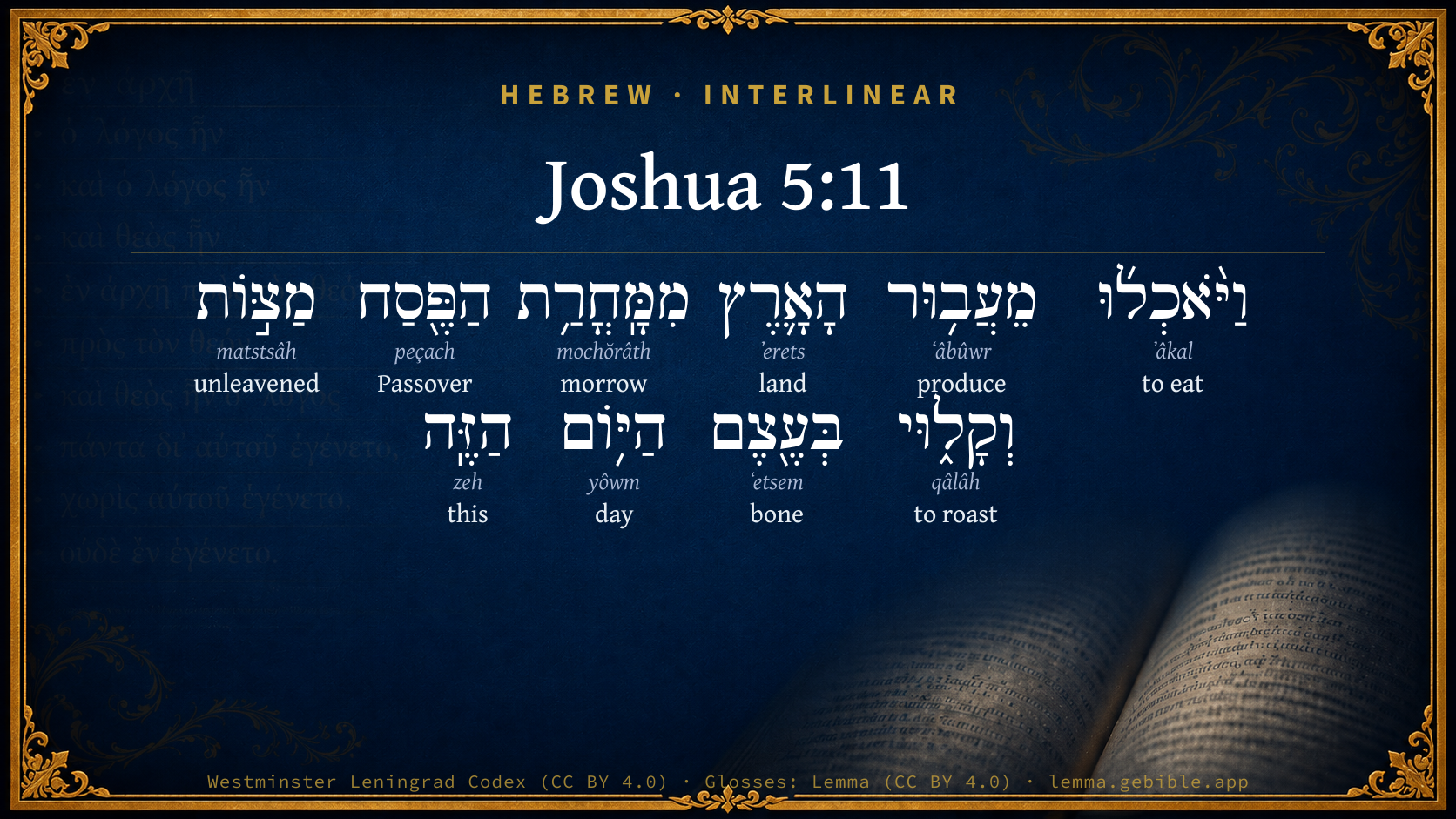
Hebrew (Westminster Leningrad Codex) Joshua 5:11 appears in the Hebrew Old Testament. The text above is from the Westminster Leningrad Codex. Each word links to its Strong’s number, a concise gloss, and parsing drawn from the Open Scriptures Hebrew Bible morphology. Click any word for its full Brown-Driver-Briggs (BDB) entry.
Download image
Cite this verse

Joshua 5:11 (World English Bible). Public Domain. Lemma interlinear Bible study tool, https://lemma.gebible.app/v/joshua/5/11.

Show BibTeX & RIS
BibTeX
RIS
English Translation
They ate of the produce of the land on the next day after the Passover, unleavened cakes and parched grain, in the same day.
World English Bible · Public Domain
Highlights Full analysis ↓
Download a study sheet

One document with this verse’s original text, its word-by-word gloss line, the meaning frame, cross-references with their text, attributed commentary, and full source and license credits — printable, and it pastes into notes with its structure intact.

This verse Autodidact and up

Study sheet (.html) Plain text (.txt)

A passage Seminary Student

Up to 50 verses in one chapter. A passage sheet keeps up to 6 commentary sources and 12 cross-references per verse, in the order this page ranks them, and says so on the sheet whenever that leaves anything out. Ask for a single verse and you get the Autodidact verse sheet above.

Everything on this page stays free to read, with no account — the sheet is a download of what is already on screen, not access to it.

Want to remove ads? Support Godless Engineer
Compare translations 3

The same verse in 3 English versions, stacked beneath the original-language interlinear above. Click any original word for its lexicon entry.

Each is an independent rendering of the whole verse — the interlinear is not word-aligned to these translations.

Highlighted words mark where these versions differ — a whole-verse word diff, not a word-by-word alignment.

  • World English Bible Public Domain
    They ate of the produce of the land on the next day after the Passover, unleavened cakes and parched grain, in the same day.
  • King James Version Public Domain
    And they did eat of the old corn of the land on the morrow after the passover, unleavened cakes, and parched corn in the selfsame day.
  • unfoldingWord Literal Text CC BY-SA 4.0
    And they ate from the produce of the land, from the morrow of the Passover, unleavened cakes and roasted, on that same day.

unfoldingWord Literal Text — © unfoldingWord, licensed CC BY-SA 4.0. Word-aligned USFM3 via Door43 (git.door43.org/unfoldingWord/en_ult).

Versions to compare (up to 4)

3 of 4 selected

Show all 18 translations

Every available English version of this verse, each an independent rendering of the whole verse.

  • World English Bible Public Domain
    They ate of the produce of the land on the next day after the Passover, unleavened cakes and parched grain, in the same day.
  • Berean Standard Bible Public Domain
    The day after the Passover, on that very day, they ate unleavened bread and roasted grain from the produce of the land.
  • Majority Standard Bible Public Domain
    The day after the Passover, on that very day, they ate unleavened bread and roasted grain from the produce of the land.
  • King James Version Public Domain
    And they did eat of the old corn of the land on the morrow after the passover, unleavened cakes, and parched corn in the selfsame day.
  • American Standard Version (1901) Public Domain
    And they did eat of the produce of the land on the morrow after the passover, unleavened cakes and parched grain, in the selfsame day.
  • Revised Version (1885) Public Domain
    And they did eat of the old corn of the land on the morrow after the passover, unleavened cakes and parched corn, in the selfsame day.
  • Geneva Bible (1599) Public Domain
    And they did eat of the corne of the land, on the morow after the Passeouer, vnleauened breade, and parched corne in the same day.
  • Douay-Rheims (1899) Public Domain
    And they ate on the next day unleavened bread of the corn of the land, and frumenty of the same year.
  • Young's Literal Translation Public Domain
    and they eat of the old corn of the land on the morrow of the passover, unleavened things and roasted `corn', in this self-same day;
  • Literal Standard Version CC BY-SA 4.0
    and they eat of the old grain of the land on the next day of the Passover, unleavened things and roasted [grain], on this very same day;
  • Unlocked Literal Bible CC BY-SA 4.0
    On the day after Passover, that same day, they ate some of the produce of the land on the day, unleavened bread and roasted grain.
  • unfoldingWord Literal Text CC BY-SA 4.0
    And they ate from the produce of the land, from the morrow of the Passover, unleavened cakes and roasted, on that same day.
  • Darby Bible Public Domain
    And they ate of the old corn of the land on the morrow after the passover, unleavened loaves, and roasted [corn] on that same day.
  • World Messianic Bible Public Domain
    They ate unleavened cakes and parched grain of the produce of the land on the next day after the Passover, in the same day.
  • Webster's Bible Public Domain
    And they ate of the old corn of the land on the morrow after the passover, unleavened cakes, and parched corn in the same day.
  • Free Bible Version CC BY-SA 4.0
    From the very next day they began to eat produce from the land: unleavened bread and roasted grain.
  • Bible in Basic English Public Domain
    And on the day after the Passover, they had for their food the produce of the land, unleavened cakes and dry grain on the same day.
  • JPS Tanakh (1917) Public Domain
    And they did eat of the produce of the land on the morrow after the passover, unleavened cakes and parched corn, in the selfsame day.

Literal Standard Version (2020), Covenant Press — licensed CC BY-SA 4.0. Text via the HelloAO Bible API (eBible.org). Unlocked Literal Bible (unfoldingWord) — licensed CC BY-SA 4.0. Text via the HelloAO Bible API (eBible.org). unfoldingWord Literal Text — © unfoldingWord, licensed CC BY-SA 4.0. Word-aligned USFM3 via Door43 (git.door43.org/unfoldingWord/en_ult). Free Bible Version, Dr. Jonathan Gallagher — licensed CC BY-SA 4.0. Text via the HelloAO Bible API (eBible.org).

Word by word

More ways to search: Search by grammar → Find every occurrence → Compare this word →

Practice this passage: Drill this verse → Learn its vocabulary →

מֵעֲב֥וּר
ʻâbûwr
H5669
“from · produce of”
Preposition + Noun, Common, Masculine, Singular, Construct
Part of Speech
Preposition + Noun
Type
Common
Gender
Masculine
Number
Singular
State
Construct
Full BDB Definition

Origin: the same as H5668

TWOT: 1556f

produce, yield
  1. וַיֹּ֨אכְל֜וּ ʼâkal H398 “and · to eat” Conjunction + Verb, Qal, Sequential Imperfect, 3rd Person, Masculine, Plural
  2. הָאָ֛רֶץ ʼerets H776 “the · land” Particle, Definite Article + Noun, Common, Both, Singular, Absolute
  3. מִמָּֽחֳרַ֥ת mochŏrâth H4283 “from · morrow of” Preposition + Noun, Common, Feminine, Singular, Construct
  4. הַפֶּ֖סַח peçach H6453 “the · Passover” Particle, Definite Article + Noun, Common, Masculine, Singular, Absolute
  5. מַצּ֣וֹת matstsâh H4682 “unleavened bread” Noun, Common, Feminine, Plural, Absolute
  6. וְקָל֑וּי qâlâh H7033 “and · roasted” Conjunction + Verb, Qal, Participle Passive, Masculine, Singular, Absolute
  7. בְּעֶ֖צֶם ʻetsem H6106 “in/at · bone of” Preposition + Noun, Common, Feminine, Singular, Construct
  8. הַיּ֥וֹם yôwm H3117 “the · day” Particle, Definite Article + Noun, Common, Masculine, Singular, Absolute
  9. הַזֶּֽה zeh H2088 “the · this” Particle, Definite Article + Pronoun, Demonstrative, Masculine, Singular

About this verse

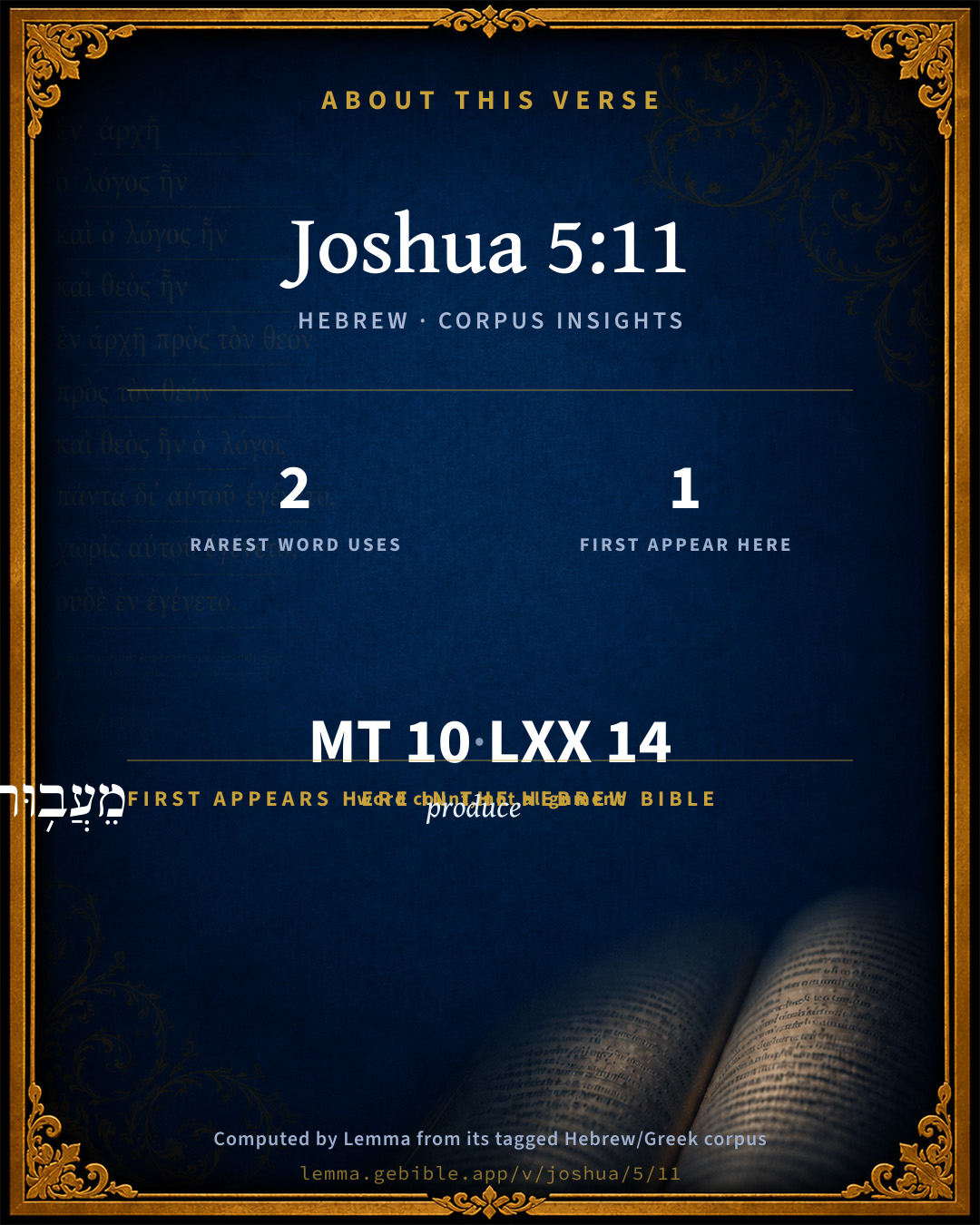
These counts appear in no published source. They are computed here, from the morphology-tagged text and Lemma’s own curated glosses. What Lemma adds →

10
words
10
distinct lemmas
Historical
section

Notable vocabulary

The rarest word here is מֵעֲב֥וּר produce H5669 — appearing just 2 times in the whole Hebrew Bible.

First appearance in Scripture

This word makes its first canonical appearance in the Hebrew Bible here:

  • מֵעֲב֥וּר produce H5669

Shared distinctive vocabulary

מֵעֲב֥וּר produce H5669 occurs in 2 verses of the Hebrew Bible. Also found in:

Grammatical profile

  • 2 verbs
  • 7 nouns
  • 1 pronoun

Verb forms

  • וַיֹּ֨אכְל֜וּ Qal · Sequential Imperfect
  • וְקָל֑וּי Qal · Participle Passive

Hebrew & Septuagint length

In English translation the verse runs 24 words from the Hebrew and 13 from the Septuagint (LXX English) — the Septuagint runs noticeably shorter here. See the side-by-side →

A rough comparison of the two English renderings, which tokenize alike — not a word-level alignment.

Word counts can differ between the Hebrew and the Greek without any difference in meaning — e.g. the Hebrew direct-object marker אֵת has no separate Greek word, and Greek often adds the article ὁ.

In the original languages it is 10 Hebrew tokens and 14 Greek tokens — but the two are counted differently (Hebrew bundles its prefixes and suffixes into one token; the Greek is in lemma form), so that isn’t a like-for-like length.

Cross-references

4

Topical passages linked to Joshua 5:11 in the Treasury of Scripture Knowledge — connected by theme and wording, ordered by reader-vote popularity; previews shown in the World English Bible.

  • Leviticus 23:14 You shall eat neither bread, nor roasted grain, nor fresh grain, until this same day, until you have brought the offering of your God. This is a statute forever throughout your generations in all your dwellings.
  • Exodus 12:18–20 In the first month, on the fourteenth day of the month at evening, you shall eat unleavened bread, until the twenty first day of the month at evening.
  • Exodus 13:6–7 Seven days you shall eat unleavened bread, and in the seventh day shall be a feast to Yahweh.
  • Leviticus 23:6 On the fifteenth day of the same month is the feast of unleavened bread to Yahweh. Seven days you shall eat unleavened bread.

Cross-references courtesy of OpenBible.info (CC BY 4.0).

Hebrew and Greek witnesses Masoretic Hebrew ↔ Greek Septuagint

The same verse in the two great witnesses to the Old Testament, shown verse-for-verse.

Here the Septuagint runs noticeably shorter than the Hebrew — LXX2012 (modern English Septuagint) 13 words vs World English Bible 24. A rough length comparison of the two English translations, not a word-level alignment — read both below.

These are two independent witnesses, not word-aligned to each other, and the Septuagint is shown in lemma (dictionary) form.

Hebrew Joshua 5:11 Masoretic · Westminster Leningrad Codex

וַיֹּ֨אכְל֜וּ מֵעֲב֥וּר הָאָ֛רֶץ מִמָּֽחֳרַ֥ת הַפֶּ֖סַח מַצּ֣וֹת וְקָל֑וּי בְּעֶ֖צֶם הַיּ֥וֹם הַזֶּֽה

They ate of the produce of the land on the next day after the Passover, unleavened cakes and parched grain, in the same day.

World English Bible · Public Domain

Greek LXX Joshua 5:11 Septuagint · lemma form

καί ἐσθίω ἀπό ὁ σῖτος ὁ γῆ ἄζυμος καί νέος ἐν οὗτος ὁ ἡμέρα

And they ate of the grain of the earth unleavened and new corn.

LXX2012 (modern English Septuagint) · Public Domain

On this verse, John Gill's Exposition discusses the Septuagint’s reading. Read the note in Commentary ↓

Hebrew: Westminster Leningrad Codex (CC BY 4.0). Greek: Septuagint (public domain); English from LXX2012 (modern English Septuagint) (Public Domain). How the Septuagint differs from the Hebrew →

Targum (Aramaic paraphrase)

1

The Targum is the ancient Jewish Aramaic paraphrase of the Hebrew Scriptures — an interpretive translation, not the Hebrew text itself. Onkelos (literal) and Pseudo-Jonathan (expansive) render the Torah, and Jonathan the Prophets. Coverage is partial: where no permissively-licensed English translation exists for a verse, only the Aramaic is shown. This is verse-level text, not a word-by-word alignment to the Hebrew.

  1. Targum Jonathan Prophets (Joshua–Malachi)
    וַאֲכַלוּ מֵעִבּוּרָא דְאַרְעָא מִבָּתַר פִּסְחָא פַּטִיר וּקְלִי בִּכְרַן יוֹמָא הָדֵין:

    (no public-domain English translation for this verse)

    Targum Jonathan — Aramaic: “Mikraot Gedolot” (public domain). English: “Sefaria Community Translation” (CC0 1.0 (public-domain dedication)); “London "Chaldee Paraphrase," 1871” (public domain). Text via Sefaria.

Commentary

Notes on Joshua 5:11 from classic Christian and Jewish commentators (each source and its license shown beneath its notes). The classic Christian expositions comment on the surrounding passage and are grouped to its opening verse, so a note may address several verses; the Jewish commentaries on the Tanakh (Rashi and others) are per-verse, so they appear only where the commentator wrote on this verse.

Lemma curates 59 commentaries, every one of them public domain or Creative Commons licensed, each selected and text-cleaned for this edition rather than reprinted as found. About our sources →

Trapp's Complete Commentary

John Trapp

Jos 5:11 And they did eat of the old corn of the land on the morrow after the passover, unleavened cakes, and parched [corn] in the selfsame day.

Ver. 11. On the morrow after the Passover.] That holy sacrament was αλεξητηριον καθαρτικον, to those believers, sanctifying those outward comforts to their use. "To the pure all things are pure."

John Trapp, A Commentary or Exposition upon All the Books of the Old and New Testament (1647–1656) — public domain. Text from a community e-Sword module.

Joseph Benson's Commentary

Jos 5:11. They eat of the old corn — The corn of the last year, which the inhabitants of those parts had left in their barns, being fled into their strong cities, or other remoter parts. On the morrow — That is, on the sixteenth day; for the passover was killed between the two evenings of the fourteenth day, and was eaten in that evening or night, which, according to the Jewish computation, whereby they begin their days at the evening, was a part of the fifteenth day, all which was the feast of the passover; and so the sixteenth day was the morrow of the passover, when they were obliged to offer unto God the first sheaf, and then were allowed to eat of the rest. Parched corn — Of that year’s corn, which was most proper for that use. Self-same day — Having an eager desire to enjoy the fruits of the land.

And this corn came very seasonably; for after the passover they were to keep the feast of unleavened bread, which they could not do when they had nothing but manna to live upon.

Joseph Benson's Commentary on the Old and New Testaments (1811–1818) — public domain. Text from a community e-Sword module.

Tyndale Open Study Notes

Tyndale Open Resources

5:11-12 God’s daily provision of manna (Exod 16:31; Num 11:9) could cease because the produce from the land was now available.

5:11 Israel reinstituted the Festival of Unleavened Bread, observed for seven days following Passover (Lev 23:6). The people ate unleavened bread and roasted grain, a favorite food of the harvest season (see Ruth 2:14).

Tyndale Open Study Notes — © Tyndale Open Resources, licensed CC BY-SA 4.0. Text via the HelloAO Bible API.

Jamieson, Fausset & Brown

Robert Jamieson, A. R. Fausset & David Brown

And they did eat of the old corn of the land--found in storehouses of the inhabitants who had fled into Jericho.

parched corn--new grain (see on Lev 23:10), probably lying in the fields. Roasted--a simple and primitive preparation, much liked in the East. This abundance of food led to the discontinuance of the manna; and the fact of its then ceasing, viewed in connection with its seasonable appearance in the barren wilderness, is a striking proof of its miraculous origin.

Jamieson, Fausset & Brown — Commentary Critical and Explanatory on the Whole Bible (1871) — public domain (CC PDM 1.0). Text via the HelloAO Bible API.

Adam Clarke's Commentary

Verse 11. They did eat of the old corn of the land] The Hebrew word עבור abur, which we translate old corn, occurs only in this place in such a sense, if that sense be legitimate. The noun, though of doubtful signification, is evidently derived from עבר abar, to pass over, to go beyond; and here it may be translated simply the produce, that which passes from the land into the hands of the cultivator; or according to Cocceius, what passes from person to person in the way of traffic; hence bought corn, what they purchased from the inhabitants of the land.

On the morrow after the passover] That is, on the fifteenth day; for then the feast of unleavened bread began. But they could neither eat bread, nor parched corn, nor green ears, till the first-fruits of the harvest had been waved at the tabernacle; (see Le 23:9, c.) and therefore in this case we may suppose that the Israelites had offered a sheaf of the barley-harvest, the only grain that was then ripe, before they ate of the unleavened cakes and parched corn.

Adam Clarke's Commentary on the Bible (1810–1826) — public domain. Text from a community e-Sword/MySword module.

John Calvin's Commentaries

11. And they did eat of the old corn, etc Whether they then began first to eat wheaten bread is not very clear. For they had dwelt in a country that was not uncultivated, and was tolerably fertile. At least in the territories of the two kings there was enough of corn to supply the inhabitants. It does not seem reasonable to suppose that the children of Israel allowed the corn which they found there to rot and perish by mere waste. And I have no doubt that they ate the flesh which remained over of the sacrifices. It is quite possible, therefore, that they did not wholly abstain from wheaten bread, and yet did not abandon their accustomed food. For a country which was assigned to a tenth part could not have furnished food sufficient for the whole multitude, as there cannot be a doubt that a just estimate was made when Moses settled in it only two tribes and a half tribe. As yet, therefore, the twelve tribes had not found sufficient food, more especially as the country had been devastated by war, and the Israelites, who were not in safety to leave the camp, could not devote their attention to agriculture. The manna was thus necessary to feed them until a more abundant supply was obtained. This took place in the land of Canaan, and then, accordingly, they returned to common food. But why they deferred it till that day is not known, unless it be that after their wound was cured, some days behooved to be spent in collecting corn, while religion did not permit them to bake bread lest they should break the Sabbath. But although that rest was sacred, we gather from the circumstances that they made haste, as the flour must have been previously prepared, seeing they could not grind it and bake it in a single day.

Be this as it may, the Lord furnished them with provision as long as their want required to be supplied. The failure of the manna on a sudden, and at the very moment, must have furnished an additional attestation to the kindness of God, inasmuch as it was thence apparent that the manna was a temporary resource, which had descended not so much from the clouds as from a paternal providence. It is moreover plain, that this is to be understood of the produce of the former year, and it is needless to raise any question in regard to it; for it would have implied too much precipitation to rush upon the produce of the present year when not yet properly matured, and a whole month would scarcely have sufficed to collect enough for the supply of so great a multitude. I cannot see why expounders should give themselves so much trouble with so clear a matter.

John Calvin's Commentaries (1540-1563) — public domain. Text from the Calvin Translation Society English edition (1840s-50s) via the Christian Classics Ethereal Library (ccel.org). Calvin's coverage is partial (roughly two-thirds of the Bible); uncommented books and verses are honest gaps, never fabricated. The 19th-century editor's footnotes and remarks are omitted so the notes are faithfully Calvin's own voice.

Ellicott's Commentary for English Readers

(11) They did eat of the old corn.—The word occurs nowhere else except in Jos_5:12. It need not have been last year’s corn; in fact, it seems to have been the produce of this very harvest. It seems to mean “that which was brought to them,” and was “the fruit” or “produce” of the land of Canaan, probably brought to the camp for sale.

A Bible Commentary for English Readers, edited by Charles John Ellicott (1878–1897) — public domain. Text from a community e-Sword module.

The Cambridge Bible for Schools and Colleges

gen. ed. J. J. S. Perowne

11. of the old corn] Rather, of the produce of the land. “And thei eten of the fruytis of the lond in the tothir day, therf looues, and potage of the same çeer, etin cornys seengid and frotid in the hond.” Wyclif. It could not have been other than the new corn just ripening at the season of the Passover (Lev_23:11), not “the old corn,” of which no sufficient supply could have been procurable.

on the morrow after the passover] In Num_33:3 these words denote the 15th of Nisan. Here, however, they must apparently mean the 16th. For the people could not lawfully eat of the new corn, till the firstfruits had been “waved before the Lord,” which was done “on the morrow after the Sabbath,” i.e. the morrow after the first day of unleavened bread; this, though not necessarily the seventh day of the week, was to be observed as a Sabbath, and therefore is so called. (Comp. Lev_23:7; Lev_23:11; Lev_23:14.)

unleavened cakes] according to the requirements of the Law, Exo_12:8; Exo_12:15.

parched corn] i.e. roasted harvest ears.

The Cambridge Bible for Schools and Colleges (gen. ed. J. J. S. Perowne; Cambridge University Press, 1878–1918) — public domain. Text from a community e-Sword module.

John Gill's Exposition

And they did eat the old corn of the land,.... That of the last year, as some versions (g), which agree with ours; in which they seem to follow the Jewish writers, who, as particularly Kimchi, Gersom, and Ben Melech, interpret it of the old corn, for this reason, because they might not eat of the new until the wave sheaf was offered up, Lev 23:10; of which old corn they suppose the unleavened cakes were made, and was also parched corn, though that word the Septuagint version translates "new"; and indeed were it not for the above law, there does not seem to be any reason for rendering it old corn, only corn of the land, as the Septuagint does; and there is some difficulty how they should get at the old corn, which it may be supposed was laid up in the granaries, when Jericho was close shut up, and none went in or out; unless they met with it in some of the villages near at hand, or it was brought them by the traders in corn, of whom they bought it, or found it in some houses and barns without the city:

on the morrow after the passover; which Kimchi and Ben Gersom say was on the fifteenth of Nisan, the passover being on the fourteenth; but if the morrow after the passover is the same with the morrow after the Sabbath, Lev 23:11; that was the sixteenth of Nisan; and so Jarchi here says, this is the day of waving the sheaf, which was always done on the sixteenth: it is difficult to say which day is meant; if it was the sixteenth, then it may refer to what they ate on that day, after the sheaf was offered (h); if it was the fifteenth, it seems necessary to understand it of the old corn; and such they must have to make their unleavened cakes of, both for the passover on the fourteenth, and the Chagigah, or feast of unleavened bread, which began the fifteenth, as it follows:

unleavened bread, and parched corn in the selfsame day; unleavened bread, for the uses before mentioned, they were obliged to, and parched corn for their pleasure; but new corn, as the Septuagint render it, was expressly forbidden before the waving of the sheaf, Lev 23:14; and therefore old corn seems to be meant; this was just forty years to a day from their coming out of Egypt.

(g) "de frumento praeteriti anni", Montanus; sic, Munster, Tigurine version, Vatablus. (h) So in Seder Olam Rabba, c. 11. p. 31.

John Gill's Exposition of the Whole Bible (1746–1763) — public domain (CC PDM 1.0). Text via the HelloAO Bible API.

Albert Barnes' Notes on the Bible

Old corn of the land - Rather “produce of the land,” the new grain just coming in at the time of the Passover. (So in Jos 5:12.)

On the morrow after the passover - These words denote in Num 33:3 the 15th Nisan, but must here apparently mean the 16th. For the Israelites could not lawfully eat of the new grain until the first fruits of it had been presented, and this was done on “the morrow after the Sabbath,” i. e. the morrow after the first day of Unleavened Bread, which was to be observed as a Sabbath, and is therefore so called. (Compare Lev 23:7, Lev 23:11, Lev 23:14.)

The term Passover, which is sometimes used for the lamb slain on the evening of the 14th Nisan, sometimes for the paschal meal, sometimes for the whole eight days’ festival, here means the first great day of the eight, the Sabbath of the first holy convocation.

Albert Barnes' Notes on the Bible (1834–1885) — public domain. Text from a community e-Sword/MySword module.

Haydock's Catholic Bible Commentary

Corn. Some pretend that the Hebrew means "old corn." But the ancient interpreters take no notice of this restriction. The offering of corn was probably omitted on this occasion, as the Israelites had not cultivated the land. --- Frumenty. Septuagint, "new corn." Hebrew, "parched, on that same day." These last words are taken by the Septuagint as a part of the next sentence.

George Leo Haydock (1774–1849), Haydock's Catholic Family Bible and Commentary, 1859 edition — public domain. Excludes Psalms (Douay-Rheims chapter numbering differs from Protestant) and Deuterocanonical books (Catholic canon only).

Matthew Poole's English Annotations

The old corn; the corn of the last year, which the inhabitants of those parts had left in their barns, being doubtless fled for fear of the Israelites into their strong cities, or other remoter and safer parts.

On the morrow after the passover, i.e. on the sixteenth day; for the passover was killed between the two evenings of the fourteenth day, and was eaten in that evening or night, which, according to the Jewish computation, whereby they begin their days at the evening, was a part of the fifteenth day, all which was the feast of the passover; and so the morrow of the sixteenth day was

the morrow after the passover, when they were obliged to offer unto God the first sheaf, and then were allowed to eat of the rest.

Parched corn; of that year’s corn, which was most proper and customary for that use.

In the selfsame day; having an eager desire to enjoy the fruits of the land.

Matthew Poole's English Annotations on the Holy Bible (1683–1685) — public domain. Text from a community e-Sword/MySword module.

Whedon's Commentary on the Bible

Daniel D. Whedon

11. The old corn of the land — There is no authority in the Hebrew for the word old. They ate of the produce of the land. The word old was inserted by our translators because it was unlawful to eat of the new grain before the sheaf was waved before Jehovah on the morrow of the Sabbath.

Lev_23:14-16. [But here is a difficulty. The morrow after the passover is used in Num_33:3, for the fifteenth of Nisan, the day after the evening on which the paschal lamb was eaten. But according to Lev_23:7, this day was to be celebrated by a holy convocation, and on it no servile work performed. How, then, shall we account for Israel’s eating the new fruit of the land on the morrow after the passover? The simplest explanation is that of Keil, who understands the word passover here, as in several other places, to mean not simply the paschal supper but the entire feast connected with it, which lasted seven days.

Parched corn — Ears of grain baked at the fire, an article of food still much relished by the Arabs. See note on Rth_2:14.]

Daniel D. Whedon (gen. ed.), Commentary on the Old and New Testaments (1874–1909) — public domain. Text from a community e-Sword module.

The Pulpit Commentary

The old corn. The produce of the land; literally, that which passes from off it, from rb to pass over. Whether new or old we have no means of telling. The barley would be ripe, (see note on Jos_2:6) but the wheat harvest had not yet taken place. The morrow after the sabbath. The 15th Nisan. (see Num_33:3) The law of the wave sheaf (Lev_23:10, Lev_23:11) was intended to apply to corn raised by the Israelites on their own land, after Canaan had been divided to them for an inheritance. (see Exo_23:16) And parched corn; i.e., ears roasted at the fire, and the grain afterwards rubbed out, a custom still in use among the Arabs. (see Lev_2:14 1Sa_17:17 2Sa_17:28, etc. See also for the precept here followed, Lev_23:14) This verse therefore adds some confirmation to the view that until their arrival in Palestine a full observance of the precepts of the law was impossible (see above, ver. 6).

The Pulpit Commentary (1880–1919), ed. H.D.M. Spence-Jones & Joseph S. Exell — public domain. Text from a community e-Sword module.

John Wesley's Explanatory Notes

Old corn - The corn of the last year, which the inhabitants of those parts had left in their barns, being fled into their strong cities, or other remoter parts. The morrow - That is, on the sixteenth day; for the passover was killed between the two evenings of the fourteenth day, and was eaten in that evening or night, which, according to the Jewish computation, whereby they begin their days at the evening, was a part of the fifteenth day, all which was the feast of the passover; and so the morrow of the sixteenth day, was the morrow after the passover, when they were obliged to offer unto God the first sheaf, and then were allowed to eat of the rest. Parched corn - Of that year's corn. which was most proper for that use. Self-same day - Having an eager desire to enjoy the fruits of the land. And this corn came very seasonably; for after the passover, they were to keep the feast of unleavened bread, which they could not do, when they had nothing but manna to live upon.

John Wesley, Explanatory Notes Upon the Whole Bible (1754–1765) — public domain. Text via the GEBible commentary corpus.

Scofield Reference Notes

C. I. Scofield

corn

The manna is a type of Christ in humiliation, known "after the flesh," giving his flesh that the believer might have life Joh 6:49-51 while the "old corn of the land" is Christ apprehended as risen, glorified, and seated in the heavenlies. Occupation with Christ on earth, "crucified through weakness," tends to a wilderness experience. An experience befitting the believer’s place in the heavenlies demands an apprehension of the power of His resurrection; 2Co 5:16; 2Co 13:4; Php 3:10; Eph 1:15-23. It is the contrast between "milk" and "meat" in Paul’s writings.; 1Co 3:1; 1Co 3:2; Heb 5:12-14; Heb 6:1-3.

The Scofield Reference Bible (1917 edition), notes by C. I. Scofield — public domain. Text from a community e-Sword module.

Rashi

Rabbi Shlomo Yitzchaki (Rashi)

From the day after the Pesach. This was the day of waving the Omer, for they sacrificed the Omer first. From the seventh day of Adar, the day when Moshe died, when the manna stopped falling, they were sufficiently supplied with the manna which was in their vessels which they gathered on the seventh of Adar, as it is said, ‘They ate the manna for forty years.’ But these forty years lacked thirty days— for the manna began to fall on the fifteenth day of Iyar. We must say therefore that in the [matzo] cakes the Bnei Yisroel took with them from Egypt, they tasted the taste of manna.

Rashi on the Tanakh — English translations: “The Judaica Press complete Tanach with Rashi, translated by A. J. Rosenberg” (CC BY 4.0); “Pentateuch with Rashi's commentary by M. Rosenbaum and A.M. Silbermann, 1929-1934” (public domain); “The Metsudah Tanach series, Lakewood, N.J” (CC BY 4.0); and “The Book of Joshua, Metsudah Publications, 1997” (CC BY 4.0). Text via Sefaria.

Radak

Rabbi David Kimhi (Radak)

They ate of the produce (meavor) of the country: They ate matza and parched grain from the old grain, since the new grain was forbidden to them until after the bringing of the omer on the sixteenth of Nissan. And even for matza, matza is forbidden from the new grain... And from where did they have old grain? From that which the merchants of the [other] nations sold to them. And the word meavor proves that it was from the old grain. For I say that the grain that is from the year that passed (avrah) is called avor, and [grain from] the next year is called produce (tevuah).

from the morrow of Passover: That is the night of the fifteenth of Nissan and its day. For the Passover sacrifice is offered on the fourteenth, and its morrow is the fifteenth. And likewise, "on the fifteenth day of the first month - on the morrow of Passover - the Children of Israel went out of Egypt" (Numbers 33:3).

Radak on the Tanakh — English translations: “Sefaria Community Translation” (CC0 1.0 (public-domain dedication)); “Eliyahu Munk, HaChut Hameshulash” (CC BY 4.0); “Rabbi Mike Feuer, Jerusalem Anthology” (CC BY 4.0); and “R. David Kimhi on the first book of Psalms, Translated by R.G. Finch, London, 1919” (public domain). Text via Sefaria.

Lesson kit

Teaching starters — assembled from the data on this page, not authored interpretation. Every prompt links to the verse data it draws on. Edit before teaching.

Joshua, in the Historical, opens this verse with 10 words (10 distinct Hebrew lemmas). Its most distinctive word is ʻâbûwr (“produce”). The Greek Septuagint runs shorter here. A historical commentator’s framing appears above. Read the whole chapter for the surrounding context.

Discussion questions

  1. The word ʻâbûwr carries the sense “produce.” How does it shape the verse?
  2. This is the first place “produce” appears in Scripture (first appears here). What does its debut here establish?
  3. How does Joshua 5:12, which shares the word «produce», read alongside this verse?
  4. The Septuagint runs shorter here than the Hebrew. What might account for the difference?
  5. These translations render this verse differently; the difference is in the English rendering, not the original. What questions does that raise?
  6. «וַיֹּ֨אכְל֜וּ» is a Qal Sequential Imperfect verb. How does that grammatical form shape the action described?
  7. Compare how Trapp's Complete Commentary and Joseph Benson's Commentary read this verse. Where do they agree or differ?

Things to notice

Reading settings

Reading text

Shown beneath each verse's original-language words.

Old Testament
Old Testament edition

Read the OT as the Masoretic Hebrew (MT) or the Greek Septuagint (LXX).

English shown for the Greek Septuagint (in the Hebrew ↔ Greek comparison).

Comparing translations? Open the Compare panel on any verse page to stack up to four side by side.