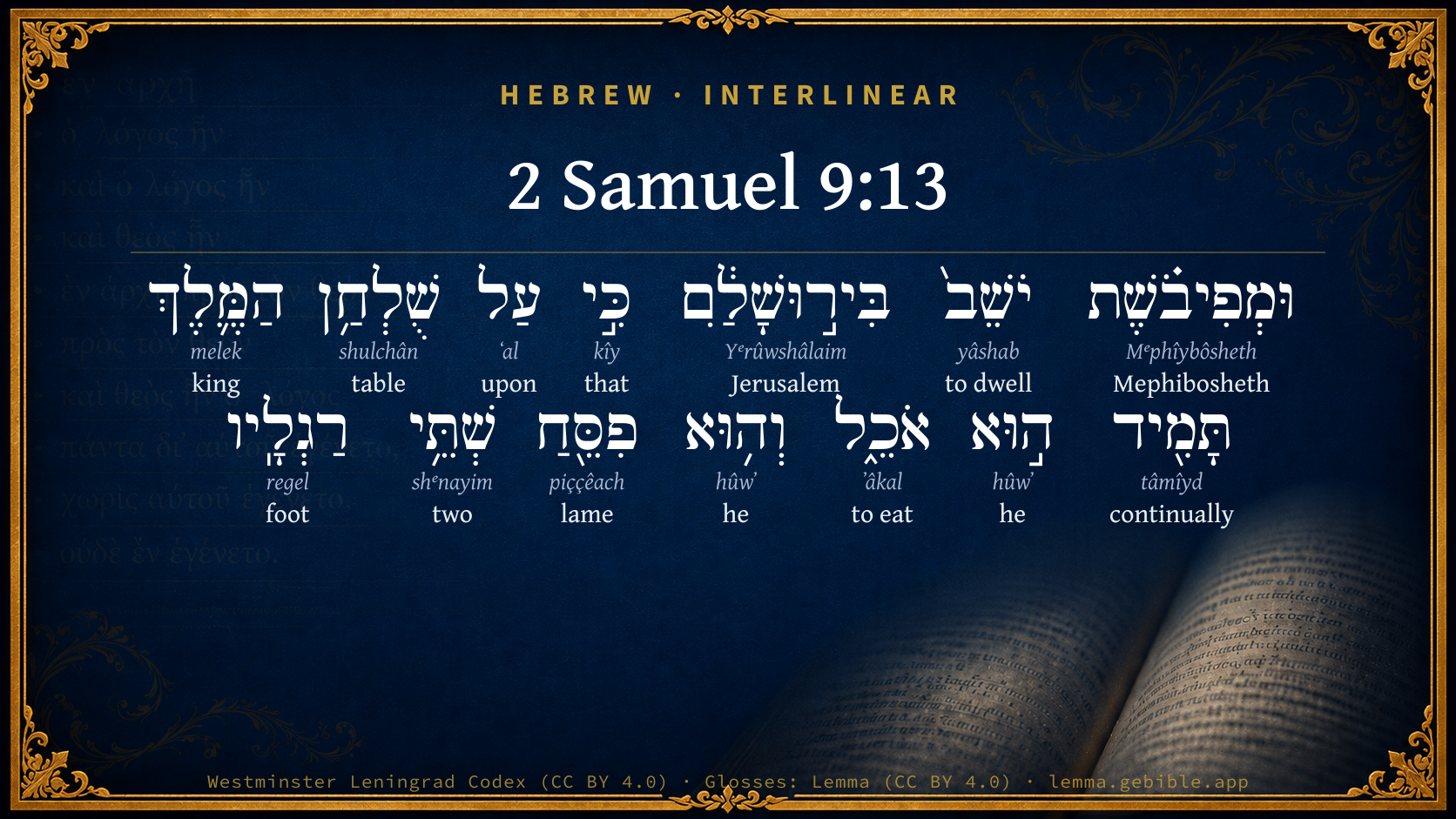
2 Samuel 9:13

Hebrew (Westminster Leningrad Codex) 2 Samuel 9:13 appears in the Hebrew Old Testament. The text above is from the Westminster Leningrad Codex. Each word links to its Strong’s number, a concise gloss, and parsing drawn from the Open Scriptures Hebrew Bible morphology. Click any word for its full Brown-Driver-Briggs (BDB) entry.
Download image
Cite this verse

2 Samuel 9:13 (World English Bible). Public Domain. Lemma interlinear Bible study tool, https://lemma.gebible.app/v/2-samuel/9/13.

Show BibTeX & RIS
BibTeX
RIS
English Translation
So Mephibosheth lived in Jerusalem; for he ate continually at the king's table. He was lame in both his feet.
World English Bible · Public Domain
Download a study sheet

One document with this verse’s original text, its word-by-word gloss line, the meaning frame, cross-references with their text, attributed commentary, and full source and license credits — printable, and it pastes into notes with its structure intact.

This verse Autodidact and up

Study sheet (.html) Plain text (.txt)

A passage Seminary Student

Up to 50 verses in one chapter. A passage sheet keeps up to 6 commentary sources and 12 cross-references per verse, in the order this page ranks them, and says so on the sheet whenever that leaves anything out. Ask for a single verse and you get the Autodidact verse sheet above.

Everything on this page stays free to read, with no account — the sheet is a download of what is already on screen, not access to it.

Want to remove ads? Support Godless Engineer
Compare translations 3

The same verse in 3 English versions, stacked beneath the original-language interlinear above. Click any original word for its lexicon entry.

Each is an independent rendering of the whole verse — the interlinear is not word-aligned to these translations.

Highlighted words mark where these versions differ — a whole-verse word diff, not a word-by-word alignment.

  • World English Bible Public Domain
    So Mephibosheth lived in Jerusalem; for he ate continually at the king's table. He was lame in both his feet.
  • King James Version Public Domain
    So Mephibosheth dwelt in Jerusalem: for he did eat continually at the king's table; and was lame on both his feet.
  • unfoldingWord Literal Text CC BY-SA 4.0
    But Mephibosheth dwelled in Jerusalem, for he was continually eating at the table of the king. And he lame, the two of his feet.

unfoldingWord Literal Text — © unfoldingWord, licensed CC BY-SA 4.0. Word-aligned USFM3 via Door43 (git.door43.org/unfoldingWord/en_ult).

Versions to compare (up to 4)

3 of 4 selected

Show all 18 translations

Every available English version of this verse, each an independent rendering of the whole verse.

  • World English Bible Public Domain
    So Mephibosheth lived in Jerusalem; for he ate continually at the king's table. He was lame in both his feet.
  • Berean Standard Bible Public Domain
    So Mephibosheth lived in Jerusalem, because he always ate at the king’s table, and he was lame in both feet.
  • Majority Standard Bible Public Domain
    So Mephibosheth lived in Jerusalem, because he always ate at the king’s table, and he was lame in both feet.
  • King James Version Public Domain
    So Mephibosheth dwelt in Jerusalem: for he did eat continually at the king's table; and was lame on both his feet.
  • American Standard Version (1901) Public Domain
    So Mephibosheth dwelt in Jerusalem; for he did eat continually at the king's table. And he was lame in both his feet.
  • Revised Version (1885) Public Domain
    So Mephibosheth dwelt in Jerusalem: for he did eat continually at the king’s table; and he was lame on both his feet.
  • Geneva Bible (1599) Public Domain
    And Mephibosheth dwelt in Ierusalem: for he did eate continually at the Kings table, and was lame on both his feete.
  • Douay-Rheims (1899) Public Domain
    But Miphiboseth dwelt in Jerusalem: because he ate always of the king's table: and he was lame of both feet.
  • Young's Literal Translation Public Domain
    And Mephibosheth is dwelling in Jerusalem, for at the table of the king he is eating continually, and he `is' lame of his two feet.
  • Literal Standard Version CC BY-SA 4.0
    And Mephibosheth is dwelling in Jerusalem, for he is continually eating at the table of the king, and he [is] lame [in] his two feet.
  • Unlocked Literal Bible CC BY-SA 4.0
    So Mephibosheth lived in Jerusalem, and he always ate at the king's table, though he was lame in both his feet.
  • unfoldingWord Literal Text CC BY-SA 4.0
    But Mephibosheth dwelled in Jerusalem, for he was continually eating at the table of the king. And he lame, the two of his feet.
  • Darby Bible Public Domain
    So Mephibosheth dwelt in Jerusalem; for he did eat continually at the king's table. And he was lame on both his feet.
  • World Messianic Bible Public Domain
    So Mephibosheth lived in Jerusalem, for he ate continually at the king’s table. He was lame in both his feet.
  • Webster's Bible Public Domain
    So Mephibosheth dwelt in Jerusalem: for he ate continually at the king's table; and was lame in both his feet.
  • Free Bible Version CC BY-SA 4.0
    But Mephibosheth lived in Jerusalem, because he always ate at the king's table. He was lame in both feet.
  • Bible in Basic English Public Domain
    So Mephibosheth went on living in Jerusalem; for he took all his meals at the king's table; and he had not the use of his feet.
  • JPS Tanakh (1917) Public Domain
    But Mephibosheth dwelt in Jerusalem; for he did eat continually at the king's table; and he was lame on both his feet.

Literal Standard Version (2020), Covenant Press — licensed CC BY-SA 4.0. Text via the HelloAO Bible API (eBible.org). Unlocked Literal Bible (unfoldingWord) — licensed CC BY-SA 4.0. Text via the HelloAO Bible API (eBible.org). unfoldingWord Literal Text — © unfoldingWord, licensed CC BY-SA 4.0. Word-aligned USFM3 via Door43 (git.door43.org/unfoldingWord/en_ult). Free Bible Version, Dr. Jonathan Gallagher — licensed CC BY-SA 4.0. Text via the HelloAO Bible API (eBible.org).

Word by word

More ways to search: Search by grammar → Find every occurrence → Compare this word →

Practice this passage: Drill this verse → Learn its vocabulary →

פִסֵּ֖חַ
piççêach
H6455
“lame”
Adjective, Adjective, Masculine, Singular, Absolute
Part of Speech
Adjective
Type
Adjective
Gender
Masculine
Number
Singular
State
Absolute
Full BDB Definition

Origin: from H6452

TWOT: 1787a

lame
  1. וּמְפִיבֹ֗שֶׁת Mᵉphîybôsheth H4648 “and · Mephibosheth” Conjunction + Noun, Proper
  2. יֹשֵׁב֙ yâshab H3427 “dwelling” Verb, Qal, Participle Active, Masculine, Singular, Absolute
  3. בִּיר֣וּשָׁלִַ֔ם Yᵉrûwshâlaim H3389 “in/at · Jerusalem” Preposition + Noun, Proper
  4. כִּ֣י kîy H3588 “that” Conjunction
  5. עַל ʻal H5921 “upon” Preposition
  6. שֻׁלְחַ֥ן shulchân H7979 “table of” Noun, Common, Masculine, Singular, Construct
  7. הַמֶּ֛לֶךְ melek H4428 “the · king” Particle, Definite Article + Noun, Common, Masculine, Singular, Absolute
  8. תָּמִ֖יד tâmîyd H8548 “continually” Noun, Common, Masculine, Singular, Absolute
  9. ה֣וּא hûwʼ H1931 “he” Pronoun, Personal, 3rd Person, Masculine, Singular
  10. אֹכֵ֑ל ʼâkal H398 “eating” Verb, Qal, Participle Active, Masculine, Singular, Absolute
  11. וְה֥וּא hûwʼ H1931 “and · he” Conjunction + Pronoun, Personal, 3rd Person, Masculine, Singular
  12. שְׁתֵּ֥י shᵉnayim H8147 “two” Adjective, Cardinal number, Feminine, Dual, Construct
  13. רַגְלָֽיו regel H7272 “feet · his” Noun, Common, Feminine, Dual, Construct + Suffix, Personal, 3rd Person, Masculine, Singular

About this verse

These counts appear in no published source. They are computed here, from the morphology-tagged text and Lemma’s own curated glosses. What Lemma adds →

14
words
13
distinct lemmas
Historical
section

Notable vocabulary

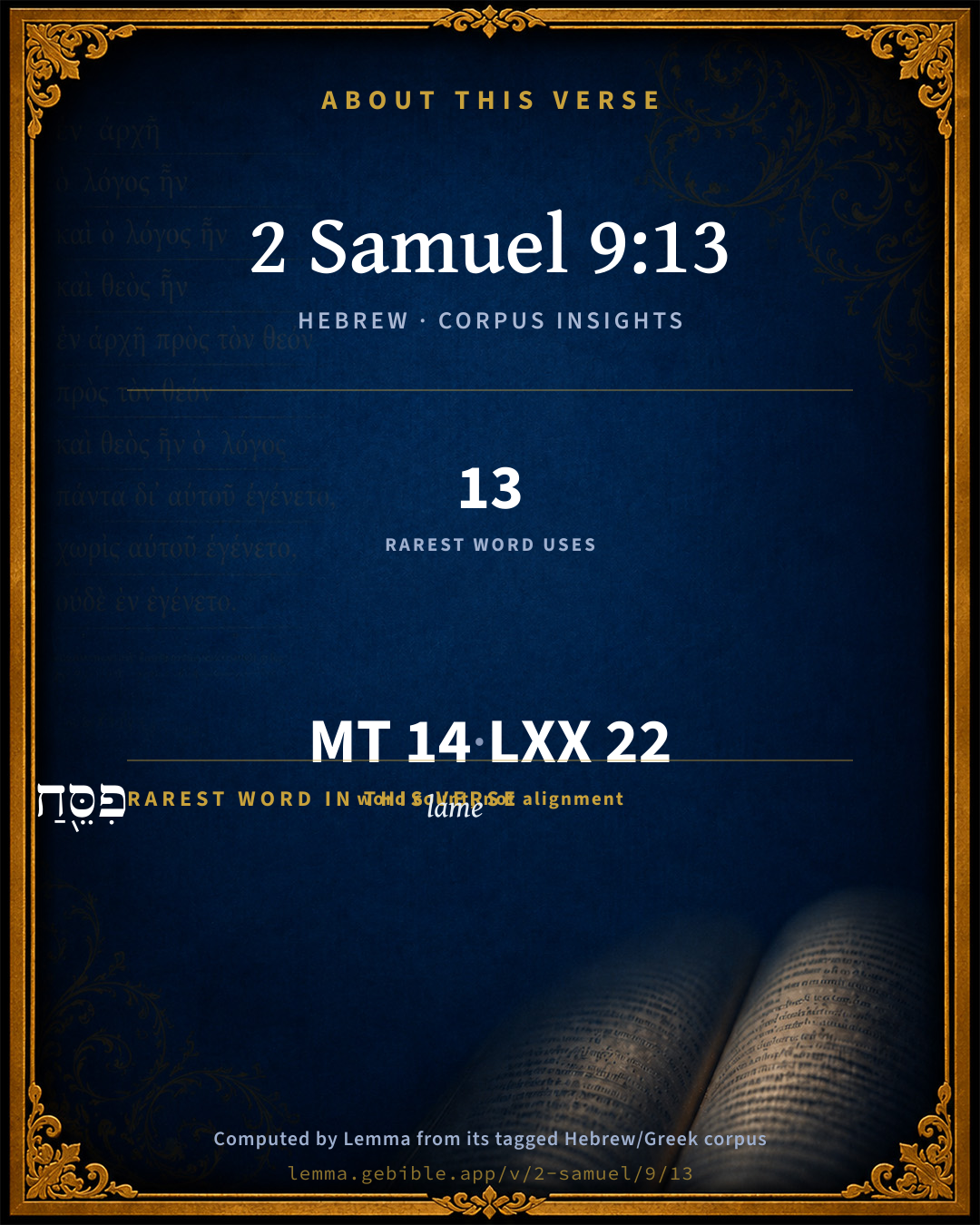
The rarest word here is פִסֵּ֖חַ lame H6455 — appearing just 13 times in the whole Hebrew Bible.

Shared distinctive vocabulary

פִסֵּ֖חַ lame H6455 occurs in 12 verses of the Hebrew Bible. Also found in:

Grammatical profile

  • 2 verbs
  • 6 nouns
  • 2 adjectives
  • 2 pronouns
  • 1 preposition
  • 1 conjunction

Verb forms

  • יֹשֵׁב֙ Qal · Participle Active
  • אֹכֵ֑ל Qal · Participle Active

Repetition

A word recurs within this verse — often emphatic in Hebrew:

  • ה֣וּא he H1931 ×2

Hebrew & Septuagint length

In English translation the verse runs 20 words from the Hebrew and 23 from the Septuagint (LXX English) — closely comparable.

A rough comparison of the two English renderings, which tokenize alike — not a word-level alignment.

Word counts can differ between the Hebrew and the Greek without any difference in meaning — e.g. the Hebrew direct-object marker אֵת has no separate Greek word, and Greek often adds the article ὁ.

In the original languages it is 14 Hebrew tokens and 22 Greek tokens — but the two are counted differently (Hebrew bundles its prefixes and suffixes into one token; the Greek is in lemma form), so that isn’t a like-for-like length.

Cross-references

3

Topical passages linked to 2 Samuel 9:13 in the Treasury of Scripture Knowledge — connected by theme and wording, ordered by reader-vote popularity; previews shown in the World English Bible.

  • 2 Samuel 9:7 David said to him, "Don't be afraid of him; for I will surely show you kindness for Jonathan your father's sake, and will restore you all the land of Saul your father; and you shall eat bread at my table continually."
  • 2 Samuel 9:3 The king said, Is there not yet any of the house of Saul, that I may show the kindness of God to him? Ziba said to the king, Jonathan has yet a son, who is lame of his feet.
  • 2 Samuel 9:10–11 You shall till the land for him, you, and your sons, and your servants; and you shall bring in [the fruits], that your master's son may have bread to eat: but Mephibosheth your master's son shall eat bread always at my table." Now Ziba had fifteen sons and twenty servants.

Cross-references courtesy of OpenBible.info (CC BY 4.0).

Hebrew and Greek witnesses Masoretic Hebrew ↔ Greek Septuagint

The same verse in the two great witnesses to the Old Testament, shown verse-for-verse.

These are two independent witnesses, not word-aligned to each other, and the Septuagint is shown in lemma (dictionary) form.

Hebrew 2 Samuel 9:13 Masoretic · Westminster Leningrad Codex

וּמְפִיבֹ֗שֶׁת יֹשֵׁב֙ בִּיר֣וּשָׁלִַ֔ם כִּ֣י עַל שֻׁלְחַ֥ן הַמֶּ֛לֶךְ תָּמִ֖יד ה֣וּא אֹכֵ֑ל וְה֥וּא פִסֵּ֖חַ שְׁתֵּ֥י רַגְלָֽיו

So Mephibosheth lived in Jerusalem; for he ate continually at the king's table. He was lame in both his feet.

World English Bible · Public Domain

Greek LXX 2 Samuel 9:13 Septuagint · lemma form

καί μεμφιβοσθε καταοἰκέω ἐν ἰερουσαλήμ ὅτι ἐπί ὁ τράπεζα ὁ βασιλεύς διά πᾶς ἐσθίω καί αὐτός εἰμί χωλός ἀμφότεροι ὁ πούς αὐτός

And Memphibosthe lived in Jerusalem, for he continually ate at the table of the king; and he was lame in both his feet.

LXX2012 (modern English Septuagint) · Public Domain

Hebrew: Westminster Leningrad Codex (CC BY 4.0). Greek: Septuagint (public domain); English from LXX2012 (modern English Septuagint) (Public Domain). How the Septuagint differs from the Hebrew →

Targum (Aramaic paraphrase)

1

The Targum is the ancient Jewish Aramaic paraphrase of the Hebrew Scriptures — an interpretive translation, not the Hebrew text itself. Onkelos (literal) and Pseudo-Jonathan (expansive) render the Torah, and Jonathan the Prophets. Coverage is partial: where no permissively-licensed English translation exists for a verse, only the Aramaic is shown. This is verse-level text, not a word-by-word alignment to the Hebrew.

  1. Targum Jonathan Prophets (Joshua–Malachi)
    וּמְפִיבֹשֶׁת יְתִיב בִּירוּשְׁלֵם אֲרֵי עַל פְּתוֹרָא דְמַלְכָּא תְּדִירָא הוּא אָכֵל וְהוּא לָקֵי בְּתַרְתֵּין רִגְלוֹהִי:

    (no public-domain English translation for this verse)

    Targum Jonathan — Aramaic: “Mikraot Gedolot” (public domain). English: “Sefaria Community Translation” (CC0 1.0 (public-domain dedication)); “London "Chaldee Paraphrase," 1871” (public domain). Text via Sefaria.

Commentary

Notes on 2 Samuel 9:13 from classic Christian and Jewish commentators (each source and its license shown beneath its notes). The classic Christian expositions comment on the surrounding passage and are grouped to its opening verse, so a note may address several verses; the Jewish commentaries on the Tanakh (Rashi and others) are per-verse, so they appear only where the commentator wrote on this verse.

Lemma curates 59 commentaries, every one of them public domain or Creative Commons licensed, each selected and text-cleaned for this edition rather than reprinted as found. About our sources →

Trapp's Complete Commentary

John Trapp

2Sa 9:13 So Mephibosheth dwelt in Jerusalem: for he did eat continually at the king’s table; and was lame on both his feet.

Ver. 13. And was lame on both his feet.] Or, Though he were lame, and therefore unfit to take his meals at the court, or to come thither at all; {2Sa 5:8} yet by special favour he enjoyed this privilege.

John Trapp, A Commentary or Exposition upon All the Books of the Old and New Testament (1647–1656) — public domain. Text from a community e-Sword module.

Tyndale Open Study Notes

Tyndale Open Resources

9:13 crippled in both feet: See 4:4.

Tyndale Open Study Notes — © Tyndale Open Resources, licensed CC BY-SA 4.0. Text via the HelloAO Bible API.

Adam Clarke's Commentary

Verse 13. Did eat continually at the king's table] He was fit for no public office, but was treated by the king with the utmost respect and affection.

Adam Clarke's Commentary on the Bible (1810–1826) — public domain. Text from a community e-Sword/MySword module.

John Gill's Exposition

So Mephibosheth dwelt in Jerusalem,.... Either in some apartments in the king's palace, or in some house in the city provided for him; for he returned not to Lodebar, nor to any mansion house upon the estate, of Saul restored unto him:

for he did eat continually at the king's table; to which he was invited, and he accepted of:

and was lame on both his feet; or "though" he was (n), yet this was no objection to David, he admitted him notwithstanding his infirmity; nor any obstruction to Mephibosheth, who found ways and means to be carried to the king's table daily.

(n) "quamvis esset", Junius & Tremellius, Piscator; so Patrick.

Next: 2 Samuel Chapter 10

John Gill's Exposition of the Whole Bible (1746–1763) — public domain (CC PDM 1.0). Text via the HelloAO Bible API.

Haydock's Catholic Bible Commentary

Feet, from five years of age, chap. iv. 4. If we add the seven years and a half of his uncle’s reign, and suppose that David would take this notice of him, as soon as he had it in his power, after the taking of Jerusalem, we may conclude that he was about thirteen years old when he was presented to the king, and behaved with the most engaging modesty and respect. If he had already a son, (ver. 12,) we may allow a few years more. (Haydock)

George Leo Haydock (1774–1849), Haydock's Catholic Family Bible and Commentary, 1859 edition — public domain. Excludes Psalms (Douay-Rheims chapter numbering differs from Protestant) and Deuterocanonical books (Catholic canon only).

The Pulpit Commentary

Lost and found: a sermon to young people.

The story of Mephibosheth may be used as a little parable of the spiritual history of everyone who is restored to God. He was:

1. A prince. To you belongs a more than princely dignity; for you are all "the offspring of God," and bear on you traces of "the image and glory" of "the Father of spirits.

2. Lost. You belong to a sinful and fallen race; and your condition is one of deprivation, helplessness, obscurity, and misery. "A true religion ought to instruct man both in his greatness and his misery" (Pascal).

3. Sought. Infinite piety has sought and is still seeking every one of you, and employs many means to find and save you. (Mat_18:10-14 Lu 15)

4. Found; unexpectedly to himself and to the joy of the seeker. So is it when the gracious message of the gospel comes to you, "not in word only, but in power.

5. Self-abased; in the presence of the king. When you see the height of Divine greatness and goodness, you also see the depth of your own unworthiness and shame.

6. Comforted. "Fear not; only believe.

7. Exated; endowed with more than had been lost; and adopted as "one of the king"s sons" (ver. 11). The gifts of God are worthy of himself. When one, to whom Alexander gave a city, declined to accept it, on the, ground that it was unsuitable to his condition, he said, "I do not ask what is becoming in you to receive, but what is becoming in me to give" (Seneca, "De Beneficiis"). D.

Eating at the king"s table.

David, out of regard to the memory of his dear friend Jonathan, and mindful of his oath to him, not only restores to his son Mephibosheth the forfeited property of Saul, and arranges for its cultivation by Ziba and his sons, but exalts Mephibosheth to the position of a constant guest at his own table, "as one of the king"s sons." So Mephibosheth "did eat continually at the king"s table." The circumstance may serve to remind us of the greater honour which good men enjoy it is theirs to eat continually at the table of the King of kings.

I THIS IS TRUE AS RESPECTS THEIR PARTICIPATION OF THE GIFTS OF GOD"S PROVIDENCE. All creatures depend upon him, and he supplies their wants. (Psa_104:27, 28 145:15, 16) But the lower creatures partake of his bounty unconscious of the hand which feeds them. They are, in relation to God, rather like the horses in the stable, or the cattle and sheep in the fields, than the children at the table. And what these are through incapacity, ungodly people are through unbelief and forgetfulness. They live on the bounty of God, unmindful of him and unthankful. His children, however, even in the enjoyment of their daily food, "sit at his table." As he provides, so they recognize his care and bounty, and give him thanks. As he is present, so they are conscious of his presence. They regard him as presiding at their meals, and are glad to discern him so near. They ask for his blessing, and receive it. They "eat to the Lord, and give God thanks". (Rom_14:6) They satisfy their appetites and gratify their tastes as in his sight. They aim "to eat and drink to the glory of God". (1Co_10:31) They not only enjoy his gifts, but commune with himself. They talk with him, and he with them. Common meals thus enjoyed become as sacraments and means of grace. Let it be our endeavour to enjoy them thus more than we have done.

II THE WORDS ARE MORE EMPHATICALLY APPLICABLE TO THE CHRISTIAN"S ENJOYMENT OF SPIRITUAL BLESSINGS. In this sense, "he eats continually at the king"s table." The image reminds us of:

1. His exaltation. Once, like Mephibosheth, living far away from the king,now brought near, and associated with, yea, made really one of, his children. Still "lame" and otherwise defective, and unfit perhaps for much service, yet admitted to favour and honour.

2. The abundance of the best provisions he enjoys. At the King"s table is plenty, and of the best. At the table of the heavenly King, spread under the gospel, are provisions the choicest and rarest, to be found nowhere else; and which nourish, not for this short earthly life, but for life eternal. The best intellectual food is here; but especially that food which quickens and nourishes the soul, in faith, and love, and hope, and holiness. Divine truth and whatever it reveals and presents the pardoning mercy and fatherly love of God, the love and sacrifice of Christ, his body and his blood, which are the real food and drink of men. Of these the believing and loving soul may partake at will, anywhere and everywhere. The King"s table is not confined to place; but especially in the house of God and at the Lord"s Supper, the table is spread, and Christians gather together to feed and feast.

3. At the King"s table is the best society. At the table of the Divine King we associate with the Father and the Son, by the Spirit; and by him also with saints and angels, "the excellent of the earth" and the excellent of heaven. The Lord fulfils his promise, "I will sup with him, and he with me". (Rev_3:20)

1. At the King"s table is gladness. The honour, the provision, the company, all tend to give pleasure.

2. There also is safety. The palace of a king is commonly the securest spot in the land. Far more assured is the safety of those who sit at the table of the heavenly King. Angels guard them; God himself is their Dwelling place and Defence.

3. The privilege of eating at the table of our King is perpetual. As in the case of Mephibosheth. If it is not continually enjoyed, it is our own fault. The privilege enjoyed by Mephibosheth would be a constant solace to him in his helplessness; and the spiritual counterpart is to Christians a constant source of comfort and support under their troubles.

III THE WORDS ARE PERFECTLY FULFILLED IN THE HEAVENLY WORLD. The future blessedness of God"s people is often compared to a feast (see Mat_8:11; Rev_2:7 Rev_19:9) It is, in fact, the continuance and the perfecting of the blessedness now enjoyed, The King himself is perfectly "manifested." "They shall see his face"; (Rev_22:4) "We shall see him as he is". (1Jn_3:2) His love and favour are so displayed as not to admit of a doubt. The provisions at his table are the same as on earth; but the guests are better able to enjoy them, their spiritual appetite and tastes being freed from all that lessens their fitness to do so. The society is the same, but those imperfect on earth are perfected in spirit and in body (Heb_12:23; Php_3:21) The security is absolute; the joy unmingled with sorrow; the feast is perpetual and without end. "Blessed is he that shall eat bread in the kingdom of God". (Luk_14:15) Who shall partake of that bliss? All are invited by the gospel; and none will be excluded but such as exclude themselves by refusing to accept the invitation, and obtain the necessary preparation for the feast, which consists in reconciliation to the King through Jesus Christ, constant loyalty and obedience to him, and joyful partaking now of his spiritual gifts. To "eat continually at the King"s table" here is the necessary condition of our doing so hereafter, as it is also the preparation for that happiness and the evidence that we shall enjoy it. G.W.

The Pulpit Commentary (1880–1919), ed. H.D.M. Spence-Jones & Joseph S. Exell — public domain. Text from a community e-Sword module.

Lesson kit

Teaching starters — assembled from the data on this page, not authored interpretation. Every prompt links to the verse data it draws on. Edit before teaching.

2 Samuel, in the Historical, opens this verse with 14 words (13 distinct Hebrew lemmas). Its most distinctive word is piççêach (“lame”). A historical commentator’s framing appears above. Read the whole chapter for the surrounding context.

Discussion questions

  1. The word piççêach carries the sense “lame.” How does it shape the verse?
  2. Leviticus 21:18 shares the word «lame» with this verse. How do the two illuminate each other?
  3. “he” occurs 2× in this one verse. What is the effect of the repetition?
  4. These translations render this verse differently. What is at stake in choosing one wording over another?
  5. The verb «יֹשֵׁב֙» is Qal Participle Active. How does its form color the action?
  6. Reading how Trapp's Complete Commentary and Tyndale Open Study Notes read this verse, where do the two commentators agree and where do they part?

Things to notice

Reading settings

Reading text

Shown beneath each verse's original-language words.

Old Testament
Old Testament edition

Read the OT as the Masoretic Hebrew (MT) or the Greek Septuagint (LXX).

English shown for the Greek Septuagint (in the Hebrew ↔ Greek comparison).

Comparing translations? Open the Compare panel on any verse page to stack up to four side by side.