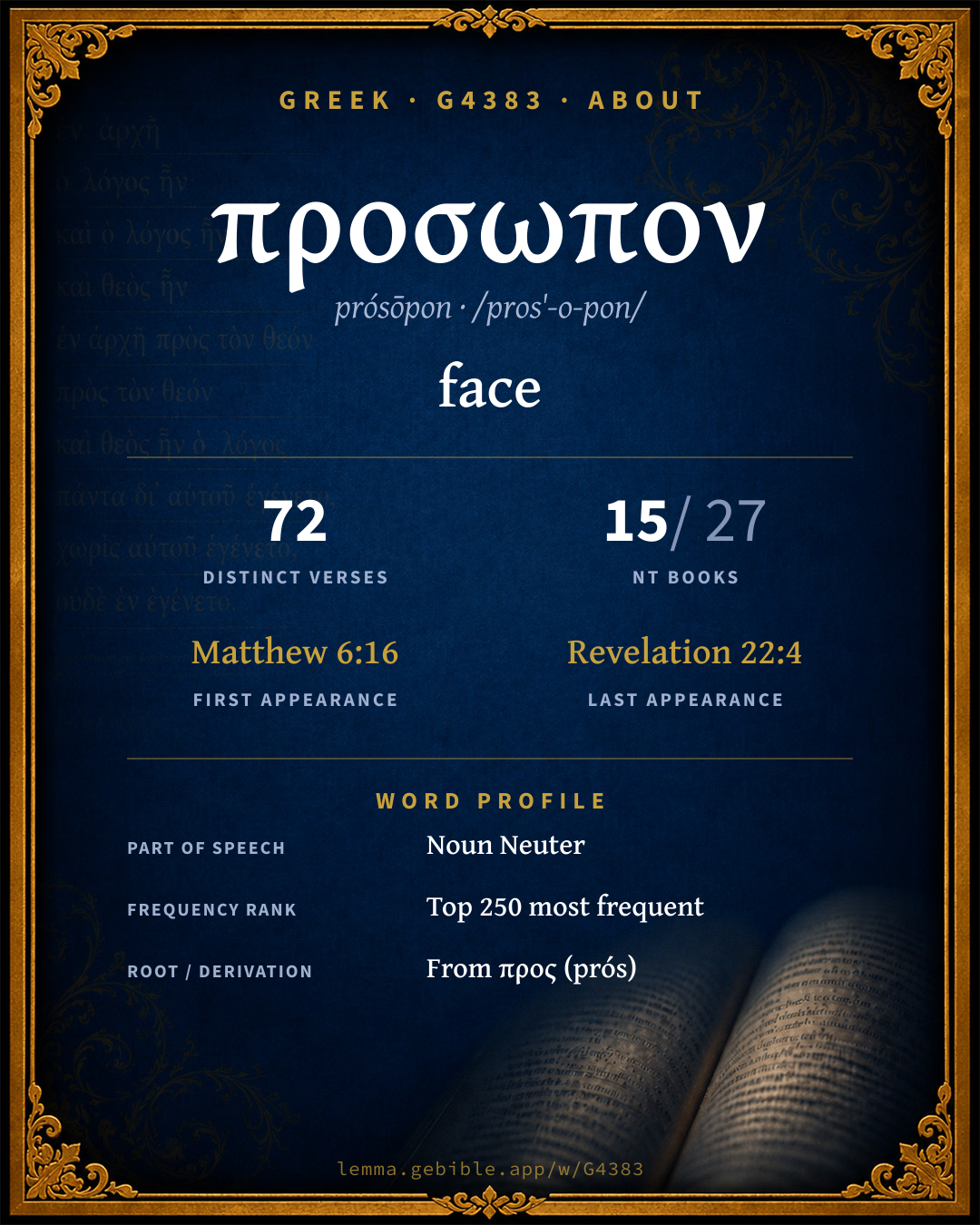
πρόσωπον
face
‘face’ is one of 4 main senses fuller range ↓
Full lexicon entry — Thayer's Greek Lexicon
From Thayer's Greek Lexicon
Where this word appears
See every Accusative-case word in the Greek New Testament →
Grammar key — what these labels mean
Part of speech
- Noun
- A naming word — a person, place, thing, or idea.
Case
- Accusative
- The case of the direct object and of extent.
- Genitive
- The case of source, possession, or “of” — answers “whose / from what.”
- Dative
- The case of the indirect object, means, or location — “to / for / with / in.”
- Nominative
- The case of the subject (and the predicate nominative).
Gender
- Neuter
- Grammatically neuter.
Number
- Singular
- One.
- Plural
- More than one.
Grammatical forms
- Noun, Accusative, Singular, Neuter 39 times (51%)
- Noun, Genitive, Singular, Neuter 19 times (25%)
- Noun, Dative, Singular, Neuter 7 times (9%)
- Noun, Accusative, Plural, Neuter 5 times (6%)
- Noun, Nominative, Singular, Neuter 4 times (5%)
- Noun, Nominative, Plural, Neuter 2 times (3%)
- Noun, Genitive, Plural, Neuter 1 time (1%)
Parsed forms decoded from the imported morphology (Robinson–Tischendorf, public domain), counted across 77 parsed occurrences — not distinct verses.
Every verse where G4383 appears — 72 distinct verses across 15 books. Click any verse to open its interlinear word-by-word view. Verse text shown in the World English Bible for context — . Each verse’s Greek form is shown with its reference; the English is not keyword-highlighted, since the data carries no word-level English alignment. Use “Compare translations” on any verse to read it across multiple English versions. This concordance covers the Greek New Testament; Septuagint (Greek Old Testament) occurrences of this word are not indexed here.
Matthew 10 verses
- Matthew 6:16 πρόσωπα n acc pl neut "Moreover when you fast, don't be like the hypocrites, with sad faces. For they disfigure their faces, that they may be seen by men to be fasting. Most assuredly I tell you, they have received their reward.
- Matthew 6:17 πρόσωπόν n acc sg neut But you, when you fast, anoint your head, and wash your face;
- Matthew 11:10 προσώπου n gen sg neut For this is he, of whom it is written, 'Behold, I send my messenger before your face, who will prepare your way before you.'
- Matthew 16:3 πρόσωπον n acc sg neut In the morning, 'It will be foul weather today, for the sky is red and threatening.' Hypocrites! You know how to discern the appearance of the sky, but you can't discern the signs of the times!
- Matthew 17:2 πρόσωπον n nom sg neut He was transfigured before them. His face shone like the sun, and his garments became as white as the light.
- Matthew 17:6 πρόσωπον n acc sg neut When the disciples heard it, they fell on their faces, and were very afraid.
- Matthew 18:10 πρόσωπον n acc sg neut See that you don't despise one of these little ones, for I tell you that in heaven their angels always see the face of my Father who is in heaven.
- Matthew 22:16 πρόσωπον n acc sg neut They sent their disciples to him, along with the Herodians, saying, "Teacher, we know that you are honest, and teach the way of God in truth, no matter who you teach, for you aren't partial to anyone.
- Matthew 26:39 πρόσωπον n acc sg neut He went forward a little, fell on his face, and prayed, saying, "My Father, if it is possible, let this cup pass away from me; nevertheless, not what I desire, but what you desire."
- Matthew 26:67 πρόσωπον n acc sg neut Then they spit in his face and beat him with their fists, and some slapped him,
Mark 3 verses
- Mark 1:2 προσώπου n gen sg neut As it is written in the prophets, "Behold, I send my messenger before your face, Who will prepare your way before you.
- Mark 12:14 πρόσωπον n acc sg neut When they had come, they asked him, "Teacher, we know that you are honest, and don't defer to anyone; for you aren't partial to anyone, but truly teach the way of God. Is it lawful to pay taxes to Caesar, or not?
- Mark 14:65 πρόσωπον n acc sg neut Some began to spit on him, and to cover his face, and to beat him with fists, and to tell him, "Prophesy!" The officers struck him with the palms of their hands.
Luke 14 verses
- Luke 1:76 προσώπου n gen sg neut And you, child, will be called a prophet of the Most High, For you will go before the face of the Lord to make ready his ways,
- Luke 2:31 πρόσωπον n acc sg neut Which you have prepared before the face of all peoples;
- Luke 5:12 πρόσωπον n acc sg neut It happened, while he was in one of the cities, behold, there was a man full of leprosy. When he saw Jesus, he fell on his face, and begged him, saying, "Lord, if you want to, you can make me clean."
- Luke 7:27 προσώπου n gen sg neut This is he of whom it is written, 'Behold, I send my messenger before your face, Who will prepare your way before you.'
- Luke 9:29 προσώπου n gen sg neut As he was praying, the appearance of his face was altered, and his clothing became white and dazzling.
- Luke 9:51 πρόσωπον n acc sg neut It came to pass, when the days were near that he should be taken up, he intently set his face to go to Jerusalem,
- Luke 9:52 προσώπου n gen sg neut and sent messengers before his face. They went, and entered into a village of the Samaritans, so as to prepare for him.
- Luke 9:53 πρόσωπον n nom sg neut They didn't receive him, because he was traveling with his face set towards Jerusalem.
- Luke 10:1 προσώπου n gen sg neut Now after these things, the Lord also appointed seventy others, and sent them two by two ahead of him into every city and place, where he was about to come.
- Luke 12:56 πρόσωπον n acc sg neut You hypocrites! You know how to interpret the appearance of the earth and the sky, but how is it that you don't interpret this time?
- Luke 17:16 πρόσωπον n acc sg neut He fell on his face at Jesus' feet, giving him thanks; and he was a Samaritan.
- Luke 20:21 πρόσωπον n acc sg neut They asked him, "Teacher, we know that you say and teach what is right, and aren't partial to anyone, but truly teach the way of God.
- Luke 21:35 πρόσωπον n acc sg neut For it will come like a snare on all those who dwell on the surface of all the earth.
- Luke 24:5 πρόσωπα n acc pl neut Becoming terrified, they bowed their faces down to the earth. They said to them, "Why do you seek the living among the dead?
Acts 11 verses
- Acts 2:28 προσώπου n gen sg neut You made known to me the ways of life. You will make me full of gladness with your presence.'
- Acts 3:13 πρόσωπον n acc sg neut The God of Abraham, Isaac, and Jacob, the God of our fathers, has glorified his Servant Jesus, whom you delivered up, and denied in the presence of Pilate, when he had determined to release him.
- Acts 3:19 προσώπου n gen sg neut "Repent therefore, and turn again, that your sins may be blotted out, so that there may come times of refreshing from the presence of the Lord,
- Acts 5:41 προσώπου n gen sg neut They therefore departed from the presence of the council, rejoicing that they were counted worthy to suffer dishonor for Jesus' name.
- Acts 6:15 πρόσωπον πρόσωπον n acc sg neut n acc sg neut All who sat in the council, fastening their eyes on him, saw his face like it was the face of an angel.
- Acts 7:45 προσώπου n gen sg neut which also our fathers, in their turn, brought in with Joshua when they entered into the possession of the nations, whom God drove out before the face of our fathers, to the days of David,
- Acts 13:24 προσώπου n gen sg neut before his coming, when John had first preached the baptism of repentance to Israel.
- Acts 17:26 προσώπου n gen sg neut He made from one blood every nation of men to dwell on all the surface of the earth, having determined appointed seasons, and the boundaries of their dwellings,
- Acts 20:25 πρόσωπόν n acc sg neut Now, behold, I know that you all, among whom I went about preaching the Kingdom of God, will see my face no more.
- Acts 20:38 πρόσωπον n acc sg neut sorrowing most of all because of the word which he had spoken, that they should see his face no more. And they accompanied him to the ship.
- Acts 25:16 πρόσωπον n acc sg neut To whom I answered that it is not the custom of the Romans to give up any man to destruction, before the accused has met the accusers face to face, and has had opportunity to make his defense concerning the matter laid against him.
1 Corinthians 2 verses
- 1 Corinthians 13:12 πρόσωπον πρόσωπον n acc sg neut n acc sg neut For now we see in a mirror, dimly, but then face to face. Now I know in part, but then I will know fully, even as I was also fully known.
- 1 Corinthians 14:25 πρόσωπον n acc sg neut And thus the secrets of his heart are revealed. So he will fall down on his face and worship God, declaring that God is among you indeed.
2 Corinthians 11 verses
- 2 Corinthians 1:11 προσώπων n gen pl neut you also helping together on our behalf by your supplication; that, for the gift bestowed on us by means of many, thanks may be given by many persons on your behalf.
- 2 Corinthians 2:10 προσώπῳ n dat sg neut Now I also forgive whomever you forgive anything. For if indeed I have forgiven anything, I have forgiven that one for your sakes in the presence of Christ,
- 2 Corinthians 3:7 πρόσωπον προσώπου n acc sg neut n gen sg neut But if the service of death, written engraved on stones, came with glory, so that the children of Israel could not look steadfastly on the face of Moses for the glory of his face; which was passing away:
- 2 Corinthians 3:13 πρόσωπον n acc sg neut and not as Moses, who put a veil on his face, that the children of Israel wouldn't look steadfastly on the end of that which was passing away.
- 2 Corinthians 3:18 προσώπῳ n dat sg neut But we all, with unveiled face beholding as in a mirror the glory of the Lord, are transformed into the same image from glory to glory, even as from the Lord, the Spirit.
- 2 Corinthians 4:6 προσώπῳ n dat sg neut seeing it is God who said, "Light will shine out of darkness," who has shone in our hearts, to give the light of the knowledge of the glory of God in the face of Jesus Christ.
- 2 Corinthians 5:12 προσώπῳ n dat sg neut For we are not commending ourselves to you again, but speak as giving you occasion of boasting on our behalf, that you may have something to answer those who boast in appearance, and not in heart.
- 2 Corinthians 8:24 πρόσωπον n acc sg neut Therefore show the proof of your love to them in front of the assemblies, and of our boasting on your behalf.
- 2 Corinthians 10:1 πρόσωπον n acc sg neut Now I Paul, myself, entreat you by the humility and gentleness of Christ; I who in your presence am lowly among you, but being absent am of good courage toward you.
- 2 Corinthians 10:7 πρόσωπον n acc sg neut Do you look at things only as they appear in front of your face? If anyone trusts in himself that he is Christ's, let him consider this again with himself, that, even as he is Christ's, so also we are Christ's.
- 2 Corinthians 11:20 πρόσωπον n acc sg neut For you bear with a man, if he brings you into bondage, if he devours you, if he takes you captive, if he exalts himself, if he strikes you on the face.
Galatians 3 verses
- Galatians 1:22 προσώπῳ n dat sg neut I was still unknown by face to the assemblies of Judea which were in Christ,
- Galatians 2:6 πρόσωπον n acc sg neut But from those who were reputed to be important (whatever they were, it makes no difference to me; God doesn't show partiality to man)--they, I say, who were respected imparted nothing to me,
- Galatians 2:11 πρόσωπον n acc sg neut But when Peter came to Antioch, I resisted him to the face, because he stood condemned.
Colossians 1 verse
1 Thessalonians 2 verses
- 1 Thessalonians 2:17 προσώπῳ πρόσωπον n dat sg neut n acc sg neut But we, brothers, being bereaved of you for a short season, in presence, not in heart, tried even harder to see your face with great desire,
- 1 Thessalonians 3:10 πρόσωπον n acc sg neut night and day praying exceedingly that we may see your face, and may perfect that which is lacking in your faith?
2 Thessalonians 1 verse
Hebrews 1 verse
James 2 verses
- James 1:11 προσώπου n gen sg neut For the sun arises with the scorching wind, and withers the grass, and the flower in it falls, and the beauty of its appearance perishes. So also will the rich man fade away in his pursuits.
- James 1:23 πρόσωπον n acc sg neut For if anyone is a hearer of the word and not a doer, he is like a man beholding his natural face in a mirror;
1 Peter 1 verse
Jude 1 verse
Revelation 9 verses
- Revelation 4:7 πρόσωπον n acc sg neut The first creature was like a lion, and the second creature like a calf, and the third creature had a face like a man, and the fourth was like a flying eagle.
- Revelation 6:16 προσώπου n gen sg neut They told the mountains and the rocks, "Fall on us, and hide us from the face of him who sits on the throne, and from the wrath of the Lamb,
- Revelation 7:11 πρόσωπα n acc pl neut All the angels were standing around the throne, the elders, and the four living creatures; and they fell on their faces before his throne, and worshiped God,
- Revelation 9:7 πρόσωπα πρόσωπα n nom pl neut n nom pl neut The shapes of the locusts were like horses prepared for war. On their heads were something like golden crowns, and their faces were like people's faces.
- Revelation 10:1 πρόσωπον n nom sg neut I saw a mighty angel coming down out of the sky, clothed with a cloud. A rainbow was on his head. His face was like the sun, and his feet like pillars of fire.
- Revelation 11:16 πρόσωπα n acc pl neut The twenty-four elders, who sit on their thrones before God's throne, fell on their faces and worshiped God,
- Revelation 12:14 προσώπου n gen sg neut Two wings of the great eagle were given to the woman, that she might fly into the wilderness to her place, so that she might be nourished for a time, and times, and half a time, from the face of the serpent.
- Revelation 20:11 προσώπου n gen sg neut I saw a great white throne, and him who sat on it, from whose face the earth and the heaven fled away. There was found no place for them.
- Revelation 22:4 πρόσωπον n acc sg neut They will see his face, and his name will be on their foreheads.
About this entry
At a glance — auto-summarized from this page’s data, not written by a person. Every figure links to its source below. This summary describes the numbers; it doesn’t interpret them.
προσωπον — transliterated prósōpon — is a Greek noun carrying the sense “face.” Its lexical range runs to 4 senses. The Greek New Testament uses it across 72 verses — moderately common. It first appears in Matthew 6:16. Related forms include προς, προσαγορευω and προσαγω. See the sense tree, 72-verse concordance, and the renderings breakdown below.
Gloss history
Strong's 1890 vs modern scholarship

About this word
Strong's G4383 catalogs a Greek word from the Greek New Testament.
These counts are not copied from any lexicon or concordance. They are computed here, from the morphology-tagged Greek New Testament. What Lemma adds →
- 72
- distinct verses
- The word appears in 72 distinct verses.
- 15 / 27
- NT books
- The word appears in 15 of 27 New Testament books.
- #220
- by frequency
- Top 250 most frequent Greek words (rank 220 of 5,347 Greek words by occurrence).
View all 72 occurrences in the concordance →
Most concentrated in
- Luke 14 verses 19%
- Acts 11 verses 15%
- 2 Corinthians 11 verses 15%
By section of the New Testament
By traditional corpus
Conventional, traditional groupings — biblical authorship is debated, so this is a traditional corpus grouping, not an authorship claim. Some books belong to more than one corpus (Luke is in both the Gospels and the Lukan corpus, and so on), so these shares overlap and need not total 100%. Each figure is a share of the word’s 72 distinct verses.
- Gospels 27 verses · 38%
- Lukan (Luke–Acts) 25 verses · 35%
- Pauline corpus 20 verses · 28%
- Johannine 9 verses · 13%
- Revelation 9 verses · 13%
- General (Catholic) Epistles 4 verses · 6%
- Hebrews 1 verse · 1%
How translations render this word
Counts come from each version’s own published word-to-Strong’s tagging or interlinear alignment — an approximate guide to how each version renders this word, not a word-level alignment the data otherwise carries. Because each total is that version’s own tagged count, the per-version totals vary from one another and need not match the appearance or distinct-verse counts above. These counts may also differ from a printed concordance because Lemma counts each distinctly tagged rendering and does not collapse phrase taggings into a single head-word total. This is a fixed set of word-tagged versions (KJV, ASV, BSB, ULT) and does not change with the reading translation you choose elsewhere. Each version’s license is shown beside its name below (and on Sources).
- King James Version: Face 48×, Presence 7×, Faces 6×
- American Standard Version: Face 54×, Faces 5×, Presence 5×
- Berean Standard Bible: Face 25×, Presence 7×, Faces 6×
- unfoldingWord Literal Text: Face 62×, Faces 9×, Of 3×
King James Version Public Domain
Renders G4383 across 74 tagged occurrences — most commonly:
Plus 6 renderings that appear only once — usually multi-word phrases or single function words the recovered tagging swept in, not distinct renderings. Not rendered by a distinct English word in 4 further occurrences.
American Standard Version Public Domain
Renders G4383 across 78 tagged occurrences — most commonly:
Plus 7 renderings that appear only once — usually multi-word phrases or single function words the recovered tagging swept in, not distinct renderings.
Berean Standard Bible Public Domain
Renders G4383 across 56 tagged occurrences — most commonly:
Plus 9 renderings that appear only once — usually multi-word phrases or single function words the recovered tagging swept in, not distinct renderings. Not rendered by a distinct English word in 20 further occurrences.
unfoldingWord Literal Text CC BY-SA 4.0
Renders G4383 across 80 tagged occurrences — most commonly:
Plus 2 renderings that appear only once — usually multi-word phrases or single function words the recovered tagging swept in, not distinct renderings.
Senses in Thayer's
The 4 senses Thayer's distinguishes for this word, in lexicon order (not ranked by frequency or importance). The full entry — with sub-senses — is in the Lexicon Entry tab.
- the front of the human head
- countenance, look
- the appearance one presents by his wealth or property, his rank or low condition
- the outward appearance of inanimate things
Word origin
Derived from προς (prós) (G4314).
From G4314 and ὤψ ō ps (the visage ; from G3700 ); the front (as being towards view ) that is the countenance aspect appearance surface ; by implication presence person : - (outward) appearance X before countenance face fashion (men´ s) person presence.
— Strong’s Exhaustive Concordance (1890), public domain.
Forms in the corpus
The 6 distinct written forms G4383 takes in the Greek New Testament, most frequent first — each parse links to that case’s occurrences in the concordance.
| Form | Parsing | Example | Uses |
|---|---|---|---|
| πρόσωπον prósōpon | Noun, Accusative, Singular, Neuter | Matthew 16:3 | 40 |
| προσώπου prosṓpou | Noun, Genitive, Singular, Neuter | Matthew 11:10 | 19 |
| πρόσωπα prósōpa | Noun, Accusative, Plural, Neuter | Matthew 6:16 | 7 |
| προσώπῳ prosṓpō | Noun, Dative, Singular, Neuter | 2 Corinthians 2:10 | 7 |
| πρόσωπόν prósōpón | Noun, Accusative, Singular, Neuter | Matthew 6:17 | 3 |
| προσώπων prosṓpōn | Noun, Genitive, Plural, Neuter | 2 Corinthians 1:11 | 1 |
Same root — word family
Other Thayer's entries built from the same root as G4383, grouped by Strong’s listed origin. These share a root / origin per the lexicon — not necessarily a shared meaning. Each links to that word’s own entry.
Derives from
Shares the same root
- προσαγορευω prosagoreúō G4316 to address
- προσαγω proságō G4317 to bring
- προσαιτεω prosaitéō G4319 to ask alms
- προσαναβαινω prosanabaínō G4320 to go up higher
- προσαναλισκω prosanalískō G4321 to spend additionally
- προσαναπληροω prosanaplēróō G4322 to fill up
- προσανατιθημι prosanatíthēmi G4323 to lay upon
- προσαπειλεω prosapeiléō G4324 to threaten further
- προσδαπαναω prosdapanáō G4325 to spend besides
- προσδεομαι prosdéomai G4326 to need additionally
- προσδεχομαι prosdéchomai G4327 to receive to oneself
- προσδοκαω prosdokáō G4328 to expect
- προσεαω proseáō G4330 to permit approach
- προσεγγιζω prosengízō G4331 to approach
- προσεδρευω prosedreúō G4332 to sit near
- προσεργαζομαι prosergázomai G4333 to work besides
- προσερχομαι prosérchomai G4334 to draw near
- προσευχομαι proseúchomai G4336 to pray
- προσεχω proséchō G4337 to attend to
- προσηλοω prosēlóō G4338 to nail to
- προσκαιρος próskairos G4340 temporary
- προσκαλεομαι proskaléomai G4341 to call to
- προσκαρτερεω proskarteréō G4342 to adhere to
- προσκεφαλαιον proskephálaion G4344 pillow
+27 more words share this root (not shown).
Derived from this word
Compare all same-root words → Showing 4 of 54 — not the complete family. They share a root, not necessarily a meaning.
Septuagint usage
The same Greek word προσωπον appears 1,060 times in the Greek Old Testament (Septuagint), across 975 verses in 37 books.
- 1,060
- LXX occurrences
- Tagged occurrences of this Greek word in the Septuagint.
- 975
- verses
- Distinct Septuagint verses containing this word.
- 37 / 39
- OT books
- The word appears in 37 of the 39 Old Testament books.
Sample Septuagint occurrences
- Genesis 2:6 πρόσωπον
- Exodus 2:15 πρόσωπον
- Leviticus 8:9 πρόσωπον
- Numbers 3:38 πρόσωπον
- Deuteronomy 1:17 πρόσωπον
- Joshua 2:10 πρόσωπον
- Judges 2:3 πρόσωπον
- Ruth 2:10 πρόσωπον
- 1 Samuel 1:14 πρόσωπον
- 2 Samuel 2:22 πρόσωπον
- 1 Kings 1:23 πρόσωπον
- 2 Kings 1:15 πρόσωπον
Septuagint occurrences (same lexeme)
Every verse where the same Strong’s number (G4383) appears in the Greek Septuagint — showing the first 50 of 975. Verse text shown in the World English Bible for context; the Greek form is the matched word — the English is not keyword-highlighted.
- Genesis 2:6 πρόσωπον but a mist went up from the earth, and watered the whole surface of the ground.
- Genesis 2:7 πρόσωπον Yahweh God formed man from the dust of the ground, and breathed into his nostrils the breath of life; and man became a living soul.
- Genesis 3:8 πρόσωπον They heard the voice of Yahweh God walking in the garden in the cool of the day, and the man and his wife hid themselves from the presence of Yahweh God among the trees of the garden.
- Genesis 3:19 πρόσωπον By the sweat of your face will you eat bread until you return to the ground, for out of it you were taken. For you are dust, and to dust you shall return."
- Genesis 4:5 πρόσωπον but he didn't respect Cain and his offering. Cain was very angry, and the expression on his face fell.
- Genesis 4:6 πρόσωπον Yahweh said to Cain, "Why are you angry? Why has the expression of your face fallen?
- Genesis 4:14 πρόσωπον Behold, you have driven me out this day from the surface of the ground. I will be hidden from your face, and I will be a fugitive and a wanderer in the earth. It will happen that whoever finds me will kill me."
- Genesis 4:16 πρόσωπον Cain went out from Yahweh's presence, and dwelt in the land of Nod, on the east of Eden.
- Genesis 6:7 πρόσωπον Yahweh said, "I will destroy man whom I have created from the surface of the ground; man, along with animals, creeping things, and birds of the sky; for I am sorry that I have made them."
- Genesis 7:4 πρόσωπον In seven days, I will cause it to rain on the earth for forty days and forty nights. Every living thing that I have made, I will destroy from the surface of the ground."
- Genesis 7:23 πρόσωπον Every living thing was destroyed that was on the surface of the ground, including man, cattle, creeping things, and birds of the sky. They were destroyed from the earth. Only Noah was left, and those who were with him in the ark.
- Genesis 8:8 πρόσωπον He sent forth a dove from him, to see if the waters were abated from off the surface of the ground,
- Genesis 8:9 πρόσωπον but the dove found no place to rest her foot, and she returned to him into the ark; for the waters were on the surface of the whole earth. He put forth his hand, and took her, and brought her to him into the ark.
- Genesis 8:13 πρόσωπον It happened in the six hundred first year, in the first month, the first day of the month, the waters were dried up from off the earth. Noah removed the covering of the ark, and looked. He saw that the surface of the ground was dried.
- Genesis 9:23 πρόσωπον Shem and Japheth took a garment, and laid it on both their shoulders, went in backwards, and covered the nakedness of their father. Their faces were backwards, and they didn't see their father's nakedness.
- Genesis 11:4 πρόσωπον They said, "Come, let's build us a city, and a tower, whose top reaches to the sky, and let's make us a name; lest we be scattered abroad on the surface of the whole earth."
- Genesis 11:8 πρόσωπον So Yahweh scattered them abroad from there on the surface of all the earth. They stopped building the city.
- Genesis 11:9 πρόσωπον Therefore the name of it was called Babel, because Yahweh confused the language of all the earth, there. From there, Yahweh scattered them abroad on the surface of all the earth.
- Genesis 16:6 πρόσωπον But Abram said to Sarai, "Behold, your maid is in your hand. Do to her whatever is good in your eyes." Sarai dealt harshly with her, and she fled from her face.
- Genesis 16:8 πρόσωπον He said, "Hagar, Sarai's handmaid, where did you come from? Where are you going?" She said, "I am fleeing from the face of my mistress Sarai."
- Genesis 16:12 πρόσωπον He will be like a wild donkey among men. His hand will be against every man, and every man's hand against him. He will live opposite all of his brothers."
- Genesis 17:3 πρόσωπον Abram fell on his face. God talked with him, saying,
- Genesis 17:17 πρόσωπον Then Abraham fell on his face, and laughed, and said in his heart, "Will a child be born to him who is one hundred years old? Will Sarah, who is ninety years old, give birth?"
- Genesis 18:16 πρόσωπον The men rose up from there, and looked toward Sodom. Abraham went with them to see them on their way.
- Genesis 19:1 πρόσωπον The two angels came to Sodom at evening. Lot sat in the gate of Sodom. Lot saw them, and rose up to meet them. He bowed himself with his face to the earth,
- Genesis 19:21 πρόσωπον He said to him, "Behold, I have granted your request concerning this thing also, that I will not overthrow the city of which you have spoken.
- Genesis 19:28 πρόσωπον He looked toward Sodom and Gomorrah, and toward all the land of the plain, and looked, and saw that the smoke of the land went up as the smoke of a furnace.
- Genesis 20:16 πρόσωπον To Sarah he said, "Behold, I have given your brother a thousand pieces of silver. Behold, it is for you a covering of the eyes to all that are with you. In front of all you are vindicated."
- Genesis 23:8 πρόσωπον He talked with them, saying, "If it be your mind that I should bury my dead out of my sight, hear me, and entreat for me to Ephron the son of Zohar,
- Genesis 23:17 πρόσωπον So the field of Ephron, which was in Machpelah, which was before Mamre, the field, the cave which was therein, and all the trees that were in the field, that were in all the border of it round about, were made sure
- Genesis 25:18 πρόσωπον They lived from Havilah to Shur that is before Egypt, as you go toward Assyria. He lived opposite all his relatives.
- Genesis 27:30 πρόσωπον It happened, as soon as Isaac had made an end of blessing Jacob, and Jacob had just gone out from the presence of Isaac his father, that Esau his brother came in from his hunting.
- Genesis 31:2 πρόσωπον Jacob saw the expression on Laban's face, and, behold, it was not toward him as before.
- Genesis 31:5 πρόσωπον and said to them, "I see the expression on your father's face, that it is not toward me as before; but the God of my father has been with me.
- Genesis 32:21 πρόσωπον So the present passed over before him: and he himself lodged that night in the camp.
- Genesis 32:22 πρόσωπον He rose up that night, and took his two wives, and his two handmaids, and his eleven sons, and passed over the ford of the Jabbok.
- Genesis 32:31 πρόσωπον The sun rose on him as he passed over Peniel, and he limped because of his thigh.
- Genesis 33:10 πρόσωπον Jacob said, "Please, no, if I have now found favor in your sight, then receive my present at my hand, because I have seen your face, as one sees the face of God, and you were pleased with me.
- Genesis 33:18 πρόσωπον Jacob came in peace to the city of Shechem, which is in the land of Canaan, when he came from Paddan Aram; and encamped before the city.
- Genesis 35:1 πρόσωπον God said to Jacob, "Arise, go up to Bethel, and live there. Make there an altar to God, who appeared to you when you fled from the face of Esau your brother."
- Genesis 35:7 πρόσωπον He built an altar there, and called the place El Beth El; because there God was revealed to him, when he fled from the face of his brother.
- Genesis 36:6 πρόσωπον Esau took his wives, his sons, his daughters, and all the members of his household, with his cattle, all his animals, and all his possessions, which he had gathered in the land of Canaan, and went into a land away from his brother Jacob.
- Genesis 38:15 πρόσωπον When Judah saw her, he thought that she was a prostitute, for she had covered her face.
- Genesis 40:7 πρόσωπον He asked Pharaoh's officers who were with him in custody in his master's house, saying, "Why do you look so sad today?"
- Genesis 41:46 πρόσωπον Joseph was thirty years old when he stood before Pharaoh king of Egypt. Joseph went out from the presence of Pharaoh, and went throughout all the land of Egypt.
- Genesis 41:56 πρόσωπον The famine was over all the surface of the earth. Joseph opened all the store-houses, and sold to the Egyptians. The famine was severe in the land of Egypt.
- Genesis 42:6 πρόσωπον Joseph was the governor over the land. It was he who sold to all the people of the land. Joseph's brothers came, and bowed themselves down to him with their faces to the earth.
- Genesis 43:3 πρόσωπον Judah spoke to him, saying, "The man solemnly warned us, saying, 'You shall not see my face, unless your brother is with you.'
- Genesis 43:5 πρόσωπον but if you will not send him, we will not go down, for the man said to us, 'You shall not see my face, unless your brother is with you.'"
- Genesis 43:26 πρόσωπον When Joseph came home, they brought him the present which was in their hand into the house, and bowed down themselves to him to the earth.
These are occurrences of the same Greek lexeme (G4383) in the Septuagint — not a translation of any one Hebrew word. The store carries no word-level Hebrew↔Greek alignment, so no Hebrew original is asserted here. Counts come from the recovered LXX Strong's tagging — high-frequency vocabulary is well covered, while rare or late forms may be untagged — so they reflect tagged occurrences and may slightly undercount.