1 Thessalonians 3:10

Greek (Tischendorf 8th ed.) 1 Thessalonians 3:10 appears in the Greek New Testament. The text above is from the Tischendorf 8th edition. Each word links to its Strong’s number and a concise gloss. Click any word for its full Thayer’s Greek Lexicon entry.
Download image
Cite this verse

1 Thessalonians 3:10 (World English Bible). Public Domain. Lemma interlinear Bible study tool, https://lemma.gebible.app/v/1-thessalonians/3/10.

Show BibTeX & RIS
BibTeX
RIS
English Translation
night and day praying exceedingly that we may see your face, and may perfect that which is lacking in your faith?
World English Bible · Public Domain
Download a study sheet

One document with this verse’s original text, its word-by-word gloss line, the meaning frame, cross-references with their text, attributed commentary, and full source and license credits — printable, and it pastes into notes with its structure intact.

This verse Autodidact and up

Study sheet (.html) Plain text (.txt)

A passage Seminary Student

Up to 50 verses in one chapter. A passage sheet keeps up to 6 commentary sources and 12 cross-references per verse, in the order this page ranks them, and says so on the sheet whenever that leaves anything out. Ask for a single verse and you get the Autodidact verse sheet above.

Everything on this page stays free to read, with no account — the sheet is a download of what is already on screen, not access to it.

Want to remove ads? Support Godless Engineer
Compare translations 3

The same verse in 3 English versions, stacked beneath the original-language interlinear above. Click any original word for its lexicon entry.

Each is an independent rendering of the whole verse — the interlinear is not word-aligned to these translations.

Highlighted words mark where these versions differ — a whole-verse word diff, not a word-by-word alignment.

  • World English Bible Public Domain
    night and day praying exceedingly that we may see your face, and may perfect that which is lacking in your faith?
  • King James Version Public Domain
    Night and day praying exceedingly that we might see your face, and might perfect that which is lacking in your faith?
  • unfoldingWord Literal Text CC BY-SA 4.0
    night and day pleading earnestly to see your face and to provide what lacking in your faith?

unfoldingWord Literal Text — © unfoldingWord, licensed CC BY-SA 4.0. Word-aligned USFM3 via Door43 (git.door43.org/unfoldingWord/en_ult).

Versions to compare (up to 4)

3 of 4 selected

Show all 19 translations

Every available English version of this verse, each an independent rendering of the whole verse.

  • World English Bible Public Domain
    night and day praying exceedingly that we may see your face, and may perfect that which is lacking in your faith?
  • Berean Standard Bible Public Domain
    Night and day we pray most earnestly that we may see you face to face and supply what is lacking from your faith.
  • Majority Standard Bible Public Domain
    Night and day we pray most earnestly that we may see you face to face and supply what is lacking from your faith.
  • King James Version Public Domain
    Night and day praying exceedingly that we might see your face, and might perfect that which is lacking in your faith?
  • American Standard Version (1901) Public Domain
    night and day praying exceedingly that we may see your face, and may perfect that which is lacking in your faith?
  • Revised Version (1885) Public Domain
    night and day praying exceedingly that we may see your face, and may perfect that which is lacking in your faith?
  • Geneva Bible (1599) Public Domain
    Night and day, praying exceedingly that wee might see your face, and might accomplish that which is lacking in your faith?
  • Douay-Rheims (1899) Public Domain
    Night and day more abundantly praying that we may see your face, and may accomplish those things that are wanting to your faith?
  • Young's Literal Translation Public Domain
    night and day exceedingly beseeching, that we might see your face, and perfect the things lacking in your faith.
  • Literal Standard Version CC BY-SA 4.0
    exceedingly imploring night and day, that we might see your face, and perfect the things lacking in your faith?
  • Unlocked Literal Bible CC BY-SA 4.0
    Night and day we pray very hard that we may see your face and provide what is lacking in your faith.
  • unfoldingWord Literal Text CC BY-SA 4.0
    night and day pleading earnestly to see your face and to provide what lacking in your faith?
  • Darby Bible Public Domain
    night and day beseeching exceedingly to the end that we may see your face, and perfect what is lacking in your faith?
  • World Messianic Bible Public Domain
    night and day praying exceedingly that we may see your face and may perfect that which is lacking in your faith?
  • Webster's Bible Public Domain
    Night and day praying exceedingly that we may see your face, and may perfect that which is lacking in your faith?
  • Free Bible Version CC BY-SA 4.0
    Night and day we pray for you as earnestly as possible, hoping to see you again face to face, and to help you continue developing your trust in God.
  • Bible in Basic English Public Domain
    Night and day requesting God again and again that we may see your face and make your faith complete.
  • Text-Critical English NT CC BY 4.0
    Night and day we pray earnestly that we may see you face to face and supply what is lacking in your faith.
  • Tyndale New Testament (1534) Public Domain
    whyle we nyght and daye praye excedingly that we myght se you presently and myght fulfill that wich is lackynge in youre fayth.

Literal Standard Version (2020), Covenant Press — licensed CC BY-SA 4.0. Text via the HelloAO Bible API (eBible.org). Unlocked Literal Bible (unfoldingWord) — licensed CC BY-SA 4.0. Text via the HelloAO Bible API (eBible.org). unfoldingWord Literal Text — © unfoldingWord, licensed CC BY-SA 4.0. Word-aligned USFM3 via Door43 (git.door43.org/unfoldingWord/en_ult). Free Bible Version, Dr. Jonathan Gallagher — licensed CC BY-SA 4.0. Text via the HelloAO Bible API (eBible.org).

Word by word

More ways to search: Search by grammar → Find every occurrence → Compare this word →

Practice this passage: Drill this verse → Learn its vocabulary →

ὑστερήματα
hystérēma
G5303
“deficiency”
Noun, Accusative, Plural, Neuter
Part of Speech
Noun
Case
Accusative
Number
Plural
Gender
Neuter
Full Thayer's Definition

Origin: from G5302

TDNT: 17:52,1

1. deficiency, that which is lacking 2. in reference to property and resources, poverty, want, destitution
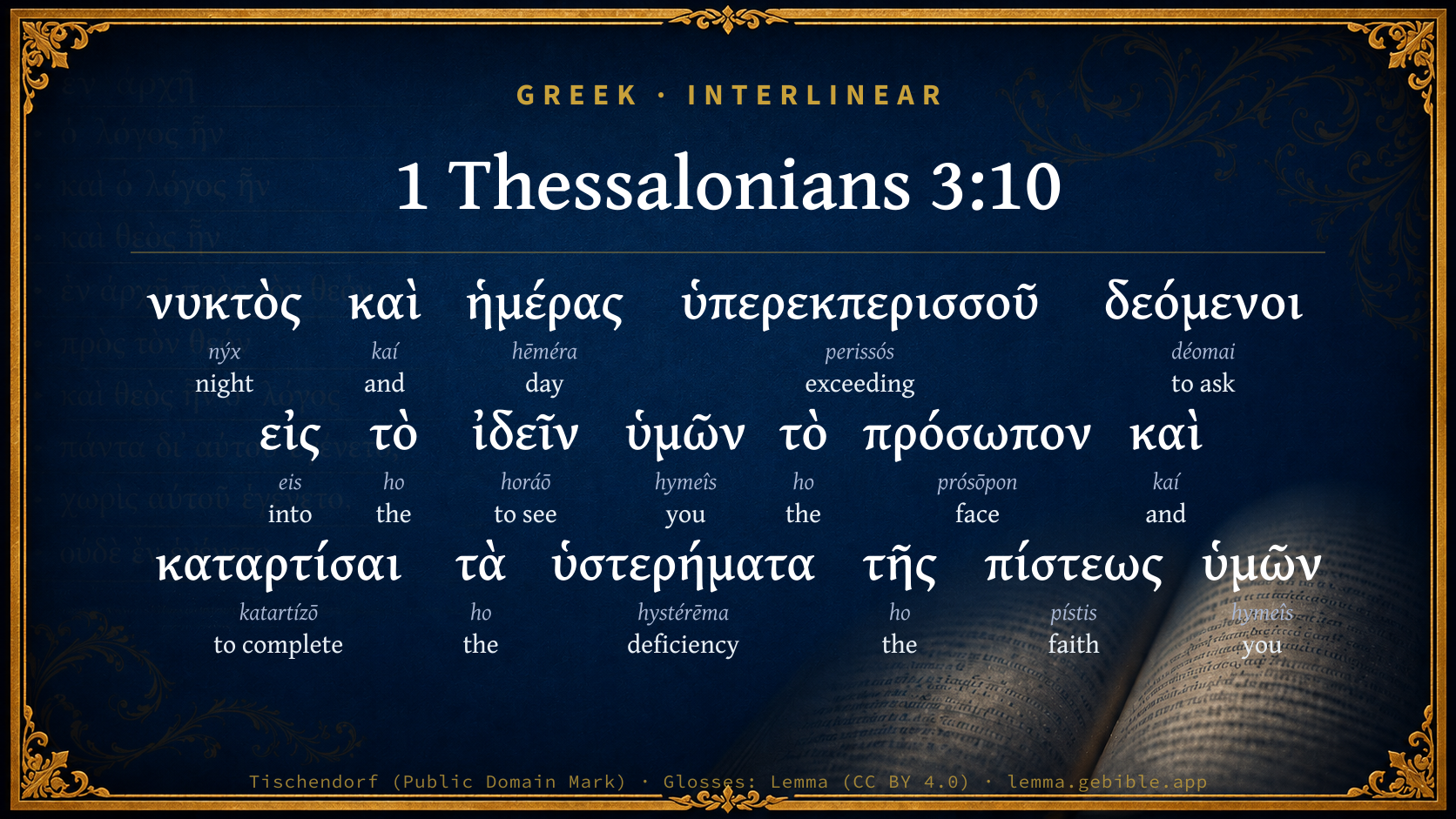
  1. νυκτὸς nýx G3571 “night” Noun, Genitive, Singular, Feminine
  2. καὶ kaí G2532 “and” Conjunction
  3. ἡμέρας hēméra G2250 “day” Noun, Genitive, Singular, Feminine
  4. ὑπερεκπερισσοῦ perissós G4053 “exceeding” Adverb
  5. δεόμενοι déomai G1189 “to ask” Verb, Present, Middle or Passive deponent, Participle, Nominative, Plural, Masculine
  6. εἰς eis G1519 “into” Preposition
  7. τὸ ho G3588 “the” Article, Accusative, Singular, Neuter
  8. ἰδεῖν horáō G3708 “to see” Verb, Aorist, Active, Infinitive
  9. ὑμῶν hymeîs G5210 “you” Personal pronoun, 2nd person, Genitive, Plural
  10. τὸ ho G3588 “the” Article, Accusative, Singular, Neuter
  11. πρόσωπον prósōpon G4383 “face” Noun, Accusative, Singular, Neuter
  12. καὶ kaí G2532 “and” Conjunction
  13. καταρτίσαι katartízō G2675 “to complete” Verb, Aorist, Active, Infinitive
  14. τὰ ho G3588 “the” Article, Accusative, Plural, Neuter
  15. τῆς ho G3588 “the” Article, Genitive, Singular, Feminine
  16. πίστεως pístis G4102 “faith” Noun, Genitive, Singular, Feminine
  17. ὑμῶν hymeîs G5210 “you” Personal pronoun, 2nd person, Genitive, Plural

About this verse

These counts appear in no published source. They are computed here, from the morphology-tagged text and Lemma’s own curated glosses. What Lemma adds →

18
words
13
distinct lemmas
Pauline Epistles
section

Notable vocabulary

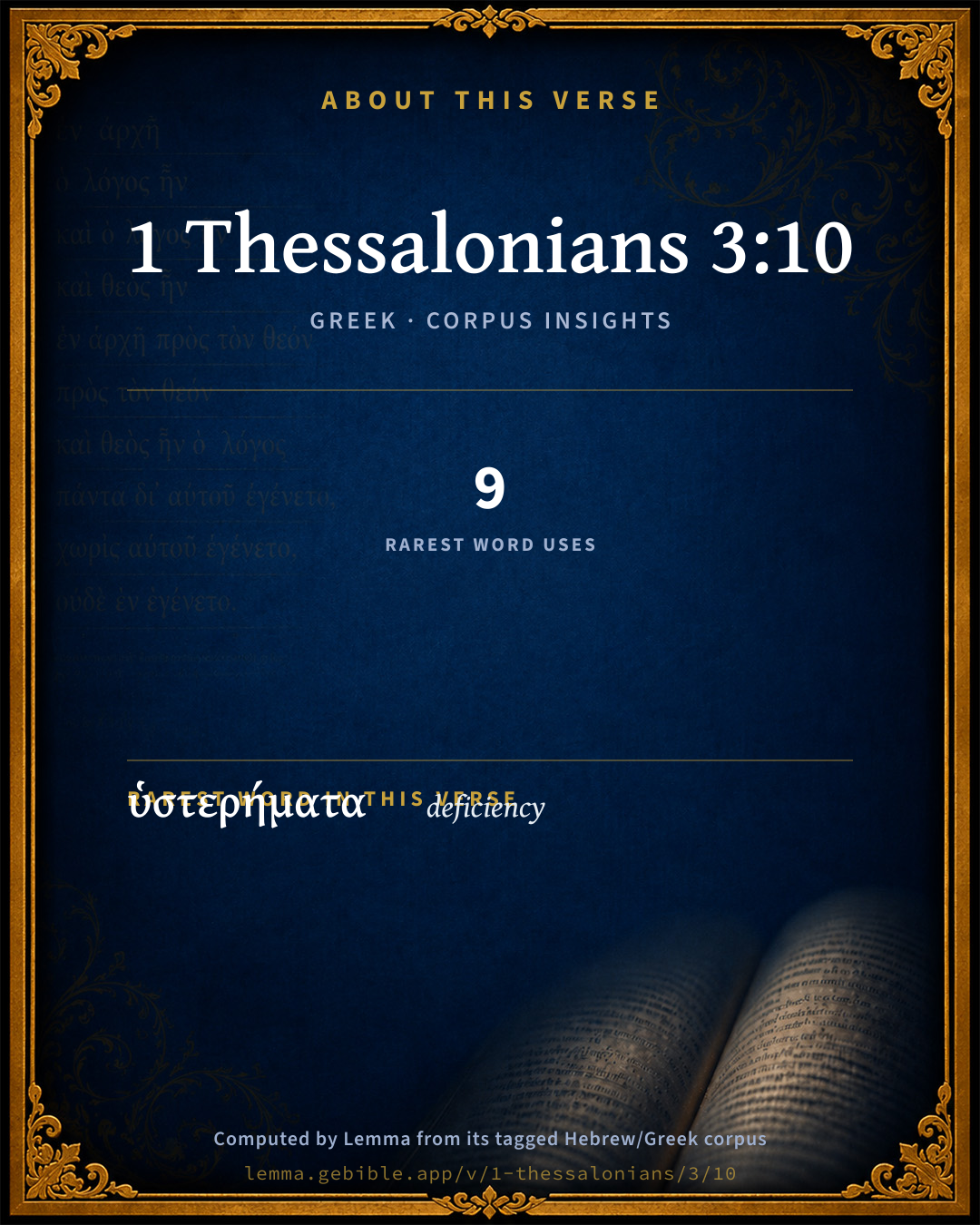
The rarest word here is ὑστερήματα deficiency G5303 — appearing just 9 times in the whole Greek New Testament.

Shared distinctive vocabulary

ὑστερήματα deficiency G5303 occurs in 9 verses of the Greek New Testament. Also found in:

Repetition

Words recur within this verse:

Cross-references

18

Topical passages linked to 1 Thessalonians 3:10 in the Treasury of Scripture Knowledge — connected by theme and wording, ordered by reader-vote popularity; previews shown in the World English Bible.

  • 2 Corinthians 13:9 For we rejoice when we are weak and you are strong. And this we also pray for, even your perfecting.
  • Romans 1:10–12 requesting, if by any means now at last I may be prospered by the will of God to come to you.
  • Romans 15:30–32 Now I beg you, brothers, by our Lord Jesus Christ, and by the love of the Spirit, that you strive together with me in your prayers to God for me,
  • 2 Corinthians 1:24 Not that we have lordship over your faith, but are fellow workers with you for your joy. For you stand firm in faith.
  • Philippians 1:25 Having this confidence, I know that I will remain, yes, and remain with you all, for your progress and joy in the faith,
  • 1 Thessalonians 2:17–18 But we, brothers, being bereaved of you for a short season, in presence, not in heart, tried even harder to see your face with great desire,
  • 1 Thessalonians 3:11 Now may our God and Father himself, and our Lord Jesus Christ, direct our way to you;
  • Acts 26:7 which our twelve tribes, earnestly serving night and day, hope to attain. Concerning this hope I am accused by the Jews, King Agrippa!
  • 2 Corinthians 1:15 In this confidence, I was determined to come first to you, that you might have a second benefit;
  • 2 Thessalonians 1:11 To this end we also pray always for you, that our God may count you worthy of your calling, and fulfill every desire of goodness and work of faith, with power;
  • 2 Timothy 1:3 I thank God, whom I serve as my forefathers did, with a pure conscience. How unceasing is my memory of you in my petitions, night and day
  • Luke 2:37 and she had been a widow for about eighty-four years), who didn't depart from the temple, worshipping with fastings and petitions night and day.
  • Colossians 1:28 whom we proclaim, admonishing every man and teaching every man in all wisdom, that we may present every man perfect in Christ Jesus;
  • Colossians 4:12 Epaphras, who is one of you, a servant of Christ, salutes you, always striving for you in his prayers, that you may stand perfect and complete in all the will of God.
  • Philemon 1:22 Also, prepare a guest room for me, for I hope that through your prayers I will be restored to you.
  • 2 Corinthians 13:11 Finally, brothers, rejoice. Be perfected, be comforted, be of the same mind, live in peace, and the God of love and peace will be with you.
  • Revelation 4:8 The four living creatures, each one of them having six wings, are full of eyes around about and within. They have no rest day and night, saying, "Holy, holy, holy, holy, holy, holy, holy, holy, holy is the Lord God, the Almighty, who was and who is and who is to come!"
  • Revelation 7:15 Therefore they are before the throne of God, they serve him day and night in his temple. He who sits on the throne will spread his tent over them.

Cross-references courtesy of OpenBible.info (CC BY 4.0).

Commentary

Notes on 1 Thessalonians 3:10 from classic Christian and Jewish commentators (each source and its license shown beneath its notes). The classic Christian expositions comment on the surrounding passage and are grouped to its opening verse, so a note may address several verses; the Jewish commentaries on the Tanakh (Rashi and others) are per-verse, so they appear only where the commentator wrote on this verse.

Lemma curates 59 commentaries, every one of them public domain or Creative Commons licensed, each selected and text-cleaned for this edition rather than reprinted as found. About our sources →

Albert Barnes' Notes on the Bible

Night and day - Constantly.

Praying exceedingly - Greek, abundantly; that is, there was much more than ordinary prayer. He made this a special subject of prayer; he urged it with earnestness, and without intermission; compare 1Th 2:17.

And might perfect that which is lacking in your faith - Might render it complete, or fill up anything which is missing. The word used here (καταρτίσαι katartisai), means, properly, to make fully ready, to put full in order, to make complete; see the Rom 9:22 note; 2Co 13:9 note; Gal 6:1 note. It is rendered mending, Mat 4:21; Mar 1:19; perfect and perfected, Mat 21:19; Luk 6:40; 2Co 13:11; 1Th 3:10; Heb 13:21; 1Pe 5:10; fitted, Rom 9:22; perfectly joined together, 1Co 1:10; restore, Gal 6:1; prepared, Heb 10:5; and framed, Heb 11:3. It is not elsewhere used in the New Testament. The meaning here is, that whatever was deficient in their views of religious doctrine the apostle desired to supply. It is to be remembered that he was with them but a comparatively short time before he was compelled to depart to Berea, and it is reasonable to suppose that there were many subjects on which he would be glad to have an opportunity to instruct them more fully.

Albert Barnes' Notes on the Bible (1834–1885) — public domain. Text from a community e-Sword/MySword module.

The Biblical Illustrator

Joseph S. Exell

1Th_3:10

Night and day praying exceedingly

Pauls prayer for the Thessalonians

I.

Its characteristics.

1. It was incessant; his aspiration by day, the breathing of his heart in the stillness of the night.

2. Intensely earnest. Above ordinary measure. It was a wrestling with his covenant God that he might see their face again. Satan had hindered this; hence the importunity.

3. Prevalent. It was heard.

II. Its occasion. He desired this boon not for the mere gratification of any feeling of friendship in him or them; but because there were what he calls the lacking measures of your faith.

1. As to doctrine, their knowledge was defective. They were entertaining not only imperfect but erroneous views, e.g. about the coming of the Lord, about the state of those who had fallen asleep, and the shares these would have in the glories of the second advent. In matters of this kind the apostolic churches generally had less defined views than those to whom have come the long results of time.

2. As to practice, there was much that called for correction. The apostolic churches, like the mission churches of our own day, were in the midst of a social corruption of which we can barely form even a conception. There were especially four classes of evils prevailing:

(1) Licentiousness, in its most degrading forms, was the besetting sin of the heathen world. The Christian converts often became contaminated with it. It lingered in the flesh when the spirit had cast it off. Even within the pale of the Church it sometimes assumed the form of a mystic Christianity. There were those who imagined themselves to have found in licentiousness the true freedom of the gospel. Chap. 4 points in this direction.

(2) In the Church itself there reigned the spirit of disorder--enhanced in the case of Thessalonica by the idleness engendered by belief in the nearness of the second coming. There are constantly recurring evidences of this in these two Epistles.

(3) There were scruples of conscience as to the observance of days, and eating with the unclean and unbelievers. The contact of Jews and Gentiles in the privileges and work of the Church could hardly fail in those days to give rise to such questions.

(4) Disputes about doctrines and teachers bred dissentions and marred the beauty of Christian life. In all these different ways unreasonable and wicked men (2Th_3:2) worked mischief which needed to be guarded against and withstood.

III. Its purpose--to perfect that which is lacking. The word perfect means to readjust, to restore. It is used in surgical language, of the setting of a bone or joint, and of repairing nets, and also of refitting and strengthening of ships.

1. In each of these senses we have fitting illustrations of Pauls purpose. His aim and that of all ministers is that Christians may be--

(1) perfectly joined together (1Co_1:10, Eph_4:12). Whatever may be their graces they have still lacking measures of faith. They need to be fitly joined together (Eph_4:16).

(2) So perfected in knowledge and practice that there shall be no defects in the gospel net.

(3) So ceaselessly to be repaired, built up, as the Ark of Safety, that they shall withstand all the rude billows of this world.

2. Thus filling up that which is lacking in faith on earth, Christs Church will at last pass into heaven where there will be nothing lacking in glory. John Howe has said, We read indeed of certain afterings of faith (as it may be significantly rendered) things lacking we render it; but there will be no afterings of glory. What is perfect admits of no increase, it is already full; and why should not a full glory satisfy? It is fulness of joy. (J. Hutchison, D. D.)

Ministerial solicitude

Why, say you, should a minister need encouraging? We have plenty of troubles all the week long, with our losses here, and crosses there, we want encouragements, but surely ministers do not. Ah! if you want to have a refutation of that idea you had better come into this pulpit, and occupy it a little time. If you would like to exchange, I would truly say that so far as the pleasure of my office is concerned, apart from the spiritual joy my Lord gives me, I would change places with a crossing sweeper, or a man who breaks stones on the road. Let a man carry out the office of a Christian minister aright, and he will never have any rest. God help, says Richard Baxter, the man who thinks the ministers an easy life. Why, he works not only all day, but in his sleep you will find him weeping for his congregation, starting in his sleep with his eyes filled with tears, as if he had the weight of his congregations sins resting on his heart, and could not bear the load, I would not be that man in the ministry who does not feel himself so fearfully responsible, that if he could escape from the ministry by going with Jonah into the depths of the sea, he would cheerfully do it; for if a minister is what he should be, there is such a weight of solemn concern, such sound of trembling in his ears, that he would choose any profession or any work, however arduous, sooner than the preachers post. If the watchman warn them not they shall perish, but their blood will I require at the watchmans hands. To sit down and spell over the question--Am I free of his blood? is terrible. I have sometimes thought I must have a day or two of rest, but I frankly confess that rest is very little rest to me, for I think I hear the cries of perishing souls, the wailings of spirits going down to hell, who chide me thus: Preacher, can you rest? Minister, can you be silent? Ambassador of Jesus can you cast aside the robes of your office? Up! and to your work again. (C. H. Spurgeon.)

The Biblical Illustrator, edited by Joseph S. Exell (c. 1880s–1900s) — public domain. Text from a community e-Sword module.

Burkitt's Expository Notes on the New Testament

William Burkitt

Obseve here, how abounding St. Paul was in the duty of prayer for the Thessalonians; his prayer was assiduous and constant, night and day; it imports frequency and constancy in performance of the duty, 1Th 3:10. His prayer was also very fervent and affectionate, praying exceedingly, excessively, as the word will bear. Spiritual affections are strong and vehement.

Note here, the admirable pattern which St. Paul sets before all the bishops and pastors of the church to the end of the world, namely, to be much, very much in prayer, to abound in this duty.

Observe, farther, the subject matter of St. Paul’s prayer, that he might see their face, and perfect what was yet lacking in their faith. Here note, that St. Paul’s short stay among the Thessalonians when he first planted the gospel, did not permit so full and complete an explication of the matters and mysteries of Christianity, as the apostle did desire; he therefore prays that God would bring him again amongst them, that he might supply what was wanting in their faith, that he might increase their knowledge, confirm their faith, inflame their love, excite their desires, quicken their endeavours, and carry on that good work to perfection in them, of which God had laid the foundation by him.

Learn hence, 1. That even in the faith of the most renowned, as well as of the new converted Christians, there is some deficiency and defect.

2. That one great end of the ministry of the word is, to help faith forward towards perfection; that which was the instrument to beget faith, is also the mean of increasing and confirming it, namely, the ordinances of God in general, and the ministry of the word in particular. As faith cometh by hearing, so is it confirmed by hearing also; longing to see your face, that we might perfect what is lacking in your faith.

William Burkitt's Expository Notes on the New Testament (1700–1703) — public domain. Text from a community e-Sword module.

Bengel's Gnomon

Johann Albrecht Bengel

1Th 3:10. Νυκτὸς, night) Alluding to his holy thoughts during the night, 2Ti 1:3.—τὰ ὑστερήματα, the things which are wanting) [the deficiency, that which is lacking]. Even the Thessalonians had points in which they were in need of improvement.

Bengel's Gnomon of the New Testament — English translation (T&T Clark, Edinburgh, 1860) — public domain. Text from a community e-Sword module.

Meyer's Critical & Exegetical Commentary

Heinrich August Wilhelm Meyer

1Th_3:10. Δεόμενοι] is not used absolutely instead of δεόμεθα or ἐσμὲν δεόμενοι, which Cornelius a Lapide and Baumgarten-Crusius assume, and Flatt thinks possible, but neither is it to be united with χαίρομεν (Schott, de Wette, Koch, Riggenbach), but belongs to the main thought τίνα … ἀνταποδοῦναι, and assigns the reason for it by the fervent longing for the readers, and anxiety for their Christian character: What sufficient thanks are we able to give to God for our joy over you, as we (cleaving to you with such paternal love that we), without ceasing, pray to see you again, and complete the defects of your faith?

νυκτός] See on 1Th_2:9. Erroneously Fromond.: it is placed first, quia nocte praecipue propter solitudinem et silentium sancti se orationi dare solent.

The accumulation of expressions νυκτὸς καὶ ἡμέρας ὑπερεκπερισσοῦ, is the natural outflow of the strength of his feeling; comp. Php_1:23.

ὑπερεκπερισσοῦ] above measure, is found only in 1Th_5:13, Eph_3:20, and Theodoton, ad Daniel, 3:22. Erroneouslybecause grammatically impossible

Clericus insists on referring it by means of a trajection not to δεόμενοι, but to ἰδεῖν, defending his opinion on the ground that ὑπερεκπερ. denotes something not strictly necessary, whereas prayer is a duty, a necessity: orantes ut videamus vultum vestrum, quasi cumulum laetitiae nostrae. Non satis erat Paulo scire Thessalonicenses constanter evangelio adhaerere, quamvis summam laetitiam ex eo nuntio perciperit, volebat ὑπερεκπερισσοῦ, ex abundanti, eos videre.

εἰς τὸ κ.τ.λ.] the design of δεόμενοι: praying to this end, in order by means of prayer (by the answer to it) to attain the ἰδεῖν and καταρτίσαι.

καταρτίζειν] is to place in the condition of perfectness, of completeness. Thus καταρτίζειν τὰ ὑστερήματα τῆς πίστεως signifies: to render complete the defects of faith, that is, in order to make perfect that which is wanting in faith (Theodoret: τὰ ἐλλείποντα πληρῶσαι). By this ὑστερήματα τῆς πίστεως Paul understands partly defects of faith as regards insight (particularly in respect of the impending advent; comp. 1Th_4:13 ff.); partly defects of faith as regards its practical verification in the Christian life (comp. 1Th_4:1 ff.). It follows, moreover, from καταρτίσαι τὰ ὑστερήματα, with what inconsiderate arbitrariness Baur misuses even this passage in support of his assertion that the Thessalonian church had already existed for a long time.

Meyer — Critical and Exegetical Commentary on the New Testament — English translation by Peter Christie, edited by Frederick Crombie (T&T Clark, 1880) — public domain. Text from a community e-Sword module.

Expositor's Greek Testament

ed. W. Robertson Nicoll

1Th 3:10 . Another adaptation of ethnic phraseology, cf. Griechische Urkunden , i. 246, 12, νυκτὸς καὶ ἡμέρας ἐντυγχάνω τῷ θεῷ ὑπὲρ ὑμῶν (a pagan papyrus from second or third century, A.D.). The connection of δεόμενοι κ . τ . λ . with the foregoing words is loose, but probably may be found in the vivid realisation of the Thessalonians called up before his mind as he praised God for their constancy. Timothy had told him of their loyalty, but had evidently acquainted him also with some less promising tendencies and shortcomings in the church; possibly the Thessalonians had even asked for guidance on certain matters of belief and practice (see below). Hence Paul’s eagerness to be on the spot again, not merely for the sake of happy fellowship (Rom 1:11 ), but to educate and guide his friends, supplying what was defective in their faith. As this was impracticable in the meantime, he proceeds to write down some kindly admonitions. Thus 10 b forms the transition to the second part of the letter; Paul, as usual, is wise enough to convey any correction or remonstrance on the back of hearty commendation. In the prayer which immediately follows, 10 a is echoed in 11, 10 b in 12, 13, for the maturing of the Thessalonian’s faith does not depend on the presence of their apostles. Whatever be the answer to the prayer of 11, the prayer of 12, 13 can be accomplished.

The Expositor's Greek Testament, edited by W. Robertson Nicoll (1897–1910) — public domain. Text from a community e-Sword module.

Cambridge Greek Testament for Schools and Colleges

10. νυκτὸς καὶ ἡμέρας ὑπερεκπερισσοῦ δεόμενοι εἰς τὸ ἰδεῖν ὑμῶν τὸ πρόσωπον, by night and day making supplication in exceeding abundant measure, to the end that we may see your face. On the temporal expression, see note to 1Th 2:9; it repeats more graphically the ἀδιαλείπτως of 1Th 1:3 (or 2), 1Th 2:13: “night and day” the Apostles are “working” and “praying” at once; they could pray while occupied with manual labour. For the union of thanksgiving and prayer, cf. 1Th 1:2, 1Th 5:17 f. Ὑπερ-εκ-περισσοῦ (cf. 1Th 3:13, -ως; Eph 3:20) is an almost extravagant intensive, plusquam abunde, found outside St Paul (who affects ὑπερ- compounds) only in Dan 3:22 (Theodotion), and in Clemens Rom. ad Corinth. xx. 11; it surpasses περισσοτέρως (1Th 2:17): cf. 2Co 1:8 b; Eph 3:8; 1Co 4:13; 1Co 15:8, for like ardours of hyperbole. Δέομαι is to beg, as for some personal boon, something that one “wants for oneself”; cf. Rom 1:10; Luk 9:38; Luk 22:32, &c. Εἰς τὸ ἰδεῖν κ.τ.λ. expresses the ulterior aim of these importunate supplications (cf. Php 1:23, τὴν ἐπιθυμίαν ἔχων εἰς τὸ ἀναλῦσαι); the writer’s prayers touched on intervening objects—the removal of hindrances (1Th 2:18), the progress of the work in hand (2Th 3:1 f.)—but this longing always animated them: cf. for εἰς τό with infin. 1Th 2:12, and note. For ἰδεῖν τὸ πρόσωπον ὑμῶν, see 1Th 2:17.

The aim of the above δεῖσθαι is twofold: “to see the face” of their beloved Thessalonians would be an extreme gratification to the writers; and this satisfaction is identified, by the vinculum of a single article, with the blessing thus brought to their readers,—εἰς τὸ … καὶ καταρτίσαι τὰ ὑστερήματα τῆς πίστεως ὑμῶν, in order to (see your face) and make good the deficiencies of your faith: “ut suppleamus” (not “compleamus,” as in Vulg.) “quæ vestræ fidei desunt” (Calvin), “ut sarciamus, &c.” (Beza). Ἡ πίστις ὑμῶν, just as in 1Th 3:2; 1Th 3:5 (see notes), stands for the whole Christianity of the Thessalonians. Τὰ ὑστερήματα points to what was lacking not in but to “the faith” of the readers. Strong and steadfast in itself (see 1Th 1:3; 1Th 1:8, 1Th 2:13, 1Th 3:6-8; 2Th 1:3), that faith required more knowledge (see e.g. 1Th 4:13), more moral discipline and sanctity of life (1Th 4:1-12) and practice in the ways of piety (1Th 5:12-22), more sobriety of temper, more steadiness and self-possession (1Th 5:1-8; 2Th 2:1 ff.). For the objective genitive to ὑστέρημα, cf. Col 1:24; 2Co 8:13 f.; also Mar 10:21, ἕν σε ὑστερεῖ. Καταρτίζω means to set right, correct—not to complete something defective in itself, but to make good and fit out that which lacks the resources or conditions necessary to its proper action or destination: cf. Rom 9:22; Heb 13:21; Mat 4:21,—“repairing their nets”; and see Lightfoot’s note ad loc.

1Th 3:11-13 breathe out the prayer which the writers, as they have just said, are continually making, 1Th 3:11 corresponding to εἰς τὸ ἰδεῖν κ.τ.λ., and 1Th 3:12 f. to the καταρτίσαι τὰ ὑστερήματα of 1Th 3:10.

Cambridge Greek Testament for Schools and Colleges (Cambridge University Press, 1896; 21 vols, various authors incl. Carr, Maclear, Plummer, Farrar, Lumby, Moule, M. R. James, Simcox) — public domain. Text from a community e-Sword module.

International Critical Commentary

10. νυκτὸ … δεόμενο. It is in the atmosphere of intense joy that he prays unceasingly (νυκτὸς καὶ ἡμέρα as 2:9) and exuberantly (ὑπερεκπερισσου as 5:13), not simply that he might see their face (as 2:17) but also that he might make up the deficencies of their faith (cf. v. 8). Both his desire to return which has been the point of his defence since 2:17 and his desire to amend the shortcomings of their faith are suffused by the spirit of joy. The converts are thus tactfully assured both of the genuineness of his longing to see them and of his confidence that their imperfections are not serious. In passing, it is worth nothing that the enthusiasm of his feeling does not prevent him from being aware of the existence of moral defects,—an interesting side-light on the ethical sondness of his religious feelings. δεόμενο, loosely attached to χαίρομε, prepares the way not only for the prayer (vv. 11-13), namely, that God and Christ may direct his way to them (v. 11), and that the Lord may increase their brotherly love and love in general (v. 12) and strengthen them to remove their defects, but also for the exhortations (4:1 ff.) in which there is a detailed and at the same time tactful treatment of the ὑστερήματ

ὑπερεκπερισσου is found in 5:13 (אAP; BDGF read ὑπερεκπερισσῶ, a word occurring in 1 Clem. 20:11 but not in Lxx), Eph 3:20 and Test. xii, Jos 17:5, but not in Lxx It is stronger than περισσοτέρω (2:17) and ὑπερπερισσῶ (in Gk. Bib. only Mar 7:37) and ἐκ περισσου (Dan. (Th.) 3:22; Mar 6:51 v. l.). See Ell. on Eph 3:20 and cf. Ambst abuntantissimo. εἰς το introduces the object of δεόμενο (BMT 412). δεῖσθα (Rom 1:10, Gal 4:12, etc.), like ἐρωτᾶ (4:1, 5:12, II 2:1, Php 4:3), is less frequent in Paul than παρακαλεῖ—ὑστέρημ is found six times in Lxx, eight times in Paul, and once in Luke (Luk 21:4); it indicates a lack and is opposed to περίσσευμ (2Co 8:13 f.). It is joined with ἀναπληροῦ (1Co 16:17, Php 2:30; cf. Test. xii, Benj. 11:5 1 Clem. 38:2), προσαναπληροῦ (2Co 9:12, 2Co 11:9) and ἀνταναπληροῦ (Col 1:24) but not elsewhere in Gk. Bib. with καταρτίζει This word (Gal 6:1, Rom 9:22, etc.; cf. προκαταρτίζει 2Co 9:5), common in Lxx, means generally to render ἄρτιο, hence to “adjust” differences, “repair” things out of repair, “set” bows, “prepare” dishes, etc.; and here “make up,” “make good” that which is lacking to complete faith. Since, however, the sense “das Fehlende” passes imperceptibly into that of “Fehler” (Dob.), as indeed 1 Clem. 2:6 (where ὑστερήματ is parallel to παραπτώματ) and Hermas Vis. III, 2:2 (where it is parallel to ἁμαρτήματ) suggest, we may translate either “make up the deficiencies of your faith” (Lillie) or “amend the short-comings of your faith” (Ruther).

III. PRAYER (3:11-13)

With δε, introducing a new section in the epistolary disposition of the letter, Paul passes from the superscription (1:1) and the thanksgiving (1:2-3:10) to the prayer (3:11-13). But the desire to see them (v. 10) and the desire to amend the deficiencies of their faith (v. 10) are resumed as he turns in prayer to the supreme court of appeal, God and Christ; but the emphasis in (3:11-13 is put less on the longing to see them (v. 11), the apologetic interest underlying 2:17-3:10, than on the shortcomings of their faith (vv. 12-13), the ὑστερήματ of v. 10. This change of emphasis prepares the way for the exhortations (4:1 ff.); in fact, when he prays that Christ may make them abound in brotherly love as well as in love (v. 12) and may strengthen them inwardly so that they may become blameless in saintliness when they appear before God at the last day when Jesus comes attended by his glorious retinue of angels (v. 13), it is not improbable that he has more or less distinctly in mind the matter of φιλαδελφί (4:9-12) and ἁγιασμό (4:3-8), to which, with λοιπό (4:1), he forthwith addresses himself.

11Now may our God and Father and our Lord Jesus himself direct our way to you. 12And as for you, may the Lord make you to increase and abound in love toward one another and toward all men, just as we too toward you, 13in order that he may strengthen your hearts (so that they may be) blameless in holiness in the presence of our God and Father when our Lord Jesus comes with all his angels.

International Critical Commentary — older volumes (1896–1929), various authors — public domain. Text from a community e-Sword module.

Geneva Bible (1599)

Geneva Bible translators

Paul was constrained through the importunate dealing of the enemies to leave the building which he had scarce begun: And for that cause he had left Silas and Timothy in Macedonia, and when Timothy came to Athens to him, he sent him back again straightway. So that he desireth to see the Thessalonians, that he may thereby thoroughly accomplish their faith and religion, that was as yet imperfect.

Geneva Bible (1599) marginal notes — public domain. Text via Bolls.life.

Jamieson, Fausset & Brown

Robert Jamieson, A. R. Fausset & David Brown

Night and day--(See on Th1 2:9). Night is the season for the saint's holiest meditations and prayers (Ti2 1:3).

praying--connected with, "we joy"; we joy while we pray; or else as ALFORD, What thanks can we render to God while we pray? The Greek implies a beseeching request.

exceedingly--literally, "more than exceeding abundantly" (compare Eph 3:20).

that which is lacking--Even the Thessalonians had points in which they needed improvement [BENGEL], (Luk 17:5). Their doctrinal views as to the nearness of Christ's coming, and as to the state of those who had fallen asleep, and their practice in some points, needed correction (Th1 4:1-9). Paul's method was to begin by commending what was praiseworthy, and then to correct what was amiss; a good pattern to all admonishers of others.

Jamieson, Fausset & Brown — Commentary Critical and Explanatory on the Whole Bible (1871) — public domain (CC PDM 1.0). Text via the HelloAO Bible API.

Adam Clarke's Commentary

Verse 10. Night and day praying exceedingly] Supplicating God at all times; mingling this with all my prayers; υπερεκπερισσου δεομενοι, abounding and superabounding in my entreaties to God to permit me to revisit you. How strong was his affection for this Church!

Might perfect that which is lacking] That I might have the opportunity of giving you the fullest instructions in the doctrine of Christ, that ye might have every thing in the most ample detail; so that the great outlines of truth which you already know may be filled up, that ye may be perfectly fitted to every good word and work.

Adam Clarke's Commentary on the Bible (1810–1826) — public domain. Text from a community e-Sword/MySword module.

John Calvin's Commentaries

10 Praying beyond measure. He returns to an expression of his desire. For it is never allowable for us to congratulate men, while they live in this world, in such unqualified terms as not always to desire something better for them. For they are as yet in the way: they may fall back, or go astray, or even go back. Hence Paul is desirous to have opportunity given him of supplying what is wanting in the faith of the Thessalonians, or, which is the same thing, completing in all its parts their faith, which was as yet imperfect. Yet this is the faith which he had previously extolled marvelously. But from this we infer, that those who far surpass others are still far distant from the goal. Hence, whatever progress we may have made, let us always keep in view our deficiencies, (ὑστερήματα,) that we may not be reluctant to aim at something farther.

From this also it appears how necessary it is for us to give careful attention to doctrine, for teachers were not appointed merely with the view of leading men, in the course of a single day or month, to the faith of Christ, but for the purpose of perfecting the faith which has been begun. But as to Paul’s claiming for himself what he elsewhere declares belongs peculiarly to the Holy Spirit, (1 Corinthians 14:14) this must be restricted to the ministry. Now, as the ministry of a man is inferior to the efficacy of the Spirit, and to use the common expression, is subordinate to it, nothing is detracted from it. When he says that he prayed night and day beyond all ordinary measure, we may gather from these words how assiduous he was in praying to God, and with what ardor and earnestness he discharged that duty.

John Calvin's Commentaries (1540-1563) — public domain. Text from the Calvin Translation Society English edition (1840s-50s) via the Christian Classics Ethereal Library (ccel.org). Calvin's coverage is partial (roughly two-thirds of the Bible); uncommented books and verses are honest gaps, never fabricated. The 19th-century editor's footnotes and remarks are omitted so the notes are faithfully Calvin's own voice.

Ellicott's Commentary for English Readers

(10) See your face.—Seeing them by proxy might satisfy for the while, but not for long. This exceeding importunate, prayer is caused by the feeling that it was Satan’s hindrance (1Th_2:18), not God’s will, which forbad the meeting. He would not so have prayed to go into Bithynia (Act_16:7), for the essence of prayer is to conform the will to God’s will.

That which is lacking in your faith.—Bishop Wordsworth points out the unflattering faithfulness of St. Paul’s dealing with his converts. What the deficiencies were is unknown, but they certainly include want of knowledge of the state of the dead and concerning the Advent.

A Bible Commentary for English Readers, edited by Charles John Ellicott (1878–1897) — public domain. Text from a community e-Sword module.

The Cambridge Bible for Schools and Colleges

gen. ed. J. J. S. Perowne

10. night and day praying exceedingly] In this last adverb, peculiar to St Paul, he strains language to express the ardour of his feeling: beyond measure exceedingly; it recurs in ch. 1Th_5:13 and Eph_3:20. Night and day puts more vividly the “without ceasing” of ch. 1Th_1:3; comp. ch. 1Th_2:9.

“Praying” is here, more strictly, begging, or beseeching, and points to the want of the suppliant (comp. 2Co_5:20, “We beg you, on Christ’s behalf, Be reconciled to God”); whereas the ordinary word for prayer (see e.g. ch. 1Th_1:2; 2Th_3:1) indicates devotion towards the object of worship. Prayer goes with thanksgiving, as in ch. 1Th_1:2-3, and constantly in St Paul; comp. ch. 1Th_5:17-18.

that we might see your face] might makes the realisation seem distant and doubtful; read may (R. V.). See notes on ch. 1Th_2:17.

and might perfect that which is lacking in your faith] Or, may make good the deficiencies of your faith; not so much what was lacking in as lacking to their faith. Thessalonian faith was in itself steadfast and vigorous (ch. 1Th_1:3; 1Th_1:8; 1Th_2:13; 1Th_3:6-8; 2Th_1:3, “Your faith groweth exceedingly”); but it needed the supplement of added Christian light and moral wisdom. Hence the teaching and admonition the Apostle supplies in chaps. 4, 5 and in the Second Epistle (see Introd. pp. 23–25). Timothy’s return from Thessalonica and the news he brought, while removing St Paul’s great anxiety, made him still more sensible of the need this young and most promising Church had for the continued instruction which he alone could supply. This increased his eagerness to revisit the Thessalonians. For a similar wish—less warmly expressed, inasmuch as it concerned strangers—see Rom_1:9-15; Rom_15:23.

The word rendered “perfect” means to fit up, furnish, fully equip; it is used of “mending nets” (Mat_4:21), of “vessels fitted for destruction” (Rom_9:22), and of “perfecting saints for work of ministration” (Eph_4:12).

The Cambridge Bible for Schools and Colleges (gen. ed. J. J. S. Perowne; Cambridge University Press, 1878–1918) — public domain. Text from a community e-Sword module.

John Gill's Exposition

Night and day praying exceedingly,.... This good news, not only comforted their hearts, and revived their spirits, and filled them with joy and thankfulness, but also sent them to the throne of grace to pray without ceasing, continually, night and day, and as often as they went thither, and that with great fervency and earnestness, in a multitude of petitions; or, as the Arabic version renders it, "with prayers exceeding a multitude"; with innumerable requests:

that we might see your face: once more, and converse face to face:

and might perfect that which is lacking in your faith? in the grace of faith; for though they remembered their work of faith with pleasure, and had had good tidings of it very lately, and were thankful that it grew exceedingly as it did, yet they knew it was not perfect, there was unbelief attending them: and though it is God's work to increase faith, as well as to produce it, yet, as the ministry of the word is the means of the first planting of it, so it also is of the increase of it. This may likewise be understood of the doctrine of faith, which though they had received in the love of it, and had made considerable progress in their knowledge of it; yet they knew but in part, and needed to be taught the way of God, and truths of the Gospel more perfectly; and the ministry of the word is for the perfecting of the saints in the knowledge of the Son of God, and of other truths; wherefore the apostle desired greatly to see them, that he might be an instrument of instructing them, more perfectly in the knowledge of divine things; and in this, and in the following epistle, he does particularly instruct them about the rise and fall of antichrist, the coming of Christ and the resurrection of the dead, articles of faith in which they seemed to have been deficient: but now, though these saints had deficiencies in their faith, yet they were not what the Jews call (o) , "such as are deficient in faith", or want faith entirely, a phrase somewhat like this which is here used.

(o) Maimon. Hilch. Mechira, c. 7. sect. 8, 9.

John Gill's Exposition of the Whole Bible (1746–1763) — public domain (CC PDM 1.0). Text via the HelloAO Bible API.

Trapp's Complete Commentary

John Trapp

10 Night and day praying exceedingly that we might see your face, and might perfect that which is lacking in your faith?

Ver. 10. Night and day praying exceedingly] Prayer must be constant and instant, with utmost assiduity and intention of affection, Luk 18:1. {See Trapp on "Luk 18:1"}

And might perfect that which is lacking in your faith] Faith is not as Jonah’s gourd, that grew up in a night; or as a bullet in a mould, that is made in a moment; but is perfected by degrees and so made even (as the word καταρτισαι signifies here in the original) and complete.

John Trapp, A Commentary or Exposition upon All the Books of the Old and New Testament (1647–1656) — public domain. Text from a community e-Sword module.

Haydock's Catholic Bible Commentary

That we may see you face. Though epistles in absence give great comfort, and help to confirm the faith once delivered, it is by preaching that the faith of Jesus Christ and true religion are both begun and accomplished. --- And may accomplish those things that are wanting to your faith? That is, give you fuller instructions. (Witham)

George Leo Haydock (1774–1849), Haydock's Catholic Family Bible and Commentary, 1859 edition — public domain. Excludes Psalms (Douay-Rheims chapter numbering differs from Protestant) and Deuterocanonical books (Catholic canon only).

Matthew Poole's English Annotations

We have here the last effect of Timothy’s message upon the apostle, it put him upon prayer for these Thessalonians; expressed by the assiduity of it, night and day, & c., that is, in a constant course; as we noted before, 1Th 2:9. And by the fervency of it, exceedingly, or excessively. The Greek word cannot well be Englished, yet is often used by the apostle when he would express any thing with an emphasis, as Eph 3:20, and in this Epistle, 1Th 5:13. And by the matter of it; that we might see your face, and might perfect that which is lacking in your faith. Though his Epistles might avail towards it, yet his personal presence would do more. There is a peculiar blessing attends oral preaching, more than reading. The like prayer he made with respect to the Romans, and upon the same account also, Rom 1:10,11. Though the apostle had before commended their faith, yet there was something lacking in it. No faith is made perfect at first; yea, the best faith may have some defects. And the word is used elsewhere to signify something that is wanting, or left behind, 1Co 16:17; Col 1:24. And their faith might be defective:

1. As to the matter of it, some mysteries of faith they might not yet understand; as the disciples did not, till after Christ’s ascension; and some of the Corinthians a while doubted the doctrine of the resurrection, 1Co 15:12, &c.

2. As to the clearness of it, with respect to the truths they did already know and believe.

3. As to the lively operations and fruits of it.

The former defects are removed by doctrine, the last by exhortation and comfort, and the apostle desired to see their face on the account of both: and to perfect a thing is to make it complete, both as to parts and degrees. The word here used we find often in the New Testament, 2Co 13:11; Gal 6:1, &c.; and variously rendered in the several translations, but yet much to the same sense: the apostle being so suddenly driven from them, he left them as a house half built; but his affection to them was so great, that he longed to return to them for the perfecting of their faith, though he had met but a while before with such great perils at Thessalonica.

Matthew Poole's English Annotations on the Holy Bible (1683–1685) — public domain. Text from a community e-Sword/MySword module.

Whedon's Commentary on the Bible

Daniel D. Whedon

10. See your face—Repeatedly St. Paul did pass through Thessalonica and confirm and make powerful that future stronghold of Christian faith.

Lacking—Literally, the lackings, deficiencies, or falterings of your faith, whether of belief in Christian truth or firmness of Christian profession.

Daniel D. Whedon (gen. ed.), Commentary on the Old and New Testaments (1874–1909) — public domain. Text from a community e-Sword module.

The Pulpit Commentary

Night and day (comp. 1Th_2:9) praying exceedingly. Denoting the intense earnestness and anxiety of the apostle for the spiritual welfare of the Thessalonians, that found vent to itself in incessant prayer for them. Now follows the subject-matter of his prayer.

That we might see your face, and might perfect that which is lacking in your faith. The faith of the Thessalonians was not perfect; it was "lacking" in several respects. It was defective in extent; they were ignorant of many of the doctrines of the gospel, and had formed erroneous views of other doctrines, such as the second advent. It was defective in application; they had not yet renounced all the corrupt practices of their former heathen life, nor had they embodied all the precepts of the gospel into their actual life. The Thessalonians were as yet but novices. So also the reason which impelled Paul to wish to come to Rome was to supply that which was lacking in the faith of the Roman converts. (Rom_1:11) Confirmation was a work in which the apostle delighted, being both important and desirable. In general, faith at first is weak and defective; it is only developed by degrees. Especially is it increased by every increase of spiritual knowledge. "Add to your faith knowledge". (2Pe_1:5, 2Pe_1:6)

The remark of Calvin is worthy of attention: "Paul is desirous of having the opportunity given him of supplying what is wanting in the faith of the Thessalonians, or, which is the same thing, completing in all its parts their faith which was as yet imperfect. Yet this is the faith which he had previously extolled marvelously. From this we infer that those who far surpass others are still far distant from the goal. Hence, whatever progress we may have made, let us keep in view our deficiencies, that we may not be reluctant to aim at something further.

Defective faith.

Our faith may be defective in various ways.

1. In its finality. It may be mingled with unbelief or with doubts; we may only partially believe. If so, let our prayer be, "Lord, I believe; help thou mine unbelief.

2. In its objects. It may not embrace all the revealed truths of religion; we may be ignorant of some of them, or have adopted erroneous notions concerning others. If so, we must "add to our faith knowledge.

3. In its efficacy. It may be too much of a dead faith; it may not exercise itself outwardly; it may not sufficiently influence our practice. If so, we must remember that "faith, if it hath not works, is dead.

4. In its steadfastness. Our faith may be wavering, unstable, liable to fail; it may be variable; sometimes we may be strong in the faith, and at other times weak. If so, let our prayer be, "Lord, increase our faith."

The Pulpit Commentary (1880–1919), ed. H.D.M. Spence-Jones & Joseph S. Exell — public domain. Text from a community e-Sword module.

John Wesley's Explanatory Notes

And perfect that which is wanting in your faith - So St. Paul did not know that "they who are once upon the rock no longer need to be taught by man."

John Wesley, Explanatory Notes Upon the Whole Bible (1754–1765) — public domain. Text via the GEBible commentary corpus.

Scofield Reference Notes

C. I. Scofield

perfect (See Scofield "Mat 5:48").

The Scofield Reference Bible (1917 edition), notes by C. I. Scofield — public domain. Text from a community e-Sword module.

Godbey's Commentary on the New Testament

William B. Godbey

ARGUMENT 4

REGENERATION NOT FULL SALVATION

10. “Night and day exceedingly desiring to see your face, and to perfect the deficiencies of your faith.” This letter sweeps the last possible vestige of the Zinzendorfian heresy forever from the field. Here we have a case of conversion beggaring all possible cavil, clear, demonstrative, giving the joy of the Holy Ghost and the fruits of the Spirit, even making them efficient missionaries and “examples to all the saints in Macedonia and Achaia.” Yet this epistle is written to “perfect the deficiencies of their faith.” Their faith for justification was certainly all right; but they did not have faith for sanctification. This was the deficiency no candid reader can deny that they were truly born from above. They were not sinners. Yet they did not enjoy full salvation. Their faith was not perfect. If so, their salvation

would have been perfect, for Jesus says it is according to your faith. I have heard preachers stoutly contend that regeneration is full salvation. You see they differ from Paul. This, of itself, is an irrefutable argument for the sanctification of the ministry. Wholly sanctified people are gloriously saved from creedism, and even their own opinions. They want nothing but the truth. they are dead to all isms and schisms, sects, creeds, theologies, denominations, and organizations. We have to get there, in order to be taught by the Holy Ghost. God help you and me to be utterly dead to every authority but the Bible! Your creed will not be mentioned in the judgment-day. You must face the great white Throne, and be judged by the Bible alone.

William B. Godbey, Commentary on the New Testament (1896–1900) — public domain. Text from a community e-Sword module.

McGarvey & Pendleton's Commentaries

J. W. McGarvey

night and day praying exceedingly that we may see your face, and may perfect that which is lacking in your faith? ["Night," says Joseph de Maistre, "is a great chapter in the Psalms, to which David often recurs." Paul, like David, employed much of the night in meditation and prayer. At such times he remembered the brevity and sudden termination of his ministry in Thessalonica, and realized that his converts were not fully instructed in many items of faith and doctrine; he therefore prayed that he might return and complete his instruction. After three or four years his prayer was answered ( Act_20:1-2 ), and some ten years after that it was again answered-- 1Ti_1:3 ]

J. W. McGarvey (with Philip Y. Pendleton), Commentaries on the New Testament (The Fourfold Gospel, 1914; Acts; and the epistles) — public domain. Text from a community e-Sword/MySword module.

The People's New Testament

B. W. Johnson

10. Night and day praying. An expression of his intense longing to see again a band of young converts so tenderly endeared to him. And might perfect that which is lacking. Instruct them more fully in knowledge and duty. So recently heathen, they needed a wise teacher very much.

B. W. Johnson's The People's New Testament with Notes (1889–1891) — public domain. Electronic text from the Christian Classics Ethereal Library (CCEL) ThML edition.

Alford’s Greek Testament

Henry Alford

10.] νυκτ. κ. ἡμ. see on ch. 2:9.

ὑπερεκπ.: see reff., and cf. Mar 6:51.

δεόμενοι belongs to the question of ver. 9—q. d., ‘what thanks can we render, &c., proportioned to the earnestness of our prayers, &c.?’ So that δεόμενοι would best be rendered praying as we do.

εἰς τό—direction, or aim, of the prayers.

καταρτίσαι τὰ ὑστ.] τὰ ἐλλείποντα πληρῶσαι, Thdrt.: cf. 2Co 9:12. These ὑστερήματα were consequences of their being as yet novices in the faith: partly theoretical, e.g. their want of stability respecting the παρουσία, and of fixed ideas respecting those who had fallen asleep in Christ,—partly practical, ch. 4:1. One can hardly conceive a greater perverseness than that of Baur, who takes this passage for a proof that the Thessalonian church had been long in the faith.

Henry Alford, The Greek Testament (1849–1861) — public domain. Text from a community e-Sword module.

Vincent's Word Studies in the New Testament

Marvin R. Vincent

Exceedingly [υπερεκπερισσου] . Comp. Eph 3:20. Paul is fond of compounds with uJper above. Of the 28 N. T. words compounded with uJper, 22 are found in Paul, and 20 of them only there.

Perfect [καταρτισαι] . Primarily, to adjust, fit together; so mend, Mt 4:21. Of the creation of the world, Heb 11:3. See on Mt 21:16; Luk 6:40; 1Pe 5:10; Rom 9:22.

Marvin R. Vincent, Word Studies in the New Testament (1887–1900) — public domain. Text from a community e-Sword/MySword module.

Lesson kit

Teaching starters — assembled from the data on this page, not authored interpretation. Every prompt links to the verse data it draws on. Edit before teaching.

1 Thessalonians, in the Pauline Epistles, opens this verse with 18 words (13 distinct Greek lemmas). Its most distinctive word is hystérēma (“deficiency”). A historical commentator’s framing appears above. Read the whole chapter for the surrounding context.

Discussion questions

  1. How does “deficiency” (hystérēma) shape what this verse is saying?
  2. How does Luke 21:4, which shares the word «deficiency», read alongside this verse?
  3. What does the repetition of “the” (4× in this one verse) do in this verse?
  4. These translations render this verse differently; the difference is in the English rendering, not the original. What questions does that raise?
  5. Compare how Albert Barnes' Notes on the Bible and The Biblical Illustrator read this verse. Where do they agree or differ?

Things to notice

Reading settings

Reading text

Shown beneath each verse's original-language words.

Old Testament
Old Testament edition

Read the OT as the Masoretic Hebrew (MT) or the Greek Septuagint (LXX).

English shown for the Greek Septuagint (in the Hebrew ↔ Greek comparison).

Comparing translations? Open the Compare panel on any verse page to stack up to four side by side.