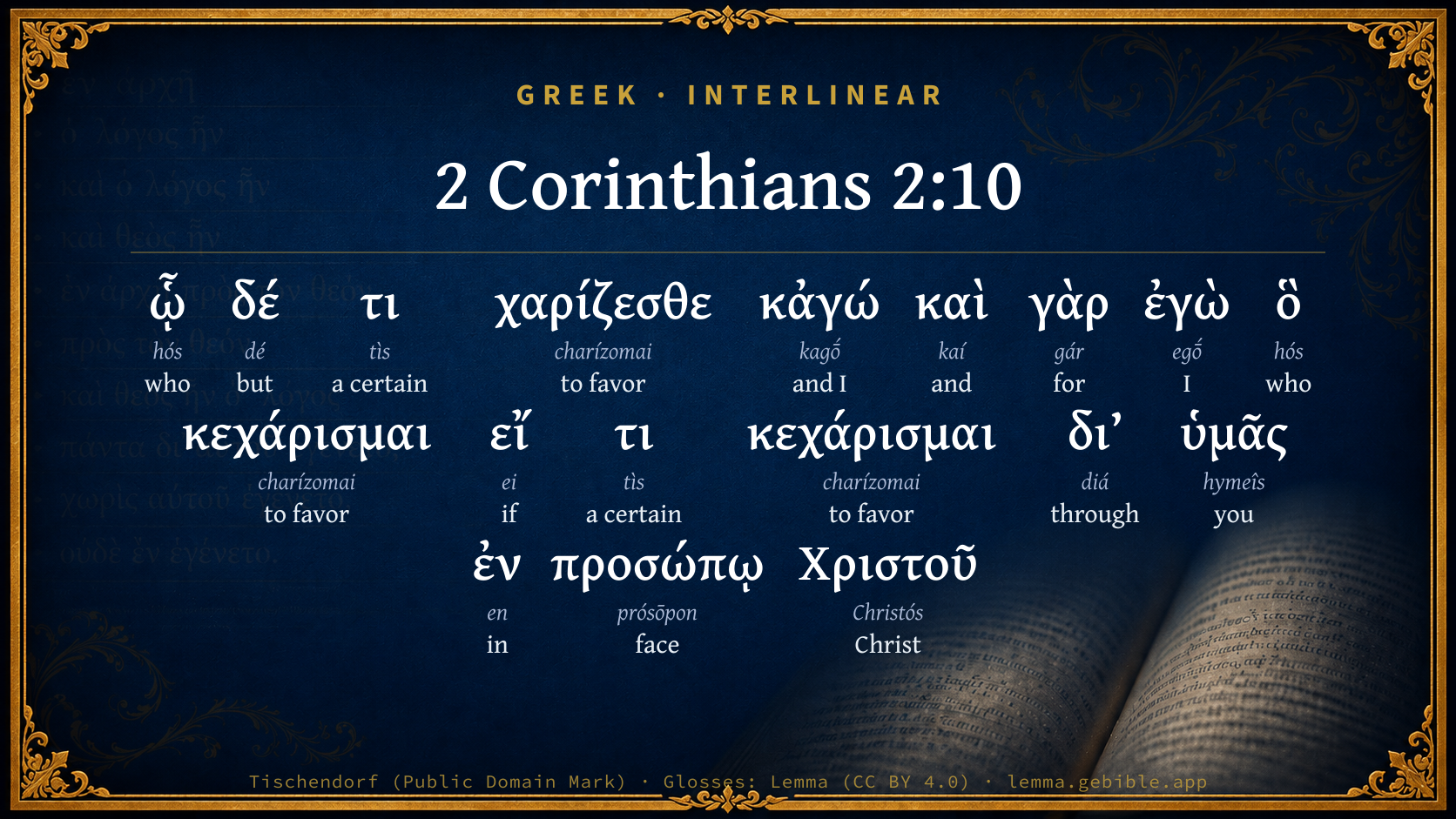
2 Corinthians 2:10

Greek (Tischendorf 8th ed.) 2 Corinthians 2:10 appears in the Greek New Testament. The text above is from the Tischendorf 8th edition. Each word links to its Strong’s number and a concise gloss. Click any word for its full Thayer’s Greek Lexicon entry.
Download image
Cite this verse

2 Corinthians 2:10 (World English Bible). Public Domain. Lemma interlinear Bible study tool, https://lemma.gebible.app/v/2-corinthians/2/10.

Show BibTeX & RIS
BibTeX
RIS
English Translation
Now I also forgive whomever you forgive anything. For if indeed I have forgiven anything, I have forgiven that one for your sakes in the presence of Christ,
World English Bible · Public Domain
Download a study sheet

One document with this verse’s original text, its word-by-word gloss line, the meaning frame, cross-references with their text, attributed commentary, and full source and license credits — printable, and it pastes into notes with its structure intact.

This verse Autodidact and up

Study sheet (.html) Plain text (.txt)

A passage Seminary Student

Up to 50 verses in one chapter. A passage sheet keeps up to 6 commentary sources and 12 cross-references per verse, in the order this page ranks them, and says so on the sheet whenever that leaves anything out. Ask for a single verse and you get the Autodidact verse sheet above.

Everything on this page stays free to read, with no account — the sheet is a download of what is already on screen, not access to it.

Want to remove ads? Support Godless Engineer
Compare translations 3

The same verse in 3 English versions, stacked beneath the original-language interlinear above. Click any original word for its lexicon entry.

Each is an independent rendering of the whole verse — the interlinear is not word-aligned to these translations.

Highlighted words mark where these versions differ — a whole-verse word diff, not a word-by-word alignment.

  • World English Bible Public Domain
    Now I also forgive whomever you forgive anything. For if indeed I have forgiven anything, I have forgiven that one for your sakes in the presence of Christ,
  • King James Version Public Domain
    To whom ye forgive any thing, I forgive also: for if I forgave any thing, to whom I forgave it, for your sakes forgave I it in the person of Christ;
  • unfoldingWord Literal Text CC BY-SA 4.0
    Now to whomever you forgive anything, I also —for indeed, the one I have forgiven (if I have forgiven anything) for your sake in the presence of Christ

unfoldingWord Literal Text — © unfoldingWord, licensed CC BY-SA 4.0. Word-aligned USFM3 via Door43 (git.door43.org/unfoldingWord/en_ult).

Versions to compare (up to 4)

3 of 4 selected

Show all 19 translations

Every available English version of this verse, each an independent rendering of the whole verse.

  • World English Bible Public Domain
    Now I also forgive whomever you forgive anything. For if indeed I have forgiven anything, I have forgiven that one for your sakes in the presence of Christ,
  • Berean Standard Bible Public Domain
    If you forgive anyone, I also forgive him. And if I have forgiven anything, I have forgiven it in the presence of Christ for your sake,
  • Majority Standard Bible Public Domain
    If you forgive anyone, I also forgive him. And if I have forgiven anything, I have forgiven it in the presence of Christ for your sake,
  • King James Version Public Domain
    To whom ye forgive any thing, I forgive also: for if I forgave any thing, to whom I forgave it, for your sakes forgave I it in the person of Christ;
  • American Standard Version (1901) Public Domain
    But to whom ye forgive anything, I `forgive' also: for what I also have forgiven, if I have forgiven anything, for your sakes `have I forgiven it' in the presence of Christ;
  • Revised Version (1885) Public Domain
    But to whom ye forgive anything, I forgive also: for what I also have forgiven, if I have forgiven anything, for your sakes have I forgiven it in the person of Christ;
  • Geneva Bible (1599) Public Domain
    To whome yee forgiue any thing, I forgiue also: for verely if I forgaue any thing, to whome I forgaue it, for your sakes forgaue I it in the sight of Christ,
  • Douay-Rheims (1899) Public Domain
    And to whom you have pardoned any thing, I also. For, what I have pardoned, if I have pardoned any thing, for your sakes have I done it in the person of Christ.
  • Young's Literal Translation Public Domain
    And to whom ye forgive anything -- I also; for I also, if I have forgiven anything, to whom I have forgiven `it', because of you -- in the person of Christ -- `I forgive it,'
  • Literal Standard Version CC BY-SA 4.0
    And to whom you forgive anything—I also; for I also, if I have forgiven anything, to whom I have forgiven [it], because of you—in the person of Christ—[I forgive it,]
  • Unlocked Literal Bible CC BY-SA 4.0
    If you forgive anyone, I forgive that person as well. What I have forgiven—if I have forgiven anything—it is forgiven for your sake in the presence of Christ.
  • unfoldingWord Literal Text CC BY-SA 4.0
    Now to whomever you forgive anything, I also —for indeed, the one I have forgiven (if I have forgiven anything) for your sake in the presence of Christ
  • Darby Bible Public Domain
    But to whom ye forgive anything, *I* also; for I also, what I have forgiven, if I have forgiven anything, [it is] for your sakes in [the] person of Christ;
  • World Messianic Bible Public Domain
    Now I also forgive whomever you forgive anything. For if indeed I have forgiven anything, I have forgiven that one for your sakes in the presence of Messiah,
  • Webster's Bible Public Domain
    To whom ye forgive any thing, I forgive also: for if I forgave any thing, to whom I forgave it, for your sakes I forgave it, in the person of Christ;
  • Free Bible Version CC BY-SA 4.0
    Anyone you forgive, I forgive too. What I have forgiven, whatever it may be, I have forgiven before Christ for your benefit.
  • Bible in Basic English Public Domain
    But if you give forgiveness to anyone, I do the same: for if I have given forgiveness for anything, I have done it because of you, in the person of Christ;
  • Text-Critical English NT CC BY 4.0
    Now if you forgive anyone of anything, I also forgive him. For if I have forgiven anyone of anything, I have done it for your sakes in the presence of Christ,
  • Tyndale New Testament (1534) Public Domain
    To whom ye forgeve enythinge I forgeve also. And verely if I forgeve enythinge to whom I forgave it for youre sakes forgave I it in the roume of Christ

Literal Standard Version (2020), Covenant Press — licensed CC BY-SA 4.0. Text via the HelloAO Bible API (eBible.org). Unlocked Literal Bible (unfoldingWord) — licensed CC BY-SA 4.0. Text via the HelloAO Bible API (eBible.org). unfoldingWord Literal Text — © unfoldingWord, licensed CC BY-SA 4.0. Word-aligned USFM3 via Door43 (git.door43.org/unfoldingWord/en_ult). Free Bible Version, Dr. Jonathan Gallagher — licensed CC BY-SA 4.0. Text via the HelloAO Bible API (eBible.org).

Word by word

More ways to search: Search by grammar → Find every occurrence → Compare this word →

Practice this passage: Drill this verse → Learn its vocabulary →

χαρίζεσθε
charízomai
G5483
“to favor”
Verb, Present, Middle or Passive deponent, Indicative, 2nd person, Plural
Part of Speech
Verb
Tense
Present
Voice
Middle or Passive deponent
Mood
Indicative
Person
2nd person
Number
Plural
Full Thayer's Definition

Origin: middle voice from G5485

TDNT: 15:12,1

1. to do something pleasant or agreeable (to one), to do a favour to, gratify a. to show one's self gracious, kind, benevolent b. to grant forgiveness, to pardon c. to give graciously, give freely, bestow 1. to forgive 2. graciously to restore one to another 3. to preserve for one a person in peril
  1. ᾧ hós G3739 “who” Relative pronoun, Dative, Singular, Masculine
  2. δέ dé G1161 “but” Conjunction
  3. τι tìs G5100 “a certain” Indefinite pronoun, Accusative, Singular, Neuter
  4. κἀγώ kagṓ G2504 “and I” Personal pronoun, 1st person, Nominative, Singular, Aramaic form
  5. καὶ kaí G2532 “and” Conjunction
  6. γὰρ gár G1063 “for” Conjunction
  7. ἐγὼ egṓ G1473 “I” Personal pronoun, 1st person, Nominative, Singular
  8. ὃ hós G3739 “who” Relative pronoun, Accusative, Singular, Neuter
  9. κεχάρισμαι charízomai G5483 “to favor” Verb, Perfect, Middle or Passive deponent, Indicative, 1st person, Singular
  10. εἴ ei G1487 “if” Conditional
  11. τι tìs G5100 “a certain” Indefinite pronoun, Accusative, Singular, Neuter
  12. κεχάρισμαι charízomai G5483 “to favor” Verb, Perfect, Middle or Passive deponent, Indicative, 1st person, Singular
  13. δι’ diá G1223 “through” Preposition
  14. ὑμᾶς hymeîs G5210 “you” Personal pronoun, 2nd person, Accusative, Plural
  15. ἐν en G1722 “in” Preposition
  16. προσώπῳ prósōpon G4383 “face” Noun, Dative, Singular, Neuter
  17. Χριστοῦ Christós G5547 “Christ” Noun, Genitive, Singular, Masculine

About this verse

These counts appear in no published source. They are computed here, from the morphology-tagged text and Lemma’s own curated glosses. What Lemma adds →

18
words
14
distinct lemmas
Pauline Epistles
section

Notable vocabulary

The rarest word here is χαρίζεσθε to favor G5483 — appearing just 23 times in the whole Greek New Testament.

Shared distinctive vocabulary

χαρίζεσθε to favor G5483 occurs in 19 verses of the Greek New Testament. Also found in:

Repetition

Words recur within this verse:

  • χαρίζεσθε to favor G5483 ×3
  • τι a certain G5100 ×2
  • ᾧ who G3739 ×2

Cross-references

4

Topical passages linked to 2 Corinthians 2:10 in the Treasury of Scripture Knowledge — connected by theme and wording, ordered by reader-vote popularity; previews shown in the World English Bible.

  • John 20:23 Whoever's sins you forgive, they are forgiven them. Whoever's sins you retain, they have been retained."
  • 2 Corinthians 5:20 We are therefore ambassadors on behalf of Christ, as though God were entreating by us. We beg you on behalf of Christ, be reconciled to God.
  • Matthew 18:18 Most assuredly I tell you, whatever things you will bind on earth will be bound in heaven, and whatever things you will release on earth will be released in heaven.
  • 1 Corinthians 5:4 In the name of our Lord Jesus Christ, you being gathered together, and my spirit, with the power of our Lord Jesus Christ,

Cross-references courtesy of OpenBible.info (CC BY 4.0).

Commentary

Notes on 2 Corinthians 2:10 from classic Christian and Jewish commentators (each source and its license shown beneath its notes). The classic Christian expositions comment on the surrounding passage and are grouped to its opening verse, so a note may address several verses; the Jewish commentaries on the Tanakh (Rashi and others) are per-verse, so they appear only where the commentator wrote on this verse.

Lemma curates 59 commentaries, every one of them public domain or Creative Commons licensed, each selected and text-cleaned for this edition rather than reprinted as found. About our sources →

Bengel's Gnomon

Johann Albrecht Bengel

2Co 2:10. Τὶ, any thing) He speaks very gently of the atrocious, but acknowledged sin.—χαρίζεσθε, ye forgive) He has no doubt, but that they will do what he wrote at 2Co 2:7.—καὶ ἐγὼ, I also) He modestly subscribes assent to the act of the Corinthians, and regards himself, as it were in the same category with them.—εἲ τι κεχάρισμαι, if I forgave any thing) The matter is limited by if any thing, in order that Paul may show his willingness to follow up the forgiveness granted to the sinner by the Corinthians. From the present I forgive, the past immediately results, I have forgiven, while Paul is in the act of writing these things.—διʼ ὑμᾶς, for your sakes) namely, I forgave.—ἐν προσώπῳ Χριστοῦ, in the presence [but Engl. Vers., person] of Christ) in the face of [before] Christ, 1Co 5:4.—ἵνα μὴ πλεονεκτηθῶμεν, lest we should be defrauded [lest an advantage be gained over us.]) The loss of a single sinner is a common loss; therefore he said for your sakes.—ὑπὸ τοῦ Σατανᾶ, by Satan) to whom Paul delivered or was about to deliver the sinner; 1Co 5:5. Satan not only devised to destroy the flesh, but the soul: and he seeks an opportunity of doing a very great injury by means of sorrow.

Bengel's Gnomon of the New Testament — English translation (T&T Clark, Edinburgh, 1860) — public domain. Text from a community e-Sword module.

Meyer's Critical & Exegetical Commentary

Heinrich August Wilhelm Meyer

2Co_2:10. A second motive for the κυρῶσαι εἰς αὐτὸν ἀγάπ. And to whomsoever (in order to hold before you yet another motive) you give pardon as to anything, to him I also give pardon. Δέ, accordingly, is the simple μεταβατικόν. Rückert wishes to supply a μέν before γάρ in 2Co_2:9, so that 2Co_2:9 and 2Co_2:10 together may give the sense: It was, indeed, my wish to find perfect obedience among you; but since you are willing to pardon him, I too am willing. But here, too, this supplement is altogether groundless; nay, in this very case, where 2Co_2:9 is referred by γάρ to what goes before, the express marking of the mutual relation of the two clauses would have been logically necessary, and hence μέν must have been used. Further, the meaning contained in Rückerts explanation would express an indifference and accommodation so strangely at variance with the apostolic authority, that the apostle would only have been thereby lowered in the eyes of his reader.

ᾧ δέ τι χαρίζεσθε, καὶ ἐγώ] general assurance (and this general expression remains also in the reason assigned that follows), to which the present special case is subordinated. The reader knew to whom the ὅς and to what the τί were to be applie.

καὶ γὰρ ἐγὼ κ.τ.λ.] Reason assigned for what was just said. For this circumstance, that I also pardon him to whom you pardon anything, rests on reciprocity: what also I on my part have pardoned, if I have pardoned anything, I have pardoned with a regard to youi.e. in order that my forgiveness may be followed by yours. This definite meaning of διʼ ὑμᾶς (not the general: for your benefit, as Flatt, de Wette, Osiander, and many others have it) is, according to the context, demanded by ᾧ τι χαρ., καὶ ἐγώ, in virtue of the logical relation of the clause containing the reason to this assurance. Paul, however, has not again written the present χαρίζομαι, but κεχάρισμαι, because he wishes to hold before his readers his own example, consequently his own precedent already set in the pardon in question. Between this κεχάρισμαι, however, and the χαρίζομαι to be supplied after καὶ ἐγώ, there is no logical contradiction. For in ᾧ δέ τι χαρίζεσθε the act of the sinner is considered as an offence to the church; as such, the church is to forgive it, and then the apostle will also forgive it: but in καὶ γὰρ ἐγὼ ὁ κεχάρισμαι it is conceived as a vexation to the apostle; as such, Paul has forgiven it, and that διʼ ὑμᾶς, for the sake of the church, in order that it too may now give free course to the pardon which the offence produced in it needed.[144] To this thoughtful combination of the various references of the act, and to the placable spirit by which the representation is pervaded, the intervening clause ΕἼ ΤΙ ΚΕΧΆΡΙΣΜΑΙ corresponds, which is by no means intended to make the act of pardon problematical (de Wette), or to designate it only as eventual, turning on the supposition of the church granting forgiveness (Billroth), but contains a delicate reference back to 2Co_2:5, in this sense, namely: ifseeing that the sinner, according to 2Co_2:5, has not properly grieved me, but youthat which I designate as κεχάρισμαι is really this; for the having pardoned presupposes the pardoner to be the injured party, which Paul, however, 2Co_2:5, denied himself to be.

Against all versions, Fathers and expositors, Rückert has taken κεχάρισμαι passively[145] of the pardoning grace which Paul experienced through his conversion. The sense would thus be: for whatever I have got pardoned, if I have got anything pardoned, I have got it pardoned for your sakes (in order as apostle of the Gentiles to lead you to salvation). See my third edition. This exposition is incorrect, partly because there is nothing in the text to suggest an allusion to the apostles conversion; partly because this pardoning grace was to him so firm and certain, and, in fact, the whole psychological basis of his working, that he could not, even in the most humble reminiscence of his pre-Christian conduct (comp. 1Co_15:9-10), have presented it as problematical by εἴ τι κεχάρισμαι; partly because with this problematical inserted clause the very ἘΝ ΠΡΟΣΏΠῼ ΧΡΙΣΤΟῦ (explained by Rückert: on the countenance of Christ beaming with Gods grace) would be at varianc.

ἘΝ ΠΡΟΣΏΠῼ ΧΡΙΣΤΟῦ] i.e. in conspectu Christi, comp. Pro_8:30, Sir_32:4, denotes the having pardoned, in so far as it has taken place διʼ ὑμᾶς, in its fullest purity and truth. It has taken place in presence of Christ, so that He was witness of it. Interpretations at variance with the words are: in Christs stead (Vulgate, Ambrosiaster, Luther, Calovius, Wetstein, and others): by Christ, as an oath (Emmerling), and others. Hofmann, who without reason maintains that according to our view it must have run ὡς ἐν προσώπῳ Χ., attaches the words to what follows, so that they would precede the ἽΝΑ by way of emphasis, like Τ. ἈΓΆΠΗΝ, 2Co_2:4 (see on Rom_11:31), and the meaning would be: Christ should not be obliged to be a spectator of how Satan deprives His church of one of its members. This interpretation could only be justified if we were in any way by the context prepared for the ἐν προσώπῳ Χ., thus taken as a specially tragic feature of the devils guile. Besides, the thought that the devil injures the church under the eyes of Christ, would be nowhere else expressed.

Observe, further, how, according to this passage, the penitence of the sinner, just as much as the removal of the offence to the church, is the aim of church-discipline, and hence its initiation and cessation are to be measured accordingly; but the Roman Catholic doctrine of indulgence[146] is at variance with this.

[144] Not: to get rid of the painful relation in which they stood to that sinner, as Hofmann infers, from his incorrect interpretation of ἵνα μὴ ἐπιβαρῶ πάντας ὑμᾶς, ver. 5.

[145] This passive use would in itself be correct as to language. See Kühner, ad Xen. Mem. i. 2. 10. The transitive use, however, is the more usual one, as at Gal_3:18; Act_27:24.

[146] Still Bisping finds its principles clearly traced out in this passage.

Meyer — Critical and Exegetical Commentary on the New Testament — English translation by Peter Christie, edited by Frederick Crombie (T&T Clark, 1880) — public domain. Text from a community e-Sword module.

Expositor's Greek Testament

ed. W. Robertson Nicoll

2Co 2:10 . ᾧ δέ τι χαρίζεσθε κ . τ . λ .: but to whom ye forgive anything, I forgive also; for what I also have forgiven ( if I have forgiven anything ) for your sakes have I forgiven it in the face of Christ . This is not a general principle, but a statement of the Apostle’s feelings at the present juncture; if they are willing to forgive the offender, so is he. Whether he advocates punishment or forgiveness it is always διʼ ὑμᾶς , “for your sakes,” and it is ἐν προσώπῳ Χριστοῦ , “in the sight of Christ”. πρόσωπον (see on 2Co 1:11 ) is a “face,” and so ἐν προσ . Χρ . is a stronger way of saying ἐνώπιον Χριστοῦ ( cf. chap. 2Co 4:2 , 2Co 8:21 , Gal 1:20 ); the Apostle claims that his acts of condemnation and forgiveness are done as “in the presence of Christ”. Both A.V. and R.V. render “in the person of Christ,” which would mean that St. Paul had acted as Christ’s delegate. But the usage of πρόσωπον in 2 Cor. is against this interpretation.

The Expositor's Greek Testament, edited by W. Robertson Nicoll (1897–1910) — public domain. Text from a community e-Sword module.

Cambridge Greek Testament for Schools and Colleges

10. δ κεχάρισμαι εἴ τι κεχάρισμαι (אABCFGO) rather than εἴ τι κεχάρισμαι ᾦ κεχάρισμαι (DKL). εἴ τι κεχάρισμαι is too well attested to be rejected as a gloss.

10. ᾦ δέ τι χαρίζεσθε, κἀγώ. The δέ is ignored in the A.V. and most earlier English Versions. It may be a mere particle of transition; or may introduce a further reason why the Corinthians should ratify love towards the offender. ‘You have proved your loyalty by your submission to discipline. But, if you now forgive, you may be sure that your forgiveness is confirmed by mine.’ He is not exactly giving them a carte blanche to act as they please; he is expressing his approval of a public act of forgiveness. “We may observe (1) that S. Paul acts upon the report of the Corinthian Church properly authenticated by Titus, his representative there (ch. 2Co 7:6-14), and (2) that he gives his official sanction to their act” (Lias). In almost all places κἀγώ, κἀμοί, κἀμέ, not καὶ ἐγώ, καί ἑμοί, καὶ ἐμέ are found in the best MSS. Gregory, Prolegomena, p. 96.

καὶ γὰρ ἐγὼ ὅ κεχάρισμαι, εἵ τι κεχάρισμαι. For also what I have forgiven, if I have forgiven anything. As in 2Co 2:5, the εἰ intimates no doubt as to the fact; and here, as there, the perfect must be retained in English: εἴ τις λελύπηκεν and εἴ τι κεχάρισμαι are parallel. The translation, ‘what I have been forgiven, if I have been forgiven anything’ does not fit the context. Note the καί: S. Paul confirms what he has said by a further consideration. The order of the words emphasizes ἑγώ as a fresh point. The meaning is, ‘I entreat you to forgive him, and you may be sure that I shall do the same; indeed for your sakes I have forgiven him already.’

ἐν προσώπῳ Χριστοῦ. This is added to prevent a misapprehension of διʼ ὑμᾶς. He acts, not out of weak affection, merely to please them, but with a full sense of responsibility. But the exact meaning is uncertain. Either, in the person of Christ, acting as His vicegerent, in persona Christi (Vulgate), in Christ’s stead’ (Luther); or, in the presence of Christ, with Him as a witness (Pro 8:30), in conspectu Christi (Calvin). Comp. σὺν τῇ δυνάμει τ. κυρίου ἡμῶν Ἰησοῦ, (1Co 5:4). In three passages in this letter the meaning of πρόσωπον is doubtful (2Co 1:11, 2Co 2:10, 2Co 4:6); in three it certainly means ‘face’ (2Co 3:7; 2Co 3:13; 2Co 3:18).

Cambridge Greek Testament for Schools and Colleges (Cambridge University Press, 1896; 21 vols, various authors incl. Carr, Maclear, Plummer, Farrar, Lumby, Moule, M. R. James, Simcox) — public domain. Text from a community e-Sword module.

Geneva Bible (1599)

Geneva Bible translators

Truly and from the heart.

Geneva Bible (1599) marginal notes — public domain. Text via Bolls.life.

Jamieson, Fausset & Brown

Robert Jamieson, A. R. Fausset & David Brown

Another encouragement to their taking on themselves the responsibility of restoring the offender. They may be assured of Paul's apostolic sanction to their doing so.

for if I forgave anything, to whom I forgave it--The oldest manuscripts read, "For even what I have forgiven, if I have forgiven anything."

for your sakes forgave I it--He uses the past tense, as of a thing already determined on; as in Co1 5:3, "I have judged already"; or, as speaking generally of forgiveness granted, or to be granted. It is for your sakes I have forgiven, and do forgive, that the Church (of which you are constituent members) may suffer no hurt by the loss of a soul, and that ye may learn leniency as well as faithfulness.

in the person of Christ--representing Christ, and acting by His authority: answering to Co1 5:4, "In the name of our Lord Jesus Christ . . . my spirit, with the power of our Lord Jesus Christ."

Jamieson, Fausset & Brown — Commentary Critical and Explanatory on the Whole Bible (1871) — public domain (CC PDM 1.0). Text via the HelloAO Bible API.

Adam Clarke's Commentary

Verse 10. To whom ye forgive any thing] Here he farther shows them that his sole object in the punishment inflicted on the transgressor, was his amendment and therefore promises to ratify, in the name and authority of Christ, the free pardon which he exhorts them to dispense.

In the person of Christ] As I believe Christ acts towards his penitent soul, so do I. Christ forgives his sin, and takes him to his favour; let us forgive him his offence against the Church, and restore him to its communion.

Adam Clarke's Commentary on the Bible (1810–1826) — public domain. Text from a community e-Sword/MySword module.

John Calvin's Commentaries

10. To whom ye forgive. That he might the more readily appease them, he added his vote in support of the pardon extended by them. “Do not hesitate to forgive: I promise that I shall confirm whatever you may have done, and I already subscribe your sentence of forgiveness.” Secondly, he says that he does this for their sake; and that too, sincerely and cordially. He had already shown how desirous he was, that the man’s welfare should be consulted: he now declares, that he grants this willingly to the Corinthians.

Instead of the expression in the sight of Christ, some prefer person, because Paul in that reconciliation was in the room of Christ, and did in a manner represent his person. I am, however, more inclined to understand him as declaring, that he forgives sincerely and without any pretence. For he is accustomed to employ this phrase to express pure and undisguised rectitude. If, however, any one prefers the former interpretation, it is to be observed that the person of Christ is interposed, because there is nothing that ought to incline us more to the exercise of mercy.

John Calvin's Commentaries (1540-1563) — public domain. Text from the Calvin Translation Society English edition (1840s-50s) via the Christian Classics Ethereal Library (ccel.org). Calvin's coverage is partial (roughly two-thirds of the Bible); uncommented books and verses are honest gaps, never fabricated. The 19th-century editor's footnotes and remarks are omitted so the notes are faithfully Calvin's own voice.

Ellicott's Commentary for English Readers

(10) To whom ye forgive any thing, I forgive also.—The procedure of 1Co_5:3-7 is again, obviously, in his mind. Though absent in body, he had made himself a sharer spiritually in that censure. He now, anticipating their compliance with his request, makes himself a sharer in the sentence of absolution.

For if I forgave any thing.—Better, if I have forgiven; and so in the following clauses. The case is put hypothetically, though he has an actual offender in his thoughts, because he had, in 2Co_2:5, all but disclaimed the character of being an aggrieved person. He confines himself, therefore, to saying: “So far as I was aggrieved, I have forgiven; so far as I have forgiven, it is for your sake as a body, not merely for my own and that of the offender.”

In the person of Christ.—Literally, in the face of Christ (See Note on 2Co_1:11.) In the presence of Christ is, therefore, a possible rendering. The English version is probably correct, the phrase conveying the same sense as “in the name of our Lord Jesus Christ” in 1Co_5:4, but in a somewhat stronger form. He had forgiven, as though Christ was acting in or by him. The forgiveness would be as authoritative as the censure. It will be noted that he claims in its fulness the authority given to the Apostles of Christ in Joh_20:23.

A Bible Commentary for English Readers, edited by Charles John Ellicott (1878–1897) — public domain. Text from a community e-Sword module.

The Cambridge Bible for Schools and Colleges

gen. ed. J. J. S. Perowne

10. To whom ye forgive any thing, I forgive also] St Paul is here exercising the power of the keys (see Mat_16:19; Mat_18:18; Joh_20:23). He is not speaking of any private forgiveness of a personal injury, but of the public absolution of an offender lying under the censure of the church. See 1Co_5:4-5. We may observe (1) that St Paul acts upon the report of the Corinthian Church properly authenticated by Titus, his representative there (ch. 2Co_7:6-14), and (2) that he gives his official sanction to their act.

to whom I forgave it] Most modern Editors read what for to whom, and the verb stands in the perfect, implying that the affair is at an end. ‘What I have forgiven, I have forgiven on your account.’ St Paul does not claim the right to ratify their act for the satisfaction of his own sense of importance, but because his Apostolic office is necessary for their edification and guidance.

in the person of Christ] Cranmer and the Geneva version render ‘in the sight’ (literally, in the face) of Christ. So also Calvin. The Vulgate which is followed by Wiclif, and of course the Rhemish, renders as in the text. Tyndale renders roume. As the Greek word signifies both person and face, the point must be left undecided. If the A. V. be correct, then St Paul acts in this matter as Christ’s representative. If the other is the correct rendering, then he performs a solemn public act in the sight of Christ and the powers unseen. It should however, be added that in this Epistle we have the word here used in the sense of person in ch. 2Co_1:11, and in the sense of face in ch. 2Co_3:7; 2Co_3:13; 2Co_3:18, and that the expression occurs again in ch. 2Co_4:6, where see note.

The Cambridge Bible for Schools and Colleges (gen. ed. J. J. S. Perowne; Cambridge University Press, 1878–1918) — public domain. Text from a community e-Sword module.

John Gill's Exposition

To whom ye forgive anything, I forgive also,.... This may extend to the forgiveness of any person, in any case; either in time past, or at the present time, or in time to come; though it has a particular respect to the forgiveness of the incestuous man, which the apostle had determined in his own mind, and was very ready to come into, and very desirous to join with the church in, as they had joined with him in the excommunication of him; and in order to engage them in such a temper and disposition, he tells them it was on their account he did it:

for if I forgave anything, to whom I forgave it, for your sakes forgave I it; which is as if he should say, whenever I have forgiven any offender, as I now do forgive this man, I always do it for your sake; either at your request, or in confidence of this, that you yourselves have forgiven; or for your good, peace, and welfare: and besides, what I do of this kind, I do it

in the person of Christ; in his sight and presence, who knows that what I do this way, I do it sincerely, and with my whole heart and soul; or rather I do it in his name, and by his authority; and since I forgive this man for your sakes, and in the name of Christ, you ought to do so likewise.

John Gill's Exposition of the Whole Bible (1746–1763) — public domain (CC PDM 1.0). Text via the HelloAO Bible API.

Trapp's Complete Commentary

John Trapp

10 To whom ye forgive any thing, I forgive also: for if I forgave any thing, to whom I forgave it, for your sakes forgave I it in the person of Christ;

Ver. 10. To whom ye forgive] Or, gratify. Mercy is that we must mutually lend and borrow one of another. Let the rigid read Gal 6:1.

John Trapp, A Commentary or Exposition upon All the Books of the Old and New Testament (1647–1656) — public domain. Text from a community e-Sword module.

Albert Barnes' Notes on the Bible

To whom ye forgive anything - The sense here is, “I have confidence in you as a Christian society and such confidence, that if you forgive an offence in one of your members, I shall approve the act, and shall also be ready to forgive.” He refers, doubtless, to this particular case; but he makes his remark general. It is implied here, I think, that the Corinthians were disposed to forgive the offending brother; and Paul here assures them that they had his hearty assent to this, and that if they did forgive him, he was ready to join them in the act, and to forgive him also.

For if I forgave anything - If I forgive anything; if I remit any of the punishments which have been inflicted by my authority.

For your sakes - It is not on account of the offender alone; it is in order to promote the happiness and purity of the church.

In the person of Christ - Locke paraphrases this, “By the authority, and in the name of Christ.” Doddridge,” As in the person of Christ, and by the high authority with which he has been pleased to invest me.” Tyndale, “In the room of Christ.” The word rendered “person” (Margin, “sight,” πρόσωπον prosōpon, from πρός pros and ὤψ ōps), means properly the part toward, at, and around the eye - Robinson. Then it means the face, visage, countenance; then the presence, person, etc. Here it probably means, in the presence of Christ; with his eye upon me, and conscious that I am acting before him, and must give account to him. It implies, undoubtedly, that Paul acted by his authority, and felt that he was doing that which Christ would approve.

Albert Barnes' Notes on the Bible (1834–1885) — public domain. Text from a community e-Sword/MySword module.

Haydock's Catholic Bible Commentary

I also. The apostle here granted an indulgence, or pardon, in the person, and by the authority of Christ, to the incestuous Corinthian, whom before he had put under penance: which pardon consisted in a release of part of the temporal punishment due to his sin. (Challoner) --- Now as you have pardoned him by my instructions, and have received him again into your communion, I also pardon [2] him, and confirm what you have done, for your sake, as well as for his, and dispense with any further severities of a longer penance, which he deserved. (St. John Chrysostom) And I do this in the person of Christ, by that power and authority derived from Christ, which he left to his apostles, when he said, (Matthew xviii. 18.) whatsoever you shall loose upon earth, shall be loosed in heaven, &c. not only in the sight of men, says St. John Chrysostom, but in the sight of God, who hath given us this power. (Witham)

===============================

[BIBLIOGRAPHY]

In persona Christi, Greek: en prosopo Christou, [not only before Christ] and St. John Chrysostom says, Greek: os tou Christou keleuontos. Christo jubente, though he had not done sufficient penance, nor deserved it: Greek: ou gar epeide axios esti, oude epeide archousan metanoian epedeixato.

George Leo Haydock (1774–1849), Haydock's Catholic Family Bible and Commentary, 1859 edition — public domain. Excludes Psalms (Douay-Rheims chapter numbering differs from Protestant) and Deuterocanonical books (Catholic canon only).

Matthew Poole's English Annotations

The word so often repeated in this verse, and translated

forgive, is χαριζομαι, which signifies to give, or gratify, or do a kindness, as well as to forgive; so as it needeth not always to be interpreted of any judicial act of absolution. If you see reason to remit any thing of the punishment inflicted upon the incestuous person, I am satisfied with what you do, I shall take no offence at you for it. If I have showed any favour to any person amongst you that hath fallen under my reproof and chastisement, it hath been for your sake, for the good and advantage of your church, or upon their motion and intercession; and I have done it sincerely in the sight of Christ (the Greek is, in the face of Christ).

Matthew Poole's English Annotations on the Holy Bible (1683–1685) — public domain. Text from a community e-Sword/MySword module.

Whedon's Commentary on the Bible

Daniel D. Whedon

10. To whom—A general, but assuming only the particular, case.

I forgive also—Literally, also I. The full unity of the Church with the apostle being assured, he now affirms his full unity with the Church. Knowing their wisdom and rectitude, he ratifies their action in advance.

In the person of Christ—Not in his presence, but as acting for his person. Christ doing it by me, his representative. So his order to excommunicate (1Co_5:4) was in the name of our Lord Jesus.

Daniel D. Whedon (gen. ed.), Commentary on the Old and New Testaments (1874–1909) — public domain. Text from a community e-Sword module.

The Pulpit Commentary

To whom ye forgive any thing. In the original there is a conjunction, "but." It would, perhaps, be pressing it too much to imply that their "forgiveness" showed that they had not accurately stood the test of perfect obedience; yet it is difficult to read the whole passage without suspecting that St. Paul, while by temperament he leaned to the side of mercy, is here showing a spirit of generous self-suppression m accepting the course which the Corinthians had followed, although it had, in some way or other, diverged from his exact directions. To whom, Obviously, again, a purposely indefinite reference to the incestuous person. I forgive also. The power of "binding" and "loosing," of "forgiving" and "retaining," had only been given to the apostles representatively and collectively, and therefore to the Christian Church (Joh_20:23) in its corporate capacity. The Corinthian Church had in this case decided to forgive, and St. Paul ratifies their decision. For if I forgave any thing, to whom I forgave it. The reading here varies between o, what, and w+, to whom, which in dictation might be easily confused. The order of the words also varies. The best reading seems to be expressed by the version, "For what I also have pardoned, if I have pardoned anything (I have pardoned it) for your sakes." This represents the reading of a, A, B, C, F, G, etc., and is followed by the Revised Version. There seems to be here an intentional vagueness, and reference to circumstances of which we are not informed, which might, perhaps, have given room for wounded feelings in any one less magnanimous than St. Paul. The line he took in this matter was taken for their sakes that is all he says, he adopted it as the best relatively, whether it was absolutely the best or not. In the person of Christ; literally, in the face of Christ; which seems to mean "in the presence of Christ," as though he were looking on at what I did. (comp. 2Co_1:11 2Co_3:7, 2Co_3:13, 18 4:6) It may be doubted whether the word prosopon ever means "person" in the New Testament, except in a secondary sense.

The Pulpit Commentary (1880–1919), ed. H.D.M. Spence-Jones & Joseph S. Exell — public domain. Text from a community e-Sword module.

John Wesley's Explanatory Notes

To whom ye forgive - He makes no question of their complying with his direction. Anything - So mildly does he speak even of that heinous sin, after it was repented of. In the person of Christ - By the authority wherewith he has invested me.

John Wesley, Explanatory Notes Upon the Whole Bible (1754–1765) — public domain. Text via the GEBible commentary corpus.

McGarvey & Pendleton's Commentaries

J. W. McGarvey

But to whom ye forgive anything, I forgive also: for what I also have forgiven, if I have forgiven anything, for your sakes have I forgiven it in the presence of Christ ;

J. W. McGarvey (with Philip Y. Pendleton), Commentaries on the New Testament (The Fourfold Gospel, 1914; Acts; and the epistles) — public domain. Text from a community e-Sword/MySword module.

The People's New Testament

B. W. Johnson

10. To whom ye forgive anything, I forgive also. As your excommunication of the man was my act, so also your restoration of him will be my act. Forgave I it in the person of Christ. As Paul acted as the servant of Christ, under his direct orders, his official acts represented in the Master.

B. W. Johnson's The People's New Testament with Notes (1889–1891) — public domain. Electronic text from the Christian Classics Ethereal Library (CCEL) ThML edition.

unfoldingWord translationNotes

Door43 World Missions Community

it is forgiven for your sake

This can be stated in active form. AT: "I have forgiven it for your sake" (See: Active or Passive)

forgiven for your sake

Possible meanings are 1) "forgiven out of my love for you" or 2) "forgiven for your benefit."

For we are not ignorant of his plans

Paul uses a negative expression to emphasize the opposite. AT: "For we know his plans well" (See: Litotes)

translationWords

forgive

Christ

Satan

unfoldingWord translationNotes — © Distant Shores Media and the Door43 World Missions Community, licensed CC BY-SA 4.0. Source: git.door43.org/Door43/en_tn.

Alford’s Greek Testament

Henry Alford

10.] Another assurance to encourage them in forgiving and reinstating the penitent;—that they need not be afraid of lack of apostolic authority or confirmation of their act from above—he would ratify their forgiveness by his sanction.

ῳ δὲ …] ‘Your forgiveness is mine:’ not said generally (as Meyer), but definitely, pointing at the one person here spoken of and no other.

κἀγώ, scil. χαρίζομαι. Then he substantiates this assurance, by further assuring them, that his forgiveness of any fault in this case, if it takes place, takes place on their account. Meyer’s (former: now (4th edn.) abandoned) and Rückert’s rendering of κεχάρισμαι as passive, disturbs the whole sense of the passage, besides being inconsistent with the N.T. usage of the word, see reff.

ἐν προσώπῳ χριστοῦ] either ‘in the presence of Christ,’ as in ref. Prov. (compare Mat 21:42),—so Theodoret, Erasm., Beza, Calv., Olsh., De W.,—or, and far better, in the person of Christ, acting as Christ, in the same way as he had commanded the punishment ἐν τῷ ὀνόματι τοῦ κυρίου ἡμῶν Ἰησοῦ, 1Co 5:4: so Vulg., Estius (who argues the matter at some length), Wetst., al.

Henry Alford, The Greek Testament (1849–1861) — public domain. Text from a community e-Sword module.

International Critical Commentary

10. ᾧ δέ τι χαρίζεσθε, κἀγώ. They had joined with him in condemning; he joins with them in forgiving. They had shown obedience in consenting to censure; let them now be sure of his consent if they desire to give love instead of blame. The Apostle is not promising always to follow their lead in exercising leniency: although the statement is general, it is manifestly limited to the particular case; and with regard to that he is not acting in the dark. He has the report of his official representative Titus to guide him, and that made it clear to him that generous treatment of the offender would do a great deal of good and little or no harm.

καὶ γὰρ ἐγὼ ὃ κεχάρισμαι. Here we have καὶ γάρ (contrast v. 9), introducing an additional reason, and ἐγώ is emphatic; ‘For also what I have forgiven,’ I on my side as distinct from you. AV is faulty in turning the perfects into aorists.

εἴ τι κεχάρισμαι. A gracious parenthesis; ‘if I have forgiven anything,’ i.e. ‘if I have had anything to forgive.’ He is not suggesting a doubt as to whether he has granted forgiveness, but he puts the fact of there being something for him to forgive as a mere hypothesis. The hypothetical statement is exactly parallel to εἴ τις λελύπηκεν: ‘if there is such person, he has received forgiveness so far as I am concerned.’ Some would translate, ‘what I have been forgiven, if I have been forgiven anything,’ which is grammatically possible, but it spoils the appeal, and is out of harmony with διʼ ὑμᾶς ἐν προσώπῳ Χρ. St Paul is not thinking of the Corinthians’ change of attitude towards himself, but of his own towards the offender and them. It is ‘for their sakes’ that he has so entirely blotted out the thought of the man’s offence. Their relation towards the offender has been a painful one, but it need not continue; let it be changed for a happy one.

ἐν προσώπῳ Χριστοῦ. ‘In the presence of Christ’; in facie Christi, or in conspectu Christi (Calv.); ὡς τοῦ Χριστοῦ ἐφορῶντος καὶ ἀρεσκομένου τοῖς γενομένοις (Thdrt.). Cf. εὐφραινόμην ἑν προσώπῳ αὐτοῦ ἐν παντὶ καιρῷ (Pro 8:30). This is more probable than ‘in the person of Christ’ (AV, RV); in persona Christi (Vulg.), an Christi Statt (Luth.), or ‘unto the glory of Christ’ (Chrys.). See on 1:11. But, however we may translate the expression, the purpose of it is to correct a possible misunderstanding of διʼ ὑμᾶς. Although it was for their sakes that he acted as he did, yet he remembered whose eye was upon him to approve or condemn his action.

κἀγώ (א* A B C2 D E O P) rather then καὶ ἐγώ (א3 C* F G K L), as in most places where such crasis is possible. ὅ κεχ. εἴ τι κεχ (א A B C F G O) rather than εἴ τι κεχ. ᾧ κεχ (D2 K L 17). Baljon suggests that εἴ τι κεχ is a gloss. It would be a very clever gloss,—subtly Pauline. As in the case of 1:6, 7, there is difference of opinion about the division of the verses. Some editors assign ἵνα μὴ … Σατανᾶ to v. 10.

International Critical Commentary — older volumes (1896–1929), various authors — public domain. Text from a community e-Sword module.

Vincent's Word Studies in the New Testament

Marvin R. Vincent

In the person [εν προσωπω] . Better, as Rev., in margin, presence; or face, as if Christ were looking on. See on ch. 2Co 1:11.

Marvin R. Vincent, Word Studies in the New Testament (1887–1900) — public domain. Text from a community e-Sword/MySword module.

Lesson kit

Teaching starters — assembled from the data on this page, not authored interpretation. Every prompt links to the verse data it draws on. Edit before teaching.

2 Corinthians, in the Pauline Epistles, opens this verse with 18 words (14 distinct Greek lemmas). Its most distinctive word is charízomai (“to favor”). A historical commentator’s framing appears above. Read the whole chapter for the surrounding context.

Discussion questions

  1. What does “to favor” (charízomai) contribute to the verse as a whole?
  2. How does Luke 7:21, which shares the word «to favor», read alongside this verse?
  3. What does the repetition of “to favor” (3× in this one verse) do in this verse?
  4. The translations on this page render this verse differently — a whole-verse word diff, not a word-by-word alignment. What might account for the different wordings?
  5. Compare how Bengel's Gnomon and Meyer's Critical & Exegetical Commentary read this verse. Where do they agree or differ?

Things to notice

  • These translations choose different wording for 16 words in this verse.
  • “to favor” occurs 3× in this single verse.
  • 14 distinct Greek lemmas span 18 words in this verse.

Reading settings

Reading text

Shown beneath each verse's original-language words.

Old Testament
Old Testament edition

Read the OT as the Masoretic Hebrew (MT) or the Greek Septuagint (LXX).

English shown for the Greek Septuagint (in the Hebrew ↔ Greek comparison).

Comparing translations? Open the Compare panel on any verse page to stack up to four side by side.