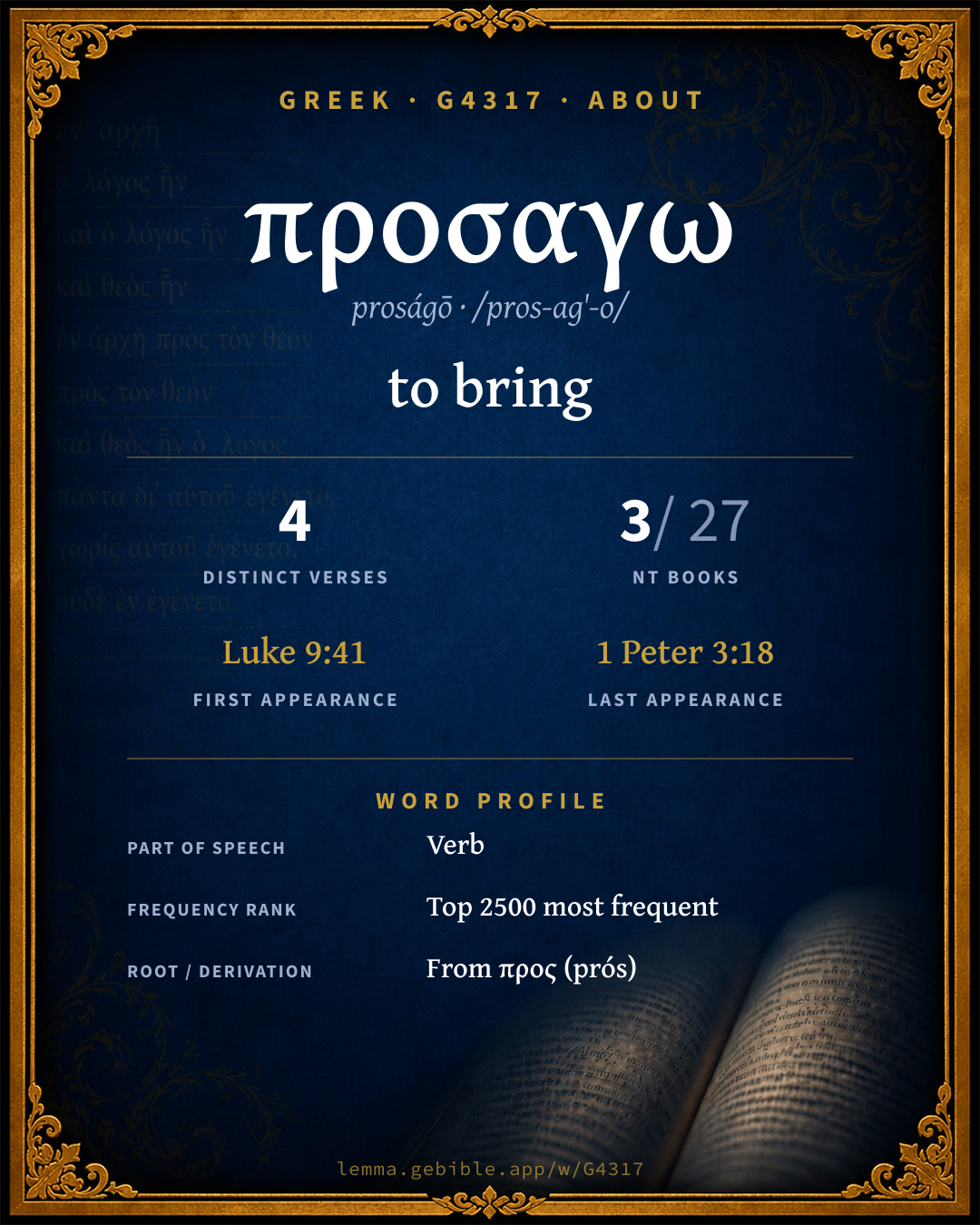
προσάγω
to bring
‘to bring’ is one of 3 main senses fuller range ↓
Full lexicon entry — Thayer's Greek Lexicon
From Thayer's Greek Lexicon
Where this word appears
See every Aorist-tense verb in the Greek New Testament →
Grammar key — what these labels mean
Part of speech
- Verb
- An action or state-of-being word.
Tense
- Aorist
- Action viewed as a simple whole, without regard to duration — often past (perfective aspect).
- Present
- Ongoing or general action in present time (imperfective aspect).
Voice
- Active
- The subject performs the action.
Mood
- Imperative
- Expresses a command or request.
- Participle
- A verbal adjective (“writing,” “having written”).
- Subjunctive
- Expresses probability, purpose, or possibility (the mood of contingency).
- Infinitive
- A verbal noun (“to write”), unmarked for person or number.
Case
- Nominative
- The case of the subject (and the predicate nominative).
Person
- 2nd person
- The one addressed (“you”).
- 3rd person
- The one spoken about (“he / she / it / they”).
Gender
- Masculine
- Grammatically masculine.
Number
- Singular
- One.
- Plural
- More than one.
Grammatical forms
- Verb, Aorist, Active, Imperative, 2nd person, Singular 1 time (25%)
- Verb, Aorist, Active, Participle, Nominative, Plural, Masculine 1 time (25%)
- Verb, Aorist, Active, Subjunctive, 3rd person, Singular 1 time (25%)
- Verb, Present, Active, Infinitive 1 time (25%)
Parsed forms decoded from the imported morphology (Robinson–Tischendorf, public domain), counted across 4 parsed occurrences — not distinct verses.
Every verse where G4317 appears — 4 distinct verses across 3 books. Click any verse to open its interlinear word-by-word view. Verse text shown in the World English Bible for context — . Each verse’s Greek form is shown with its reference; the English is not keyword-highlighted, since the data carries no word-level English alignment. Use “Compare translations” on any verse to read it across multiple English versions. This concordance covers the Greek New Testament; Septuagint (Greek Old Testament) occurrences of this word are not indexed here.
Luke 1 verse
Acts 2 verses
- Acts 16:20 προσαγαγόντες aor act ptcp nom pl masc When they had brought them to the magistrates, they said, "These men, being Jews, are agitating our city,
- Acts 27:27 προσάγειν pres act inf But when the fourteenth night had come, as we were driven back and forth in the Adriatic Sea, about midnight the sailors surmised that they were drawing near to some land.
1 Peter 1 verse
About this entry
At a glance — auto-summarized from this page’s data, not written by a person. Every figure links to its source below. This summary describes the numbers; it doesn’t interpret them.
προσαγω — transliterated proságō — is a Greek verb carrying the sense “to bring.” It is rare — just 4 verses in the entire Greek New Testament. Its uses cluster heavily in Acts (50% of all occurrences). Its earliest occurrence is Luke 9:41. Thayer's distinguishes 3 senses for it. Each statement above links to its evidence; the full detail follows below.
Gloss history
Strong's 1890 vs modern scholarship

About this word
Strong's G4317 catalogs a Greek word from the Greek New Testament.
These counts are not copied from any lexicon or concordance. They are computed here, from the morphology-tagged Greek New Testament. What Lemma adds →
- 4
- distinct verses
- The word appears in 4 distinct verses.
- 3 / 27
- NT books
- The word appears in 3 of 27 New Testament books.
- #1,877
- by frequency
- Top 2500 most frequent Greek words (rank 1,877 of 5,347 Greek words by occurrence).
View all 4 occurrences in the concordance →
By section of the New Testament
By traditional corpus
Conventional, traditional groupings — biblical authorship is debated, so this is a traditional corpus grouping, not an authorship claim. Some books belong to more than one corpus (Luke is in both the Gospels and the Lukan corpus, and so on), so these shares overlap and need not total 100%. Each figure is a share of the word’s 4 distinct verses.
- Lukan (Luke–Acts) 3 verses · 75%
- Gospels 1 verse · 25%
- General (Catholic) Epistles 1 verse · 25%
How translations render this word
Counts come from each version’s own published word-to-Strong’s tagging or interlinear alignment — an approximate guide to how each version renders this word, not a word-level alignment the data otherwise carries. Because each total is that version’s own tagged count, the per-version totals vary from one another and need not match the appearance or distinct-verse counts above. These counts may also differ from a printed concordance because Lemma counts each distinctly tagged rendering and does not collapse phrase taggings into a single head-word total. This is a fixed set of word-tagged versions (KJV, ASV, BSB, ULT) and does not change with the reading translation you choose elsewhere. Each version’s license is shown beside its name below (and on Sources).
- King James Version: Bring 1×, Brought 1×, Drew near 1×
- American Standard Version: Bring 1×, He might bring 1×, They had brought 1×
- Berean Standard Bible: Bring 2×
- unfoldingWord Literal Text: Be approaching 1×, Bring 1×, Having brought 1×
King James Version Public Domain
Renders G4317 across 4 tagged occurrences — most commonly:
American Standard Version Public Domain
Renders G4317 across 4 tagged occurrences — most commonly:
Berean Standard Bible Public Domain
Renders G4317 across 4 tagged occurrences — most commonly:
Plus 2 renderings that appear only once — usually multi-word phrases or single function words the recovered tagging swept in, not distinct renderings.
unfoldingWord Literal Text CC BY-SA 4.0
Renders G4317 across 4 tagged occurrences — most commonly:
Senses in Thayer's
The 3 senses Thayer's distinguishes for this word, in lexicon order (not ranked by frequency or importance). The full entry — with sub-senses — is in the Lexicon Entry tab.
- to open a way of access, for one to God
- in a forensic sense, to summon (to trial or punishment)
- to draw near to, approach
Word origin
Derived from προς (prós) (G4314).
Forms in the corpus
The 4 distinct written forms G4317 takes in the Greek New Testament, most frequent first — each parse links to that tense’s occurrences in the concordance.
| Form | Parsing | Example | Uses |
|---|---|---|---|
| προσάγαγε proságage | Verb, Aorist, Active, Imperative, 2nd person, Singular | Luke 9:41 | 1 |
| προσάγειν proságein | Verb, Present, Active, Infinitive | Acts 27:27 | 1 |
| προσαγάγῃ prosagágē | Verb, Aorist, Active, Subjunctive, 3rd person, Singular | 1 Peter 3:18 | 1 |
| προσαγαγόντες prosagagóntes | Verb, Aorist, Active, Participle, Nominative, Plural, Masculine | Acts 16:20 | 1 |
Same root — word family
Other Thayer's entries built from the same root as G4317, grouped by Strong’s listed origin. These share a root / origin per the lexicon — not necessarily a shared meaning. Each links to that word’s own entry.
Derives from
Shares the same root
- προσαγορευω prosagoreúō G4316 to address
- προσαιτεω prosaitéō G4319 to ask alms
- προσαναβαινω prosanabaínō G4320 to go up higher
- προσαναλισκω prosanalískō G4321 to spend additionally
- προσαναπληροω prosanaplēróō G4322 to fill up
- προσανατιθημι prosanatíthēmi G4323 to lay upon
- προσαπειλεω prosapeiléō G4324 to threaten further
- προσδαπαναω prosdapanáō G4325 to spend besides
- προσδεομαι prosdéomai G4326 to need additionally
- προσδεχομαι prosdéchomai G4327 to receive to oneself
- προσδοκαω prosdokáō G4328 to expect
- προσεαω proseáō G4330 to permit approach
- προσεγγιζω prosengízō G4331 to approach
- προσεδρευω prosedreúō G4332 to sit near
- προσεργαζομαι prosergázomai G4333 to work besides
- προσερχομαι prosérchomai G4334 to draw near
- προσευχομαι proseúchomai G4336 to pray
- προσεχω proséchō G4337 to attend to
- προσηλοω prosēlóō G4338 to nail to
- προσκαιρος próskairos G4340 temporary
- προσκαλεομαι proskaléomai G4341 to call to
- προσκαρτερεω proskarteréō G4342 to adhere to
- προσκεφαλαιον proskephálaion G4344 pillow
- προσκληροω prosklēróō G4345 to allot
+27 more words share this root (not shown).
Derived from this word
Compare all same-root words → Showing 4 of 54 — not the complete family. They share a root, not necessarily a meaning.
Septuagint usage
The same Greek word προσαγω appears 147 times in the Greek Old Testament (Septuagint), across 129 verses in 19 books.
- 147
- LXX occurrences
- Tagged occurrences of this Greek word in the Septuagint.
- 129
- verses
- Distinct Septuagint verses containing this word.
- 19 / 39
- OT books
- The word appears in 19 of the 39 Old Testament books.
Sample Septuagint occurrences
- Genesis 27:25 προςἄγω
- Exodus 3:4 προςἄγω
- Leviticus 1:2 προςἄγω
- Numbers 5:16 προςἄγω
- Deuteronomy 2:19 προςἄγω
- Joshua 3:9 προςἄγω
- 1 Samuel 1:25 προςἄγω
- 2 Samuel 3:34 προςἄγω
- 1 Kings 18:21 προςἄγω
- 2 Kings 16:14 προςἄγω
- 2 Chronicles 29:23 προςἄγω
- Psalms 71:10 προςἄγω
Septuagint occurrences (same lexeme)
Every verse where the same Strong’s number (G4317) appears in the Greek Septuagint — showing the first 50 of 129. Verse text shown in the World English Bible for context; the Greek form is the matched word — the English is not keyword-highlighted.
- Genesis 27:25 προςἄγω He said, "Bring it near to me, and I will eat of my son's venison, that my soul may bless you." He brought it near to him, and he ate. He brought him wine, and he drank.
- Genesis 48:9 προςἄγω Joseph said to his father, "They are my sons, whom God has given me here." He said, "Please bring them to me, and I will bless them."
- Exodus 3:4 προςἄγω When Yahweh saw that he turned aside to see, God called to him out of the midst of the bush, and said, "Moses! Moses!" He said, "Here I am."
- Exodus 14:10 προςἄγω When Pharaoh drew near, the children of Israel lifted up their eyes, and behold, the Egyptians were marching after them; and they were very afraid. The children of Israel cried out to Yahweh.
- Exodus 19:4 προςἄγω 'You have seen what I did to the Egyptians, and how I bore you on eagles' wings, and brought you to myself.
- Exodus 21:6 προςἄγω then his master shall bring him to God, and shall bring him to the door or to the door-post, and his master shall bore his ear through with an awl, and he shall serve him for ever.
- Exodus 28:1 προςἄγω "Bring Aaron your brother, and his sons with him, near to you from among the children of Israel, that he may minister to me in the priest's office, even Aaron, Nadab and Abihu, Eleazar and Ithamar, Aaron's sons.
- Exodus 29:4 προςἄγω You shall bring Aaron and his sons to the door of the tent of meeting, and shall wash them with water.
- Exodus 29:8 προςἄγω You shall bring his sons, and put coats on them.
- Exodus 29:10 προςἄγω "You shall bring the bull before the tent of meeting: and Aaron and his sons shall lay their hands on the head of the bull.
- Exodus 40:12 προςἄγω You shall bring Aaron and his sons to the door of the tent of meeting, and shall wash them with water.
- Exodus 40:14 προςἄγω You shall bring his sons, and put coats on them.
- Leviticus 1:2 προςἄγω "Speak to the children of Israel, and tell them, 'When anyone of you offers an offering to Yahweh, you shall offer your offering of the cattle, from the herd and from the flock.
- Leviticus 1:3 προςἄγω "'If his offering is a burnt offering from the herd, he shall offer a male without blemish. He shall offer it at the door of the Tent of Meeting, that he may be accepted before Yahweh.
- Leviticus 1:10 προςἄγω "'If his offering is from the flock, from the sheep, or from the goats, for a burnt offering, he shall offer a male without blemish.
- Leviticus 3:1 προςἄγω "'If his offering is a sacrifice of peace offerings; if he offers it from the herd, whether male or female, he shall offer it without blemish before Yahweh.
- Leviticus 3:3 προςἄγω He shall offer of the sacrifice of peace offerings an offering made by fire to Yahweh; the fat that covers the innards, and all the fat that is on the innards,
- Leviticus 3:7 προςἄγω If he offers a lamb for his offering, then he shall offer it before Yahweh;
- Leviticus 3:12 προςἄγω "'If his offering is a goat, then he shall offer it before Yahweh:
- Leviticus 4:3 προςἄγω if the anointed priest sins so as to bring guilt on the people, then let him offer for his sin, which he has sinned, a young bull without blemish to Yahweh for a sin offering.
- Leviticus 4:4 προςἄγω He shall bring the bull to the door of the Tent of Meeting before Yahweh; and he shall lay his hand on the head of the bull, and kill the bull before Yahweh.
- Leviticus 4:14 προςἄγω when the sin in which they have sinned is known, then the assembly shall offer a young bull for a sin offering, and bring it before the Tent of Meeting.
- Leviticus 5:8 προςἄγω He shall bring them to the priest, who shall first offer the one which is for the sin offering, and wring off its head from its neck, but shall not sever it completely.
- Leviticus 6:7 προςἄγω The priest shall make atonement for him before Yahweh, and he will be forgiven concerning whatever he does to become guilty."
- Leviticus 7:8 προςἄγω The priest who offers any man's burnt offering, even the priest shall have for himself the skin of the burnt offering which he has offered.
- Leviticus 7:14 προςἄγω Of it he shall offer one out of each offering for a heave offering to Yahweh. It shall be the priest's who sprinkles the blood of the peace offerings.
- Leviticus 7:16 προςἄγω "'But if the sacrifice of his offering is a vow, or a freewill offering, it shall be eaten on the day that he offers his sacrifice; and on the next day what remains of it shall be eaten:
- Leviticus 7:25 προςἄγω For whoever eats the fat of the animal, of which men offer an offering made by fire to Yahweh, even the soul who eats it shall be cut off from his people.
- Leviticus 7:35 προςἄγω This is the anointing portion of Aaron, and the anointing portion of his sons, out of the offerings of Yahweh made by fire, in the day when he presented them to minister to Yahweh in the priest's office;
- Leviticus 8:13 προςἄγω Moses brought Aaron's sons, and clothed them with coats, and tied sashes on them, and put headbands on them; as Yahweh commanded Moses.
- Leviticus 8:14 προςἄγω He brought the bull of the sin offering, and Aaron and his sons laid their hands on the head of the bull of the sin offering.
- Leviticus 8:18 προςἄγω He presented the ram of the burnt offering: and Aaron and his sons laid their hands on the head of the ram.
- Leviticus 8:22 προςἄγω He presented the other ram, the ram of consecration: and Aaron and his sons laid their hands on the head of the ram.
- Leviticus 8:24 προςἄγω He brought Aaron's sons; and Moses put some of the blood on the tip of their right ear, and on the thumb of their right hand, and on the great toe of their right foot; and Moses sprinkled the blood on the altar round about.
- Leviticus 10:19 προςἄγω Aaron spoke to Moses, "Behold, this day they have offered their sin offering and their burnt offering before Yahweh; and such things as these have happend to me: and if I had eaten the sin offering today, would it have been pleasing in the sight of Yahweh?"
- Leviticus 14:2 προςἄγω "This shall be the law of the leper in the day of his cleansing. He shall be brought to the priest,
- Leviticus 14:12 προςἄγω "The priest shall take one of the male lambs, and offer him for a trespass offering, with the log of oil, and wave them for a wave offering before Yahweh.
- Leviticus 16:1 προςἄγω Yahweh spoke to Moses, after the death of the two sons of Aaron, when they drew near before Yahweh, and died;
- Leviticus 16:6 προςἄγω "Aaron shall offer the bull of the sin offering, which is for himself, and make atonement for himself and for his house.
- Leviticus 16:9 προςἄγω Aaron shall present the goat on which the lot fell for Yahweh, and offer him for a sin offering.
- Leviticus 16:11 προςἄγω "Aaron shall present the bull of the sin offering, which is for himself, and shall make atonement for himself and for his house, and shall kill the bull of the sin offering which is for himself.
- Leviticus 16:20 προςἄγω "When he has made an end of atoning for the Holy Place, the Tent of Meeting, and the altar, he shall present the live goat.
- Leviticus 19:21 προςἄγω He shall bring his trespass offering to Yahweh, to the door of the Tent of Meeting, even a ram for a trespass offering.
- Leviticus 22:20 προςἄγω But whatever has a blemish, that you shall not offer: for it shall not be acceptable for you.
- Leviticus 22:22 προςἄγω Blind, injured, maimed, having a wart, festering, or having a running sore, you shall not offer these to Yahweh, nor make an offering by fire of them on the altar to Yahweh.
- Leviticus 22:24 προςἄγω That which has its testicles bruised, crushed, broken, or cut, you shall not offer to Yahweh; neither shall you do thus in your land.
- Leviticus 23:8 προςἄγω But you shall offer an offering made by fire to Yahweh seven days. In the seventh day is a holy convocation: you shall do no regular work.'"
- Leviticus 23:18 προςἄγω You shall present with the bread seven lambs without blemish a year old, one young bull, and two rams. Yhey shall be a burnt offering to Yahweh, with their meal offering, and their drink offerings, even an offering made by fire, of a sweet aroma to Yahweh.
- Leviticus 23:25 προςἄγω You shall do no regular work; and you shall offer an offering made by fire to Yahweh.'"
- Leviticus 23:27 προςἄγω "However on the tenth day of this seventh month is the day of atonement: it shall be a holy convocation to you, and you shall afflict yourselves; and you shall offer an offering made by fire to Yahweh.
These are occurrences of the same Greek lexeme (G4317) in the Septuagint — not a translation of any one Hebrew word. The store carries no word-level Hebrew↔Greek alignment, so no Hebrew original is asserted here. Counts come from the recovered LXX Strong's tagging — high-frequency vocabulary is well covered, while rare or late forms may be untagged — so they reflect tagged occurrences and may slightly undercount.