
Revelation 4:7

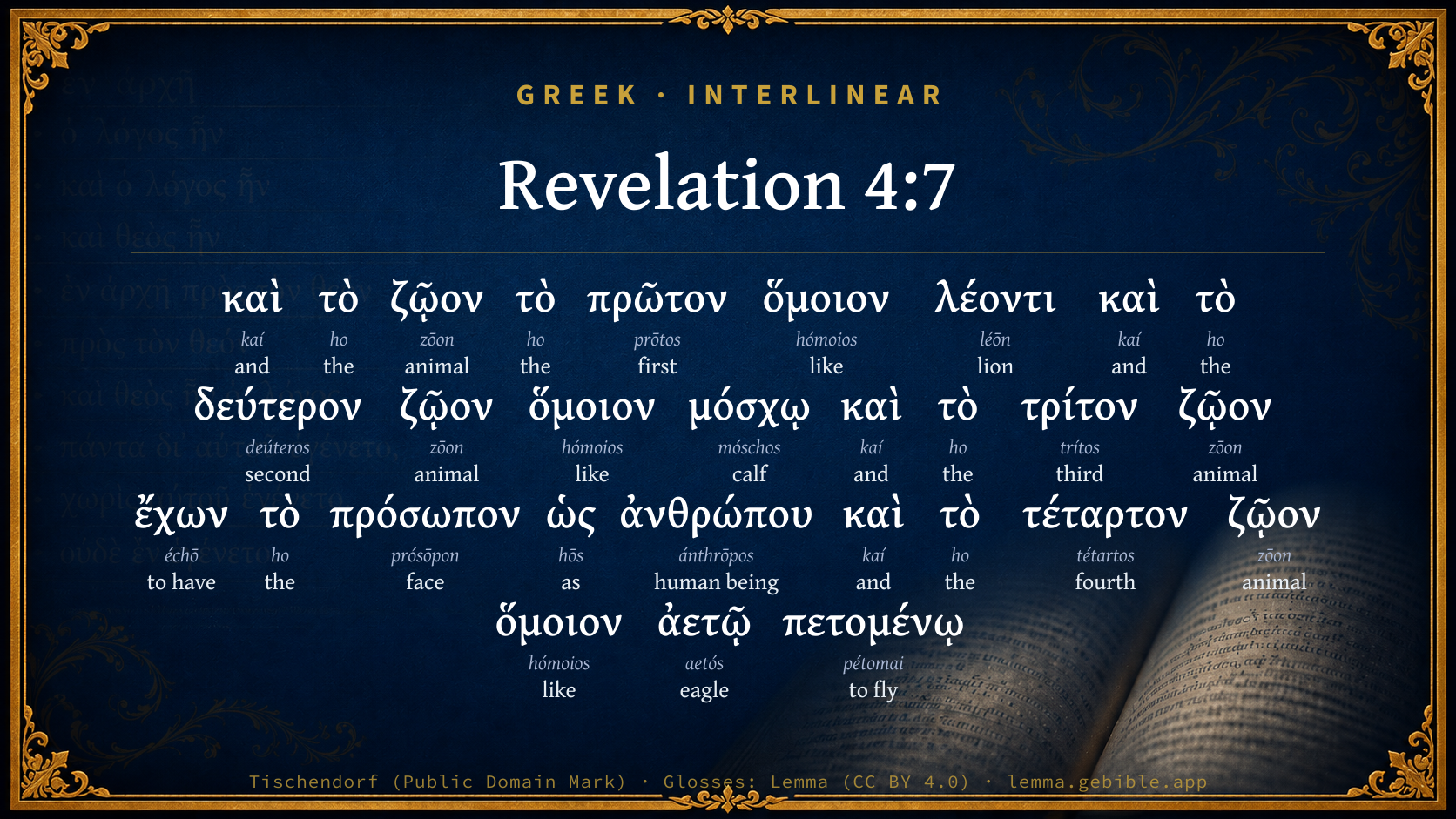
Greek (Tischendorf 8th ed.) Revelation 4:7 appears in the Greek New Testament. The text above is from the Tischendorf 8th edition. Each word links to its Strong’s number and a concise gloss. Click any word for its full Thayer’s Greek Lexicon entry.
Download image
Cite this verse

Revelation 4:7 (World English Bible). Public Domain. Lemma interlinear Bible study tool, https://lemma.gebible.app/v/revelation/4/7.

Show BibTeX & RIS
BibTeX
RIS
English Translation
The first creature was like a lion, and the second creature like a calf, and the third creature had a face like a man, and the fourth was like a flying eagle.
World English Bible · Public Domain
Highlights
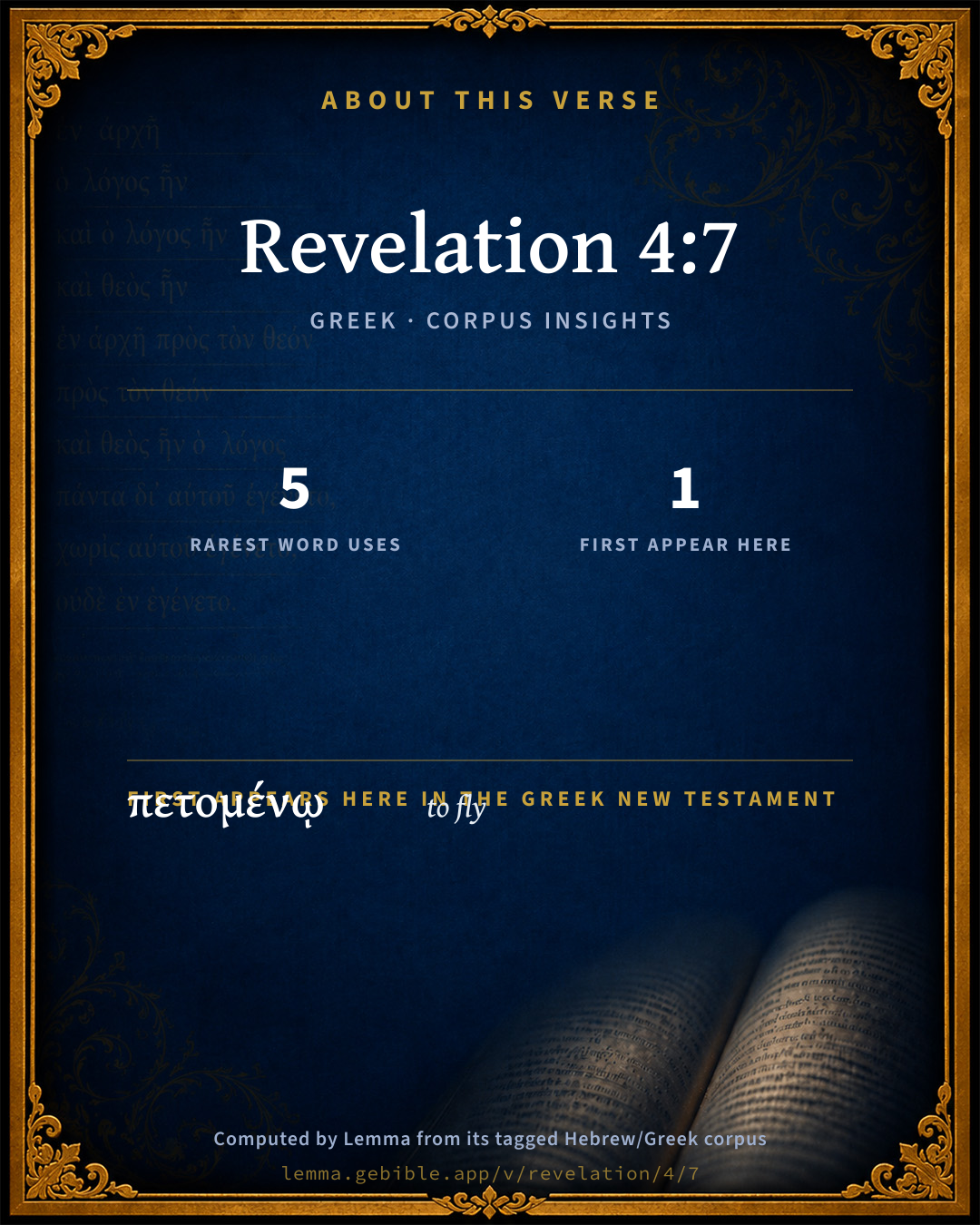
  • 1 first appearance in the Greek New Testament
Full analysis ↓
Download a study sheet

One document with this verse’s original text, its word-by-word gloss line, the meaning frame, cross-references with their text, attributed commentary, and full source and license credits — printable, and it pastes into notes with its structure intact.

This verse Autodidact and up

Study sheet (.html) Plain text (.txt)

A passage Seminary Student

Up to 50 verses in one chapter. A passage sheet keeps up to 6 commentary sources and 12 cross-references per verse, in the order this page ranks them, and says so on the sheet whenever that leaves anything out. Ask for a single verse and you get the Autodidact verse sheet above.

Everything on this page stays free to read, with no account — the sheet is a download of what is already on screen, not access to it.

Want to remove ads? Support Godless Engineer
Compare translations 3

The same verse in 3 English versions, stacked beneath the original-language interlinear above. Click any original word for its lexicon entry.

Each is an independent rendering of the whole verse — the interlinear is not word-aligned to these translations.

Highlighted words mark where these versions differ — a whole-verse word diff, not a word-by-word alignment.

  • World English Bible Public Domain
    The first creature was like a lion, and the second creature like a calf, and the third creature had a face like a man, and the fourth was like a flying eagle.
  • King James Version Public Domain
    And the first beast was like a lion, and the second beast like a calf, and the third beast had a face as a man, and the fourth beast was like a flying eagle.
  • unfoldingWord Literal Text CC BY-SA 4.0
    And the first living creature like a lion, and the second living creature like a calf, and the third living creature having a face as of a man, and the fourth living creature like a flying eagle.

unfoldingWord Literal Text — © unfoldingWord, licensed CC BY-SA 4.0. Word-aligned USFM3 via Door43 (git.door43.org/unfoldingWord/en_ult).

Versions to compare (up to 4)

3 of 4 selected

Show all 19 translations

Every available English version of this verse, each an independent rendering of the whole verse.

  • World English Bible Public Domain
    The first creature was like a lion, and the second creature like a calf, and the third creature had a face like a man, and the fourth was like a flying eagle.
  • Berean Standard Bible Public Domain
    The first living creature was like a lion, the second like a calf, the third had a face like a man, and the fourth was like an eagle in flight.
  • Majority Standard Bible Public Domain
    The first living creature was like a lion, the second like a calf, the third had the face of a man, and the fourth was like an eagle in flight.
  • King James Version Public Domain
    And the first beast was like a lion, and the second beast like a calf, and the third beast had a face as a man, and the fourth beast was like a flying eagle.
  • American Standard Version (1901) Public Domain
    And the first creature `was' like a lion, and the second creature like a calf, and the third creature had a face as of a man, and the fourth creature `was' like a flying eagle.
  • Revised Version (1885) Public Domain
    And the first creature was like a lion, and the second creature like a calf, and the third creature had a face as of a man, and the fourth creature was like a flying eagle.
  • Geneva Bible (1599) Public Domain
    And the first beast was like a lion, and the second beast like a calfe, and the thirde beast had a face as a man, and the fourth beast was like a flying Eagle.
  • Douay-Rheims (1899) Public Domain
    And the first living creature was like a lion: and the second living creature like a calf: and the third living creature, having the face, as it were, of a man: and the fourth living creature was like an eagle flying.
  • Young's Literal Translation Public Domain
    and the first living creature `is' like a lion, and the second living creature `is' like a calf, and the third living creature hath the face as a man, and the fourth living creature `is' like an eagle flying.
  • Literal Standard Version CC BY-SA 4.0
    and the first living creature—like a lion; and the second living creature—like a calf; and the third living creature has the face as a man; and the fourth living creature—like an eagle flying.
  • Unlocked Literal Bible CC BY-SA 4.0
    The first living creature was like a lion, the second living creature was like a calf, the third living creature had a face like a man, and the fourth living creature was like a flying eagle.
  • unfoldingWord Literal Text CC BY-SA 4.0
    And the first living creature like a lion, and the second living creature like a calf, and the third living creature having a face as of a man, and the fourth living creature like a flying eagle.
  • Darby Bible Public Domain
    and the first living creature like a lion, and the second living creature like a calf, and the third living creature having the face as of a man, and the fourth living creature like a flying eagle.
  • World Messianic Bible Public Domain
    The first creature was like a lion, the second creature like a calf, the third creature had a face like a man, and the fourth was like a flying eagle.
  • Webster's Bible Public Domain
    And the first living being was like a lion, and the second living being like a calf, and the third living being had a face as a man, and the fourth living being was like a flying eagle.
  • Free Bible Version CC BY-SA 4.0
    The first creature looked like a lion, the second like a young bull, the third had a human face, and the fourth looked like a flying eagle.
  • Bible in Basic English Public Domain
    And the first beast was like a lion, and the second like an ox, and the third had a face like a man, and the fourth was like an eagle in flight.
  • Text-Critical English NT CC BY 4.0
    The first living creature was like a lion, the second living creature was like a calf, the third living creature had the face of a man, and the fourth living creature was like an eagle in flight.
  • Tyndale New Testament (1534) Public Domain
    And the fyrste best was lyke a lion the seconde best lyke a calfe and the thyrde beste had a face as a man and the fourthe beste was like a flyinge egle.

Literal Standard Version (2020), Covenant Press — licensed CC BY-SA 4.0. Text via the HelloAO Bible API (eBible.org). Unlocked Literal Bible (unfoldingWord) — licensed CC BY-SA 4.0. Text via the HelloAO Bible API (eBible.org). unfoldingWord Literal Text — © unfoldingWord, licensed CC BY-SA 4.0. Word-aligned USFM3 via Door43 (git.door43.org/unfoldingWord/en_ult). Free Bible Version, Dr. Jonathan Gallagher — licensed CC BY-SA 4.0. Text via the HelloAO Bible API (eBible.org).

Word by word

More ways to search: Search by grammar → Find every occurrence → Compare this word →

Practice this passage: Drill this verse → Learn its vocabulary →

ἀετῷ
aetós
G105
“eagle”
Noun, Dative, Singular, Masculine
Part of Speech
Noun
Case
Dative
Number
Singular
Gender
Masculine
Full Thayer's Definition

Origin: from the same as G109

TDNT: None

1. an eagle: since eagles do not usually go in quest of carrion, this may to a vulture that resembles an eagle 2. an eagle as a standard (Roman Military)
  1. καὶ kaí G2532 “and” Conjunction
  2. τὸ ho G3588 “the” Article, Nominative, Singular, Neuter
  3. ζῷον zōon G2226 “animal” Noun, Nominative, Singular, Neuter
  4. τὸ ho G3588 “the” Article, Nominative, Singular, Neuter
  5. πρῶτον prōtos G4413 “first” Adjective, Nominative, Singular, Neuter, Superlative
  6. ὅμοιον hómoios G3664 “like” Adjective, Nominative, Singular, Neuter
  7. λέοντι léōn G3023 “lion” Noun, Dative, Singular, Masculine
  8. καὶ kaí G2532 “and” Conjunction
  9. τὸ ho G3588 “the” Article, Nominative, Singular, Neuter
  10. δεύτερον deúteros G1208 “second” Adjective, Nominative, Singular, Neuter
  11. ζῷον zōon G2226 “animal” Noun, Nominative, Singular, Neuter
  12. ὅμοιον hómoios G3664 “like” Adjective, Nominative, Singular, Neuter
  13. μόσχῳ móschos G3448 “calf” Noun, Dative, Singular, Masculine
  14. καὶ kaí G2532 “and” Conjunction
  15. τὸ ho G3588 “the” Article, Nominative, Singular, Neuter
  16. τρίτον trítos G5154 “third” Adjective, Nominative, Singular, Neuter
  17. ζῷον zōon G2226 “animal” Noun, Nominative, Singular, Neuter
  18. ἔχων échō G2192 “to have” Verb, Present, Active, Participle, Nominative, Singular, Masculine
  19. τὸ ho G3588 “the” Article, Accusative, Singular, Neuter
  20. πρόσωπον prósōpon G4383 “face” Noun, Accusative, Singular, Neuter
  21. ὡς hōs G5613 “as” Adverb
  22. ἀνθρώπου ánthrōpos G444 “human being” Noun, Genitive, Singular, Masculine
  23. καὶ kaí G2532 “and” Conjunction
  24. τὸ ho G3588 “the” Article, Nominative, Singular, Neuter
  25. τέταρτον tétartos G5067 “fourth” Adjective, Nominative, Singular, Neuter
  26. ζῷον zōon G2226 “animal” Noun, Nominative, Singular, Neuter
  27. ὅμοιον hómoios G3664 “like” Adjective, Nominative, Singular, Neuter
  28. πετομένῳ pétomai G4072 “to fly” Verb, Present, Middle or Passive deponent, Participle, Dative, Singular, Masculine

About this verse

These counts appear in no published source. They are computed here, from the morphology-tagged text and Lemma’s own curated glosses. What Lemma adds →

29
words
16
distinct lemmas
Revelation
section

Notable vocabulary

The rarest word here is ἀετῷ eagle G105 — appearing just 5 times in the whole Greek New Testament.

First appearance in Scripture

This word makes its first canonical appearance in the Greek New Testament here:

  • πετομένῳ to fly G4072

Shared distinctive vocabulary

ἀετῷ eagle G105 occurs in 5 verses of the Greek New Testament. Also found in:
Repetition

Words recur within this verse:

Cross-references

6

Topical passages linked to Revelation 4:7 in the Treasury of Scripture Knowledge — connected by theme and wording, ordered by reader-vote popularity; previews shown in the World English Bible.

  • Ezekiel 10:14 Every one had four faces: the first face was the face of the cherub, and the second face was the face of a man, and the third face the face of a lion, and the fourth the face of an eagle.
  • Ezekiel 1:10 As for the likeness of their faces, they had the face of a man; and they four had the face of a lion on the right side; and they four had the face of an ox on the left side; they four had also the face of an eagle.
  • Ezekiel 10:21 Every one had four faces, and every one four wings; and the likeness of the hands of a man was under their wings.
  • Ezekiel 1:8 They had the hands of a man under their wings on their four sides; and they four had their faces and their wings [thus]:
  • Daniel 7:4 The first was like a lion, and had eagle's wings: I saw until the wings of it were plucked, and it was lifted up from the earth, and made to stand on two feet as a man; and a man's heart was given to it.
  • Revelation 4:6 Before the throne was something like a sea of glass, similar to crystal. In the midst of the throne, and around the throne were four living creatures full of eyes before and behind.

Cross-references courtesy of OpenBible.info (CC BY 4.0).

Commentary

Notes on Revelation 4:7 from classic Christian and Jewish commentators (each source and its license shown beneath its notes). The classic Christian expositions comment on the surrounding passage and are grouped to its opening verse, so a note may address several verses; the Jewish commentaries on the Tanakh (Rashi and others) are per-verse, so they appear only where the commentator wrote on this verse.

Lemma curates 59 commentaries, every one of them public domain or Creative Commons licensed, each selected and text-cleaned for this edition rather than reprinted as found. About our sources →

Whedon's Commentary on the Bible

Daniel D. Whedon

The beasts, or cherubim; the four and twenty elders, Rev_4:7-11.

7. Lion… calf… man… eagle—These four are the cherubim, the precedent of which will be found in the first chapter of Ezekiel. But the old prophet’s cherubim had each one the four faces and the four wings. This, and the fact that in Rev_5:8, they “fell down before the Lamb,” suggests that these were human in form and animal only in face. They thus symbolize the living creation in its highest aspects and its relations to its Creator.

Cognate to this interpretation was the view of the early Church writers, that the cherubim represent the four Gospels. These Gospels are an earth-wide gospel; a gospel to be preached to every creature. They are to be spread to the “four corners of the earth.” That the four cherubim represent the four Gospels is an idea, as Wordsworth well remarks, coming from the school of John, being found in Irenaeus, the pupil of the pupil of John. It may be more than a coincidence that the Gospels are the creational number, four. But when writers have proceeded to assign either one of the four symbols to either one Gospel the want of individual resemblance has produced a variety of assignments. Irenaeus makes the lion, John; the steer, Luke; the man, Matthew: and the eagle, Mark. Augustine makes the lion, Matthew; the man, Mark; the ox, Luke; and the eagle, John. We suppose that most modern critics would concede the eagle to the soaring John; to Luke, the broad, Pauline, humanitarian friend of the Gentiles, if not himself a Gentile, most would concede the man; to the concise and vigorous Mark, the lion; and to plain, substantial, ultra-Jewish Matthew, both the sturdiness and the sacrificial character of the ox.

Daniel D. Whedon (gen. ed.), Commentary on the Old and New Testaments (1874–1909) — public domain. Text from a community e-Sword module.

Tyndale Open Study Notes

Tyndale Open Resources

4:7 These four creatures symbolize four types of beings: a lion represents wild animals, an ox represents domesticated animals, a human represents humanity, and an eagle represents the birds (cp. Ezek 1:10). These four figures are drawn from Ezek 1 (cherubim) and Isa 6 (seraphim). They probably represent the best of creation as worshiping God. Missing from this worldwide orchestra are fish, which ancient people associated with the evil sea (see Rev 21:1), and insects, represented by locusts in the evil kingdom (see 9:1-11).

Tyndale Open Study Notes — © Tyndale Open Resources, licensed CC BY-SA 4.0. Text via the HelloAO Bible API.

Bengel's Gnomon

Johann Albrecht Bengel

Rev 4:7. Μόσχῳ) a bullock, an ox. The Hebrew בקר and פר and שור are rendered by the Septuagint μόσχος.

Bengel's Gnomon of the New Testament — English translation (T&T Clark, Edinburgh, 1860) — public domain. Text from a community e-Sword module.

Meyer's Critical & Exegetical Commentary

Heinrich August Wilhelm Meyer

Rev_4:7. While, in Ezekiel,[1783] the forms of the four cherubim[1784] bear in wonderful combination the fourfold faces of the lion, the ox, the man, and the eagle, John with more distinct clearness has so seen the four beings that in each of them only a part of that fourfold form is expressed. In this, also, he is distinguished from Ezekiel, that he represents his four beings, not each with four but with six wings, as the seraphim in Isaiah 6.; yet, on the other hand, John agrees with Ezekiel, that in him the wings, as well as the whole body, appear full of eyes (Rev_4:8).

The second being is like a μόσχος, i.e., not a calf in distinction from a grown ox, but, as is already required in an aesthetic respect, the ox. The LXX. have μόσχος, Eze_1:10, for שׁור;[1785] also Ezek. 21:37;[1786] Lev_22:23. But they render thus also the words פָר,[1787] עֵגֶל[1788] and בָקָר[1789] By μόσχος, therefore, only some animal of that class is designated; the more precise determination is given by the context.

The third ζῶον has τὸ πρόσωπον[1790] ἈΝΘΡΏΠΟΥ. In Ezekiel the chief form of the cherubim is human; this has been adopted also by Vitr. and Hengstenb. for the Apoc.[1791] On the contrary, Beng. infers from the words ἜΧ. Τ. ΠΡΌΣΩΠΟΝ, Κ.Τ.Λ.: So it did not have in other respects the form of a man. Ebrard is right in being contented with not knowing more than is said in the text. In the third being, however, the human face is characteristic; just as in the eagle, to which the fourth being is like, not so much the form in itself, as the flying, is significant, and therefore marked.

[1783] Ch. Rev_1:10.

[1784] Cf. E. Riehm, De Natura et Notione Symbolica Cheruborum, Bas. et Ludov., 1864, p. 23. Cf. also Stud. u. Krit., 1871, p. 399 sq.; Lämmert, D. Cherubim der H. Schrift., Jahrb. f. Deutsche Theologie, Gotha, 1867, p. 587 sq., 609 sq.; L. Seeburg, Die Sage von den Greifen bei den Alten; James 1 : Ueber d. Ursprung der Sage und ihre Verbreitung im Oriente, Göttinger Inaugural-Dissertat. (1867), pp. 7, 32 sq.

[1785] Eze_1:7, as it refers to the feet of the cherubim, does not belong here.

[1786] LXX., Rev_22:1.

[1787] Exo_29:10.

[1788] Exo_32:4.

[1789] Gen_12:16.

[1790] ὡς. See Critical Remarks.

[1791] Cf. Rev_5:8, Rev_19:4, where the beasts fall down, which cannot be thought of if two of them were four-footed.

NOTES BY THE AMERICAN EDITOR

XLIV. Rev_4:6-8. τέσσερα ζῷα

Cf. Cremer (Lexicon): Properly, a living creature, which also occurs elsewhere also in profane Greek, where ζῶον, a post-Homeric word, generally signifies living creature, and only in special instances a beast; θηρίον = animal, as embracing all living beings, must be retained in the Revelation, where four ζῶα are represented as being between Gods throne and those of the elders which surround it, the description given of which (Rev_4:6-8) resembles that of the הַיוֹת in Eze_1:5 sqq.; the cherubim in Ezekiel 10 (cf. Psa_18:1; Psa_99:1; Psa_80:2; 1Sa_4:4; 2Sa_6:2; 2Ki_19:15). They are named living creatures here and in Ezekiel 1, on account of the life which is their main feature. They are usually the signs and tokens of majesty, of the sublime majesty of God, both in his covenant relation, and in his relation to the world (for the latter, see Psa_99:1); and therefore it is that they are assigned so prominent a place, though no active part in the final scenes of sacred history (Rev_6:1-7). The appearance of four represents the concentration of all created life in this world, the original abode of which, Paradise, when life had fallen to sin and death, was given over to the cherubim. They do not, like the angels, fulfil the purposes of God in relation to men; they are distinct from the angels (Rev_5:11). We are thus led to conclude that they materially represent the ideal pattern of the true relation of creation to its God. Oehler (O. T. Theology, p. 260): It is the cherubim, as Schultz well expresses it, which at one and the same time proclaim and veil his presence. The lion and the bull are, as is well known, symbols of power and strength; man and the eagle are symbols of wisdom and omniscience; the latter attribute is expressed also in the later form of the symbol by the multitude of eyes. The continual mobility of the ζῶα (Rev_4:8) signifies the never-resting quickness of the Divine operations; this is probably symbolized also by the wheels in Ezekiel 1. The number four is the signature of all-sidedness (towards the four quarters of heaven). Thus Jehovah is acknowledged as the God who rules the world on all sides in power, wisdom, and omniscience. Instead of natural powers working unconsciously, is placed the all-embracing, conscious activity of the living God.

Meyer — Critical and Exegetical Commentary on the New Testament — English translation by Peter Christie, edited by Frederick Crombie (T&T Clark, 1880) — public domain. Text from a community e-Sword module.

Expositor's Greek Testament

ed. W. Robertson Nicoll

Rev 4:7 . μόσχῳ , “an ox or steer” (as LXX). The four animals are freely compounded out of the classical figures of Ezekiel’s cherubim and the seraphim in Isa 6 ; the latter supply the six wings apiece. This function of ceaseless praise (Rev 4:8-9 ) is taken from Enoch lxi. 10 f., where the cherubim and seraphim are also associated but not identified with the angelic host (though in 40. the cherubim are equivalent to the four archangels); for a possible Babylonian astral background, cf. Zimmern in Schrader, 3 626 632, and Clemen’s Religionsgeschichtliche Erklärung des N. T. (1909), pp. 74 f. Behind them lie the signs of the zodiac (the bull, the archer, the lion and the eagle, as a constellation of the North; so, e.g. , Gunkel, Bruston, etc.). The analogous figures of the four funerary genii before the Egyptian throne represent the four points of the compass.

The Expositor's Greek Testament, edited by W. Robertson Nicoll (1897–1910) — public domain. Text from a community e-Sword module.

Jamieson, Fausset & Brown

Robert Jamieson, A. R. Fausset & David Brown

calf--"a steer" [ALFORD]. The Septuagint often uses the Greek term here for an ox (Exo 22:1; Exo 29:10, &c.).

as a man--The oldest manuscripts have "as of a man."

Jamieson, Fausset & Brown — Commentary Critical and Explanatory on the Whole Bible (1871) — public domain (CC PDM 1.0). Text via the HelloAO Bible API.

Adam Clarke's Commentary

Verse 7. The first beast was like a lion] It is supposed that there is a reference here to the four standards or ensigns of the four divisions of the tribes in the Israelitish camp, as they are described by Jewish writers.

The first living creature was like a lion; this was, say the rabbins, the standard of JUDAH on the east, with the two tribes of Issachar and Zabulon. The second, like a calf or ox, which was the emblem of EPHRAIM who pitched on the west, with the two tribes of Manasseh and Benjamin. The third, with the face of a man, which, according to the rabbins, was the standard of REUBEN who pitched on the south, with the two tribes of Simeon and Gad. The fourth which was like a flying (spread) eagle, was, according to the same writers, the emblem on the ensign of DAN who pitched on the north, with the two tribes of Asher and Naphtali. This traditionary description agrees with the four faces of the cherub in Ezekiel's vision. See my notes and diagrams on Num. 2.

Christian tradition has given these creatures as emblems of the four evangelists. To John is attributed the EAGLE; to Luke the OX, to Mark the LION, and to Matthew the MAN, or angel in human form. As the former represented the whole Jewish Church or congregation, so the latter is intended to represent the whole Christian Church.

Adam Clarke's Commentary on the Bible (1810–1826) — public domain. Text from a community e-Sword/MySword module.

Ellicott's Commentary for English Readers

(7) And the first beast (better, in each case, living being) was like a lion, and the second beast like a calf (comp. Eze_1:7; Eze_1:10), and the third beast had a face as a man (or, its countenance as of a man), and the fourth beast was like a flying eagle.—These are living beings, not “beasts,” as in the Authorised version. The rendering “beasts” introduces confusion of thought, and violates the laws of Apocalyptic, indeed of Bible imagery. The evil powers are described under the emblem of wild beasts; for thus brute force, and unrestrained passion, and self-will, &c., are symbolised. (See Rev_11:7; Rev_13:1-2; Rev_16:2; Rev_17:3; Rev_17:7; Rev_19:19-20; Rev_20:10.) But these “living beings” do not represent the evil element in the world. They are representative of animated nature. They are four in number—as there are four beings which hold a primacy in the world: among created beings, man; among birds, the eagle; among cattle, the ox; among untamed animals, the lion. The characteristics of these four chiefs of creation unite to make a perfect picture of the spirit of true service, which should be brave as the lion, patient as the ox, aspiring as the eagle, intelligent as man. It may here be noted that the number “four” in the Apocalypse is almost always associated with the earth. (See Rev_7:1.) We need only call to mind the four quarters, four elements, four seasons, to see its fitness. (Comp. Rev_21:13; Rev_21:16.) The living creatures are “full of eyes.” This strong expression is used again in the next verse. Twice used, its meaning must be significant. The same idea is found in the later prophets of the Old Testament. The wheels of Ezekiel and their tires (Eze_1:18; Eze_10:12) were full of eyes. The stone of Zechariah had seven (the perfect number) eyes (Zec_3:9). The thought is emphasised again in Rev_5:6, where the Lamb is said to have seven eyes. Multiplicity of eyes may symbolise vitality and vigilance. Some have thought, inappropriately enough, that it signifies the unceasing praise of God’s works. A better interpretation is given by Dr. Currey. “The power of nature is no blind force, it is employed in the service of God’s providence, and all over it the stamp of reason is impressed.” (See Speaker’s Commentary on Eze_1:18). May we not add that the force of nature is always observant of God’s will? Its myriad eyes are fixed on Him, as the eyes of a servant on his master (Psa_123:2); doing His commandment, hearkening unto the voice of His word (Psa_103:20-21); the eyes too of all creation wait on God, who gives them meat in due season (Psa_104:27, Prayer Book version)—

“His state

Is kingly; thousands at His bidding speed And post o’er land and ocean without rest;

They also serve who only stand and wait.”

A Bible Commentary for English Readers, edited by Charles John Ellicott (1878–1897) — public domain. Text from a community e-Sword module.

The Cambridge Bible for Schools and Colleges

gen. ed. J. J. S. Perowne

7. The description of these living creatures does not exactly agree with any of the O. T. parallels: in Ezekiel 1, which is the nearest, the four Cherubim, as they are called, have human figures, calves’ feet, and each has four faces, of the same four animals as these: also they have each four wings, while these have six, like the Seraphim of Isa_6:2. Probably the meaning is, that these four represent the Cherubim and Seraphim who “continually do cry ‘Holy, Holy, Holy, Lord God of Sabaoth’.” We have no reason to suppose that the Angels, or these super-angelic Beings, have proper bodies or invariable forms: they appear in such forms as may please God, or may be appropriate to the purpose for which He bids them appear. For further discussion as to their meaning, see Excursus I.

The Cambridge Bible for Schools and Colleges (gen. ed. J. J. S. Perowne; Cambridge University Press, 1878–1918) — public domain. Text from a community e-Sword module.

John Gill's Exposition

And the first beast was like a lion,.... And this figure expresses the strength of the ministers of the word, the lion being the strongest among beasts, Pro 30:30, to do the work they are called to, to endure hardness, as good soldiers of Christ, and to bear the infirmities of the weak; and also it denotes their courage and boldness in preaching the Gospel of Christ, without fearing the faces of men, or of being afraid of their revilings:

and the second beast like a calf; or "ox", for so the word here used signifies in the Hellenistic language, and with the Septuagint interpreters, and agrees with Eze 1:10, and designs the laboriousness of Christ's faithful ministers in treading out the corn of Gospel truth, who labour in the word and doctrine, and are labourers with God; as also their humility, meekness, and patience in bearing insults, reproaches, and sufferings for Christ, and instructing those that oppose themselves:

and the third beast had a face as a man; and points at the humanity and tender heartedness, the wisdom, prudence, knowledge, and understanding, and the use of the reasoning faculty, together with a manly spirit in abiding by the Gospel at any rate; all which are so necessary in the ministers of the word.

And the fourth beast was like a flying eagle; which sets forth the sagacity and penetration of Gospel ministers into the deep things of God, and mysteries of grace, and their readiness and swiftness to do the will of God, in publishing the everlasting Gospel; see Rev 14:6.

John Gill's Exposition of the Whole Bible (1746–1763) — public domain (CC PDM 1.0). Text via the HelloAO Bible API.

Trapp's Complete Commentary

John Trapp

7 And the first beast was like a lion, and the second beast like a calf, and the third beast had a face as a man, and the fourth beast was like a flying eagle.

8 And the four beasts had each of them six wings about him; and they were full of eyes within: and they rest not day and night, saying, Holy, holy, holy, Lord God Almighty, which was, and is, and is to come.

Ver. 8. Full of eyes within] To look to themselves also as well as to the flock, Act 20:28, lest while they preach to others, &c., 1Co 9:27.

They rest not] Gr. They have no rest, and yet they have no unrest either, the sweet content they take in their continual employment is fitter to be believed than possible to be discoursed.

Holy, holy] This they double, treble, and warble upon, nine times over.

John Trapp, A Commentary or Exposition upon All the Books of the Old and New Testament (1647–1656) — public domain. Text from a community e-Sword module.

Albert Barnes' Notes on the Bible

And the first beast was like a lion - A general description has been given, applicable to all, denoting that in whatever form the divine government is administered, these things will be found; a particular description now follows, contemplating that government under particular aspects, as symbolized by the living beings on which the throne rests. The first is that of a lion. The lion is the monarch of the woods, the king of beasts, and he becomes thus the emblem of dominion, of authority, of government in general. Compare Gen 49:9; Amo 3:8; Joe 3:16; Dan 7:4. As emblematic of the divine administration, this would signify that He who sits on the throne is the ruler over all, and that his dominion is absolute and entire. It has been made a question whether the whole body had the form of a lion, or whether it had the appearance of a lion only as to its face or front part. It would seem probable that the latter only is intended, for it is expressly said of the “third beast” that it had “the face of a man,” implying that it did not resemble a man in other respects, and it is probable that, as these living creatures were the supports of the throne, they had the same form in all other particulars except the front part. The writer has not informed us what was the appearance of these living creatures in other respects, but it is most natural to suppose that it was in the form of an ox, as being adapted to sustain a burden. It is hardly necessary to say that the thing supposed to be symbolical here in the government of God - his absolute rule - actually exists, or that it is important that this should be fairly exhibited to people.

And the second beast like a calf - Or, more properly, a young bullock, for so the word - μόσχος moschos - means. The term is given by Herodotus (ii. 41; iii. 28) to the Egyptian god Apis, that is, a young bullock. Such an emblem, standing under a throne as one of its supports, would symbolize firmness, endurance, strength (compare Pro 14:4); and, as used to represent qualities pertaining to him who sat on the throne, would denote stability, firmness, perseverance: qualities that are found abundantly in the divine administration. There was clearly, in the apprehension of the ancients, some natural fitness or propriety in such an emblem. A young bullock was worshipped in Egypt as a god. Jeroboam set up two idols in the form of a calf, the one in Dan and the other in Bethel, 1Ki 12:28-29. A similar object of worship was found in the Indian, Greek, and Scandinavian mythologies, and the image appears to have been adopted early and extensively to represent the divinity.

The above figure is a representation of a calfidol, copied from the collection made by the artists of the French Institute at Cairo. It is recumbent, with human eyes, the skin flesh-colored, and the whole after-parts covered with a white and sky-blue drapery: the horns not on the head, but above it, and containing within them the symbolical globe surmounted by two feathers. The meaning of the emblems on the back is not known. It is copied here merely to show that, for some cause, the calf was regarded as an emblem of the Divinity. It may illustrate this, also, to remark that among the sculptures found by Mr. Layard, in the ruins of Nineveh, were not a few winged bulls, some of them of large structure, and probably all of them emblematic. One of these was removed with great difficulty, to be deposited in the British Museum. See Mr. Layard’s Nineveh and its Remains, vol. ii. pp. 64-75. Such emblems were common in the East; and, being thus common, they would be readily understood in the time of John.

And the third beast had a face as a man - There is no intimation as to what was the form of the remaining portion of this living creature; but as the beasts were “in the midst of the throne,” that is, under it as a support, it may be presumed that they had such a form as was adapted to that purpose - as supposed above, perhaps the form of an ox. To this living creature there was attached the head of a man, and that would be what would be particuLarly visible to one looking on the throne. The aspect of a man here would denote intelligence - for it is this which distinguishes man from the creation beneath him; and if the explanation of the symbol above given be correct, then the meaning of this emblem is, that the operations of the government of God are conducted with intelligence and wisdom. That is, the divine administration is not the result of blind fate or chance; it is founded on a clear knowledge of things, on what is best to be done, on what will most conduce to the common good.

Of the truth of this there can be no doubt; and there was a propriety that, in a vision designed to give to man a view of the government of the Almighty, this should be appropriately symbolized. It may illustrate this to observe, that in ancient sculptures it was common to unite the head of a man with the figure of an animal, as cobining symbols. Among the most remarkable figures discovered by Mr. Layard, in the ruins of Nineveh, were winged, human-headed lions. These lions are thus described by Mr. Layard: “They were about twelve feet in height, and the same number in length. The body and limbs were admirably portrayed; the muscles and bones, although strongly developed, to display the strength of the animal, showed, at the same time, a correct knowledge of its anatomy and form. Expanded wings sprung from the shoulder and spread over the back; a knotted girdle, ending in tassels, encircled the loins. These sculptures, forming an entrance, were partly in full, and partly in relief. The head and forepart, facing the chambers, were in full; but only one side of the rest of the slab was sculptured, the back being placed against the wall of sun-dried bricks” (“Nineveh and its Remains,” vol. i. p. 75).

The following engraving will give an idea of one of these human-headed animals, and will serve to illustrate the passage before us alike in reference to the head, indicating intelligence, and the wings, denoting rapidity. On the use of these figures, found in the ruins of Nineveh, Mr. Layard makes the following sensible remarks - remarks admirably illustrating the view which I take of the symbols before us: “I used to contemplate for hours these mysterious emblems, and muse over their intent and history. What more noble forms could have ushered the people into the temple of their gods? What more subblime images could have been borrowed from nature by people who sought, unaided by the light of revealed religion, to embody their conceptions of the wisdom, power, and ubiquity of a Supreme Being? They could find no better type of intellect and knowledge than the head of a man; of strength, than the body of the lion; of rapidity of motion, than the wings of a bird. These winged, human-headed lions were not idle creations, the offspring of mere fancy their meaning was written upon them. They had awed and instructed races which flourished 3000 years ago. Through the portals which they guarded, kings, priests, and warriors had borne sacrifices to their altars, long before the wisdom of the East had penetrated into Greece, and had furnished its mythology with symbols long recognized by the Assyrian votaries” (“Nineveh and its Remains,” vol. i. p. 75, 76).

And the fourth beast was like a flying eagle - All birds, indeed, fly; but the epithet flying is here employed to add intensity to the description. The eagle is distinguished, among the feathered race, for the rapidity, the power, and the elevation of its flight. No other bird is supposed to fly so high; none ascends with so much power; none is so majestic and grand in his ascent toward the sun. That which would be properly symbolized by this would be the rapidity with which the commands of God are executed; or this characteristic of the divine government, that the purposes of God are carried into prompt execution. There is, as it were, a vigorous, powerful, and rapid flight toward the accomplishment of the designs of God - as the eagle ascends unmolested toward the sun. Or, it may be that this symbolizes protecting care, or is an emblem of that protection which God, by his providence, extends over those who put their trust in him.

Thus, in Exo 19:4, “Ye have seen how I bare you on eagles’ wings.” “Hide me under the shadow of thy wings,” Psa 17:8. “In the shadow of thy wing’s will I rejoice,” Psa 63:7. “As an eagle stirreth up her nest, fluttereth over her young, spreadeth abroad her wings, taketh them, beareth them on her wings: so the Lord alone did lead him,” Deu 32:11-12, etc. As in the case of the other living beings, so it is to be remarked of the fourth living creature also, that the form of the body is unknown. There is no impropriety in supposing that it is only its front aspect that John here speaks of, for that was sufficient for the symbol. The remaining portion “in the midst of the throne” may have corresponded with that of the other living beings, as being adapted to a support. In further illustration of this it may be remarked, that symbols of this description were common in the Oriental world.

Figures in the human form, or in the form of animals, with the head of an eagle or a vulture, are found in the ruins of Nineveh, and were undoubtedly designed to be symbolic. “On the earliest Assyrian monuments,” says Mr. Layard (“Nineveh and its Remains,” vol. ii., p. 348, 349), “one of the most prominent sacred types is the eagle-headed, or the vulture-headed, human figure. Not only is it found in colossal proportions on the walls, or guarding the portals of the chambers, but it is also constantly represented in the groups on the embroidered robes. When thus introduced, it is generally seen contending with other mythic animals - such as the human-headed lion or bull; and in these contests it is always the conqueror. it may hence be inferred that it was a type of the Supreme Deity, or of one of his principal attributes. A fragment of the Zoroastrian oracles, preserved by Eusebius, declares that ‘God is he that has the head of a hawk. He is the first, indestructible, eternal, unbegotten, indivisible, dissimilar; the dispenser of all good; incorruptible; the best of the good, the wisest of the wise; he is the father of equity and justice, self-taught, physical and perfect, and wise, and the only inventor of the sacred philosophy.’ Sometimes the head of this bird is added to the body of a lion.

Under this form of the Egyptian hieracosphinx it is the conqueror in combats with other symbolical figures, and is frequently represented as striking down a gazelle or wild goat. It also clearly resembles the gryphon of the Greek mythology, avowedly an Eastern symbol, and connected with Apollo, or with the sun, of which the Assyrian form was probably an emblem.” The following figure found in Nimroud, or ancient Nineveh; may furnish an illustration of one of the usual forms. If these views of the meaning of these symbols are correct, then the idea which would be conveyed to the mind of John, and the idea, therefore, which should be conveyed to our minds, is, that the government of God is energetic, firm, intelligent, and that in the execution of its purposes it is rapid like the unobstructed flight of an eagle, or protective like the care of the eagle for its young. When, in the subsequent parts of the vision, these living creatures are represented as offering praise and adoration to Him that sits on the throne Rev 4:8; Rev 5:8, Rev 5:14, the meaning would be, in accordance with this representation, that all the acts of divine government do, as if they were personified, unite in the praise which the redeemed and the angels ascribe to God. All living things, and all acts of the Almighty, conspire to proclaim his glory. The church, by her representatives, the “four and twenty elders,” honors God; the angels, without number, unite in the praise; all creatures in heaven, in earth, under the earth, and in the sea Rev 5:13, join in the song; and all the acts and ways of God declare also his majesty and glory: for around his throne, and beneath his throne, are expressive symbols of the firmness, energy, intelligence, and power with which his government is administered.

Albert Barnes' Notes on the Bible (1834–1885) — public domain. Text from a community e-Sword/MySword module.

Haydock's Catholic Bible Commentary

Like a lion, &c. The qualities in these animals are observed to be courage and strength in the lion; profit to human life, by the calf; reason and wisdom, by the face of man: soaring high, and rapidity or swiftness, by the eagle: whether we understand those spiritual perfections to belong to blessed spirits, or to the apostles in general, or to the four evangelists. (Witham)

George Leo Haydock (1774–1849), Haydock's Catholic Family Bible and Commentary, 1859 edition — public domain. Excludes Psalms (Douay-Rheims chapter numbering differs from Protestant) and Deuterocanonical books (Catholic canon only).

Matthew Poole's English Annotations

It is observed concerning these four living creatures, (for so they were, not beasts in a strict sense, as it is opposed to flying things, for the fourth was a fowl):

1. That they were the same mentioned in Ezekiel’s vision, Eze 1:10; only each one there is said to have had the four faces of these creatures, here each one had a single face proper to it.

2. That these were the four creatures whose portraitures were in the four ensigns of the Israelites as they were marshalled into four companies, allotting the men of three tribes to each company.

Judah’s standard had a lion in its colours, according to Jacob’s prophecy of that tribe, Gen 49:9, Ephraim had an ox, Reuben had a man, Dan an eagle. This the learned Mede proves from the Rabbins, who, though fabulous enough, yet in such a thing may be credited. It is also thought they answered the four cherubims in the temple.

Question. But what is signified by these four living creatures?

Solution. Some say the four evangelists; others, four apostles, &c. But certainly they judge best who say, that by them is signified the various gifts with which God blesseth his ministers, giving to some more courage and fortitude, that they are like lions; to others more mildness and meekness, that they are like oxen or calves; others have more wisdom and prudence, which most adorn a man; others a more piercing insight into the mysteries of God’s kingdom, rendering them like eagles.

Matthew Poole's English Annotations on the Holy Bible (1683–1685) — public domain. Text from a community e-Sword/MySword module.

The Pulpit Commentary

And the first beast was like a lion, and the second beast like a calf, and the third beast had a face as a man, and the fourth beast was like a flying eagle. (Upon "beast" (zwon), see on ver. 6. For the signification, see also above on ver. 6) Whether there was any difference in the forms as a whole, or whether the difference consisted chiefly or solely in the thee, cannot be certainly known. Each being is symbolical of some class or some quality of which it is representative. (For the application, see on ver. 6)

The Pulpit Commentary (1880–1919), ed. H.D.M. Spence-Jones & Joseph S. Exell — public domain. Text from a community e-Sword module.

John Wesley's Explanatory Notes

And the first - Just such were the four cherubim in Ezekiel, who supported the moving throne of God; whereas each of those that overshadowed the mercy-seat in the holy of holies had all these four faces: whence a late great man supposes them to have been emblematic of the Trinity, and the incarnation of the second Person. A flying eagle - That is, with wings expanded.

John Wesley, Explanatory Notes Upon the Whole Bible (1754–1765) — public domain. Text via the GEBible commentary corpus.

Scofield Reference Notes

C. I. Scofield

beasts

Living creatures.

(See Scofield Eze 1:5).

The Scofield Reference Bible (1917 edition), notes by C. I. Scofield — public domain. Text from a community e-Sword module.

The People's New Testament

B. W. Johnson

7–8. The first creature was like a lion. It looked like a lion, but was not a lion. It had other characteristics. Like a calf. Had a body similar to that of the ox. Had the face of a man. Otherwise its structure differed from that of men. Like a flying eagle. It will be seen that four departments of animated nature are represented. That of the wild beasts of prey; that of domestic animals, the human species, and the fowls of the air. Each is represented by what, in the eyes of a Hebrew, would be regarded as its highest type.

B. W. Johnson's The People's New Testament with Notes (1889–1891) — public domain. Electronic text from the Christian Classics Ethereal Library (CCEL) ThML edition.

unfoldingWord translationNotes

Door43 World Missions Community

The first living creature was like a lion, the second living creature was like a calf, the third living creature had a face like a man, and the fourth living creature was like a flying eagle

How the head of each living creature appeared to John is expressed as a comparison with something more familiar. (See: Simile)

living creature

"living being" or "living thing." See how you translated this in Revelation 4:6

full of eyes on top and underneath

The top and bottom of each wing was covered with eyes.

who is to come

Existing in the future is spoken of as coming. (See: Metaphor)

translationWords

life

creature

like

lions

cow

face

eagle

holy

lord

Almighty

unfoldingWord translationNotes — © Distant Shores Media and the Door43 World Missions Community, licensed CC BY-SA 4.0. Source: git.door43.org/Door43/en_tn.

Cambridge Greek Testament for Schools and Colleges

7. ἔχων. With AB2; Text. Rec[161] reads ἔχον with אP.

[161] Rec. Textus Receptus as printed by Scrivener.

ὡς ἀνθρώπον. With A Primas[162] Vg[163]; א reads ὡς ὅμοιον ἀνθρώπου; B2 omits ὡς; Text. Rec[164] reads ὡς ἄνθρωπος with P 1.

[162] Primasius, edited by Haussleiter.

[163] Vulgate.

[164] Rec. Textus Receptus as printed by Scrivener.

7. The description of these living creatures does not exactly agree with any of the O.T. parallels: in Ezekiel 1, which is the nearest, the four Cherubim, as they are called, have human figures and calves’ feet; and each has four faces, of the same four animals as these: also they have each four wings, while these have six, like the Seraphim of Isa 6:2. Probably the meaning is, that these four represent the Cherubim and Seraphim who “continually do cry ‘Holy, Holy, Holy, Lord God of Sabaoth’ ”. We have no reason to suppose that the Angels, or these super-angelic Beings, have proper bodies or invariable forms: they appear in such forms as may please God, or may be appropriate to the purpose for which He bids them appear. For further discussion as to their meaning, see Excursus I.

ἔχων. Is as likely to be a misspelling resting on mispronunciation as a false concord. Pausanias of Cæsarea in Cappadocia and a famous pupil of Herodes Atticus habitually confounded long and short letters, a common Syrian fault.

Cambridge Greek Testament for Schools and Colleges (Cambridge University Press, 1896; 21 vols, various authors incl. Carr, Maclear, Plummer, Farrar, Lumby, Moule, M. R. James, Simcox) — public domain. Text from a community e-Sword module.

Vincent's Word Studies in the New Testament

Marvin R. Vincent

Lion, calf, man, eagle. From this passage is derived the familiar symbolism of the four Evangelists; Mark seated on a lion, Luke on a steer, Matthew on a man, and John on an eagle. These are varied however. Irenaeus attributes the lion to John, and the eagle to Mark. Augustine the lion to Matthew, the man to Mark.

Lion. See on 1Pe 5:8.

Calf [μοσχω] . Compare Luk 14:23. In the Septuagint for an ox or steer. Exo 22:1; Eze 1:10.

Eagle [αετω] . See on Mt 24:28.

Marvin R. Vincent, Word Studies in the New Testament (1887–1900) — public domain. Text from a community e-Sword/MySword module.

Lesson kit

Teaching starters — assembled from the data on this page, not authored interpretation. Every prompt links to the verse data it draws on. Edit before teaching.

Revelation, in the Revelation, opens this verse with 29 words (16 distinct Greek lemmas). Its most distinctive word is aetós (“eagle”). A historical commentator’s framing appears above. Read the whole chapter for the surrounding context.

Discussion questions

  1. How does “eagle” (aetós) shape what this verse is saying?
  2. The word “to fly” first appears here in Scripture. What is being introduced at this debut?
  3. Matthew 24:28 shares the word «eagle» with this verse. How do the two illuminate each other?
  4. “animal” occurs 4× in this one verse. What is the effect of the repetition?
  5. The translations on this page render this verse differently — a whole-verse word diff, not a word-by-word alignment. What might account for the different wordings?
  6. Reading how Whedon's Commentary on the Bible and Tyndale Open Study Notes read this verse, where do the two commentators agree and where do they part?

Things to notice

  • 1 word makes its first canonical appearance in Scripture here.
  • These translations choose different wording for 5 words in this verse.
  • “animal” occurs 4× in this single verse.
  • 16 distinct Greek lemmas span 29 words in this verse.

Reading settings

Reading text

Shown beneath each verse's original-language words.

Old Testament
Old Testament edition

Read the OT as the Masoretic Hebrew (MT) or the Greek Septuagint (LXX).

English shown for the Greek Septuagint (in the Hebrew ↔ Greek comparison).

Comparing translations? Open the Compare panel on any verse page to stack up to four side by side.