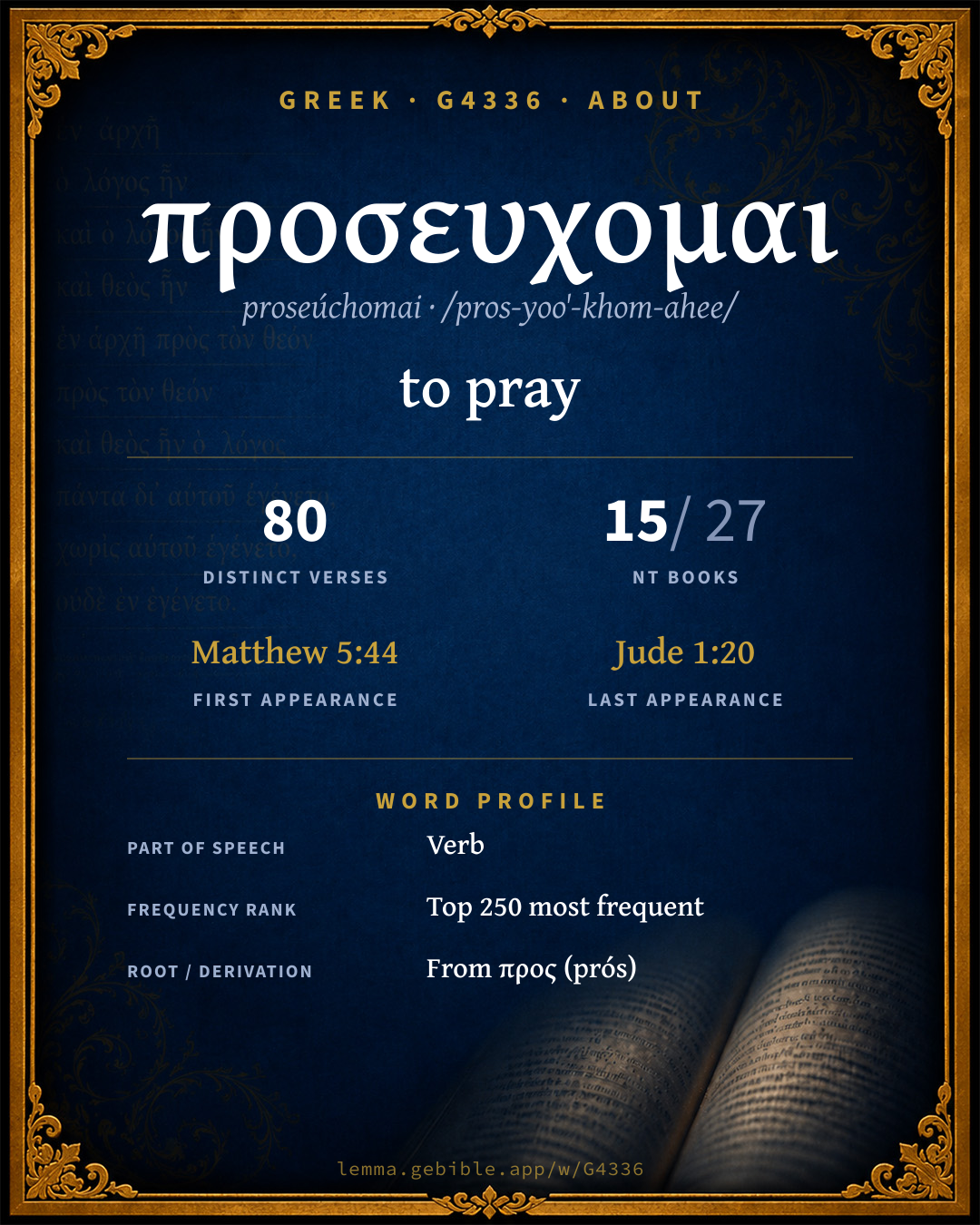
προσεύχομαι
to pray
Full lexicon entry — Thayer's Greek Lexicon
From Thayer's Greek Lexicon
Where this word appears
See every Present-tense verb in the Greek New Testament →
Grammar key — what these labels mean
Part of speech
- Verb
- An action or state-of-being word.
Tense
- Present
- Ongoing or general action in present time (imperfective aspect).
- Aorist
- Action viewed as a simple whole, without regard to duration — often past (perfective aspect).
- Imperfect
- Continuous or repeated action in past time (“was writing”).
- Future
- Action expected in future time.
Voice
- Middle or Passive deponent
- Middle/passive in form but active in meaning.
- Middle deponent
- Middle in form but active in meaning.
Mood
- Imperative
- Expresses a command or request.
- Participle
- A verbal adjective (“writing,” “having written”).
- Indicative
- States a fact or asks a factual question (the mood of reality).
- Infinitive
- A verbal noun (“to write”), unmarked for person or number.
- Subjunctive
- Expresses probability, purpose, or possibility (the mood of contingency).
Case
- Nominative
- The case of the subject (and the predicate nominative).
- Accusative
- The case of the direct object and of extent.
- Genitive
- The case of source, possession, or “of” — answers “whose / from what.”
Person
- 2nd person
- The one addressed (“you”).
- 3rd person
- The one spoken about (“he / she / it / they”).
- 1st person
- The speaker (“I / we”).
Gender
- Masculine
- Grammatically masculine.
- Feminine
- Grammatically feminine.
- Neuter
- Grammatically neuter.
Number
- Plural
- More than one.
- Singular
- One.
Grammatical forms 29 distinct
- Verb, Present, Middle or Passive deponent, Imperative, 2nd person, Plural 13 times (15%)
- Verb, Present, Middle or Passive deponent, Participle, Nominative, Plural, Masculine 10 times (12%)
- Verb, Aorist, Middle deponent, Indicative, 3rd person, Singular 7 times (8%)
- Verb, Aorist, Middle deponent, Infinitive 6 times (7%)
- Verb, Present, Middle or Passive deponent, Infinitive 6 times (7%)
- Verb, Aorist, Middle deponent, Participle, Nominative, Plural, Masculine 5 times (6%)
- Verb, Imperfect, Middle or Passive deponent, Indicative, 3rd person, Singular 5 times (6%)
- Verb, Present, Middle or Passive deponent, Participle, Nominative, Singular, Masculine 5 times (6%)
+21 more forms (28 occurrences)
Parsed forms decoded from the imported morphology (Robinson–Tischendorf, public domain), counted across 85 parsed occurrences — not distinct verses.
Every verse where G4336 appears — 80 distinct verses across 15 books. Click any verse to open its interlinear word-by-word view. Verse text shown in the World English Bible for context — . Each verse’s Greek form is shown with its reference; the English is not keyword-highlighted, since the data carries no word-level English alignment. Use “Compare translations” on any verse to read it across multiple English versions. This concordance covers the Greek New Testament; Septuagint (Greek Old Testament) occurrences of this word are not indexed here.
Matthew 13 verses
- Matthew 5:44 προσεύχεσθε pres mid/pass.dep impv 2pl But I tell you, love your enemies, bless those who curse you, do good to those who hate you, and pray for those who mistreat you and persecute you,
- Matthew 6:5 προσεύχησθε προσεύχεσθαι pres mid/pass.dep subj 2pl pres mid/pass.dep inf "When you pray, you shall not be as the hypocrites, for they love to stand and pray in the synagogues and in the corners of the streets, that they may be seen by men. Most assuredly, I tell you, they have received their reward.
- Matthew 6:6 προσεύχῃ πρόσευξαι pres mid/pass.dep subj 2sg aor mid.dep impv 2sg But you, when you pray, enter into your inner chamber, and having shut your door, pray to your Father who is in secret, and your Father who sees in secret will reward you openly.
- Matthew 6:7 Προσευχόμενοι pres mid/pass.dep ptcp nom pl masc In praying, don't use vain repetitions, as the Gentiles do; for they think that they will be heard for their much speaking.
- Matthew 6:9 προσεύχεσθε pres mid/pass.dep impv 2pl Pray like this: 'Our Father in heaven, may your name be kept holy.
- Matthew 14:23 προσεύξασθαι aor mid.dep inf After he had sent the multitudes away, he went up into the mountain by himself to pray. When evening had come, he was there alone.
- Matthew 19:13 προσεύξηται aor mid.dep subj 3sg Then little children were brought to him, that he should lay his hands on them and pray; and the disciples rebuked them.
- Matthew 24:20 προσεύχεσθε pres mid/pass.dep impv 2pl Pray that your flight will not be in the winter, nor on a Sabbath,
- Matthew 26:36 προσεύξωμαι aor mid.dep subj 1sg Then Jesus came with them to a place called Gethsemane, and said to his disciples, "Sit here, while I go there and pray."
- Matthew 26:39 προσευχόμενος pres mid/pass.dep ptcp nom sg masc He went forward a little, fell on his face, and prayed, saying, "My Father, if it is possible, let this cup pass away from me; nevertheless, not what I desire, but what you desire."
- Matthew 26:41 προσεύχεσθε pres mid/pass.dep impv 2pl Watch and pray, that you don't enter into temptation. The spirit indeed is willing, but the flesh is weak."
- Matthew 26:42 προσηύξατο aor mid.dep ind 3sg Again, a second time he went away, and prayed, saying, "My Father, if this cup can't pass away from me unless I drink it, your desire be done."
- Matthew 26:44 προσηύξατο aor mid.dep ind 3sg He left them again, went away, and prayed a third time, saying the same words.
Mark 10 verses
- Mark 1:35 προσηύχετο impf mid/pass.dep ind 3sg Early in the night, he rose up and went out, and departed into a deserted place, and prayed there.
- Mark 6:46 προσεύξασθαι aor mid.dep inf After he had taken leave of them, he went up the mountain to pray.
- Mark 11:24 προσεύχεσθε pres mid/pass.dep ind 2pl Therefore I tell you, all things whatever you pray and ask for, believe that you receive them, and you shall have them.
- Mark 11:25 προσευχόμενοι pres mid/pass.dep ptcp nom pl masc Whenever you stand praying, forgive, if you have anything against anyone; so that your Father, who is in heaven, may also forgive you your transgressions.
- Mark 12:40 προσευχόμενοι pres mid/pass.dep ptcp nom pl masc those who devour widows' houses, and for a pretense make long prayers. These will receive greater condemnation."
- Mark 13:18 προσεύχεσθε pres mid/pass.dep impv 2pl Pray that your flight won't be in the winter.
- Mark 14:32 προσεύξωμαι aor mid.dep subj 1sg They came to a place which was named Gethsemane. He said to his disciples, "Sit here, while I pray."
- Mark 14:35 προσηύχετο impf mid/pass.dep ind 3sg He went forward a little, and fell on the ground, and prayed that, if it were possible, the hour might pass away from him.
- Mark 14:38 προσεύχεσθε pres mid/pass.dep impv 2pl Watch and pray, that you may not enter into temptation. The spirit indeed is willing, but the flesh is weak."
- Mark 14:39 προσηύξατο aor mid.dep ind 3sg Again he went away, and prayed, saying the same words.
Luke 18 verses
- Luke 1:10 προσευχόμενον pres mid/pass.dep ptcp nom sg neut The whole multitude of the people were praying outside at the hour of incense.
- Luke 3:21 προσευχομένου pres mid/pass.dep ptcp gen sg masc Now it happened, when all the people were baptized, Jesus also had been baptized, and was praying. The sky was opened,
- Luke 5:16 προσευχόμενος pres mid/pass.dep ptcp nom sg masc But he withdrew himself into the desert, and prayed.
- Luke 6:12 προσεύξασθαι aor mid.dep inf It happened in these days, that he went out to the mountain to pray, and he continued all night in prayer to God.
- Luke 6:28 προσεύχεσθε pres mid/pass.dep impv 2pl bless those who curse you, and pray for those who mistreat you.
- Luke 9:18 προσευχόμενον pres mid/pass.dep ptcp acc sg masc It happened, as he was praying alone, that the disciples were with him, and he asked them, "Who do the multitudes say that I am?"
- Luke 9:28 προσεύξασθαι aor mid.dep inf It happened about eight days after these sayings, that he took with him Peter, John, and James, and went up onto the mountain to pray.
- Luke 9:29 προσεύχεσθαι pres mid/pass.dep inf As he was praying, the appearance of his face was altered, and his clothing became white and dazzling.
- Luke 11:1 προσευχόμενον προσεύχεσθαι pres mid/pass.dep ptcp acc sg masc pres mid/pass.dep inf It happened, that when he finished praying in a certain place, one of his disciples said to him, "Lord, teach us to pray, just as John also taught his disciples."
- Luke 11:2 προσεύχησθε pres mid/pass.dep subj 2pl He said to them, "When you pray, say, 'Our Father in heaven, May your name be kept holy. May your Kingdom come. May your will be done on Earth, as it is in heaven.
- Luke 18:1 προσεύχεσθαι pres mid/pass.dep inf He also spoke a parable to them that they must always pray, and not give up,
- Luke 18:10 προσεύξασθαι aor mid.dep inf "Two men went up into the temple to pray; one was a Pharisee, and the other was a tax collector.
- Luke 18:11 προσηύχετο impf mid/pass.dep ind 3sg The Pharisee stood and prayed to himself like this: 'God, I thank you, that I am not like the rest of men, extortioners, unrighteous, adulterers, or even like this tax collector.
- Luke 20:47 προσεύχονται pres mid/pass.dep ind 3pl who devour widows' houses, and for a pretense make long prayers: these will receive greater condemnation."
- Luke 22:40 προσεύχεσθε pres mid/pass.dep impv 2pl When he was at the place, he said to them, "Pray that you don't enter into temptation."
- Luke 22:41 προσηύχετο impf mid/pass.dep ind 3sg He was withdrawn from them about a stone's throw, and he knelt down and prayed,
- Luke 22:44 προσηύχετο impf mid/pass.dep ind 3sg Being in agony he prayed more earnestly. His sweat became like great drops of blood falling down on the ground.
- Luke 22:46 προσεύχεσθε pres mid/pass.dep impv 2pl and said to them, "Why do you sleep? Rise and pray that you may not enter into temptation."
Acts 16 verses
- Acts 1:24 προσευξάμενοι aor mid.dep ptcp nom pl masc They prayed, and said, "You, Lord, who know the hearts of all men, show which one of these two you have chosen
- Acts 6:6 προσευξάμενοι aor mid.dep ptcp nom pl masc whom they set before the apostles. When they had prayed, they laid their hands on them.
- Acts 8:15 προσηύξαντο aor mid.dep ind 3pl who, when they had come down, prayed for them, that they might receive the Holy Spirit;
- Acts 9:11 προσεύχεται pres mid/pass.dep ind 3sg The Lord said to him, "Arise, and go to the street which is called Straight, and inquire in the house of Judas for one named Saul, a man of Tarsus. For behold, he is praying,
- Acts 9:40 προσηύξατο aor mid.dep ind 3sg Peter put them all out, and kneeled down and prayed. Turning to the body, he said, "Tabitha, get up!" She opened her eyes, and when she saw Peter, she sat up.
- Acts 10:9 προσεύξασθαι aor mid.dep inf Now on the next day as they were on their journey, and got close to the city, Peter went up on the housetop to pray at about noon.
- Acts 10:30 προσευχόμενος pres mid/pass.dep ptcp nom sg masc Cornelius said, "Four days ago, I was fasting until this hour, and at the ninth hour, I prayed in my house, and behold, a man stood before me in bright clothing,
- Acts 11:5 προσευχόμενος pres mid/pass.dep ptcp nom sg masc "I was in the city of Joppa praying, and in a trance I saw a vision: a certain container descending, like it was a great sheet let down from heaven by four corners. It came as far as me.
- Acts 12:12 προσευχόμενοι pres mid/pass.dep ptcp nom pl masc Thinking about that, he came to the house of Mary, the mother of John whose surname was Mark, where many were gathered together and were praying.
- Acts 13:3 προσευξάμενοι aor mid.dep ptcp nom pl masc Then, when they had fasted and prayed and laid their hands on them, they sent them away.
- Acts 14:23 προσευξάμενοι aor mid.dep ptcp nom pl masc When they had appointed elders for them in every assembly, and had prayed with fasting, they commended them to the Lord, on whom they had believed.
- Acts 16:25 προσευχόμενοι pres mid/pass.dep ptcp nom pl masc But about midnight Paul and Silas were praying and singing hymns to God, and the prisoners were listening to them.
- Acts 20:36 προσηύξατο aor mid.dep ind 3sg When he had spoken these things, he knelt down and prayed with them all.
- Acts 21:5 προσευξάμενοι aor mid.dep ptcp nom pl masc When it happened that we had accomplished the days, we departed and went on our journey. They all, with wives and children, brought us on our way until we were out of the city. Kneeling down on the beach, we prayed.
- Acts 22:17 προσευχομένου pres mid/pass.dep ptcp gen sg masc "It happened that, when I had returned to Jerusalem, and while I prayed in the temple, I fell into a trance,
- Acts 28:8 προσευξάμενος aor mid.dep ptcp nom sg masc It happened that the father of Publius lay sick of fever and dysentery. Paul entered in to him, prayed, and laying his hands on him, healed him.
Romans 1 verse
1 Corinthians 6 verses
- 1 Corinthians 11:4 προσευχόμενος pres mid/pass.dep ptcp nom sg masc Every man praying or prophesying, having his head covered, dishonors his head.
- 1 Corinthians 11:5 προσευχομένη pres mid/pass.dep ptcp nom sg fem But every woman praying or prophesying with her head unveiled dishonors her head. For it is one and the same thing as if she were shaved.
- 1 Corinthians 11:13 προσεύχεσθαι pres mid/pass.dep inf Judge for yourselves. Is it appropriate that a woman pray to God unveiled?
- 1 Corinthians 14:13 προσευχέσθω pres mid/pass.dep impv 3sg Therefore let him who speaks in another language pray that he may interpret.
- 1 Corinthians 14:14 προσεύχωμαι προσεύχεται pres mid/pass.dep subj 1sg pres mid/pass.dep ind 3sg For if I pray in another language, my spirit prays, but my understanding is unfruitful.
- 1 Corinthians 14:15 προσεύξομαι προσεύξομαι fut mid.dep ind 1sg fut mid.dep ind 1sg What is it then? I will pray with the spirit, and I will pray with the understanding also. I will sing with the spirit, and I will sing with the understanding also.
Ephesians 1 verse
Philippians 1 verse
Colossians 3 verses
- Colossians 1:3 προσευχόμενοι pres mid/pass.dep ptcp nom pl masc We give thanks to God the Father of our Lord Jesus Christ, praying always for you,
- Colossians 1:9 προσευχόμενοι pres mid/pass.dep ptcp nom pl masc For this cause, we also, since the day we heard this, don't cease praying and making requests for you, that you may be filled with the knowledge of his will in all spiritual wisdom and understanding,
- Colossians 4:3 προσευχόμενοι pres mid/pass.dep ptcp nom pl masc praying together for us also, that God may open to us a door for the word, to speak the mystery of Christ, for which I am also in bonds;
1 Thessalonians 2 verses
2 Thessalonians 2 verses
- 2 Thessalonians 1:11 προσευχόμεθα pres mid/pass.dep ind 1pl To this end we also pray always for you, that our God may count you worthy of your calling, and fulfill every desire of goodness and work of faith, with power;
- 2 Thessalonians 3:1 προσεύχεσθε pres mid/pass.dep impv 2pl Finally, brothers, pray for us, that the word of the Lord may spread rapidly and be glorified, even as also with you;
1 Timothy 1 verse
Hebrews 1 verse
James 4 verses
- James 5:13 προσευχέσθω pres mid/pass.dep impv 3sg Is any among you suffering? Let him pray. Is any cheerful? Let him sing praises.
- James 5:14 προσευξάσθωσαν aor mid.dep impv 3pl Is any among you sick? Let him call for the elders of the assembly, and let them pray over him, anointing him with oil in the name of the Lord,
- James 5:17 προσηύξατο aor mid.dep ind 3sg Elijah was a man with a nature like ours, and he prayed earnestly that it might not rain, and it didn't rain on the earth for three years and six months.
- James 5:18 προσηύξατο aor mid.dep ind 3sg He prayed again, and the sky gave rain, and the earth brought forth its fruit.
Jude 1 verse
About this entry
At a glance — auto-summarized from this page’s data, not written by a person. Every figure links to its source below. This summary describes the numbers; it doesn’t interpret them.
προσευχομαι — transliterated proseúchomai — is a Greek verb carrying the sense “to pray.” Debuting at Matthew 5:44, it then recurs through the corpus. The Greek New Testament uses it across 80 verses — moderately common. It shares a root with προς, προσαγορευω and προσαγω. Each statement above links to its evidence; the full detail follows below.
Gloss history
Strong's 1890 vs modern scholarship

About this word
Strong's G4336 catalogs a Greek word from the Greek New Testament.
These counts are not copied from any lexicon or concordance. They are computed here, from the morphology-tagged Greek New Testament. What Lemma adds →
- 80
- distinct verses
- The word appears in 80 distinct verses.
- 15 / 27
- NT books
- The word appears in 15 of 27 New Testament books.
- #200
- by frequency
- Top 250 most frequent Greek words (rank 200 of 5,347 Greek words by occurrence).
View all 80 occurrences in the concordance →
By section of the New Testament
By traditional corpus
Conventional, traditional groupings — biblical authorship is debated, so this is a traditional corpus grouping, not an authorship claim. Some books belong to more than one corpus (Luke is in both the Gospels and the Lukan corpus, and so on), so these shares overlap and need not total 100%. Each figure is a share of the word’s 80 distinct verses.
- Gospels 41 verses · 51%
- Lukan (Luke–Acts) 34 verses · 43%
- Pauline corpus 17 verses · 21%
- General (Catholic) Epistles 5 verses · 6%
- Hebrews 1 verse · 1%
How translations render this word
Counts come from each version’s own published word-to-Strong’s tagging or interlinear alignment — an approximate guide to how each version renders this word, not a word-level alignment the data otherwise carries. Because each total is that version’s own tagged count, the per-version totals vary from one another and need not match the appearance or distinct-verse counts above. These counts may also differ from a printed concordance because Lemma counts each distinctly tagged rendering and does not collapse phrase taggings into a single head-word total. This is a fixed set of word-tagged versions (KJV, ASV, BSB, ULT) and does not change with the reading translation you choose elsewhere. Each version’s license is shown beside its name below (and on Sources).
- King James Version: Pray 28×, Prayed 18×, Praying 11×
- American Standard Version: Pray 29×, Prayed 13×, Praying 13×
- Berean Standard Bible: Pray 33×, Prayed 11×, Praying 9×
- unfoldingWord Literal Text: Pray 30×, Praying 19×, He prayed 6×
King James Version Public Domain
Renders G4336 across 89 tagged occurrences — most commonly:
Plus 11 renderings that appear only once — usually multi-word phrases or single function words the recovered tagging swept in, not distinct renderings. Not rendered by a distinct English word in 1 further occurrence.
American Standard Version Public Domain
Renders G4336 across 87 tagged occurrences — most commonly:
Plus 14 renderings that appear only once — usually multi-word phrases or single function words the recovered tagging swept in, not distinct renderings.
Berean Standard Bible Public Domain
Renders G4336 across 83 tagged occurrences — most commonly:
Plus 8 renderings that appear only once — usually multi-word phrases or single function words the recovered tagging swept in, not distinct renderings. Not rendered by a distinct English word in 1 further occurrence.
unfoldingWord Literal Text CC BY-SA 4.0
Renders G4336 across 93 tagged occurrences — most commonly:
Plus 16 renderings that appear only once — usually multi-word phrases or single function words the recovered tagging swept in, not distinct renderings.
Senses in Thayer's
The 1 sense Thayer's distinguishes for this word, in lexicon order (not ranked by frequency or importance). The full entry — with sub-senses — is in the Lexicon Entry tab.
- to offer prayers, to pray
Word origin
Derived from προς (prós) (G4314).
Forms in the corpus
The 29 distinct written forms G4336 takes in the Greek New Testament, most frequent first — each parse links to that tense’s occurrences in the concordance.
Same root — word family
Other Thayer's entries built from the same root as G4336, grouped by Strong’s listed origin. These share a root / origin per the lexicon — not necessarily a shared meaning. Each links to that word’s own entry.
Derives from
Shares the same root
- προσαγορευω prosagoreúō G4316 to address
- προσαγω proságō G4317 to bring
- προσαιτεω prosaitéō G4319 to ask alms
- προσαναβαινω prosanabaínō G4320 to go up higher
- προσαναλισκω prosanalískō G4321 to spend additionally
- προσαναπληροω prosanaplēróō G4322 to fill up
- προσανατιθημι prosanatíthēmi G4323 to lay upon
- προσαπειλεω prosapeiléō G4324 to threaten further
- προσδαπαναω prosdapanáō G4325 to spend besides
- προσδεομαι prosdéomai G4326 to need additionally
- προσδεχομαι prosdéchomai G4327 to receive to oneself
- προσδοκαω prosdokáō G4328 to expect
- προσεαω proseáō G4330 to permit approach
- προσεγγιζω prosengízō G4331 to approach
- προσεδρευω prosedreúō G4332 to sit near
- προσεργαζομαι prosergázomai G4333 to work besides
- προσερχομαι prosérchomai G4334 to draw near
- προσεχω proséchō G4337 to attend to
- προσηλοω prosēlóō G4338 to nail to
- προσκαιρος próskairos G4340 temporary
- προσκαλεομαι proskaléomai G4341 to call to
- προσκαρτερεω proskarteréō G4342 to adhere to
- προσκεφαλαιον proskephálaion G4344 pillow
- προσκληροω prosklēróō G4345 to allot
+27 more words share this root (not shown).
Derived from this word
Compare all same-root words → Showing 4 of 54 — not the complete family. They share a root, not necessarily a meaning.
Septuagint usage
The same Greek word προσευχομαι appears 79 times in the Greek Old Testament (Septuagint), across 77 verses in 15 books.
- 79
- LXX occurrences
- Tagged occurrences of this Greek word in the Septuagint.
- 77
- verses
- Distinct Septuagint verses containing this word.
- 15 / 39
- OT books
- The word appears in 15 of the 39 Old Testament books.
Sample Septuagint occurrences
- Genesis 20:7 προςεὔχομαι
- Exodus 10:17 προςεὔχομαι
- Judges 13:8 προςεὔχομαι
- 1 Samuel 1:10 προςεὔχομαι
- 2 Samuel 7:27 προςεὔχομαι
- 1 Kings 8:28 προςεὔχομαι
- 2 Kings 4:33 προςεὔχομαι
- 1 Chronicles 17:25 προςεὔχομαι
- 2 Chronicles 6:19 προςεὔχομαι
- Ezra 6:10 προςεὔχομαι
- Psalms 5:3 προςεὔχομαι
- Isaiah 16:12 προςεὔχομαι
Septuagint occurrences (same lexeme)
Every verse where the same Strong’s number (G4336) appears in the Greek Septuagint — showing the first 50 of 77. Verse text shown in the World English Bible for context; the Greek form is the matched word — the English is not keyword-highlighted.
- Genesis 20:7 προςεὔχομαι Now therefore, restore the man's wife. For he is a prophet, and he will pray for you, and you will live. If you don't restore her, know for sure that you will die, you, and all who are yours."
- Genesis 20:17 προςεὔχομαι Abraham prayed to God. God healed Abimelech, and his wife, and his maid-servants, and they bore children.
- Exodus 10:17 προςεὔχομαι Now therefore please forgive my sin again, and pray to Yahweh your God, that he may also take away from me this death."
- Judges 13:8 προςεὔχομαι Then Manoah entreated Yahweh, and said, Oh, Lord, please let the man of God whom you did send come again to us, and teach us what we shall do to the child who shall be born.
- 1 Samuel 1:10 προςεὔχομαι She was in bitterness of soul, and prayed to Yahweh, and wept sore.
- 1 Samuel 1:12 προςεὔχομαι It happened, as she continued praying before Yahweh, that Eli marked her mouth.
- 1 Samuel 1:26 προςεὔχομαι She said, Oh, my lord, as your soul lives, my lord, I am the woman who stood by you here, praying to Yahweh.
- 1 Samuel 1:27 προςεὔχομαι For this child I prayed; and Yahweh has given me my petition which I asked of him:
- 1 Samuel 2:25 προςεὔχομαι If one man sin against another, God shall judge him; but if a man sin against Yahweh, who shall entreat for him? Notwithstanding, they didn't listen to the voice of their father, because Yahweh was minded to kill them.
- 1 Samuel 7:5 προςεὔχομαι Samuel said, Gather all Israel to Mizpah, and I will pray for you to Yahweh.
- 1 Samuel 8:6 προςεὔχομαι But the thing displeased Samuel, when they said, Give us a king to judge us. Samuel prayed to Yahweh.
- 1 Samuel 12:19 προςεὔχομαι All the people said to Samuel, Pray for your servants to Yahweh your God, that we not die; for we have added to all our sins [this] evil, to ask us a king.
- 1 Samuel 12:23 προςεὔχομαι Moreover as for me, far be it from me that I should sin against Yahweh in ceasing to pray for you: but I will instruct you in the good and the right way.
- 1 Samuel 14:45 προςεὔχομαι The people said to Saul, Shall Jonathan die, who has worked this great salvation in Israel? Far from it: as Yahweh lives, there shall not one hair of his head fall to the ground; for he has worked with God this day. So the people rescued Jonathan, that he didn't die.
- 2 Samuel 7:27 προςεὔχομαι For you, Yahweh of Hosts, the God of Israel, have revealed to your servant, saying, I will build you a house: therefore has your servant found in his heart to pray this prayer to you.
- 1 Kings 8:28 προςεὔχομαι Yet have respect for the prayer of your servant, and for his supplication, Yahweh my God, to listen to the cry and to the prayer which your servant prays before you this day;
- 1 Kings 8:29 προςεὔχομαι that your eyes may be open toward this house night and day, even toward the place of which you have said, My name shall be there; to listen to the prayer which your servant shall pray toward this place.
- 1 Kings 8:30 προςεὔχομαι Listen you to the supplication of your servant, and of your people Israel, when they shall pray toward this place: yes, hear in heaven, your dwelling-place; and when you hear, forgive.
- 1 Kings 8:33 προςεὔχομαι When your people Israel are struck down before the enemy, because they have sinned against you; if they turn again to you, and confess your name, and pray and make supplication to you in this house:
- 1 Kings 8:35 προςεὔχομαι When the sky is shut up, and there is no rain, because they have sinned against you; if they pray toward this place, and confess your name, and turn from their sin, when you do afflict them:
- 1 Kings 8:42 προςεὔχομαι (for they shall hear of your great name, and of your mighty hand, and of your outstretched arm); when he shall come and pray toward this house;
- 1 Kings 8:44 προςεὔχομαι If your people go out to battle against their enemy, by whatever way you shall send them, and they pray to Yahweh toward the city which you have chosen, and toward the house which I have built for your name;
- 1 Kings 8:48 προςεὔχομαι if they return to you with all their heart and with all their soul in the land of their enemies, who carried them captive, and pray to you toward their land, which you gave to their fathers, the city which you have chosen, and the house which I have built for your name:
- 1 Kings 8:54 προςεὔχομαι It was so, that when Solomon had made an end of praying all this prayer and supplication to Yahweh, he arose from before the altar of Yahweh, from kneeling on his knees with his hands spread forth toward heaven.
- 2 Kings 4:33 προςεὔχομαι He went in therefore, and shut the door on them both, and prayed to Yahweh.
- 2 Kings 6:17 προςεὔχομαι Elisha prayed, and said, Yahweh, Please open his eyes, that he may see. Yahweh opened the eyes of the young man; and he saw: and, behold, the mountain was full of horses and chariots of fire round about Elisha.
- 2 Kings 6:18 προςεὔχομαι When they came down to him, Elisha prayed to Yahweh, and said, Please smite this people with blindness. He struck them with blindness according to the word of Elisha.
- 2 Kings 19:20 προςεὔχομαι Then Isaiah the son of Amoz sent to Hezekiah, saying, Thus says Yahweh, the God of Israel, Whereas you have prayed to me against Sennacherib king of Assyria, I have heard [you].
- 1 Chronicles 17:25 προςεὔχομαι For you, my God, have revealed to your servant that you will build him a house: therefore has your servant found [in his heart] to pray before you.
- 2 Chronicles 6:19 προςεὔχομαι Yet have you respect to the prayer of your servant, and to his supplication, Yahweh my God, to listen to the cry and to the prayer which your servant prays before you;
- 2 Chronicles 6:20 προςεὔχομαι that your eyes may be open toward this house day and night, even toward the place where you have said that you would put your name there; to listen to the prayer which your servant shall pray toward this place.
- 2 Chronicles 6:21 προςεὔχομαι Listen you to the petitions of your servant, and of your people Israel, when they shall pray toward this place: yes, hear from your dwelling-place, even from heaven; and when you hear, forgive.
- 2 Chronicles 6:24 προςεὔχομαι If your people Israel be struck down before the enemy, because they have sinned against you, and shall turn again and confess your name, and pray and make supplication before you in this house;
- 2 Chronicles 6:26 προςεὔχομαι When the sky is shut up, and there is no rain, because they have sinned against you; if they pray toward this place, and confess your name, and turn from their sin, when you do afflict them:
- 2 Chronicles 6:32 προςεὔχομαι Moreover concerning the foreigner, who is not of your people Israel, when he shall come from a far country for your great name's sake, and your mighty hand, and your outstretched arm; when they shall come and pray toward this house:
- 2 Chronicles 6:34 προςεὔχομαι If your people go out to battle against their enemies, by whatever way you shall send them, and they pray to you toward this city which you have chosen, and the house which I have built for your name;
- 2 Chronicles 6:38 προςεὔχομαι if they return to you with all their heart and with all their soul in the land of their captivity, where they have carried them captive, and pray toward their land, which you gave to their fathers, and the city which you have chosen, and toward the house which I have built for your name:
- 2 Chronicles 7:1 προςεὔχομαι Now when Solomon had made an end of praying, the fire came down from heaven, and consumed the burnt offering and the sacrifices; and the glory of Yahweh filled the house.
- 2 Chronicles 7:14 προςεὔχομαι if my people, who are called by my name, shall humble themselves, and pray, and seek my face, and turn from their wicked ways; then will I hear from heaven, and will forgive their sin, and will heal their land.
- 2 Chronicles 30:18 προςεὔχομαι For a multitude of the people, even many of Ephraim and Manasseh, Issachar and Zebulun, had not cleansed themselves, yet did they eat the Passover otherwise than it is written. For Hezekiah had prayed for them, saying, The good Yahweh pardon everyone
- 2 Chronicles 32:20 προςεὔχομαι Hezekiah the king, and Isaiah the prophet the son of Amoz, prayed because of this, and cried to heaven.
- 2 Chronicles 32:24 προςεὔχομαι In those days Hezekiah was sick even to death: and he prayed to Yahweh; and he spoke to him, and gave him a sign.
- 2 Chronicles 33:13 προςεὔχομαι He prayed to him; and he was entreated of him, and heard his supplication, and brought him again to Jerusalem into his kingdom. Then Manasseh knew that Yahweh he was God.
- Ezra 6:10 προςεὔχομαι that they may offer sacrifices of sweet savor to the God of heaven, and pray for the life of the king, and of his sons.
- Ezra 10:1 προςεὔχομαι Now while Ezra prayed and made confession, weeping and casting himself down before the house of God, there was gathered together to him out of Israel a very great assembly of men and women and children; for the people wept very sore.
- Ezra 11:4 προςεὔχομαι
- Ezra 11:6 προςεὔχομαι
- Ezra 12:4 προςεὔχομαι
- Ezra 14:3 προςεὔχομαι
- Psalms 5:3 προςεὔχομαι Yahweh, in the morning you shall hear my voice. In the morning I will lay my requests before you, and will watch expectantly.
These are occurrences of the same Greek lexeme (G4336) in the Septuagint — not a translation of any one Hebrew word. The store carries no word-level Hebrew↔Greek alignment, so no Hebrew original is asserted here. Counts come from the recovered LXX Strong's tagging — high-frequency vocabulary is well covered, while rare or late forms may be untagged — so they reflect tagged occurrences and may slightly undercount.