

Jude 1:16
Greek (Tischendorf 8th ed.) Jude 1:16 appears in the Greek New Testament. The text above is from the Tischendorf 8th edition. Each word links to its Strong’s number and a concise gloss. Click any word for its full Thayer’s Greek Lexicon entry.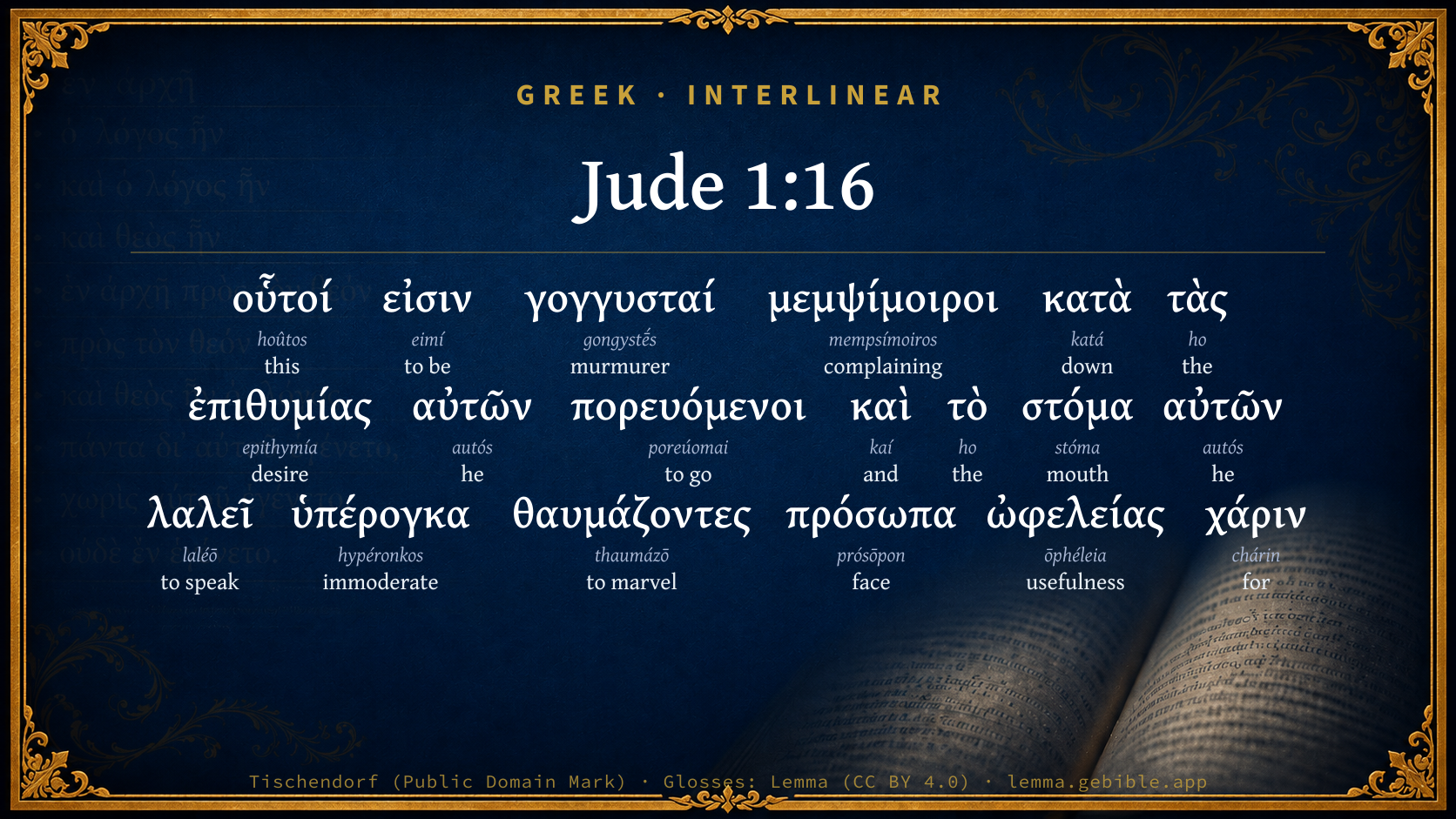
These are murmurers and complainers, walking after their lusts (and their mouth speaks proud things), showing respect of persons to gain advantage.
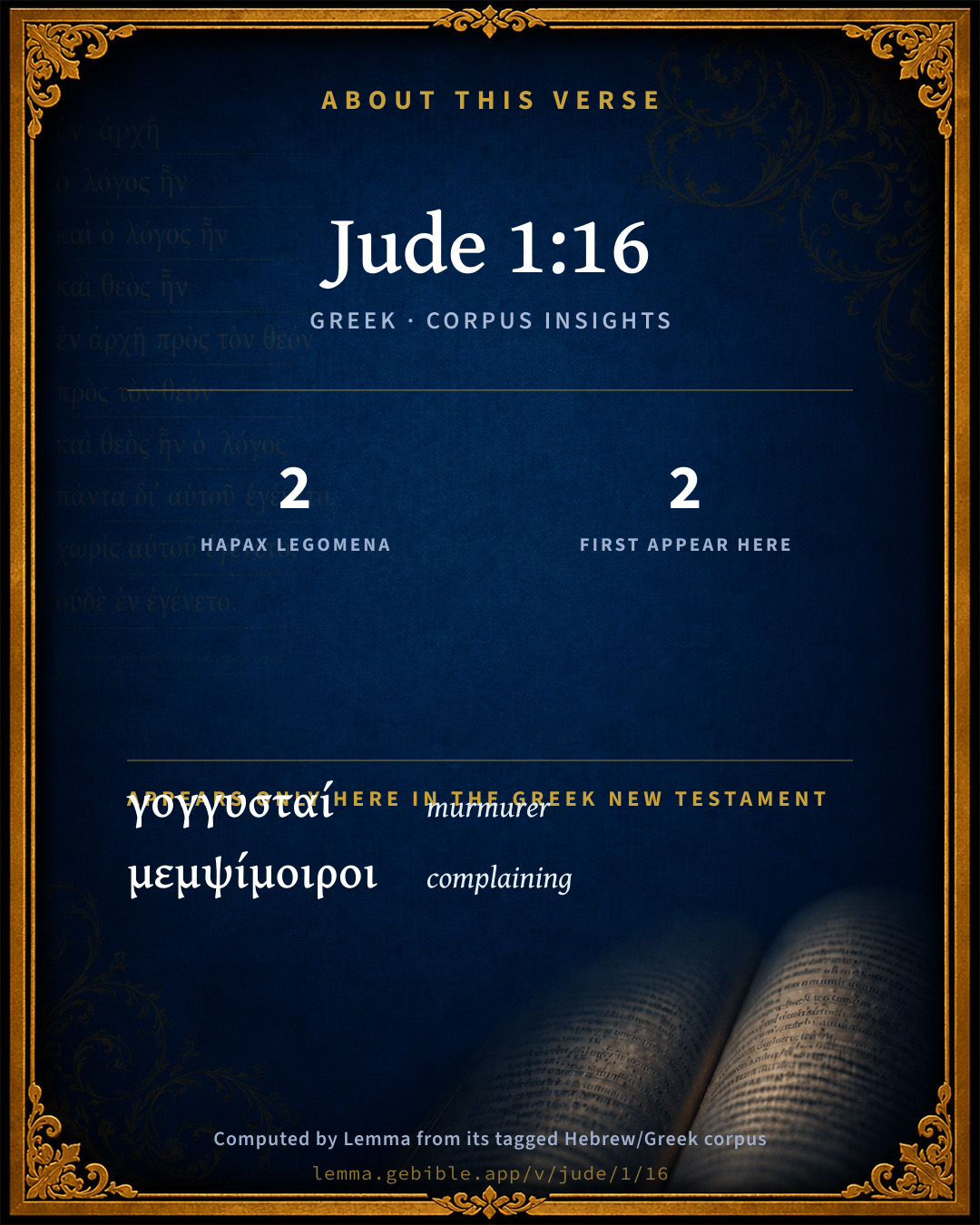
- 2 hapax legomena — only here in the Greek New Testament
- 2 first appearances in the Greek New Testament
Download a study sheet
One document with this verse’s original text, its word-by-word gloss line, the meaning frame, cross-references with their text, attributed commentary, and full source and license credits — printable, and it pastes into notes with its structure intact.
This verse Autodidact and up
A passage Seminary Student
Up to 50 verses in one chapter. A passage sheet keeps up to 6 commentary sources and 12 cross-references per verse, in the order this page ranks them, and says so on the sheet whenever that leaves anything out. Ask for a single verse and you get the Autodidact verse sheet above.
Everything on this page stays free to read, with no account — the sheet is a download of what is already on screen, not access to it.
Compare translations 3
The same verse in 3 English versions, stacked beneath the original-language interlinear above. Click any original word for its lexicon entry.
Each is an independent rendering of the whole verse — the interlinear is not word-aligned to these translations.
Highlighted words mark where these versions differ — a whole-verse word diff, not a word-by-word alignment.
-
World English Bible Public Domain
These are murmurers and complainers, walking after their lusts (and their mouth speaks proud things), showing respect of persons to gain advantage.
-
King James Version Public Domain
These are murmurers, complainers, walking after their own lusts; and their mouth speaketh great swelling words, having men's persons in admiration because of advantage.
-
unfoldingWord Literal Text CC BY-SA 4.0
These ones are murmurers, complainers, going according to their lusts, and their mouth speaks boastful things, admiring faces for the sake of advantage.
unfoldingWord Literal Text — © unfoldingWord, licensed CC BY-SA 4.0. Word-aligned USFM3 via Door43 (git.door43.org/unfoldingWord/en_ult).
Show all 19 translations
Every available English version of this verse, each an independent rendering of the whole verse.
-
World English Bible Public Domain
These are murmurers and complainers, walking after their lusts (and their mouth speaks proud things), showing respect of persons to gain advantage.
-
Berean Standard Bible Public Domain
These men are discontented grumblers, following after their own lusts; their mouths spew arrogance; they flatter others for their own advantage.
-
Majority Standard Bible Public Domain
These men are discontented grumblers, following after their own lusts; their mouths spew arrogance; they flatter others for their own advantage.
-
King James Version Public Domain
These are murmurers, complainers, walking after their own lusts; and their mouth speaketh great swelling words, having men's persons in admiration because of advantage.
-
American Standard Version (1901) Public Domain
These are murmurers, complainers, walking after their lusts (and their mouth speaketh great swelling `words'), showing respect of persons for the sake of advantage.
-
Revised Version (1885) Public Domain
These are murmurers, complainers, walking after their lusts (and their mouth speaketh great swelling words), shewing respect of persons for the sake of advantage.
-
Geneva Bible (1599) Public Domain
These are murmurers, complainers, walking after their owne lustes: Whose mouthes speake proud things, hauing mens persons in admiration, because of aduantage.
-
Douay-Rheims (1899) Public Domain
These are murmurers, full of complaints, walking according to their own desires, and their mouth speaketh proud things, admiring persons for gain's sake.
-
Young's Literal Translation Public Domain
These are murmurers, repiners; according to their desires walking, and their mouth doth speak great swellings, giving admiration to persons for the sake of profit;
-
Literal Standard Version CC BY-SA 4.0
These are discontented grumblers, walking according to their own lusts; and their mouth speaks swollen words, giving admiration to persons for the sake of profit;
-
Unlocked Literal Bible CC BY-SA 4.0
These are grumblers, complainers, who follow their evil desires. They are loud boasters, who, for their own advantage, flatter others.
-
unfoldingWord Literal Text CC BY-SA 4.0
These ones are murmurers, complainers, going according to their lusts, and their mouth speaks boastful things, admiring faces for the sake of advantage.
-
Darby Bible Public Domain
These are murmurers, complainers, walking after their lusts; and their mouth speaks swelling words, admiring persons for the sake of profit.
-
World Messianic Bible Public Domain
These are murmurers and complainers, walking after their lusts—and their mouth speaks proud things—showing respect of persons to gain advantage.
-
Webster's Bible Public Domain
These are murmurers, complainers, walking after their own lusts; and their mouth speaketh great swelling words, having men's persons in admiration because of advantage.
-
Free Bible Version CC BY-SA 4.0
Such people are grumblers, always complaining. They follow their own evil desires, speaking boastfully about themselves, and flattering others to get what they want.
-
Bible in Basic English Public Domain
These are the men who make trouble, ever desiring change, going after evil pleasures, using high-sounding words, respecting men's position in the hope of reward.
-
Text-Critical English NT CC BY 4.0
These men are grumblers and complainers, walking according to their own lusts. They speak bombastic words with their mouths, admiring people for their own advantage.
-
Tyndale New Testament (1534) Public Domain
These are murmurers complayners walkynge after their awne lustes whose mouthes speake proude thynges. They have men in greate reverence be cause of a vauntage.
Literal Standard Version (2020), Covenant Press — licensed CC BY-SA 4.0. Text via the HelloAO Bible API (eBible.org). Unlocked Literal Bible (unfoldingWord) — licensed CC BY-SA 4.0. Text via the HelloAO Bible API (eBible.org). unfoldingWord Literal Text — © unfoldingWord, licensed CC BY-SA 4.0. Word-aligned USFM3 via Door43 (git.door43.org/unfoldingWord/en_ult). Free Bible Version, Dr. Jonathan Gallagher — licensed CC BY-SA 4.0. Text via the HelloAO Bible API (eBible.org).
Word by word
More ways to search: Search by grammar → Find every occurrence → Compare this word →
Practice this passage: Drill this verse → Learn its vocabulary →
- Appears 1× in the Greek New Testament
- First appears here
- Part of Speech
- Noun
- Case
- Nominative
- Number
- Plural
- Gender
- Masculine
Full Thayer's Definition
- οὗτοί hoûtos G3778 “this” Demonstrative pronoun, Nominative, Plural, Masculine
- εἰσιν eimí G1510 “to be” Verb, Present, Active, Indicative, 3rd person, Plural
- γογγυσταί gongystḗs G1113 “murmurer” Noun, Nominative, Plural, Masculine
- μεμψίμοιροι mempsímoiros G3202 “complaining” Adjective, Nominative, Plural, Masculine
- κατὰ katá G2596 “down” Preposition
- τὰς ho G3588 “the” Article, Accusative, Plural, Feminine
- ἐπιθυμίας epithymía G1939 “desire” Noun, Accusative, Plural, Feminine
- αὐτῶν autós G846 “he” Personal pronoun, Genitive, Plural, Masculine
- πορευόμενοι poreúomai G4198 “to go” Verb, Present, Middle or Passive deponent, Participle, Nominative, Plural, Masculine
- καὶ kaí G2532 “and” Conjunction
- τὸ ho G3588 “the” Article, Nominative, Singular, Neuter
- στόμα stóma G4750 “mouth” Noun, Nominative, Singular, Neuter
- αὐτῶν autós G846 “he” Personal pronoun, Genitive, Plural, Masculine
- λαλεῖ laléō G2980 “to speak” Verb, Present, Active, Indicative, 3rd person, Singular
- ὑπέρογκα hypéronkos G5246 “immoderate” Adjective, Accusative, Plural, Neuter
- θαυμάζοντες thaumázō G2296 “to marvel” Verb, Present, Active, Participle, Nominative, Plural, Masculine
- πρόσωπα prósōpon G4383 “face” Noun, Accusative, Plural, Neuter
- ὠφελείας ōphéleia G5622 “usefulness” Noun, Genitive, Singular, Feminine
- χάριν chárin G5484 “for” Adverb
About this verse
These counts appear in no published source. They are computed here, from the morphology-tagged text and Lemma’s own curated glosses. What Lemma adds →
- 19
- words
- 17
- distinct lemmas
- General Epistles
- section
Notable vocabulary
2 hapax legomena — words that appear only here in the entire Greek New Testament:
First appearance in Scripture
These words make their first canonical appearance in the Greek New Testament here:
Shared distinctive vocabulary
ὑπέρογκα immoderate G5246 occurs in 2 verses of the Greek New Testament. Also found in:
Cross-references
36Topical passages linked to Jude 1:16 in the Treasury of Scripture Knowledge — connected by theme and wording, ordered by reader-vote popularity; previews shown in the World English Bible.
- 2 Peter 2:18 For, uttering great swelling words of emptiness, they entice in the lusts of the flesh, by licentiousness, those who are indeed escaping from those who live in error;
- Philippians 2:14 Do all things without murmurings and disputes,
- 2 Peter 2:10 but chiefly those who walk after the flesh in the lust of defilement, and despise authority. Daring, self-willed, they are not afraid to speak evil of dignitaries;
- 1 Timothy 6:5 constant friction of people of corrupt minds and destitute of the truth, who suppose that godliness is a means of gain. Withdraw yourself from such.
- 1 Corinthians 10:10 Neither grumble, as some of them also grumbled, and perished by the destroyer.
- James 1:14–15 But each one is tempted, when he is drawn away by his own lust, and enticed.
- 1 Peter 2:11 Beloved, I beg you as foreigners and pilgrims, to abstain from fleshly lusts, which war against the soul;
- 1 Peter 4:2 that you no longer should live the rest of your time in the flesh for the lusts of men, but for the will of God.
- 2 Peter 3:3 knowing this first, that in the last days mockers will come, walking after their own lusts,
- Jude 1:18 They said to you that "In the last time there will be mockers, walking after their own ungodly lusts."
- Leviticus 19:15 "'You shall do no injustice in judgment: you shall not be partial to the poor, nor show favoritism to the great; but in righteousness shall you judge your neighbor.
- Numbers 16:11 Therefore you and all your company are gathered together against Yahweh: and Aaron, what is he who you murmur against him?
- Psalms 15:4 In whose eyes a vile man is despised, But who honors those who fear Yahweh; He who keeps an oath even when it hurts, and doesn't change;
- Psalms 17:10 They close up their callous hearts. With their mouth they speak proudly.
- Psalms 73:9–11 They have set their mouth in the heavens. Their tongue walks through the earth.
- Isaiah 29:24 They also who err in spirit shall come to understanding, and those who murmur shall receive instruction.
- John 6:61 But Jesus knowing in himself that his disciples murmured at this, said to them, "Does this cause you to stumble?
- Galatians 5:16 But I say, walk by the Spirit, and you won't fulfill the lust of the flesh.
- 1 Peter 1:14 as children of obedience, not conforming yourselves according to your former lusts as in your ignorance,
- 2 Peter 2:1–3 But there also arose false prophets among the people, as among you also there will be false teachers, who will secretly bring in destructive heresies, denying even the Master who bought them, bringing on themselves swift destruction.
- Jude 1:15 to execute judgment on all, and to convict all the ungodly of all their works of ungodliness which they have done in an ungodly way, and of all the hard things which ungodly sinners have spoken against him."
- Numbers 14:36 The men, whom Moses sent to spy out the land, who returned, and made all the congregation to murmur against him, by bringing up an evil report against the land,
- Deuteronomy 1:27 and you murmured in your tents, and said, Because Yahweh hated us, he has brought us forth out of the land of Egypt, to deliver us into the hand of the Amorites, to destroy us.
- Job 17:4–5 For you have hidden their heart from understanding, Therefore shall you not exalt them.
- Job 32:21 Please don't let me respect any man's person, Neither will I give flattering titles to any man.
- Job 34:19 Who doesn't respect the persons of princes, Nor regards the rich more than the poor; For they all are the work of his hands.
- Psalms 106:25 But murmured in their tents, And didn't listen to Yahweh's voice.
- Proverbs 28:21 To show partiality is not good; Yet a man will do wrong for a piece of bread.
- Luke 5:30 Their scribes and the Pharisees murmured against his disciples, saying, "Why do you eat and drink with the tax collectors and sinners?"
- Luke 15:2 The Pharisees and the scribes murmured, saying, "This man welcomes sinners, and eats with them."
- Luke 19:7 When they saw it, they all murmured, saying, "He has gone in to lodge with a man who is a sinner."
- John 6:41 The Jews therefore murmured concerning him, because he said, "I am the bread which came down out of heaven."
- Galatians 5:24 Those who belong to Christ have crucified the flesh with its passions and lusts.
- 1 Thessalonians 4:5 not in the passion of lust, even as the Gentiles who don't know God;
- 2 Timothy 4:3 For the time will come when they will not listen to the sound doctrine, but, having itching ears, will heap up for themselves teachers after their own lusts;
- James 2:1–9 My brothers, don't hold the faith of our Lord Jesus Christ of glory with partiality.
Cross-references courtesy of OpenBible.info (CC BY 4.0).
Lesson kit
Teaching starters — assembled from the data on this page, not authored interpretation. Every prompt links to the verse data it draws on. Edit before teaching.
Jude, in the General Epistles, opens this verse with 19 words (17 distinct Greek lemmas). Its most distinctive word is gongystḗs (“murmurer”). A historical commentator’s framing appears above. Read the whole chapter for the surrounding context.
Discussion questions
- The word gongystḗs carries the sense “murmurer.” How does it shape the verse?
- This verse holds 2 words here found nowhere else in the Greek New Testament. What might the rare words draw attention to?
- 2 words here appear for the first time in Scripture. What is being introduced at this debut?
- 2 Peter 2:18 shares the word «immoderate» with this verse. How do the two illuminate each other?
- “the” occurs 2× in this one verse. What is the effect of the repetition?
- The translations on this page render this verse differently — a whole-verse word diff, not a word-by-word alignment. What might account for the different wordings?
- Reading how Matthew Henry's Commentary and The Biblical Illustrator read this verse, where do the two commentators agree and where do they part?
Things to notice
- 2 words in this verse appear nowhere else in the Greek New Testament.
- 2 words make their first canonical appearance in Scripture here.
- These translations choose different wording for 25 words in this verse.
- “the” occurs 2× in this single verse.
- 17 distinct Greek lemmas span 19 words in this verse.
Commentary
Notes on Jude 1:16 from classic Christian and Jewish commentators (each source and its license shown beneath its notes). The classic Christian expositions comment on the surrounding passage and are grouped to its opening verse, so a note may address several verses; the Jewish commentaries on the Tanakh (Rashi and others) are per-verse, so they appear only where the commentator wrote on this verse.
Lemma curates 59 commentaries, every one of them public domain or Creative Commons licensed, each selected and text-cleaned for this edition rather than reprinted as found. About our sources →
Matthew Henry's Commentary
Matthew Henry's Commentary on the Whole Bible (1708–1710) — public domain (CC PDM 1.0). Text via the HelloAO Bible API.
The Biblical Illustrator
Joseph S. Exell
The Biblical Illustrator, edited by Joseph S. Exell (c. 1880s–1900s) — public domain. Text from a community e-Sword module.
Joseph Benson's Commentary
Joseph Benson's Commentary on the Old and New Testaments (1811–1818) — public domain. Text from a community e-Sword module.
Lange's Commentary on the Holy Scriptures
Lange's Commentary on the Holy Scriptures (Critical, Doctrinal, and Homiletical), ed. John Peter Lange, English translation edited by Philip Schaff (1864–1880) — public domain. Text from a community e-Sword module.
The Expositor's Bible
William Robertson Nicoll, ed., The Expositor's Bible (London: Hodder & Stoughton, 1887–1910) — public domain. 65 of 66 books (1 Corinthians is not separately keyed, as that volume carries no machine-parseable verse references); section-level commentary keyed to the opening verse. Introductory and overview sections not keyed to a specific passage are excluded.
Tyndale Open Study Notes
Tyndale Open Resources
Tyndale Open Study Notes — © Tyndale Open Resources, licensed CC BY-SA 4.0. Text via the HelloAO Bible API.
Bengel's Gnomon
Johann Albrecht Bengel
Bengel's Gnomon of the New Testament — English translation (T&T Clark, Edinburgh, 1860) — public domain. Text from a community e-Sword module.
Meyer's Critical & Exegetical Commentary
Heinrich August Wilhelm Meyer
Meyer — Critical and Exegetical Commentary on the New Testament — English translation by Peter Christie, edited by Frederick Crombie (T&T Clark, 1880) — public domain. Text from a community e-Sword module.
Expositor's Greek Testament
ed. W. Robertson Nicoll
The Expositor's Greek Testament, edited by W. Robertson Nicoll (1897–1910) — public domain. Text from a community e-Sword module.
Jamieson, Fausset & Brown
Robert Jamieson, A. R. Fausset & David Brown
Jamieson, Fausset & Brown — Commentary Critical and Explanatory on the Whole Bible (1871) — public domain (CC PDM 1.0). Text via the HelloAO Bible API.
Adam Clarke's Commentary
Adam Clarke's Commentary on the Bible (1810–1826) — public domain. Text from a community e-Sword/MySword module.
John Calvin's Commentaries
John Calvin's Commentaries (1540-1563) — public domain. Text from the Calvin Translation Society English edition (1840s-50s) via the Christian Classics Ethereal Library (ccel.org). Calvin's coverage is partial (roughly two-thirds of the Bible); uncommented books and verses are honest gaps, never fabricated. The 19th-century editor's footnotes and remarks are omitted so the notes are faithfully Calvin's own voice.
The Cambridge Bible for Schools and Colleges
gen. ed. J. J. S. Perowne
The Cambridge Bible for Schools and Colleges (gen. ed. J. J. S. Perowne; Cambridge University Press, 1878–1918) — public domain. Text from a community e-Sword module.
John Gill's Exposition
John Gill's Exposition of the Whole Bible (1746–1763) — public domain (CC PDM 1.0). Text via the HelloAO Bible API.
Albert Barnes' Notes on the Bible
Albert Barnes' Notes on the Bible (1834–1885) — public domain. Text from a community e-Sword/MySword module.
Haydock's Catholic Bible Commentary
George Leo Haydock (1774–1849), Haydock's Catholic Family Bible and Commentary, 1859 edition — public domain. Excludes Psalms (Douay-Rheims chapter numbering differs from Protestant) and Deuterocanonical books (Catholic canon only).
Matthew Poole's English Annotations
Matthew Poole's English Annotations on the Holy Bible (1683–1685) — public domain. Text from a community e-Sword/MySword module.
Whedon's Commentary on the Bible
Daniel D. Whedon
Daniel D. Whedon (gen. ed.), Commentary on the Old and New Testaments (1874–1909) — public domain. Text from a community e-Sword module.
The Pulpit Commentary
The Pulpit Commentary (1880–1919), ed. H.D.M. Spence-Jones & Joseph S. Exell — public domain. Text from a community e-Sword module.
John Wesley's Explanatory Notes
John Wesley, Explanatory Notes Upon the Whole Bible (1754–1765) — public domain. Text via the GEBible commentary corpus.
Burkitt's Expository Notes on the New Testament
William Burkitt
William Burkitt's Expository Notes on the New Testament (1700–1703) — public domain. Text from a community e-Sword module.
Godbey's Commentary on the New Testament
William B. Godbey
William B. Godbey, Commentary on the New Testament (1896–1900) — public domain. Text from a community e-Sword module.
The People's New Testament
B. W. Johnson
B. W. Johnson's The People's New Testament with Notes (1889–1891) — public domain. Electronic text from the Christian Classics Ethereal Library (CCEL) ThML edition.
Cambridge Greek Testament for Schools and Colleges
Cambridge Greek Testament for Schools and Colleges (Cambridge University Press, 1896; 21 vols, various authors incl. Carr, Maclear, Plummer, Farrar, Lumby, Moule, M. R. James, Simcox) — public domain. Text from a community e-Sword module.
Alford’s Greek Testament
Henry Alford
Henry Alford, The Greek Testament (1849–1861) — public domain. Text from a community e-Sword module.
International Critical Commentary
International Critical Commentary — older volumes (1896–1929), various authors — public domain. Text from a community e-Sword module.
Vincent's Word Studies in the New Testament
Marvin R. Vincent
Marvin R. Vincent, Word Studies in the New Testament (1887–1900) — public domain. Text from a community e-Sword/MySword module.