Galatians 1:22

Greek (Tischendorf 8th ed.) Galatians 1:22 appears in the Greek New Testament. The text above is from the Tischendorf 8th edition. Each word links to its Strong’s number and a concise gloss. Click any word for its full Thayer’s Greek Lexicon entry.
Download image
Cite this verse

Galatians 1:22 (World English Bible). Public Domain. Lemma interlinear Bible study tool, https://lemma.gebible.app/v/galatians/1/22.

Show BibTeX & RIS
BibTeX
RIS
English Translation
I was still unknown by face to the assemblies of Judea which were in Christ,
World English Bible · Public Domain
Download a study sheet

One document with this verse’s original text, its word-by-word gloss line, the meaning frame, cross-references with their text, attributed commentary, and full source and license credits — printable, and it pastes into notes with its structure intact.

This verse Autodidact and up

Study sheet (.html) Plain text (.txt)

A passage Seminary Student

Up to 50 verses in one chapter. A passage sheet keeps up to 6 commentary sources and 12 cross-references per verse, in the order this page ranks them, and says so on the sheet whenever that leaves anything out. Ask for a single verse and you get the Autodidact verse sheet above.

Everything on this page stays free to read, with no account — the sheet is a download of what is already on screen, not access to it.

Want to remove ads? Support Godless Engineer
Compare translations 3

The same verse in 3 English versions, stacked beneath the original-language interlinear above. Click any original word for its lexicon entry.

Each is an independent rendering of the whole verse — the interlinear is not word-aligned to these translations.

Highlighted words mark where these versions differ — a whole-verse word diff, not a word-by-word alignment.

  • World English Bible Public Domain
    I was still unknown by face to the assemblies of Judea which were in Christ,
  • King James Version Public Domain
    And was unknown by face unto the churches of Judaea which were in Christ:
  • unfoldingWord Literal Text CC BY-SA 4.0
    Now I was unknown by face to the churches of Judea in Christ.

unfoldingWord Literal Text — © unfoldingWord, licensed CC BY-SA 4.0. Word-aligned USFM3 via Door43 (git.door43.org/unfoldingWord/en_ult).

Versions to compare (up to 4)

3 of 4 selected

Show all 19 translations

Every available English version of this verse, each an independent rendering of the whole verse.

  • World English Bible Public Domain
    I was still unknown by face to the assemblies of Judea which were in Christ,
  • Berean Standard Bible Public Domain
    I was personally unknown, however, to the churches of Judea that are in Christ.
  • Majority Standard Bible Public Domain
    I was personally unknown, however, to the churches of Judea that are in Christ.
  • King James Version Public Domain
    And was unknown by face unto the churches of Judaea which were in Christ:
  • American Standard Version (1901) Public Domain
    And I was still unknown by face unto the churches of Judaea which were in Christ:
  • Revised Version (1885) Public Domain
    And I was still unknown by face unto the churches of Judaea which were in Christ:
  • Geneva Bible (1599) Public Domain
    But they had heard onely some say, Hee which persecuted vs in time past, nowe preacheth the faith which before he destroyed.
  • Douay-Rheims (1899) Public Domain
    And I was unknown by face to the churches of Judea, which were in Christ:
  • Young's Literal Translation Public Domain
    and was unknown by face to the assemblies of Judea, that `are' in Christ,
  • Literal Standard Version CC BY-SA 4.0
    and was unknown by face to the assemblies of Judea, that [are] in Christ,
  • Unlocked Literal Bible CC BY-SA 4.0
    I was still not personally known to the churches of Judea that are in Christ.
  • unfoldingWord Literal Text CC BY-SA 4.0
    Now I was unknown by face to the churches of Judea in Christ.
  • Darby Bible Public Domain
    But I was unknown personally to the assemblies of Judaea which [are] in Christ;
  • World Messianic Bible Public Domain
    I was still unknown by face to the assemblies of Judea which were in Messiah,
  • Webster's Bible Public Domain
    And was unknown by face to the churches of Judea which were in Christ:
  • Free Bible Version CC BY-SA 4.0
    Even so, my face wasn't known to those in the churches of Judea.
  • Bible in Basic English Public Domain
    And the churches of Judaea which were in Christ still had no knowledge of my face or person:
  • Text-Critical English NT CC BY 4.0
    But I was personally unknown to the churches of Judea that are in Christ.
  • Tyndale New Testament (1534) Public Domain
    and was vnknowen as touchinge my person vnto the congregacions of Iewrye which were in Christ.

Literal Standard Version (2020), Covenant Press — licensed CC BY-SA 4.0. Text via the HelloAO Bible API (eBible.org). Unlocked Literal Bible (unfoldingWord) — licensed CC BY-SA 4.0. Text via the HelloAO Bible API (eBible.org). unfoldingWord Literal Text — © unfoldingWord, licensed CC BY-SA 4.0. Word-aligned USFM3 via Door43 (git.door43.org/unfoldingWord/en_ult). Free Bible Version, Dr. Jonathan Gallagher — licensed CC BY-SA 4.0. Text via the HelloAO Bible API (eBible.org).

Word by word

More ways to search: Search by grammar → Find every occurrence → Compare this word →

Practice this passage: Drill this verse → Learn its vocabulary →

ἀγνοούμενος
agnoéō
G50
“to be ignorant”
Verb, Present, Passive, Participle, Nominative, Singular, Masculine
Part of Speech
Verb
Tense
Present
Voice
Passive
Mood
Participle
Case
Nominative
Number
Singular
Gender
Masculine
Full Thayer's Definition

Origin: from G1 (as a negative particle) and G3539

TDNT: 02:55,2

1. to be ignorant, not to know 2. not to understand, unknown 3. to err or sin through mistake, to be wrong
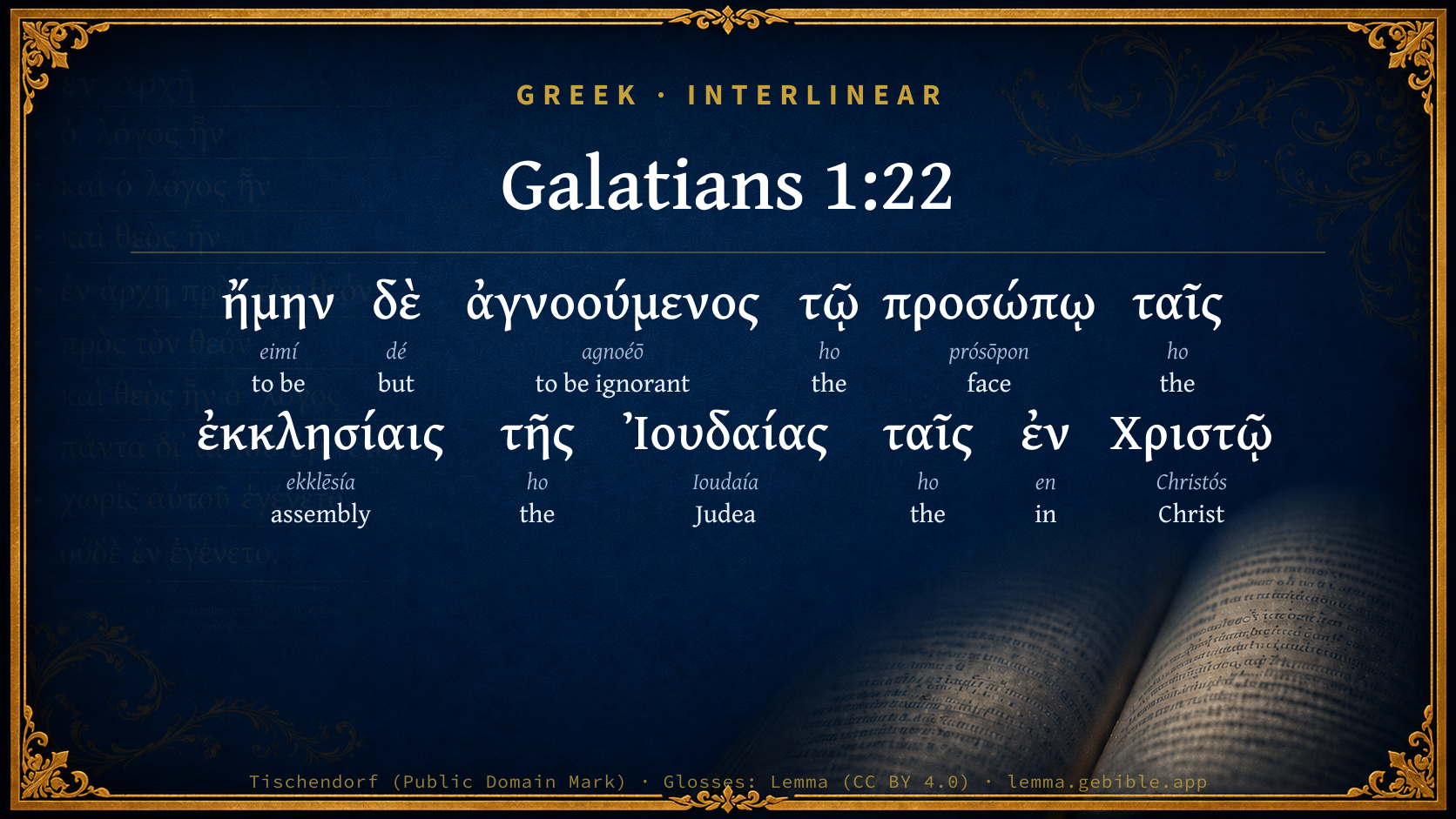
  1. ἤμην eimí G1510 “to be” Verb, Imperfect, Middle, Indicative, 1st person, Singular
  2. δὲ dé G1161 “but” Conjunction
  3. τῷ ho G3588 “the” Article, Dative, Singular, Neuter
  4. προσώπῳ prósōpon G4383 “face” Noun, Dative, Singular, Neuter
  5. ταῖς ho G3588 “the” Article, Dative, Plural, Feminine
  6. ἐκκλησίαις ekklēsía G1577 “assembly” Noun, Dative, Plural, Feminine
  7. τῆς ho G3588 “the” Article, Genitive, Singular, Feminine
  8. Ἰουδαίας Ioudaía G2449 “Judea” Noun, Genitive, Singular, Feminine
  9. ταῖς ho G3588 “the” Article, Dative, Plural, Feminine
  10. ἐν en G1722 “in” Preposition
  11. Χριστῷ Christós G5547 “Christ” Noun, Dative, Singular, Masculine

About this verse

These counts appear in no published source. They are computed here, from the morphology-tagged text and Lemma’s own curated glosses. What Lemma adds →

12
words
9
distinct lemmas
Pauline Epistles
section

Notable vocabulary

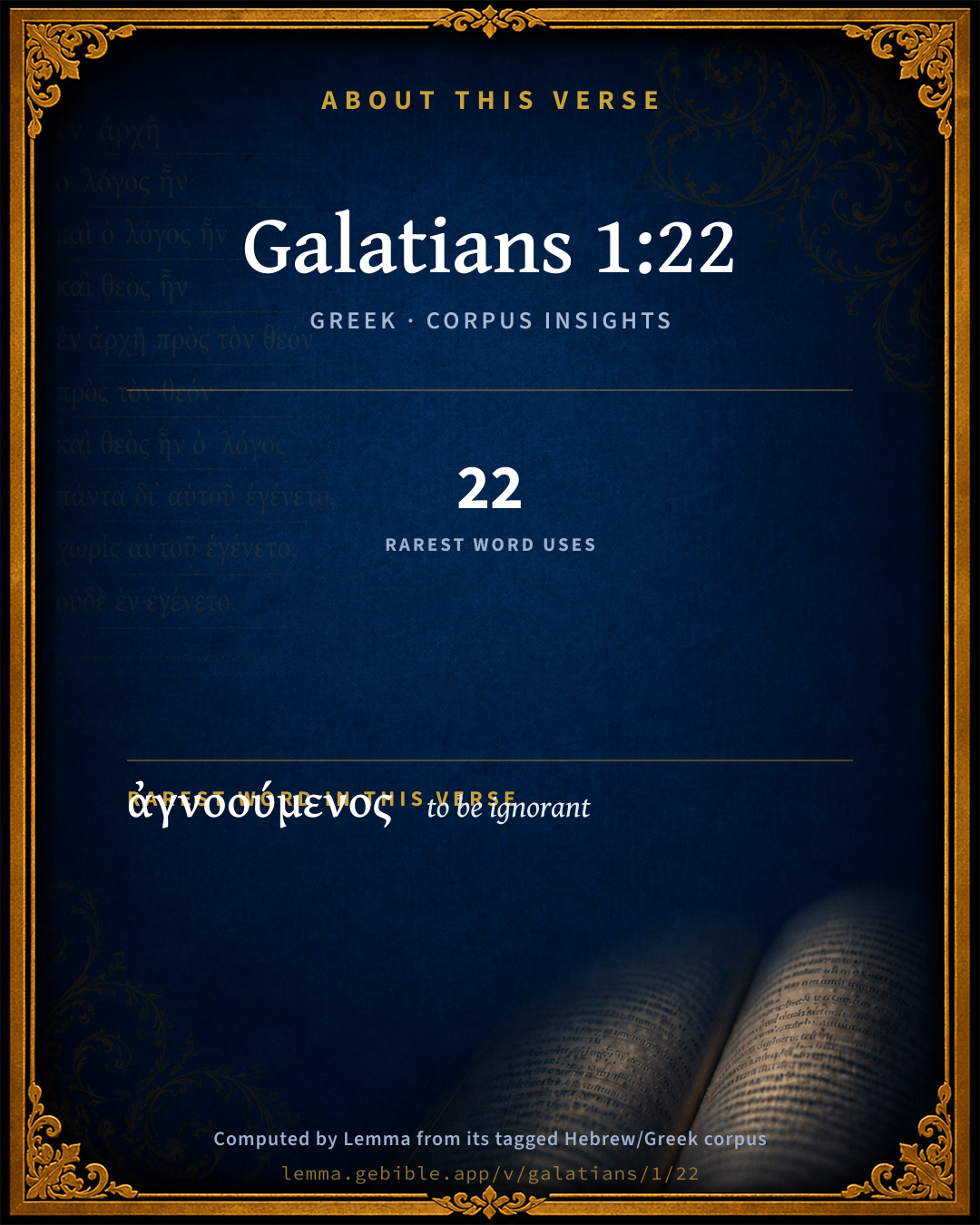
The rarest word here is ἀγνοούμενος to be ignorant G50 — appearing just 22 times in the whole Greek New Testament.

Shared distinctive vocabulary

ἀγνοούμενος to be ignorant G50 occurs in 21 verses of the Greek New Testament. Also found in:

Repetition

A word recurs within this verse:

Cross-references

7

Topical passages linked to Galatians 1:22 in the Treasury of Scripture Knowledge — connected by theme and wording, ordered by reader-vote popularity; previews shown in the World English Bible.

  • 1 Thessalonians 2:14 For you, brothers, became imitators of the assemblies of God which are in Judea in Christ Jesus; for you also suffered the same things from your own countrymen, even as they did from the Jews;
  • Romans 16:7 Greet Andronicus and Junias, my relatives and my fellow prisoners, who are notable among the apostles, who also were in Christ before me.
  • Acts 9:31 So the assemblies throughout all Judea and Galilee and Samaria had peace, and were built up. They were multiplied, walking in the fear of the Lord and in the comfort of the Holy Spirit.
  • 1 Corinthians 1:30 But of him, you are in Christ Jesus, who was made to us wisdom from God, and righteousness and sanctification, and redemption:
  • Philippians 1:1 Paul and Timothy, servants of Jesus Christ; To all the saints in Christ Jesus who are at Philippi, with the overseers and deacons:
  • 1 Thessalonians 1:1 Paul, Silvanus, and Timothy, to the assembly of the Thessalonians in God the Father and the Lord Jesus Christ: Grace to you and peace from God our Father and the Lord Jesus Christ.
  • 2 Thessalonians 1:1 Paul, Silvanus, and Timothy, to the assembly of the Thessalonians in God our Father, and the Lord Jesus Christ:

Cross-references courtesy of OpenBible.info (CC BY 4.0).

Commentary

Notes on Galatians 1:22 from classic Christian and Jewish commentators (each source and its license shown beneath its notes). The classic Christian expositions comment on the surrounding passage and are grouped to its opening verse, so a note may address several verses; the Jewish commentaries on the Tanakh (Rashi and others) are per-verse, so they appear only where the commentator wrote on this verse.

Lemma curates 59 commentaries, every one of them public domain or Creative Commons licensed, each selected and text-cleaned for this edition rather than reprinted as found. About our sources →

The Biblical Illustrator

Joseph S. Exell

Gal_1:22

Which were in Christ.

Relation of Churches to Christ:

I. They are founded on Christ (Mat_16:18; 1Co_1:2).

II. They are built by Christ (Eph_4:16).

III. They are the body of Christ (Eph_1:23; Eph_4:12).

IV. They are redeemed through Christ (Act_20:28; Eph_5:25).

V. They are consecrated to Christ (Eph_5:26).

VI. They will be glorified in Christ (Eph_5:27). We are reminded of the beautiful symbol of the prophet, as he saw in the Messianic age flecks of doves, varied it may be in their plumage, speeding with fleet wings to the windows of the true ark, safe in Christ from the windy storm and tempest (Isa_9:8); or the still more apposite figure employed by the Redeemer Himself when not only does He speak of the individual members of His flock, calling His own separate sheep by name, and one by one leading them out; but also refers to them in the aggregate. They constitute, though with divers folds and many under-shepherds, one great flock--reposing in green pastures, and by the waters of comfort under Himself, the chief Shepherd and Bishop of souls. (J. R. Macduff, D. D.)

The Biblical Illustrator, edited by Joseph S. Exell (c. 1880s–1900s) — public domain. Text from a community e-Sword module.

Bengel's Gnomon

Johann Albrecht Bengel

Gal 1:22. Τῆς Ιὀυδαίας, of Judœa) with the exception of Jerusalem.

Bengel's Gnomon of the New Testament — English translation (T&T Clark, Edinburgh, 1860) — public domain. Text from a community e-Sword module.

Meyer's Critical & Exegetical Commentary

Heinrich August Wilhelm Meyer

Gal_1:22. But I was so completely a stranger to the land of Judaea, that at the time of my sojourn in Syria and Cilicia I was personally unknown to the churches, etc. These statements (Gal_1:22-24) likewise go to prove that Paul had not been a disciple of the apostles, which is indeed the object aimed at in the whole of the context. As a pupil of the apostles, he would have remained in communication with Jerusalem; and thence issuing, he would first of all have exercised his ministry in the churches of Judaea, and would have become well known to them. According to Hofmann, the end at which Paul aims in Gal_1:22 f. is conveyed by καὶ ἐδόξαζον κ.τ.λ. in Gal_1:24, so that Gal_1:22-23 are only related to this as the protasis to the apodosis. This idea is at variance with the independent and important nature of the two affirmations in Gal_1:22-23; if Paul had intended to give them so subordinate a position as that which Hofmann supposes, he would have done it by a participial construction (ἀγνοοῦντες δὲ … μόνον δὲ ἀκούοντες, ὅτι κ.τ.λ., ἐδόξαζον κ.τ.λ.), perhaps also with the addition of καίπερ, or in some other marked way. In the form in which the apostle has written it, his report introduced by ἔπειτα in Gal_1:21 is composed of propositions quite as independent as those following ἔπειτα in Gal_1:18, and Gal_1:22-23 cannot be intended merely to introduce Gal_1:24. Hofmann is therefore the more incorrect in asserting that Paul, from Gal_1:21 onwards, is not continuing the proof of his apostolic independence in contradistinction to the other apostles, but is exhibiting the harmony of his preaching with the faith of the mother-church at Jerusalem and its apostles. Others, inconsistently with the context, suppose that Paul desired to refute the allegation that he had been a learner from the churches of Judaea (Oecumenius, Gomarus, Olshausen), or that he himself had taught judaistically in Judaea (Chrysostom, Theophylact, Grotius; comp. Usteri), or that he had visited Syria and Cilicia as the deputy of the churches of Judaea (Michaelis).

τῷ προσώπῳ] as regards the (my) countenance, that is, personally. Comp. 1Th_2:17.

ταῖς ἐκκλησίαις τῆς Ἰουδ.] This is meant to refer to the churches out of Jerusalem, consequently in the Ἰουδαία γῆ, Joh_3:22. For that he was known to the church in the capital is not only a matter of inference from his pre-Christian activity, but is certain from that fifteen days visit (Gal_1:18), and is attested by Act_9:26-30. Neither in Act_9:26-30 nor in Act_26:19 f. (see on these passages) is there any such inconsistency with the passage before us, as has been urged against the historical character of the Acts, especially by Hilgenfeld, Baur, and Zeller.

Meyer — Critical and Exegetical Commentary on the New Testament — English translation by Peter Christie, edited by Frederick Crombie (T&T Clark, 1880) — public domain. Text from a community e-Sword module.

Expositor's Greek Testament

ed. W. Robertson Nicoll

Gal 1:22 . ἤμην δὲ ἀγν . The correct translation is not I was unknown (as our versions render it), but I was becoming unknown . At the beginning of this period he was a familiar figure in Jerusalem, but in the course of ten years’ absence he gradually became a stranger to the Christians of Judæa. ἐκκλησίαις . This passage speaks of the Churches of Judæa in the plural, as does also 1Th 2:14 . In the Acts the Church throughout Judæa, Galilee and Samaria is described as a single Church according to the text of the best MSS. (Act 9:31 ): the funds contributed for the relief of the poor Christians in Judæa are handed over to the Elders at Jerusalem (Act 11:29 , (Act 12:25 ); brethren from Judæa are censured as members of their own body by the assembled Church at Jerusalem (Act 15:1 ; Act 15:24 ). It would seem from this that an effective unity of administration and control existed in Jerusalem side by side with local organisation of the several Churches of Judæa.

The Expositor's Greek Testament, edited by W. Robertson Nicoll (1897–1910) — public domain. Text from a community e-Sword module.

Geneva Bible (1599)

Geneva Bible translators

The doctrine of faith.

Geneva Bible (1599) marginal notes — public domain. Text via Bolls.life.

Jamieson, Fausset & Brown

Robert Jamieson, A. R. Fausset & David Brown

So far was I from being a disciple of the apostles, that I was even unknown in the churches of Judea (excepting Jerusalem, Act 9:26-29), which were the chief scene of their labors.

Jamieson, Fausset & Brown — Commentary Critical and Explanatory on the Whole Bible (1871) — public domain (CC PDM 1.0). Text via the HelloAO Bible API.

Adam Clarke's Commentary

Verse 22. And was unknown by face] I was not personally acquainted with any of the Churches of Judea; I was converted in another place, and had not preached the Gospel in any Christian congregation in that country; I knew only those at Jerusalem.

Adam Clarke's Commentary on the Bible (1810–1826) — public domain. Text from a community e-Sword/MySword module.

John Calvin's Commentaries

22. And was unknown by face. This appears to be added for the sake of shewing more strongly the wickedness and malignity of his slanderers. If the churches of Judea who had only heard respecting him, were led to give glory to God for the astonishing change which he had wrought in Paul, how disgraceful was it that those who had beheld the fruits of his amazing labors should not have acted a similar part! If the mere report was enough for the former, why did not the facts before their eyes satisfy the latter?

John Calvin's Commentaries (1540-1563) — public domain. Text from the Calvin Translation Society English edition (1840s-50s) via the Christian Classics Ethereal Library (ccel.org). Calvin's coverage is partial (roughly two-thirds of the Bible); uncommented books and verses are honest gaps, never fabricated. The 19th-century editor's footnotes and remarks are omitted so the notes are faithfully Calvin's own voice.

Ellicott's Commentary for English Readers

(22) Was unknown by face.—The Greek is a shade stronger: I continued unknown. If in Jerusalem itself the Apostle had not had time to receive instruction from any one, still less was this the case with the other Christian communities of Judæa. To these he was not known even by sight. At the same time, so far were they from manifesting any opposition to his teaching, that their one thought was joy to hear of his conversion.

The churches of Judæa.—Judæa is here distinguished from Jerusalem. The phrase is noticeable as pointing to the spread and early organisation of the Church at a date removed by not more than ten years from our Lord’s ascension.

Which were in Christ.—This is added in order to distinguish the Christian from the Jewish communities. It means, however, something more than merely “Christian.” The various sections of the Christian Church not only professed a common creed, and were called by a common name, but they stood in the same direct and personal relation to Christ as their Head. It was His presence diffused among them which gave them unity.

A Bible Commentary for English Readers, edited by Charles John Ellicott (1878–1897) — public domain. Text from a community e-Sword module.

The Cambridge Bible for Schools and Colleges

gen. ed. J. J. S. Perowne

22. and was unknown] rather, and I continued unknown. So far from his having learned the truths which he taught from the other Apostles, the Churches of Judæa, to which they principally ministered at this time, did not know him even by sight. It is not certain whether the Church of Jerusalem is included among these. Bengel says, “outside Jerusalem.” But it is quite possible that during the fortnight spent in Jerusalem he had not become personally known to the brethren there.

which were in Christ] The word Church (= ecclesia, an assembly, Act_19:32; Act_19:39; Act_19:41) had not yet acquired the exclusively restricted sense of a Christian congregation. The Church of God (with its component churches or congregations) had existed in the patriarchal age and in subsequent times (even in the dark days when “they that feared the Lord spake often one to another”), until the coming of Christ. But they were not ‘in Christ’, until they had believed in and confessed the faith of Christ crucified.

The Cambridge Bible for Schools and Colleges (gen. ed. J. J. S. Perowne; Cambridge University Press, 1878–1918) — public domain. Text from a community e-Sword module.

John Gill's Exposition

And was unknown by face,.... Or "in person". This is said to prevent what might be objected, that though the apostle had not received the Gospel he preached from any of the apostles at Jerusalem; yet he might have had it from the churches that were in the land of Judea, and from some of the principal men in them; but this was so far from being truth, that he was not so much as known unto the churches of Judea which were in Christ; for there was not only a famous church of believers in Christ at Jerusalem, the metropolis of the land, but there were several congregated churches in the several parts of that country: by Judea we are to understand that part of the land of Israel so called, which was distinct not only from Samaria; but from Galilee and Perea, or the country beyond Jordan; for according to the Jews (d), the land of Israel was divided into three parts, Judea, Perea, and Galilee. Judea again was divided into three parts, the hill country, the plain, and the valley; and the plain of Lydda is as the plain of the south, and its mountainous part as the king's mountain; from Bethhoron to the sea is one province: and elsewhere (e) it is said, that the hill country of Judea is the king's mountain, the plain of it is the plain of the south, and the valley is from Engedi to Jericho--from Bethhoron to Emmaus is mountainous, from Emmaus to Lydda is a plain, and from Lydda to the sea a valley; from which may be collected where this country lay, and where were these churches here spoken of; the foundation of which might be laid in the conversion of some in those parts, through the ministry of the disciples of Christ, who were appointed witnesses of him not only in Jerusalem, but in all Judea and Samaria, Act 1:8 and about the time of the Apostle Paul's conversion, and his being at Jerusalem, there were churches gathered in Judea, as distinct from Galilee and Samaria, Act 9:31 particularly at Caesarea, Lydda, Saron, and Joppa. It is very likely that all the apostles, when they first set out to preach the Gospel after the ascension of Christ and the effusion of the Spirit, began in Judea; though some might make a very short stay, and others a longer. The Apostle and Evangelist Matthew is generally thought to have exercised his ministry chiefly in Judea, and to have continued there long; here he wrote his Gospel for the sake of the Jews that believed (f); and that, as a very ancient writer says (g), when Peter and Paul preached at Rome, and founded the church there. Judas Thaddaeus is also said (h) to go through Judea, Galilee, Samaria, Arabia, Syria, and Mesopotamia; and certain it is, that Philip, after he had baptized the eunuch, preached in all the cities from Azotus to Caesarea, where he seems to have stayed awhile and preached, Act 8:40 and where afterwards was a Gospel church state, of which See Gill on Act 10:48 and at Lydda and Saron, which were both in Judea, there were saints who were visited by the Apostle Peter, and others converted by him, about the time that our apostle here refers to; of the church at Lydda; See Gill on Act 9:32 at Joppa also, which was in the tribe of Dan, there were disciples at the same time, and very likely a church there; See Gill on Act 9:38 and it may be observed that the Apostle Peter was the minister of the circumcision, he had the Gospel of the circumcision committed to him, and he continued with and preached much to the circumcised Jews; and so in all likelihood was the instrument of planting the churches in Judea here spoken of. These are said to be

in Christ, as the church at Thessalonica, and that at Corinth are elsewhere said to be; because they professed to believe in Christ, were called by his name, and called upon his name; and though every individual member of them might not be in Christ, really united to him, and have communion with him; yet since they were all under a profession of him, they are considered as in him. The Arabic version reads it, "the churches of Judea which believe in Christ"; which though not a literal translation, gives the true sense of the passage, and distinguishes those churches from the synagogues or assemblies of the Jews which did not believe in Christ.

(d) Misn. Sheviith, c. 9. sect. 2. (e) T. Hieros. Sheviith, fol. 38. 4. (f) Hieron. Catalog. Script. Ecclesiast. sect. 4. fol. 90. A. (g) Irenaeus adv. Haeres. l. 3. c. 1. (h) Hist. Eccles. Magdeburg. cent. 1. l. 2. c. 10. p. 449.

John Gill's Exposition of the Whole Bible (1746–1763) — public domain (CC PDM 1.0). Text via the HelloAO Bible API.

Trapp's Complete Commentary

John Trapp

22 And was unknown by face unto the churches of Judaea which were in Christ:

Ver. 22. And was unknown] So far was Paul from learning aught of them.

John Trapp, A Commentary or Exposition upon All the Books of the Old and New Testament (1647–1656) — public domain. Text from a community e-Sword module.

Albert Barnes' Notes on the Bible

And was unknown by face ... - Paul had visited Jerusalem only, and he had formed no acquaintance with any of the churches in the other parts of Judea. He regarded himself at the first as called to preach particularly to the Gentiles, and he did not remain even to form an acquaintance with the Christians in Judea.

The churches of Judea - Those which were out of Jerusalem. Even at the early period of the conversion of Paul there were doubtless many churches in various parts of the land,

Which were in Christ - United to Christ; or which were Christian churches. The design of mentioning this is, to show that he had not derived his views of the gospel from any of them. He had neither been instructed by the apostles, nor was he indebted to the Christians in Judea for his knowledge of the Christian religion.

Albert Barnes' Notes on the Bible (1834–1885) — public domain. Text from a community e-Sword/MySword module.

Matthew Poole's English Annotations

To be in Christ, signifieth:

1. Their being Christians indeed; they having received Christ by a true and lively faith, and given themselves to the obedience of his precepts. In this sense the apostle saith: If any man be in Christ he is a new creature.

2. Their being Christians in name, by baptism and outward profession. These churches are said to be in Christ in this latter sense.

We have a parallel text, 1Th 2:14. They do not judge improperly, who think that by Judea here is not meant the province, but the whole country of Judea; which comprehended not Judea only, but Samaria and Galilee. John Baptist and our Saviour (who both mostly preached in Galilee) had prepared their due matter for gospel churches. Peter, and John, and Philip, preached the gospel in many villages of the Samaritans, Act 8:25,40. Of all these churches Paul speaks, telling us he was personally unknown unto them; so far he was from learning the Christian doctrine from the apostles or them.

Matthew Poole's English Annotations on the Holy Bible (1683–1685) — public domain. Text from a community e-Sword/MySword module.

Whedon's Commentary on the Bible

Daniel D. Whedon

22. Unknown… churches of Judea—And so could not have borrowed the Judean and Jerusalemite type of gospel. He was unknown at Jerusalem, only excepting the acquaintance they acquired with him, according to his own account, during his abode with Peter. Probably his intercourse was mainly with the Hellenists at Jerusalem. See Act_9:29, and note.

Daniel D. Whedon (gen. ed.), Commentary on the Old and New Testaments (1874–1909) — public domain. Text from a community e-Sword module.

The Pulpit Commentary

Vers. 22-24. It is somewhat difficult to determine, and when determined to make evident in translation, the precise flexure in the intonation (so to speak) of these verses. So far as the present writer can see, it is this: the de in ver. 22 is slightly adversative to the foregoing sentence; as if it were, "During that time the people of Syria and Cilicia saw a great deal of me, hut the Churches of Judaea did not see me at all." The de in ver. 23 introduces a contrast to the foregoing "unknown by face;" as if it were, "They knew me not by face, but only by report." The rendering to be now given will endeavour to represent this view of the whole passage.

And was unknown by face (hmhn demenov tw proswpw); but I was all the while unknown by face. The dative tw proswpw, "by face," or "in person," marks (see Winer," Gram. N. T.," 6, a) the sphere to which a wider term is restricted, as taiv fresin. (1Co_14:20) Its addition prepares the reader for the subsequent intimation that, though unknown by personal presentment, he was not unknown by repute. (comp. pw 1Th_2:17, Prosw ouj kardia) The widened form of the verb, hpmhn ajgnooumenov, instead of hjgnooumhn, intimates the long-continued period, represented by the words "all the while" in our rendering, for which the statement held good; which observation applies also to the ajkouontev hsan of ver. 23. The word "still," introduced in the Revised Version, imports, as I humbly venture to think, on idea not actually expressed in the Greek. The apostle states no more than that the Churches of Judaea had at that time no opportunity of coming to know him personally. There is no eti, They had, that is (for this is what seems intended), no opportunity of knowing him in his new character as a disciple of Christ. Whether or not they had known him in the terrible aspect of an unrelenting persecutor, is a matter which for the present lies out of the field of view. The period to which the apostle means this remark of his to apply may be assumed to be the whole time between his conversion and the close of this stay of his in Syria and Cilicia." This, as we learn from the Acts, terminated with Barnabas"s fetching him to join him in his work at Antioch. After this he did become known to the disciples of Judaea. Unto the Churches of Judaea which were in Christ (taiv ejkklhsiaiv thv jIoudaiav taiv ejn Cristw). This honorific form of designation, "which were in Christ," breathes a feeling on the part of the apostle of reverential respect for those Churches, as already organized communities vitally united to Christ, while he was as yet only beginning his Christian life (comp. Rom_16:7, "Who were also in Christ before me This ceremonious respectfulness is the more in place, inasmuch as the apostle had reason to know that the doctrinal position which he fell himself set to defend, in reference to obedience to the Mosaic Law, was generally distasteful to Jewish believers. Grateful is it, however, to his own feelings to recollect, and now thus publicly to recognize, the kindness and devout thankfulness which in those early days of his Christian career they had evinced with reference to him (see note on ver. 24). At the same time, his entire independence of the whole Jewish community when first beginning to preach is plainly indicated. It was from no Judaean Church any more than from Jerusalem and its apostles and elders that he derived the gospel which he had then and ever since been proclaiming. If we take the bearing of the clause, "which were in Christ," as above proposed, we have no need of (Ecumenius"s remark, endorsed by various critics, including Alford and even Bishop Lightfoot, that it was added to distinguish the ejkklhsiai of Christians from synagogues of non-Christian Jews. Indeed, the remark is itself open to grave exception. It is true that ejkklhsia in the singular number is used of the whole Israelite community antecedently to the Christian dispensation; but it is never found either in the New Testament or in the Septuagint to denote, as sunagwgh does, an organized collection of Israelites as such, dwelling in a particular neighbourhood, in the way that it is applied to an organized collection of Christians in a neighbourhood; neither is the noun ever applied to Israelites as such in the plural number. The term ejkklhsiai would, of course, be taken to mean Christian Churches and no other.

The Pulpit Commentary (1880–1919), ed. H.D.M. Spence-Jones & Joseph S. Exell — public domain. Text from a community e-Sword module.

Luther on Galatians

Martin Luther

VERSE 22, 23, 24. And was unknown by face unto the churches of Judaea which were in Christ: But they had heard only, that he which persecuted us in times past now preacheth the faith which once he destroyed. And they glorified God in me.

In Syria and Cilicia Paul won the indorsement of all the churches of Judea, by his preaching. All the churches everywhere, even those of Judea, could testify that he had preached the same faith everywhere. "And," Paul adds, "these churches glorified God in me, not because I taught that circumcision and the law of Moses should be observed, but because I urged upon all faith in the Lord Jesus Christ."

Martin Luther — Commentary on the Epistle to the Galatians (1535), English translation by Theodore Graebner (Zondervan, 1939) — public domain (U.S. copyright not renewed). Text from a community e-Sword module.

McGarvey & Pendleton's Commentaries

J. W. McGarvey

And I was still unknown by face unto the churches of Judaea which were in Christ:

J. W. McGarvey (with Philip Y. Pendleton), Commentaries on the New Testament (The Fourfold Gospel, 1914; Acts; and the epistles) — public domain. Text from a community e-Sword/MySword module.

The People's New Testament

B. W. Johnson

22. And was unknown by face, etc. The churches of Judea had heard of him, but few had seen him.

B. W. Johnson's The People's New Testament with Notes (1889–1891) — public domain. Electronic text from the Christian Classics Ethereal Library (CCEL) ThML edition.

Cambridge Greek Testament for Schools and Colleges

22. ἤμην δὲ ἀγνοούμενος … μόνον δὲ ἀκούοντες ἦσαν. As this is an original Greek part of the N.T., not a translation from Hebrew or Aramaic, Dr Moulton is inclined to give this periphrastic tense its full classical emphasis, “I was entirely unknown … only they had been hearing” (Proleg. 1906, p. 227).

τῷ προσώπῳ. Cf. Col 2:1; 1Th 2:17.

ταῖς ἐκκλησίαις, Gal 1:2 note.

τῆς Ἰουδαίας ταῖς ἐν Χριστῷ. The qualifying τ. ἐν Χρ. prevents any misunderstanding, Gal 1:13 note. The Church at Jerusalem had indeed seen St Paul since his conversion (Act 9:29; Act 11:30), but he distinguishes Judaea from Jerusalem, as in his speech in Act 26:20. Neither here nor in any of the three other passages where Ἰουδαία occurs in St Paul’s writings is there any reason to think that he includes more than approximately the old kingdom of Judah, i.e. that he uses the word in its Roman official sense of the district including Galilee and Samaria. See Introd. p. xx.

Cambridge Greek Testament for Schools and Colleges (Cambridge University Press, 1896; 21 vols, various authors incl. Carr, Maclear, Plummer, Farrar, Lumby, Moule, M. R. James, Simcox) — public domain. Text from a community e-Sword module.

International Critical Commentary

22. ἤμην δὲ ἀγνοούμενος τῷ προσώπῳ ταῖς ἐκκλησίαις τῆς Ἰουδαίας ταῖς ἐν Χριστῷ, “and I was unknown by face to the churches of Judea that are in Christ.” The periphrastic form of the imperfect tends to emphasise the continuance of the state, “I remained unknown.” The motive of these statements of the apostle respecting his departure into Syria and Cilicia and the non-acquaintance of the Judean churches with him is doubtless to show that his work during this period was not in that region in which it would have been if he had placed himself under the direction of the Twelve, but that, on the contrary, he began at once an independent mission. This, rather than, e. g., the intention to show that he was not under the influence or instruction of these churches, is what is required by the nature of the argument, which has to do not with his contact with Christians in general, but with his subjection to the influence of the leaders of primitive Christianity. On the expression ταῖς ἐκκλησίαις … ἐν Χριστῷ, cf. 1Th 1:1, 1Th 1:2:14, 2Th 1:1, Php 1:1. On the force of the preposition as meaning “in fellowship with,” see Th. s. v. 16 b, and cf. 5:6. The expression characterises the churches referred to as Christian as distinguished from Jewish, but reflects also the apostle’s conception of the intimacy of the fellowship between these communities and the risen Jesus.

In itself the phrase “churches of Judea” of course includes that of Jerusalem. Nor is that church excluded by the fact of Paul’s persecution of it, since this would not necessarily involve his meeting face to face those whom he persecuted, and, moreover, some years elapsed between the events referred to in v. 13 and those here recorded; nor by the visit of Paul to Jerusalem, as recorded in vv. 18, 19, since the statement that he was unknown can hardly be taken so literally as to mean that no member of the church had ever seen him. In favour of the more inclusive use of the term is also 1Th 2:14, where a similar phrase is employed without the exclusion of Jerusalem. Nor can Act 9:25-29 be regarded as a serious argument against the more inclusive sense of the term. For, though v. 29 manifestly implies such an acquaintance of Paul with the Christians of Jerusalem as to contradict his statement here if it includes Jerusalem, and though v. 29 itself might be accepted as not directly contradicted by vv. 18, 19 of the present passage, yet the conflict between the first-hand testimony of the latter and vv. 27, 28 of the Acts passage is such as to call in question the accuracy in details of the whole section in Acts. Act 26:20 is even more at variance with Paul’s statement here, unless it refers to a period subsequent to the period covered by Gal 1:18-24. Nor can Joh 3:22 be cited as evidence that Ἰουδαία can mean Judea exclusive of Jerusalem, the language there being ἡ Ἰουδαία γῆ, not ἡ Ἰουδαία alone; nor Mat 3:5, Ἰεροσόλυμα καὶ πᾶσα ἡ Ἰουδαία (cf. Paris and all France); nor Jos. Ant. 10. 184 (9:7): ἔρημος πᾶσα ἡ Ἰουδαία καὶ Ἱεροσόλυμα καὶ ὁ ναός διέμεινεν, since as the temple is in Jerusalem, so may Jerusalem be in Judea. On the other hand it can not justly be urged, as is done by Bous., that a statement pertaining to the churches of Judea exclusive of Jerusalem would be without force, since, as pointed out above, the reference is in any case probably not to these churches as a source of instruction, but as those among whom he would probably have been working if he had put himself under the guidance of the Twelve. While, therefore, in speaking of “the churches of Judea” Paul may have had chiefly in mind those outside of Jerusalem, the word Judea can not apparently designate the territory outside Jerusalem as distinguished from the city. Of the location of the churches of Judea outside of Jerusalem we have no exact knowledge. On the extent of the territory covered by the term, see detached note on Ἰουδαία, pp. 435 f.

International Critical Commentary — older volumes (1896–1929), various authors — public domain. Text from a community e-Sword module.

Vincent's Word Studies in the New Testament

Marvin R. Vincent

Was unknown [ημην αγνοουμενος] . Better, was still unknown, the imperfect denoting that he remained unknown during his stay in Syria and Cilicia.

Of Judaea. The province, as distinguished from Jerusalem, where he must have been known as the persecutor of the church. See Act 9:1, 2.

Which were in Christ. See on 1Th 2:14.

Marvin R. Vincent, Word Studies in the New Testament (1887–1900) — public domain. Text from a community e-Sword/MySword module.

Lesson kit

Teaching starters — assembled from the data on this page, not authored interpretation. Every prompt links to the verse data it draws on. Edit before teaching.

Galatians, in the Pauline Epistles, opens this verse with 12 words (9 distinct Greek lemmas). Its most distinctive word is agnoéō (“to be ignorant”). A historical commentator’s framing appears above. Read the whole chapter for the surrounding context.

Discussion questions

  1. The word agnoéō carries the sense “to be ignorant.” How does it shape the verse?
  2. How does Mark 9:32, which shares the word «to be ignorant», read alongside this verse?
  3. What does the repetition of “the” (4× in this one verse) do in this verse?
  4. These translations render this verse differently; the difference is in the English rendering, not the original. What questions does that raise?
  5. Compare how The Biblical Illustrator and Bengel's Gnomon read this verse. Where do they agree or differ?

Things to notice

  • These translations choose different wording for 8 words in this verse.
  • “the” occurs 4× in this single verse.
  • 9 distinct Greek lemmas span 12 words in this verse.

Reading settings

Reading text

Shown beneath each verse's original-language words.

Old Testament
Old Testament edition

Read the OT as the Masoretic Hebrew (MT) or the Greek Septuagint (LXX).

English shown for the Greek Septuagint (in the Hebrew ↔ Greek comparison).

Comparing translations? Open the Compare panel on any verse page to stack up to four side by side.